Introduction
Many events in our daily lives share common features with previous experiences. For example, the differences between eating two dinners at a restaurant, such as the dishes ordered off the menu, might be overshadowed by the similarities between these events, such as being accompanied by the same friends. Pattern separation is thought to help orthogonalize the memories for these overlapping events into discrete representations by emphasizing the subtle details that make events unique from one another (McClelland et al., Reference McClelland, McNaughton and O’Reilly1995; Norman & O’Reilly, Reference Norman and O’Reilly2003; Rolls, Reference Rolls2013). The ability to accurately separate overlapping memories is beneficial because it renders them less susceptible to interference (Kirwan & Stark, Reference Kirwan and Stark2007; Rolls, Reference Rolls2013; Yassa & Stark, Reference Yassa and Stark2011).
Continuous recognition paradigms are often used to study pattern separation. Participants view a series of common objects on white backgrounds and are asked to identify objects that are identical and objects that are perceptually similar to ones previously viewed in the task, such as two coffee mugs with slight differences in shape or color. The ability to accurately differentiate between similar and identical objects is thought to reflect successful pattern separation since it relies on the evaluation of the unique and often subtle perceptual details of the objects, rather than relying on a general evaluation of seeing a “coffee mug” (Stark et al., Reference Stark, Yassa, Lacy and Stark2013; Stark et al., Reference Stark, Stevenson, Wu, Rutledge and Stark2015; Carr et al., Reference Carr, Castel and Knowlton2015; Yassa & Stark, Reference Yassa and Stark2011). Conversely, falsely identifying similar objects as identical to ones that were viewed previously may suggest a deficit in pattern separation (Stark et al., Reference Stark, Yassa, Lacy and Stark2013; Stark et al., Reference Stark, Stevenson, Wu, Rutledge and Stark2015). Older adults are less accurate at identifying similar objects compared to younger adults, even though they perform equally well at recognizing identical objects (Stark et al., Reference Stark, Yassa, Lacy and Stark2013; Stark et al., Reference Stark, Stevenson, Wu, Rutledge and Stark2015; Stark & Stark, Reference Stark and Stark2017). In fact, several studies have shown that older adults are more likely to identify similar objects as identical, reflecting difficulty differentiating similar pieces of information (Stark et al., Reference Stark, Yassa, Lacy and Stark2013; Stark et al., Reference Stark, Stevenson, Wu, Rutledge and Stark2015; Stark & Stark, Reference Stark and Stark2017; Toner et al., Reference Toner, Pirogovsky, Kirwan and Gilbert2009; Yassa et al., Reference Yassa, Lacy, Stark, Albert, Gallagher and Stark2011).
Despite the appeal of continuous recognition paradigms, objects in the real world never truly occur in isolation, but rather are embedded within the broader environment or context around them. It is well established that this context has an impact both on the ability to identify objects and to recognize previously encountered objects. In regard to object identification, the presence of a familiar context can both aid in quick judgements regarding the identity of objects typically found in those contexts (Bar & Aminoff, Reference Bar and Aminoff2003; Bar, Reference Bar2003, Reference Bar2004; Biederman, Reference Biederman, Kubovy and Pomerantz1981; Fenske et al., Reference Fenske, Aminoff, Gronau and Bar2006; Palmer, Reference Palmer1975), while also leading to misidentification of objects when similar features are shared with one another (Palmer, Reference Palmer1975; Bar & Ullman, Reference Bar and Ullman1996). In studies of memory, where objects are embedded in backgrounds, the repetition of the same background will increase the accuracy of recognition for repeated objects, while shifting the background will disrupt accurate recognition (Feenan & Snodgrass, Reference Feenan and Snodgrass1990; Hayes et al., Reference Hayes, Glisky, McAllister, Greenleaf, Ketcham, Nadel and Ryan2005; Racsmány et al., Reference Racsmány, Bencze, Pajkossy, Szőllősi and Marián2021; Gutchess et al., Reference Gutchess, Hebrank, Sutton, Leshikar, Chee, Tan, Goh and Park2007), even if participants are instructed to focus solely on the object and disregard the background (Hayes et al., Reference Hayes, Nadel and Ryan2007).
Older adults, who already have a difficult time distinguishing between highly similar objects, may be especially sensitive to context changes. Gutchess et al. (Reference Gutchess, Hebrank, Sutton, Leshikar, Chee, Tan, Goh and Park2007) presented identical and novel objects in repeated or novel semantically related scenes and found that older adults made more false alarms compared to young when novel objects were placed in repeated scenes. Mistaking a new object as one previously seen may suggest that the repeated context is influencing older adults to a greater degree than younger adults, demonstrating a greater sensitivity to repeated contexts (Gutchess et al., Reference Gutchess, Hebrank, Sutton, Leshikar, Chee, Tan, Goh and Park2007). However, some novel objects in this study may have inadvertently appeared perceptually similar to the repeated objects, making it difficult to distinguish between the impact of repeated backgrounds versus object similarity. In another recent study, Racsmány et al. (Reference Racsmány, Bencze, Pajkossy, Szőllősi and Marián2021) evaluated the effect of irrelevant scenes on pattern separation in younger adults and found that repeated backgrounds decreased correct identifications of similar objects. Potentially, older adults would make even more errors due to their increased sensitivity to repeated contexts.
Older adults may be more sensitive to contexts and have more difficulty distinguishing between similar pieces of information due to age-related changes in the medial temporal lobe (MTL) (Burke et al., Reference Burke, Gaynor, Barnes, Bauer, Bizon, Roberson and Ryan2018; Yassa & Stark, Reference Yassa and Stark2011; Stark et al., Reference Stark, Stevenson, Wu, Rutledge and Stark2015; Wilson et al., Reference Wilson, Gallagher, Eichenbaum and Tanila2006). Detail and holistic information may be carried separately, and age-related changes may lead to an imbalance between holistic information and details, where holistic information is overemphasized and details are underemphasized compared to younger adults (Burke et al., Reference Burke, Gaynor, Barnes, Bauer, Bizon, Roberson and Ryan2018). This change would result in a greater number of errors of identifying similar objects as old on repeated scenes. Difficulty in inhibiting irrelevant information has also been suggested to account for the errors older adults make on various types of memory tasks (Amer et al., Reference Amer, Wynn and Hasher2022; Campbell et al., Reference Campbell, Hasher and Thomas2010; Campbell & Hasher, Reference Campbell and Hasher2018). By this view, older adults may make more errors when recognizing similar objects on a repeated scene because of their inability to disregard the background, even though it is irrelevant to the object recognition task.
Individuals with a higher risk for Alzheimer’s disease (AD) may also have an imbalance between detail and holistic information. Early, elevated levels of tau deposition in area 35 of the perirhinal cortex (PRC) and the subsequent propagation throughout the MTL, may deemphasize holistic information (Braak et al., Reference Braak, Alafuzoff, Arzberger, Kretzschmar and Del Tredici2006; Burke et al., Reference Burke, Gaynor, Barnes, Bauer, Bizon, Roberson and Ryan2018). Therefore, high-risk individuals may show a distinct pattern of impairment where both detail and holistic information are underutilized on pattern separation tasks. Studying individuals that carry the apolipoprotein ϵ4 allele is one way to evaluate those at a higher risk for AD because cognitively normal older adults with at least one copy ϵ4 show early, elevated tau and amyloid deposition (Selkoe, Reference Selkoe2001). Although correctly identifying similar objects would still be poor on object recognition tasks, the degree to which errors are made in repeated contexts may not be as heightened in older ϵ4 carriers as a consequence of elevated neuropathology.
A continuous object recognition paradigm with objects superimposed on semantically related scenes was used among a sample of older and younger ϵ4 carriers and noncarriers. We expected older adults to perform worse than younger adults on measures of pattern separation across all contexts. Additionally, older adults may over rely on holistic information by incorrectly identifying similar objects as old more than younger adults, and this would be more pronounced in repeated contexts. Older ϵ4 carriers may have an impaired detail pathway (due to age-related changes) in addition to an impaired holistic pathway (due to elevated neuropathology). This combination would produce fewer errors of identifying similar objects as old among repeated contexts.
Method
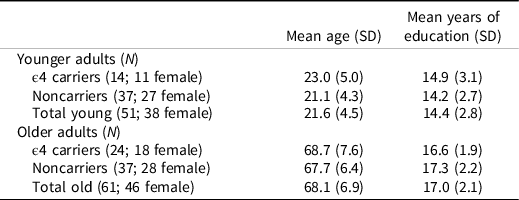
Sixty-one older and 21 younger adults were recruited from an existing pool in our laboratories at the University of Arizona. Thirty younger adults were also recruited from an undergraduate psychology course. All participants were genotyped for APOE status using blood spots or saliva. The sample included ϵ3 homozygotes (ϵ3/ϵ3) and ϵ4 heterozygotes (ϵ3/ϵ4). Individuals who were ϵ4 homozygotes (ϵ4/ϵ4) and those with the ϵ2 allele were excluded. APOE ϵ4 carriers and noncarriers were matched on age and education level. There were no differences in years of education between ϵ4 carriers and noncarriers, F(1,108) < 1, p = .96, or interaction between age and APOE, F(1,108) = 2.04, p = .16. Older adults had and significantly more education, F(1,108) = 22.5, p < .001, having on average 2.6 more years of education than younger adults (Table 1). No older adults included scored below 26 on the Montreal Cognitive Assessment. All participants provided informed consent. This study was approved by the Institutional Review Board of the University of Arizona and was completed in accordance with the Helsinki Declaration.
Mean age and years of education between older and younger ϵ4 carriers and noncarriers

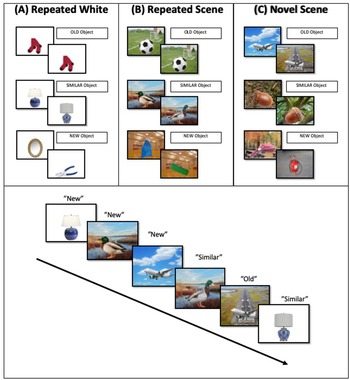
Identical and perceptually similar object pairs were superimposed on semantically related scenes and presented in a semirandom order continuously on a computer. Objects were not embedded naturalistically, which is different from paradigms used previously in our laboratory (Memel & Ryan, Reference Memel and Ryan2017). Object pairs appeared in either a new scene that had never been seen before (Novel Scene), a scene that was presented previously (Repeated Scene), or on a white background (Repeated White) (Figure 1). Participants used a keyboard to indicate whether the object was old, similar, or new compared to objects seen previously in the task. A total of 480 objects were shown. Thirty identical and 30 similar object pairs were shown for each context, in addition to 120 novel objects with no identical or similar pair. Identical and similar pairs were shown within 9–12 trials of the referent object. Trials automatically moved on after 3 seconds. Participants also underwent a practice session and given feedback if needed.
Sample stimuli for each of the three contexts and an example of how the task appeared for participants with the correct repsonses above each stimulus. Example stimuli in the Repeated White: two identical red socks (old objects), two similar blue lamps (similar objects), and a mirror and pliers (novel objects). Example stimuli in the Repeated Scene: two identical soccer balls on the same soccer field (old objects), two similar ducks on the same pond (similar objects), and a gym bag and sweat band in the same gym (novel objects). Example stimuli in the Novel Scene: two identical airplanes with one in the sky and the other on a runway (old objects), two similar acorns with one on the ground and the other in a tree (similar objects), and a napkin on picnic scene and fire extingusher on the ground (novel obejects).

Recognition was measured as the proportion of correctly identified old objects within each context. The recognition scores were corrected for false alarms by subtracting the recognition false alarms, calculated as the proportion of novel objects incorrectly identified as old within each context (referred to as Corrected Recognition). Pattern separation was measured as the proportion of correctly identified similar objects within each context, corrected by subtracting the “similarity false alarm” rate. The similarity false alarm rate was defined as the proportion of novel objects that were incorrectly identified as similar within each context. This score, referred to as Corrected Pattern Separation, is comparable to pattern separation scores in other studies (Stark & Stark, Reference Stark and Stark2017; Yassa et al., Reference Yassa, Lacy, Stark, Albert, Gallagher and Stark2011). When a similar object was shown, participants can either mistake a similar object as old or as new. Differences between the proportion of these errors were calculated and referred to as Error Difference Scores. Higher positive difference scores indicated a tendency to identify similar objects as old more than new. Lower negative difference scores indicated a tendency to identify similar objects as new more than old.
Corrected Recognition, Corrected Pattern Separation, Error Difference Scores, and the two false alarm rates were analyzed with separate 3x2x2 mixed model ANOVAs that included context (Repeated White, Repeated Scene, and Novel Scene) as the repeated measure, and APOE status (carrier and noncarrier) and age group (younger and older adults) as the between-subject variables. Partial eta squared (ηp 2) and Cohen’s d were calculated for measures of effect size for F statistics and t statistics, respectively.
Results
Corrected Recognition
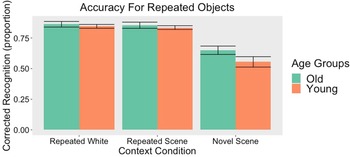
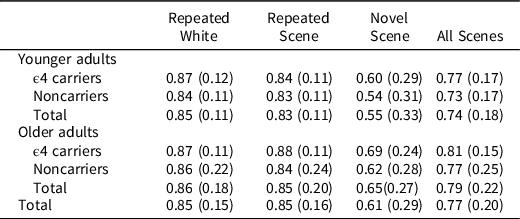
Corrected Recognition was the proportion of correctly identified old objects within each context after subtracting out false alarms, which was the proportion of novel objects identified as old (Table 2 and Figure 2). Both younger and older adults had higher Corrected Recognition in the Repeated Scene and Repeated White compared to the Novel Scene. Recognition scores for all participants substantially dropped when old objects were placed on novel scenes. Participants benefited from keeping the background consistent between the first and second time the object was shown, regardless if it was a scene or a white background. This was indicated by a main effect of context, F(2, 216) = 76.19, p < .001, ηp 2 = 0.41 and follow up paired t-tests between the Repeated White and the Novel Scene, t(111) = 10.07, p < .001, d = 1.02, and between the Repeated Scene and the Novel Scene, t(111) = 9.78, p < .001, d = 1.02. Context did not interact with age, F = 1.73, APOE status, or age and APOE status, all F’s < 1. No main effects of age, F = 1.37, or APOE status, F = 1.28, or interactions were found, F < 1.
The proportion of correctly recognized old objects corrected for Recognition False Alarms (Corrected Recognition) for younger and older adults is on the y-axis and the context conditions are on the x-axis. There was a main effect of context, p < .001, and follow up t-tests indicated poorer performance for all participants when old objects were placed in novel scenes compared to all other contexts.

Corrected Recognition. Mean proportions and standard deviations for correctly identifying an old object corrected for false alarms in each context among younger ϵ4 carriers (n = 14) and noncarriers (n = 37) and older ϵ4 carriers (n = 24) and noncarriers (n = 37). A mixed model ANOVA revealed a main effect of context, p < .001. Follow up t-tests indicated poorer performance when old objects were placed in novel scenes compared to all other contexts

Recognition False Alarms
The Repeated Scene led to greater Recognition False Alarms by all participants. The familiarity from the scene led participants to incorrectly identify objects that have never been seen before as something old. This was indicated by the main effect of context, F(2,216) = 10.81, p < .001, ηp 2 = 0.09, and by the paired t-tests between the Repeated Scene and the Repeated White t(111) = 3.42, p = .01, d = 0.34 and between the Repeated Scene and Novel Scene t(111) = 4.37, p < .001, d = 0.50. However, older adults had a higher propensity to commit false alarms across all contexts, indicated by a main effect of age, F(1,108) = 6.41, p < .05, and this was the most pronounced in the Repeated Scene, evidenced by the significant interaction between context and age, F(2,216) = 6.31, p < .01, ηp 2 = 0.06 (Table 3). No main effects or interactions with APOE status were found, all F’s < 1.
Recognition False Alarms. Mean proportions and standard deviations for incorrectly identifying a novel object as old in each context among younger ϵ4 carriers (n = 14) and noncarriers (n = 37) and older ϵ4 carriers (n = 24) and noncarriers (n = 37). A mixed model repeated measures ANOVA revealed a main effect of context, p < .001. Follow up t-tests indicated that false alarms were higher in the Repeated Scene compared to the other two contexts. A significant context by age interaction indicated that older adults made more false alarms particularly in the Repeated Scene, p < .01

Corrected Pattern Separation
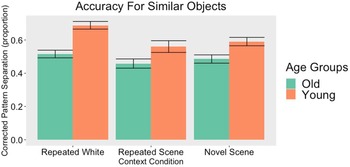
Corrected Pattern Separation was the proportion of correctly identified similar objects within each context after subtracting the Similarity False Alarms (Table 4 and Figure 3). All participants were more accurate when similar objects were presented on the Repeated White background compared to the other two contexts. Simply having objects in a scene, whether it was novel or repeated, resulted in lower pattern separation scores for all participants, shown by the main effect of context, F(2, 216) = 7.53, p < .001, ηp 2 = 0.41, and the subsequent paired t-tests between the Repeated White and the Repeated Scene, t(111) = 4.67, p < .001, d = 0.45 and between the Repeated White and Novel Scene, t(111) = 3.56, p = .001, d = 0.34. Younger adults were better at identifying similar objects than older adults across all contexts, indicated by a main effect of age, F(1,108) = 17.52, p < .001, ηp 2 = 0.14 (Figure 3). Context did not interact with age, F < 1. There was no main effect for APOE status, F < 1, and all interactions involving APOE were nonsignificant, F’s < 1.7.
The proportion of correctly recognized similar objects corrected for Similarity False Alarms (Corrected Pattern Separation) for younger and older adults is on the y-axis and the context conditions are on the x-axis. Similar objects were more accurately identified on a white background compared to all other contexts, a main effect of context, p < .001. Younger adults performed better across all contexts, a main effect of age, p < .001.

Corrected Pattern Separation. Mean proportion scores and standard deviations for correctly identifying a similar object corrected for Similarity False Alarms in each context among younger ϵ4 carriers (n = 14) and noncarriers (n = 37) and older ϵ4 carriers (n = 24) and noncarriers (n = 37). A mixed model repeated measures ANOVA revealed a main effect of context, p < .001, and a main effect of age, p < .001

Similarity False Alarms
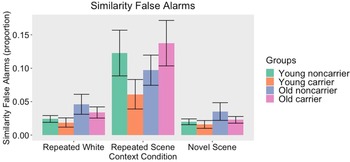
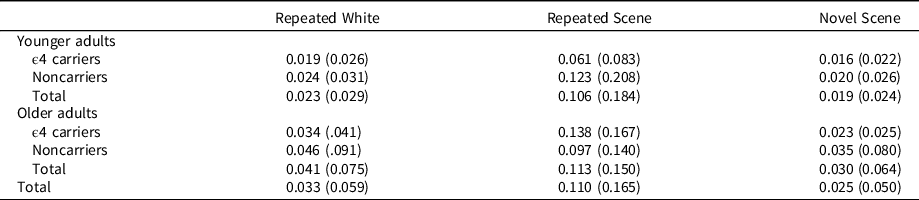
Similarity False Alarms are shown in Table 5 and Figure 4. Similar objects presented in the Repeated Scene significantly increased Similarity False Alarms compared to all other contexts for all participants. This was indicated by the main effect of context, F(2,216) = 25.83, p < .001, ηp 2 = 0.19, and paired-samples t-tests between the Repeated Scene and the Repeated White, t(111) = 5.45, p < .001, d = 0.65, and the Repeated Scene compared to the Novel Scene, t(111) = 6.08, p < .001, d = 0.88. Additionally, participants had higher Similarity False Alarms in the Repeated White compared to the Novel Scene, t(111) = 2.58, p < .05, d = 0.34. Context also interacted with age and APOE status, F(2,216) = 3.22, p < .05, ηp 2 = 0.03, such that younger ϵ4 carriers committed fewer Similarity False Alarms in the Repeated Scene, but this effect switched among older adults, such that older ϵ4 carriers made the most Similarity False Alarms in the Repeated Scene. Follow up analyses were conducted for younger and older adults separately. For younger adults, no interaction was found between APOE status and context, F(2,98) = 1.02. For older adults, a marginal interaction between APOE status and context was observed, F(2,118) = 2.88, p = .06, ηp 2 = 0.05, such that in the Repeated Scene, older carriers had higher Similarity False Alarms than older noncarriers.
The proportion of Similarity False Alarms are on the y-axis and the contexts are on the x-axis. The triple interaction between context, age, and APOE status indicates that in the Repeated Scene, the younger ϵ4 carriers (orange) had lower false alarms compared to the younger noncarriers (green). In older adults, the trend is in the opposite direction where the older ϵ4 carriers (purple) had higher false alarms compared to the older noncarriers (blue), p < .05.

Similarity False Alarms. Mean proportions and standard deviations for incorrectly identifying a novel object as similar in each context among younger ϵ4 carriers (n = 14) and noncarriers (n = 37) and older ϵ4 carriers (n = 24) and noncarriers (n = 37). A mixed model repeated measures ANOVA revealed a main effect of context, p < .001, and a triple interaction between context, age, and APOE status, p < .05

Error Difference Score
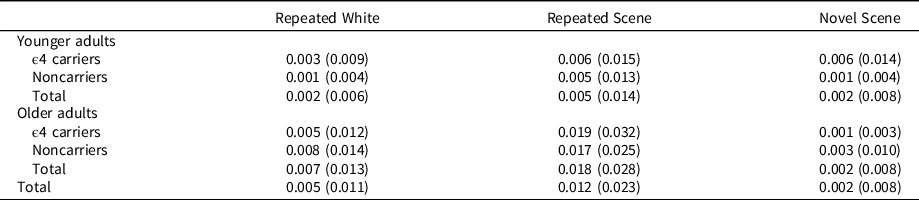
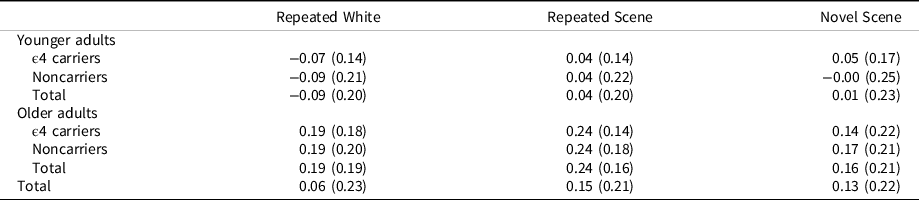
Error Differences Scores were calculated by subtracting the proportion of similar objects identified as old by new in each context (Table 6). Older adults were more likely to misidentify similar objects as old across all contexts compared to younger adults, a main effect of age, F(1,108) = 36.74, p < .001, ηp 2 = 0.25. Age interacted with context, F(2,216) = 5.15, p < .01, ηp 2 = 0.05, therefore, paired t-tests for younger and older adults were done separately. Younger adults had error scores relatively close to zero across all contexts, suggesting no substantial bias toward identifying similar objects as old or new. However, paired t-tests revealed that if younger adults were to make an error, they incorrectly identified similar objects as new in the Repeated White background compared to the Repeated Scene (t(50) = 7.39, p < .001, d = 1.07) and the Repeated White background compared to the Novel Scene (t(50) = 3.35, p < .01, d = 0.48). Older adults had a different pattern of errors. They were more likely to identify objects as old across all contexts. This was exacerbated when similar objects were in the Repeated Scene, shown by paired t-tests between the Repeated Scene and the Repeated White, t(60) = 2.44, p < .05, d = 0.30, and between the Repeated Scene and the Novel Scene, t(60) = 2.79, p < .01, d = 0.37.
Error Difference Scores. Mean proportions and standard deviations for the difference between the proportion of identifying similar objects as old and identifying similar objects as new in each context among younger ϵ4 carriers (n = 14) and noncarriers (n = 37) and older ϵ4 carriers (n = 24) and noncarriers (n = 37). A mixed model repeated measures ANOVA revealed a main effect of age, p < .001, and an interaction between context and age, p < .01

Discussion
To our knowledge, this is the only study to systematically study the impact of age, context, and APOE status on recognition memory and pattern separation. To summarize the key findings, younger and older adults did not differ on recognizing repeated objects; however, younger adults performed better than older adults when identifying similar objects. We found a main effect of context on pattern separation where all participants benefited from having similar objects shown on a repeated white background compared to a repeated or novel scene. Older adults were more likely to make a certain kind of error, identifying similar objects as old, and the repeated scenes drove up these errors for older adults. Analysis of the Similar False Alarms revealed a unique interaction between ϵ4, age, and context such that in the repeated scene, the younger ϵ4 carriers had lower Similarity False Alarms than noncarriers. Older ϵ4 carriers, on the other hand, made more Similarity False Alarms in the repeated scene compared to older noncarriers. However, unexpectedly, no other main effects or interactions with APOE status were found.
Recognition and Pattern Separation in Aging
Our results are consistent with previous studies showing that younger and older adults did not differ on identifying old objects while older adults performed significantly worse compared to younger adults when identifying similar objects (Davidson et al., Reference Davidson, Vidjen, Trincao-Batra and Collin2019; Stark et al., Reference Stark, Yassa, Lacy and Stark2013; Stark et al., Reference Stark, Stevenson, Wu, Rutledge and Stark2015; Stark & Stark, Reference Stark and Stark2017; Toner et al., Reference Toner, Pirogovsky, Kirwan and Gilbert2009). We suggest that age-related impairments in pattern separation but not recognition occur because of inefficiencies in utilizing subtle perceptual details (Burke et al., Reference Burke, Gaynor, Barnes, Bauer, Bizon, Roberson and Ryan2018, Carr et al., Reference Carr, Castel and Knowlton2015; Kensinger & Schacter, Reference Kensinger and Schacter1999; Stark et al., Reference Stark, Yassa, Lacy and Stark2013; Stark & Stark, Reference Stark and Stark2017). During object recognition, participants may be able to rely on familiarity when recognizing a previously presented coffee mug. Utilizing perceptual details, however, is especially critical in differentiating between highly similar objects such as two similar coffee mugs (Yassa et al., Reference Yassa, Lacy, Stark, Albert, Gallagher and Stark2011).
Our results suggest that it is not simply that older adults perform poorly on pattern separation, but rather that they commit a specific kind of error that younger adults do not make. When older adults make errors, they are more likely to identify similar objects as old compared to younger adults, as reflected in our error difference score. Calculating a difference by subtracting the proportion of identifying similar objects as old from new can indicate if groups were biased to commit one error over another. This is additional evidence for an age-related decline in utilizing the details to orthogonalize representations in the brain for accurate memory retrieval. Similar findings that indicate older adults identify similar objects as old have been shown in other studies as well (Davidson et al., Reference Davidson, Vidjen, Trincao-Batra and Collin2019; Pidgeon & Morcom, Reference Pidgeon and Morcom2014; Stark et al., Reference Stark, Yassa, Lacy and Stark2013; Stark et al., Reference Stark, Stevenson, Wu, Rutledge and Stark2015). These errors suggest that older adults could be using a holistic representation when making similarity judgements. Yassa and Stark (Reference Yassa and Stark2011) suggest that aging is associated with a shift from pattern separation toward pattern completion, likely related to functional and structural changes in the MTL (Yassa & Stark, Reference Yassa and Stark2011). Younger adults, on the other hand, may have a slight bias to identify similar objects as new, particularly on white backgrounds. However, they showed less bias in general, with error difference scores close to zero across all contexts.
The Impact of Context on Recognition and Pattern Separation
For recognition memory, old objects on a repeated white background and on a repeated scene resulted in better memory scores than shifting the context to a novel scene. Both groups experienced an equivalent decrease in recognition memory performance when an old object was placed on a novel scene that was never seen before. This replicated previous findings from our lab showing that reinstating the context at retrieval for object recognition benefited older and younger adults in the same way (Memel & Ryan, Reference Memel and Ryan2017). It is important to note that repeating a white background had the same benefit as repeating a complex visual scene. Objects and contexts are hypothesized to be processed holistically and automatically rather than two separate components, making recognition of the object more difficult when it is shifted to a novel scene (Hasher & Zacks, Reference Hasher and Zacks1979; Hayes et al., Reference Hayes, Nadel and Ryan2007). Keeping contexts consistent between encoding and retrieval have shown benefits for recognition memory for objects (Gutchess et al., Reference Gutchess, Hebrank, Sutton, Leshikar, Chee, Tan, Goh and Park2007; Hayes et al., Reference Hayes, Glisky, McAllister, Greenleaf, Ketcham, Nadel and Ryan2005; Hayes et al., Reference Hayes, Nadel and Ryan2007; Memel & Ryan, Reference Memel and Ryan2017; Racsmány et al., Reference Racsmány, Bencze, Pajkossy, Szőllősi and Marián2021), words (Craik & Schloerscheidt, Reference Craik and Schloerscheidt2011), and faces (Hayes et al., Reference Hayes, Baena, Truong and Cabeza2010). These benefits are true for tasks that use semantically related scenes (Hayes et al., Reference Hayes, Nadel and Ryan2007) and for tasks that superimpose objects on irrelevant backgrounds (Racsmány et al., Reference Racsmány, Bencze, Pajkossy, Szőllősi and Marián2021). Unlike the experiments described in Hayes et al. (Reference Hayes, Nadel and Ryan2007), objects in this task were not embedded naturalistically as objects from this task were superimposed on backgrounds. Racsmány et al. (Reference Racsmány, Bencze, Pajkossy, Szőllősi and Marián2021) also superimposed objects; however, these scenes were not semantically related to the object. For example, a picture of a bird cage was superimposed in a bathroom. The impact of context shift therefore appears to be robust, irrespective if objects are embedded naturalistically or superimposed.
In contrast to object recognition, context impacted pattern separation for older and younger adults differently. All participants had more difficulty identifying similar objects when they were placed in a scene, repeated or novel, compared to a repeated white background. The white background and the repeated scene impacted recognition of old objects in the same way, whereas the repeated scene impaired recognition for similar objects. Although the white background is still a repeated context, the repeated scenes have more familiar components than a white background, potentially leading participants to incorrectly identify similar objects as old. Additionally, repeated scenes increased the Similarity False Alarms for all participants, thus having the largest impact on the corrected pattern separation scores in the Repeated Scene context condition. Interestingly, a post hoc analysis of the uncorrected pattern separation scores showed that performance in the Repeated Scene and Repeated White contexts were not statistically different, t(111) = 1.14, ns.
Surprisingly, identifying similar objects in novel or repeated scenes did not differ. We hypothesized that performance in novel scenes would be better than repeated scenes because novel scenes do not have any familiar components other than any potential familiarity produced from the similar object itself. The novel scenes in this study are still semantically related to the similar object. For example, in Figure 1, a bar of soap is presented in a laundromat and then another similar bar of soap is presented in a bathroom. One explanation could be that the relationship between the soap and the new background led participants to be less accurate when identifying the similar object on novel, but related scenes (Bar & Ullman, Reference Bar and Ullman1996). Bar (Reference Bar2004) proposed that visual information, such as a scene, can be quickly extracted to activate “context frames,” which would include objects typically associated with that scene. The activation of semantically related objects could have overshadowed the subtle details of the similar object on the screen, leading to identifying a similar object as old. Initially it may appear as if the repeated scene and novel scene have the same impact on pattern separation, given they both resulted in poorer performance than the repeated white background. However, a deeper look at the Similarity False Alarms would suggest that these scene conditions are indeed impacting pattern separation differently. Unlike the repeated scene, novel scene did not lead participants to commit many Similarity False Alarms. When Similarity False Alarms were not corrected for, the scores within the repeated scenes become significantly higher than the scores in the novel scenes. Without correcting for Similarity False Alarms, it may look as if repeated scenes resulted in better accuracy for similar objects compared to novel scenes. However, the elevated Similarity False Alarms would suggest that the repeated scene led to a general tendency to call objects similar, increasing both their accuracy score in addition to their Similarity False Alarms. Neither the repetition of the white background nor the novel scene resulted in the same elevation of Similarity False Alarms, suggesting a unique effect from the repeated scene on Similarity False Alarms.
Age-related declines in the ability to inhibit irrelevant information could be another explanation for the context effects we observed among older adults (for a recent review, see Amer et al., Reference Amer, Wynn and Hasher2022). By this view, poorer inhibitory control among older adults may result in goal-irrelevant information being incorporated into the memory representation to a greater degree than younger adults, and this information may then interfere with successful retrieval. For example, in studies by Hasher and colleagues (Campbell et al., Reference Campbell, Hasher and Thomas2010; Campbell & Hasher, Reference Campbell and Hasher2018), participants were shown pictures with superimposed irrelevant words in a 1-back working memory task. A surprise paired associate memory task followed, where picture-word pairs were either preserved or rearranged from the initial encoding phase. Older adults performed better when the picture-word pair was preserved relative to rearranged pairs or words presented on a novel picture (Biss et al., Reference Biss, Campbell and Hasher2013). Younger adults, on the other hand, did not show any differences in performance between the type of pairs, suggesting that older, but not younger adults, integrated the visual context into their memory representation, which benefitted memory performance.
An age-related difference in the ability to inhibit contextual information could explain the heighted context effect observed among older adults in the present study. However, our results, as well as prior studies of object recognition (Hayes et al., Reference Hayes, Glisky, McAllister, Greenleaf, Ketcham, Nadel and Ryan2005; Hayes et al., Reference Hayes, Nadel and Ryan2007), demonstrated that younger adults are also highly influenced by context. In a series of object recognition studies with young adults, Hayes et al. (Reference Hayes, Nadel and Ryan2007) demonstrated that changing the visual context always resulted in impaired object recognition, even when participants were explicitly told to disregard the background. In the present study, objects presented on a novel scene resulted in poorer recognition performance for both younger and older adults compared to objects presented on either a repeated scene or a repeated white background. Furthermore, both younger and older adults were more accurate in identifying similar objects when they were presented on repeated white backgrounds. Taken together, these results are consistent with the notion that binding objects and the surrounding context within a scene is obligatory and automatic, and that all components of the representation are utilized when making memory judgements. The results in the present study suggest that the integration of visual context to the representation may be age-invariant. The results may be better explained by differences in the reliance on context among older and younger adults during memory retrieval, rather than a decline in inhibitory control.
Detailed and Holistic Information in Aging
By presenting similar objects across stable and shifting contexts, our study evaluated how detailed and holistic contextual information is differentially utilized by younger and older adults during pattern separation. Older adults had more difficulty identifying similar objects and, importantly, misidentified similar objects as old across all contexts compared to younger adults. The results fit well with the hypothesis that older adults overemphasize holistic information and underutilize details when assessing memory for objects (Burke et al., Reference Burke, Gaynor, Barnes, Bauer, Bizon, Roberson and Ryan2018; Gutchess et al., Reference Gutchess, Hebrank, Sutton, Leshikar, Chee, Tan, Goh and Park2007). Older adults have more difficulty using the details to distinguish between highly similar objects (Camfield et al., Reference Camfield, Fontana, Wesnes, Mills and Croft2018; Davidson et al., Reference Davidson, Vidjen, Trincao-Batra and Collin2019; Pidgeon & Morcom, Reference Pidgeon and Morcom2014; Reagh et al., Reference Reagh, Ho, Leal, Noche, Chun, Murray and Yassa2016; Stark et al., Reference Stark, Yassa, Lacy and Stark2013; Stark et al., Reference Stark, Stevenson, Wu, Rutledge and Stark2015; Stark & Stark, Reference Stark and Stark2017; Toner et al., Reference Toner, Pirogovsky, Kirwan and Gilbert2009), and require a greater degree of dissimilarity between features in order to effectively discriminate between items (Wilson et al., Reference Wilson, Gallagher, Eichenbaum and Tanila2006; Yassa et al., Reference Yassa, Lacy, Stark, Albert, Gallagher and Stark2011). Additionally, older adults showed an overreliance on the context. Repeating the scene increased the likelihood that older adults identified similar objects as old objects, and this increase was not seen in younger adults.
The overreliance on holistic information observed among older adults is consistent with the changes in MTL circuitry that are observed during normal aging (Burke et al., Reference Burke, Gaynor, Barnes, Bauer, Bizon, Roberson and Ryan2018; Wilson et al., Reference Wilson, Gallagher, Eichenbaum and Tanila2006; Yassa et al., Reference Yassa, Lacy, Stark, Albert, Gallagher and Stark2011; Yassa & Stark, Reference Yassa and Stark2011). Yassa and Stark (Reference Yassa and Stark2011) suggest that the loss of inhibitory inputs to the dentate gyrus/CA3 region of the hippocampus result in a shift away from pattern separation and toward pattern completion, where incomplete information may be sufficient to access previously stored representations (Marr, Reference Marr1971; Yassa & Stark, Reference Yassa and Stark2011). This shift would account for older adults’ overall propensity to identify similar objects as old, across all context conditions. Although Yassa et al. (Reference Yassa, Lacy, Stark, Albert, Gallagher and Stark2011) did not evaluate the impact of context on pattern separation, their hypothesis may also account for a broader shift toward pattern completion where a repeated scene further exacerbates this error.
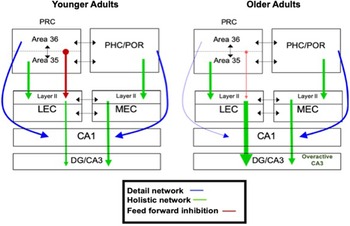
A recent model of age-related changes to MTL circuity posits two distinct networks between the hippocampus, PRC, and parahippocampal cortex (PHC) (Burke et al., Reference Burke, Gaynor, Barnes, Bauer, Bizon, Roberson and Ryan2018). In contrast to the PRC and PHC carrying non-spatial and spatial information, respectively (Barense et al., Reference Barense, Henson, Lee and Graham2010; Mormann et al., Reference Mormann, Simon, Cerf, Ison, Kraskov, Tran, Knieling, Quiroga, Koch and Fried2017), more recent evidence from animal studies suggests that these networks are not content driven. Rather, two parallel, computationally distinct pathways carry detailed and holistic information that incorporates both spatial and non-spatial information (see Figure 5). One pathway involves direct projections, carrying detailed information, from PRC and PHC to CA1. A second pathway involves indirect projections, carrying holistic information, from PRC and PHC via entorhinal cortex, projecting to CA3. Age-related damage to PRC results in loss of integrity to the direct pathway, as well as a normal inhibition to the indirect pathway. The net effect is a shift away from perceptual and spatial detail, and a greater reliance on holistic processing. Our results are consistent with this shift, as older adults were impaired in utilizing subtle, perceptual details to distinguish between old and similar objects and were influenced to a greater degree by holistic information provided by both the similar objects and the repeated scenes.
This is adapted from Burke et al. (Reference Burke, Gaynor, Barnes, Bauer, Bizon, Roberson and Ryan2018), Figure 2. Two parallel pathways from the PRC and PHC carry direct and indirect projections into the hippocampus. The direct pathway carries detailed information and the indirect pathway carries holistic information (referred to as “gist” or course network in Burke et al., Reference Burke, Gaynor, Barnes, Bauer, Bizon, Roberson and Ryan2018). In aging, decreased PRC activation leads to less excitation of the direct pathway and less inhibition in the indirect pathway, resulting in a greater emphasis on holistic information.

A Subtle Effect of ϵ4
Finally, ϵ4 did not have a significant impact on most outcomes. However, analysis of Similarity False Alarms revealed a triple interaction between ϵ4, context, and age. In the repeated scene, younger ϵ4 carriers had fewer Similarity False Alarms compared to younger noncarriers. The subtle advantage for younger ϵ4 carriers suggests that they were less influenced by the repeated scene. This pattern flipped among older adults, such that older ϵ4 carriers made more Similarity False Alarms compared to noncarriers, suggesting that they were influenced to a greater degree by the repeated scene. We originally hypothesized that older ϵ4 carriers would be less biased by repeated scenes, potentially due to elevated neuropathology in the PRC. However, this finding suggests a greater bias from the repeated scenes. One possibility is that preclinical pathology associated with ϵ4 results in additional damage to the indirect pathway, which appears to produce greater bias toward holistic information, rather than less, compared to noncarriers. If early neuropathology is responsible for these subtle changes among older ϵ4 carriers, then performance on tasks other than pattern separation would also likely be affected. For example, object discrimination, which does not depend on memory and requires discrimination of stimuli with overlapping features, is well-documented to rely the PRC (Barense et al., Reference Barense, Gaffan and Graham2007; Barense et al., Reference Barense, Henson, Lee and Graham2010; Ryan et al., Reference Ryan, Cardoza, Barense, Kawa, Wallentin‐Flores, Arnold and Alexander2012). To our knowledge, no study exists currently that has evaluated the relationship between object discrimination and pattern separation. Based on our model, one would expect that these two distinct tasks would be correlated, at least among older adults and potentially even more strongly among individuals who are at high risk for developing AD. The effect of ϵ4 is novel, and clearly warrants replication and further study. It is important to note, however, that ϵ4 cannot be considered a proxy for neuropathology. More direct quantification of tauopathy would be needed to understand these relationships. Finally, the number ϵ4 carriers, particularly in the young, may have also limited our power to see other main effects or interactions with ϵ4.
The ϵ4 interaction may support the antagonistic pleiotropy hypothesis (Han & Bondi, Reference Han and Bondi2008; Tuminello & Han, Reference Tuminello and Han2011). Antagonistic pleiotropy describes a gene that has beneficial effects on fitness early in life, and detrimental effects later in life (Albin, Reference Albin1993; Williams, Reference Williams1957). A review from Tuminello and Han (Reference Tuminello and Han2011), described how some studies found cognitive benefits among young ϵ4 carriers compared to noncarriers (Bloss et al., Reference Bloss, Delis, Salmon and Bondi2010; Marchant et al., Reference Marchant, King, Tabet and Rusted2010; Rusted et al., Reference Rusted, Evans, King, Dowell, Tabet and Tofts2013; Mondadori et al., Reference Mondadori, de Quervain, Buchmann, Mustovic, Wollmer, Schmidt, Boesiger, Hock, Nitsch, Papassotiropoulos and Henke2007). However, some studies do not show ϵ4 advantages in younger adults (Dennis et al., Reference Dennis, Browndyke, Stokes, Need, Burke, Welsh-Bohmer and Cabeza2010; Filbey et al., Reference Filbey, Slack, Sunderland and Cohen2006; Ruiz et al., Reference Ruiz, Castillo, Labayen, Moreno, Fuentes, Lamuno, Granda, Lucia and Ortega2010; Evans et al., Reference Evans, Dowell, Tabet, King, Hutton and Rusted2017; Filippini et al., Reference Filippini, MacIntosh, Hough, Goodwin, Frisoni, Smith, Matthews, Beckmann and Mackay2009; Ihle et al., Reference Ihle, Bunce and Kliegel2012; Weissberger et al., Reference Weissberger, Nation, Nguyen, Bondi and Han2018). Meta-analyses of younger ϵ4 carriers and noncarriers indicate that variability in results are likely a due to a wide range of variables including tests used, ages included, control for other AD risk factors, and inclusion of ϵ2 carriers (Ihle et al., Reference Ihle, Bunce and Kliegel2012; Tuminello & Han, Reference Tuminello and Han2011; Weissberger et al., Reference Weissberger, Nation, Nguyen, Bondi and Han2018).
The impact of context on recognition memory was different compared to pattern separation. In recognition, context impacts older and younger adults in the same way, but differences in age emerged during pattern separation. Older adults were not able to utilize the perceptual details in order to distinguish between similar objects and relied more on holistic information, leading to a particular pattern of errors that younger adults did not make. Nonpathological ϵ4 aging may also perpetuate older adults’ greater sensitivity to holistic information.
Acknowledgements
This work was supported by the Arizona Alzheimer’s Consortium; Arizona Department of Health Services; and the McKnight Brain Research Foundation.
Conflicts of interest
None.