Introduction
Crinoids suffered a mass extinction during the end-Katian at the onset of end-Ordovician glaciation, and it was not until the Aeronian (Llandovery, early Silurian) that crinoid generic richness recovered to pre-extinction levels (Peters and Ausich, Reference Peters and Ausich2008). This extinction and recovery resulted in a reorganization of crinoid faunas from the Early Paleozoic to the Middle Paleozoic Crinoid Evolutionary Fauna (Baumiller, Reference Baumiller1994; Ausich et al., Reference Ausich, Kammer and Baumiller1994). Until the early 1980s, Llandovery crinoid faunas were very poorly known (Ausich and Deline, Reference Ausich and Deline2012). However, a new appreciation for the Llandovery crinoid faunal recovery (Ausich and Deline, Reference Ausich and Deline2012) is emerging with the discovery of new Llandovery faunas from Iowa (Witzke and Strimple, Reference Witzke and Strimple1981), Ohio (Ausich, Reference Ausich1984a, Reference Ausichb, Reference Ausich1985, Reference Ausich1986a, b, c, d, Reference Ausich1987a, Reference Ausichb; Ausich and Dravage, Reference Ausich and Dravage1988; Boyarko and Ausich, Reference Boyarko and Ausich2009), Britain and Ireland (e.g., Donovan and Sevastopulo, Reference Donovan and Sevastopulo1989; Donovan, Reference Donovan1993; Donovan and Harper, Reference Donovan and Harper2003; Donovan and Lewis, Reference Donovan and Lewis2005; Fearnhead and Donovan, Reference Fearnhead and Donovan2007a, Reference Fearnhead and Donovanb, c; Fearnhead and Harper, Reference Fearnhead and Harper2007; Donovan et al., Reference Donovan, Lewis, Crabb and Widdison2008, Reference Donovan, Lewis, Fearnhead and Widdison2009, Reference Donovan, Widdison, Lewis and Fearnhead2010, Reference Donovan, Lewis, Fearnhead and Widdison2012), and New York and Canada (e.g., Eckert Reference Eckert1984, Reference Eckert1990; Eckert and Brett, Reference Eckert and Brett2001; Ausich and Copper, Reference Ausich and Copper2010).
The work by Ausich and colleagues in Ohio described faunas from the upper parts of the Brassfield Formation (Aeronian) and was an extension of the pioneering work of Foerste (Reference Foerste1919). With the exception of Ausich and Dravage (Reference Ausich and Dravage1988) and Boyarko and Ausich (Reference Boyarko and Ausich2009), Brassfield crinoid faunas are primarily known from the greater Dayton, Ohio, area. Ausich and Dravage (Reference Ausich and Dravage1988) and Boyarko and Ausich (Reference Boyarko and Ausich2009) described only two species and recognized two taxa in open nomenclature from Adams County, Ohio, and northern Kentucky. Thus, the new, low-diversity fauna described herein from Bath County, Kentucky, is particularly significant for understanding the geographic variability of crinoid faunas from the Brassfield Formation and for its even earlier Rhuddanian age. Here, we describe a pelmatozoan fauna with six taxa, including two rhombiferans and four crinoids. Crinoid taxa include one new genus, two new species, and two taxa left in open nomenclature. New taxa include the calceocrinid crinoid, Browerocrinus arthrikos n. gen., n. sp. and a flexible crinoid, Temnocrinus americanus n. sp. Temnocrinus was previously recognized only from the Much Wenlock Limestone (Homerian) of England.
The richness of this crinoid fauna from Bath County is low in comparison to that from the Dayton, Ohio, area, but crinoids, rhombiferans, and an asteroid co-occur in this relatively limited exposure. The asteroid Gordonaster brassfieldensis was described by Blake and Ettensohn (Reference Blake and Ettensohn2009). With Anartiocystis whitei Sumrall, Reference Sumrall2002, and Brockocystis nodosarius Foerste, Reference Foerste1919, this is the only Brassfield locality known in which two rhombiferan genera co-occur, although Broadhead and Ettensohn (Reference Broadhead and Ettensohn1981) described the co-occurrence of two Brockocystis species (B. tecumseth and B. nodosaria) at the same horizon in the lower massive member farther to the north in Fleming County, Kentucky. From this same northern locality, Broadhead and Ettensohn (Reference Broadhead and Ettensohn1981) also described an Aeronian species of Brockocystis from the Oldham Member of the Crab Orchard Formation, immediately overlying the Brassfield Formation.
The Brassfield Formation represents the first major Silurian episode of sea-level rise during the waning phases of the end-Ordovician glaciation. Although small reefs do occur in the Brassfield Formation (Sheehy, Reference Sheehy1981; Schneider and Ausich, Reference Schneider and Ausich2002), most of this unit was an extensive grainstone/packstone facies that was deposited with the reestablishment of the Silurian epicontinental sea in eastern North America (McLaughlin et al., Reference McLaughlin, Cramer, Brett and Kleffner2008; Brett et al., Reference Brett, Cramer, McLaughlin, Kleffner, Showers and Thomka2012; Ettensohn et al., Reference Ettensohn, Lierman, Mason, Andrews, Hendricks, Phelps and Gordon2013). Based on data presented herein, it is clear that considerable faunal diversity existed within the widespread Brassfield facies, and that this diversity developed somewhat earlier than previously thought.
Geographic, stratigraphic, and paleoenvironmental occurrence
Echinoderms discussed in this paper were collected from Bath County, Kentucky, and are from a roadside borrow pit along the southern side of Interstate 64, ~0.5 mi (0.8 km) west of the intersection of Interstate 64 and Kentucky Highway 36 (38° 7.4' N lat., 83° 45.5' W long., USGS Preston Quadrangle) (Gordon and Ettensohn, Reference Gordon and Ettensohn1984; Blake and Ettensohn, Reference Blake and Ettensohn2009). The echinoderms are from the uppermost part of the lower massive or “cherty” member of the Brassfield Formation (Gordon and Ettensohn, Reference Gordon and Ettensohn1984; Blake and Ettensohn, Reference Blake and Ettensohn2009; Ettensohn et al., Reference Ettensohn, Lierman, Mason, Andrews, Hendricks, Phelps and Gordon2013), which occurs in the Distomodus kentuckyensis conodont Assemblage Zone (Rexroad and Kleffner, Reference Rexroad and Kleffner1984) and is regarded as early Llandovery (Rhuddanian) in age in east-central and northeastern Kentucky (Ettensohn et al., Reference Ettensohn, Lierman, Mason, Andrews, Hendricks, Phelps and Gordon2013). This unit is present below the biostratigraphically significant Aeronian “bead bed” or “cogwheel bed” of Foerste (Reference Foerste1919), Rexroad et al. (Reference Rexroad, Branson, Smith, Summerson and Boucot1965), and Rexroad (Reference Rexroad1967), and represents a high-energy, sandbelt environment in a westwardly transgressing, shallow, open-marine sequence (Gordon and Ettensohn, Reference Gordon and Ettensohn1984; Ettensohn et al., Reference Ettensohn, Lierman, Mason, Andrews, Hendricks, Phelps and Gordon2013). Within that setting, the echinoderms inhabited an irregular hardground surface that was apparently persistent throughout much of northeastern and east-central Kentucky (Broadhead and Ettensohn, Reference Broadhead and Ettensohn1981; Gordon and Ettensohn, Reference Gordon and Ettensohn1984; Blake and Ettensohn, Reference Blake and Ettensohn2009). In fact, this surface may have local biostratigraphic significance (Broadhead and Ettensohn, Reference Broadhead and Ettensohn1981), and may be the same surface from which Foerste (Reference Foerste1919) described the type specimens of Brockocystis nodosarius in Ohio. Like most of the Kentucky Brassfield Formation, the unit has been pervasively dolomitized by secondary processes related to the formation of the Cincinnati Arch (Gordon and Ettensohn, Reference Gordon and Ettensohn1984).
At first, the Aeronian age of similar echinoderm faunas from the Dayton area (e.g., Peters and Ausich, Reference Peters and Ausich2008) may seem to contradict the Rhuddanian age of the Kentucky fauna; however, this is a product of paleogeography. The exposures of the Brassfield Formation in east-central and northeastern Kentucky occur farther eastward than do the exposures near Dayton, Ohio, from which most Brassfield echinoderms have been described. This means that the early Silurian transgression first reached east-central and northeastern Kentucky during late Rhuddanian time, but not until the Aeronian did it migrate farther westward into the Dayton area. Hence, although Brassfield Formation units in the Dayton area may be homotaxial with those in east-central and northeastern Kentucky, the units in Kentucky are slightly older, and the contained, post-extinction, Llandovery, crinoid faunal recovery (Ausich and Deline, Reference Ausich and Deline2012) most likely had a Rhuddanian origin.
Systematic paleontology
Terminology follows Moore (Reference Moore1962), Ubaghs (Reference Ubaghs1978), Brett (Reference Brett1981), and Ausich et al. (Reference Ausich, Brett, Hess and Simms1999); classification follows Ausich (Reference Ausich1998). Repository abbreviations are as follows: CMCIP, Cincinnati Museum Center, Cincinnati, Ohio, and USNM, U.S. National Museum, Smithsonian Institution. All measurements are in mm; * indicates that the character is incomplete or compressed.
Order Glyptocystitida Bather, Reference Bather1899
Family Callocystitidae Bernard, Reference Bernard1895
Remarks
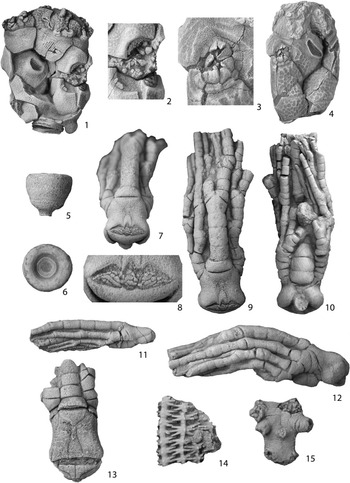
In southwestern Ohio and northeastern Kentucky, Brockocystis nodosarius Foerste, Reference Foerste1919, is a reasonably common glyptocystitid in the limestones and dolostones of the Brassfield Formation and lower Crab Orchard Formation, the occurrence of which is based primarily on the distinctive cone-shaped columnals that occur in the proximal portion of the mesistele (Fig. 1.5, 1.6). However, Anartiocystis has only been reported from two Brassfield localities: Montgomery County, Ohio (Ausich and Schumacher, Reference Ausich and Schumacher1984), and the present locality in Bath County, Kentucky (Sumrall, Reference Sumrall2002). This is the only known locality in the Brassfield Formation where Anartiocystis and Brockocystis co-occur.
Brassfield Formation rhombiferans and crinoids from Kentucky. (1, 2, 5, 6) Brockocystis nodosarius Foerste, Reference Foerste1919; (1) D-ray lateral view of a crushed specimen, USNM 594948, ×3.0; (2) mostly disarticulated periproct region, USNM 594948, ×8.0; (5) lateral view of a specialized proxistele columnal, USNM 594950, ×3.5; (6) proximal view of specialized proxistele columnal, USNM 594950, ×3.5; (3, 4) Anartiocystis whitei Sumrall, Reference Sumrall2002; (3) articulated periproct region, USNM 594952, ×8.0; (4) D-ray lateral view of partially crushed specimen, USNM 594952, ×3.0; (7–13), Browerocrinus arthrikos n. gen. n. sp.; (7) E-ray view of aboral cup and proximal arms, holotype, USNM 594961, ×3.5; (8) small plating covering the hinge between the radial and basal plate circlets, holotype, USNM 594961, ×8.0; (9) E-ray view of crown, holotype, USNM 594961, ×3.5; (10) posterior view of crown, holotype, USNM 594961, ×3.5; (11) lateral view of juvenile crown, paratype, USNM 594963, ×4.0; (12) lateral view of crown, holotype, USNM 594961, ×3.5; (13) E-ray view of aboral cup with proximal arms, note small plates covering the hinge between the radial and basal circlets, paratype, USNM 594962, ×3.5; (14) Dendrocrinus sp., lateral view of a compressed anal sac, USNM 595072, ×3.5; (15) partial holdfast of Stereoaster sp., USNM 594959, ×3.5.

The systematics of the Callocystitidae is currently under consideration. Consequently, these two genera are not placed in a subfamily.
Subfamily uncertain
Genus Anartiocystis Ausich and Schumacher, Reference Ausich and Schumacher1984
Type species
Anartiocystis foerstei Ausich and Schumacher, Reference Ausich and Schumacher1984, by monotypy.
Other species
Anartiocystis whitei Sumrall, Reference Sumrall2002.
Anartiocystis whitei Sumrall Reference Sumrall2002
Material
Holotype: CMCIP 50601; new material: USNM 594952–594958.
Occurrence
Brassfield Formation, Rhuddanian (Llandovery, Silurian), Bath County, Kentucky.
Remarks
With ambulacra confined to the radial plates, these seven new specimens are assigned to A. whitei. The largest (19 mm, USNM 594953) of these new specimens (Fig. 1.4) is larger than those reported by Sumrall (Reference Sumrall2002). Specimens are either mostly inflated (USNM 594953, USNM 594954, USNM 594956) or compacted (USNM 594952, USNM 594955, USNM 594957). The periproct on USNM 594952 is very well preserved (Fig. 1.3). The periphery of the periproct plating is comprised of 14 or 15 variously sized tetragonal, pentagonal, and hexagonal plates. Articulated to this outer ring is a series of elongate, broadly triangular plates that taper toward the center of the periproct. Although mostly disarticulated, a discontinuous ring of smaller, elongate plates occurs at the summit of the periproct plating.
Genus Brockocystis Foerste, Reference Foerste1919
Type species
Brockocystis nodosarius Foerste, Reference Foerste1919, by monotypy.
Brockocystis nodosarius Foerste, Reference Foerste1919
Material
Syntypes: USNM 85346A to USNM 85346E; new material: USNM 594948 to USNM 594951.
Occurrence
Brassfield Formation, Rhuddanian (Llandovery, Silurian), Bath County, Kentucky.
Remarks
Two partially compacted thecae (e.g., Fig. 1.1), distinctive proximal mesistele columnals (Fig. 1.5, 1.6), and numerous isolated plates were collected from the Brassfield Formation of Bath County, Kentucky. These are relatively large specimens (up to ~20 mm). Although not nearly as complete as in A. whitei (Fig. 1.3), some periproct plating is preserved on both thecae of B. nodosarius (Fig. 1.2). This periproct plating is comprised of much smaller and more numerous plates than the periproct of A. whitei. Although these are large specimens, they are still relatively small compared to the unnamed species described by Broadhead and Ettensohn (Reference Broadhead and Ettensohn1981) from the overlying Crab Orchard Formation. Plates from B. nodosarius have also been reported from the upper massive member (Aeronian) of the Brassfield in what may be another prominent echinoderm-bearing horizon from northeastern Kentucky (Broadhead and Ettensohn, Reference Broadhead and Ettensohn1981).
Class Crinoidea Miller, Reference Miller1821
Subclass Camerata Wachsmuth and Springer, 1885
Order Diplobathrida Moore and Laudon, Reference Moore and Laudon1943
Suborder Eudiplobathrina Ubaghs, Reference Ubaghs1953
Superfamily Rhodocrinitoidea Roemer, 1853
Family Rhodocrinitidae Roemer, 1853
Genus Stereoaster Foerste, Reference Foerste1919
Material
USNM 594959, 594960.
Occurrence
Brassfield Formation, Rhuddanian (Llandovery, Silurian), Bath County, Kentucky.
Remarks
One holdfast from this fauna corresponds to the distinctive holdfast of Stereoaster squamosus Foerste, Reference Foerste1919 from the Brassfield Formation, which was initially identified as an asteroid. This holdfast has multiple rhizoids, each of which is comprised of numerous, irregularly arranged plates (Fig. 1.15). Ausich (Reference Ausich1986c) described a complete specimen in which this holdfast was attached to a rhodocrinitid crinoid crown. Stereoaster squamosus is the most abundant crinoid in the area of Dayton, Ohio; however, this is the first occurrence of this genus beyond the Dayton region.
Order Cladida Moore and Laudon, Reference Moore and Laudon1943
Suborder Dendrocrinida Bather, Reference Bather1899
Superfamily Dendrocrinoidea Wachsmuth and Springer, Reference Wachsmuth and Springer1886
Family Dendrocrinidae Wachsmuth and Springer, Reference Wachsmuth and Springer1886
Genus Dendrocrinus Hall, Reference Hall1852
Material
USNM 594972 and USNM 594973.
Occurrence
Brassfield Formation, Rhuddanian (Llandovery, Silurian), Bath County, Kentucky.
Remarks
Two fragments of a cladid anal sac were recovered from this site. This anal sac is comprised of columns of large, plicate plates and is consistent with the anal sac of Dendrocrinus (Fig. 1.14). Dendrocrinus daytonensis Ausich, Reference Ausich1986b, was reported from the Brassfield Formation in the greater Dayton area. However, a species identification is not possible based solely on a partial anal sac; thus, this taxon is left in open nomenclature.
Subclass Disparida Moore and Laudon, Reference Moore and Laudon1943
Order Calceocrinida Ausich, Reference Ausich1998
Family Calceocrinidae Meek and Worthen, Reference Meek and Worthen1869
Genus Browerocrinus new genus
Type species
Browerocrinus arthrikos n. gen. n. sp.
Diagnosis
As for species, by monotypy.
Etymology
In honor of James C. Brower.
Occurrence
Rhuddanian (Llandovery), Silurian; North America.
Remarks
Calceocrinids are among the most diverse families of crinoids from the Brassfield Formation. This new genus is the fourth described. Calceocrinus insertus Foerste, Reference Foerste1919, Stibarocrinus centervillensis (Foerste, Reference Foerste1919), and Trypherocrinus brassfieldensis Ausich, Reference Ausich1984a, occur in the greater Dayton, Ohio area (Ausich, Reference Ausich1984a), and Boyarko and Ausich (Reference Boyarko and Ausich2009) described Trypherocrinus adamsensis from Adams County, Ohio. Boyarko and Ausich (Reference Boyarko and Ausich2009) also described an isolated aboral cup from an indeterminate calceocrinid, which is now recognized as Browerocrinus arthrikos n. gen. n. sp. Disparid crinoids were characteristic of the Early Paleozoic Crinoid Evolutionary Fauna (CEF), as described by Baumiller (Reference Baumiller1994) and Ausich et al. (Reference Ausich, Kammer and Baumiller1994); and the Calceocrinidae was the only disparid family that underwent a significant radiation immediately after the late Ordovician (end-Katian) extinction event (Ausich and Deline, Reference Ausich and Deline2012).
Among calceocrinids, only Calceocrinus, Cremacrinus, Stibarocrinus, and Browerocrinus have four basal plates. These genera can be distinguished because Calceocrinus has a calyx that is laterally to abanally-adanally compressed, with a short or long suture between the E-ray infer- and superradials, bilateral heterotomous lateral arm branching, and the crown recumbent on the column; Cremacrinus has a calyx that is abanally-adanally compressed, long suture between the E-ray infer- and superradials, bilateral heterotomous lateral arm branching, and the crown recumbent or pendant on the column; Stibarocrinus has a calyx that is subcylindrical in shape, short suture between the E-ray infer- and superradials, bilateral heterotomous with robust beta ramules for lateral arm branching, and the crown pendant on the column. In contrast, Browerocrinus has a calyx that is abanally-adanally compressed, short suture between the E-ray infer- and superradials, poorly isotomous lateral arm branching, and the crown pendant on the column.
Browerocrinus arthrikos new genus new species
2009 Calceocrinid indeterminate, Boyarko and Ausich, p. 106–107, figs. 3–4.
Diagnosis
Crown with perfect bilateral symmetry, crown pendant on column, aboral cup adanally-abanally compressed, ligament pit divided, four basal plates, four basal plates part of distal basal circlet, four basal plates in column concavity, E-ray infer- and superradial plates with short suture, proximal width of E-ray inferradial approximately 30% of hinge length, B and C inferradials not fused with one another and not fused with A and D radials, E-ray arm branches, main axils with non-axillaries, three arms, lateral arm branching poorly isotomous, beta ramule present, but unknown whether branched or unbranched.
Description
Crown small, slender, and pendant on column. Aboral cup relatively small, abanally-adanally compressed, constricted mid-height (Figs. 1.9, 2.5). Four basal plates; all four basal plates in column concavity; all four basal plates part of distal margin of basal circlet with DE and AE basal plates together occupying approximately 80% of this margin; projections from the radial circlet proximally and basal circlet distally divide the ligament pit. Radial circlet abanally-adanally compressed, rectangular with medial restriction in aboral view. A and D radials majority of radial plate circlet. E inferradial and E superradial narrow toward the center of radial circlet with narrow sutural contact. E inferradial 30% of proximal margin of radial circlet along hinge. E superradial 100% of aboral cup distal margin, supports E-ray arm. A and D lateral arms from upper lateral facet of A and D radial; two lower lateral facets on A and D radial plates support B and C inferradials.
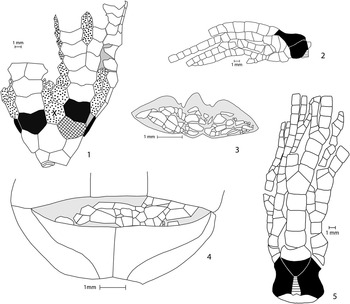
Camera lucida drawings of Brassfield Formation crinoids. (1) Temnocrinus americanus n. sp., paratype, USNM 594968, CD-interray view of calyx (compare to Fig. 3.6); (2–5) Browerocrinus arthrikos n. gen. n. sp.; (2) lateral view of holotype, USNM 594961 (compare to Fig. 1.12); (3) plating partially covering the hinge area, holotype, USNM 594961 (compare to Fig. 1.8); (4) plating partially covering the hinge area, paratype, USNM 594962 (compare to Fig. 1.13); (5) E-ray view of holotype, USNM 594961 (compare to Fig. 1.9). Patterns and plate designations: black, radial or superradial plate; horizontal rule, inferradial plate; cross hatch, radianal plate; stippled, interradial and intrabrachial plates; grey, matrix.

Numerous, minute plates cover the hinge region (Figs. 1.7, 1.8, 1.13, 2.3, 2.4); plates irregular in shape but commonly elongate and oriented more or less with long axis of plates parallel to the long axis of the hinge region. On USNM 594961, the crown is closed and minute plates more widely spaced (Figs. 1.7, 2.3); on USNM 594962 the crown is open and minute plates more completely fill the hinge area (Figs. 1.13, 2.4). Anal X hexagonal, supported beneath by the subanal (fused B and C superradials); four known anal plates above anal X; at least three proximal anal plates rectangular (Fig. 1.10). Anal sac very long, projecting for length of preserved arms.
Three arms. E-ray arm robust and branched, brachials variable in height. Fourth or fifth primibrachial, third or fourth secundibrachial, and fourth or higher tertibrachial axillary (Fig. 1.9, 2.5). E-ray brachial height:width ratio ranges from 2.0 times wider than high to 1.1 times wider than high.
Lateral arms with weakly developed main axil series and arm branching pattern different from normal calceocrinid bilateral heterotomy (Figs. 1.12, 2.2). Four axillaries in main axil, one non-axillary brachial between each axillary. Alpha ramule on the primaxil arm bifurcates on the second alphabrachial and supports the betabrachitaxis adanally; the abanal alpha ramule is completely covered by other arms, so no details known. Third betabrachial axillary with a gammabrachitaxis abanally and atomous beta ramule adanally. Third gammabrachial axillary with only the adanal deltabrachitaxis visible. Third deltabrachial axillary, which is the final bifurcation preserved; unbranched epsilonbrachials above as known.
On the secundaxil arm, third alphabrachial axillary and supports the betabrachitaxis adanally and abanal branch mostly covered. Third betabrachial axillary; third gammabrachial axillary; third deltabrachial axillary; and no further branching preserved on this arm.
Tertaxil arm bifurcates on third alphabrachial with betabrachitaxis adanal and the alpha ramule abanal. Distally, abanal branch is atomous. Third betabrachial axillary and supports the gammabrachitaxis abanally and the beta ramule adanally. Third gammabrachial axillary, other details unknown.
Quartaxil arm present but not preserved, so branching condition above the second alphabrachial unknown. Omega ramule present but only two brachials preserved, so branching condition unknown.
Proximal-most columnals very thin, heteromorphic, circular; lumen circular; columnal height increases distally. Mesistele and dististele unknown.
Etymology
Arthrikos (Greek, of a joint) in reference to the distinctive bifurcations on the finger-like arms.
Material
Holotype USNM 594961; paratypes USNM 594962–594964, CMCIP 51205; other material: USNM 594965 and 594966.
Occurrence
Brassfield Formation. Rhuddanian (Llandovery, Silurian), Bath County, Kentucky.
Remarks
Seven specimens of B. arthrikos include: (1) USNM 594961, a complete crown of an adult; (2) USNM 594962, an aboral cup with proximal arms preserved; (3) USNM 594963, a complete crown of a juvenile (Fig. 1.11); (4) USNM 594964, an aboral cup; (5) CMCIP 51205, an aboral cup; (6) USNM 594965, a partial aboral cup; and (7) USNM 594966, a set of distal arms.
This new material is significant for understanding calceocrinid morphology, in general, because two specimens preserve irregular, minute plates covering the hinge region. The Calceocrinidae are unique among crinoids because the crown is imperfectly to perfectly bilaterally symmetrical (Moore, Reference Moore1962; Ubaghs, Reference Ubaghs1978). Rather than two circlets of five plates positioned around the oral-aboral axis of the organisms, the basal circlet is reduced to a crescent shape, and the radial circlet is typically either rectangular or trapezoidal in shape. These two circlets articulate along a hinge that allowed the crown to close recumbently along the column (which ran along the sea floor) or open perpendicular to the sediment-water interface in a feeding position (Moore, Reference Moore1962; Ausich, Reference Ausich1986d; Brower, Reference Brower1988). The nature of the soft tissue on the basal plate-radial plate hinge articulation has been a point of discussion, but no evidence exists for any connective tissue other than ligaments.
USNM 594961 and 594962 are exceptional in possessing a series of minute calcareous plates filling the basal-radial plate junction region (see Bather, Reference Bather1893, pl. 14, figs. 141,142; Springer, Reference Springer1926, pl. 28, figs. 20 and 20a). These plates (“supplementary plates” of Bather and Springer) are minute, irregularly shaped, typically elongate plates that are commonly oriented with the long axis approximately oriented along the width of the articulation. USNM 594962 has the hinge open, and these plates are juxtaposed close to one another and nearly fill the gape between the circlets. Conversely, USNM 594961 has the hinge closed, and the small plates are more widely separated from one another, yielding a much less dense covering of these plates over the gape between circlets. Contrasting preservational modes with contrasting crown positions demonstrate that these plates are not an artifact. Herein, these plates are interpreted to have been held within a leathery integument that covered the hinge region. It is reasonable to assume that other calceocrinids also possessed such an integument, presumably to protect tissue vital to the hinge mechanism. The absence of this small plating in almost all other calceocrinids could be a taphonomic artifact, or it is possible that other taxa had an integument that lacked plating.
USNM 594963 is a juvenile specimen (Fig. 1.11), with USNM 594961 (Fig. 1.9, 1.10, 1.12) and USNM 594962 (Fig. 1.13) each progressively larger. Thus, a general indication of plate-shape change through growth can be deduced for B. arthrikos. The height-to-width ratio of the basal circlet is relatively constant, as is the height to proximal width of the radial circlet. In contrast, the height to distal width of the radial circlet is much greater in larger specimens, and the height-to-width ratio of brachial plates is much smaller (Table 1). These changes in shape through growth contrast somewhat with results of descriptions by Brower (Reference Brower1990), who reported a relative increase in the height-to-width ratio in calceocrinids for both the proximal and distal cup width.
Measurements in mm on growth series of Browerocrinus arthrikos. Height, width, and height-width ratio of basal circlets, E-ray arm first primibrachials, and E-ray arm second primibrachials.

Measurements
CMCIP 51205, basal circlet height, 1.5; basal circlet width, 5.3; radial circlet height, 5.7; radial circlet width, 6.4; and column length, 0.4* (Table 1).
Subclass Flexibilia von Zittel, Reference von Zittel1895
Order Sagenocrinida Springer, Reference Springer1913
Superfamily Sagenocrinitoidea Roemer, 1854
Family Dactylocrinidae Bather, Reference Bather1899
Genus Temnocrinus Springer, Reference Springer1902
Type species
Cyathocrinites tuberculatus Miller, Reference Miller1821, by monotypy.
Occurrence
Rhuddanian (Llandovery), Silurian, North America; Homerian (Wenlock), Silurian, England. Temnocrinus was known previously only from the Much Wenlock Limestone Formation at Dudley, England (Ramsbottom, Reference Ramsbottom1953; Donovan et al., Reference Donovan, Widdison, Lewis and Fearnhead2010), and T. tuberculatus was hitherto the only named species (Webster, Reference Webster2003).
Fearnhead (Reference Fearnhead2009) described and figured a cf. Temnocrinus sp. from the Hughley Shales (Telychian, Llandovery, Silurian) at Devil’s Dingle, north of Buildwas, Shropshire (Fearnhead, Reference Fearnhead2009; Donovan et al., Reference Donovan, Widdison, Lewis and Fearnhead2010). However, that specimen appears to lack interradial plates, and Fearnhead (Reference Fearnhead2009) stated that the two primibrachials are free above the radials. The posterior side is not visible on this specimen, so the anal series cannot be compared with that of Temnocrinus. Based on the lack of interradial plates, Fearnhead’s cf. Temnocrinus is not here considered to belong to Temnocrinus.
Donovan et al. (Reference Donovan, Lewis, Crabb and Widdison2008) also listed an occurrence of T. tuberculatus from the basal Woolhope Limestone (Sheinwoodian, Wenlock, Silurian) from quarries at Clencher Mill Lane, Ledbury, Herefordshire. However, Donovan et al. (Reference Donovan, Widdison, Lewis and Fearnhead2010) stated that T. tuberculatus is known only from the Much Wenlock Limestone at Dudley. As no museum number is cited for the Clencher Mill Lane occurrence, it needs to be independently confirmed (S. K. Donovan, personal comm. 25 February 2014). The Temnocrinus species described herein is the first occurrence of the genus from the Rhuddanian and the first from North America (Webster, Reference Webster2003).
Temnocrinus americanus new species
Diagnosis
Large species with elongate crown; as many as six or more brachitaxes. Aboral cup medium cone shaped. Infrabasals fully visible in side view. Plate sculpturing mostly smooth on calyx; tubercles and prominent lateral nodes on secundibrachials through quartibrachials. Primibrachials two; secundibrachials typically four; tertibrachials five to eight. Arm branches in second through fourth brachitaxes diverge after the second or third plate above the axillary. Interarea with three to eight plates in two to four ranges, followed by small, unsutured plates of the oral region. Distal-most margins of interradial plates form upward-directed spines.
Description
Crown elongate, ovate, expanding distally to lowermost quartibrachials; thereafter more compact with narrower brachials. Arms coiling inward toward the oral surface beginning with quintibrachials.
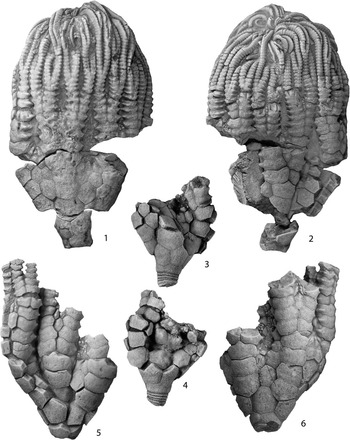
Aboral cup (Fig. 3.5, 3.6) medium cone shaped; width-to-height ratio ~1.2 to 1.3. Plates gently convex with smooth plate sculpturing. Infrabasals three, unequal with smaller azygous infrabasal in C ray. Infrabasals wider than high and not covered by column cicatrix; plates entirely visible in side view of calyx. Infrabasal circlet ~20% of total aboral cup height.
Temnocrinus americanus n. sp. (1, 2) holotype, USNM 594967, ×2.0; (1) B-ray view of crushed crown; (2) D-ray view of crushed crown; (3, 4) paratype, USNM 594969, juvenile specimen, ×4.0; (3) B-ray view; (4) D-ray view; (5, 6) paratype, USNM 594968, ×2.5; (5) A-ray view of crushed crown; (6) CD-interray view of crushed crown.

Basals five, in lateral contact; pentagonal (AB and DE), hexagonal (BC and EA), and heptagonal (CD). Basal plates slightly higher than wide or as wide as high; basals slightly smaller than radials. Basal circlet ~40% of total aboral cup height. CD basal truncated distally where it borders with anal X plate.
Radials five, in narrow contact except for CD interray; hexagonal (C and D), heptagonal (A and E) and octagonal (B); radials wider than high. Radial circlet ~40% of total aboral cup height. Radianal immediately below C radial. Radianal full width of C radial and aligned with radial circlet; C radial above radial circlet, having form of an extra primibrachial plate (Fig. 2.1).
Anal X hexagonal, slightly higher than wide; sutured below to CD basal and radianal and laterally to C and D radials. Eight or more plates follow in uniseries from right shoulder of anal X; series sutured to C ray. These anal plates with a coalesced transverse row of tubercles on each plate, on the plate margins opposite the C ray. Above the left shoulder of the anal X follows a succession of three plates, with one in the first row and two in the second row. Two of these plates sutured to D ray. Interarea above anal plates filled with small, unsutured oral region plates, some of which appear to be cone-shaped.
Regular interrays with two to four ranges of sutured interradial plates, rising to level of first or second secundibrachial and effectively fixing entire primibrachitaxis and lower part of secundibrachitaxis. One interradial plate in first range, two in second, and three each in third and fourth ranges, where present. Some in most distal range of interradial plates with vertically and medially directed spines. Distalmost one or two ranges of interradial plates with either single large tubercle or smaller tubercles aligned in vertical axial column within plate.
Intrabrachial plates between both secundibrachials and tertibrachials, with one or more large tubercles. As many as five or more intrabrachials between secundibrachials and one to three intrabrachials between tertibrachials. Intrabrachials above tertibrachitaxis absent.
Oral surface unknown, but interareas between arms and above sutured interrradial plates contain small, unsutured plates that were likely imbedded in a flexible integument not preserved in fossil specimens.
Arms branch as many as five times. First two divisions on fixed brachials isotomous; more distal divisions poorly isotomous, with equal-sized arm branches, but with branching occurring at slightly different levels. Primibrachials consistent at two in all of the three known specimens. Secundibrachials nearly consistent at four in the two specimens where preserved. Tertibrachials five to eight, as known; higher brachitaxes variable in length. In quintibrachitaxis, arms begin to coil inward toward oral region, coiling tightly at distal margins. For second through fourth brachitaxes, first few plates of each series sutured medially; arm branches do not diverge immediately after axillary. Intrabrachials above point of arm branching in secundibrachitaxis and tertibrachitaxis. For quintibrachitaxis and higher, arms diverge immediately following axillary of next lower brachitaxis.
Brachials rectilinear uniserial (sensu Webster and Maples, Reference Webster and Maples2008); brachials wider than high proximally to as wide as high distally; aborally rounded; approximate height-to-width ratio 0.7 for both primibrachials and secundibrachials. Brachial sutures in fixed brachials nearly straight, arcuate, or subtly sinuous; free arms with sinuous sutures; tertibrachials and higher brachials with patelloid processes. Plate sculpturing on lower brachials mostly smooth; free brachials in secundibrachitaxis through quartibrachitaxis with transverse rows of tubercles on lateral margins that coalesce, forming pronounced lateral brachial nodes. Above quartibrachitaxis, lateral nodes disappear as brachials narrow transversely and deepen adorally. Terti- and quartibrachials covered with small tubercles. Ambulacral surface of brachials obscured by matrix on available specimens; largest specimen with small ambulacral cover plates on one of the distal arms.
Proximal column (Fig. 3.3, 3.4) circular and homeomorphic, with thin discoidal columnals widening proximally to slightly narrower than the width of infrabasal circlet. External sutures crenulate. Outer surface of epifacet rounded, latus profile slightly convex. Lumen roughly circular to polygonal; lumen diameter at level of most proximal columnal 27% of total columnal diameter as measured on USNM 594968. Mesistele, dististele, and means of attachment unknown.
Etymology
Americanus recognizes the first species of Temnocrinus described from North America.
Material
Holotype USNM 594967; paratypes USNM 594968 and 594969.
Occurrence
Brassfield Formation, Rhuddanian (Llandovery, Silurian), Bath County, Kentucky.
Remarks
USNM 594967 is a large, nearly complete crown measuring 54 mm high. USNM 594968 is a slightly smaller individual preserving the calyx, the anal series and lower brachitaxa, and parts of the three most proximal columnals. USNM 594969 is a much smaller, immature specimen preserving a crushed calyx, a few free brachials, and the six most proximal columnals. All three specimens have been compacted to some degree.
Previously, Temnocrinus was represented only by the type species. With the addition of T. americanus, amendment of the generic concept is required. Specimens described herein closely resemble T. tuberculatus in the overall construction of the calyx and the anal series. Characters considered important for placement within Temnocrinus include: the radianal as the lower part of a compound radial in the primitive position directly below the C ray, truncated distal margin of the CD basal supporting the anal X, anal series articulating with the C ray, multiple interradial plates, presence of intrabrachials, two primibrachials, elongate form of the crown, general shape and plate sculpture of the brachials, sinuous sutures between brachials, and mode of arm branching.
Temnocrinus americanus is distinguished from T. tuberculatus in having an overall more elongated crown with more interradial plates and fixed brachials, more intrabrachials, a somewhat smoother plate sculpture on the calyx and lower brachials, and more pronounced lateral brachial nodes.
The crown of T. americanus is more elongate overall owing to several factors. Infrabasals are taller and not covered by the proximal column as in T. tuberculatus, giving T. americanus more of a cone-shaped aboral cup, versus a low bowl-shaped aboral cup in T. tuberculatus. The three known specimens of T. americanus have four secundibrachials where known, with one exception on one branch in the A ray of USNM 594968, where there must have been more than four because although only four are preserved, the fourth secundibrachial is non-axillary. Temnocrinus tuberculatus typically has only three secundibrachials, although the number can vary from one to seven (Donovan et al., Reference Donovan, Widdison, Lewis and Fearnhead2010), and specimens with four secundibrachials are known (Springer, Reference Springer1920; Donovan et al., Reference Donovan, Widdison, Lewis and Fearnhead2010). The anal series of T. americanus is similarly elongated, with the anal X followed by as many as eight or more plates, whereas in T. tuberculatus, the anal X is followed by four or five plates (Donovan et al., Reference Donovan, Widdison, Lewis and Fearnhead2010). The holotype of T. americanus, USNM 594967, is a large specimen with a total crown height of 54 mm, whereas in T. tuberculatus a large crown height is 40 mm (Springer, Reference Springer1920), and crown height varies between 17 and 50 mm (Donovan et al., Reference Donovan, Widdison, Lewis and Fearnhead2010).
Interradial plates are more numerous in T. americanus than in the type species, with two to four ranges of plates in the regular interareas. Temnocrinus tuberculatus has two ranges, with one large plate in the first range and two smaller plates in the second (Springer, Reference Springer1920; Donovan et al., Reference Donovan, Widdison, Lewis and Fearnhead2010), which are rarely in contact with one another (Donovan et al., Reference Donovan, Widdison, Lewis and Fearnhead2010). Interradial plates extend somewhat higher in T. americanus, reaching the first or second secundibrachial; in T. tuberculatus interradial plates do not rise above the primibrachitaxis.
Intrabrachial plates are also more numerous in T. americanus and extend higher in the crown, with intrabrachials between both secundibrachials and tertibrachials. Temnocrinus tuberculatus commonly has a single small intrabrachial between the first and second secundibrachial (Donovan et al., Reference Donovan, Widdison, Lewis and Fearnhead2010). Intrabrachials in T. americanus are between the second secundibrachials and extending distally to the first tertibrachials; more distally, intrabrachials are between the third to fifth tertibrachials. Because the intrabrachial plates do not immediately follow the axillary in T. americanus, the arms in the second and third brachitaxes are somewhat more firmly joined together than in T. tuberculatus. These extra intrabrachial plates may have provided T. americanus with additional rigidity in the arms.
Plate sculpture includes tubercles for both species; however, T. americanus has smooth calyx plates, except for the distal one to two ranges of interradial plates and the anal plates above the anal X that are articulated with the C ray, which bear tubercles. Temnocrinus americanus also has tubercles on the intrabrachial plates and on the brachials in the secundibrachitaxis through the quartibrachitaxis. Temnocrinus tuberculatus has tubercles that also cover calyx plates, and tubercles aligned in horizontal rows on radials and lower brachials, tending to coalesce into vertical ridges on higher brachials (Springer, Reference Springer1920). Springer (Reference Springer1920) noted considerable variation in the degree of ornamentation of T. tuberculatus, with some specimens almost smooth, but he attributed some of this to preservational differences. Preservation does not appear to account for the smoother calyx of T. americanus, as all three specimens are consistent, and tubercles are preserved as noted above on the same specimens.
Lateral brachial nodes on T. americanus are more pronounced than on T. tuberculatus; however, Springer (Reference Springer1920) noted that the lateral nodes, which he likened to “wing-like buttresses,” were present to a greater or lesser degree in most specimens of T. tuberculatus and were not always apparent in side view because of the roundedness of the brachials. Springer illustrated a large individual of T. tuberculatus with the lateral brachial nodes quite prominent (Springer, Reference Springer1920, pl. 16, fig. 15). All three specimens of T. americanus have these lateral nodes, including the smallest individual.
Although arms of both species of Temnocrinus are distinctive, they also appear to be somewhat convergent with those of Protaxocrinus interbrachiatus (Angelin, Reference Angelin1878) from the Wenlock of Gotland. This species, which also has arms with tubercles and lateral nodes, was illustrated by Springer (Reference Springer1920, pl. 45, figs. 13–16). Protaxocrinus interbrachiatus is easily distinguished from the two species of Temnocrinus, however, by its very different CD basal, which has a notch on the distal right side where the anal X is sutured. Only the first three plates of the anal series following the anal X in P. interbrachiatus are articulated with the C ray, whereas in Temnocrinus, the entire series is in sutural contact with the C ray.
Although Flexibilia are typically among the rarest of crinoids, with many species represented by only a few specimens (Springer, Reference Springer1920), T. tuberculatus is abundant in the well-collected Much Wenlock Limestone at Dudley (Springer, Reference Springer1920; Ramsbottom, Reference Ramsbottom1953). Temnocrinus tuberculatus was eagerly sought by collectors (Springer, Reference Springer1920) and at least 254 specimens are present in British museums alone (Donovan et al., Reference Donovan, Widdison, Lewis and Fearnhead2010).
Crinoid genera in the Silurian were commonly cosmopolitan, with many genera common to England, Sweden, and North America (Holland, Reference Holland1971; Sevastopulo et al., Reference Sevastopulo, Ausich and Franzén-Bengtson1989). The genus Temnocrinus, however, was previously known only from the type species, T. tuberculatus, which in turn was known only from the type horizon and locality, the Much Wenlock Limestone Formation (Homerian, Wenlock) at Dudley, England (Springer, Reference Springer1920; Ramsbottom, Reference Ramsbottom1953; Webster, Reference Webster2003; Donovan et al., Reference Donovan, Widdison, Lewis and Fearnhead2010). The addition of T. americanus extends the geographic range of Temnocrinus to include North America. The presence of T. americanus in the lower Brassfield Formation extends the chronologic range of the genus from the Rhuddanian to the Homerian.
Crinoidea Incertae Sedis
Remarks
In addition to the holdfast of Stereoaster squamosus, other types of holdfasts are also present in this fauna, although they are disassociated from crown material and cannot be identified. This material is deposited as USNM 595074, and includes simple discoidal holdfasts (both digitate and non-digitate) attached to an encrusting bryozoan or free. Larger terminal holdfasts with branching pseudocirri are also present.
Conclusions
A new low-diversity echinoderm fauna, comprised of six pelmatozoan taxa, three of which are new, is described from the lower Brassfield Formation (Rhuddanian) of east-central Kentucky. The fauna also contains a previously described asteroid. Although the Kentucky fauna contains new taxa, the echinoderms are very similar to previously described faunas from the area of Dayton, Ohio that are Aeronian in age. This new fauna represents one of the earliest examples of the Llandovery crinoid faunal recovery after the echinoderm extinctions that accompanied the latest Ordovician glaciation.
Acknowledgments
We thank Dan Levin for his normal efficiency, and S.K. Donovan and G.D. Sevastopulo whose careful reviews greatly improved this manuscript.