Introduction
Over the past few decades, social enterprises have received growing attention in public policy, academia and popular discourse as a promising and innovative means to resolve increasingly complex societal challenges (Ayob et al., Reference Ayob, Teasdale and Fagan2016; Teasdale, Reference Teasdale2010; Sinclair et al., Reference Sinclair, Mazzei, Baglioni and Roy2018). Broadly speaking, social enterprises (SEs) are hybrid organisations that employ market-based strategies to achieve specific social objectives (Gerrard, Reference Gerrard2015) and are one of many tangible outcomes of social entrepreneurship (Mair and Martí, Reference Mair and Martí2006). Research on the conceptual definitions, functions, capabilities, performance and impact of social enterprises has also grown rapidly (Lee and Chandra, Reference Lee and Chandra2020; Monroe-White and Zook, Reference Monroe-White and Zook2018; Rothschild, Reference Rothschild2009). One key study area on the function of SEs pertains to their ability to combat social exclusion, or alternatively to facilitate social inclusion for disadvantaged individuals (Oosterlynck et al., Reference Oosterlynck, Novy and Kazepov2019; Smith et al., Reference Smith, McVilly, McGillivray and Chan2018).
There is an important research gap in SE literature in the lack of attention paid to the context within which social entrepreneurship takes place, and where social enterprises operate (Chandra et al., Reference Chandra, Teasdale and Tjiptono2020). Here, we define context as the institutional environment (Chan et al., Reference Chan, Kuan and Wang2011; North, Reference North1990) comprising public policy (regulation), norms, and cognitive beliefs within which all social entrepreneurial activities occur. As put forth in several studies (Chandra et al., Reference Chandra, Teasdale and Tjiptono2020; Welter et al., Reference Welter, Baker and Wirsching2019), social entrepreneurship is a contextualized phenomenon. Studies have shown how various configurations or characteristics of institutional context can shape the development, growth, and impact of social enterprises by creating both barriers and enablers (Chan et al., Reference Chan, Kuan and Wang2011; Chan et al., Reference Chan, Chui, Chan and Yip2019; Chan et al., Reference Chan, Chui and Chandra2021).
In this vein, empirical work examining the role of social enterprises in facilitating the inclusion of people with disabilities in relation to the broader institutional context remains underexplored. This is particularly the case in Hong Kong, a city underscored by a productivist welfare regime (Holliday, Reference Holliday2000) that prioritizes economic growth and productivity in lieu of social rights, and where social policies are primarily used as a means to promote economic participation via the market (Chui et al., Reference Chui, Tang, Kwan, Fung Chan, Tse, Chiu and Lum2018; Chui et al., Reference Chui, Shum and Lum2019).
This study fills this gap by positioning itself at the intersection between social enterprise, employment policy, and disability studies. We draw on the perspectives of work integration social enterprise (WISE) representatives and people with disabilities involved with WISEs to address the following interrelated research questions: (1) Whether WISEs promote inclusion in people with disabilities, and if so how? (2) Whether or not WISEs enable people with disabilities to transition to open employment. Given the rapid proliferation of SE as a global phenomenon, this study has international relevance, especially for those who seek to understand the complex and dynamic intersections between social enterprise, inclusion and labour market participation of people with disabilities.
Social enterprise as a vehicle to enable labour market integration
Globally, people with disabilities constitute as much as 15% (or one billion) of the world’s total population (ILO, 2020). To date, scholars, policymakers and civil society actors alike have put forth tremendous efforts in accomplishing the dual imperatives: to achieve social inclusion for people with disabilities on the one hand, and combat exclusion on the other hand. The World Bank (2015, p. 50) defines social inclusion as ‘the process of improving the ability, opportunity and dignity of people disadvantaged on the basis of their identity to take part in society’. Conversely, exclusion is the systematic inability for disadvantaged population groups to access and participate in multiple and interrelated life domains including economic, social, cultural and political realms that the general population are privy to (Burchardt et al., Reference Burchardt, Le Grand, Piachaud, Hills, Le Grand and Piachaud2002). Despite concerted efforts in pursuing equal opportunities and inclusion for people with disabilities, disparities prevail in human capital outcomes such as employment, education attainment and income levels, as compared to the general population (Humber, Reference Humber2014; Lillestø and Sandvin, Reference Lillestø and Sandvin2014; Meltzer et al., Reference Meltzer, Robinson and Fisher2020). Specifically, the exclusion of people with disabilities from the mainstream labour market and from decent work remains pervasive (ILO, 2020).
While this study recognises that exclusion and inclusion comprise multiple life domains (Burchardt et al., Reference Burchardt, Le Grand, Piachaud, Hills, Le Grand and Piachaud2002), we focused on examining the role of work integration social enterprises (WISEs) in facilitating labour market integration for people with disabilities for three primary reasons. First, because employment has been theorized as a key mechanism for inclusion (Barnes and Mercer, Reference Barnes and Mercer2005; Chau et al., Reference Chau, Yu and Boxall2018; Hall et al., Reference Hall, Kurth and Hunt2013), with studies demonstrating a positive correlation between paid work and life satisfaction among people with disabilities (Barnes and Mercer, Reference Barnes and Mercer2005; Chau et al., Reference Chau, Yu and Boxall2018; Hall et al., Reference Hall, Kurth and Hunt2013). Conversely, exclusion from the labour market or unemployment has been consistently linked to poor health and wellbeing outcomes (Modini et al., Reference Modini, Joyce, Mykletun, Christensen, Bryant, Mitchell and Harvey2016). Second, while increased policy emphasis is placed on furthering the development of social enterprise as a vehicle to create employment opportunities for disadvantaged communities, there remains a dearth of empirical data to substantiate such claims (Chui et al., Reference Chui, Shum and Lum2019; Teasdale, Reference Teasdale2010). Third, there are limited SE studies that take into account the wider institutional contexts and how such context may affect these enterprises alongside people with disabilities who work in them (Meltzer et al., Reference Meltzer, Kayess and Bates2018; Smith et al., Reference Smith, McVilly, McGillivray and Chan2018). Disability itself may present a unique set of challenges requiring different solutions for social enterprise and policymakers to contend with.
Nevertheless, existing studies examining the nexus between social enterprise and labour market integration for marginalized communities do provide insight. Employment-focused social enterprises, commonly known as work integration social enterprises (WISEs), are specifically designed to provide job opportunities for those who would otherwise be excluded from the mainstream labour market (Kummitha, Reference Kummitha2016; Qian et al., Reference Qian, Riseley and Barraket2019), or to train disadvantaged individuals in order to enhance their employability. Studies have shown that WISEs were able to generate a range of positive social and psychological benefits including enhanced psychological well-being, self-efficacy (empowerment) and expanded social networks and capital among disadvantaged individuals with whom they were involved (Chui et al., Reference Chui, Shum and Lum2019; Ho and Chan, Reference Ho and Chan2010; Leung et al., Reference Leung, Ho, Tjia, Tam, Chan and Lai2019). Several studies, although limited in scope, have shown that social enterprises are able to create job opportunities for people with disabilities and to combat labour market exclusion (Gidron, Reference Gidron2014; Kim, Reference Kim2009; Spear and Bidet, Reference Spear and Bidet2005). Despite evidence affirming the role of WISE in creating job opportunities for disadvantaged individuals, few studies have examined the possible conundrum between WISE and its role in enabling people with disabilities to transition into open employment in a more contextualised manner that takes into account the institutional environment and its interaction with WISEs.
Study context: Hong Kong policy approach to employment for people with disabilities
There are an estimated 679,600 people with disabilitiesFootnote 1 in Hong Kong, accounting for approximately 9.7% of the total population of 7 million. Of the 558,000 people with disabilities aged 15 and over in Hong Kong, approximately 76,200 (13.6%) were employed. (Census and Statistics Department, 2015).
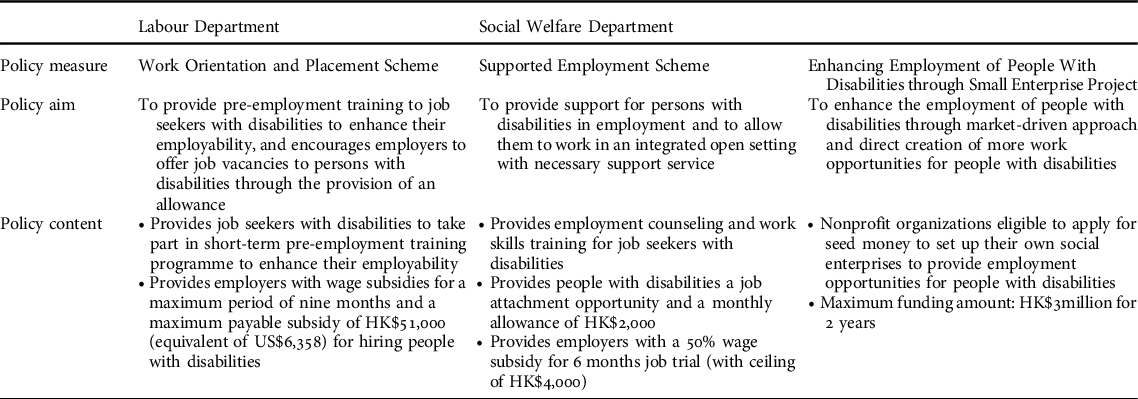
Unlike neighbouring regions such as mainland China and Japan, Hong Kong does not have a comprehensive disability employment policy or corresponding affirmative policy measures such as disability employment quotas, or tax incentives for employers. Nevertheless, existing supportive employment measures aimed at facilitating employment for people with disabilities are primarily conducted through three policy pathways (see Table 1). The first is through the Work Orientation and Placement Scheme (WOPS) implemented in 2005, which provides employers with wage subsidies for a maximum period of nine months and a maximum payable subsidy of HK$51,000 (equivalent of US$6,358) for hiring people with disabilities. The second policy pathway is through the Supported Employment Scheme, which provides people with disabilities with a job attachment opportunity for up to three months and a monthly allowance of HK$2,000 (equivalent of US$256). The third policy pathway is the Enhancing Employment of People with Disabilities through Small Enterprise Projects (3Es) launched in 2001 that seeks to address the underemployment of those with disabilities. Under this 3E Project, non-governmental organisations can apply for seed money to set up employment-focused social enterprises specifically to create job opportunities for those with disabilities. The maximum funding support per business is HK$3 million (equivalent of US$387,082) for up to two years (Social Welfare Department, 2020a). As with most other public policy funds aimed at developing social enterprises, only non-profit organisations are eligible to apply for this funding scheme. Consequently, work integration social enterprises affiliated with non-profit organisations became the dominant SE model in Hong Kong (Chan et al., Reference Chan, Chui, Chan and Yip2019; Chan et al., Reference Chan, Kuan and Wang2011; Tang et al., Reference Tang, Fung, Au, Lee and Ko2008). Most employment support services for people with disabilities are provided by these social enterprises (Cheng et al., Reference Cheng, Chiu, Fung and Au2015).
Disabiltiy employment policy measures for people with disabilities in Hong Kong

The Hong Kong government stipulates the primary objectives of WISEs as twofold: to enable ‘people who are at risk of permanent exclusion from the labour market by integrating them into work and society through a productive activity’, and ‘to assist the unemployed to move back to mainstream employment’ (Commission On Poverty, 2005). WISEs are conceived from the policy standpoint as a key vehicle to facilitate inclusion, and as a transition to open employment for people with disabilities in Hong Kong. Heavy emphasis is put on its role in poverty alleviation and in promoting self-reliance. By 2018 there were 651 social enterprises in Hong Kong (SEBC, 2020). Of these, it is estimated that 73 social enterprises have an exclusive mission on disability-related issues, typically through direct employment of people with disabilities (Social Enterprise Business Centre (SEBC), 2020). Yet, there is no available data regarding the total number of people with disabilities or their respective types of disabilities working in these social enterprises. Nevertheless, an open directory indicated that while certain social enterprises employ people with a specific type of disability (e.g. those with mental health issues), others define disability more generally, evidenced by their employees who exhibit a wide range of different types of disabilities (e.g. people with visual impairment, people with intellectual disabilities, etc.) (SEBC, 2021).
Taking the social economy sector as a whole, however, social enterprises were reported to have employed approximately 7,000 people in 2015 (Legislative Council of the Hong Kong SAR, 2016).
Method
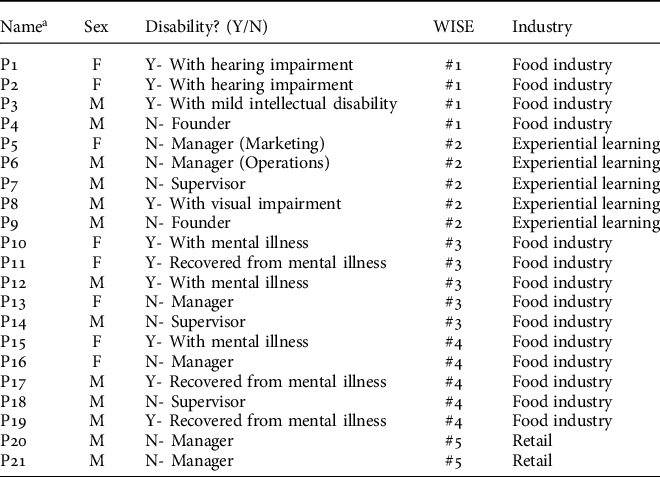
To achieve our research objectives, we adopted a qualitative method of inquiry (Lune and Berg, Reference Lune and Berg2017) for our study using semi-structured in-depth interviews. We employed purposeful sampling to select five work integration social enterprises whose organisational missions were to create job opportunities for people with disabilities (see Table 2) from an open directory of social enterprises made available by the Hong Kong Council of Social Service, an umbrella organisation of more than 400 non-profit organisations in the city. All the WISEs we selected employed people with disabilities, and all five WISEs we approached agreed to participate in the study. We did not focus on any one type of disability because our priority was to understand the overall employment experience of disabled people. Among each of those WISEs, potential participants were invited to participate in the study via email or by personal invitation if they fulfilled the following criteria: (1) they were full-time paid employees of WISEs at the time of the study and (2) they self-identified as having at least one form of disability. In addition, managers and founders of the WISEs were invited to participate in the research if they were a manager or a founder at the time of the study. Within that sampling framework, 21 participants in five WISEs participated in the research. Table 2 presents participants’ demographic details alongside information regarding the specific industry within which their respective WISE operate. Additionally, all sample participants were engaged in paid work at the time of the interview, albeit at varying levels. It is important to note that, at the bare minimum, participants’ wage levels were paid a minimum hourly age as stipulated by the Hong Kong Labour Ordinance, at HK$34.5 per hour in 2017. However, as characteristic of the non-profit sector, the general wage levels are comparatively lower than the private market (Dai et al., Reference Dai, Lau and Lee2019)
Demographic details of study participants (n = 21)

An interview guide was used to elicit the participants’ views concerning the present research objective. Questions posed to employees included: ‘Do you have any prior work experience in the open market?’ ‘Can you describe your work experience in the current WISE?’; ‘Do you think WISEs can promote inclusion in Hong Kong?’; ‘Do you think WISEs are enabling you to transition to open employment?’; ‘If not, what are the barriers?’ Participants were specifically asked to reflect how their own disabilities, if any, affected their employment opportunities and experiences. Questions posed to the managers and founders of WISEs included: ‘What were your motivations for setting up the WISE?’; ‘Do you think WISEs promote inclusion?’; ‘What challenges do you encounter in your attempt to promote inclusion?’; ‘Do you think WISEs enable persons with disabilities to transition to the open market?’; ‘Other than WISEs, what else can be done to enable more persons with disabilities to participate in the labour market?’
Each interview took approximately 60 to 90 minutes to complete. All interviews took place between May 2016 and March 2017 at venues convenient to the participants, typically at a private room within their worksites (the WISE itself). Having ensured participants’ anonymity and acquired their informed consent, we audiotaped and transcribed all interviews verbatim. This study was approved by the University of Hong Kong Human Research Ethics Committee.
Data analysis
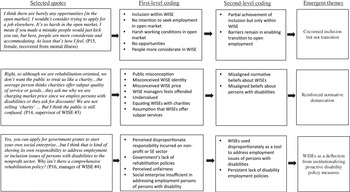
Data were analysed using a thematic analytic process (Braun and Clarke, Reference Braun and Clarke2012) with the following steps. First, we read the transcripts repeatedly in order to familiarise ourselves with the data. Second, phrases and words relevant to our research questions were extracted and openly coded. An initial list of codes was generated. Third, we collapsed these initial codes into relevant categories from which the final emergent themes were generated. For example, as it became evident that one emergent theme was that participants had little intention to transition into the open market, we classified those illustrative examples under the theme ‘Cocooned inclusion but not transition’. We then reviewed and refined all the themes before presenting them. Figure 1 illustrates the analytical process.
Analytical procedure for in-depth interviews (n=21)

To ensure data reliability, the two authors of this article undertook the coding process independently. Comparisons between the emergent themes were made and, where there were discrepancies, the authors went back to the data and resolved disputes. A third author of this article then reviewed the emergent findings to generate further consensus. Furthermore, we shared our initial findings with several participants to ensure that our interpretation of findings accurately represented those of participants. All data were analysed using the qualitative statistical software NVivo. Below we present the emergent themes, substantiated by illustrative quotes extracted directly from participants.
Results
Three key themes relating to the role of WISEs in promoting social inclusion and in enabling people with disabilities to transition into open employment emerged from our thematic analysis. The themes were Cocooned inclusion but not transition; Reinforced normative demarcation; and WISEs as a deflection from institutionalising proactive disability policy measures. In reporting these themes, we strove to explicate the relationship between the participants’ views and the overall disability policy measures (or lack thereof) in Hong Kong.
Cocooned inclusion but not transition
The first evident theme generated from our data revealed that, although participants indicated that they were able to garner a sense of inclusiveness and belonging via their employment in the WISE, they did not believe that the commercial market offered a similarly inclusive working culture and environment. As evidenced by the excerpts below, participants were able to identify specific workplace culture and processes (e.g. interpersonal relationships) that had enabled them to experience inclusion. However, this sense of inclusion was not observed or felt beyond the WISE itself. This is significant because it reveals the dynamic and complex nuances within the workplace environment that directly challenge the assumptive relationship between employment and inclusion as purported by some theorists (Hall et al., Reference Hall, Kurth and Hunt2013), as well as the government’s claim that WISEs were able to combat social exclusion (Commission On Poverty, 2005).
I feel very supported and cared for…my boss learned sign language just to communicate with us. (P1, female, with hearing impairment)
Recalling their previous work experiences in the open market, participants were able to articulate how their work experience in social enterprises differentiated from that in more traditional companies:
Unlike how our boss cares about us here, in the [open market] nobody cares about anybody. They won’t be bothered with talking to you or really getting to know you…but my colleagues here, we talk a lot to each other and care about each other (P2, female, with hearing impairment)
Previously I couldn’t find any meaning at work… I had no motivation to work and was always worried someone may take advantage of me because of my disability. Here I feel safe…I don’t want to leave this workplace at all. (P12, male, with mental illness)
WISEs take into account our abilities. They allow us to have some flexibility…When I first started, I worked 4 hours, then when I [could] cope I gradually increased my working hours to 8. You can’t do that in the open market. (P15, female, with mental illness)
Despite positive gains from their employment in the WISEs, participants indicated that similar accommodating employment measures were not available in the open market. From the perspective of our participants, it appears that barriers against participation in the open labour market are still very much in evidence for people with disabilities. None of the participants in our study had an intention or desire to seek employment in the open market despite what would appear to be appealing factors including potentially acquiring higher wage levels. It is, however, more important to note that wage levels were not a primary concern in shaping participants’ decision against attempting to seek employment in the open market. Rather, prior working experience within the open market had deterred them from doing so.
Interviewer: you said you can’t find a job in the open market –why is that?
Respondent: I am quite old now and I have a hearing problem. It’s very difficult for people [like myself] to find a job. (P1, female, with hearing impairment)
It’s so difficult for us people to look for a job elsewhere…I don’t have any plans to leave [my current workplace] and am very happy here. (P12, male, with mental illness)
I think there are barely any opportunities [in the open market]. I wouldn’t consider trying to apply for a job elsewhere. It’s so harsh in the open market, I mean if you made a mistake people would just kick you out, but here, people are more considerate and accommodating. At least that’s how I feel. (P15, female, recovered from mental illness)
The managers and founders of the WISEs gave similar views. Participants noted that, although the WISEs were able to provide job opportunities for people with disabilities, the market still lacked real opportunities to enable them to transition into the open job market. In this respect WISEs appear to be able to achieve inclusiveness within themselves, but only in a cocooned sense. Exclusion from the mainstream labour market still prevails. Indeed, the employment rate of people with disabilities aged 15 years or above remains disproportionately low compared to the general population, at approximately 13.6% and 60.8% respectively (Census and Statistics Department, 2015). Managers also point out that without proactive measures to address inaccessibility and ‘disabling workplace environments’ (Hall and Wilton, Reference Hall and Wilton2011) in the private market, the impact of WISE in facilitating social inclusion for those with disabilities would remain limited. Taking these points together, it appears that WISEs have limited ability to enable people with disabilities to transition to open employment.
We are an empowerment platform, enabling our friends with visual and hearing impairments to demonstrate their talent and capability here at our workplace. But how many of them can I hire as a WISE? Not even 100 in total. So even if we are a very successful WISE, so what? I think we are doing meaningful work here, but look, we have so many persons with disabilities with high qualifications here in Hong Kong, with university degrees, yet they have so many difficulties in finding jobs in the private market. Their employment rate is something like a little under 30% compared to about 80% among ‘abled graduates’…why is that? So WISEs become sort of like ivory towers…after all, I feel the corporates are very reluctant to hire people with differences. (P5, manager of WISE #2)
Most of our employees with disabilities are content where they are now. They find the work meaningful, but if they try it out in the open market, the competition is much fiercer and maybe the risks are much higher, so they prefer staying to work in WISEs…Also, we need more diversified opportunities in the open market for people with disabilities…right now it seems only ‘low-skills’ jobs are available to them, like cleaning…but in fact many are highly educated. There are really very limited opportunities in the open market (P13, manager of WISE #3)
We consider [it] a successful case of transitioning if s/he can find a job in the open market and maintain it for at least 6 months or longer…our success rate is [a] little lower than thirty percent. This means most couldn’t achieve this…most of them come back to our WISE. (P21, manager of WISE #5)
Reinforced normative demarcation
Our second emergent theme was reinforced normative demarcation. Whereas our participants with disabilities overwhelmingly indicated that they felt a sense of inclusiveness via their employment in the WISE, managers and founders questioned the very notion of whether a WISE can successfully combat exclusion and discriminatory attitudes towards people with disabilities at societal level. They observed that because most of the public still equated social enterprise with charity, WISEs might, albeit unintentionally, exacerbate and perpetuate their own ‘otherness’ and marginalization from ‘mainstream’ society. This finding sheds light on how existing societal norms regarding the role of WISEs constitute a key barrier in facilitating inclusion.
I don’t really advertise ourselves as a WISE…we want to promote inclusion…and not have people think of us as a charity. (P4, founder of WISE #1)
How many people in the public actually understand the purpose of WISEs? Speaking from my experience, I think very few…When we charge for our services or products, customers ask why aren’t we selling them at a cheaper price. They ask for discounts and simply assume that we are a charity…This mind set really needs to change. (P7, supervisor of WISE #2)
Managers expressed indignation toward the negative normative perception of WISEs, and also toward perceptions of disability. Recounting the numerous occasions where patrons asked for a discount on their products and services because they were a WISE employing disabled people, one participant felt such requests were patronizing and reflected underlying normative assumptions about people with disabilities. This reflection also provided additional insight as to why transitioning into the open market remains difficult for people with disabilities. As argued by Moser (Reference Moser2000), ‘the main problem is a norm that locates agency, mobility and a centred subjectivity in a naturalised and given human body. Measured against this norm, disabled people will always be constituted as Other, as deficient and dependent’ (p. 201).
Put it this way, we don’t treat our employees like they are service recipients or clients. If you’re talking about equal opportunity and inclusion, then persons with disabilities are also entitled to equal participation in contributing to society. They don’t need to be put in the spotlight or need [the public’s] pity, just respect and actual opportunities. This is an important distinction that is necessary to achieve inclusion. But it seems the public simply does not understand this. They still focus on our employees’ disabilities rather than their capabilities. (P9, founder of WISE #2)
Right, so although we are rehabilitation-oriented, we don’t want the public to treat us like a charity…the average person thinks charities offer subpar quality of service or goods…they ask me why we are charging market price since we employ persons with disabilities or they ask for discounts! We are not selling ‘charity’ … But I think the public is still confused. (P14, supervisor of WISE #3)
WISEs as a deflection from institutionalising proactive disability policy measures
Although the Hong Kong government actively embraces WISE as a promising policy tool for social inclusion (Commission On Poverty, 2005), participants indicated that it should not be conceived as a panacea to combat the exclusion of people with disabilities. Hence, our third emergent theme focuses on the complex and dynamic relationship between WISE and public policy, or the lack thereof. Despite existing employment support schemes enacted by the government (Social Welfare Department, 2020a), participants indicated that they were ‘painfully insufficient’ (P9, founder of WISE #2) and remedial in nature. For instance, the government-funded Supported Employment Scheme only had a total quota of 1,633 places with limited time period (Social Welfare Department, 2020b, p. 8). Considering that there were approximately 179,900 working age (18-64 years) people with disabilities (Census and Statistics Department, 2015), participants criticised the government for shunning or deflecting its own responsibility from mainstreaming and implementing more proactive policy measures to ensure equal opportunities to participate in the labour market for people with disabilities. Instead, this responsibility has been disproportionately allocated to the non-profit sector. The absence of more proactive disability policy measures has even led one participant to question the raison d'être of WISE:
Yes, you can apply for government grants to start your own social enterprise…but I think that is kind of shoving its own responsibility to address employment or inclusion issues of persons with disabilities to the non-profit sector. Why isn’t there a comprehensive rehabilitation policy? To go even one step further, I would ask whether being employed in a WISE means that they are truly integrated and accepted by society? Honestly there would be no need for us [WISEs] to exist if the government actually had a good policy to ensure equal employment opportunities or social integration for persons with disabilities.’ (P16, manager of WISE #4)
Such testaments are reflective of the underlying tenets of Hong Kong’s overall approach to welfare, described as a productivist welfare regime that prizes ‘efficiency’, profitability and economic growth above the social rights and equity of people (Chui et al., Reference Chui, Tang, Kwan, Fung Chan, Tse, Chiu and Lum2018; Holliday, Reference Holliday2000). Within this paradigm, and adhering to its principle of non-interventionism (Yang and Kühner, Reference Yang and Kühner2020), social policy interventions are remedial in nature, reserved only for the most vulnerable in society as ‘handouts’ rather than used as an enabling and empowering tool to facilitate equal opportunities and inclusion for disadvantaged individuals in a comprehensive manner. Participants suggested that the government should take the lead in employing disabled people in order to create a more inclusive society.
Sure, the government right now can partially subsidise some equipment costs if corporates hire people with disabilities…like wheelchairs and assist[ive] devices. This is a good thing, but why not take a lead to hire people with disabilities themselves? Why leave everything to us? (P9, founder of WISE #2)
I think the government really needs to do more to enable us to gain employment … I mean, if they took the lead and employ[ed] more people like us, wouldn’t that be more impactful? Other organisations will follow if that’s the case. (P15, female, with mental illness)
Discussion
Drawing on the perspectives of 21 current employees, managers and founders of WISEs in Hong Kong, this study examined the role of WISEs in promoting the inclusion of people with disabilities, and in facilitating their transition into open employment within the wider institutional context of Hong Kong. Although we found that employees were able to glean a sense of inclusion within the WISE, a finding which corroborates existing studies (Chui et al., Reference Chui, Shum and Lum2019; Kummitha, Reference Kummitha2016), this notion of inclusion did not extend beyond the organisational level. Despite the stated intentions of public policy on social enterprises, the ability of WISE in enabling people with disabilities to transition into the open labour market remains limited. Additional insights can be generated from our findings.
First, although some scholars maintain that employment is key to inclusion (Chau et al., Reference Chau, Yu and Boxall2018), our findings challenge this supposition. Instead, our study revealed a more nuanced relationship between employment and inclusion. As substantiated by the participants, many of whom had previous work experience in the private market, employment status itself is an insufficient marker of inclusion. This finding lends credence to studies that offer a more nuanced and cautious conceptualisation of the term ‘inclusion’ (George et al., Reference George, McGahan and Prabhu2012; Tsakalou et al., Reference Tsakalou, Hamilton and Brown2020). Specifically, although from the policy standpoint labour market participation is conceived as a marker for ‘inclusion’, that participants did not glean the same sense of inclusion in the open market suggests a form of ‘segregated’ inclusion (Tsakalou et al., Reference Tsakalou, Hamilton and Brown2020) that may further induce feelings of disenfranchisement. Thus, as substantiated by our findings, rather than simply conceptualising employment status as a form of inclusion, it is the workplace environment, conditions and processes such as interpersonal relationships between colleagues, as well as the availability of flexible and accommodating employment measures, that enables people with disabilities to feel included and respected. This finding echoes existing studies criticising the overgeneralization and assumptive relationship between paid work and inclusion among disadvantaged individuals (Dai et al., Reference Dai, Lau and Lee2019; Humber, Reference Humber2014).
Second, it is evident that prevailing societal norms regarding WISEs (that they are charities seeking ‘help’ from the public), and of people with disabilities themselves (that they are victims seeking ‘handouts’) constitute key barriers in combating labour market exclusion for those with disabilities. Such negative perceptions regarding disabled people have been documented in disability studies in Hong Kong (Poon-McBrayer, Reference Poon-McBrayer2013). Similarly, the public perception of social enterprises as charities has also been shown in more recent studies (Chan et al., Reference Chan, Chui and Chandra2021). This is significant because the very intention of a WISE is to promote inclusion and combat exclusion. Yet ironically, as WISEs have been misunderstood and often misconceived of as ‘charities’, this has served to reinforce the ‘otherness’ and negative labelling effect on people with disabilities working within them. Dai et al. (Reference Dai, Lau and Lee2019) also questioned the role of WISEs in empowering and facilitating inclusion of marginalized women in Hong Kong. In this light, if negative normative assumptions about the function of WISEs in society and of people with disabilities remain unchanged, it is unlikely that social inclusion, in its broadest sense (Burchardt et al., Reference Burchardt, Le Grand, Piachaud, Hills, Le Grand and Piachaud2002), can be achieved. This finding suggests the need to shift the public’s perception of WISEs and of people with disabilities lest they continue to contend with marginalization.
Third, while scholars and policymakers often conceive of social enterprises as ‘transformative social innovation’ and a policy solution to social ills (Avelino et al., Reference Avelino, Wittmayer, Pel, Weaver, Dumitru, Haxeltine, Kemp, Jørgensen, Bauler, Ruijsink and O’Riordan2019), this study presents a more sobering view from practitioners’ perspectives of their ability to realise those changes. The intended functions of WISEs in combating social exclusion or in facilitating social inclusion of marginalized population groups are clearly constrained by existing normative, structural conditions (or deficits), normative, and public policy – in other words, the institutional environment within which social enterprises operate (Sinclair et al., Reference Sinclair, Mazzei, Baglioni and Roy2018; McKinnon et al., Reference McKinnon, Kennedy, Barraket and DeCotta2020). As findings suggest, although some WISEs were able to enable some of their employees to transition into the open market, most return to the WISE due to their inability to uphold employment elsewhere in the open market. This creates a somewhat ‘revolving door’ phenomenon where social enterprises continue to provide employment opportunities and transition services for people with disabilities yet falls short in enabling people with disabilities to achieve more permanent forms of inclusion or integration in the open market. This results in people with disabilities returning to the WISE and repeating the cycle. In this light, it appears that Hong Kong’s institutional environment has confined both WISEs and people with disabilities within a circle of ‘segregated inclusion’ rather than offering genuine opportunities for permanent and meaningful inclusion.
Our findings echo those highlighted by disability scholars, who argue that inclusion of people with disabilities will remain limited unless there are corresponding policy measures to address the systematic exclusion of disabled people from the mainstream labour market (Hall and Wilton, Reference Hall and Wilton2011). As studies have demonstrated (Chan and Wong, Reference Chan and Wong2005), employers in Hong Kong remain resistant toward employing people with disabilities, and few accommodating employment measures are available to disabled people in the mainstream open market, where most of the jobs are. This shows the inherent deficits within the open market that require changes in both policy action in ensuring equitable employment opportunities, and in normative assumptions about the capabilities of people with disabilities in participating meaningfully in the labour market. Indeed, a United Nations report in 2012 outlining the deficits of the open market also noted the city’s lack of affirmative action to ensure equal labour market participation for people with disabilities. Employment creation via WISE aimed at people with disabilities should not be a deflection from, or seen as a solution to, the lack of more proactive policy measures aimed at addressing the systematic marginalization of people with disabilities from the mainstream labour market.
Taken together, the challenges outlined by our participants in their quest to realise their WISE missions may to a large extent be attributed to the underlying tenets of a productivist welfare regime, where existing employment support services remain residual and are primarily aimed at enhancing the employability of people with disabilities at the individual level, without addressing structural and institutional inequalities and barriers (Chui and Chan, Reference Chui and Chan2019; Cockain, Reference Cockain2018). Other studies have also shown how social enterprises, while aspiring to create meaningful employment for disadvantaged individuals, are often constrained by the broader economic constraints that enterprises confront (Wilton and Evans, Reference Wilton and Evans2018). This study extends this argument by illustrating that the government’s residual approach toward disability in effect constrained WISEs: from optimising their functions in promoting inclusion and enabling people with disabilities to transition into open employment. The government’s absence of proactive disability measures, reflective of its noninterventionist tendencies, in effect undermines both the rights and the capabilities of people with disabilities in participating meaningfully in society.
Thus, on the basis of the current findings, this article argues that the over-romanticisation of WISEs may have diluted our attention from important public policy discourse and debate that should address the systematic marginalisation and disenfranchisement of people with disabilities, as well as of other disadvantaged population groups. Other researchers have produced similar findings pertaining to Hong Kong’s lack of systematic policies in facilitating a socially inclusive society (Chui et al., Reference Chui, Arat, Chan and Wong2020). While this article by no means wishes to discredit the role of WISEs in enhancing the well-being of people with disabilities and in creating positive social and economic impacts, our findings do call into question the extent to which WISEs are able to combat systemic exclusion of disadvantaged individuals from the mainstream labour market (Teasdale, Reference Teasdale2010).
To conclude, this study examined the role of work integration social enterprises in facilitating social inclusion of people with disabilities in Hong Kong and in enabling them to transition to the open labour market. Empirical evidence revealed that, although WISEs can create an inclusive work environment for people with disabilities, their role in facilitating the transition into employment in the open market remains questionable. Unless comprehensive disability employment policies address marginalisation at the institutional level as well as the negative normative assumptions pertaining to WISEs and people with disabilities, the demarcation between disabled and ‘able’ people will prevail. An inclusive society should afford equal opportunities to all people, regardless of difference, to participate across different life domains including economic (the labour market), social, political and cultural integration (Burchardt et al., Reference Burchardt, Le Grand, Piachaud, Hills, Le Grand and Piachaud2002). This article challenges the key supposition, as purported by existing SE policies in Hong Kong, that employment in a WISE is indicative of ‘inclusion’ for disadvantaged individuals. It is not.
Limitations
Findings generated from this study should be interpreted within its limitations. First, we focused specifically on acquiring the perspectives of founders, managers and employees in work integration social enterprises since WISEs have been heavily promoted as a key policy tool to facilitate employment for people with disabilities. Whether other disability employment policy measures such as Supported Employment Scheme and WOPS will produce similar results as those generated from this study warrants further investigation. Second, the qualitative nature of this study precluded the possibility of testing relationships. Future studies may consider adopting quantitative methods to examine, for instance, the intention among people with disabilities to seek open employment on a larger scale, and to investigate the barriers they face. Longitudinal studies tracking the employment trajectories of people with disabilities from WISEs to the open market would also be invaluable. Third, because the objective of this study was to understand the overall employment experience of disabled people, we did not explore how specific type of disabilities may affect participants’ experiences in the open market and in working in WISEs (for example, how people with ‘non-visible’ disability and those with ‘visible’ disability may experience work differently). Future studies may consider adopting a more nuanced approach in exploring the experiences of work among specific groups of people facing the same type of disability. Lastly, this study did not include samples of people with disabilities currently employed in the open market. Thus, as acknowledged by Abbott et al. (Reference Abbott, Barraket, Castellas, Hiroy, Suchowerska and Ward-Christie2019), future comparative research is needed to consider the effectiveness of social enterprises in facilitating labour market integration in comparison to other approaches. Future SE literature conducted in the context of disability may consider addressing this gap.
Competing interests
The author(s) declare none.