1. Introduction
The Indian economy has grown rapidly at 6–8 per cent per year since 1995 and planners aim to sustain an 8 per cent growth rate in the next years. Growth has created considerable optimism about India and its place in the world. After many years of little change, poverty appears to be on the decline with an estimated 5–7 per cent reduction in the late 1990s (Sundaram and Tendulkar, Reference Sundaram and Tendulkar2003a, Reference Sundaram and Tendulkarb, Reference Sundaram and Tendulkarc; Deaton, Reference Deaton, Deaton and Kozel2005). Life expectancy increased from 59 years in 1991 to 64 years in 2008 and the primary school completion rate was at 96 per cent in 2008 (World Bank, 2012). Economic growth has resulted in a boom in the manufacturing and service sectors, large investments in infrastructure and energy projects, and a soaring middle class.
However, India's long awaited growth is not without its costs. Inequality may be on the rise, particularly in urban areas, and there is significant environmental degradation. Population growth, urbanization and industrial development have led to a decline in water and air quality and degradation of renewable resources (Kumar and Bhattacharya, Reference Kumar and Bhattacharya1999; FSI, 2009). In 2005 there were violations of national air quality standards at least 40 per cent of the time in over one-third of the stations where air quality is monitored (CPCB, 2005). A more recent assessment shows that nearly 50 per cent of some 88 industrial areas were critically polluted (FSI, 2009). Ground and surface water contamination are also of major concern – some one million deaths per year are attributed to water-borne diseases such as diarrhea (Parikh et al., Reference Parikh, Parikh, Raghuram and Parikh1999). In terms of renewable resources, the critical issues are erosion, salinization and degradation of forest resources.
In this context, it is important to ask if India will be able to sustain its high rates of growth and continue to offer its citizenry improvements in quality of life. Any casual observer of India can see both increased economic development and a continuous decline in environmental quality. However, less clear are the tipping points or thresholds that are being crossed, which could result in ecological feedback into the economic systems and cause potentially catastrophic problems. Thus, overall, is India making the right decisions? Is growth solving current problems without mining the wealth of future generations? As discussed in Arrow et al. (Reference Arrow, Dasgupta, Goulder, Mumford and Oleson2012), one way to answer this question is to ask if India's comprehensive wealth is increasing.
Identifying changes in India's wealth would require estimating changes in manufactured, human, institutional and natural capital and establishing the accounting prices of assets. There have been some attempts to examine changes in India's wealth (Gundimeda et al., Reference Gundimeda, Sanyal, Sinha and Sukhdev2005, Reference Gundimeda, Sanyal, Sinha and Sukhdev2006, Reference Gundimeda, Sukhdev, Sinha and Sanyal2007; Atkinson and Gundimeda, Reference Atkinson and Gundimeda2006; World Bank, 2006, 2011). The World Bank's data for three comparable years (1995, 2000 and 2005) shows comprehensive wealth per capita increasing in India. However, the resource component of wealth has a negative trajectory (Mukhopadhyay and Shyamsundar, Reference Mukhopadhyay, Shyamsundar and Ghate2012). Thus, while wealth in India appears to be increasing, this is certainly at the cost of natural resources.
The data and methodological challenges of providing a comprehensive answer on wealth are immense. Because of this, the Government of India recently set up an Expert Group with Sir Partha Dasgupta as the Chair to help develop a framework for greening India's national accounts. Given the complexities of empirically estimating wealth, for this note we consider only one aspect of wealth, i.e., forest stocks.
In the following sections, we show how the framework discussed by Arrow et al. (Reference Arrow, Dasgupta, Goulder, Mumford and Oleson2012) can be applied to natural forests in India. We also examine the implications of forest asset losses for poverty reduction efforts. This note builds on and summarizes previous work undertaken in this area (Gundimeda et al., Reference Gundimeda, Sanyal, Sinha and Sukhdev2005, Reference Gundimeda, Sanyal, Sinha and Sukhdev2006, Reference Gundimeda, Sukhdev, Sinha and Sanyal2007; Mukhopadhyay and Shyamsundar, Reference Mukhopadhyay, Shyamsundar and Ghate2012).
2. Forest resources and changes in wealth
How have forests fared in India? The Forest Survey of India documents forest changes every two years based on satellite data and ground verification. The most recent survey for 2007 suggests that forests have marginally increased by 0.07 million ha relative to 2005 (FSI, 2009). Very dense forests have increased marginally by 38 km2 and open forests have increased by 1,626 km2 at the expense of medium dense forests. The increase in forest area is a result of afforestation efforts by the Indian government, community-based management practices and regeneration in areas abandoned by shifting cultivators (FSI, 2009). These slightly positive indicators on forests do not fully reflect the reality that there is continuous degradation in many forested areas to meet timber and subsistence energy needs. Forest degradation also vastly differs across states.
To assess how forest wealth has changed, Arrow et al. (Reference Arrow, Dasgupta, Goulder, Mumford and Oleson2012) suggest estimating changes in forest stocks and valuing these changes at their shadow prices. We summarize an application of this framework to India's forest wealth during the period 2001 and 2003 (Gundimeda et al., Reference Gundimeda, Sanyal, Sinha and Sukhdev2005, Reference Gundimeda, Sanyal, Sinha and Sukhdev2006, Reference Gundimeda, Sukhdev, Sinha and Sanyal2007; Atkinson and Gundimeda, Reference Atkinson and Gundimeda2006). Changes in forest wealth are obtained as the aggregated change in the value of six forest products: timber, fuelwood, non-timber forest products (NTFPs), forest biomass carbon, and recreational and genetic services.
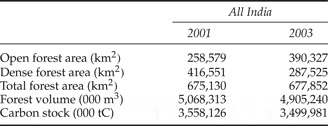
Timber is the most obvious component of forest wealth. Net changes in timber stocks equal the increase in the stock due to natural growth, natural regeneration and afforestation less the amount that is depleted due to extraction, conversion to other economic activities like shifting cultivation, transfer of land to non-forest uses, or forest encroachments. To obtain carbon stocks, the volume of forest biomass was first estimated (Haripriya, Reference Haripriya2000b, Reference Haripriya2002, Reference Haripriya2003) and then converted to carbon, assuming a carbon content of 0.5 Mg C per Mg of oven-dry biomass. Since forests cannot be used for timber extraction and carbon sequestration at the same time, reserved forests are assumed to be used for carbon sequestration and protected forests for timber, fuelwood, NTFPs, etc. Forests also provide erosion control, hydrological services, biodiversity, etc. Changes in these services are more difficult to assess. Table 1 shows that dense forest areas decreased, while open forest areas increased between 2001 and 2003. Further, forest biomass declined by 3 per cent, leading to a decline in carbon stocks by 2 per cent.
Changes in forest stocks during 2001 and 2003

Source: FSI (2003, 2005) and Gundimeda et al. (Reference Gundimeda, Sanyal, Sinha and Sukhdev2005, Reference Gundimeda, Sanyal, Sinha and Sukhdev2006).
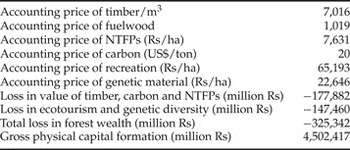
The biggest challenge in estimating changes in wealth is in establishing shadow prices. As Arrow et al. (Reference Arrow, Dasgupta, Goulder, Mumford and Oleson2012) show, shadow prices reflect contributions to wellbeing by the direct and indirect use of forest goods and services. Various methods were used to obtain the shadow values of different components of India's forest wealth. The shadow price of timber equals net rent, i.e., price less the cost of extraction. Resource rent is estimated as the average prices of roundwood and fuelwood minus the unit costs of extraction (Haripriya, Reference Haripriya1998, Reference Haripriya2000a, Reference Haripriya2001). Carbon was valued at US$20/tC, based on its global market value. The shadow price of NTFPs was computed as the discounted value of products per hectare (Haripriya, Reference Haripriya2000a, Reference Haripriya2001). The shadow price of recreation is the consumer surplus derived for tourists, which was estimated using a benefit transfer approach. The biodiversity values of forests were estimated by assessing the value of marginal species for medicinal purposes. Here the approach was to establish the incremental contribution of a species to the probability of making a commercial discovery (Rausser and Small, Reference Rausser and Small2000). Methodological details on shadow values of biodiversity and recreational services are provided in Gundimeda et al. (Reference Gundimeda, Sanyal, Sinha and Sukhdev2006).
Table 2 presents the shadow values of different forest components and the results on forest wealth for India during the period 2001 and 2003. The analysis suggests that forest wealth declined by Rs. 325 billion during 2001–2003 (equivalent to US$6.5 billion at the January 2012 exchange rate). The largest component of this decline in wealth comes from a decline in carbon, timber and NTFPs.
Accounting prices and forest wealth

Source: Gundimeda et al. (Reference Gundimeda, Sanyal, Sinha and Sukhdev2005, Reference Gundimeda, Sanyal, Sinha and Sukhdev2006).
3. Implications for the poor
Globally, an estimated 22 per cent of the income of households who live in and around forests is drawn from these resources (Vedeld et al., Reference Vedeld, Angelsen, Sjaastad and Berg2004). In India, the study that originally drew attention to the link between forest income and the poor was N.S. Jodha's work on village commons (Jodha, Reference Jodha1986). He found that poor rural households, on average, derived 9–26 per cent of their income from common property natural resources, while rich households derived 1–4 per cent of their income from the same. Jodha's study suggested that the commons in India, however ‘degraded’, were important to the livelihoods of the poor. Twenty years later, other studies provide evidence of the continued contribution of forest income to the poor. Dutta et al. (Reference Dutta, Roy, Saha and Maity2004), for instance, find that forest-fringe households in rural West Bengal obtain, on average, 30 per cent of their income from forests. Macro evidence suggests that local commons, whether they are pastures or degraded forests, are used by nearly 50 per cent of households in India (Chopra and Dasgupta, Reference Chopra and Dasgupta2008). Thus, a decline in forest wealth has real implications for India's poor.
Clearly, in the current period, forests are an important asset used by India's rural poor. However, as India grows and rural wealth increases, is it reasonable to expect the poor to depend less on forests? Thus, should we not worry about the impact of negative changes in forest wealth on the poor? There are, of course, many factors that mediate the link between forests and poverty. As incomes rise, we expect demand for energy, fodder or water to increase. This is an income or scale effect, which can lead to increased use of forests. On the other hand, increases in the value of time, exit opportunities for labor, and the availability of substitutes for forest products will reduce dependence. Another consideration is that rural market and economic growth will not evenly benefit everybody. Even if markets offer new opportunities, only some part of the local population may avail themselves of these, while others may continue to be dependent on forests. New markets without proper regulatory systems may also lead to indiscriminate use of forests, limiting supply further. Overall, a quick review of village-level studies suggests that demand for fuelwood may not be very income elastic and is unlikely to decline in the immediate future as income and wealth increases in rural India. Thus, it is very important to manage forests better to ensure that any changes do not further aggravate rural poverty.
4. Conclusions
In this note, we summarize results from studies that assess changes in forest wealth in India based on Gundimeda et al. (Reference Gundimeda, Sanyal, Sinha and Sukhdev2005, Reference Gundimeda, Sanyal, Sinha and Sukhdev2006, Reference Gundimeda, Sukhdev, Sinha and Sanyal2007). Forest assets are important both from a wealth and asset portfolio perspective and for poor households who use forests. Sustainability analysis of forest stocks is required for both reasons.
How do we better estimate changes in forest wealth in India? For physical data on forest stocks, we can continue to rely on the Forest Service of India, which uses increasingly sophisticated tools for its surveys and analyses. However, the real challenge is in estimating the accounting prices of forest products. We need more carefully done studies that estimate the value of different forest goods and services. We also need to establish feasible baselines for sustainability analysis. Such studies need to be consistently done at local and state levels before they can be aggregated and integrated into national accounts.