Introduction
Mating systems are governed by the spatial distribution of resources and mating partners (Emlen & Oring, Reference Emlen and Oring1977). The female's investment in reproduction is dictated by her physiological state, the expectation of future reproductive opportunities, and the trade-off between the two (Nilsson & Svensson, Reference Nilsson and Svensson1996; Candolin, Reference Candolin1998). In contrast, males generally seek promiscuous, multiple mating opportunities with minimal investment in offspring, in order to maximize their reproductive success (Trivers, Reference Trivers and Campbell1972). Nonetheless, polygyny, in which a male bonds with several females and also cares for the offspring, is common in nature, as is monogyny, in which a male bonds with a single female and both partners tend to the young (Emlen & Oring, Reference Emlen and Oring1977; Wong et al., Reference Wong, Meunier and Kölliker2013). In insects, small size and high rate of mortality have hindered the evolution of paternal care (Zeh & Smith, Reference Zeh and Smith1985). Promiscuous mating is therefore the most common mating system in insects, whereas polygynous mating systems are rare and monogamous mating is even rarer.
Mate choice by the female is prevalent in all mating systems (Trivers, Reference Trivers and Campbell1972; Andersson & Iwasa, Reference Andersson and Iwasa1996). Males may also exhibit preference or differential investment in females, as mating is often costly for them too (Bonduriansky, Reference Bonduriansky2001; Byrne & Rice, Reference Byrne and Rice2006; Harari et al., Reference Harari, Zahavi and Thiéry2011; Scharf et al., Reference Scharf, Peter and Martin2013). This may lead to mutual choice, especially when both parents invest in caring for the offspring (Trivers, Reference Trivers and Campbell1972). Mutual mate choice often results in assortative mating (the positive correlation between a coupling pair in any trait, but mainly body size; Crespi, Reference Crespi1989; Jiang et al., Reference Jiang, Bolnick and Kirkpatrick2013). Size-assortative mating can be achieved by several behavioral mechanisms (Crespi, Reference Crespi1989; Harari et al., Reference Harari, Handler and Landolt1999; Jiang et al., Reference Jiang, Bolnick and Kirkpatrick2013), such as male-male competition for larger females, greater readiness of females to mate with more competitive males, physical barriers that interfere with mating when size differences are extreme, or a spatial/temporal correlation between female and male sizes. Assortative mating is especially common when reproduction involves long parental care, as, for example, in monogamous seahorses and western bluebirds (Jones et al., Reference Jones, Moore, Kvarnemo, Walker and Avise2003; Jacobs et al., Reference Jacobs, Fair and Zuk2015). While size-assortative mating is sometimes related to food availability and niche partitioning in insects (Saldamando-Benjumea et al., Reference Saldamando-Benjumea, Estrada-Piedrahíta, Velásquez-Vélez and Bailey2014; Rebar & Rodríguez, Reference Rebar and Rodríguez2015), it is often also connected to the costs and benefits associated with male and female body size (Crespi, Reference Crespi1989; Harari et al., Reference Harari, Handler and Landolt1999; McLain et al., Reference McLain, Pratt and Shure2015).
Parental care, which is found in various animal taxa (Royle et al., Reference Royle, Smiseth and Kölliker2012), carries clear benefits for offspring but bears substantial costs for parents (Alonzo, Reference Alonzo2012; Ghalambor et al., Reference Ghalambor, Peluc and Martin2013; Scharf et al., Reference Scharf, Peter and Martin2013). In earwigs and treehoppers, for instance, a trade-off between parental care and future reproduction, as well as significant benefits to offspring expressed in higher hatching success or survival, have been demonstrated (Zink, Reference Zink2003; Kölliker, Reference Kölliker2007). Parental care is expressed in various ways, ranging from egg or offspring attendance, to matriphagy, in which the mother sacrifices her future reproductive potential and terminates her life by feeding the offspring with her own body (Salomon et al., Reference Salomon, Schneider and Lubin2005; Trumbo, Reference Trumbo, Royle, Smiseth and Kölliker2012; Wong et al., Reference Wong, Meunier and Kölliker2013). Biparental care, whereby both males and females contribute to offspring welfare, is advantageous, when the benefits to offspring contributed by the attending parents exceed the potential reproductive benefits of parental desertion and remating for each of the parents (Ratnieks, Reference Ratnieks1996; Gilbert & Manica, Reference Gilbert and Manica2015). Biparental care in insects may involve guarding the female to prevent remating, limiting extra-pair copulation, guarding the nest from attack by parasites and predators, providing food or even actively feeding the larvae (Zeh & Smith, Reference Zeh and Smith1985; Trumbo, Reference Trumbo2006; Shimada & Maekawa, Reference Shimada and Maekawa2011; Suzuki, Reference Suzuki2013; Kirkendall et al., Reference Kirkendall, Biedermann, Jordal, Vega and Hofstetter2015).
Here, we studied the reproductive advantage gained when the mating system, parental care and mate choice are combined, within the framework of ecological constraints, in a single study of the cypress bark beetle, Phloeosinus armatus (Reitter, 1887). Mating system, mate choice, and parental care have been usually considered in separate studies (Kirkendall, Reference Kirkendall1983; Reid & Roitberg, Reference Reid and Roitberg1994; McGraw et al., Reference McGraw, Szekely, Young, Szekely, Moore and Komdeur2010; Harari & Steinitz, Reference Harari and Steinitz2013; Gilbert & Manica, Reference Gilbert and Manica2015). This study is unique for testing all three factors in the same species under the same framework.
Bark beetles attack weak or recently dead trees. When a suitable host is found, the ‘pioneering sex’ first excavates the mating chamber and then emits species-specific sex pheromones that attract a mass of conspecific beetles of both sexes (Berryman, Reference Berryman1974; Anderbrant, Reference Anderbrant1990; Raffa et al., Reference Raffa, Phillips, Salom, Schowalter and Filip1993). If males are first to reach the host and release pheromones to attract females, polygyny is expected. However, when females are first to attack the tree and call for males, monogamy is the expected mating system (Kirkendall, Reference Kirkendall1983). The number of arms constructing the gallery systems may also indicate the mating system: a single arm suggests one female in the system and thereby monogamy, whereas more than one arm indicates the presence of multiple females and thus polygyny (Kirkendall, Reference Kirkendall1983; Mendel, Reference Mendel1984). Finally, number of resident males and females in the galleries also define the mating systems (Kirkendall, Reference Kirkendall1983; Kirkendall et al., Reference Kirkendall, Biedermann, Jordal, Vega and Hofstetter2015). In most bark beetle systems sequential monogamy, in which both males and females may remate after a period of biparental care, is the norm (Kirkendall et al., Reference Kirkendall, Kent, Raffa, Choe and Crespi1997). Parental care in these systems includes clearing frass and debris from the galleries (Kirkendall et al., Reference Kirkendall, Kent, Raffa, Choe and Crespi1997; Robertson, Reference Robertson1998). The presence of males increased the number of eggs laid and experimental removal of males led to higher female mortality (Robertson, Reference Robertson1998).
Our first goal was to define the mating system (monogamous or polygynous), to identify the ‘pioneering sex’, and test for the occurrence of maternal or biparental care in this species. The ‘pioneering sex’ defines the mating system: Males should establish a polygynous mating system, with multiple arms in the galleries, whereas females should establish a monogamous system. Second, if males spend time in caring for young, we expect them to also choose their female mates since their future reproductive success is hindered by missed mating opportunities. If both sexes choose their mates (as we predict), size-assortative mating is expected, because each individual attempts to maximize its reproductive potential (Crespi, Reference Crespi1989; Harari et al., Reference Harari, Handler and Landolt1999; Jiang et al., Reference Jiang, Bolnick and Kirkpatrick2013). Third, paternal care is expected due to the ephemeral, fast deteriorating nature of the host trees.
Material and methods
Studied animal
The cypress bark beetle P. armatus Reitter, 1887 (Coleoptera: Curculionidae) is a common pest of the Mediterranean cypress (Cupressus sempevirens L.) in the East Mediterranean region (Mendel, Reference Mendel1984). Most Phloeosinus species build a one-armed gallery, probably initiated by one female that calls for males. In the minority of species the male initiates the gallery construction and produces an aggregation pheromone that attracts both males and females (Kirkendall, Reference Kirkendall1983). Assortative mating has not been reported in this genus, although biparental care is common (Kirkendall, Reference Kirkendall1983). Phloeosinus armatus colonizes weakened trees of various species of the genera Cupressus and Juniperus, where it breeds in the trunk and in branches larger than 2–3 cm in diameter. The egg galleries are excavated by adults in the cortex, including the upper layer of the sapwood (Mendel, Reference Mendel1984; Pennacchio et al., Reference Pennacchio, Danti, Benassai, Squarcini, Marziali, Di Lonardo and Roversi2013). The beetle establishes up to four generations a year, each in a different tree. Phloeosinus armatus is monogamous (Balachowsky & Chararas, Reference Balachowsky and Chararas1961) and bigamous (Mendel, Reference Mendel1984), digging one- or two-armed galleries, accordingly. It is assumed that the male constructs the entrance tunnel to the mating chamber and the mating chamber itself, while the female bores the egg gallery (Mendel, Reference Mendel1984).
General methodology
Ten Italian cypress trees (Cupressus sempervirens), ~30 years old, were felled during March–April of 2004 and 2005 in the Tarum Forest in the Judean foothills of Israel (31°46′40″N, 34°58′41″E). Logs of 5–10 m with a mean (±1 SD) diameter of 28.8 ± 6.9 cm were placed horizontally on a wooden trestle at both ends, about 50 cm above the ground. Logs attacked by P. armatus, indicated by fresh dust and frass mounds, were observed every 2–3 days until emergence of the beetle brood (~50 days). New galleries, indicated by fresh mounds, were marked using tags of different colors as date codes. Certain portions of the galleries were exposed at various intervals using a chisel, revealing galleries at various stages. The beetles were carefully collected from each gallery, placed in small cups, one cup for each gallery system, and brought to the laboratory. We measured the pronotum width as a proxy of body size using a stereomicroscope (accuracy of 0.1 mm; Mendel, Reference Mendel1984), and sorted the beetles by sex according to differences in spines on the elytra margins (Roques & Battisti, Reference Roques, Battisti, Du Cros, Ducrey, Barthelemy, Pichot, Giannini, Raddi, Roques, Sales and Thibaut1999). A total of 211 galleries were exposed and 312 beetles were collected.
Pioneering sex and mating system
In order to identify the pioneering sex, galleries were exposed 1 day after first observing the entrance hole in the log, by the presence of a small mound of frass and dust. Resident beetles were collected into small cups, one cup for each gallery, and were taken to the laboratory to determine their gender. To determine the mating system, a sample of galleries (6–15 depending on the colonization rate) were exposed in intervals of 1–4 days for 49 days, when offspring are about to leave their natal gallery. To determine the number of galleries branching from the mating chamber, we carefully excavated the area around the chamber following the direction of the exposed galleries to their full length at that point of time. We recorded the developmental stage of the galleries. All exposed beetles were collected into small cups, one cup for each gallery system, and brought to the laboratory, where they were sorted according to sex (N = 211 galleries). In bark beetle mating systems, the male or the female stop producing pheromone after the initiation of the gallery. No extra males are therefore expected to be attracted to the established gallery (Kirkendall, Reference Kirkendall1983).
Parental care
After defining the mating system (monogamous; see the section Results), we aimed at discovering which of the parents is the first to leave and at which stage of the gallery it occurs. Galleries were excavated for this purpose 1–4 weeks after first observation of an active penetration. We collected the beetles in the gallery, sexed them, determined their size (pronotum width), counted all eggs (if found) in the two arms, and measured the length of each tunnel. We determined whether the presence of a female, or both a female and a male in the gallery had an effect on the number of eggs deposited, using ANCOVA with time elapsed since we first encountered the penetrated hall (estimated time between colonization of the gallery and excavation, in days) as a covariate. Number of eggs and time elapsed were both square-root transformed, as they deviated from normal distribution based on a Kolmogorov–Smirnov test (P < 0.0001 for both). We then narrowed our sample size to cases in which both parents were present, and examined the effect of male and female body size on the number of eggs observed, with time elapsed since we first encountered the mating chamber as a covariate.
Assortative mating
Field observations
In order to check for assortative mating, we correlated female and male size using a Spearman correlation, because of a deviation of body size from normal distribution (Kolmogorov–Smirnov test; P = 0.0047 and 0.0048 for females and males, respectively). We then used Wilcoxon signed ranks test to examine whether females within each pair were larger than males, and a Kruskal–Wallis test to explore the sexual-size dimorphism in the general population. We tested the effect of female and male size on the maximum tunnel width and length, using multiple linear regression tests. Time elapsed since first encountering the gallery was used as a covariate only for tunnel length, as tunnel width was not expected to change with time.
Laboratory experiments
For this experiment we brought beetle-infested logs to the laboratory (25°C, 14:10 L:D, 65% relative humidity). We cut the logs into 30 cm pieces, and placed them in dark boxes having only one opening at the top. A glass tube was attached to the opening such that upon emerging, beetles flew to the light and were caught in the tube. Beetles were collected every day, separating males and females to different cages to assure their virginity.
To test for assortative mating we brought cut logs (150 cm in length) with no signs of beetle presence to the laboratory and placed the emerged virgin females individually in a 15 cm3 plastic cup (diameter of 3 cm), along the log (distance between two females >20 cm). After the female constructed a mating chamber (~30 min.) we placed a similar cup containing a virgin male over the entrance of the mating chamber (N = 68 pairs). We measured the time elapsed between introducing the male to the female's burrowing entrance to the mating chamber and the time the male took to enter the chamber. The experiment lasted for 150 min, during which we checked every 5 min whether the male had entered the bark. Males usually entered quite fast (a median of 33.5 min for beetles entering earlier than after 150 min). Beetles that remained inside the tree for 15 min or less were excluded from further analysis, and beetles that entered in the last 15 min were included if they did not leave within the next 15 min. The purpose was to assure that such males are indeed interested in mating. Males and females in the experiment were kept separately, and were randomly chosen from the respective cage. Body size (pronotum width) of males and females was measured at the end of the experiments.
We used a multiple linear regression model with male and female size as explanatory variables, and the time elapsed until a male entered the chamber as the response variable. We then used an additional linear regression with ∆size (male-female) as the explanatory variable, and time to enter as the response variable. Because time was skewed to the right, it was log10-transformed. All statistical analyses were performed with Systat v. 12 (Systat Software, Inc., San Jose California USA).
Results
General results
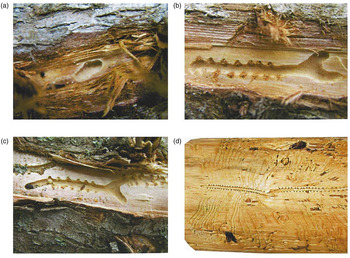
During the research 312 beetles (180 females and 132 males) were collected from the fallen trees. We characterized four gallery developmental stages (N = 211): (1) mating chamber excavated (N = 28), (2) one arm only (N = 71), (3) galleries with two arms (N = 56) and construction of larvae digging tunnels (N = 56) (fig. 1). A single arm was usually found a day after gallery construction (stage 2 above; length of 2.45 ± 1.10 cm, mean ± 1 SD, range of 0.9–5.2 cm). Two arms were almost always found in exposed systems older than 2 days (stages 3 and 4 above; length of 4.04 ± 2.67 cm, mean ± 1 SD, range of 0.33–14.31 cm). Offspring emergence from the log started ~50 days after the onset of the observations.
The developmental stages of the gallery: (a) mating chamber, (b) one armed-gallery with eggs, (c) two-armed gallery with the beginning of larval tunnels, and (d) fully developed two-armed gallery with larval tunnels.

The pioneering sex and mating system
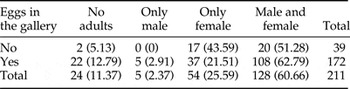
When exposing the galleries 1 day after the first observation of the frass/dust (N = 121), galleries in different lengths and developmental stages were observed, indicating that in some cases first observation of the dust mount was not the first day of colonization. To define the pioneering sex, only beetles that were found in the first stage of the gallery development were considered (i.e., when only a mating chamber had been constructed; N = 28). In 18 such galleries a lone female was found (64.3%) and one male and one female were both present in the rest (35.7%). In no case a male alone was present in galleries at this developmental stage, and we also never found two males in one gallery, reducing the likelihood that females were mated twice.
Considering all excavated galleries (N = 211), a female alone was found in 53 (25.1%) galleries, both males and females were found in 132 (62.6%) of all galleries, a male alone was found in only three (1.4%) of the cases, whereas in 23 (10.9%) of the cases no adults were found. We discovered a maximum of two arms branching from the mating chamber in opposite directions, perpendicular to the tree trunk (fig. 1).
Parental care
Eggs were laid in both arms of the gallery (Range of 1–122 eggs, 27.15 ± 24.58 eggs, mean ± 1 SD). Of the galleries excavated before egg laying (N = 39), a female alone was present in 17 (43.6%) galleries, both male and female were observed in 20 (51.3%) galleries, two (5.1%) galleries were neglected as no adult beetles were found, and in no gallery a male alone was present. At time of egg presence in the galleries (N = 172), both males and females were found in 108 (62.8%) of all the galleries, females alone were present in 37 (21.5%) of the cases, and no parents were present in 22 (12.8%) of the arms. In five galleries (2.9%), only males were found, these cases were omitted from the analyses in light of their rarity (table 1).
Occurrence of adults and brood in the gallery (% of galleries).

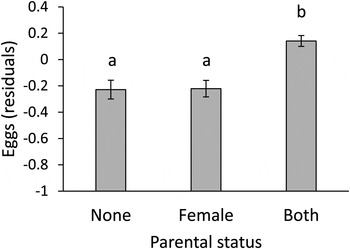
The presence of adult beetles, whether a female alone or both a male and a female, affected the number of eggs in the two galleries (ANCOVA followed by a Tukey post-hoc test, time as a covariate; F 2,163 = 10.25, P < 0.0001). More eggs were observed when both parents were present, followed by the presence of the female alone; the lowest number of eggs was found when no adults were present in the gallery at the time of exposure (fig. 2). Significant differences were observed when comparing cases with (a) two parents present to cases where a lone female was in the gallery (Tukey post-hoc test, P = 0.0007), and (b) cases with no adults present (Tukey post-hoc test, P < 0.0003). There was no difference, though, between the presence of only female and when no adults were observed in the gallery. As expected, time elapsed (days) since first locating new galleries positively affected the number of eggs found in the galleries (F 1,163 = 128.37, P < 0.0001).
The effect of parental status (both parents, only female, or no adults were present when opening the gallery) on the number of eggs detected (Means ± 1 SE). The latter is corrected for the time elapsed since placement of the log (residuals of eggs on time). See the section Results for sample sizes. Letters denote significant differences between groups based on Tukey's post-hoc test (P < 0.05).

Male size, but not female size, positively affected the number of eggs found (males: t = 2.48, P = 0.015, coefficient = 11.07; females: t = 0.011, P = 0.99, coefficient = 0.052; N = 108, model R 2 = 0.43). The effect of time elapsed since gallery construction significant (t = 8.06, P < 0.0001, coefficient = 0.499).
Assortative mating
Field observations
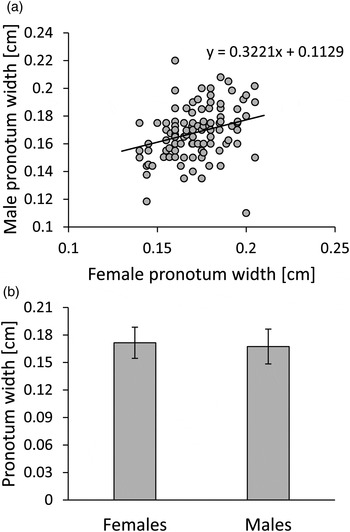
Female and male body size were positively correlated (Spearman R = 0.318, N = 125, P = 0.0003; fig. 3a). Within pairs, females were somewhat larger than males, although not significantly so (Wilcoxon signed rank test: Z = −1.84, N = 124; P = 0.066). A similar pattern was observed in the general population (disregarding pairs), females, on an average, were slightly larger than males (N = 180 and 132, respectively; Mann–Whitney test; U = 13,336.5, P = 0.064; females: 0.172 ± 0.017; male: 0.167 ± 0.019 cm; mean ± 1 SD; fig. 3b). The size difference was small (~2.5%), with a considerable overlap in body size between the sexes. In all exposed galleries, males were found between the females and the mating chamber. Female but not male size was correlated with the tunnel width, with larger individuals constructing wider tunnels (female: coefficient = 0.452, t = 3.34, P = 0.0011; male: coefficient = 0.131, t = 1.08, P = 0.28; N = 125, model R 2 = 0.114). However, whereas male size positively correlated with tunnel length (coefficient = 10.40, t = 2.07, P = 0.040; N = 122, model R 2 = 0.730), female size did not (coefficient = 1.17, t = 0.21, P = 0.83). The time factor, as expected, had a significant effect on tunnel length (t = 17.51, P < 0.0001).
(a) The positive correlation between paired male and female body size, as collected in the field. (b) General female and male size in the population (disregarding pairs). Females are very slightly larger than males. Means ± 1 SD are presented.

Laboratory experiment
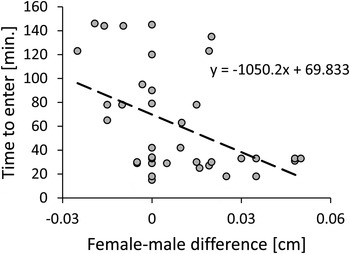
Both female and male size affected the time required for males to enter the chamber, but in an inverse manner: (1) larger males took longer to enter the chamber (coefficient = 6.41, t = 2.20, P = 0.035, N = 38, model R 2 = 0.208), while (2) the presence of larger females was associated with shorter male entry times (coefficient = −8.65, t = −2.37, P = 0.024). Using the ∆size as the explanatory variable showed a similar pattern (coefficient = 7.25, t = 3.02, P = 0.0046, N = 38, model R 2 = 0.202), the time it took males to enter the chamber decreased when resident females were larger than entering males (fig. 4).
The negative correlation between the size differences between females and males (∆size) and the time elapsed till the male entered the mating chamber.

Discussion
The cypress bark beetle presents an excellent model for insects reproducing in fast-deteriorating breeding sites. Here, we studied three important components of sexual selection: the mating system, mate choice, and parental care, and determined how they interact to affect the reproductive success of both male and female beetles. We detected a monogamous mating system in this beetle, in which the female, joined by one male, bores the mating chamber and the two-armed gallery. We found a strong evidence for biparental care of the young, as the presence of a male in a gallery together with the female resulted in a larger number of brood. Both males and females leave the gallery before the offspring mature, and may thus have an opportunity to colonize new sites, leading to sequential monogamy. We also found a support, although weak, for size-assortative mating in the cypress bark beetle.
The pioneering sex and mating system
Three lines of evidence strongly support a monogamous mating system in the studied bark beetle: (1) females were the pioneering sex, thereby releasing the species specific pheromone that attracts males (Kirkendall, Reference Kirkendall1983) and dig the mating chamber. (2) The number of beetles in the galleries never exceeded two, one of each sex, and males alone were hardly found. (3) Two-armed galleries were found in all excavated galleries. A one-armed gallery system is typical for monandrous species and is the general rule in most studies of bark beetles, while two-armed galleries often contain two females. However, it does not always hold true (Kirkendall, Reference Kirkendall1983). This had probably led to the mistaken identification of the two-armed gallery of P. armatus in Israel as bigamous (Mendel, Reference Mendel1984). The same species in Europe constructs one-armed galleries (Balachowsky & Chararas, Reference Balachowsky and Chararas1961), and the reason for this difference between European and Israeli populations remains unclear. The pioneering sex has an important role in establishing the mating system (Kirkendall, Reference Kirkendall1983), but this could be also determined by other, unrelated factors. For instance, in the spruce bark beetle there is a possible link between males being the pioneering sex and their low number of bristles on the cuticle. Thus, when attacking live trees that secret much resin, the males have a lower chance of getting stuck in resin (Schlyter & Cederholm, Reference Schlyter and Cederholm1981). Other adaptations, such as production of specific proteins helping to overcome the host defenses (Pitt et al., Reference Pitt, Robert, Bonnett, Keeling, Bohlmann and Huber2014) are possible, as well as earlier emergence than the other sex, in order to occupy early suitable sites (Stock et al., Reference Stock, Pratt and Borden2013).
Parental care
The male remains in the gallery for the duration of oviposition, but often leaves when the eggs hatch. This suggests that the extent of the male's assistance is limited mainly to clearing the gallery of debris and dust during excavation of the egg tunnels. This indication is supported by the location of males between the females and the mating chambers in all galleries. The larvae do not require male assistance, as they chew their way forward, away from the egg tunnel, leaving their debris behind. In a specific system of Ambrosia beetles, larvae can even clear the debris by themselves (Biedermann & Taborsky, Reference Biedermann and Taborsky2011). Larger males of the bark beetle Ips pini were better frass and debris cleaners than smaller males, reduced harassment from other males, provided better genes for the offspring, and had more and larger offspring (Reid & Roitberg, Reference Reid and Roitberg1994, 1995, 1998; Wong & Candolin, Reference Wong and Candolin2005). Male size, but not female size, was positively correlated with the number of eggs laid. There are some possible mechanisms explaining the effect of male size on fecundity: Females may increase their reproductive investment when the male value is perceived as high (Horváthová et al., Reference Horváthová, Nakagawa and Uller2011), expressed in both longer egg tunnels and more eggs. Robertson & Roitberg (Reference Robertson and Roitberg1998) suggested that females may mate sooner with larger males, leaving them longer time to lay more eggs before the deterioration of the resource. Large males may produce larger offspring if size is heritable, and larger males help more and are more efficient in frass and debris cleaning than smaller ones (Robertson & Roitberg, Reference Robertson and Roitberg1998). This is a possible explanation for the size assortative mating observed in this species. Indeed, in this study more eggs were present in galleries when both parents were present than in those having only the female, suggesting the contribution of biparental care to the reproductive success of both sexes (e.g., Sowig, Reference Sowig1996). Monogamy and nesting together are both common features of insects demonstrating biparental care, as they both increase the certainty of paternity (Suzuki, Reference Suzuki2013).
Assortative mating
The results of this study reveal a weak correlation of body size between the sexes, which can be carefully interpreted as a weak size-assortative mating (similar to previous studies finding such correlation levels; Arnqvist et al., Reference Arnqvist, Rowe, Krupa and Sih1996; Jiang et al., Reference Jiang, Bolnick and Kirkpatrick2013). Weak assortative mating is expected when taking into account the large overlap in male and female body sizes with slightly larger females in the cypress bark beetle population. Larger size is preferred by insects of both sexes: larger females are often more fecund (Honěk, Reference Honěk1993; Harari et al., Reference Harari, Handler and Landolt1999; Herdman et al., Reference Herdman, Kelly and Godin2004) and larger males may be more fertile (Skinner & Watt, Reference Skinner and Watt2007), provide larger/richer nuptial gifts (Gwynne, Reference Gwynne2008), or provide indirect benefits due to heritable traits, such as better body condition (Andersson, Reference Andersson1994). Larger insects of both sexes better tolerate stress, such as starvation or cold temperature (Renault et al., Reference Renault, Hance, Vannier and Vernon2003; Scharf et al., Reference Scharf, Galkin and Halle2015). All the above suggest that when both males and females prefer larger partners as mates, the expected result is assortative mating, when larger individuals leave smaller males to smaller females through both active and passive mate choice (Harari et al., Reference Harari, Handler and Landolt1999).
A significant, positive correlation was found in the laboratory experiment between male body size and the time it took to enter the mating chamber, and a negative correlation between female body size and the time till a male entered the chamber. Furthermore, males entered the mating chamber faster when they are smaller than the resident females. Assuming a mutual choice in this species, these interactions cautiously suggest that both females and males prefer large partners. In bark beetles, and similar to other insects, larger females are more fecund (Amman & Cole, Reference Amman and Cole1983), larger males more often win in male-male competition for mates (Reid & Roitberg, Reference Reid and Roitberg1995) and larger bark beetle males have more offspring than smaller ones (Reid & Roitberg, Reference Reid and Roitberg1995; Robertson, Reference Robertson1998; this study). Finally, large males may also be choosier because they are more efficient in taking care of the young, raising their value for females and thus enabling them a better choice of mates (Reid & Roitberg, Reference Reid and Roitberg1995; Robertson, Reference Robertson1998; Reid & Baruch, Reference Reid and Baruch2010). Nevertheless, assortative mating has not been detected in some bark beetle systems displaying biparental care (Teale et al., Reference Teale, Hager and Webster1994; Pureswaran & Borden, Reference Pureswaran and Borden2003; Reid & Baruch, Reference Reid and Baruch2010). In spite of the benefits of large male size, large differences between male and female size might impede the pair's efficiency in burrowing the tunnels, i.e., the female or male would be forced to widen the gallery in order to enable easy movement of the parents. In effect, in this study the pair width was correlated.
Similar to many other insects, males are slightly smaller than females. The results may reflect male choice and/or female's acceptance of specific males. Larger males have little competition, and may thus take more time to enter the chamber while assessing the size of the female compared with themselves. Larger males may also be choosier, because they have more mating opportunities (Reid & Baruch, Reference Reid and Baruch2010). Males require less time entering the chamber of a large female than of a smaller one, supporting the notion that all males prefer large females. We considered the possibility that smaller females prefer smaller males, as they fit more easily into the excavated egg tunnels. This, however, is not likely as larger males led to more brood, suggesting selection pressure on females to mate with large males. Large or competitive males could also pose some drawbacks as they may depart earlier from the gallery, in order to exploit their higher reproductive potential (Robertson & Roitberg, Reference Robertson and Roitberg1998; Wong, Reference Wong2004). Indeed, in our study females were found alone in ~21% of all galleries with eggs.
The mechanism by which male and female assess each other's size was not tested in this study. A female may, however, assess the size of a male when he tries to enter the gallery in relation to the gallery entrance size, which was constructed by the female according to her body size. The female can also assess his size by his resistance when she pushes him out of the gallery entrance. Males can assess the size of the female by: (1) the size of the entrance, (2) the female's head in the entrance, (3) the strength of her pushing against the male, and (4) the amount and quality of the pheromone she releases (Teale et al., Reference Teale, Hager and Webster1994; Chen et al., Reference Chen, Salcedo and Sun2012).
Conclusions
The three components of sexual selection – the mating system, biparental care and mate choice – interact in shaping the reproductive pattern and success of the cypress bark beetle P. armatus, in its fast-degrading breeding site. The female is first to arrive at the weakened tree, in which she constructs the mating chamber. Number of brood is higher when both males and females are present in the gallery until the time of offspring dispersal. A significant correlation between male and female pronotum width suggests size-assortative mating as a result of mutual mate choice, based on the benefits for both sexes in mating with larger individuals.
Acknowledgements
The authors would like to thank Dr Alex Protasov of the Department of Entomology, the Volcani Center, and Nitza Saphir, a former employee of KKL Forest Department, for their help in the laboratory and field work. The authors are grateful to L. R. Kirkendall for his helpful comments on a previous draft. IS was supported by the People Programme (Marie Curie Actions) of the European Union's Seventh Framework Programme (FP7/2007–2013) under REA grant agreement n° [333442].
Disclosure
None of the authors have any involvement, financial or otherwise, that might potentially bias this work.