Healthcare-associated infections (HAIs) have been estimated to complicate the hospitalizations of up to 15% of patients in resource-limited settings (RLSs).Reference Allegranzi, Bagheri Nejad and Combescure1 In Vietnam, despite increasing attention to infection prevention and control measures, the prevalence of HAIs is 12%–30% in intensive care units (ICUs).Reference Ha and Ha2–Reference Le, Hf and Vu4 Hand hygiene (HH) is the single most effective method of preventing HAIs. Despite the demonstrated effectiveness of HH in preventing HAIs in Vietnam,Reference Thi Anh Thu, Thi Hong Thoa and Thi Van Trang5 observational studies have found that HH adherence is 30%–70%.Reference Salmon, Tran, Bui, Pittet and McLaws6–Reference Phan, Tran and Tran9
Groups such as the World Health Organization (WHO) endorse patient and family involvement in HH improvement strategies.10 These strategies typically involve mechanisms that enable patients and their family members to “participate” in healthcare worker (HCW) infection prevention practices by reminding HCWs to clean their hands. This approach has intuitive appeal: patients and their families can be constant observers of HCW practices, and they receive the most direct benefit from optimal HCW HH. Studies primarily from well-resourced settings have shown that multimodal strategies incorporating patient and family empowerment may improve HCW HH.Reference McGuckin, Taylor, Martin, Porten and Salcido11–Reference Petersen, Herman, Sturm, Crossno and Friedman19 However, the use of patient and family empowerment tools in RLSs remains largely unexplored. Notably, in a recent review, only 3 of 26 included studies were conducted in low- or middle-income countries.Reference Gould, Moralejo, Drey, Chudleigh and Taljaard20 Altogether, the real-world usability and actual marginal effects of patient and family empowerment strategies to improve HCW performance of HH in RLS remain uncertain.Reference Gould, Moralejo, Drey, Chudleigh and Taljaard20, Reference Davis, Parand, Pinto and Buetow21
In Vietnam, the use of low-cost visual reminder tools (as have been developed for well-resourced hospital settingsReference McGuckin, Waterman and Storr12, Reference McGuckin, Waterman and Porten15, Reference Lastinger, Gomez, Manegold and Khakoo22, Reference Lent, Eckstein, Cameron, Budavich, Eckstein and Donskey23) may be cost-efficient and allow patients and their families more flexibility to navigate the hierarchical patient–HCW interactions typically present in the healthcare setting. In this study, we sought to develop a tool to empower patients and their families in a Vietnamese pediatric ICU to remind HCWs to perform HH and to determine its effectiveness and acceptability as well as barriers to its use.
Methods
Population and setting
This study took place from October through November 2018 at the Vietnam National Children’s Hospital (VNCH) in Hanoi, Vietnam. VNCH is a 1,790-bed government-funded pediatric referral hospital serving northern Vietnam. It houses 350 ICU beds, including neonatal, medical/surgical, and several subspecialty ICUs. The prevalence of HAIs at VNCH has been estimated to be 5.2% in the year 2017 and 3.1% in 2018. Our study took place in a single subspecialty ICU. The study was approved by the institutional review boards at Boston Children’s Hospital and VNCH.
Hand hygiene tool design
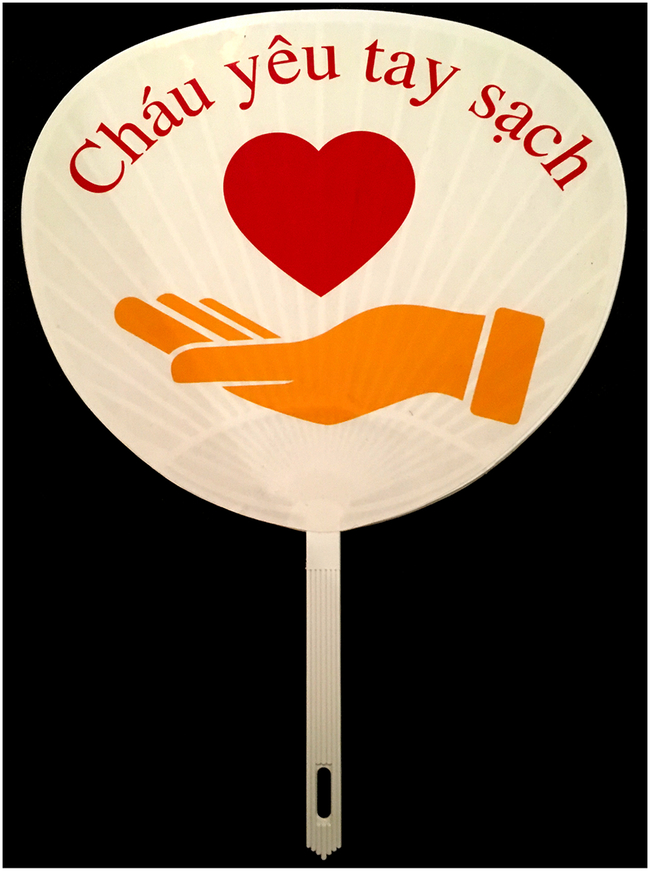
Using published patient and family empowerment tools as models,Reference McGuckin, Waterman and Storr12, Reference McGuckin, Waterman and Porten15, Reference Lastinger, Gomez, Manegold and Khakoo22, Reference Lent, Eckstein, Cameron, Budavich, Eckstein and Donskey23 we developed a demonstration set of visual reminder tools combining text and HH-related visual images. We conducted 3 separate focus group discussions with the family members of patients (n = 8), nurses (n = 8), and physicians (n = 8) to elicit opinions about the demonstration tools as well as perspectives on the role of patient and family empowerment in HH promotion. Based on these discussions, a final visual reminder tool was developed (Fig. 1). The cost of each printed tool was ~US$1.
Visual hand hygiene reminder tool. The text reads “I love clean hands.”

We also developed a short educational script for patients and their family members to describe the risks of HAIs, the importance of HCW HH in preventing HAIs, and moments when HCWs should perform HH. This standardized script was read to and discussed with families upon enrollment in the implementation period. Because a primary intention of this study was to assess the use of HH tools in an organic, real-world setting, to mitigate a Hawthorne effect, we opted not to provide education on HH or describe the purpose of the tools to the HCWs.
HH monitoring
Two research assistants were trained in HH observation methods using the WHO HH audit tool kit.Reference Sax, Allegranzi, Chraiti, Boyce, Larson and Pittet24 Following demonstration of >95% concordance in HH documentation using online practice videos and on-site observation, these research assistants unobtrusively observed HH in 2 main rooms of the target ICU. Observations occurred for at least 2 hours per day. Opportunities for HH were defined using the WHO’s “Five Moments of Hand Hygiene”: (1) before touching a patient; (2) before clean or aseptic procedures; (3) after body fluid exposure risk; (4) after touching a patient; and (5) after touching a patient’s surroundings.Reference Sax, Allegranzi, Uckay, Larson, Boyce and Pittet25 Performance of HH was defined as either using alcohol hand rub or washing hands with soap and water prior to or after each moment, as appropriate. In addition, observers recorded type of HH (hand rub or soap and water), profession (nurse, doctor, or “other”), and adequacy of HH (defined as washing hands with soap and water for at least 15 seconds, or visibly covering all surfaces of both hands with hand rub). Data were recorded using a modified and translated WHO HH audit sheet Reference Sax, Allegranzi, Chraiti, Boyce, Larson and Pittet24 and were entered into a Research Electronic Data Capture (REDCap) database.Reference Harris, Taylor, Thielke, Payne, Gonzalez and Conde26
Baseline observation and implementation
Prior to implementing the visual reminder tool, research assistants unobtrusively observed baseline HCW HH over 2 weeks (31.5 observation hours over 11 days). Neither clinicians nor patients and their families were notified that HH was being observed. Informed consent was waived for this portion of the study. The implementation period of the study occurred over the subsequent 3 weeks (51.5 observation hours over 18 total days). During the implementation period, researchers approached all newly admitted families in target rooms of the ICU to explain the study and to seek informed consent. Because all patients admitted to the ward were <18 years old, a single parent of each patient was requested to sign consent. After informed consent had been given, research assistants provided 1 session of education and a visual tool to each participating family. Research assistants continued to observe HCW HH, as well as patients’ and families’ use of reminder tools. We conducted interrater reliability assessments once during the baseline period and twice during the implementation period.
To gauge the acceptability of the tool, we conducted written surveys with enrolled families at the time of discharge. In addition, focus group discussions were conducted with family members, nurses, and physicians following the implementation period.
Primary and secondary outcomes
The primary outcome was the change in the performance rate of HH from the baseline to the implementation period. The HH rate was calculated as number of completed HH events divided by total HH opportunities. Secondary outcomes included changes in HH rate by profession, HH moment, and time of day, as well as changes in HH adequacy.
Data analysis
We used frequencies and proportions to summarize HH opportunities, performance, and adequacy. We used χ2 tests to compare proportions between the baseline and implementation periods. Logistic regression models were used to examine changes in HH rate. The association was adjusted for observation room status, time of observation (weekday business hours vs weekday evening or weekend), and WHO moment of HH. In the regression models presented here, we treat HH opportunities as independent. Models in which HH opportunities were treated as dependent at the level of observation period (typically 2–3 observation periods per day) were minimally different from the model in which opportunities were treated as independent. Two-sided P values <.05 were considered statistically significant. Analyses were conducted using Stata version 14.2 software (StataCorp, College Station, TX).
Results
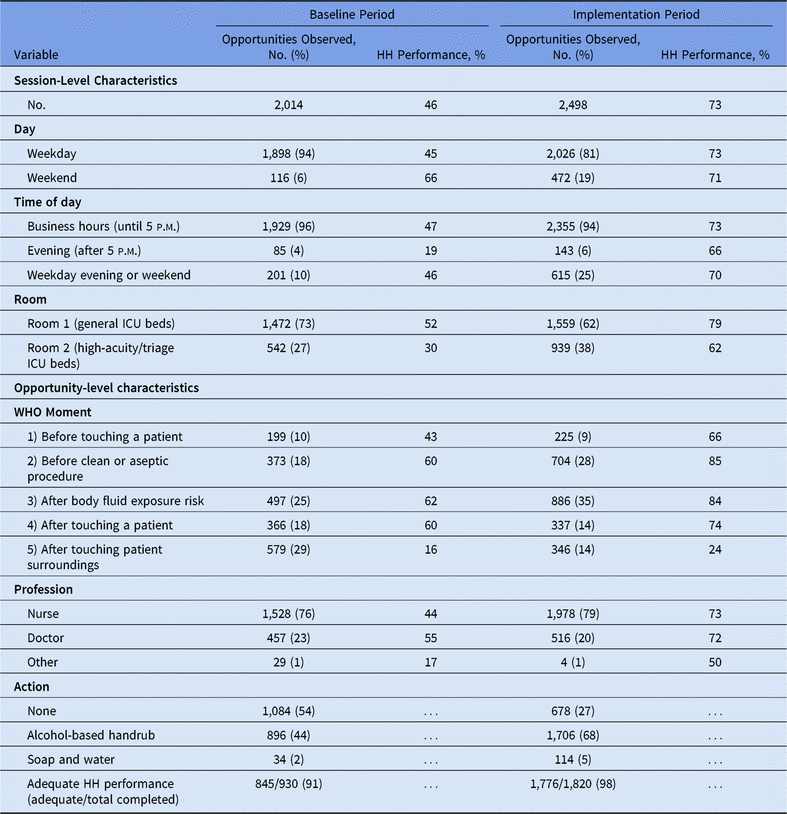
During the 35-day study, HH observations were conducted on 29 days, and 24% of observation time occurred either after 5 p.m. or during weekends. In total, 2,014 and 2,498 HH opportunities were recorded during the baseline and implementation periods, respectively (Table 1). During the implementation period, 73 families consented to receive the reminder tool and brief education. One family initially declined to participate in the study but then requested to participate the subsequent day. No other families declined participation.
Session and Observation Characteristics and Hand Hygiene (HH) Performance

Note. ICU, intensive care unit.
We observed 3 instances in which the reminder tool was used actively to remind a HCW to perform HH. In discharge surveys, 8 of 73 families (11%) reported using the tool to prompt HH during the study period. We observed that the reminder tool was often left in a visible place on the patients’ beds or was waved as a fan to cool patients or family members.
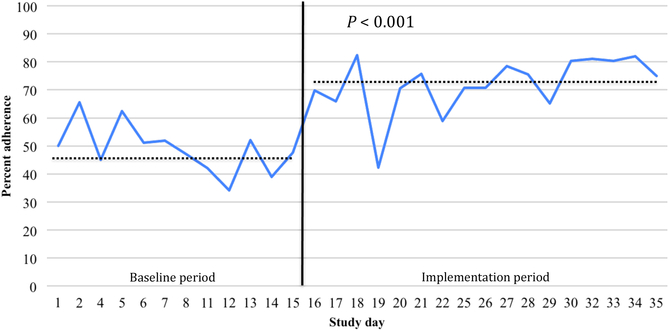
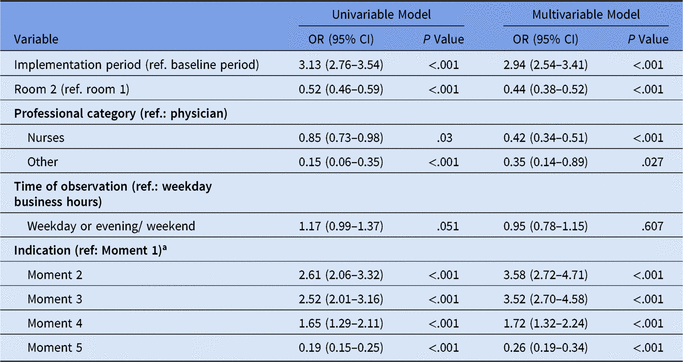
Baseline HH adherence was 46%, and increased to 73% during the implementation period (P < .001) (Fig. 2). In multivariable analyses, the odds of HCWs performing HH during the implementation period were significantly higher than baseline (adjusted odds ratio [aOR], 2.94; 95% confidence interval [CI], 2.54–3.41; P < .001) after adjusting for observation room, HCW type, time of observation (weekday business hours vs evening or weekend) and HH moment. Table 2 shows results of univariable and multivariable logistic regression models of predictors of HH.
Healthcare worker hand hygiene in baseline and implementation periods. Dashed lines represent mean hand hygiene (46% baseline vs 73% implementation; P < .001). The solid line indicates the beginning of the implementation period.

Predictors of Hand Hygiene in Univariable and Multivariable Models

Note. OR, odds ratio; CI, confidence interval.
a See the text for definitions of each moment.
We detected substantial variability in HH performance based on WHO moment, both in the baseline and implementation periods. The lowest adherence occurred after touching patient surroundings (moment 5) in both baseline and implementation periods (Table 1). Similarly, we observed variability in HH performance based on profession (Table 1). Rates of HH among nonnurse, nonphysician staff were low throughout the study, although few HH opportunities were measured for this group.
The quality of HH was high in both the baseline and implementation periods (Table 1). Of 930 completed HH opportunities in the baseline period, 845 (91%) were rated as adequate. Of 1,820 completed HH opportunities in the implementation period, 1,776 (98%) were rated as adequate. Adequacy was significantly higher in the implementation period than in the baseline period (P < .001).
At all 3 interrater reliability assessments, there was complete agreement in the assessment of HH performance, the method of HH, HH adequacy, and the type of HCW performing HH (data not shown).
Discussion
To our knowledge, this is the first study of the effectiveness of visual empowerment tools to improve HH in Southeast Asia. Visual aids used in prior studies from well-resourced settings have relied upon diverse reminders to prompt HH, such as pins for hospital gowns,Reference McGuckin, Taylor, Martin, Porten and Salcido11, Reference Randle, Clarke and Storr14 mugs,Reference McGuckin, Taylor, Martin, Porten and Salcido11 posters,Reference Randle, Clarke and Storr14 aprons,Reference Randle, Clarke and Storr14 and balloons.Reference Fitzpatrick, Pantle, McLaws and Hughes16 Effectiveness studies have assessed a number of these tools as part of multimodal strategies to improve HH. Although it is difficult to isolate the marginal effect of the visual reminder tools themselves, these studies have observed improvement in HH following the introduction of interventions.Reference McGuckin, Taylor, Martin, Porten and Salcido11, Reference McGuckin, Waterman and Storr12, Reference Randle, Clarke and Storr14, Reference McGuckin, Waterman and Porten15
Understanding whether empowerment strategies are effective is particularly critical in RLSs, where social hierarchies may disenfranchise patients and their families and where cost constraints may limit the ability to implement a full complement of interventions in multimodal HH campaigns. In our study, we specifically did not provide concomitant education to HCWs about HH or the purpose of the reminder tools. Our goal was to understand the use and marginal impact of the tools in an environment that closely mimicked a nonresearch setting. Although a number of interventions that focus on providing education and feedback to HCWs have been studied in Vietnam,Reference Thi Anh Thu, Thi Hong Thoa and Thi Van Trang5, Reference Salmon, Nguyen and McLaws27–Reference Thuy Hang and Hang29 our results lend support to including low-cost visual reminder tools in HH improvement strategies in Vietnam and similar RLS.
Rates of observed and self-reported use of empowerment tools were low in our study. Our observed rates were similar to previously reported rates of patients and their families reminding HCWs to perform HH in well-resourced settings.Reference Lent, Eckstein, Cameron, Budavich, Eckstein and Donskey23, Reference Julian, Subramanian, Brumbach and Whitener30 Observed changes in HH behavior could have been due to several intervention-related factors. First, even a few isolated uses of the reminder tool may have caused awareness of HH nonadherence among HCWs, leading to behavior change. For example, in a preimplementation focus group discussion, one physician reported that he was embarrassed when a family member reminded him to wash his hands and that he was attuned to HH after the incident. Second, even when not being held up as reminders, visual tools were frequently visible in patients’ beds or used as fans and may have served as passive reminders. For example, one family member described using the tool to fan a patient to remind HCWs to perform HH instead of overtly holding it up. HCWs in postintervention focus group discussions also noted that the tool was valuable to remind them to perform HH (data not shown). Third, introduction of the tools could have alerted HCWs to the fact that their HH was being monitored, and our findings could represent a Hawthorne effect. Although typically written off as study bias, the Hawthorne effect itself could be a component of a valuable HH intervention, particularly if HCWs are made aware that patients and their families are acting as “monitors.”
Acceptability of empowerment tools for patients and their families has been raised as a potential barrier to use. Several studies have found mixed acceptance of involving patients and their families to remind HCWs to perform HH. Pertinently, Le et alReference Le, Lehman, Nguyen and Craig31 surveyed HCW attitudes about reminding patients and their families to perform HH at a referral hospital in Vietnam. Only 37%–58% of HCWs (subdivided by professional type) felt that patients should remind HCWs to perform HH.Reference Le, Lehman, Nguyen and Craig31 In our study, family members who were surveyed upon discharge generally felt that the reminder tools were acceptable and useful (data presented separately). However, trepidation about HCW reactions to being reminded to perform HH may have contributed to the overall low rates of tool use that we observed in the implementation period.
In follow-up focus group discussions, several family members described having no need to use the visual tools because they felt that HCW HH was already optimal. This appraisal of providers’ HH practices occurred despite specific education about the WHO Five Moments of HH, and despite observed HH rates that remained suboptimal even in the implementation period. The discrepancy between families’ impressions and our objective observations argues for empowerment interventions for patients and their families that include focused instruction about specific indications for HCW HH. Several such education tools have been pilot tested, including informational brochures,Reference McGuckin, Taylor, Martin, Porten and Salcido11, Reference McGuckin, Waterman and Storr12, Reference Randle, Clarke and Storr14, Reference Pantle, Fitzpatrick, McLaws and Hughes32 videos,Reference McGuckin, Taylor, Martin, Porten and Salcido11 group educators,Reference Ahmed Awaji and Al-Surimi13 and posters directed toward patients and their families.Reference Ahmed Awaji and Al-Surimi13, Reference Fitzpatrick, Pantle, McLaws and Hughes16
We found substantial variation in HH performance by opportunity type. There were low rates of HH in moment 5 (after touching patients’ surroundings) in both baseline and implementation periods. In particular, HCWs often did not perform HH after touching patient charts, which were hung at the end of each patient’s bed, although patient charts are known to be the source of microbial contamination.Reference Chen, Chen and Wang33 These findings are consistent with prior research,Reference Loyland, Wilmont, Cohen and Larson34–Reference Allegranzi, Gayet-Ageron and Damani37 including a study at VNCH using unobtrusive video surveillance of HH that found overall low rates of HH after touching patient surroundings even after a feedback intervention was implemented.Reference Dang, Le, Le and Phung38 Importantly, because moment 5 typically occurs at the end of a patient encounter, it may be recalcitrant to HH improvement strategies that employ reminders to patients and their families because reminders would typically occur at the beginning or middle of patient encounters. Fundamentally, the benefit of HH at moment 5 is to the next patient that the HCW encounters. Taken together, these results suggest that there is a need for specific education on HH for WHO moment 5, particularly in open wards.
We also found variability in HH performance by professional category. Physicians demonstrated higher HH rates in the baseline period, and nurses demonstrated the greatest improvement during the implementation period. Other studies have found higher rates of HH among nurses than physicians,Reference McLaws, Pantle, Fitzpatrick and Hughes17, Reference Pittet, Hugonnet and Harbarth39, Reference Sax, Uckay, Richet, Allegranzi and Pittet40 including in Vietnam.Reference Nguyen, Nguyen and Jones28 Nurses and physicians may respond to different stimuli to improve HH and may have different relationships with the patients and their families. Patients and families may also have differential willingness to remind nurses and physicians to perform HH. We also detected significant differences in HH performance between the 2 rooms of the ICU in which the study was conducted, for unclear reasons. Further investigation of how to optimize visual reminder tools for different HCW types, and in relation to different settings within a hospital or medical unit, is warranted.
Quality of HH was relatively high in both the baseline and implementation periods of our study. This likely reflects infection prevention initiatives at VNCH that preceded our study. Others have recommended that strategies to improve HCW HH should target both frequency and quality.Reference Davis, Parand, Pinto and Buetow21 Multimodal strategies to improve HH, particularly those that include HCW education and feedback, are likely best suited to address these nuances of HH. Future studies could investigate how empowering patients and their families could be leveraged to address specific deficiencies in HH quality.
Our study has several advantages in advancing understanding of patient and family empowerment tools to improve HH in RLS. First, we used direct observation of HH at multiple times of the day and on weekends. Second, we attempted to blind HCWs from the knowledge that we were observing HH. Third, we used an empowerment tool designed with substantial input from relevant end users. Finally, we attempted to isolate the effects of the empowerment strategy to understand its marginal impact and to simulate real-world use.
However, our study also has several limitations. First, we measured behavior change over a short time period, and our positive results may not reflect durable HH improvement. Second, our study took place in a single unit at VNCH, and our results may not generalize to other units or hospitals with dissimilar layouts, workflows, or infrastructure. Third, although our positive findings were robust after accounting for multiple potential confounders, our study design did not permit us to control for unmeasured confounding or for secular trends. Finally, we were unable to measure changes in HAI rates over the course of the study.
Our results provide empiric evidence that giving families visual reminder tools and brief HH education is associated with increased HCW HH. These effects may be further amplified using multimodal strategies involving HCW education and feedback.Reference Davis, Parand, Pinto and Buetow21 Additionally, our results demonstrate the wide variability in HH performance at different moments for HH and across different HCW professions, and they suggest the need for HH improvement strategies (eg, targeted education for HCWs and families or specifically placed reminders) directed toward different types of HCWs and HCW–patient interactions. Furthermore, we identified families’ lack of knowledge of when HCWs should perform HH, and overestimation of HH performance, as potentially actionable barriers to reminder use. Future studies should investigate the long-term effectiveness of visual empowerment tools for patients and their families as well as ways to tailor empowerment tools to be most visually appealing, noticeable, and directive. The low cost of visual reminder tools such as these could make them cost-effective components of future HH improvement campaigns in RLSs.
In conclusion, in this short-term, prospective study of a family empowerment tool to improve HCW HH in a Vietnamese pediatric ICU, implementation of a visual reminder tool given to families, as well as brief education on the importance of HCW HH, was associated with significantly increased HCW HH rates. We identified ways to improve future empowerment strategies, including improving families’ awareness of when HH should be performed. Visual reminder tools such as the one described here may be a promising component of multimodal HH improvement strategies.
Acknowledgments
The authors would like to thank the patients and staff of the Vietnam National Children’s Hospital.
Financial support
This work was supported by the Boston Children’s Hospital Fred Lovejoy Housestaff Research and Education Fund and by a Boston Children’s Hospital Global Health Grant.
Conflicts of interest
All authors report no conflicts of interest relevant to this article.