Introduction
What is Out of Home Care?
OOHC is a term used in Australia by professionals working in the community and government sectors that refers to a group of children under the age of 18 years old who the state government has assessed as being in need of protection (Australian Institute of Health and Welfare (AIHW), 2015). In Australia, statutory protection of OOHC children is the responsibility of each state and territory. The Australian Federal Government funds programs and has the oversight responsibility for areas like income support, education and health care. In co-operation, federal and state governments work together to ensure the safety and protection of OOHC children with the state governments having the greatest responsibility. Children are placed into OOHC for many reasons, including being at risk, vulnerable and in unstable family relationships or in situations of neglect, psychological, sexual or physical abuse. Children in care are one of the most vulnerable groups in our community with emotional abuse and neglect being the most common primary type of substantiated abuse and neglect experienced (AIHW, 2015).
OOHC programs provide short and long term accommodation and allied related health support services for children. OOHC can be generally summarised into five models of care; these include relative/kinship care, family group homes, foster care, residential care and independent living. Kinship care or relative care is a type of care that places children with someone they already know such as a relative or someone who may have a community connection as in the case of Australian Indigenous communities. Foster care, like kinship care, is family based care; however it differs in that it is with a family that the child does not previously know. Residential care is for children who are unsuited to family based placements due to their challenging behaviours and/or high support needs and is provided through state funding.
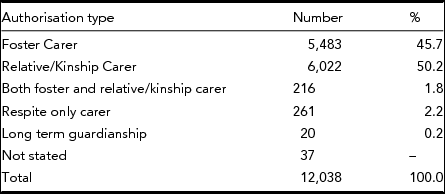
Within the OOHC system, children can be placed in a variety of living arrangements depending on their needs and the available resources. In Australia, the number of children in OOHC continues to rise, with an increase of 6.2 to 8.1 per 1000 from 2009 to 2014 (AIHW, 2015). $3.3 billion was spent in 2013–2014 on OOHC, which is an increase of $77.8 million (2.4%) from 2012 to 2013 (Australian Government Report Productivity Commission, 2015). There were 51,539 children in the OOHC system during 2013–2014 with 55,067 requiring a care and protection order. There was an average of 12,038 households approved to provide OOHC placements. Fifty per cent of these households care for 1 child, 28% care for 2 children and 17.6% care for 3–4 children with 4% have caring responsibility for 5 or more children placed in their care (AIHW, 2015). The majority of these placements were children placed into foster care or relative/kinship care. It is clear there are inadequate numbers of carers to meet the needs of all children in the OOHC system. Based on these figures, every available foster care placement would need to accommodate 4.2 children each in order to meet the current demands.
In NSW, it was the Department of Families and Communities’ (NSW FACS, 2015) responsibility to implement OOHC programs. In 2012, this responsibility began a transition process through which OOHC services were transferred to non-government organisations (NGOs) as recommended by James Wood from the Special Inquiry into Child Protection Services (NSW FACS, 2015). In NSW, children and young people stay in care until they are able to return to their families through five different types of foster care arrangements, identified by FACS as being: immediate or crisis care, respite care, short to medium term care, long term, and relative or kinship care. Immediate care is to provide care for children in need of urgent assistance or who are experiencing a crisis causing removal from the birth family to be urgently required. Respite care is for families who need a break from their caring role and is short term in nature. Short term to medium term care is a placement for up to six months duration where there is a strong focus on trying to reunify the child with their birth parents or extended family. Long term care is where a placement is longer than six months and the child is not expected to return to their birth family (NSW FACS, 2015). The NSW government has recently reviewed its role in OOHC and under the Community Services Plan 2012 aims to implement a better future for children in OOHC within the five key areas. These include transferring OOHC service delivery to the non-government sector, improving the health, education and wellbeing outcomes for children and young people in care, creating stronger connections for Aboriginal children and young people in care, improving advocacy for children and young people in care and providing better support for young people leaving care (NSW FACS, 2015).
A foster care household is one which is co-ordinated from NGOs, where the organisation ensures the individuals in the household have undergone appropriate screening, selection and approval processes, received authorisation from the relevant department to enable a child to be placed in their care, and are part of an ongoing process of review and support. In Australia, foster carers are granted legal guardianship rights through state courts. For example in NSW, the NSW Children's Court grants guardianship status until the child in the foster care family reaches 18 years of age. Due to their domestic circumstances, children in OOHC are clearly a disadvantaged equity group within the public sector social and education systems.
Widening Participation
The phrase “widening participation” is the description of initiatives aimed at disadvantaged students to encourage participation in tertiary education; that is, progression to further and higher education following the completion of year 12 at high school. Widening participation, as defined in the UK's Kennedy Report (Kennedy, Reference Kennedy1997, p. 5), “means increasing access to learning and providing opportunities for success and progression to a much wider cross-section of the population than now”. Central government funding aimed at widening participation in Australia has been allocated through the Higher Education Participation and Partnerships Program (HEPPPFootnote 1) for the purpose of redressing disadvantage and engaging more young people in higher education (Cuthill & Schmidt, Reference Cuthill and Schmidt2011). Demographics from Census data show that while 25% of the Australian population come from a low socio-economic (LSES) background; this cohort is under-represented, as only 15% actually progress to higher education. LSES background locations are identified by recording socio-economic factors in collector districts in national census surveys (Australian Bureau of Statistics (ABS), 2014).
Since 2010 and a World Economic Forum report (Schwab, Reference Schwab2012), and for reasons of economic development and the status of Australia as a nation in world standing, students who have not traditionally entered higher education must be encouraged to do so to fill the skills gap in a rapidly developing business environment. Following the Bradley report, the Australian government set targets that 40% of 25–34 year old people will hold at least a bachelor-level qualification by 2020 and that students from LSES backgrounds should make up 20% of higher education enrolments (Bradley, Reference Bradley2008). These targets are set to increase the level of skills in the population of Australia to help the nation keep its status in the world economy; although the Bradley report (Bradley, Reference Bradley2008) found that it was “losing ground”. In addition, the author of the landmark Gonski Report (Gonski, Reference Gonski2011) stated that the “difference in school opportunity” for students from a LSES background was “alarming” (Hurst, Reference Hurst2013). For these, and many other reasons, the Australian Federal government resources programs targeted at disadvantaged students who belong to specific equity groups, such as people from LSES backgrounds (McLachlan, Gilfillan, & Gordon, Reference McLachlan, Gilfillan and Gordon2013) through the HEPPP funds (Department of Education (DoE), 2014).
Equity groups of people, identified as having a disadvantage, were defined by the report A Fair Chance for All and later adopted by the Australian equity framework (Department of Employment, Education and Training (DEET), 1990), these groups being as follows:
• “People from low SES backgrounds.
• People from regional and remote areas.
• People with a disability.
• People from non-English speaking backgrounds.
• Women in non-traditional areas of study and higher education.
• Indigenous people” (Naylor, Baik, & James, Reference Naylor, Baik and James2013).
The Dawkins (1988) report was the first initiative in Australia to specifically investigate equity in education with the objective of “the achievement of a fairer and more just society” (p. iii). The equity targets were later recognised in the Martin Report (Martin, Reference Martin1994) and subsequent work built a framework for measuring the performance of universities in successfully targeting the equity groups (Pitman & Koshy, Reference Pitman and Koshy2014). It is important to note that, although OOHC children might fit into one of the above equity groups, they are not specifically identified in government targeting of disadvantaged groups.
Comparisons with Equity Groups
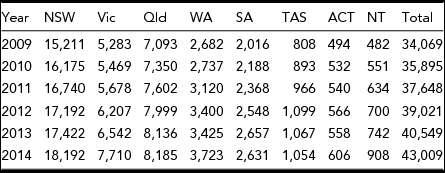
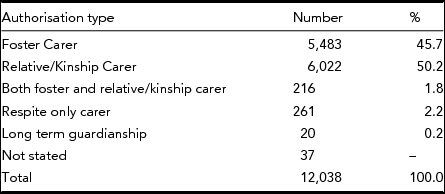
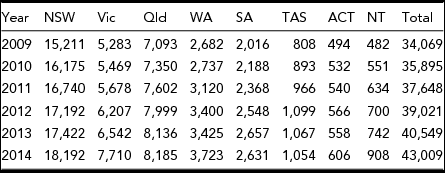
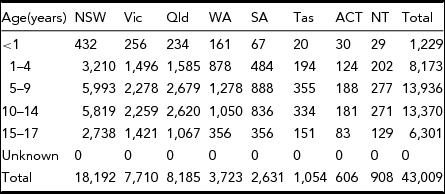
This article will now discuss children in care and their educational needs in relation to tertiary education by examining the size of the issue, the progression of OOHC children in their education; education outcomes of OOHC children; reasons for OOHC children under-achieving in education; and solutions to offer OOHC children greater opportunities and equity. As at 30th June 2014, Australia has 43,000 children living in OOHC; this being an increase of 20% from 2010. The highest number of children living in OOHC in Australia is in NSW, with 18,192 children, followed by Queensland with 8,185 children (AIHW, 2015). This equates to 1 in 102 Australian children aged between 0 and 17 years of age in the OOHC system every year, not living with their birth family. The number of children in care in Australia continues to rise every year as can be seen from Table 1, resulting in 90% of children who are living in OOHC in Australia being in home based care with foster carers or relative/kinship care—see Table 2.
Number of children aged 0–17 in out of home care, state and territories, 30th June 2009 to 30th June 2014 (AIHW, 2015).
Overview of funded out of home care households, on an average day during 2013–2014 (AIHW, 2015).
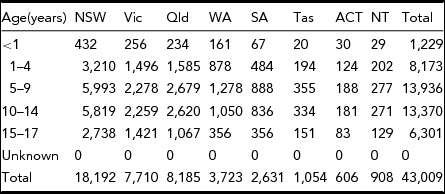
Reviewing Table 3 it can be seen that at 30th June 2014 there were 33,607 compulsory school aged children and young people in OOHC in Australia (AIHW, 2015). Children in most Australian states attend high school between the ages of 12 and 18 years. In 2010, the Australian government mandated that all children are expected to attend school until they are 17 years of age. High school in most Australian states starts in year 7 and ends with year 12 being the final year of school. All students must finish year 10, after which time they have three options; continue in education and training, be in full-time work or a combination of education and training. Children who wish to discontinue their schooling and not complete the last 2 years of school may enter the workforce or attend vocational training such as a Technical and Further Education (TAFE) college.
Children in out of home care, by age, states and territories, 30 June 2014 (AIHW, 2015).
To date, there has been no national data collection or reporting of the education outcomes for children in care. There has been research in the United Kingdom that reports that three quarters of children who leave care between the ages of 16 and 18 do so without any qualifications (Broad, Reference Broad1998; Fletcher-Campbell, Reference Fletcher-Campbell1997). In Australia, only 47% of children in state care proceeded in their education beyond year 10 and 35% completed year 12 compared to 55.3% of young people in the general population in that same year (Michell, Reference Michell2012).
Formalised government assistance from the state is only available until a child turns 18 years of age (Creed, Tilbury, Buys, & Crawford, Reference Creed, Tilbury, Buys and Crawford2011). Transitioning to independence may take longer than 18 years of age and may take some young people until 25 years of age (McDowall, Reference McDowall2009; Mendes, Reference Mendes2008). Some states in Australia are now starting to encourage care leavers to complete vocational education, with South Australia, Victoria and Western Australia recently charging no fees for care leavers who enrol in training courses at TAFE institutes (Beauchamp, Reference Beauchamp2014).
There has been limited research into OOHC children attending university in Australia. Children in OOHC are not considered an equity group and no data is collected on their access, retention or graduation rates from any higher education institution. McDowall surveyed 275 children between the ages of 15 and 18 years of age who were transitioning out of the care system and 196 individuals who were aged under 25 years who had already transitioned out of the care system (McDowall, Reference McDowall2012). The survey showed that only 35% of care leavers completed year 12, 11% undertook a TAFE course and 2.8% attended a higher education course. Of these children, 28.5% were unemployed. La Trobe University recently released a report which suggests a long-awaited and much needed framework to increase university access for children who were previously in the OOHC system—care leavers (Harvey, McNamara, Andrewartha, & Luckman, Reference Harvey, McNamara, Andrewartha and Luckman2015). Care leaver is a term often used to refer to children who have been in the OOHC system and now left due to being over 18 years of age.
Comparisons with General Population
ABS data shows, of the 3,694,101 children who were eligible to attend school between 2013 and 2014, 44% of these children attended a secondary school. Of the young people who were aged between 15 to 19 years, 82% were engaged in formal study (ABS, 2015). In 2014, the completion rate for NSW children in year 12 was 81%. This compares poorly with the care leavers who had a 35% completion rate. In 2015, Anglicare Victoria (2015) stated that in between January 2013 and January 2015, of the eligible school aged children in the Victorian OOHC system, 80.4% attended school full time, 21.3% have changed school in the last 12 months and 19.5% of children had been suspended (Anglicare, 2015). Earlier in the decade, Harvey found similar results with children in care scoring lower on standardised testing and frequently absent from school (Harvey, Reference Harvey2004).
In the past, teachers saw OOHC children as undesirable students (Toth, Reference Toth1997). Indeed, high achieving care leavers were often told by career advisors to aim low (Jackson & Martin, Reference Jackson and Martin1998). Social workers and guardians saw education as somebody else's business (Fletcher-Campbell & Hall, Reference Fletcher-Campbell and Hall1990). Children in care, themselves, believed that improvements in their education came because of encouragement and support provided by their care placements (Harker, Dobel-Ober, Lawrence, Berridge, & Sinclair, Reference Harker, Dobel-Ober, Lawrence, Berridge and Sinclair2003; Lynes & Goddard, Reference Lynes and Goddard1995).
Some authors believe that the fault of children to learn in the education system is due to the low priority given to education by social workers and case workers. Jackson and McParlin (Reference Jackson and McParlin2006) found children in care have their schooling disrupted numerous times due to placement changes, low expectations and lack of access to appropriate resources for study. Barriers to success in education for children in care include a lack of support from family and lack of additional support from the school (CREATE Foundation, 2006). Children in OOHC may have lower ideals placed on them and lower expectations to succeed. Lack of ambition does seem to be a problem with children in care (Creed et al., Reference Creed, Tilbury, Buys and Crawford2011).
Harvey et al. (Reference Harvey, McNamara, Andrewartha and Luckman2015), in a study undertaken of Australian public universities, found that most universities do not have any policy, support structure or specific procedure; with only two universities having recruitment policies or guidelines targeted, four universities were delivering outreach programs specifically aimed at care leavers and one university had a scholarship program aimed at care leavers. They recommend among many points a national framework for care leavers with consistent data collection across state and territories within Australia, legislation to assist care leavers after 18, formal state collaboration between the education sector and the child protection sector and bursaries for care leavers attending university (Harvey et al., Reference Harvey, McNamara, Andrewartha and Luckman2015).
Sacrifices and Life Issues
Children in OOHC may be being abused or neglected prior to entering the OOHC system. Once in the OOHC system they often undergo a number of placements within different accommodation settings, it is common for children to have up to four placements before they become settled (Jackson, Reference Jackson2001). These past and current events may impact on their everyday behaviours and expectations.
Every time a child changes families, they may also change schools; they need to build new friendships, leave belongings behind, change study routines and have a willingness to continue with life routines. Research findings indicate that while one or two changes may not have a significant impact on these children, multiple school transitions or attending more than four schools has a cumulative negative impact on their academic and behavioural functioning, which can lead to young people being unprepared for leaving care and lack skills in managing education as well as employment and other life preparatory skills (Mendes, Johnson, & Moslehuddin, Reference Mendes, Johnson and Moslehuddin2011).
Recruiting and retaining enough carers to manage the increasing number of children entering the OOHC system is a mammoth task. Finding carers who understand the education needs of children and have an understanding of the higher education system is even more difficult as they, themselves, may have no experience of attending higher education. A majority of care leavers credit their educational success to a well-informed foster care guardian or another adult that offered them support and encouragement (Jackson & Martin, Reference Jackson and Martin1998). The educational level of foster carers was the most important factor in enabling children in care to catch up with their peers academically (Heath, Colton, & Aldgate, Reference Heath, Colton and Aldgate1994). Children and young people in OOHC have experienced significant trauma due to abuse or neglect which may impact on their ability to learn and interact in socially appropriate ways. The NSW Parliament advises that these issues may manifest in poor academic performance, poor engagement with the school environment and with peers, and behavioural problems resulting in educational difficulties and exclusion. Poor transition experiences exacerbate disengagement and poor educational outcomes for children and young people (NSW Parliament, 2012).
Children in OOHC are a serious problem, hiding in the uncollected data frameworks within the Australian community. This may be because there is no national data collected on them and the problem is not identified. The problems we have identified are: OOHC numbers increasing; the average child in OOHC is moving home four times before settling in a long-term foster care environment, there is not enough availability of carer households and; the low rates of school completion.
What Information, Advice and Guidance is Available for Children in OOHC for their Education Options/Choices/Progress?
Universities across Australia via the University Admission Centre (UAC) have a special educational access scheme which enables applicants to outline their disadvantages when applying for university admission. This awards successful students with bonus entry points for university entrance schemes. The provisions relating to disadvantage include difficult home environment and disrupted schooling and would be appropriate for many children in OOHC or children who have left the care system (UAC, 2014). There are a limited number of scholarships available to children from OOHC across government and education providers. Many of the scholarships offered come under equity titled scholarships and would apply equally to different disadvantaged groups within the community. The University of Western Sydney (UWS) is one example where a scholarship is offered specifically for children in OOHC for $7500 per year with a maximum of 3 years’ payment being made to successful applicants to complete their studies, with smaller grants available for such items as text books or food vouchers (UWS, 2015a).
From Small Beginnings
In 2014, the UWS initiated a program working with OOHC children and NGOs in the care system. The program was funded through the Commonwealth Government's HEPPP funds. OOHC children are currently not considered an equity target group directly under the program; however, they do meet the overall aims of the program. The program's goals were to raise aspirations of OOHC children to attend higher education, create networks and develop trust within the OOHC system and, importantly, to advocate for the needs of OOHC children and young people in relation to higher education. Within the program a framework was developed that included an outreach and retention strategy for OOHC children and young people. Outreach within the strategy related to any work that was undertaken external to the university and retention applied to work completed within the University. In an outreach capacity UWS, like all other Australian universities, does not collect data on children who have previously been in the OOHC system; this specific information is only available to authorised organisations working in the field and, of course, is subject to data sharing protocols. Therefore, the university must work in partnership with government and third sector organisations working with OOHC young people. The program was also developed with the view to including current UWS student volunteers who had previously been in care, entry based on the students self-identifying their background. The program was designed to allow students to be trained as student ambassadors to assist on outreach programs and mentor current children in OOHC. Current UWS care leavers would also be offered support both academically, financially and emotionally if required. The ability to locate these students proved to be difficult and resource intensive, and continues to be a component of the OOHC business plan for further development by the University in 2015 (UWS, 2015b).
The access program proved to be more successful with full day “taster” university programs being offered to students in OOHC. A UWS taster day allows primary and high school aged students to experience the university campus, interact with current students and engage in educational programs that allow students to understand university concepts and terminology and have a fun, engaging learning experience. A weekly robotics program was offered to all children in OOHC living in Greater Western Sydney once a week during school terms. UWS collaborated with NGOs and attended training sessions, foster carer information sessions, conferences, camps and large picnic events to engage with families, staff and children on higher education concepts that would allow people the “permission” to start thinking of university not only as an option for children in OOHC, but begin to see UWS as a component of the child and families’ community. Permission has purposefully been used to describe the environment that was found when dealing with OOHC families and staff. Initially, many NGO staff struggled with the concept that university may be a viable option for children in OOHC; however, this was only temporary. Through its evaluation framework and program review practices UWS has been able to measure the OOHC program's effectiveness in 2014 (OWP, 2014). With the success of the programs, UWS now has been able to secure a large scholarship specifically for children in OOHC to assist young adults to complete their studies (UWS, 2015a). UWS has also employed a full time Care Co-ordinator to further develop these programs in 2015.
Conclusion
This paper has identified an issue that is well known to those who work in the sector, but remains neglected in terms of government responses and active initiatives on the part of the OOHC sector government staff.
Under our noses a vast number of young people are being discriminated against and not given a fair chance and the opportunities that other children claim as entitlements. Young people in OOHC are faced with many decisions around leaving care at the age when they should be looking at educational options (Jackson & Cameron, Reference Jackson and Cameron2014).
In observance of the COAG objectives on widening participation that apply to all children, youngsters who are in OOHC should be recognised as a special equity group and opportunities and extra support should be channelled to them via Federal government funds such as HEPP to balance social justice and fairness towards them to ensure they have the same opportunities as all other children. There is an old saying in management consultancy circles: “what gets measured gets done”; using this maxim, one solution to this serious equity problem is to record the size and progress of the education of OOHC children. There are two measures which could immediately highlight the issue and lead directly to mitigation or solution of the problem: OOHC children should be classified as an equity group under the Commonwealth HEPP program, and; universities should be required to collect commencement and retention data on children who have previously been in care.
This paper has identified a paucity of data that is available on the subject of OOHC children being given the opportunity to participate in further and higher education, therefore another potential solution is for further research to be carried out in this area (Harvey et al., Reference Harvey, McNamara, Andrewartha and Luckman2015). Once the research has established rigorous and robust evidence of the situation and the levels of disadvantage, this should be swiftly followed by practical information, advice, guidance and support for all stakeholders in the OOHC system, thereby engaging government, NGOs, charitable organisations, education professionals and children in the process of providing solutions. In addition, further collaboration, such as the highly successful Bridges to Higher Education program in Sydney (KPMG (Company), 2015), is required across universities and state government departments to include higher education as a real option for children in OOHC. Other practical measures already within the purview of universities to offer as solutions are: the creation of more scholarships specifically for young people who have been in care, and more work in retention programs to support young people who have left care or who are young carers while they are studying at university (Harvey et al., Reference Harvey, McNamara, Andrewartha and Luckman2015). The issue of discrimination against children in OOHC should be addressed immediately. The questions we should be asking are (i) why is there not more assistance for this disadvantaged group? and (ii) why are we not making this group of forgotten children a priority within our education systems and giving them a fair go?