Chiari malformation Type I (CM) is a clinical disorder with a prevalence rate six times that of multiple sclerosis (Anderson et al. Reference Anderson, Ellenberg, Leventhal, Rheingold, Rodriguez and Silberberg1992; Speer et al. Reference Speer, Enterline, Mehltretter, Hammock, Joseph, Dickerson, Ellenbogen, Milhorat, Hauser and George2003). In CM, volumetric reduction affecting the posterior cranial region can cause cerebellar tonsil descent and compression into the brainstem and upper cervical spine. CM patients may experience a variety of physical sensory or motor effects, and often present with severe headache and neck pain. Moreover, it has been demonstrated that during each cardiac cycle, a cerebrospinal fluid pressure wave can generate a fluid force analogous to a ‘water-hammer’ effect, thought to cause cervico-medullary compression (Shaffer et al. Reference Shaffer, Martin and Loth2011), potentially exacerbating pain.
In addition to the physical symptoms, compression-related sequelae may also impact higher order cognitive and affective systems. Certainly, disruption to the reciprocal connectivity between the cortex and brainstem–cerebellar regions can alter cognitive and emotional behavior (see Schmahmann, Reference Schmahmann2010; Magal, Reference Magal2013). However, pain (most notably chronic pain) can also significantly alter mood and attention, with deleterious effects on cognition (see Eccleston & Crombez, Reference Eccleston and Crombez1999). Indeed, previous research has established a negative relationship between chronic pain and cognitive performance in general (Moriarty et al. Reference Moriarty, McGuire and Finn2003), with researchers also exploring the influence of individual differences in psychological mechanisms on this relationship (e.g. Bosma & Kessels, Reference Bosma and Kessels2002). In particular, there is evidence that pain has a distracting effect on focused attention (e.g. attention to encoding and retrieving information in memory can be distracted by prepotent or anticipatory pain: Eccleston & Crombez, Reference Eccleston and Crombez1999).
Memory deficits in CM
Many CM patients report memory-related symptoms (e.g. 44% of CM patients report memory symptoms, Fischbein et al. Reference Fischbein, Saling, Marty, Kropp, Meeker, Amerine and Chyatte2015). Allen et al. (Reference Allen, Houston, Pollock, Buzzelli, Li, Harrington, Martin, Loth, Lien, Maleki and Luciano2014) previously found a statistical trend for memory deficits in CM patients (relative to age- and education-matched controls), although this effect was eliminated when Oswestry neck pain scores (a measure of head and neck pain disability) were statistically considered. Essentially, although small and underpowered (n = 24 patients), Allen et al. identified a relative memory deficit that was reduced in CM patients when self-reported pain levels were taken into account. Accordingly, the perception of pain appeared to compromise delayed recall.
Inasmuch as CM represents a condition with well-documented neurobehavioral sequelae (Luciano et al. Reference Luciano, Martin, Allen and Loth2014), and for which there is a common surgical treatment (i.e. decompression surgery), it offers a unique opportunity to consider the complex relationship between condition status (surgery v. no surgery), self-reported experience of pain, and select cognitive outcomes. Unlike the few previous studies of cognition in CM (Allen et al. Reference Allen, Houston, Pollock, Buzzelli, Li, Harrington, Martin, Loth, Lien, Maleki and Luciano2014; Lacy et al. Reference Lacy, Ellefson, DiDios-Stern and Frim2016), the current effort more specifically addresses the relationship between pain, attentional focus, and delayed recall in a substantially larger sample of CM patients.
Practically, recall memory can be compromised by inattentiveness or distraction (e.g. chronic pain) occurring at encoding and/or retrieval. Thus, to assess whether a recall memory weakness in CM was related to cognitive control deficits when attempting to encode or retrieve information, we included both immediate and delayed recall tasks. In this way, if delayed recall was compromised to a greater extent than immediate recall, this could support the notion that memory retrieval is influenced by a mechanism other than that which might simply impact encoding in CM. Therefore, in the present study we specifically assessed immediate and delayed recall performance while evaluating the degree to which individual differences in focused attention impacted the relationship between self-reported perceptions of chronic pain and objective measures of recall memory in CM patients.
A role for focused attention
Our inclusion of focused attention as an individual difference variable that might influence the relationship between pain and cognition is predicated, in part, on the previous work of Eccleston & Crombez (Reference Eccleston and Crombez1999) who provided evidence that chronic pain interrupts focused attention – thereby disrupting cognition. In addition, focused attention on pain is associated with higher perceived pain levels (Melzack & Wall, Reference Melzack and Wall1982; Nouwen et al. Reference Nouwen, Cloutier, Kappas, Warbrick and Sheffield2006), and increased attention to pain has been correlated with higher pain intensity, emotional distress, and psychosocial disability (McCracken, Reference McCracken1997).
We chose to assess individual differences in self-focused attention using two distinct aspects of private self-consciousness – or one's tendency to direct attention to inner aspects of oneself, such as thoughts, feelings, and bodily sensations (Trapnell & Campbell, Reference Trapnell and Campbell1999; DaSilveira et al. Reference DaSilveira, DeSouza and Gomes2015). The first of these, rumination, involves negative thoughts and feelings (e.g. regret, anxiety) and corresponds more closely with the Five Factor personality dimension of neuroticism (‘neurotic self-attentiveness’). The second, reflection, involves a more positive self-exploration that tends to be aligned with the personality dimension of openness to experience (‘intellectual self-attentiveness’; Trapnell & Campbell, Reference Trapnell and Campbell1999, p. 287). Previous research has emphasized the ability to train focused attention in order to help individuals regulate emotions – especially by focusing on positive rather than negative emotions (e.g. Wadlinger & Isaacowitz, Reference Wadlinger and Isaacowitz2011). In the present study, we assessed individual differences in reflection and rumination, believed to be differentially associated with dispositional tendencies in self-focused attention (i.e. rumination-negative; reflection-positive; Trapnell & Campbell, Reference Trapnell and Campbell1999).
Might focused attention alter memory?
Allen et al. (Reference Allen, Kaut, Lord, Hall, Bowie and Grabbe2005) previously tested a model of age differences in memory, demonstrating that individual differences in neuroticism mediated age differences in episodic memory such that elevated levels of (non-clinical) neuroticism in younger adults (i.e. relative to older adults) were associated with better episodic memory performance. Interestingly, higher levels of extraversion have also been associated with better memory performance among older adults (Allen et al. Reference Allen, Kaut, Baena, Lien and Ruthruff2011). Age-related alterations in the neural architecture of memory and emotion can impact cognition (for integrated models, see Damasio, Reference Damasio1994; Bechara et al. Reference Bechara, Damasio, Damasio and Lee1999), yet the findings of Allen et al. (Reference Allen, Kaut, Lord, Hall, Bowie and Grabbe2005, Reference Allen, Kaut, Baena, Lien and Ruthruff2011) reinforce the expectation that individual differences in personality factors (e.g. extraversion) strongly associated with different dimensions of self-focused attention (e.g. reflection) might impact recall memory.
Exner et al. (Reference Exner, Martin and Rief2009) observed that higher levels of rumination diminished memory performance among individuals diagnosed with obsessive–compulsive disorder; alternatively, Beaty et al. (Reference Beaty, Kaufman, Benedek, Jung, Kenett, Jauk, Neubauer and Silvia2016) reported that reflection was positively associated with default network activation levels and better memory performance. Therefore, it is suggested that increases in reflection (associated with a positive dispositional style) will facilitate memory, and increases in rumination (associated with a negative dispositional proclivity) will impair memory.
Results are somewhat mixed regarding the degree to which rumination levels improve (Allen et al. Reference Allen, Kaut, Lord, Hall, Bowie and Grabbe2005) or impair (Exner et al. Reference Exner, Martin and Rief2009) memory. As mentioned, Exner et al. (Reference Exner, Martin and Rief2009) reported a disruption for individuals diagnosed with obsessive–compulsive disorder, whereas the Allen et al. (Reference Allen, Kaut, Lord, Hall, Bowie and Grabbe2005) findings of memory improvement among healthy younger adults (with higher levels of neuroticism) suggested a potential interaction between clinical status and individual differences in affective disposition on relevant cognitive outcomes.
In the present study, we specifically examined chronic pain patients, and hypothesized that the clinical experience of pain, combined with individual differences in emotion-laden variations in self-focused attention (rumination v. reflection) would uniquely impact memory. In particular, we were interested in the degree to which self-reported levels of pain influenced cognitive task performance (e.g. processing to-be-remembered information), and whether individual differences in personality variables associated with self-focused attention helped individuals better cope with pain-related distraction, thereby leading to improved memory.
Predictions
We predicted that CM patients would have poorer recall than healthy non-patient controls, and that individuals higher in reflection would have better delayed-recall memory performance than their low-reflection counterparts. Given that more ruminative persons tend to experience more negative thoughts and feelings (Trapnell & Campbell, Reference Trapnell and Campbell1999), we also hypothesized that they might be more distractible by pain, which could therefore undermine recall memory. Finally, given that Garcia et al. (unpublished observations) found that non-decompressed CM patients had higher depression, anxiety, and stress levels than decompressed CM patients, we predicted that surgical status would moderate the effect of pain on recall performance.
Methods
Ethics statement
The research reported in the present study was approved by the University of Akron Institutional Review Board, and all participants provided written informed consent.
Participants
The data in the present study were collected via a web-based survey. These data are part of the Chiari 1000. For the present study, we included 638 adult participants’ data who were diagnosed with CM (18 years and older, mean age = 38.1 years, 34% had attended college) and who completed the McGill Pain Questionnaire-Short Form-Revised (SF-MPQ-2, Dworkin et al. Reference Dworkin, Turk, Revicki, Harding, Coyne, Peirce-Sandner, Bhagwat, Everton, Burke, Cowan, Farrar, Hertz, Maxi, Rappaport and Melzack2009), the Rey Auditory Verbal Learning Task (RAVLT, Schmidt, Reference Schmidt1996), and the Rumination-Reflection Questionnaire (RRQ, Trapnell & Campbell, Reference Trapnell and Campbell1999). Of these 638 participants, 341 had undergone posterior cranial fossa decompression surgery (self-reported mean age of diagnosis = 31.85 years, range = 1–64 years of age: self-reported time since last decompression surgery = 4.99 years, range = 1–39 years), whereas 297 had not undergone decompression surgery (self-report mean age of diagnosis = 34.5 years, range = 7–63 years). A subset of these participants provided structural MRI scans used for diagnosis to the Chiari 1000 database. For individuals who had undergone decompression surgery, 121/341 participants had available MRIs, and for non-decompressed individuals, 132/297 participants had available MRIs. Following Houston et al. (Reference Houston, Eppelheimer, Pahlavian, Biswas, Urbizu, Martin, Bapuraj, Luciano, Allen and Lothin press), we assessed midsagittal tonsillar herniation in the subsample with available MRIs. Both groups exceeded the 5 mm herniation necessary for a diagnosis of CM. However, the decompressed sample showed significantly more tonsillar herniation (mean = 9.53 mm) than did the non-decompressed sample (mean = 7.01 mm), t(251) = 3.96, p < 0.001. We also included a convenience sample of 102 healthy control participants (mean age = 46.8 years) who had been tested in previous research (Baena et al. Reference Baena, Allen, Kaut and Hall2010; Allen et al. Reference Allen, Kaut, Baena, Lien and Ruthruff2011) using the immediate recall portion of the RAVLT.
Measures
The SF-MPQ-2 (Dworkin et al. Reference Dworkin, Turk, Revicki, Harding, Coyne, Peirce-Sandner, Bhagwat, Everton, Burke, Cowan, Farrar, Hertz, Maxi, Rappaport and Melzack2009) is the most widely used self-report pain questionnaire. This 22-item measure uses a Likert format to assess pain (i.e. 0 = none to 10 = worst possible) yielding four subscales (i.e. continuous, intermittent, neuropathic, and affective pain) and a total pain score. The scale demonstrates good internal consistency with α reliabilities ranging between 0.73 and 0.89 for the specific scales, and 0.91 and 0.94, respectively, for the total pain score (Dworkin et al. Reference Dworkin, Turk, Revicki, Harding, Coyne, Peirce-Sandner, Bhagwat, Everton, Burke, Cowan, Farrar, Hertz, Maxi, Rappaport and Melzack2009; Tokar et al. unpublished observations). The SF-MPQ-2 total pain index was used instead of the Oswestry neck pain index (i.e. an index of functional disability) because functional disability tends to be an indirect measure of pain, whereas the SF-MPQ-2 provides a more direct self-report of experienced pain.
The RAVLT (Schmidt, Reference Schmidt1996) consists of a list of 15 words that are administered orally, one at a time. In the traditional RAVLT, there are five learning trials followed by a recognition trial and a subsequent delayed-recall trial (Trial 7). Trial 1 is assumed to be an index of short-term memory, and Trial 7 an indicator of delayed recall (Lezak et al. Reference Lezak, Howieson and Loring2004). To accommodate the web-based methods used in the present study, we presented each of the items visually on the screen (i.e. 2 s per word) followed immediately by a prompt for participants to type as many of the previously presented words as possible. Delayed recall was assessed with the same instructions, but after an approximately 30-min retention interval (i.e. during which participants filled out a series of additional questionnaires). The number of correctly recalled (typed) words was recorded to measure immediate and delayed recall performance.
The RRQ is a 24-item test measuring rumination (12 items) and reflection (12 items) (Trapnell & Campbell, Reference Trapnell and Campbell1999). Each item is rated from 1 (strongly disagree) to 5 (strongly agree). This test demonstrated good internal consistency with α reliabilities of 0.91 for reflection and 0.90 for rumination.
Results
First, we compared the immediate recall performance (RAVLT, Trial 1, delayed recall data were not available for the control sample) of all 638 CM patients with that of a convenience sample of 102 previously assessed (Baena et al. Reference Baena, Allen, Kaut and Hall2010; Allen et al. Reference Allen, Houston, Pollock, Buzzelli, Li, Harrington, Martin, Loth, Lien, Maleki and Luciano2014) healthy controls with no neurological diagnoses. Controls were significantly older, on average (mean age = 46.8 years), than the CM patients. Between-group analysis revealed significant group differences in immediate recall, t(738) = −4.27, p < 0.001 (M CM = 5.96 words, M Control = 6.93 words), with the healthy control group recalling significantly more (15%) words than the CM group.
Next, we further examined recall memory, but limited our analyses to CM patients alone (i.e. a split-half technique was used for all categorical-dependent variables except for age). Two separate 2 (surgical status: decompressed and non-decompressed) × 2 (continuous pain levels derived from the SF-MPQ-2: high v. low) × 2 (RRQ reflection: high v. low) × 2 (RRQ rumination: high v. low) × 2 (age: younger = under 40 years of age, older = 40 years of age, or older) mixed analyses of variance (ANOVA) were conducted on the immediate and delayed recall data.
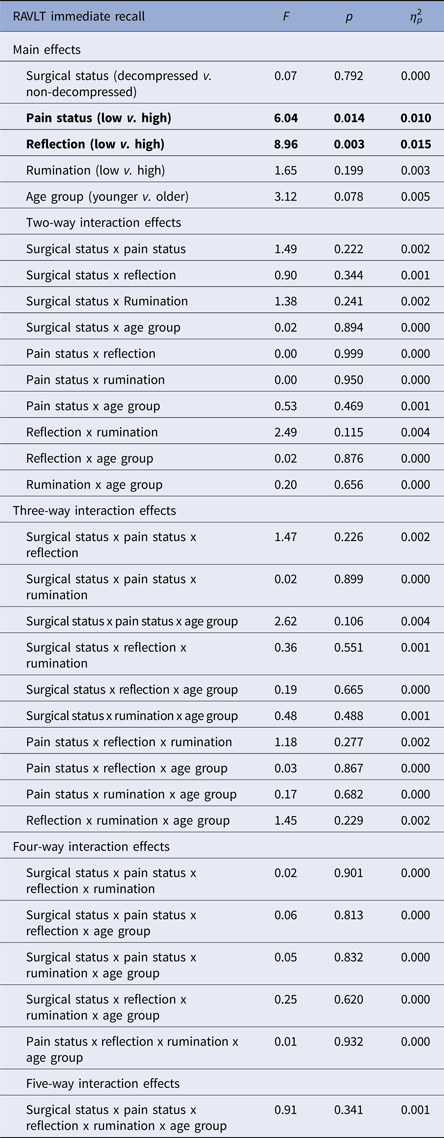
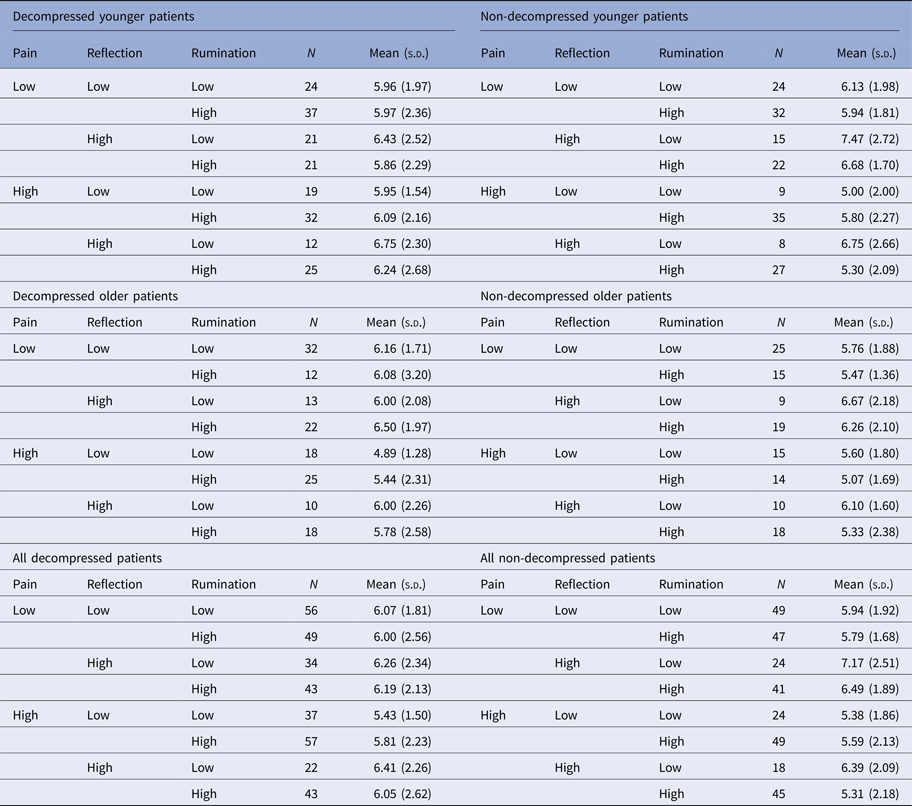
On the measure of immediate recall (see Table 1 for statistical results and Table 2 for conditional means), higher reflection status appeared to enhance performance (mean recall: low reflection = 5.79 words, high reflection = 6.19 words), whereas the higher self-reported pain group showed diminished recall (SF-MPQ-2 total pain category: low = 6.16 words, high = 5.79 words). No interactions for immediate recall reached statistical significance (all ps > 0.05).
Results of the mixed ANOVA conducted on RAVLT immediate recall performance

The bold highlight reflects the two significant effects.
Conditional means for pain, reflection, and rumination groupings for immediate recall by decompression status

Note. Groupings were determined as follows: pain (SF-MPQ-2) – low=, high=; reflection (RRQ) – low=, high=; rumination (RRQ) – low=, high=; age – low<40, high⩾40.
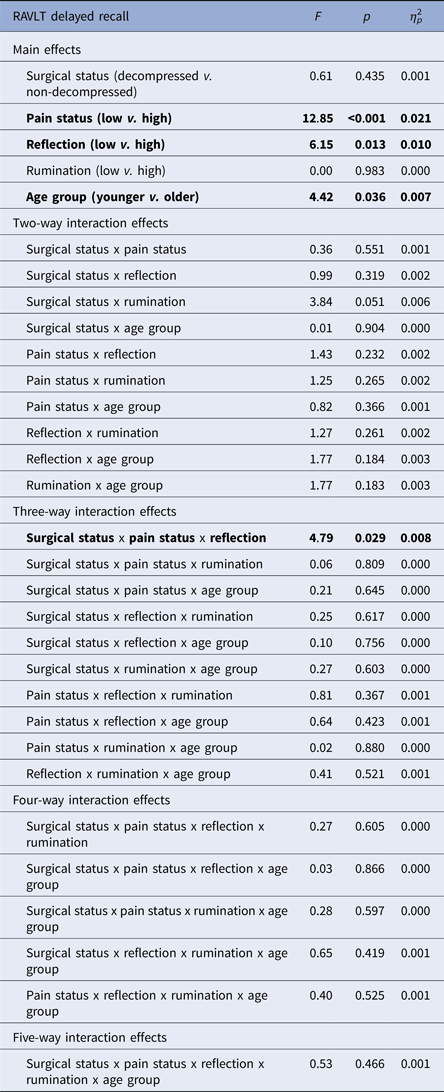
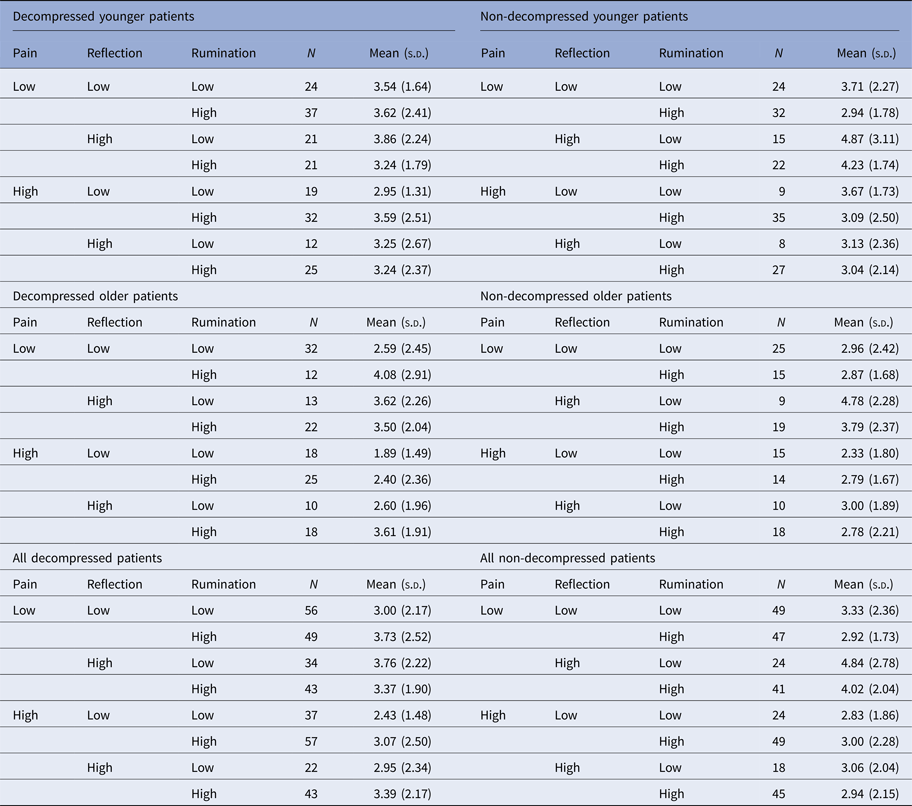
For delayed recall (see Table 3 for statistical results and Table 4 for conditional means), we again observed a significant benefit of higher reflection status (mean delayed recall: low reflection = 3.07 words, high reflection = 3.53 words), and further noted a deleterious effect for self-reported pain status (total pain category: low = 3.51 words, high = 2.98 words). It was also noted that delayed recall was significantly better among younger adults (mean = 3.46 words recalled) compared with older adults (mean = 3.01 words recalled).
Results of the mixed ANOVA conducted on the RAVLT delayed recall performance

The bold highlight reflects the two significant effects.
Conditional means for pain, reflection, and rumination groupings for delayed recall by decompression status

Note. Groupings were determined as follows: pain (SF-MPQ-2) – low=, high=; reflection (RRQ) – low=, high=; rumination (RRQ) – low=, high=; age – low< 0, high⩾40.
The above reported main effects for delayed recall were qualified by a significant surgical status x reflection x pain interaction (see Fig. 1). To interpret this three-way interaction, we assessed simple effects separately by surgical status. Among non-decompressed subjects, the simple effect of reflection x pain was significant (p = 0.02). Mean recall was best for those with high reflection scores and low pain status (mean = 4.32 words), whereas high self-reported pain and high reflection (mean = 2.97), high pain and low reflection (mean = 2.95), and low pain and low reflection (mean = 3.12) showed lower recall. For participants having previously undergone decompression surgery, there was no reflection x pain interaction (p = 0.65) (low reflection: high pain = 2.82, low pain = 3.34; high reflection: high pain = 3.25, low pain = 3.55).
Number of words recalled for delayed recall as a function of reflection type (high v. low), pain level (high v. low), and surgical status (decompressed v. non-decompressed).

Of particular importance here, and reinforced by the data in Fig. 1, non-decompressed individuals reporting lower levels of pain and higher levels of reflection demonstrated significantly higher delayed recall than for any of the other three conditions.
Discussion
We assessed group differences in immediate and delayed recall between a large sample of CM patients (N = 638) and a group of previously assessed healthy controls (N = 102). Further, we examined relationships between total pain, memory (RAVLT, Trials 1 and 7, immediate recall and delayed recall, respectively), reflection and rumination, and age (younger v. older adults) in individuals diagnosed with CM.
Memory and Chiari malformation
Individuals diagnosed with CM showed poorer RAVLT (Trial 1) immediate recall performance, recalling 15% fewer words than healthy controls. These results are in contrast with those of Allen et al. (Reference Allen, Houston, Pollock, Buzzelli, Li, Harrington, Martin, Loth, Lien, Maleki and Luciano2014), who, in a small sample, found mixed evidence for CM deficits in memory for immediate recall. Nevertheless, the current finding is of particular interest inasmuch as this underscores a relative cognitive reduction in a clinical sample that previously has received minimal attention. Presumably, and in the context of the present correlational methods, pain-based distraction (e.g. Eccleston & Crombez, Reference Eccleston and Crombez1999) appears to impact early encoding and/or later retrieval mechanisms. This contention merits further investigation; however, the current findings add to a growing body of literature reporting cognitive deficits in persons with CM (see Allen et al. Reference Allen, Houston, Pollock, Buzzelli, Li, Harrington, Martin, Loth, Lien, Maleki and Luciano2014; Fischbein et al. Reference Fischbein, Saling, Marty, Kropp, Meeker, Amerine and Chyatte2015; Lacy et al. Reference Lacy, Ellefson, DiDios-Stern and Frim2016).
Another interest given the design of this study, our intended comparison between CM patients who had undergone decompression surgery compared to those who had not received this surgery, failed to identify overall group differences in recall performance. One might have anticipated a relative decrement for non-decompressed participants, expecting higher levels of self-reported pain that might compromise attention and/or memory. On the contrary, pain levels did not differ between the groups. As such, it is possible that CM, as a chronic condition in which patients might be symptomatic for many years before surgery, may have altered fiber-tract integrity in a manner that could affect memory (Kumar et al. Reference Kumar, Rathore, Srivastava, Yadav, Behari and Gupta2011). Another possibility suggested by the subset of CM participants with available MRIs was that, prior to surgery, the decompressed participants had more severe neuropathology (9.53 mm of tonsillar herniation) than did non-decompressed participants (7.01 mm). Perhaps decompression surgery attenuated cervicomedullary crowding, thereby minimizing neural sequelae and eliminating any differences in overall memory performance and pain reported here.
Finally, with regard to basic memory effects, in all CM patients (N = 638), delayed recall performance was poorer in individuals 40 years of age or older (compared with those younger than 40). Because CM was typically not as readily diagnosed until the wider availability of MRIs (e.g. the late 1980s), most CM patients tend to be younger. The present sample ranged from 18 to 74 years of age, but most of the participants were under 60. This raises a potentially important question about the relationship between cognitive function and increased adult age in CM relative to the general population. CM may very well exacerbate the typical negative effect of aging on cognition. Future research is needed to answer this question.
Moderation effects for rumination and reflection
A key dimension in the framing of the current study was the potential moderating effect of personality disposition on the relationship between the self-reported experience of pain and the corollary effect on memory. Arguably, a correlational study of this nature – in itself – has limited causal applications, and any suggestion of direct and/or modulatory influences must be offered cautiously. Nevertheless, our theoretical approach and empirical outcomes to the question of CM and memory are consistent with the extensive literature in humans and animals indicating that chronic pain can negatively impact cognition (e.g. Eccleston & Crombez, Reference Eccleston and Crombez1999; Berryman et al. Reference Berryman, Stanton, Bowering, Tabor, McFarlane and Moseley2013; Cardoso-Cruz et al. Reference Cardoso-Cruz, Sousa, Vieira, Lima and Galhardo2013), and that this situation can be potentially aggravated by focusing attention on pain (i.e. which increases pain; Melzack & Wall, Reference Melzack and Wall1982; McCracken, Reference McCracken1997; Nouwen et al. Reference Nouwen, Cloutier, Kappas, Warbrick and Sheffield2006). Furthermore, it is recognized that reflection is associated with improved memory (Beaty et al. Reference Beaty, Kaufman, Benedek, Jung, Kenett, Jauk, Neubauer and Silvia2016), but rumination may undermine memory performance for individuals with unresolved pain or even prepotent distraction (e.g. Exner et al. Reference Exner, Martin and Rief2009).
The main effect of reflection on recall memory is of particular interest here, suggesting that a reflective disposition might be an important determinant in cognitive performance given the contextual backdrop (e.g. pain, medical complications, treatment strategies) shared among those with a clinical diagnosis of CM. More importantly, our obtained interaction between pain levels and reflection levels significantly added to the prediction of recall memory. In particular, and selectively among those in the non-decompressed group, lower levels of pain (SF-MPQ-2, Dworkin et al. Reference Dworkin, Turk, Revicki, Harding, Coyne, Peirce-Sandner, Bhagwat, Everton, Burke, Cowan, Farrar, Hertz, Maxi, Rappaport and Melzack2009) and higher levels of reflection were associated with significantly better delayed recall performance relative to lower levels of reflection (an effect not occurring for immediate recall).
One intriguing result was the finding that surgical status itself moderated the interaction between pain and reflection. That is, non-decompressed individuals who self-reported lower pain scores and higher levels of reflection showed better delayed recall. It is worth emphasizing that this was observed only for the non-decompressed participants. It is possible that patients who have undergone a decompression procedure may have had a history of more severe symptoms or physical/cognitive compromise which could persist in impacting cognitive performance when comparing decompressed and non-decompressed groups (Luciano et al. Reference Luciano, Martin, Allen and Loth2014). In response to this possibility, we report no main effect of surgical status on immediate or delayed recall, thereby diminishing the likelihood that mere surgical status would be a differentiating factor in memory performance. Moreover, in further exploring the potential for group differences as a function of surgical status, we examined correlations between surgical status and SF-MPQ-2 total pain level (r = 0.05, p = 0.25), as well as surgical status and functional disability (Oswestry neck pain disability index, Fairbanks et al. Reference Fairbanks, Couper, Davies and O'Brien1980) (r = 0.06, p = 0.11). It appears that decompressed CM patients in the present study did not have more severe symptoms than non-decompressed CM patients – so the surgery itself cannot account for the obtained interaction among surgical status, reported pain levels, and reflection.
We also examined the possibility that age at diagnosis and time-since-decompression-surgery were related to levels of immediate and delayed recall, and reflection scores. We did so by correlating immediate and delayed recall, reflection, SF-MPQ-2 total pain scores, and functional disability with age of diagnosis and time since the last decompression surgery. Age of diagnosis (full sample: N = 638) was correlated with delayed recall (r = −0.11, p = 0.006) and surgical status (decompressed v. non-decompressed) (r = −0.12, p = 0.003). Next, separate analyses were conducted for decompressed and non-decompressed participants. For decompressed CM participants, age of diagnosis was correlated with delayed recall (r = −0.13, p = 0.018), but this correlation was not significant for the non-decompressed group (r = −0.09, p = 0.11). For just decompressed patients, we correlated these same variables with time-since-surgery. The only significant correlation was between time-since-surgery and functional disability (r = −0.12, p = 0.033). Because reflection and pain did not correlate with either age of CM diagnosis or time-since-decompression-surgery, it does not appear that the observed interaction for pain, delayed recall, and reflection is confounded by age of diagnosis or time since surgery. However, as age of diagnosis increases for decompressed (but not non-decompressed) CM individuals, delayed recall decreases. Future research is needed to examine this issue.
As the retention interval between immediate and delayed recall was contingent upon questionnaire completion rather than a fixed time, there was some variability in the length of the retention interval. Thus, we correlated delayed recall performance with retention interval (r = −0.25, p < 0.001). To test whether the retention interval duration affected the three-way interaction observed for delayed recall, we conducted an analysis of covariance to statistically control for differences in retention interval across participants (delayed recall still served as the dependent variable, and the same five independent variables were used). The adjusted surgical status x reflection level x pain level interaction remained significant, F(1, 605) = 5.17, p = 0.02.
Understanding the effects of surgical status
The interaction regarding surgical status is statistically unique and of potential applied value in establishing a model for future research. One possibility is that the pain x reflection simple-effect interaction among non-decompressed respondents could be a manifestation of something analogous to an expectancy effect (similar to a placebo effect; Walsh et al. Reference Walsh, Seidman, Sysko and Gould2002).
Alternatively, it is reasonable to assume that non-decompressed individuals might have avoided surgical decompression due merely to less severe symptomology. Accordingly, among those who report lower pain (i.e. reduced condition severity; less need for medications), their higher reflective style might be associated with more optimal cognitive performance.
Implications and limitations
These results may have implications for chronic pain, in general – not just for CM patients. That is, individuals with stronger attentional focusing abilities (as indexed by RRQ reflection) are likely better able to inhibit the deleterious effects of pain on memory. This may be an important aspect of resilience. One possibility is that therapeutic interventions such as acceptance and commitment therapy (ACT: Veehof et al. Reference Veehof, Trompetter, Bohlmeijer and Schreurs2016) might additionally help chronic pain patients with even higher levels of pain to focus their attention away from chronic pain (and toward other functions such as memory).
It is important to underscore that the present study was conducted using data from a web-based survey and not patient medical records. While the larger sample size afforded by this approach may increase sensitivity/power, it may also introduce biases. Our subset analyses based on tonsillar herniation derived from structural MRIs suggested that both non-decompressed and decompressed CM patients possessed the hallmark anatomical characteristic of CM – tonsillar herniation of 5 mm, or greater. However, self-reported dates of diagnosis and time of surgery may not be as accurate as medical reports. Without medical records, we also do not know potentially important reasons for why surgery was, or was not conducted. Finally, without medical records details such as the specific type of decompression surgery (e.g. craniectomy only, or craniectomy with duraplasty and even tonsillar resection, see Doberstein et al. Reference Doberstein, Torabi and Klinge2017) are not known.
Another limitation of the present study is that the present design does not allow us to distinguish between cognitive effects due to pain and cognitive effects due to other factors – such as cerebellar cognitive affective syndrome (Schmahmann & Sherman, Reference Schmahmann and Sherman1998; Schmahmann, Reference Schmahmann2004). What we do know in the present study, though, is that increased pain was associated with poorer delayed recall. Future CM research is needed to carefully distinguish between cognitive effects due to fiber-tract damage in the cerebellum (cerebellar cognitive affective syndrome) and to indirect effects of pain (e.g. distraction) on cognition.
Given the aforementioned cautions, one interpretation of the results presented here is that individual differences in reflection and SF-MPQ-2 total pain jointly affect CM patients’ ability to retrieve information from long-term memory (i.e. delayed recall). Essentially, the joint effect of high self-reported pain levels and low levels of reflection appear to prevent non-decompressed CM patients from retrieving RAVLT items from long-term memory, but do not seem to interfere substantively with short-term memory.
As a caveat, the finding that higher levels of reflection improved delayed recall among those with lower self-reported pain levels – but only for the non-decompressed participants – suggests that CM with cervico-medullary compression might increase central sensitization (i.e. above the level of the foramen magnum), thereby resulting in a neurocognitive phenomenon analogous to increased ‘gain control’ in non-decompressed CM patients. Indeed, future investigations into the gradual recruitment of executive-level processes (e.g. modular gains in reflective tendencies; focused attention; anticipatory vigilance) in response to the challenges of somatic or psycho-social symptoms (e.g. pain; distraction; diminished arousal) among those not selecting a surgical solution would be of particular interest.
This hypothesized expectancy/gain effect might account for the three-way interaction reported here: Most notably, among non-decompressed participants, particularly those establishing or otherwise accentuating a more reflective cognitive style, physical and/or emotional symptomology might be attenuated in conjunction with improved performance on proxies of cognitive ability (e.g. memory). Indeed, the potential to integrate methods of neuroimaging and electrophysiology with neuropsychological appraisal offers unique opportunities to evaluate the underlying assumptions of the perspective offered here. Reduced neocortical activation, consequent to compression-related ascending fiber integrity or thalamocortical dimunition, could gradually sensitize or elevate (through mechanisms of plasticity) a more flexible and adaptive cortical system.
Conclusions
CM is a condition that has received considerable attention with regard to structural and fluid mechanic characteristics associated with the diagnosis (Shaffer et al. Reference Shaffer, Martin and Loth2011; Luciano et al. Reference Luciano, Martin, Allen and Loth2014; Houston et al. Reference Houston, Eppelheimer, Pahlavian, Biswas, Urbizu, Martin, Bapuraj, Luciano, Allen and Lothin press), but much less emphasis has been given to the possible affective and cognitive sequelae (but see Allen et al. Reference Allen, Houston, Pollock, Buzzelli, Li, Harrington, Martin, Loth, Lien, Maleki and Luciano2014; Lacy et al. Reference Lacy, Ellefson, DiDios-Stern and Frim2016; Garcia et al. unpublished observations). While Allen et al. (Reference Allen, Houston, Pollock, Buzzelli, Li, Harrington, Martin, Loth, Lien, Maleki and Luciano2014) observed executive function deficits in CM patients after controlling for the effect of functional disability due to pain; the present study illustrates the impact that pain has on recall memory – and the potential moderating effects of reflection and surgical status. It appears that chronic pain in CM either distracts focused attention away from memory processes, or that pain draws attentional capacity away from memory retrieval. Note that we are not suggesting that reflection ‘explains away’ the significance of chronic pain in CM. To the contrary, we hope to use the personality variable of reflection to better understand chronic pain (e.g. by assessing the efficacy of ACT interventions in CM). Developing the ability to use executive control/focused attention to concentrate on other everyday tasks (such as memory) and inhibit the prepotent ‘siren call’ of pain is crucial for successfully coping with chronic pain. Finally, the present results suggest that screening chronic pain patients for individual differences in reflection might be clinically useful – and that expectancy effects in surgical procedures may be present.