INTRODUCTION
Parkinson’s disease (PD) is characterized by motor manifestations that reflect, at least in part, pathological loss of dopaminergic neurons in regions of the ventral midbrain. While PD is traditionally thought of as primarily a motor disease, emphasis has also been placed on the cognitive sequelae that can accompany the disorder, as dopamine dysregulation can have significant effects on those aspects of cognition that depend on an intact dopaminergic system. One brain region with significant dopaminergic innervation is the prefrontal cortex, and research has consistently demonstrated PD-related impairments in processes thought to rely on this area, such as executive functioning. Source memory, or memory for context, is also thought to be frontally dependent but has received very little attention in the PD literature. The current study examined source memory and executive functioning in individuals with PD.
PD and Cognition
The dopamine dysregulation implicated in the pathophysiology of PD is thought to result from a loss of pigmented cells in the ventral midbrain, resulting in dopaminergic hypofunction in efferent pathways, most notably the nigrostriatal pathway connecting the substantia nigra to the striatum. The striatum projects to mesolimbic and mesocortical areas via striato-thalamo-cortical circuits, and one particular circuit with significant implications for cognitive functioning links the dorsolateral prefrontal cortex (DLPFC) and the dorsolateral head of the caudate (Alexander et al., Reference Alexander, Delong and Strick1986). Given this connectivity between the striatum and the DLPFC, it is not surprising that PD-related dysfunction in the striatum can lead to impairments in those cognitive processes dependent on the DLPFC, namely, executive functioning (Mega et al., Reference Mega, Cummings and Jeffrey1994; Rinne et al., Reference Rinne, Portin, Ruottinen, Nurmi, Bergman, Haaparanta and Solin2000). Studies have found a range of executive functioning deficits in individuals with PD, including working memory (Farina et al., Reference Farina, Gattellaro, Pomati, Magni, Perretti, Cannata, Nichelli and Mariani2000; Owen et al., Reference Owen, James, Leigh, Summers, Marsden, Quinn, Lange and Robbins1992; Owen et al., Reference Owen, Sahakian, Hodges, Summers, Polkey and Robbins1995; Postle et al., Reference Postle, Jonides, Smith, Corkin and Growdon1997), planning and problem-solving ability (Culbertson et al., 2004; Hanes et al., 1996; Lewis et al., 2003;), verbal fluency (Azuma et al., Reference Azuma, Cruz, Bayles, Tomoeda and Montgomery2003; Green et al., 2002; Gurd, 1995; Hanes et al., 1996; Stefanova et al., Reference Stefanova, Kostic, Ziropadja, Ocic and Markovic2001), and set-shifting (Bondi et al., Reference Bondi, Kaszniak, Bayles and Vance1993; Dirksen et al., Reference Dirksen, Howard, Cronin-Golomb and Oscar-Berman2006; Farina et al., Reference Farina, Gattellaro, Pomati, Magni, Perretti, Cannata, Nichelli and Mariani2000; Green et al., 2002; Hayes et al., Reference Hayes, Davidson, Keele and Rafal1998; Lange et al., 1992; Owen et al., Reference Owen, James, Leigh, Summers, Marsden, Quinn, Lange and Robbins1992; Stamenovic et al., Reference Stamenovic, Djuric, Jolic, Zivadinovic and Djuric2004), although findings of frontal deficits have not been entirely consistent (Farina et al., Reference Farina, Gattellaro, Pomati, Magni, Perretti, Cannata, Nichelli and Mariani2000; Gabrieli et al., Reference Gabrieli, Singh, Stebbins and Goetz1996; Levin et al., 1989; Rogers et al., Reference Rogers, Sahakian, Hodges, Polkey, Kennard and Robbins1998), possibly due to heterogeneity in samples. It has been suggested that these executive functioning deficits are direct effects of dopamine dysregulation, and neuroimaging studies using both PD and nonclinical populations have linked markers of dopamine and functional activation in both the striatum and the prefrontal cortex to performance on executive functioning tasks (Backman et al., Reference Backman, Ginovart, Dixon, Wahlin, Wahlin, Halldin and Farde2000; Brück et al., Reference Brück, Portin, Lindell, Laihinen, Bergman, Haaparanta, Solin and Rinne2001; Cropley et al., Reference Cropley, Fujita, Innis and Nathan2006; Lewis et al., 2003; Marie et al., Reference Marie, Barre, Dupuy, Viader, Defer and Baron1999; Rinne et al., Reference Rinne, Portin, Ruottinen, Nurmi, Bergman, Haaparanta and Solin2000; Sawamoto et al., Reference Sawamoto, Piccini, Hotton, Pavese, Thielemans and Brooks2008; van Beilen et al., Reference van Beilen, Portman, Kiers, Maguire, Kaasinen, Koning, Prium and Leenders2008; Volkow et al., Reference Volkow, Gur, Wang, Fowler, Moberg, Ding, Hitzemann, Smith and Logan1998). Further implicating the dopamine system in executive functioning, dopaminergic medication in the form of l-dopa or dopamine agonists has been shown to improve executive functioning performance (Beato et al., Reference Beato, Levy, Pillon, Vidal, du Montcel and Deweer2008; Brusa et al., Reference Brusa, Bassi and Pierantozzi2002; Costa et al., Reference Costa, Peppe, Dell’Agnello, Carlesimo, Murri, Bonuccelli and Caltagirone2003; Costa et al., Reference Costa, Peppe, Brusa, Caltagirone, Gatto and Carlesimo2008; Gotham et al., 1988; Hamel & Riklan, 1975; Lange et al., 1992; Lange et al., 1995; Luciana et al., Reference Luciana, Collins and Depue1998; Owen et al., Reference Owen, Sahakian, Hodges, Summers, Polkey and Robbins1995).
Source Memory and PD
One area of cognitive functioning that has received little attention in the PD literature is source memory. Source memory is thought of as memory for the characteristics of the specific conditions or context under which a memory is acquired. It has been suggested that context retrieval is related to the integrity of the frontal lobes, more specifically the DLPFC, as has been demonstrated by studies using lesion evidence, neuropsychological data, and neuroimaging (Craik et al., Reference Craik, Morris, Morris and Loewen1990; Dobbins et al., Reference Dobbins, Simons and Schacter2004; Glisky et al., 1995, 2001; Nolde et al., Reference Nolde, Johnson and D’Esposito1998; Trott et al., Reference Trott, Friedman, Ritter, Fabiani and Snodgrass1999).
Based on the frontal nature of the dopamine dysregulation and cognitive impairments found in PD, individuals with PD should presumably also show deficits in source memory. Previous studies have found associations between source memory and executive functioning in healthy older adults. Craik et al. (Reference Craik, Morris, Morris and Loewen1990) demonstrated that source memory correlated with measures of verbal fluency and the Wisconsin Card Sorting Test (WCST). Glisky et al. (1995, 2001) have demonstrated that performance on a source memory task is predicted by performance on a composite measure of tests thought to assess frontal functioning. A frontal composite score was calculated based on five executive functioning tasks thought to be related to the self-initiation of integrative encoding in working memory: the WCST, a test of mental arithmetic, backwards digit span (BDS), verbal fluency, and a test of mental control. PD-related impairments have been demonstrated on most of these tasks (Azuma et al., Reference Azuma, Cruz, Bayles, Tomoeda and Montgomery2003; Bondi et al., Reference Bondi, Kaszniak, Bayles and Vance1993; Farina et al., Reference Farina, Gattellaro, Pomati, Magni, Perretti, Cannata, Nichelli and Mariani2000; Green et al., 2002; Gurd, 1995; Hanes et al., 1996; Lange et al., 1992; Levin et al., 1989; Lewis et al., Reference Lewis, Slabosz, Robbins, Barker and Owen2005; Rinne et al., Reference Rinne, Portin, Ruottinen, Nurmi, Bergman, Haaparanta and Solin2000; Stamenovic et al., Reference Stamenovic, Djuric, Jolic, Zivadinovic and Djuric2004; Stefanova et al., Reference Stefanova, Kostic, Ziropadja, Ocic and Markovic2001), and it has been suggested that these executive functioning tasks tap similar processes as those used in source memory. Thus, it was hypothesized that PD patients who show impairments on these executive functioning tasks should also demonstrate an impairment in source memory.
The Current Study
Despite the burgeoning research on frontal functioning in PD, few published studies have specifically examined source memory in PD. Taylor et al. (Reference Taylor, Saint-Cyr and Lang1990) used a two-list learning task to examine source memory in a group of unmedicated PD patients. Imbedded in a delayed recognition task, participants were asked to judge whether words came from a first list heard five times or a second list heard only once. The authors demonstrated a PD-related source memory deficit in list localization. However, presenting the lists an unequal number of times should have led to list differences in levels of familiarity, which is an automatic feeling of recognition in the absence of specific recollection (Jacoby, Reference Jacoby1991). Thus, source memory judgments in this task could be based on levels of familiarity rather than the actual memory for the source of the stimulus. Given that PD patients may have impairments in familiarity processes (Davidson et al., Reference Davidson, Anaki, Saint-Cyr, Chow and Moscovitch2006), it is unclear whether poor performance on this task stemmed from a deficit in source memory or familiarity.
Hsieh and Lee (1999) examined different types of source monitoring in a group of medicated PD patients by manipulating the external and internal nature of the source of the to-be-remembered information. PD patients were impaired only in the more difficult manipulation when asked to discriminate between two internal sources, and the authors suggested that the lack of discriminability between these sources resulted in source impairments for the PD patients. However, these authors increased the distinctiveness of the external–external condition by having participants both hear male and female speakers and see pictures of the speakers, making this an easier task by increasing the discriminability of the two sources. It is possible that with less contextual cues (i.e., just the sound of a male or a female voice), patients may show impairments in discriminating between two external sources. In addition, the patients in this study were tested while in a medicated state, which may mask some of the cognitive deficits associated with the disease (Lange et al., 1992). The current study examined executive functioning and source memory in individuals with PD in an unmedicated state, eliminating medication status as a confounding factor and actually using it as a variable of interest. The current study used a source memory recall test for voices, eliminating possible effects of familiarity. It was expected that PD patient would demonstrate deficits in source memory and executive functioning compared to a healthy control group. Moreover, it was hypothesized that source memory would be negatively affected by medication withdrawal in the PD group.
METHODS
Participants
Twenty-six individuals diagnosed with PD were recruited for the study via advertisements and referrals from physicians and other researchers. Of these 26 individuals, 2 were unable to complete the study (1 fell asleep repeatedly during the study session and 1 reported that she guessed randomly at all the answers), and thus, data from 24 patients were used in the analyses. Patients were excluded from the study if they had received surgical treatment for PD or received a PD diagnosis before the age of 50. All patients in the PD group had previously received a diagnosis of PD from their physician and were taking some form of dopaminergic medication (i.e., l-dopa or dopamine agonists). Inclusion criteria limited disease severity to mild-to-moderate levels (i.e., Hoehn and Yahr Stages 1–3; Hoehn & Yahr, Reference Hoehn and Yahr1967) in order to limit the heterogeneity of the patient sample and reduce the possibility of dementia. Of the 24 PD patients, 10 met Hoehn and Yahr criteria for Stage 1 or 1.5, 13 for Stage 2 or 2.5, and 1 for Stage 3. The age of the PD patients ranged from 56 to 80 years (M = 69.04, SD = 7.42), with education levels ranging from a high school diploma to a doctoral degree (M = 16.58 years, SD = 2.86). Average age at diagnosis was 64.62 years (SD = 8.05). Depression was not included as an exclusionary criterion, as depression can be a secondary result of underlying dopamine pathology and excluding for depression could possibly have reduced the power to examine cognitive functions associated with dopamine dysregulation. One PD patient reported a previous diagnosis of depression and was taking some form of an antidepressant.
Twenty-four control participants were recruited from a university community and matched to each patient on sex, age, and education level. Mean age of control participants was 68.67 years (SD = 8.34), with a mean education level of 17.08 (SD = 3.03). Paired-samples t tests revealed no significant differences between the PD and the control groups in age, t(23) = 0.70, p = ns, or education, t(23) = −1.2, p = ns. Two control participants reported a history of depression and were currently taking antidepressants. Both individuals reported being stable on medication for at least 6 months and did not currently meet criteria for depression based on their responses on the Geriatric Depression Scale (GDS).
Exclusion criteria for both groups included dementia [Mini-Mental State Exam (MMSE) score < 26], a history of traumatic brain injury or neurological disorder other than PD, medications believed to affect cognitive function (e.g., anticholinergics), a history of alcohol or drug dependence, or a psychiatric disorder other than depression. One PD patient and two control participants reported a previous diagnosis of depression and were taking some form of an antidepressant. These three participants reported that their depression was stable on antidepressants and were not currently depressed.
Materials
The MMSE was administered to exclude for dementia, and the GDS was given to assess depression. Sections II (activities of daily living) and III (motor examination) from the United Parkinson’s Disease Rating Scale (UPDRS) were used to determine Hoehn and Yahr disease stage and symptom severity.
Neuropsychological tasks
A set of five neuropsychological tests traditionally associated with frontal functioning was administered: the FAS verbal fluency task (FAS), the modified Wisconsin Card Sorting Test (mWCST), BDS and Mental Control from the Wechsler Memory Scale-III, and Mental Arithmetic from the Wechsler Adult Intelligence Scale–Revised. This composite was previously used by Glisky et al. (2001) and found to correlate to source memory in healthy older adults. Mean scores for each hand on the finger tapping test (FTT) and estimates of premorbid intellectual functioning based on the North American Adult Reading Test (NAART) were also obtained.
A composite frontal factor score (FFAC) was computed from the raw scores on the BDS, Mental Control, and Mental Arithmetic; categories achieved on the mWCST; and total words produced on the FAS. The raw scores from these tests were converted to z-scores based on the sample of 48 patients and controls, and an FFAC score was computed for each participant by averaging their z-scores on the five tests. For more detail on the use of this frontal composite, refer to Glisky et al. (1995, 2001).
Memory tasks
A total of 132 neutral sentences were used for the memory tasks, taken from Cook (Reference Cook2007). Each sentence was recorded by both a female and a male speaker. Six lists of 20 sentences were formed along with a list of 12 sentences serving as practice and buffer items.
For the source memory study task, participants heard sentences spoken by a male and a female voice. They were instructed to rate each sentence on how likely it would be that the sentence would be heard on the radio, using a Likert-scale rating from 1 to 5. They were told that they would be tested afterward on whether the male or the female spoke each sentence and two practice sentences were given. The 20 sentences were presented aurally in randomized order, with 2 sentences added at both the beginning and the end of the list to serve as primacy and recency buffers. For each study list, half of the sentences were spoken by the male and half by the female. The study list was presented twice, with the 20 sentences presented in a different random order each time. After the study presentation, participants were given the source test. Each sentence was displayed at the top of the screen, and participants were asked to decide whether the male or the female spoke that sentence by pressing the “M” or “F” key. Two practice sentences were given, and the test was self-paced.
For the item memory study task, participants heard sentences spoken by one male voice. Presentation of the item study lists was identical to that of the source study lists, except that all sentences were presented in a male voice. The participants were told that a memory test would be given later, which would require them to recognize the sentences they just heard. After the item study presentation, participants were given a two-alternative forced-choice test. Two sentences were displayed on the screen, labeled “A” and “B.” Participants were asked to decide which sentence they heard and to respond by pressing either the “A” or the “B” button on the keyboard. Half of the previously heard sentences were presented as Sentence A and half were presented as Sentence B. The test was self-paced. The source and item memory tasks were presented on a laptop screen using DMDX software (Forster & Forster, Reference Forster and Forster2003).
Six counterbalancing conditions were created such that across participants, each of the three lists served as the item study list, item distractor list, and source study list, and that for the source study list, each sentence was spoken by both the male and the female speaker. The order of the source and item tasks was counterbalanced across participants. Each PD patient and his or her matched control received the same counterbalancing condition and source/item sequence. Participants completed the source and item tasks a total of two times across two sessions and heard a new, nonoverlapping set of sentences each session.
Procedure
PD patients were asked to come to the laboratory for two sessions, scheduled at the same time of day, at least 1 day apart. For one visit, patients were asked to abstain from their PD-related medication for a period of at least 12 hours (the off-medication session). The average withdrawal period was 14.88 hours, with a range of 12–21 hours. For the on-medication session, patients were asked to take their medication as normal. The sequencing of the on-/off-medication sessions was counterbalanced across subjects. The motor examination of the UPDRS, FTT, and memory tests was given during both sessions. During the off-medication session, patients also completed the MMSE, the GDS, and the neuropsychological battery.
Control participants also came to the laboratory for two sessions, scheduled at the same time of day, at least 1 day apart. Each session was assigned to be either “on-medication” or “off-medication,” as determined by the sequence that was assigned to their corresponding PD patient. This was done for matching purposes, but no changes in their normal medication regimen were made. Control participants completed the same tests in the on- and off-medication sessions as the PD patients, with the exception of the UPDRS, which was not administered to control participants. All data were collected in compliance with human subjects regulations.
RESULTS
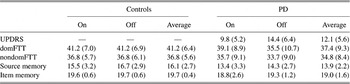
There were no significant differences in premorbid intelligence (as measured by the NAART) or mental status (as measured by the MMSE) between the groups, t(23) = −0.45, t(23) = −0.70. The PD group endorsed significantly more depressive symptoms than the control group, t(23) = 3.28, p = .003. Seven PD patients and no control participants met criteria for mild or moderate depression (i.e., GDS > 10). Within the PD group, a paired-samples t test indicated a significant difference between on- and off-medication conditions on the UPDRS motor exam, t(23) = −7.07, p < .001. As expected, UPDRS scores were lower in the on-medication condition (M = 9.83, SD = 5.23) compared to the off-medication condition (M = 14.38, SD = 6.36), indicating that motor symptoms improved with medication administration.
Memory Effects
In order to examine whether the effects of medication on cognitive and motor performance in PD patients were significantly different than fluctuations that normally arise in repeated testing, three univariate analyses of variance were conducted with group (PD/control) as the between-subject factor; medication status (on/off) as the within-subject factor; and source memory, item memory, and FTT scores each as the dependent variable. Table 1 displays these raw scores separated by group and medication status. There was a significant interaction between group and medication status for dominant FTT scores, F(1,46) = 4.11, p = .048, ή = .08, as scores improved with medication in the PD group, t(23) = 2.58, p = .02, but not in the control group. There were no group-by-medication interactions for source memory, item memory, or nondominant FTT. There was a main effect of group on source memory, F(1,46) = 9.466, p = .004, ή
 = .17, as the PD group performed significantly worse than the control group. Item memory performance did not differ significantly between the PD group and the control group, F(1,46) = 3.347, p = .07, ή
 = .07. A specific PD-related impairment in source memory but not item memory was further illustrated by a significant interaction in a repeated measures analysis of variance with group (PD/control) as the between-subject factor and memory test (item/source) as the within-subject factor, F(1,46) = 5.25, p = .03.
Mean (SD) scores for patients and controls on memory and motor tests on- and off-medication

Notes
Source and item memory scores represent raw scores out of a possible 20. domFTT, dominant finger tapping; nondomFTT, nondominant finger tapping.
Neuropsychological Effects
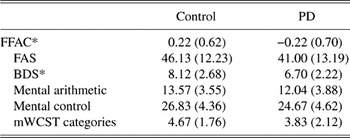
The means and standard deviations for the PD group (off-medication) and the control group on each of the neuropsychological measures are presented in Table 2. Paired-samples t tests indicated that the PD group performed significantly worse on FFAC, t(23) = −2.67, p = .01, and dominant FTT, t(23) = −2.39, p = .03. Within the FFAC subtests, only group differences on the BDS were significant, t(23) = −2.11, p = .046, as the PD group performed worse than the control group. However, examining the subtest scores, the patient group consistently scored lower than the control group on each subtest.
Neuropsychological data and memory scores for patients and controls

* p < .05.
Correlational Analyses
Scores on the GDS did not correlate to either source memory or the FFAC in the PD group (r = −.23, ns; r = −.31, ns), the control group (r = .25, ns; r = .27, ns), or the combined group (r = −.21, ns; r = −.26, ns), suggesting that depression did not account for any group differences in cognition. NAART IQ scores were positively correlated with the FFAC in the PD group (r = .57, p = .004), the control group (r = .50, p = .02), and also the combined group (r = .49, p = .001). However, when NAART scores were entered as a covariate in an analysis of covariance, the main effect of group on FFAC scores remained significant, F(1,46) = 6.42, p = .02, ή = .13.
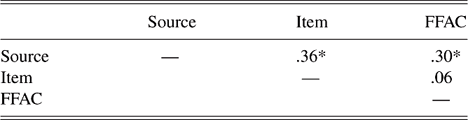
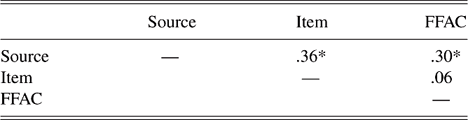
Correlations between source memory, item memory, and the FFAC for all 48 participants are presented in Table 3. Because source and item memory scores were not affected by medication status in the PD group, “on” and “off” medication memory scores were averaged for all participants to form averaged memory scores for the correlational analyses. A correlational analysis with all participants demonstrated that source memory was significantly correlated with item memory (r = .36, p = .01), but within the groups, the correlation was significant within the PD group (r = .40, p = .05) but not within the control group (r = .18, ns). However, when one outlier who scored extremely low on both memory tasks was removed from the PD group analysis, this correlation was no longer significant, r = .33, p = .13 (removing this outlier from between-group comparisons did not affect the results).
Correlations among the FFAC and memory scores for all participants
* p < .05.
Of particular interest were the correlations between source memory and the FFAC. In the combined group of 48 individuals, the FFAC was modestly correlated to source memory, r = .30, p = .03. However, within each of the two groups, this correlation failed to reach significance (r = .07, p = .76 for the PD group and r = .31, p = .15 for the control group). When group status was entered into a regression equation with the FFAC, the FFAC no longer accounted for a significant portion of source memory variance (p = .20). Group membership was the only significant predictor for source memory, accounting for 12% of the variance in source memory. Thus, the overall correlation between FFAC and source memory appears to be driven by group differences. Specifically, the below-average scores in both tasks are predominantly contributed by individuals in the PD group.
Within the PD group, UPDRS scores were negatively correlated to both dominant and nondominant FTT scores in both medication conditions (all ps < .01). Neither FTT scores nor any measure of disease severity (i.e., UPDRS scores, years since diagnosis, or Hoehn and Yahr stage) was significantly correlated with any of the cognitive measures.
DISCUSSION
As expected, PD patients demonstrated deficits on a composite measure of executive function, replicating previous findings and adding to the growing literature on PD-related frontal dysfunction. While a dopaminergic basis is possible given previous findings specifically linking dopamine to several of the tasks comprising the composite, this cannot be confirmed in the present study as this hypothesis was not directly tested. Of note, patients demonstrated significantly impaired performance on only one of the individual subtests, suggesting that executive functioning deficits can be subtle at the individual test level. However, a composite measure of frontal functioning was sufficiently sensitive to demonstrate executive dysfunction that might have otherwise been overlooked, illustrating the utility of using such a measure.
The current study also extends previous findings of disease-related frontal deficits to include source memory, an area that has received little attention in the literature. As hypothesized, PD patients demonstrated impairments in source memory. This source memory deficit was demonstrated fairly consistently across 18 of the 24 matched patient–control pairs. This source memory deficit can have important implications, as the ability to connect a memory event to its context has been associated with other cognitive processes. For example, poor source memory can lead to increased interference in working memory (Hedden & Park, 2001), false recognition (Piguet et al., Reference Piguet, Connally, Krendl, Huot and Corkin2008), cryptomnesia (Brown & Halliday, Reference Brown and Halliday1991; Marsh & Bower, Reference Marsh and Bower1993), and an overreliance on stereotypes during recollection (Dodson et al., Reference Dodson, Darragh and Williams2008).
A previous study by Hsieh and Lee (1999) found that a sample of medicated PD patients only demonstrated deficits on a difficult source memory task requiring discrimination between two internally generated sources. The authors hypothesized that the ability to monitor sources was dependent on the distinctiveness of the cues, and thus, patients only demonstrated deficits on those tasks where insufficient perceptual cues were provided. They argued that presenting voices of different genders in an external source task provided enough perceptual detail for accurate contextual discrimination. The current findings suggest that patients can in fact demonstrate impairments in discriminating between perceptually distinct sources. One difference between this study and the previous study is that the external source task was more difficult in the current study, as less perceptual detail was provided. PD patients were impaired in both source memory and executive functioning, although executive functioning did not predict source memory performance within the PD group.
Depression can have significant effects on cognitive functions relying on the frontal lobes, such as executive functioning. The link between depression and source memory is more tenuous, as to our knowledge, only one study has demonstrated a relation between depression and source memory (Degl’Innocenti & Backman, Reference Degl’Innocenti and Backman1999). In the current study, the PD group endorsed significantly more depressed symptoms than the control group, raising the possibility that PD-related source memory and executive functioning deficits may be due, in part, to the negative effects of depression. However, GDS scores were not significantly correlated with either source memory or executive functioning, suggesting that depression cannot account for the PD-related cognitive deficits demonstrated in the current study.
Source Memory and Dopamine
The current study implemented a medication withdrawal period to examine source memory independent of possible medication effects, an important manipulation, given previous findings that dopaminergic medication can have significant effects on cognition. Source memory was tested both on- and off-medication; however, medication withdrawal did not affect source memory despite having significant effects on motor abilities, as equivalent source memory impairments were observed in patients both on- and off-medication. It may be that cognitive tasks are less sensitive to phasic dopamine changes than are motor tasks, possibly related to the greater severity of dopamine depletion in motor versus cognitive areas (e.g., the putamen and caudate, respectively). The results are consistent with previous studies that have demonstrated no effect of medication administration on cognitive tasks, suggesting the possibility of involvement from other neurotransmitter systems (Brusa et al., Reference Brusa, Bassi and Pierantozzi2002; Brusa et al., Reference Brusa, Tiraboschi, Koch, Peppe, Pierantozzi, Ruggieri and Stanzione2005; Lange et al., 1992; Lange et al., 1993). However, it may also be that heterogeneity in dopaminergic medication across subjects and a relatively short withdrawal period may have masked potential medication effects in the current study. A study directly measuring markers of dopamine (such as a positron emission tomography study) would be beneficial in better elucidating the role of dopamine in source memory deficits in PD.
Source Memory and Executive Functioning
FFAC scores correlated with source memory in the combined group of patients and controls. However, regression analyses demonstrated that this correlation was driven by group differences, as the PD group demonstrated impairments in both measures. Within both the PD and the control groups, FFAC scores did not predict source memory as was expected based on previous findings in healthy older adults. While the increased psychometric reliability obtained from using a composite measure increased statistical power, the study may have still been underpowered due to a relatively small sample size. However, previous research by Cook (Reference Cook2007) using the same source memory and frontal measures and a sample size of 24 individuals demonstrated an association between source memory and the FFAC in healthy older adults. Based on these findings, it was expected that this relation would be replicated with our sample, at least in the control group. However, one statistical confound in the current study was the uneven distribution of scores in both groups (i.e., 16 of the 24 patients and 8 of the 24 controls scored below the mean). If executive functioning predicted source memory scores, as would be expected based on previous research, it is likely that uneven group distributions precluded any significant correlations.
In conclusion, source memory and a composite measure of frontal functioning were impaired in a group of individuals with PD. While medication withdrawal did not affect source memory, future studies using more direct measures of neurophysiology (e.g., neuroimaging) may help elucidate the functional changes that may underlie these disease-related cognitive changes. Source memory impairments can have important implications for everyday memory functioning, and the current study extends the sparse literature on source memory in PD to demonstrate that individuals with PD demonstrate source memory impairments disproportionate to memory for content.
ACKNOWLEDGMENTS
This work was supported by National Research Service Award 5F31MH071994-03 to L.L.D. The authors thank the participants for their willingness to participate and Mr. Donald Hitko for his help with organizing participant recruitment. This article is based on a doctoral dissertation by L.L.D.