INTRODUCTION
The heteronemertean Baseodiscus hemprichii (Ehrenberg, Reference Ehrenberg, Hemprich and Ehrenberg1831), in the family Valenciniidae (or Baseodiscidae), is one of the few species of nemerteans that is reliably identifiable by only the external appearance even after preservation, due to the characteristic body coloration and pattern (Kajihara & Kato, Reference Kajihara and Kato2009). This species is widely distributed in the tropical to temperate Indo-Pacific region, from the Red Sea to Easter Island (Gibson, Reference Gibson1995; Boyko, Reference Boyko2001). In Japanese waters, it has been reported from Nakanoshima, Tokara Islands (Iwata, Reference Iwata1954a), Shirahama (Iwata, Reference Iwata1954b), Hachijōjima (Iwata, Reference Iwata, Okada and Uchida1960), Amami-Ōshima (Ooishi, Reference Ooishi1964), Tanegashima (Kajihara, Reference Kajihara and Go2001) and Okinawa (Kajihara, Reference Kajihara and Go2005) (Figure 1).
Map of Japan and surrounding areas, showing localities from which Baseodiscus hemprichii (Ehrenberg, Reference Ehrenberg, Hemprich and Ehrenberg1831) has been recorded: Nakanoshima (Iwata, Reference Iwata1954a), Shirahama (Iwata, Reference Iwata1954b), Hachijōjima (Iwata, Reference Iwata, Okada and Uchida1960), Amami-Ōshima (Ooishi, Reference Ooishi1964), Tanegashima (Kajihara, Reference Kajihara and Go2001), Okinawa (Kajihara, Reference Kajihara and Go2005) and Tateyama (present study); Takakura (Reference Takakura1898) did not report B. hemprichii from Misaki (insert).

During a marine course for undergraduate students conducted by the Marine and Coastal Research Center (MCRC), Ochanomizu University, Tateyama, Japan, a specimen of B. hemprichii was collected, which extends the northern boundary of the species' distribution by about 1°18′ in latitude. In this paper, we briefly describe the specimen and discuss its implications with respect to warming ocean temperatures.
MATERIALS AND METHODS
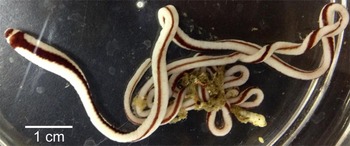
The specimen (Figure 2) was collected intertidally on a rocky shore at Okinoshima Park, Tateyama (34°59′N 139°29′E), Japan, on 15 March 2013. It was photographed alive and then fixed in 10% formalin–seawater and deposited in the Hokkaido University Museum with the catalogue number ZIHU 4400.
Baseodiscus hemprichii (Ehrenberg, Reference Ehrenberg, Hemprich and Ehrenberg1831), ZIHU 4400: photograph taken in life.

RESULTS
Baseodiscus hemprichii (Ehrenberg, Reference Ehrenberg, Hemprich and Ehrenberg1831)
(Figure 2)
The specimen's tail was lost during collection. In life, the anterior fragment of the body measured 24 cm long by 5 mm in maximum width. The body has a white basement colour and dark chestnut markings tinged with purple, including a cephalic patch covering the dorsal surface of the head, a mid-dorsal stripe, and a mid-ventral stripe. The anterior end of the mid-dorsal stripe extends laterally, nearly reaching the mouth on the ventral side; the mid-ventral stripe commences from just behind the mouth. The colour pattern of our specimen thus resembles that illustrated by Gibson (Reference Gibson1979, figure 5A, 5a); the coloration did not significantly change after fixation. Numerous, small, black-pigmented ocelli are distributed along the lateral margin of the head; these are also recognizable in the preserved state.
DISCUSSION
The occurrence of Baseodiscus hemprichii at Tateyama indicates a possible northward expansion of the species' distribution during the last few decades. The large size of our specimen (>24 cm long) and its occurrence in March indicate that it had survived at least one winter, implying a sustainable population in Tateyama, rather than an episodic migration event. The previous northern-most record of B. hemprichii was a specimen collected in 1950 at Tōshima (33°41′N 135°20′E), a small island near Seto Marine Biological Station, Shirahama, Japan (Iwata, Reference Iwata1954b). While we cannot completely rule out the possibility that a population of B. hemprichii has existed at Tateyama for the past few decades, we regard this as unlikely. Staff and students at the MCRC surveyed marine animals at Tateyama, mostly in the vicinity of the marine centre, from 1969 to 1975 (Anon., 1973; Watanabe, Reference Watanabe1975) and detected 15 species of nemerteans, including the congener Baseodiscus curtus (Hubrecht, Reference Hubrecht1879), but not the distinctively coloured B. hemprichii. Much earlier, at the end of the 19th Century, Professor Usamaro Takakura extensively studied the nemertean fauna at Misaki (Kajihara, Reference Kajihara2004, Reference Kajihara2007), about 28 km from Tateyama (Figure 1). Takakura (Reference Takakura1898) reported 21 species of anoplan nemerteans from Misaki, including Baseodiscus curtus and Baseodiscus sp. [possibly B. antillensis (Bürger, Reference Bürger1895) or B. delineatus (Delle Chiaje, Reference Delle Chiaje1825)], under the names Eupolia curta and Eupolia sp., respectively, but not B. hemprichii. This suggests that B. hemprichii did not occur at Misaki in the 1890s, and strengthens the case that this species did not occur around the Boso Peninsula until recently.
Although nothing is known about the larval biology of B. hemprichii, members of the Pilidiophora clade (Thollesson & Norenburg, Reference Thollesson and Norenburg2003), which also includes species in Baseodiscus (Andrade et al., Reference Andrade, Strand, Schwartz, Chen, Kajihara, von Döhren, Sun, Junoy, Thiel, Norenburg, Turbeville, Giribet and Sundberg2012), typically produce a planktotrophic pilidium larva. Planktotrophic larvae generally spend a relatively long period in the water column; Maslakova (Reference Maslakova2010) reported that the pilidium larvae of the heteronemertean Micrura alaskensis Coe, Reference Coe1901 mostly reached metamorphosis after 5–8 weeks of development. The warm Kuroshio Current flowing south to north along the Pacific coast of Japan (and a branch of this current flowing south to north in the Sea of Japan) potentially transport long-lived planktotrophic larvae northward. The northern distributional limits of intertidal and littoral marine invertebrate species, however, will depend on the latitudinal sea-surface temperature gradient and the species' tolerance to low temperature. For example, sea-surface temperature in winter is a major limiting factor in the distribution of corals (Veron & Minchin, Reference Veron and Minchin1992).
Sea-surface temperature around Japan has risen in the last 100 years, e.g. +1.5°C at Shirahama and +1.1°C at Tateyama (Takatsuki et al., Reference Takatsuki, Kuragano, Shiga, Bungi, Inoue, Fujiwara and Ariyoshi2007). Based on records spanning 80 years in Japanese temperate areas, Yamano et al. (Reference Yamano, Sugihara and Nomura2011) reported a northward range expansion of tropical reef corals at rates up to 14 km/year, although it happened within the Sino-Japanese Province (Briggs & Bowen, Reference Briggs and Bowen2012). The northern limit of the staghorn coral Acropora solitaryensis Veron & Wallace, Reference Veron and Wallace1984, for example, was the Kushimoto–Shirahama area in 1965–1977, but had moved northward to Tateyama by 1999–2010. We consider the apparent northward range extension of B. hemprichii to Tateyama likewise to be an effect of rising sea-surface temperature and expect that additional tropical species will be found to show similar shifts northward.
ACKNOWLEDGEMENTS
We thank Dr Masato Kiyomoto (MCRC) and Dr Hiroshi Namikawa (National Museum of Nature and Science, Tsukuba) for organizing the Open Marine Course of Biology, held 13–18 March 2013 at the MCRC. L.Y. thanks Dr Masato Hirose (International Coastal Research Center, Atmosphere and Ocean Research Institute, University of Tokyo) for guidance in the field, and all the participants in the marine course for their support in both the field and the laboratory. We are grateful to Professor Matthew H. Dick (Hokkaido University) for his critical comments on an earlier version of the manuscript and improving the original English text.