Introduction
The genus Colutea L. (Fabaceae), commonly known as bladder senna, is composed of about 28 deciduous species (Mabberley, Reference Mabberley2008) found in southern Europe, northeastern and eastern Africa, and western and Central Asia (Browicz, Reference Browicz1963a, Reference Browicz, Tutin, Heywood, Burgess, Valentine, Walters and Webb1968; Krüssmann, Reference Krüssmann1984; Mabberley, Reference Mabberley2008). The species are currently classified into five sections: Colutea (consisting of four subsections), Multiflora Browicz, Rostrata Browicz (consisting of two subsections), Armata Browicz and Oreophysa Bunge ex Boiss. (Boissier, Reference Boissier1872; Browicz, Reference Browicz1963a). The infrageneric groups found in Iran are Colutea sect. Colutea subsect. Colutea and subsect. Graciles Browicz, Colutea sect. Rostrata subsect. Centralasiaticeae Browicz, Colutea sect. Armata, and Colutea sect. Oreophysa (Boissier, Reference Boissier1872; Browicz, Reference Browicz1963a, Reference Browicz1984; Kazempour Osaloo et al., Reference Kazempour Osaloo, Kazemi Nooreini, Maassoumi and Rastegar Pouyani2006). The genus includes nine species in Iran, five of which are endemic to the country (Boissier, Reference Boissier1872; Browicz, Reference Browicz1984; Kazempour Osaloo et al., Reference Kazempour Osaloo, Kazemi Nooreini, Maassoumi and Rastegar Pouyani2006; Ghahremaninejad & Ghahremani, Reference Ghahremaninejad and Ghahremani2008).
The identification, classification and subdivision of Colutea species has always been challenging and difficult as the species tend to be very similar, especially those with the same flower colour. The delimitation of sections, subsections and species in Colutea has largely been based on the following characters: spinescence of shoots; the shape of the top of the keel; pubescence of ovary; shape and length of wings; colour and length of flowers; number of flowers in inflorescence; length of calyx teeth and kind of incisions between them; number of leaflet pairs; size and shape of leaflets; pubescence of leaflets; arrangement of leaves; pattern of bark peeling; termination of fruit apex; length of fruit stipe; and colour of calyx hairs (Browicz, Reference Browicz1963a; Krüssmann, Reference Krüssmann1984).
Browicz (Reference Browicz1984), in the last comprehensive study on the genus in Iran, recorded 13 species of Colutea from the Iranian plateau, of which seven are known from the country of Iran. From the surrounding countries, 13 Colutea species were recorded by Shaparenko (Reference Shaparenko and Komarov1946) in the Flora of the USSR, four of which are known from Iran, and four species were recorded by Davis (Reference Davis1970) in the Flora of Turkey, one of which is also in Iran. The latter, Colutea cilicica, is also recorded from Greece (Browicz, Reference Browicz, Tutin, Heywood, Burgess, Valentine, Walters and Webb1968). Since the account in Flora Iranica (Browicz, Reference Browicz1984) a molecular taxonomic study has shown that Oreophysa microphylla (Jaub. & Spach) Browicz should be included in Colutea as C. triphylla (Kazempour Osaloo et al., Reference Kazempour Osaloo, Kazemi Nooreini, Maassoumi and Rastegar Pouyani2006). In addition, Ghahremaninejad & Ghahremani (Reference Ghahremaninejad and Ghahremani2008) have recorded Colutea komarovii from the Arasbaran protected region in western Iran.
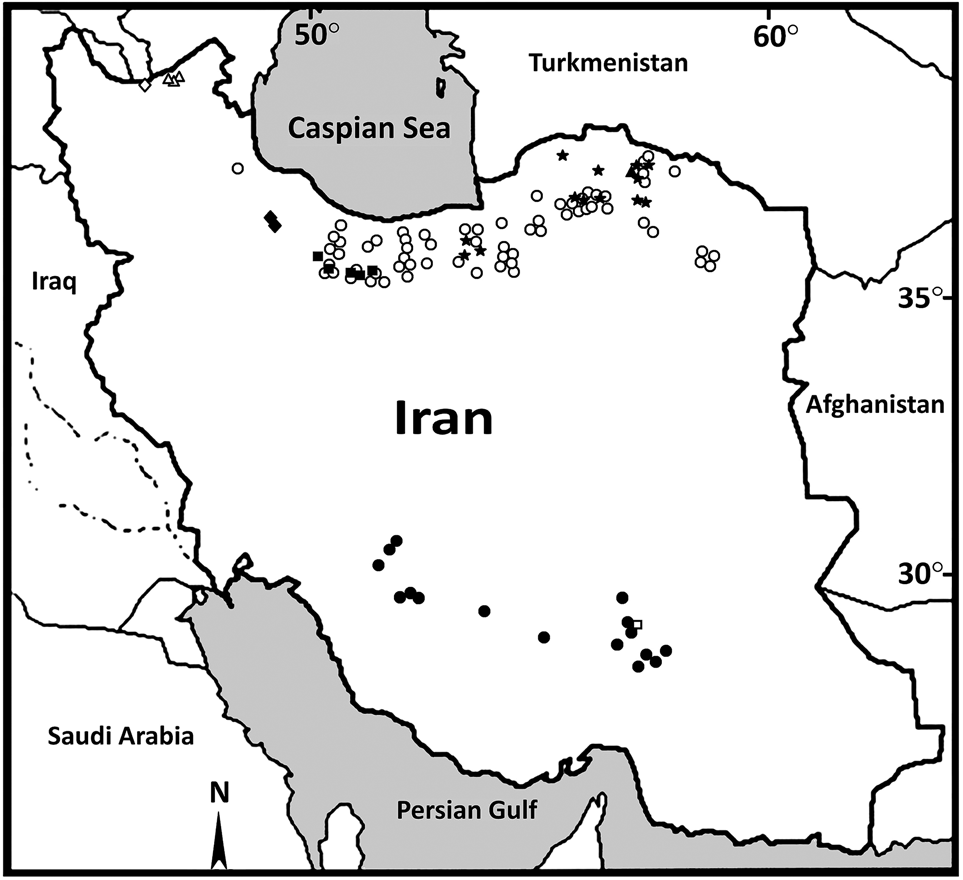
The study of Colutea in Iran has necessitated the description of two new subsections within the existing infrageneric framework of the genus. Hence a key is presented to the sections, subsections and species, and additional notes are given for the species. The distribution of each species in the country has also been indicated (Fig. 1). The order for the species follows that of Browicz (Reference Browicz1963a, Reference Browicz1984).
Distribution map of the genus Colutea L. in Iran. Filled shapes indicate species endemic to the country. ◇ C. komarovii, ♦ C. uniflora, △ C. cilicica, ▲ C. gifana, ○ C. buhsei, ● C. persica, ■ C. triphylla, ★ C. porphyrogramma, □ C. gracilis.

Materials and Methods
This study is based on a combination of field studies and the investigation of 305 herbarium specimens from the following herbaria (Thiers, continuously updated): FAR, FUMH, IRAN, KAR, P, T, TARI, TUH, W and Shahid Bahonar University of Kerman herbarium (abbreviated UKH, but this is not in Thiers (continuously updated)). Fresh specimens were collected in the field allowing us to examine morphological variation of species in both living and herbarium material.
Identification key to the sections, subsections and species of Colutea in Iran
1a. Shrub; leaves multifoliolate 2
1b. Suffrutescent herb; leaves trifoliolate; (sect. Oreophysa) 4(i). C. triphylla
2a. Shrubs unarmed; inflorescences with one or numerous flowers; flowers large, around or more than 15 mm long 3
2b. Shrubs with thorns; inflorescences with 1–2 flowers; flowers small, up to 15 mm long; (sect. Armata) 8
3a. Keel rounded at the apex; (sect. Colutea) 4
3b. Keel with small beak at the apex; (sect. Rostrata) 6
4a. Shoots after peeling grey-brown; leaflets large, 15–30 × 9–15 mm, mostly broad-elliptic; ovary glabrous; (subsect. Colutea) 1a(i). C. cilicica
4b. Shoots after peeling brown-violet, lustrous; leaflets shorter, 5–13 × 3–10 mm, mostly obovate; ovary glabrous-tomentose; (subsect. Graciles) 5
5a. Leaflets glabrous above; inflorescence shorter than supporting leaves; flowers up to 16 mm long; ovary tomentose 1b(i). C. gracilis
5b. Leaflets more or less pubescent above; inflorescence longer than or equal to supporting leaves; flowers 16–23 mm long; ovary glabrous or with a few hairs on ventral suture 1b(ii). C. persica
6a. Flowers generally 15 mm long; wings falcate; (subsect. Uniflora) 2c(i). C. uniflora
6b. Flowers over 18 mm long; wings linear geniculate 7
7a. Shoots after peeling red-brown, lustrous; leaves with 2–5(–6) pairs of leaflets; leaflets pubescent below; inflorescence more or less equal to supporting leaves; calyx teeth 4–5 times shorter than tube; (subsect. Centralasiaticeae) 2a(i). C. buhsei
7b. Shoots after peeling grey; leaves with 1–2 pairs of leaflets; leaflets glabrous on both sides; inflorescence more than 1.5 times longer than supporting leaves; calyx teeth equal to tube; (subsect. Gifana) 2b(i). C. gifana
8a. Leaflets 2–7.5 × 2–6 mm; pedicels 0.3–1 mm long; wings with spur; fruits papery-leathery 3(i). C. komarovii
8b. Leaflets 3–4.5 × 1.5–3 mm; pedicels 2–8 mm; wings without spur; fruits thin, papery 3(ii). C. porphyrogramma
Notes on the Sections, Subsections and Species of Colutea in Iran
1. Colutea sect. Colutea. – Colutea sect. Eucolutea Boiss., Fl. Orient. 2: 194 (1872), p.p. – Type species: Colutea arborescens L.
Unarmed shrubs. Leaves with 2–6(–7) pairs of leaflets. Inflorescence with 1–6 flowers. Flowers over 15 mm long; wings linear; keel rounded at the apex.
1a. Colutea sect. Colutea subsect. Colutea. – Colutea sect. Colutea subsect. Arborescentes Browicz, Monogr. Bot. 14: 22, 24 (1963). – Type species: Colutea arborescens L.
Leaflets large, mostly broad-elliptic. Flowers yellow; wings geniculate. One species in Iran.
1a(i). Colutea cilicica Boiss. & Bal. in Boiss., Diagn. Pl. Orient. nov. ser. 2, 5: 83 (1856). – Type: Turkey, Cilicia, Mersina, Balansa s.n. (G n.v.). Figs 1, 2.
Colutea sect. Colutea. A. Colutea cilicica, Arasbaran protected region, East Azarbaijan; B. Colutea persica, Shiraz to Dasht-e-Arjan, Fars.
Distribution. Turkey, Iran, Caucasus, N Iraq, N Syria, N Palestine and Greece.
Specimens studied. East Azarbaijan: Qaradagh Mountains, Arasbaran protected region, Kaleibar, before Babak Fort, 13 viii 2009, Pooyan 12013 & 12014 (FAR!); After Babak Fort, 27 v 2010, Pooyan 12015 & 12016 (FAR!); Arasbaran protected region, Hejrandust to Makidi, 1400–1750 m, 7 vi 1976, Assadi & Maassoumi 20185 (TRAI!); Makidi to Veinagh, 1000–1700 m, 14 v 1975, Wendelbo & Assadi 17041 (TARI!, W!); Veinagh, 4 vii 1978, Termeh, Moussavi & Habibi 38971 (W!); Between Veinagh and Tou-Ali, 20 vi 2005, Ghahreman & Attar 35481 (TUH!); Between Kalaleh Olya and Vaighan three-way, 1200 m, 19 vi 2004, Ghahreman, Attar & Hamzeh’ee 35532 (TUH!); Kaleibar to Hasan Beiglou, vi 1941, Sabeti 3725 (KAR!); Hasan Beiglou, iv 1958, Mirdamadi 6156 (W!); ibid., iv 1950, Unknown 3726 (KAR!). Zanjan: Tarom, Abhar, 900 m, 19 vi 1973, Makouii 9917 (TARI!).
1b. Colutea sect. Colutea subsect. Graciles Browicz, Monogr. Bot. 14: 22, 69 (1963). – Type species: Colutea gracilis Freyn & Sint.
Leaflets medium, mostly obovate. Flowers yellow or orange yellow; wings geniculate. Two species in Iran.
1b(i). Colutea gracilis Freyn & Sint. ex Freyn, Bull. Herb. Boiss. sér. 2, 4: 46 (1904). – Type: Turkmenistan, Kisil-Arwat, Karakala, Sundsodagh Mountain, Sintenis 1705 (P!).
Colutea gracilis Freyn & Sint. is reported here from Iran for the fourth time. The previous specimens were collected from Chartut, in Golestan province (Gorgan), and Kuh-i-Nasr, in Kerman province (Browicz, Reference Browicz1963a, Reference Browicz1984).
Note. Parsa (Reference Parsa1948) listed the taxon ‘Colutea persica Boiss. var. gracilis Freyn’ but there is no evidence that Freyn ever published this name as a variety. In Flora Iranica Browicz (Reference Browicz1984) included the name ‘Colutea persica Boiss. var. gracilis (Freyn) Parsa’ in synonymy of C. gracilis Freyn & Sint. ex Freyn, presumably in the belief that Parsa had made a new combination from Colutea gracilis. This may be because Parsa listed the variety as occurring in Kuh-i-Nasr at 2800–3000 m, a known locality for Colutea gracilis, and that it had small leaves (in comparison to C. persica). Parsa (Reference Parsa1948), however, gave no evidence he was making a new combination, listed no specimens, there is no illustration, and the description is too short to have any confidence in the identity of this plant. This variety must, therefore, remain an unknown entity.
Distribution. Turkmenistan and Iran.
Specimens studied. Kerman: Kuh-i-Nasr, 2800–3000 m, 23 v 1892, Bornmüller 3688 (P!); Rayen, 2400 m, 24 v 1981, Manuchehri, Heravi & Jafari 277 (TARI!).
1b(ii). Colutea persica Boiss., Diagn. Pl. Orient. nov. ser. 1, 6: 33 (1845). – Type: Iran, Fars, Kuh-e Delu, Kotschy 4348 (holo W!; iso P!, W!). Figs 1, 2.
Colutea persica is a problematic, challenging species which occurs over a large part of southern Iran. There is a wide range of variation in features such as hairs on the ovary and leaf and flower size. Colutea persica is intermediate in leaf and flower size between C. buhsei and C. gracilis (C. buhsei > C. persica > C. gracilis) although there is an overlap with both species. Even though, on first appearance, it is hard to distinguish this species from each of the other two they can be readily distinguished on closer examination (see key above). In particular Colutea persica does not have the tomentose ovary of the other two species.
Distribution. Endemic to Iran.
Specimens studied. Kohgiluyeh and Boyer-Ahmad: Yasuj, Kakan, Margoon waterfall, 1960 m, 23 v 2005, Noroozi & Shams 14850 (TARI!); ibid., 2100 m, 27 v 1995, Ghahreman & Attar 19062 (TUH!). Fars: 100 km N Shiraz, Sad-e-Doroudzan, 1000 m, 30 iv 1973, Babakhanlou 9097 (TARI!); Shiraz to Dasht-e-Arjan, 10 km before Dasht-e-Arjan, 1997–2016 m, 5 v 2010, Pooyan 12017, 12018, 12019 & 12023 (FAR!); Dasht-e-Arjan to Kazerun, 40 km before Kazerun, 2048 m, 5 v 2010, Pooyan 12020, 12021 & 12022 (FAR!); 42 km E Kazeroun, 2100 m, 10 v 1959, Pabot 986 (TARI!); Kuh-e Delu, 13 vi 1842, Kotschy 511 (P!, W!); 27 km from Nurabad to Korekan, Doshman-Ziary region, 2000 m, 31 v 1983, Mozaffarian 45755 (TARI!); 20 km from Estahbanat to Neiriz, S Daryach-e Bakhtegan, 1750 m, 8 vi 1983, Mozaffarian 47100 (TARI!); 26 km NW Ardekan, 2500 m, 13 vii 1959, Pabot 2394 (TARI!). Hormozgan: c.100 km NE Bandar Abbas, Bagh-e Hana, 2000–2500 m, 26 vi 1995, Assadi 73692 (TARI!). Kerman: SE Kerman, Sekonj, 9 vi 2000, Mirtajeddini 1326 (UKH!); Mahan to Joopar, Ghanat-e-Ghastan, 20 v 2010, Pooyan 12025 & 12026 (FAR!); Jebal Barez mountains, after Deh-e Bakri, after Esfand tunnel, 2405 m, 20 v 2010, Pooyan 12024 (FAR!); 40 km from Jiroft on the road to Kerman, Kuh-e Sarzeh, 3000–3300 m, 13 vi 1997, Assadi & Miller 25367 (TARI!); Kerman to Jiroft (Rayen road), 35 km to Jiroft, 20 v 2010, Pooyan 12030 (FAR!); Rayen to Jiroft, before Dalfard, 20 v 2010, Pooyan 12027 & 12028 (FAR!); Dalfard, 1900 m, Unknown 21 (TARI!); Rayen, Kuh-e Hazar, Hazargol valley, 2800–3200 m, 16 vi 1975, Foroughi & Assadi 16256 (TARI!); Kuh-e Hazar, Zahroud, 2700 m, Edmondson & Miller 1644 (TARI!); 54 km Jiroft to Baft, 20 v 2010, Pooyan 12029 (FAR!); 40 km to Baft, road of Gughar, after Godal village, 2864 m, 27 v 2002, Ghahreman, Attar, Mehdigholi & Mirtajjedini 28582 (TUH!); Bardsir, Bid Khun, 23 v 2011, Mirtajeddini s.n. (UKH!); Baft, 18 v 2011, Hofreh Nejadi s.n. (UKH!); Baft, Goghar, 27 v 2011, Majdzadeh s.n. (UKH!); Baft to Khabr, Kuh-e Khabr, 3500–3800 m, 8 vi 1977, Assadi, Edmondson & Miller 1779 (W!); ibid., 2300–2500 m, 28 v 1975, Mousavii & Tehrani 33567-E (W!); Khabr National Park, 2400 m, 9 vi 77, Assadi, Edmondson & Miller 1728 (W!); Rafsanjan, Sarcheshmeh, 28 viii 1998, Sarcheshmehpour 1327 (UKH!).
2. Colutea sect. Rostrata Browicz, Monogr. Bot. 14: 22, 83 (1963). – Colutea sect. Eucolutea Boiss., Fl. Orient., 2: 194 (1872), p.p. (not including the type). – Type species: Colutea orientalis Mill.
Unarmed shrubs. Leaves with 1–5 pairs of leaflets. Inflorescence with 1–5 flowers. Flowers 14–25 mm long; wings linear or falcate; keel ending with a beak at the apex; beak often elongated and bent.
2a. Colutea sect. Rostrata subsect. Centralasiaticeae Browicz, Monogr. Bot. 14: 22, 93 (1963). – Type species: Colutea buhsei (Boiss.) Shap.
Shoots after peeling red or red-brown, lustrous. Leaflets pubescent below. Inflorescence more or less equal in length to subtending leaves, with 1–5 flowers. Flowers large, over 18 mm long; wings longer than keel or, exceptionally, equal to it, geniculate. Calyx teeth at least 2 times shorter than tube. Fruit large.
2a(i). Colutea buhsei (Boiss.) Shap., Fl. URSS 11: 320 (1941). – Type: Iran, Mazandaran, Elburz Mountain, Boissier s.n. (G n.v.). Figs 1, 3.
Colutea sect. Rostrata. A. Colutea buhsei, Salook National Park, North Khorassan, provided courtesy of Atefeh Ezazi; B. Colutea gifana, near Ghezelghan, North Khorassan; C. Colutea uniflora, near Lowshan, Gilan.
Although Browicz (Reference Browicz1963a, Reference Browicz1967) mentioned two Colutea buhsei specimens from southern Iran, and included these in a distribution map, we have not seen any specimens from this area, either in the herbarium or in the field. This species, found in northern Iran, is the most widespread of the Colutea species in the country.
Distribution. Iran and Central Asia.
Specimens studied. Golestan: Gorgan, Naharkhoran Forest, Bani Agheli 12050 (T!); Gorgan to Shahrud, Chaharbagh, Chelcheli Protected Region, 31 vii 2009, Pooyan 12007, 12008 & 12009 (FAR!); Shahkuh, 17 vii 1940, Koelz 16327 (W!); 15 km N Aliabad, Zarrin-Gol valley, 470 m, 19 v 2005, Assadi & Hemmati 88858 (TARI!); Aliabad, Gauba & Mirdamadi 597 (KAR!); 12 km SE Azadshahr, 320 m, 10 v 1960, Pabot 75339 (TARI!); 28853 (W!); Azadshahr to Shahrud, 1400 m, 22 v 1977, Rechinger 55485 (W!); ibid., 300 m, 23 viii 1996, Assadi & Azadi 76114 (TARI!); ibid., 300 m, 3 v 1974, Wendelbo, Foroughi, Sanii & Shirdelpur 11102 (TARI!); ibid., 320 m, Pabot 7539 (TARI!); Now Deh, 7 v 1955, Money 6534 (W!); 84 km E Gonbad-e Kavus, 740 m, 3 ix 1960, Pabot 5029 (TARI!); 85 km NE Gonbad, 750 m, 14 v 1966, Pabot 7762 (TARI!); Minudasht, 11 v 1968, Unknown 118 (W!); Golestan National Park, 600 m, 1 v 1974, Wendelbo, Foroughi, Sanii & Shirdelpur 11022 (TARI!); ibid., 30 vii 2009, Pooyan 12004 & 12005 (FAR!); ibid., 7 vii 2000, Mirtajeddini 1325 (UKH!); ibid., 1640 m, 9 v 1972, Sabeti 6017 (TARI!); ibid., Rezaiyan 23861 (TARI!); ibid., 1350–1700 m, 5 vi 1987, Mozaffarian & Abouhamzeh 59043 (TARI!); ibid., 26 vii 1972, Iranshahr & Zargani 41198-E (W!); ibid., 1700 m, 26 vii 1972, Rowshan 7533 (TARI!); ibid., 27 viii 2009, Pooyan 12012 (FAR!); ibid., 30 vii 2009, Pooyan 12006 (FAR!); ibid., 400–600 m, 3 vi 1975, Rechinger 52601 (W!); ibid., 600 m, 21 xi 1996, Akhani 12376 (W!); ibid., 1800 m, Hewer 3871 (TARI!). Mazandaran: Kiasar forest, 2068 m, without collector 3449 (T!); ibid., 1593 m, without collector 3257 (T!); Kiasar to Damghan, 1850 m, 29 vii 1975, Moussavi & Karavar 33593-E (W!); ibid., 29 vii 2009, Pooyan 12001 & 12002 (FAR!); ibid., 450 m, 17 v 1978, Wendelbo & Assadi 29578 (TARI!); Pol-Sefid to Sangedeh, 4500 m, 14 x 1977, Assadi 25535 (TARI!); ibid., 1200 m, 18 vi 1995, Assadi 73388 (TARI!); ibid., 1400 m, 25 ii 1972, Domanchik 31375 (TARI!); Pol-Sefid to Firuzkuh, 1400 m, 20 vi 1948, Rechinger & Rechinger 5563 (W!); ibid., 29 vii 2009, Pooyan 12003 (FAR!); ibid., 1710 m, 12 v 1971, Gheissari 1313 (TARI!); ibid., 2500 m, 30 iii 1973, Babakhanlou & Amin 16171 (TARI!); ibid., 17 v 1989, Haghghian 12047 & 12048 (T!); ibid., 27 v 1986, Daneshpajuh & Zangani 41197-E (W!); Amol to Polur, 10 v 1990, Bafendeh 12045 & 12046 (FAR!); ibid., 3 v 1965, Tregubov 115 (TARI!); ibid., 2350 m, 5 x 1982, Mozaffarian & Aboohamzeh 42611 (TARI!); ibid., 2260 m, 10 vii 1960, Pabot 4095 (TARI!); 28852 (W!); ibid., 16 viii 1981, Zargani 41196-E (W!); ibid., 1930 m, 10 vii 1971, Athari 2553 (TARI!); Chalus to Kandavan, 1000 m, 27 v 1965, Mobayen 7227 (TUH!); ibid., 500 m, 9 v 1998, Assadi 78712 (TARI!); ibid., 1930 m, 8 ix 1971, Riazi 2769 (TARI!); ibid., 2110 m, 15 iv 1970, Foroughi 313 (TARI!); ibid., 2000 m, 19 vii 1984, Assadi & Maassoumi 51698 (TARI!); ibid., 2100 m, 21 vi 1974, Rechinger 48339 (W!); ibid., 480 m, Assadi 76696 (TARI!); ibid., 2200–2600 m, 6–7 vii 1948 , Rechinger & f. Rechinger 6359 (W!); ibid., 2100 m, 23 vi 1982, Ghahreman, Aghustin & Shaikhaleslami 4070 & 7232 (TUH!); ibid., 700 m, 28 iv 1959, Wendelbo 409 (W!); ibid., 11 v 1961, Stutz 1166 (W!); ibid., 2180 m, 27 vii 1960, Pabot 4648 (TARI!); ibid., 2000 m, 7 vi 1960, Pabot 3541 (TARI!); ibid., vi 1984, Ghahreman, Aghustin & Sheikhaleslami 7231 (TUH!); ibid., 1300 m, 24 v 1974, Wendelbo & Shirdelpur 11713 (TARI!); ibid., 1800 m, 17 v 1978, Runemark & Mozaffarian 28089 (TARI!); Kandavan to Haraz Road, 1900–2300 m, 23 vi 1979, Assadi & Mozaffarian 33032 (TARI!); ibid., 1600 m, 11 vii 1997, Ghahreman, Attar & Ghahremaninejad 21224 (TUH!). East Azarbaijan: 30 km S Khalkhal, c.1500 m, 1 v 1981, Forghandust 36269 (TARI!); Chuli region, 15 km S Herowabad, 21 vii 1970, Ferguson 64 (W!). North Khorassan: Golestan National Park, 1050 m, 20 vii 1971, Edmondson 736 (W!); ibid., 720 m, 30 v 1972, Foroughi 6219 (TARI!); ibid., 1770 m, 7 vii 1989, Vafaee, Gazory & Shaikh 518 (TARI!); ibid., 300 m, 21 vi 1977, Hewer 3979 (TARI!); ibid., 1500–1800 m, 8–10 vi 1975, Rechinger 53123 (W!); ibid., 1200 m, 5 vi 1975, Rechinger 52933 (W!); ibid., 1000 m, Rechinger 32569 (W!); ibid., 800 m, 10 viii 1967, Rechinger 37636 (W!); Bojnurd to Gifan, Ghahreman, Attar & Hamzehee 36536 (TUH!); ibid., 1200 m, 22 v 1984, Assadi & Maassoumi 50312 (TARI!); ibid., 26 viii 2009, Pooyan 12010 & 12011 (FAR!); Kopet Dag, 600–700 m, 8 ix 1976, Vasak 07766 (W!); ibid., 1800 m, 14–15 vii 1937, Rechinger 1730 (W!); Minaloo, 1600 m, 23 v 1984, Assadi & Maassoumi 50381 (TARI!). Razavi Khorassan: Quchan, Gardaneh Allah-Akbar, 24 vii 1972, Iranshahr & Zargani 41199-E (W!); Dargaz, Daroongar village, 1700 m, 13 vi 1988, Vafaee 280 (TARI!); Robat-e Qozloq, 15 vi 1940, Koelz 16215 (W!); Ardak to Tolgor, Mount Hazar Masjed, 1200–1600 m, 7–10 vi 1948, Rechinger & f. Rechinger 4967 (W!); Mashhad, Zoshk, 1550 m, 23 v 1972, Foroughi 6300 (TARI!); Ghadamgah, Dizbad village, 1700–2200 m, 4 viii 1983, Mozaffarian 45576 (TARI!); Mount Binalud, 1600–1900 m, 11 vii 1988, Saghafi & Beizai 34 (TARI!); ibid., 2500 m, 26 vii 2001, Assadi & Ranjbar 82265 (TARI!); ibid., 1600–1900 m, 17 vi 1981, Assadi & Mozaffarian 36036 (TARI!); Esfarayen, Mount Shah-Jahan, 1400–2500 m, 8 vi 1984, Mozaffarian 48602 (TARI!); ibid., 1400–1800 m, 28 vi 1984, Mozaffarian 48679 (TARI!); Kotal-e yekn Chenar, v 1940, Koelz 16724 (W!). Semnan: Azadshar to Shahrud, Khush Yeilaq, 2000–2200 m, 17 v 1948, Rechinger & Rechinger 5405 (W!); Gorgan to Shahrud, Chahar-Bagh road, 2200 m, 12 vii 1976, Assadi & Maassoumi 21180 (TARI!); ibid., 2700 m, 12 vii 1976, Assadi & Maassoumi 21161 (TARI!); ibid., 2300 m, 24 vii 2001, Assadi & Ranjbar 82155 (TARI!); ibid., 2300–2700 m, 31 vii 1982, Assadi & Mozaffarian 40796 (TARI!); ibid., 2300 m, 20–26 vi 1948, Rechinger & Rechinger 5888 (W!); Shahrud, Kuh-e Abr, Kuh-e Ghatri, 2500 m, 23 vi 1974, Wendelbo & Foroughi 12940 (TARI!); 30 km N Mehmandust, 2700–3000 m, 22 vi 1975, Moussavi & Karavar 33591-E (W!); Tazareh village, 2500–3000 m, 24 vii 2001, Assadi & Ranjbar 82189 (TARI!); Kiasar to Semnan, 1400–1500 m, 30 v 1975, Rechinger 52392 (W!); ibid., 2200–2400 m, 20 vi 1975, Moussavi & Karavar 33596-E (W!); ibid., 2300 m, 11 vii 1959, Wendelbo 1357 (W!); ibid., 2400–2700 m, 29 vii 1982, Assadi & Mozaffarian 40720 (TARI!); ibid., 2000–2150 m, 9 viii 1978, Termeh, Mossavi & Tehrani 39431 (W!). Tehran: Semnan to Firuzkuh, 2000–2600 m, 24 v 1994, Safavi 80610 (TARI!); Rineh to Damavand, 2410 m, 8 viii 1971, Panahi 2534 (TARI!); ibid., 1850–1950 m, 15 v 1978, Mozaffarian 32264 & 32329 (TARI!); ibid., 2350–2400 m, 25 vii 2007, Mohebbi 90774 (TARI!); ibid., 6–26 iii 1946, Ganjalizadeh 4007 (TUH!); Shemshak, 2000 m, 19 vi 1972, Dini & Azarm 16169 (TARI!); ibid., 2200 m, 2 viii 1972, Babakhanlou, Amin & Bazargan 16170 (TARI!); ibid., 1930 m, 12 vi 1973, Babakhanlou & Amin 16175 (TARI!); Fesham to Zayegan, 2200 m, 30 v 1990, Zarre 69598 (TARI!); Fasham road, 5 viii 1990, Bafandeh 12049 (T!); Chitgar, National Botanical Garden, 1320 m, vi 1983, Ghahreman & Aghustin 7233 (TUH!); ibid., 10 v 1988, Gauba 3727 (KAR!). Alborz: Karaj to Chalus, 1750 m, 18 vi 1973, Babakhanlou & Amin 16173 (TARI!); ibid., 2080 m, 5 vi 1973, Babakhanlou & Amin 16174 (TARI!); ibid., 1560 m, 3 vi 1973, Babakhanlou & Amin 16176 (TARI!); ibid., 1800 m, 22 vii 1967, Babakhanlou 24097 (TARI!); ibid., 1900–2350 m, 3 vii 1985, Assadi & Jamzad 55227 (TARI!); ibid., 2100 m, 1 vi 1991, Assadi & Shahsavari 69634 (TARI!); ibid., 1800 m, 25 vi 1974, Amin & Bazargan 19279 (TARI!); ibid., 2010 m, Assadi 76675 (TARI!); ibid., 1200–1500 m, 16 v 1956, Schmid 5703 (W!); ibid., 1700 m, 26 v 1937, Rechinger 523 (W!); ibid., 2000–2200 m, Bornmüller 6621 & 6622 (P!); Karaj, Kuh-e Dasht, 1600 m, 7 vi 1937, Rechinger 765 (W!). Qazvin: Qazvin to Alamut, 2000 m, 25 vii 1970, Babakhanlou 16172 (TARI!); ibid., 1990 m, 26 vii 1970, Foroughi 763 (TARI!); ibid., 1240 m, 6 v 1973, Babakhanlou & Amin 16177 (TARI!); ibid., 1460 m, Foroughi 657 (TARI!).
2b. Colutea sect. Rostrata subsect. Gifana Pooyan, F.Ghahrem. & Assadi, subsect. nov.
Rami corticibus fibrosis demum grisei vel cremei, opaci. Foliola rotundata, elliptica vel late obovata, supra et subtus glabra. Inflorescentia foliis suffultis quam 1.5-plo longiora, 2–5-flora. Flores c.20 mm longi; alae carinam aequantes, geniculatae. Dentes calycis tubum aequantes. Legumen magnum. – Type species: Colutea gifana Parsa
Shoots after peeling grey or cream, opaque. Leaflets glabrous on both sides. Inflorescence at least 1.5 times longer than supporting leaves, with 2–5 flowers. Flowers large, c.20 mm long; wings equal to keel, geniculate. Calyx teeth equal to tube. Fruit large.
2b(i). Colutea gifana Parsa, Kew Bull. 1: 21 (1947). – Type: Iran, Khorassan, Gifan, Parsa 238 (K n.v.). Figs 1, 3.
Colutea gifana has previously been included in Colutea sect. Rostrata subsect. Centralasiaticeae (Browicz Reference Browicz1963a, Reference Browicz1984). However, Colutea gifana’s two-year-old shoots are not red or red-brown and lustrous but rather grey or cream and opaque. Also, in Colutea gifana, the leaves are mostly alternate and the wings are mostly equal in length to the keel, unlike most other species of Colutea subsect. Centralasiaticeae. With its large flowers and its tomentose ovary it also doesn’t have the characters of Colutea subsect. Orientales. Therefore, we place it in its own subsection, Colutea subsect. Gifana.
Distribution. Endemic to Iran.
Specimens studied. North Khorassan: Bojnurd, near Ghezelghan, 947 m, 29 iv 2008, Memariani & Zengooei 39615 (FUMH!); ibid., 1004–1010 m, 21 v 2011, Pooyan 13211, 13212, 13213 & 13214 (FAR!).
2c. Colutea sect. Rostrata subsect. Uniflora Pooyan, F.Ghahrem. & Assadi, subsect. nov.
Rami corticibus fibrosis demum rubro-fusci, nitentes. Foliola rotundata, lanceolata vel oblonga, comparate crassa, supra et subtus pubescentia. Inflorescentia foliis suffultis breviora, uniflora. Flores c.15 mm longi; alae carina breviores vel aequantes, falcatae. Dentes calycis tubo 2–3-plo breviora. Legumen parvum. – Type species: Colutea uniflora G.Beck
Shoots after peeling red-brown, lustrous. Leaflets in comparison to others thick, pubescent on both sides. Inflorescence shorter than supporting leaves, 1-flowered. Flowers small, c.15 mm long; wings shorter than or equal to keel, falcate. Calyx teeth 2 or 3 times shorter than tube. Fruit small.
2c(i). Colutea uniflora G.Beck ex Stapf, Denkschr. Akad. Wiss. Wien, Math.-Nat. Kl. 51: 332 (1886). – Type: Iran, Qazvin, Pichler s.n. (W!). Figs 1, 3.
Although Colutea uniflora has been called a weakly spinescent shrub and been placed in Colutea sect. Armata (along with the other spinescent shrubs) (Browicz, Reference Browicz1963a, Reference Browicz1984), based on our herbarium and field investigations it should rather be categorised as an unarmed species. The remains of the previous year’s branches in this taxon resemble those in species of other sections, but not the taxa of Colutea sect. Armata. In other characters, mostly its beaked keel, falcate wings and c.15 mm long flowers, it can be placed in Colutea sect. Rostrata. Moreover, as Colutea uniflora has c.15 mm long flowers, tomentose ovaries and mainly elliptic leaflets, it doesn’t have the characters of Colutea subsect. Orientales, C. subsect. Centralasiaticeae, or C. subsect. Gifana. A new subsection is established to accommodate it.
Distribution. Endemic to Iran.
Specimens studied. Gilan: Rudbar, Manjil, 10 v 1935, Gauba 3728 (KAR!); Qazvin to Lowshan, the old road, 3 v 1882, Pichler s.n. (W!); ibid., c.1200 m, 13 v 1902, Bornmüller 6623 (P!, W!); ibid., Gauba 601 & 602 (W!); ibid., 570–600 m, 6 v 2011, Pooyan 12037, 13201, 13202, 13203, 13204, 13205 & 13206 (FAR!); ibid., 26 iv 2012, Pooyan 14153, 14501, 14502, 14503, 14504 & 14505 (FAR!).
3. Colutea sect. Armata Browicz, Monogr. Bot. 14: 22, 111 (1963). – Type species: Colutea armata Hems. & Lace
Spinescent shrubs. Leaves with 1–4 pairs of leaflets; leaflets small, pubescent on both sides. Inflorescence with 1–2 flowers. Flowers shorter than 15 mm long; keel ending with a beak at the apex. Fruit broad obovate to spindle-shaped, short pointed.
3(i). Colutea komarovii Takht., Zametki Sist. Geogr. Rast. 9: 22 (1940). – Type: Republic of Nakhichevan, Circa Ordubad, Sagal Mountain, Schelkovnikov & Kara-Murza (TBI n.v.). Figs 1, 4.
Colutea sect. Armata. A. Colutea komarovii, Jolfa to Norduz, East Azarbaijan; B. Colutea porphyrogramma, Golestan National Park, North Khorassan.
Colutea komarovii was first recorded for Iran by Ghahremaninejad & Ghahremani (Reference Ghahremaninejad and Ghahremani2008). Although it can be difficult to distinguish from Colutea porphyrogramma the leaves and flowers in C. porphyrogramma are generally smaller than in C. komarovii.
Distribution. Iran and S Caucasia.
Specimens studied. East Azarbaijan: 51 km from Jolfa to Duzal, margin of Aras river, 850 m, 13 vi 2002, Ghahremani & Imani 7815 (T!); ibid., 22 vi 2009, Pooyan 12041 (FAR!); Jolfa to Norduz, after Siahrood, 560–800 m, 26 v 2010, Pooyan 12031, 12032, 12033, 12034, 12035 & 12036 (FAR!); ibid., 7 v 2011, Pooyan 13207, 13208, 13209 & 13210 (FAR!).
3(ii). Colutea porphyrogramma Rech.f., Anz. Österr. Akad. Wiss., Math.-Naturwiss. Kl. 101: 400 (1964). – Type: Iran, Gorgan, Maraveh Tappeh, Sharif 2568-E (W!). Figs 1, 4.
Distribution. Endemic to Iran.
Specimens studied. Golestan: Kordkuy to Hajiabad, 1800–2000 m, 21 v 1986, Maassoumi 55058 (TARI!); ibid., 1700 m, Maassoumi 55066 (TARI!); Azadshahr, 9 v 1958, without collector 14682-E (W!); Maraveh Tappeh to Ghazanghayeh, 300 m, 22 iv 1986, Assadi & Maassoumi 55511 (TARI!); Golestan National Park, 900–1000 m, 5 v 1975, Rechinger 52791 (W!). North Khorassan: Golestan National Park, 1270 m, 29 v 1972, Foroughi 6102 (TARI!); ibid., 920–1000 m, 21 v 1976, Termeh et al. 34820-E (W!); ibid., 1500 m, 30 v 1972, Foroughi 6101 (TARI!); ibid., 1500 m, 3 v 1998, Hojjat & Zangooei 31150 (FUMH!); ibid., 1250–1300 m, 21 vi 1974, Wendelbo & Foroughi 12823 (TARI!); ibid., 19 v 1950, Sharif 2568-E (W!); ibid., 950 m, 17 iv 2001, Joharchi & Zangooei 33244 (FUMH!); ibid., 1400 m, 30 v 1984, Joharchi & Zangooei 11403 (FUMH!); ibid., 1000 m, 17 iv 2000, Joharchi & Zangooei 32651 (FUMH!); ibid., 1300 m, 15 v 1988, Joharchi & Zangooei 16637 (FUMH!); ibid., 1500 m, vi 1984, Ghahreman & Aghustin 7229 (TUH!); ibid., 16 iv 2011, Pooyan 12039, 12040 & 12042 (FAR!); ibid., 1350 m, Rechinger 32554 (W!); ibid., 1200 m, 7 v 1975, Rechinger 53001 (W!); ibid., 1100 m, 18 v 1975, Rechinger 53739 (W!); Bojnurd to Gifan, Qezelqan, 30 iv 2011, Pooyan 12043 (FAR!); ibid., 2010 m, 21 v 2011, Pooyan 13215 (FAR!); Bojnurd to Shirvan, 1150 m, 12 v 1992, Faghihnia & Zangooei 21742 (FUMH!); ibid., 1450 m, 13 v 1990, Rashed 18480 (FUMH!); ibid., 110 m, 30 v 1984, Assadi & Maassoumi 50877 (TARI!). Semnan: c.35 km N Damghan, Tuyeh, 1850 m, 16 v 1978, Wendelbo & Assadi 29485 (TARI!); ibid., 1900–2250 m, 7 v 1977, Rechinger 56419 (W!).
4. Colutea sect. Oreophysa Bunge ex Boiss., Fl. Orient. 2: 196 (Dec 1872 or Jan 1873). – Type species: Colutea triphylla Bunge ex Boiss.
Suffrutescent herbs, unarmed. Leaves with 3 leaflets. Inflorescence 1-flowered. Flowers 10–12 mm long; wings obovate-oblong, keel rounded at the apex.
4(i). Colutea triphylla Bunge ex Boiss., Fl. Orient. 2: 196 (Dec 1872 or Jan 1873). – Sphaerophysa microphylla Jaub. & Spach, Ill. Pl. Orient. 1: 126 (1843). – Oreophysa triphylla (Bunge ex Boiss.) Bornm., Bull. Herb. Boiss. sér. 2, 5: 652 (1905), nom. illeg. – Oreophysa microphylla (Jaub. & Spach) Browicz, Kew Bull. 16: 493–495 (1963). – Type: Iran, from mountains near Tehran, Aucher-Eloy s.n. (P n.v.). Figs 1, 5.
Colutea sect. Oreophysa. Colutea triphylla, NW Karaj, Alborz.
A recent molecular taxonomic study has shown that Oreophysa microphylla, the name used in Flora Iranica (Browicz, Reference Browicz1984), belongs in Colutea under the name C. triphylla (Kazempour Osaloo et al., 2006). Three specimens have been investigated here, and in reproductive features, as well as in molecular sequence data, this taxon belongs to Colutea. Yet unlike other members of Colutea the taxon has a suffruticose growth, subdichotomous branches of the shoots, considerable elongation of the internodes, reduced foliage with trifoliolate leaves, and broad wings (Browicz, Reference Browicz1963b). Furthermore, the shoots are in the shape of curved twigs and are not woody.
Distribution. Endemic to Iran. Type from the S slopes of Elburz Mountain.
Specimens studied. Tehran: Fasham, Shemshak, 1900 m, 27 vi 1972, Amin & Mousavi 16904 (TARI!); Tehran, Darband, 1850 m, 15 vi 1998, Mazooji 022932 (T!); ibid., 1800 m, 24 vi 1972, Mousavi & Amin 16806 (TARI!); ibid., 1900 m, 24 vi 1972, Mousavi & Amin 2381 (TARI!); Lashgarak, Zardband, 1900 m, 16 vi 1972, Dini & Arazm 16797 (TARI!); Shemiran, 1700 m, Pabot 5004 (TARI!); Darakeh, 1850 m, 2 vii 1972, Amin & Bazargan 16796 (TARI!); Farahabad, 2200 m, 3 vii 1972, Bazargan & Amin 16805 (TARI!); Souleghan, 24 vi 1986, Jamzad 57071 (TARI!). Alborz: Kalak, 1600 m, 20 vii 1971, Mousavi 23506 (TARI!); ibid., 1500 m, 27 vii 1971, Mousavi 16800 (TARI!); ibid., 1830 m, 2 vi 1973, Babakhanlou & Amin 23519 (TARI!); ibid., 1900 m, 3 vi 1972, Foroughi 16804 (TARI!); Karaj, Vasiyeh, 18 vi 1934, Esfandiari 3908 (KAR!); Karaj, Kuh-e Karaj, 3 vi 1933, Esfandiari 3905 (KAR!); Ali Abad, 18 viii 1933, Gauba 3907 (KAR!); Kuh-e Dasht, 1500–2000 m, 19 vii 1979, Assadi & Mozaffarian 33325 (TARI!); ibid., 1900 m, 16 vii 1990, Jamzad & Akhyani 68149 (TARI!); ibid., 1850 m, 16 vii 1972, Riazi 6345 (TARI!); ibid., 1850 m, 20 v 1974, Dini 8910 (TARI!); Chalus road, 13 vi 1934, Esfandiari 3904 & 3906 (KAR!); ibid., 1700 m, 18 vi 1973, Babakhanlou & Amin 16802 (TARI!); ibid., 1400 m, 6 vi 1971, Foroughi 1676 (TARI!); ibid., 1500 m, 3 vi 1974, Foroughi, Sanii & Amini 12312 (TARI!); ibid., 1600 m, 23 v 1974, Wendelbo & Shirdelpur 11618 (TARI!); 20 km NW Karaj, 1550 m, 13 vi 1973, Babakhanlou & Amin 16801 (TARI!); Baraghan, 1760 m, 2 vi 1972, Forughian & Hariri 16421 (TARI!); ibid., Pooyan 13219, 13220, 14151 & 14152 (FAR!); Quchak, 1750 m, 25 vii 1972, Babakhanlou, Amin & Bazargan 16799 (TARI!).
Acknowledgements
The authors thank the curator of the herbarium TARI (Tehran, Iran) and Dr Farideh Attar (TUH, Tehran, Iran) for giving us the opportunity to study their Colutea collections. We are indebted to Mr Mohammad Reza Joharchi and the herbarium FUMH (Mashhad, Iran) for their generosity, sending us their Colutea porphyrogramma and C. gifana collections, and for helping us with the genus distribution in North Khorassan province. Our thanks also go to Dr Mansour Mirtajjedini, UKH (Kerman, Iran), for providing us with their Colutea collections from Kerman province. Our sincere thanks also go to KAR (Karaj, Iran) herbarium for giving us the opportunity of revising Gauba’s Colutea collections as well as their Oreophysa collections. We also wish to thank the directors and curators of the W (Vienna, Austria), P (Paris, France), and IRAN, FAR and T (Tehran, Iran) herbaria for allowing us to study their specimens.