Introduction
Hereditary haemorrhagic telangiectasia, also known as Osler–Weber–Rendu syndrome, is an autosomal dominant inherited genetic disorder that affects vasculature, resulting in telangiectasias and arteriovenous malformations at specific vascular sites. Telangiectasias are usually found in nasal and oral mucous membranes, in addition to the face, fingertips and the alimentary tract. Larger arteriovenous malformations affect the brain, lung, liver and, less commonly, the spine. Telangiectasias arise because of weakness in the peri-vascular connective tissue, causing post-capillary venule enlargement and encroachment upon dilated arterioles, with the resultant loss of the intervening capillary bed – an important part of haemostasis in the bleeding state.Reference Braverman, Keh and Jacobson 1
There have been numerous mutations described in families with hereditary haemorrhagic telangiectasia, but only three genes have been specifically identified and together these account for over 88 per cent of cases.Reference Letteboer, Mager, Snijder, Koeleman, Lindhout and Ploos van Amstel 2 These genes are: ENG, which codes for endoglin,Reference McAllister, Grogg, Johnson, Gallione, Baldwin and Jackson 3 ACVRL1, which codes for the activin receptor-like kinase ALK1,Reference Johnson, Berg, Baldwin, Gallione, Marondel and Yoon 4 and, less commonly, SMAD4.Reference Gallione, Repetto, Legius, Rustgi, Schelley and Teipar 5 Each of these three genes encodes a protein involved in the transforming growth factor beta superfamily signalling, which, through a cascade of interactions with ligands and receptors, results in modulation of transcription within the nucleus.Reference Dupuis-Girod, Bailly and Plauchu 6 ENG and ACVRL1 mutations result in hereditary haemorrhagic telangiectasia types 1 and 2 respectively, and SMAD4 mutations result in the syndrome associated with pre-malignant juvenile polyposis.Reference Gallione, Repetto, Legius, Rustgi, Schelley and Teipar 5 The hereditary haemorrhagic telangiectasia type 1 phenotype is associated with a higher incidence of gastrointestinal bleeding from telangiectasias,Reference Kjeldsen, Møller, Brusgaard, Vase and Andersen 7 pulmonary arteriovenous malformationsReference Letteboer, Mager, Snijder, Koeleman, Lindhout and Ploos van Amstel 2 , Reference Kjeldsen, Møller, Brusgaard, Vase and Andersen 7 , Reference Paez, Giraud, Lesca, Decullier, Babin and Carette 8 and cerebral arteriovenous malformations,Reference Letteboer, Mager, Snijder, Koeleman, Lindhout and Ploos van Amstel 2 , Reference Paez, Giraud, Lesca, Decullier, Babin and Carette 8 whereas hereditary haemorrhagic telangiectasia type 2 shows a higher incidence of hepatic arteriovenous malformations.Reference Letteboer, Mager, Snijder, Koeleman, Lindhout and Ploos van Amstel 2
A recent population-based study conducted in the UK found the point prevalence for hereditary haemorrhagic telangiectasia to be 1 in 9400.Reference Donaldson, McKeever, Hall, Hubbard and Fogarty 9 It was associated with a strong female preponderance (adjusted prevalence rate ratio of 1.53, 95 per cent confidence interval = 1.24–1.88) and a large geographical variation, with the highest prevalence rate ratio in the South West and the lowest in the West Midlands.Reference Donaldson, McKeever, Hall, Hubbard and Fogarty 9
According to the Office of National Statistics, hereditary haemorrhagic telangiectasia was reported as the underlying cause of death in approximately 1 in 70 000 deaths in England and Wales during 2011. 10 Studies show that causes of hereditary haemorrhagic telangiectasia related deaths are attributable not only to the systemic manifestations of the disease (i.e. pulmonary, hepatic and cerebral arteriovenous malformations), but also to massive epistaxis and gastrointestinal bleeding.Reference Kjeldsen, Vase and Green 11 , Reference Sabba, Pasculli, Suppressa, D'Ovidio, Lenato and Resta 12 Life expectancy decreases by 6–7 years, and cumulative mortality increases significantly, from 14 per cent at 50 years to 51 per cent at 70 years, in patients with hereditary haemorrhagic telangiectasia as compared with healthy controls.Reference Sabba, Pasculli, Suppressa, D'Ovidio, Lenato and Resta 12 Impaired survival is also significantly related to the presence of cerebral arteriovenous malformations and gastrointestinal bleeding, but not to pulmonary arteriovenous malformations (screened and treated preventatively), hepatic arteriovenous malformations or genetic mutation results.Reference Goodwin, Nisenbaum, Edwards and Faughnan 13
Causes of death or significant morbidity relating to untreated pulmonary arteriovenous malformations include transient ischaemic attacks, which lead to embolic stroke or brain abscesses, as a direct result of right-to-left shunting and lack of filtration of thrombi in the non-existent capillary bed. Cerebral arteriovenous malformations can result in haemorrhagic strokes, and hepatic arteriovenous malformations can result in high-output cardiac failure, portal hypertension and biliary necrosis.Reference Garcia-Tsao, Korzenik, Young, Henderson, Jain and Byrd 14
With such a significant morbidity and mortality profile, and frequently observed gaps in diagnosis and care, the Hereditary Hemorrhagic Telangiectasia Foundation International, and their scientific and medical advisory board, identified a need to develop clinical guidelines. These guidelines, published in 2009, are based on literature published up to 2006 and expert opinion.Reference Faughnan, Palda, Garcia-Tsao, Geisthoff, McDonald and Proctor 15 In particular, the guidelines include recommendations for genetic testing, and screening for cerebral, hepatic and pulmonary arteriovenous malformations, in addition to gastrointestinal bleeding. These recommendations were an attempt to limit the morbidity and mortality profile of the condition. The consensus was that the condition should also be managed in a centre of excellence for hereditary haemorrhagic telangiectasia, rather than in a district general hospital setting.
From an ENT perspective, these guidelines are anecdotally poorly recognised. This is despite epistaxis being one of the most common presenting features of hereditary haemorrhagic telangiectasia, with the average age of onset of 12 years and the incidence of epistaxis approaching 100 per cent by the age of 40 years.Reference Berg, Porteus, Reinhardt, Gallione, Holloway and Umasunthar 16 – Reference Porteus, Burn and Proctor 19 Epistaxis occurs because of the proximity of the telangiectasias to the nasal mucosa, in addition to their thin-walled structure and lack of contractile elements within the vessels. When minor trauma occurs (even the friction of air), significant bleeding ensues; the disease burden can be considerable.
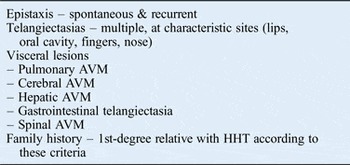
This paper aimed to assess whether patients with hereditary haemorrhagic telangiectasia in a district general hospital population had been screened appropriately, according to the international guidelines for the diagnosis and management of hereditary haemorrhagic telangiectasia, and to ascertain which specialty patients presented to first with their symptoms. The paper also aimed to advise practising ENT clinicians how to approach the initial task of managing the hereditary haemorrhagic telangiectasia patient, based on updated literature published since the international guidelines were devised. This assumes correct diagnosis according to the Curaçao criteria (Table I).Reference Shovlin, Guttmacher, Buscarini, Faughnan, Hyland and Westermann 20 Whilst the scope of this paper does not include the evidence for optimal epistaxis management, this can be found within the guidelines, in addition to the wider ENT literature.Reference Faughnan, Palda, Garcia-Tsao, Geisthoff, McDonald and Proctor 15 , Reference Lund and Howard 21 , Reference Harvey, Kanagalingam and Lund 22
Curaçao diagnostic criteria for hereditary haemorrhagic telangiectasiaReference Shovlin, Guttmacher, Buscarini, Faughnan, Hyland and Westermann 20

The diagnosis is classed as ‘definite’ if three criteria are fulfilled, as ‘possible or suspected’ if two criteria are fulfilled, and as ‘unlikely’ if fewer than two criteria are fulfilled. AVM = arteriovenous malformation; HHT = hereditary haemorrhagic telangiectasia
Materials and methods
Patients
Patients were identified by various methods, including identifying in-patient or day-case stays in both hospitals in the Shrewsbury and Telford Hospital NHS Trust, across all specialties during the last eight years. This was achieved using International Classification of Diseases version 10 codes for hereditary haemorrhagic telangiectasia, regardless of whether their stay was related to hereditary haemorrhagic telangiectasia. Patients were also identified by their attendance at ENT clinics and by other family members.
All patients with a definite or suspected diagnosis of hereditary haemorrhagic telangiectasia according to the Curaçao criteria were included. Data were extracted from case notes, radiology and haematology databases, and the patient was considered screened regardless of which hospital or specialty had undertaken the screening.
Curaçao criteria
The criteria against which each patient was assessed were those set out by the international guidelines for the diagnosis and management of hereditary haemorrhagic telangiectasia.Reference Faughnan, Palda, Garcia-Tsao, Geisthoff, McDonald and Proctor 15 According to these criteria, patients should be referred for genetic testing for hereditary haemorrhagic telangiectasia; patients should be screened for cerebral arteriovenous malformation using magnetic resonance imaging (MRI) (with or without contrast); patients should be screened for pulmonary arteriovenous malformations using transthoracic contrast echocardiography (where facilities and expertise exist) or computed tomography (CT); patients aged over 35 years should have annual haemoglobin or haematocrit checks, and, if anaemia is found to be disproportionate to epistaxis then oesophago-gastro-duodenoscopy should be performed; and patients with abnormal liver enzymes or symptoms suggestive of complications of hepatic arteriovenous malformations should undergo a Doppler ultrasound (US) or CT scan.
Literature search
The search for new evidence published since the guidelines were devised was undertaken using Medline, Embase and the Cumulative Index to Nursing and Allied Health Literature databases. The search terms included: hereditary haemorrhagic telangiectasia (and associated spellings), genetics, pulmonary or lung arteriovenous malformation, cerebral or brain arteriovenous malformation, hepatic or liver arteriovenous malformation, gastrointestinal arteriovenous malformation or telangiectasia, diagnosis, and treatment. All abstract results were reviewed and case reports discounted.
Results
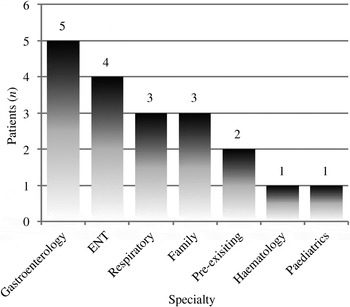
Nineteen patients were identified with definite or probable hereditary haemorrhagic telangiectasia, 11 of whom were male (57.8 per cent). Figure 1 demonstrates the specialty to which patients were initially referred (where the clinical diagnosis was made), with gastroenterology and ENT being the most common. Seventy-nine per cent of cases required some form of input from ENT regarding epistaxis management.
Specialty where patient first attended with symptoms. ‘Family’ refers to cases where a family member was diagnosed and screening suggested for the index patient, and ‘pre-existing’ refers to patients for whom the diagnosis had already been made in a different hospital.

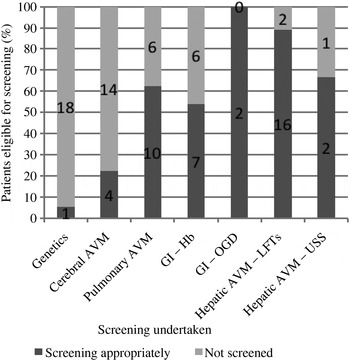
Screening was undertaken in only one patient from the ENT clinic (using a head MRI scan); other patients were screened by the medical teams or hereditary haemorrhagic telangiectasia centres. Not all patients were appropriate for screening; they may have already developed the condition and been undergoing treatment for the arteriovenous malformation in question. Figure 2 demonstrates the genetic and systemic arteriovenous malformation screening undertaken, conducted according to the guidelines.
Summary of screening fulfilment according to the guidelines.Reference Faughnan, Palda, Garcia-Tsao, Geisthoff, McDonald and Proctor 15 ‘GI – Hb’ refers to patients eligible for a haemoglobin check; ‘GI – OGD’ refers to patients found to be anaemic on a haemoglobin check who should have undergone oesophago-gastro-duodenoscopy if epistaxis was mild; ‘Hepatic AVM – LFTs’ refers to patients eligible for liver function testing for hepatic arteriovenous malformation; and ‘Hepatic AVM – USS’ refers to patients with abnormal liver enzymes or symptomatic hepatic arteriovenous malformation patients eligible for an ultrasound scan. The numbers in the columns represent the absolute numbers of patients in each group. AVM = arteriovenous malformation

Discussion
These results show a snapshot of secondary care involvement in the management of hereditary haemorrhagic telangiectasia, across all specialties within a district general hospital setting. It is difficult to compare our results of screening uptake as the wider literature primarily originates from tertiary centres with an interest in hereditary haemorrhagic telangiectasia, although we have no reason to suspect that Shropshire and Mid-Wales are any different with respect to hereditary haemorrhagic telangiectasia care.
Shortfalls arose in correctly identifying all affected patients, resulting in selection bias. The searches would have missed those patients only attending non-ENT out-patient clinics and those attending for any screening investigations as outpatients (e.g. endoscopy). Our screening results are therefore likely to be an overestimate of the true value for the total local population with hereditary haemorrhagic telangiectasia.
The authors also recognise that patients were assessed according to guidelines published in 2009, when their diagnoses and initial screening opportunities may have pre-dated this. However, it was felt that as the data captured included a screen at any point in time, there was opportunity for all patients in 2009 to have undergone any further screening that had previously been omitted. It also helped to identify where the current gaps in screening were, so that patients could subsequently be investigated as appropriate.
The ENT literature largely concentrates on the management of epistaxis in these patients, with little regard for the systemic implications of the condition. The authors feel that there is a vital screening opportunity missed in many cases, especially when such a proportion of patients require ENT input either at initial diagnosis (21 per cent) or for management of epistaxis in general (79 per cent). Verkerk et al. evaluated all those patients requiring treatment for epistaxis at the Royal National Throat, Nose and Ear Hospital with regard to pulmonary arteriovenous malformation screening, and found that only 57.7 per cent had been screened.Reference Verkerk, Shovlin and Lund 23 Our pulmonary arteriovenous malformation screening rate, at 62.5 per cent, was comparable, especially given our secondary care status. Despite this, our remaining areas, in particular genetic screening and cerebral screening, showed poor adherence to the guidelines. Possible explanations include unawareness of the systemic involvement of hereditary haemorrhagic telangiectasia, absolute diagnoses of hereditary haemorrhagic telangiectasia not requiring genetic testing confirmation, and possibly clinician awareness of cerebral arteriovenous malformation screening not being appropriate given the lack of adequate treatment options.
With regard to the international guidelines for the diagnosis and management of hereditary haemorrhagic telangiectasia, issues may arise when applying them to a UK population. Thirty-three clinicians and experts formed the international panel, of which 23 (69.6 per cent) were from North America, with only 1 clinician from the UK. This document outlines the strength of recommendation to be weak for genetic, cerebral arteriovenous malformation and pulmonary arteriovenous malformation screening, and to be strong for hepatic arteriovenous malformation and gastrointestinal bleeding. The recommendations were all based on level 3 evidence, except those for pulmonary arteriovenous malformations, which were based on level 2 evidence.Reference Faughnan, Palda, Garcia-Tsao, Geisthoff, McDonald and Proctor 15
Shovlin published an extensive literature review in 2010, which highlighted the wider issues of screening in hereditary haemorrhagic telangiectasia and evaluated further literature published since the international guidelines were devised.Reference Shovlin 24 In an earlier review, Govani and Shovlin discussed the medical justification for screening regimes in asymptomatic individuals for hereditary haemorrhagic telangiectasia population centres, focusing on the degree of danger posed by silent arteriovenous malformations, the safety and tolerability of the diagnostic tool, the advantages offered by the correct diagnosis in terms of patient management and follow up, and the safety of effective treatments.Reference Govani and Shovlin 25 Risk–benefit considerations are subsequently used to determine whether the detection and treatment of the asymptomatic arteriovenous malformation are likely to have overall positive health benefits for the patient.Reference Govani and Shovlin 25 This is particularly pertinent in a UK setting from a financial perspective, which may be different in other countries. The following sections are updates regarding the screening issues outlined in the international guidelines, designed specifically with UK ENT clinicians in mind.
Genetic testing
The international guidelines recommend that all patients with clinically confirmed hereditary haemorrhagic telangiectasia undergo genetic testing to evaluate the causative mutation in their family.Reference Faughnan, Palda, Garcia-Tsao, Geisthoff, McDonald and Proctor 15 However, in as many as 20 per cent of families, a causative mutation is not identified, and not all mutations in the ENG, ACVRL1 and SMAD4 genes result in clinically apparent hereditary haemorrhagic telangiectasia.Reference Govani and Shovlin 25 With this in mind, screening asymptomatic patients raises ethical considerations.
A positive test result will broadly mean one of three possibilities: (1) the phenotype is not apparent, and the patient remains asymptomatic; (2) the phenotype is mild; and (3) the phenotype is more severe. Due consideration should be given to each of these possibilities prior to the test with respect to the consequences. Knowledge of the presence of a mutation but not the ultimate phenotype can cause patients considerable worry, especially when arteriovenous malformation prevention is not possible and effective treatments are limited. A positive result would significantly alter life insurance premiums and securement of a mortgage, which would be disastrous in an asymptomatic patient or mild phenotype patient with normal life expectancy.
Therefore, it is suggested that genetic testing be reserved for patients where true benefits are likely to be gained; for instance, where a positive test result can confirm a suspected diagnosis of hereditary haemorrhagic telangiectasia. Genetic testing is not necessary to confirm a ‘definite’ diagnosis based on Curaçao criteria.Reference Govani and Shovlin 25
Pulmonary arteriovenous malformations
Data indicate that up to 60 per cent of patients have pulmonary arteriovenous malformations identified via screening with transthoracic contrast echocardiography,Reference Kjeldsen, Oxhøj, Andersen, Green and Vase 26 and that pulmonary arteriovenous malformations are often not diagnosed until an associated stroke (66.7 per cent) or cerebral abscess (64.3 per cent) occurs.Reference Shovlin, Jackson, Bamford, Jenkins, Benjamin and Ramadan 27 Indeed, pulmonary shunts of grade 2 or above have recently been shown to be significantly associated with the risk of a cerebral ischaemic event or abscess,Reference Velthuis, Buscarini, Van Gent, Gazzaniga, Manfredi and Danesino 28 and predict the need for transcatheter embolotherapy.Reference Velthuis, Buscarini, Van Gent, Gazzaniga, Danesino and Westermann 29 Data reviewed by the working group responsible for the international guidelines for the diagnosis and management of hereditary haemorrhagic telangiectasia demonstrated that embolisation showed very high rates of technical success and significant improvement in oxygenation, with a good safety profile.Reference Faughnan, Palda, Garcia-Tsao, Geisthoff, McDonald and Proctor 15
Since the publication of the international guidelines, there has been further evidence for excellent long-term success rates following the occlusion of large pulmonary arteriovenous malformations with the Amplatzer™ vascular plug, with no major complications or recanalisations.Reference Kucukay, Ozdemir, Senol, Okten, Ereren and Karan 30 However, emerging evidence suggests that, as 85 per cent of hereditary haemorrhagic telangiectasia type 1 patients have a positive transthoracic contrast echocardiography findingReference van Gent, Post, Snijder, Westermann, Plokker and Mager 31 that is not significant enough to require treatment, high-resolution CT might be employed as an alternative screening tool to reduce costs and limit resources.Reference Govani and Shovlin 25
Further considerations include the ionising radiation involved with these investigations. The cumulative radiation doses in hereditary haemorrhagic telangiectasia individuals undergoing CT surveillance scanning post-embolisation (every three to five yearsReference Cartin-Ceba, Swanson and Krowka 32 ) are considerably high.Reference Hanneman, Faughnan and Prabhudesai 33 Data regarding the optimal screening interval for pulmonary arteriovenous malformations after the first negative CT scan are lacking. The national hereditary haemorrhagic telangiectasia centre in London suggests that further CT scanning is not necessary in adulthood unless patients' ‘clinical circumstances change substantially’.Reference Shovlin 34 Interim screening can be performed with oxygen saturation monitoring and chest radiographs.
Cerebral arteriovenous malformations
Screening for cerebral arteriovenous malformations is less straightforward. The incidence has been approximated at 23 per cent in patients with hereditary haemorrhagic telangiectasia.Reference Fulbright, Chaloupka, Putman, Sze, Merriam and Lee 35 A study conducted in 2003 demonstrated that hereditary haemorrhagic telangiectasia patients under the age of 45 years have a 6- to 22-fold increased risk of haemorrhagic stroke, with males being at a significantly higher risk, with a 1.4–2 per cent per annum per patient lifetime risk.Reference Easey, Wallace, Hughes, Jackson, Taylor and Shovlin 36
There are no large case series focusing on treatments for cerebral arteriovenous malformations in hereditary haemorrhagic telangiectasia patients, and the evidence is therefore drawn from treatment in non-hereditary haemorrhagic telangiectasia patients. Treatment options include surgical excision, obliteration by radiotherapy and endovascular interventions. The treatments have variable success rates and side effect profiles, depending on the type of cerebral arteriovenous malformation being treated. For example, with surgical excisions, small superficial cerebral arteriovenous malformations attract a mortality rate of 0 per cent and cure rates of 94–100 per cent,Reference Fleetwood and Steinberg 37 , Reference Pikus, Beach and Harbaugh 38 whereas midbrain arteriovenous malformations unfortunately attract a mortality rate of nearly 20 per cent.Reference Maraire and Awad 39
More recently, a group published their series of endovascular treatments of cerebral arteriovenous malformations with regard to haemorrhagic complications.Reference Baharvahdat, Blanc, Termechi, Pistocchi, Bartolini and Redjem 40 They experienced bleeds in 11 per cent of procedures, for which over half were associated with non-arterial perforation and resulted in increased neurological deficits and worse prognosis.
A large multicentre and multinational randomised controlled trial (the ‘ARUBA’ trial) assessed the risk of death or stroke in patients with unruptured cerebral arteriovenous malformations, comparing medical management of neurological symptoms against medical and interventional management (including surgery, stereotactic radiotherapy and embolisation).Reference Mohr, Parides, Stapf, Moquete, Moy and Overbey 41 The trial was stopped in the early stages because of higher numbers of strokes and neurological deficits in the intervention arm.
Therefore, it can be argued that screening for and detection of a cerebral arteriovenous malformation puts the patient and clinician in a difficult situation. The lifetime risk of a bleed is low but not absent, and the interventions yield poorer prognoses than the medical management of symptoms. It is therefore considered unwise to routinely offer screening to these patients. However, if the patient opts for screening despite the anticipated drawbacks, the screening tool of choice remains cerebral MRI. The ‘gold standard’ of cerebral angiography attracts a 0.5 per cent risk of permanent stroke.Reference Willinsky, Taylor, TerBrugge, Farb, Tomlinson and Montanera 42
Hepatic arteriovenous malformations
The prevalence of hepatic arteriovenous malformations is significantly higher and can be over 70 per cent in some series, depending on the imaging modality used.Reference Ianora, Memeo, Sabba, Cirulli, Rotondo and Angelelli 43 – Reference Memeo, Stabile Ianora, Scardapane, Suppressa, Cirulli and Sabbà 45 Despite this, few of the malformations cause symptoms (8 per cent), and treatments are purely based on symptomatic improvement.Reference Ianora, Memeo, Sabba, Cirulli, Rotondo and Angelelli 43 , Reference Buscarini, Danesino, Olivieri, Lupinacci, De Grazia and Reduzzi 46 Indeed, a consensus document published in 2006 stated that treatments for asymptomatic hepatic arteriovenous malformations were not recommended.Reference Buscarini, Plauchu, Garcia Tsao, White, Sabbà and Miller 47
When the malformations become symptomatic, treatments include a variety of medical therapies, transarterial embolisations and liver transplantation in the extreme. A recent study on hepatic artery embolisation described a 10 per cent mortality rate, with a complication rate requiring re-intervention of 20 per cent.Reference Chavan, Luthe, Gebel, Barg-Hock, Seifert and Raab 48 This, together with transplantation, is reserved for those patients in whom medical therapy has failed, and only 3 per cent of hereditary haemorrhagic telangiectasia patients with hepatic arteriovenous malformations will experience medical therapy failure.Reference Buscarini, Manfredi, Gazzaniga, Reduzzi, Danesino and Olivieri 49 Despite this, bevacizumab (an anti-vascular endothelial growth factor monoclonal antibody), has demonstrated improvements in patients with high-output cardiac failure associated with hepatic arteriovenous malformation.Reference Dupuis-Girod, Ginon, Saurin, Marion, Guillot and Decullier 50 , Reference Young, Henderson, White and Garcia-Tsao 51 However, controlled trials and further evidence are required to determine its safety and ideal regimen when used for prolonged periods of time.
The international guidelines state that Doppler US should be offered to those with symptoms of hepatic arteriovenous malformations and/or abnormal liver enzyme function, implying that this is a valid test.Reference Faughnan, Palda, Garcia-Tsao, Geisthoff, McDonald and Proctor 15 A recent conference abstract, however, demonstrated that although liver enzyme abnormalities were significantly associated with the presence of hepatic arteriovenous malformations, their presence had low sensitivity in terms of distinguishing between asymptomatic hepatic arteriovenous malformations and those causing significant liver disease. In addition, liver enzyme abnormalities did not accurately predict liver disease progression.Reference Singh, Swanson and Kamath 52 The same authors also demonstrated that 53 per cent and 67 per cent of symptomatic patients had biochemical abnormalities and abnormal liver examination findings respectively, but 32 per cent of asymptomatic patients had a high cardiac index, abnormal liver examination findings or biochemical abnormalities.Reference Singh, Swanson and Kamath 53
Doppler US scanning is still regarded as the gold standard, as there is no radiation exposure involved and it is adequately sensitive.Reference Buscarini, Buscarini, Danesino, Piantanida, Civardi and Quaretti 54 , Reference Caselitz, Bahr, Bleck, Chavan, Manns and Wagner 55 More recent evidence suggests the use of intravenous contrast with ultrasonography, which demonstrates sensitivity rates of 89 per cent as compared with CT; this technique is therefore a possible contender for future screening when more data become available.Reference Guillot, Marion, Decullier, Saurin, Plauchu and Calender 56
It is therefore felt that Doppler US (with contrast if available) should be used to screen patients if they become symptomatic. However, liver enzyme testing is considered a poor discriminator and should be disregarded as a screening tool for hepatic arteriovenous malformations.
Gastrointestinal bleeding
Gastrointestinal bleeding can be a significant problem for hereditary haemorrhagic telangiectasia patients, causing iron deficiency anaemia. Indeed, anaemia from gastrointestinal bleeding and/or epistaxis can result in a transfusion rate of 50 per cent in hereditary haemorrhagic telangiectasia patients.Reference Montifar, Kasthuri, Kim, Young and Faughnan 57 Anaemia also appears to be more significant in women with hereditary haemorrhagic telangiectasia and is diagnosed at an earlier age (34 years in females vs 43 years in males), although this latter finding relates to being female and not to hereditary haemorrhagic telangiectasia causes.Reference Montifar, Kasthuri, Kim, Young and Faughnan 57
After diagnosis of anaemia that is not related to epistaxis severity, the international guidelines suggest upper gastrointestinal endoscopy as the first-line investigation.Reference Faughnan, Palda, Garcia-Tsao, Geisthoff, McDonald and Proctor 15 Recent data suggest that although endoscopy is relatively safe, hereditary haemorrhagic telangiectasia patients have a 10-fold increase in complications as compared with the general population, specifically infection and bleeding post-procedure.Reference Rozenberg and Faughnan 58 Capsule endoscopy has been evaluated in hereditary haemorrhagic telangiectasia patients as an alternative; this has demonstrated a high diagnostic yield, with telangiectasias identified in 87 per cent of cases, with no adverse events reported.Reference Greve, Moussata, Gaudin, Lapalus, Giraud and Dupuis-Girod 59
Endoscopic treatments for gastrointestinal bleeding include argon plasma coagulation. This has demonstrated a complete response of 80 per cent in the short term and 60 per cent in the longer term (three to four years), with a complication rate of 2.2 per cent, as reported in a review published in 2014.Reference Manfredi, Crino, De Grazia, Lupinacci, Brambilla and Menozzi 60 This appears to be a more effective and safer treatment than the suggested medical treatments, which include oestrogen-progesterone preparations, thalidomide and tranexamic acid to name but a few. Such medical treatments may be poorly tolerated, and are associated with side effects such as venous thromboembolism, feminising effects in men, bleeding, hypertension, stroke and gastrointestinal perforation.Reference Manfredi, Buscarini, De Grazia, Lupinacci, Menozzi and Brambilla 61 , 62 However, bevacizumab has mounting evidence as a useful treatment in reducing severe bleeding in hereditary haemorrhagic telangiectasia patients, both from an epistaxis point of view and in terms of gastrointestinal bleeds.Reference Radwi, Ponnampalam, Faughnan and Shehata 63 , Reference Kanellopoulou and Alexopoulou 64
-
• Hereditary haemorrhagic telangiectasia patients regularly consult ENT clinicians for epistaxis management
-
• Opportunities for systemic arteriovenous malformation screening are often missed, leading to potential morbidity and mortality
-
• International guidelines exist on the screening for each arteriovenous malformation
-
• These guidelines have been revised within the context of a UK healthcare system, and with up-to-date evidence regarding appropriateness and efficacy
Current consensus suggests that if iron replacement measures (diet and supplements) fail to limit anaemia associated with gastrointestinal bleeding, then first-line treatments should be local and include argon plasma coagulation rather than medical therapies. However, these decisions should be made under the supervision and guidance of hereditary haemorrhagic telangiectasia centre specialists, rather than at a local level.
Yearly haemoglobin checks for asymptomatic patients are therefore still recommended, as per international guidelines. For symptomatic patients, haemoglobin checks should be undertaken when patients have symptoms of anaemia and are likely to require a transfusion, and capsule endoscopy should be conducted, or endoscopy if these are not available.
The screening and intervention risks and benefits in children and pregnant women are beyond the scope of this article. However, ENT clinicians should be mindful of the types of screening issues already explored for arteriovenous malformations in adults. The authors recommend that tertiary specialist advice is sought prior to any investigations.
Conclusion
Screening opportunities for patients with hereditary haemorrhagic telangiectasia are often missed in a secondary care setting, but particularly by ENT clinicians. Recent evidence and consideration of the issues around screening and the associated treatments where arteriovenous malformations are detected have resulted in amendments of the international guidelines for the diagnosis and management of hereditary haemorrhagic telangiectasia, specifically designed for ENT clinicians within the UK.
These revised guidelines can be summarised as follows: (1) ensure the diagnosis is correct using the Curaçao criteriaReference Shovlin, Guttmacher, Buscarini, Faughnan, Hyland and Westermann 20 (seek genetic testing only if uncertain); (2) discuss the diagnosis and potential for other arteriovenous malformations with the patient; (3) arrange high-resolution CT scans of the chest and conduct screening for pulmonary arteriovenous malformation; (4) arrange annual haemoglobin check for those aged over 35 years (if the patient is anaemic, suggest diet supplementation with or without iron supplements); (5) arrange capsule endoscopy or oesophago-gastro-duodenoscopy if the anaemia continues in excess of epistaxis symptoms; (6) arrange a Doppler US scan of the liver if the patient is symptomatic (dyspnoea, orthopnoea, ascites, jaundice or variceal haemorrhage);Reference Sabbà and Pompili 65 (7) if systemic arteriovenous malformations are found, refer the patient to a specialist centre for treatment (see Appendix 1 for national hereditary haemorrhagic telangiectasia centre contact details); (8) discuss familial implications with the patient and request that family members be referred by their general practitioner; (9) discuss with the patient the rationale for non-screening of cerebral arteriovenous malformations (refer the patient to a national hereditary haemorrhagic telangiectasia centre for further advice if the patient wishes to be screened); and (10) commence epistaxis management (if necessary) as per best evidence for hereditary haemorrhagic telangiectasia patients.
Acknowledgements
The authors acknowledge the kind help of Dr C Shovlin and VJ Lund for their advice regarding the manuscript.
Appendix 1. National UK hereditary haemorrhagic telangiectasia centre contact details
Dr C Shovlin,
Hammersmith Hospital,
Du Cane Road,
London W12 0HS, UK
Tel: 020 3313 1000
Dr G Robinson,
Hull Royal Infirmary,
Anlaby Road,
Hull HU3 2JZ, UK
Tel: 01482 875 875