Introduction
Robert Butler (Reference Butler, Butler and Gleason1985) called for a change in our perception of ageing from ‘dependency’ to ‘productivity’ in his edited book Productive Aging. In Japan, people aged 65 years and older accounted for 28 per cent of the total population in 2017 (Statistics Bureau 2017a) and this figure is projected to rise to 35 per cent by 2040 (National Institute of Population and Social Security Research 2017). At the same time, the working-age population (15–64) will decrease to 54 per cent of the total population. The increasing old-age dependency ratio has turned older people's participation in productive activities into an important policy issue.
Productive activities are ‘any activity that produces goods and services, whether paid or not, including activities such as housework, child care, volunteer work, and help to family and friends’ (Herzog et al. Reference Herzog, Kahn, Morgan, Jackson and Antonucci1989: S130). A key productive role for older adults is volunteering in the community, such as supporting frail elderly and disadvantaged children, or assisting in keeping the environment clean and safe. Volunteering may be further differentiated between formal and informal types. Formal volunteering is typically defined as ‘activity involving a person's time and effort that is not compensated by regular payment or monetary reward, but is freely undertaken and produces goods and services for organizations and by extension, for other individuals’ (Burr et al. Reference Burr, Choi, Mutchler and Caro2005: S247). In this article we use the term ‘volunteering’ to refer to formal volunteering which differs from ‘informal volunteering’ defined as helping friends, neighbours and family members who live outside the household (Mutchler, Burr and Caro Reference Mutchler, Burr and Caro2003). When the study refers to informal volunteering for family, we use the term ‘unpaid work for family’.
A number of longitudinal studies have shown volunteering to have beneficial effects on older adults in Western developed nations. Compared to non-volunteers, older volunteers are more likely to show both higher life satisfaction and subjective health (Luoh and Herzog Reference Luoh and Herzog2002; Morrow-Howell et al. Reference Morrow-Howell, Hinterlong, Rozario and Tang2003; Van Willigen Reference Van Willigen2000), and lower risk of depressive symptoms (Li and Ferraro Reference Li and Ferraro2006; Morrow-Howell et al. Reference Morrow-Howell, Hinterlong, Rozario and Tang2003), functional limitations (Li and Ferraro Reference Li and Ferraro2006; Luoh and Herzog Reference Luoh and Herzog2002; Morrow-Howell et al. Reference Morrow-Howell, Hinterlong, Rozario and Tang2003), frailty (Jung et al. Reference Jung, Gruenewald, Seeman and Sarkisian2010), high blood pressure (Sneed and Cohen Reference Sneed and Cohen2013) and mortality (Okun, Yeung and Brown Reference Okun, Yeung and Brown2013). Although studies are relatively limited, the beneficial effects on health and wellbeing are also observed in Asian nations including Japan (Li, Chen and Chen Reference Li, Chen and Chen2013; Sugihara et al. Reference Sugihara, Sugisawa, Shibata and Harada2008; Tomioka, Kurumatani and Hosoi Reference Tomioka, Kurumatani and Hosoi2017).
Volunteering as social demand
With rising social security costs associated with population ageing, it is not realistic to expect the public sector to provide all the necessary services. Furthermore, changes in the family structure have increased the need for volunteers. The traditional system of three-generational households is breaking down in many parts of Japan, resulting in many elderly single and couple households (Ministry of Health, Labour and Welfare 2017). Help with household chores and assistance to get outside the home is not fully provided for under the public long-term care insurance system (LTC). If such support is not available within the local community, the frail elderly person faces the possibility of being institutionalised and thus increases the LTC costs. The most recent revision of the LTC has acknowledged the need to increase volunteering activities to support elderly people to remain in their own homes. Healthy older people are being encouraged to volunteer as it is considered that this productive activity will have the added benefit of enhancing the volunteers’ own psychological and physical wellbeing and delay their need to use the LTC services (Ministry of Health, Labour and Welfare 2016).
Whilst increased volunteering is being encouraged, policy makers are also promoting greater labour-force participation among older people, including raising the pension age from 60 to 65. Indeed, labour participation was 64 per cent (men: 77%, women: 51%) for age 60–64 and 43 per cent (men: 53%, women: 33%) for age 65–69 in 2016, which is an increase by 11 and 8 points, respectively, from 2006 (Statistics Bureau 2017b). If the labour-force participation competes with volunteer participation, the delay in retirement may reduce the number of volunteers in the community.
Moreover, a considerable number of older people already engage in unpaid work for family. Caring for a sick or disabled family member is also a major productive role for older adults. In Japan, family care-givers are ageing as well, such that 70 per cent of the co-resident primary care-givers are 60 years or older (Ministry of Health, Labour and Welfare 2017). Although custodial grandparenting (Hayslip and Kaminski Reference Hayslip and Kaminski2005) is not yet a major social issue in Japan, providing care to grandchildren to assist their parents is highly expected because of the increase in working mothers (Komatsu, Saito and Kai Reference Komatsu, Saito and Kai2010).
Morrow-Howell (Reference Morrow-Howell2010) regarded the relationship between volunteering and other social activities as one of the leading-edge questions in volunteer research. How older adults can balance multiple productive roles is becoming more important, particularly in a super-ageing society like Japan. However, we have little knowledge about how employment and unpaid work for family are linked with volunteering among Japanese older adults. This study examined these linkages as a first step to promote volunteering. If we find that employed people are less likely to volunteer, for example, we could focus on the way to connect the employed to volunteer work.
Relationships between productive activities: competing or complementary?
Volunteering, employment and unpaid work for family may compete as well as complement with one another. For instance, the role-overload hypothesis suggests that individuals facing too many demands from multiple roles experience strain which limits engagement in certain roles such as volunteering (Choi et al. Reference Choi, Burr, Mutchler and Caro2007; Lancee and Radl Reference Lancee and Radl2014; Mutchler, Burr and Caro Reference Mutchler, Burr and Caro2003). Whilst the activity or role-substitution hypothesis states that the loss of a significant role (e.g. retirement from paid work) would serve as the impetus to take on a new role (e.g. volunteering) (Chambré Reference Chambré1984; Lancee and Radl Reference Lancee and Radl2012, Reference Lancee and Radl2014). Although ‘role-substitution’ assumes a different motivation from ‘role-overload’, both presume the relationship between the two roles to be negative in the sense that those who engage in one activity are less likely to engage in another.
In contrast, according to the complementary perspective, engaging in a productive activity may facilitate contact with social networks and organisations that provide more opportunities for volunteering (Burr et al. Reference Burr, Choi, Mutchler and Caro2005; Carr and Kail Reference Carr and Kail2013; Choi et al. Reference Choi, Burr, Mutchler and Caro2007). Moreover, one may be motivated to volunteer to acquire career-related skills and contacts (Clary et al. Reference Clary, Snyder, Ridge, Copeland, Stukas, Haugen and Miene1998; Okun, Barr and Herzog Reference Okun, Barr and Herzog1998). Conversely, skills acquired through paid work, care-giving or other housework may be valuable for volunteering. Finally, when a role is obligatory and stressful, such as care for a sick family member, people may pursue other activities as a respite (Choi et al. Reference Choi, Burr, Mutchler and Caro2007; Hoyert and Seltzer Reference Hoyert and Seltzer1992).
Employment and volunteering
Evidence regarding the linkages between employment and volunteering is mixed. In support for the competing hypothesis, retirees were found to be more likely to start volunteering, compared with those employed (Hank and Erlinghagen Reference Hank and Erlinghagen2010; Butrica, Johnson and Zedlewski Reference Butrica, Johnson and Zedlewski2009), although McNamara and Gonzales (Reference McNamara and Gonzales2011) did not find an association between employment status and entry into volunteering. Moreover, hours of volunteering for the non-employed (or part-time workers) are more likely to be longer than those for the employed (or full-time workers) (Chambré Reference Chambré1984; Mutchler, Burr and Caro Reference Mutchler, Burr and Caro2003; McNamara and Gonzales Reference McNamara and Gonzales2011).
In contrast, consistent with the complementary perspective, a higher percentage of those in the labour force volunteer than those not in the labour force in the United States of America (USA) (Bureau of Labor Statistics 2016; Chambré Reference Chambré1984) and volunteering delays labour-force withdrawal (Carr and Kail Reference Carr and Kail2013; Lancee and Radl Reference Lancee and Radl2012). In a study for older adults by Choi (Reference Choi2003), part-time workers, but not full-time workers, were more likely to volunteer than non-workers.
These mixed findings suggest that results could vary according to the level of participation in the labour force (i.e. full-time, part-time or non-workers) as well as the level of participation in volunteer activities. Full-time workers are less likely to engage in volunteering, at least for long hours, compared with part-time or non-workers (Choi Reference Choi2003; McNamara and Gonzales Reference McNamara and Gonzales2011; Mutchler, Burr and Caro Reference Mutchler, Burr and Caro2003). However, the negative association between hours of working and probability of volunteering may not be linear, considering Choi's (Reference Choi2003) findings that part-time workers were more likely to volunteer than non-workers.
Unpaid work for family and volunteering
Findings regarding the association between volunteering and unpaid family work are equally diverse. Burr et al. (Reference Burr, Choi, Mutchler and Caro2005) found that care-givers who devoted more time to care-giving for sick or disabled friends or relatives reported a greater number of volunteer hours than non-care-givers. In their study, care-givers were also more likely than non-care-givers to be asked to volunteer, suggesting connections with social networks that provide information and opportunities for volunteering. Nonetheless, spousal care-giving was shown to compete with volunteering among women (Choi et al. Reference Choi, Burr, Mutchler and Caro2007) or to increase the cessation of volunteering (McNamara and Gonzales Reference McNamara and Gonzales2011). Some research suggests that associations between care-giving and social activities that are not productive would vary depending on the relationship to a care recipient (Farkas and Himes Reference Farkas and Himes1997; Hoyert and Seltzer Reference Hoyert and Seltzer1992).
Regarding child care, Bulanda and Jendrek (Reference Bulanda and Jendrek2016) reported that providing non-residential grandchild care increased volunteerism. In this study, grandparents raising co-residential grandchildren had lower odds of volunteering than those providing no regular grandchild care, but this negative association was insignificant after controlling for socio-economic status and health and wellbeing, suggesting that variations in these resources could account for the differences in volunteerism between the groups. Butrica, Johnson and Zedlewski (Reference Butrica, Johnson and Zedlewski2009) showed that providing child care, including grandchild care, was not significantly associated with ceasing to volunteer, while starting child care enhanced the probability of starting volunteer work. Thus, although previous research is limited, it suggests that providing care for grandchildren may have a complementary relationship with volunteering.
There remain several questions to be solved regarding unpaid work for family. The first one is how hours of unpaid family work are associated with volunteering; whether full-time level unpaid work competes with volunteering as paid work seems to do. Previous studies have examined unpaid work by types of activities such as sick/disabled care and grandchild care, and consequently even those in the highest participation group engaged much fewer hours in the activity than those of full-time paid workers (e.g. 200 hours or more per year for sick/disabled care in Burr et al. Reference Burr, Choi, Mutchler and Caro2005). Although hours of a single activity may rarely exceed full-time level among the general population, total hours of unpaid work for family could be longer, especially when caring for a co-resident family member is added to the time taken for household chores.
The second question is how different types of unpaid work for family correlate with volunteering. There seems to be variations across types of activities within unpaid work for family due to different levels of burden or problems specific to each activity. In the case of sick/disabled care, the relationship with the care recipient could affect the results. In addition, the type of activity may offer varying degrees of contact with social networks or organisations that provide opportunities for volunteering. However, as few studies have directly examined these as mediators, the third question would be to what extent one's social network increases opportunities for volunteering in the event that a complementary relationship between volunteering and other productive activities exists.
Volunteering in the Japanese setting
The vast majority of studies reviewed above were based on data derived from the Health and Retirement Study (Bulanda and Jendrek Reference Bulanda and Jendrek2016; Butrica, Johnson and Zedlewski Reference Butrica, Johnson and Zedlewski2009; Carr and Kail Reference Carr and Kail2013; Choi et al. Reference Choi, Burr, Mutchler and Caro2007; McNamara and Gonzales Reference McNamara and Gonzales2011) or the Americans’ Changing Lives survey (Burr et al. Reference Burr, Choi, Mutchler and Caro2005; Mutchler, Burr and Caro Reference Mutchler, Burr and Caro2003) in the USA, and some from European longitudinal studies (Hank and Erlinghagen Reference Hank and Erlinghagen2010; Lancee and Radl Reference Lancee and Radl2012, Reference Lancee and Radl2014). There is very limited understanding of volunteering among old adults in non-Western nations. Regarding Japanese older adults, we found only one study that examined associations of employment and unpaid work for family with volunteer participation (i.e. participating or not) among the young-old in an urban city (Lee et al. Reference Lee, Saito, Takahashi and Kai2008). This study reported that full-time paid workers were less likely to volunteer than non-workers for women, but this relationship was not significant for men.
Volunteering can vary across countries that differ significantly in culture and social institutions. For example, in the 2015 Current Population Survey (CPS) in the USA, 24 per cent of adults aged 65 and older volunteered through or for an organisation during the survey reference year, and 43 per cent of the volunteers reported a religious organisation as the main organisation for which they volunteered (Bureau of Labor Statistics 2016). In the 2016 Survey on Time Use and Leisure Activities (STULA), where volunteer work is not limited to organisational work, 25 per cent of older Japanese (65+) had done at least one of 11 different volunteer activities in the past year (Statistics Bureau 2017c). The volunteer activity with the highest participation rate of 13 per cent is for ‘local improvement activities (cleaning up parks and roads, planting flowers, or promoting the local community, etc.)’, for which 70 per cent of the volunteers worked as a member of a neighbourhood association. Participation rates for other volunteer activities are all less than 7 per cent. Thus, participation in charity work or volunteer work for a religious organisation is not so common in Japan where most volunteering take place through neighbourhood associations.
In addition to employment and unpaid work for family, previous studies have shown that human, social and cultural capital are key factors of volunteering (Bulanda and Jendrek Reference Bulanda and Jendrek2016; Burr et al. Reference Burr, Choi, Mutchler and Caro2005; Choi et al. Reference Choi, Burr, Mutchler and Caro2007; McNamara and Gonzales Reference McNamara and Gonzales2011; Wilson and Musick Reference Wilson and Musick1997). They suggested that people with more human capital, measured by higher education and better financial and health status, were more likely to volunteer (Bulanda and Jendrek Reference Bulanda and Jendrek2016; Burr et al. Reference Burr, Choi, Mutchler and Caro2005; Choi Reference Choi2003; Choi et al. Reference Choi, Burr, Mutchler and Caro2007; McNamara and Gonzales Reference McNamara and Gonzales2011; Wilson and Musick Reference Wilson and Musick1997), although education and subjective financial status were not significantly associated with volunteering in Lee et al. (Reference Lee, Saito, Takahashi and Kai2008) for Japanese older adults. More social capital or a larger social network was positively associated with volunteering (Burr et al. Reference Burr, Choi, Mutchler and Caro2005; Wilson and Musick Reference Wilson and Musick1997). Religiosity or religious behaviour has been used as a proxy for cultural capital because cultural capital is a complex construct (Bulanda and Jendrek Reference Bulanda and Jendrek2016). While it has been consistently shown that religious people are more likely to volunteer in Western studies (Bulanda and Jendrek Reference Bulanda and Jendrek2016; Choi Reference Choi2003; Choi et al. Reference Choi, Burr, Mutchler and Caro2007; McNamara and Gonzales Reference McNamara and Gonzales2011; Wilson and Musick Reference Wilson and Musick1997), few studies have examined the relationship between religiosity and volunteering in Japan where Christianity is not a major religion.
Thus, Japan provides an ideal setting for further validation and elaboration of research based on Western developed nations in that it extends the variance in key factors influencing volunteering beyond what is observable in the Western nations.
The present study
We aimed to address the following three research questions, by using data from a national sample of Japanese adults aged 60 and older. First, how do the levels of paid work and unpaid work for family associate with the extent of volunteering? To answer this question, we measured unpaid work for family as the total hours of sick/disabled care, grandchild care and general household chores, and categorised paid work and unpaid family work into four or five levels ranging from 0 to 150 hours or more per month (i.e. full-time level work). In addition, we conceptualised that linkages among employment, unpaid work for family and volunteering existed in the context of one's human, social and cultural capital (e.g. Wilson and Musick Reference Wilson and Musick1997). With the framework, we hypothesised that spending long hours (i.e. 150+ hours per month) on paid work would compete with volunteering, whereas spending fewer than 150 hours on one's job may complement volunteering. A similar association between unpaid work for family and volunteering was hypothesised, but the levels of the association may differ from those between paid work and volunteering.
Second, how do different types of unpaid work for family correlate with volunteering? We hypothesised that, for example, unpaid sick/disabled care and grandchild care may differ in how they compete with or complement volunteering.
Third, does a complementary relationship between volunteering and productive activities exist, and if so, to what extent does one's social network account for increased opportunities for volunteering? Since volunteering is often provided in the community context, social network was measured as community network, such as informal ties with neighbours and membership of community organisations.
Methods
Sample and data
Data came from the 2012 survey of the National Survey of the Japanese Elderly (NSJE), an eight-wave (1987, 1990, 1993, 1996, 1999, 2002, 2006 and 2012) longitudinal survey of a nationwide probability sample of Japanese older adults. In 2012, the new cohort aged 60–92 were added to the older panel aged 76 or older who were recruited in the years 1987, 1990, 1996 and 1999. We analysed data of this new cohort cross-sectionally because variables of productive activities were available only for them.
Regarding the 2012 new cohort, 2,500 people aged 60–92 were randomly selected from Resident Registers using a two-stage stratified sampling method. We excluded 21 people who lived in long-term care institutions and another 18 who had died by the time of survey. Among the remaining 2,461, 1,324 (54%) people responded to a face-to-face interview themselves and 126 (5%) to a proxy interview. We used the data of the 1,324 self-respondents here.
Measures
Volunteer participation
Respondents were asked whether they had participated in the following six activities in the past year: (a) local improvement activities such as cleaning up a road or park (including planting flowers campaign, conservation of nature, etc.); (b) local safety promotion activities such as traffic safety campaigns, crime prevention and disaster prevention; (c) volunteer activities for the elderly, handicapped, children, welfare facilities, etc.; (d) acted as a leader or assistant who manages community activities or a social group; (e) a district welfare commissioner, probation officer, administrative consulting commissioner or other public volunteer activities; (f) other activities for community or volunteer activities. Most neighbourhood associations engage in the first two activities to some degree in Japan. If the respondents had participated in any of the activities, they were asked how often they did these activities altogether in the past year. Fischer, Mueller and Cooper (Reference Fischer, Mueller and Cooper1991) suggested whether the time commitment is ‘regular’ or ‘occasional’ is one of the important dimensions to classify volunteer roles. We operationally defined ‘regular volunteer’ as those who volunteered once a month or more in the past year, and ‘occasional volunteer’ as those who did less than once a month. Those who did not participate in any volunteer activities are referred to as ‘non-volunteer’.
Paid work
Employment status was categorised into ‘not working’, ‘less than 50 hours per month’, ‘50–149 hours per month’ and ‘150 hours or more per month’. The category ‘less than 50 hours’ also included those who worked on an irregular basis. The last category of ‘150 hours or more’ corresponds to 35 hours or more per week, which means the person is a full-time worker. We originally categorised hours by 50-hour intervals, but categories of ‘50–99 hours’ and ‘100–149 hours’ were integrated into ‘50–149 hours’ because each category only consisted of around 5 per cent of the respondents. Although some studies suggest that unemployment impedes men's volunteer participation (Lancee and Radl Reference Lancee and Radl2014; Taniguchi Reference Taniguchi2006), we did not differentiate unemployment from ‘not working’ because only 15 non-workers were looking for a job. Thus, the majority of non-workers are assumed to be retirees or housewives in our sample.
Unpaid work for family
Three aspects of unpaid work for family were measured: (a) care-giving for a disabled or sick family member(s) (sick/disabled care), (b) grandchild care and (c) household chores. Questions were as follows. In the past year, (a) ‘have you taken care of a disabled or sick family member or relative? Include even slight assistance or care taking such as watching after a person with dementia, etc.’; (b) ‘have you taken care of a grandchild or great-grandchild? Include playing with him/her or tutoring’; (c) ‘have you done household chores, shopping or child care for yourself, family members or relatives? Include weeding and watering plants, car or bike maintenance or furniture repair as part of housework’. Those who had done any of these activities in the past year were asked its frequency. If they had done at least once a month, then they were asked how many hours they did them each day. The frequency was converted to days per month, taking a mid-point of each category (e.g. 4–6 days per week = 5 days, multiplied by 4.3 weeks per month = 21.5 days per month), and was multiplied by hours per day to obtain hours per month for each activity.
Total hours of unpaid work for family per month were the sum of the three activities, divided into five categories: never, less than 50 hours, 50–99 hours, 100–149 hours, and 150 hours or more. ‘Never’ includes those who did the activity less than once a month. As household work often comprises a mixture of the three activities, they are not mutually exclusive. However, we believe there was little over-counting because correlations between the activities were low (Spearman's rho < 0.20). Very few people spent more than 150 hours per month on a single activity (1.4% for (a) and (b); 3.5% for (c)). Thus, when we examined the three activities separately, we used a different criterion: never, less than 30 hours, and 30 hours or more per month which corresponds to one hour or more per day. Regarding (a) sick/disabled care, we also asked about the relationship with the person whom the respondent took care of the most (e.g. spouse, parent, parent-in-law, etc.).
Covariates
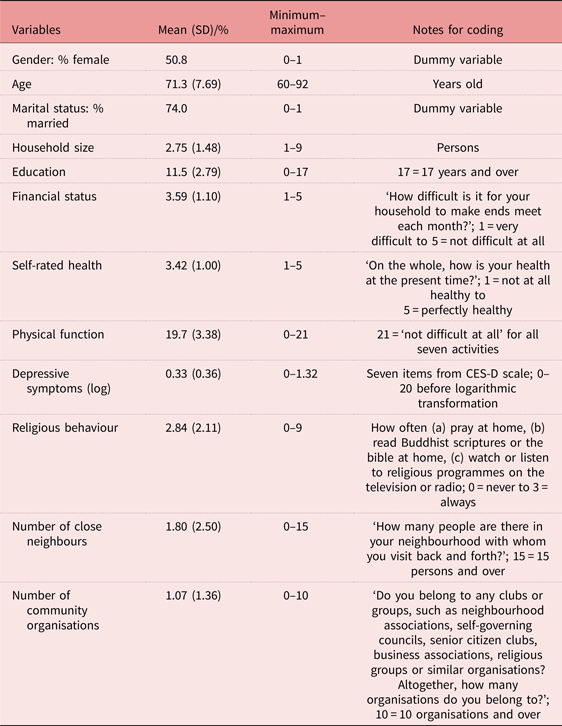
Gender (female = 1), age and several other variables corresponding to human, social and cultural capital were introduced as covariates to predict volunteering as in the previous studies (Bulanda and Jendrek Reference Bulanda and Jendrek2016; Burr et al. Reference Burr, Choi, Mutchler and Caro2005; Choi et al. Reference Choi, Burr, Mutchler and Caro2007; McNamara and Gonzales Reference McNamara and Gonzales2011; Wilson and Musick Reference Wilson and Musick1997). Descriptive statistics for these variables are shown in Table 1. Measures for human capital were years of education, subjective financial status, self-rated health, physical function and depressive symptoms. Financial status and self-rated health were assessed by five-point scales with a higher score reflecting more financial stability or better health (for the questions, see Table 1). Physical function was assessed using seven items: standing for about 15 minutes; walking a few blocks; lifting and carrying, etc. Each activity had a four-point rating and a higher score meant better physical function (0–21, Cronbach's alpha = 0.91). Depressive symptoms were measured by the sum of seven items from the Center for Epidemiologic Studies Depression (CES-D) scale (Radloff Reference Radloff1977), with a higher score indicating more depressive symptoms (0–21, alpha = 0.81). This variable was used after logarithmic transformation due to high skewness of the distribution.
Characteristics of respondents

Notes: N = 1,310. SD: standard deviation. CES-D: Center for Epidemiologic Studies Depression.
Social capital was measured by social network variables including family and non-family network such as marital status (married = 1), household size (i.e. number of people living together) and two other indicators of community network: number of neighbours with whom one has close contact and number of affiliated community organisations. Religious behaviour as a proxy for cultural capital was measured by frequency of private religious practices which Krause et al. (Reference Krause, Liang, Bennett, Kobayashi, Akiyama and Fukaya2010) developed for Japanese older adults. Although Cronbach's alpha was low (0.47), we used the composite index of three items in Table 1 (0–9) to capture a variety of practices based on different religions as much as possible. Religious affiliation among the respondents was mainly Buddhism (37%), although 49 per cent reported they did not have a specific religion.
Data analyses
First, we examined bivariate associations between hours of paid work or unpaid work for family and volunteer participation through chi-square tests. Next, we treated volunteer participation (reference category: non-volunteer) as an outcome variable in a multinominal logistic regression analysis where hours of paid work and unpaid work for family were introduced as explanatory variables. Regarding hours of unpaid work for family, the variable of total hours was introduced in Model A, and then it was replaced by individual hours for sick/disabled care, grandchild care and household chores in Model B. All the covariates, except the two indicators of community network, were included in Model A and Model B1. In Model B2, the number of close neighbours and membership of community organisations were added in order to examine whether a complementary relationship between some productive roles and volunteer participation could be explained by a larger community network. Before examining Model B2, we compared the mean values of these two network variables across levels of participation in paid work and three types of unpaid family work, using one-way analysis of variance and Tamhane's T2 for post hoc tests, which is applicable for unequal sample sizes and unequal variances.
Additionally, we checked the effect of the relationship to a care recipient instead of hours of sick/disabled care as Model B1. Given the gendered nature of roles in Japan, we also examined interactions by paid work and unpaid work for family in Models A and B to check whether the associations varied across gender.
We deleted 14 respondents from the analysis because of missing data for productive activities. Missing data for covariates were imputed via the multiple imputation method (Rubin Reference Rubin1987; number of data-sets = 5). The missing rate for each covariate was less than 2 per cent except for financial status (2.9%) and depressive symptoms (2.1%). Thus, the final sample size analysed was 1,310. All statistical analyses were performed using the IBM SPSS version 20 software.
Results
Participation in volunteer and other productive activities
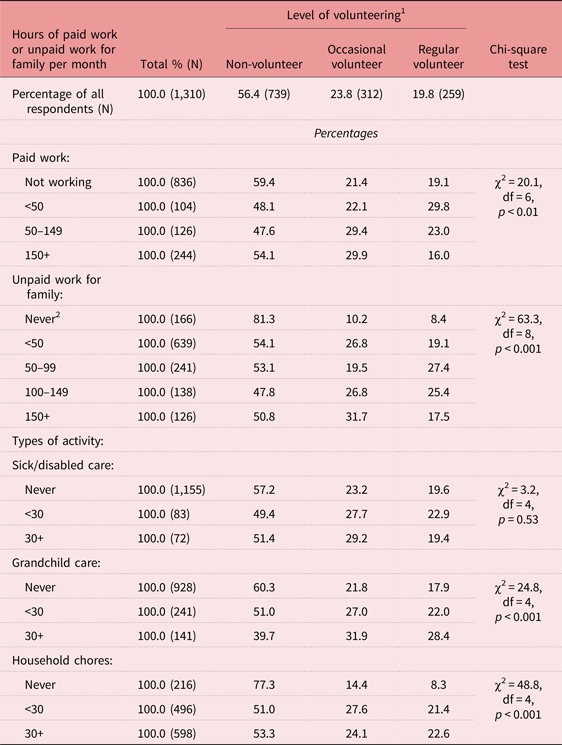
As shown in the first row of Table 2, more than half of the respondents (56%) had not done any volunteer activities in the past year (non-volunteer), while 20 per cent of them volunteered at least once a month (regular volunteer) and 24 per cent volunteered less than once a month (occasional volunteer). The activity type most engaged in was ‘local improvement activities such as cleaning up a road or park’ (32%), followed by ‘acted as a leader or assistant who manages community activities or a social group’ (20%), ‘local safety promotion activities’ (12%) and ‘volunteer activities for the elderly, etc.’ (9%).
Volunteer participation rates by hours of paid work and unpaid work for family
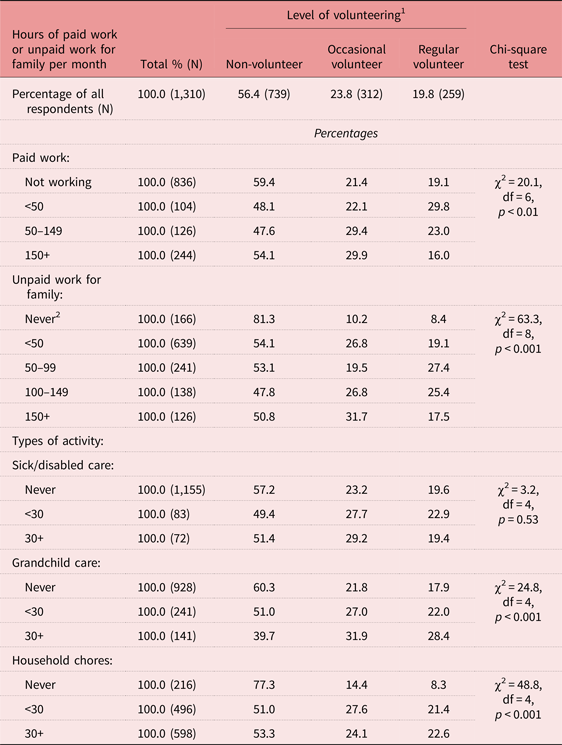
Notes: 1 Occasional: volunteered several times a year; regular: volunteered once a month or more. 2. ‘Never’ includes those who did the activity several times a year but less than once a month. df: degrees of freedom.
One-third of respondents (N = 474) were currently working, including part-time or irregular workers. About half of the respondents (N = 639) engaged in unpaid work for family for less than 50 hours per month. Among the three types of activities for family, the largest number of respondents did 30 hours or more per month of household chores (N = 598 or 46% of respondents), followed by grandchild care (N = 141; 11%) and sick/disabled care (N = 72; 5%).
Cross-tabulation of Table 2 showed that non-workers of paid or unpaid work for family were more likely to be non-volunteers compared to those who spent some time on these activities. For example, 81 per cent of respondents who did not do any work for family did not volunteer either, which was a much higher rate compared with those who did unpaid work for family. Chi-square tests revealed that levels of volunteer participation differed by hours of paid work and unpaid work other than sick/disabled care.
Hours of paid work, total hours of unpaid work for family and volunteering
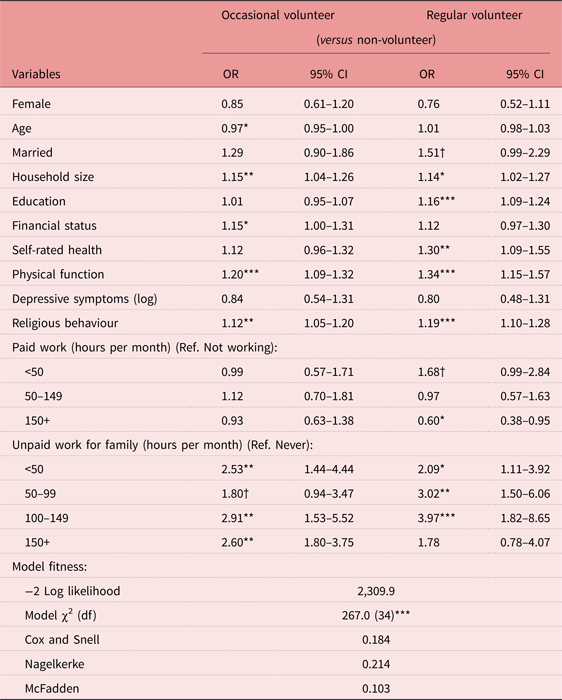
Table 3 shows results of a multinominal logistic regression analysis for Model A in which unpaid work for family was treated as its total hours. Occasional and regular volunteers were compared with non-volunteers, respectively. When human, social and cultural capital variables except community networks were controlled, hours of paid work were not significantly associated with being an occasional volunteer. In contrast, they showed a non-linear association with being a regular volunteer: odds ratios (ORs) of those working less than 150 hours per month were not significantly different from non-paid workers at the 0.05 level, though the OR (1.68) of less than 50 hours was nearly significant (95% confidence interval (CI) = 0.99–2.84, p = 0.055), whereas those working 150 hours or more were less likely to be a regular volunteer (OR = 0.60, CI = 0.38–0.95).
Multinominal logistic regression analysis for volunteer participation: Model A with total hours of unpaid work for family

Notes: OR: odds ratio. 95% CI: 95 per cent confidence interval (lower–upper bound). Ref.: reference category. df: degrees of freedom.
Significance levels: † p < 0.10, * p < 0.05, ** p < 0.01, *** p < 0.001.
Regarding total hours of unpaid work for family, ORs for all categories were over 1.00 for both occasional and regular volunteers, showing that those who did not work for family were least likely to be a volunteer. However, the difference between the probability of ‘never’ and ‘150 hours or more’ for being a regular volunteer was not statistically significant (OR = 1.78, CI = 0.78–4.07). The highest ORs (2.91, 3.97) of ‘100–149 hours per month’ suggested that those who did moderate hours of unpaid work for family were most likely to be a volunteer. When the reference category was changed to ‘100–149 hours’, the ORs of ‘150 hours or more’ became 0.90 (CI = 0.50–1.61) and 0.44 (CI = 0.23–0.88) for occasional and regular volunteer, respectively, suggesting that doing unpaid work for family on a full-time level hinders regular volunteering, but not occasional volunteering, just as with full-time paid workers.
In addition, a larger household size, better physical function and being more religious consistently enhanced probability of volunteer participation (Table 3). Higher education and better self-rated health were significantly associated with being a regular volunteer, but not with occasional volunteer.
Sick/disabled care, grandchild care and household chores
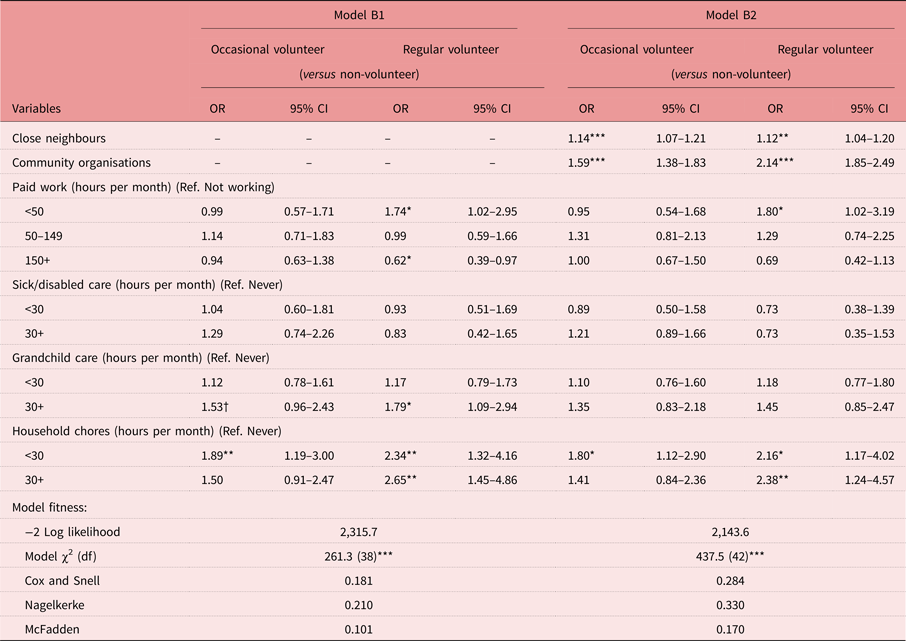
Next, hours of sick/disabled care, grandchild care and household chores were introduced separately instead of as total hours of unpaid work for family (Table 4). In Model B1, the same variables were controlled as in Model A (Table 3). Paid work showed similar results to Model A, though the OR of ‘less than 50 hours’ for regular volunteer reached significant level in Model B1 (OR = 1.74. CI = 1.02–2.95). Hours of sick/disabled care did not show a significant association with volunteering. Those who took care of grandchildren 30 hours or more per month were more likely to be a regular volunteer than those who did not take care of them (OR = 1.79, CI = 1.09–2.94). Those who did household chores, regardless of hours, were more than two times more likely to be a regular volunteer than those who did none. Thus, the complementary relationships with volunteering were observed for paid work of ‘less than 50 hours’, grandchild care of ‘30 hours or more’ and household chores.
Multinominal logistic regression analysis for volunteer participation: Model B with sick/disabled care, grandchild care and household chores

Notes: Gender, age, marital status, household size, education, financial status, self-rated health, physical function, depressive symptoms and religious behaviour are controlled. OR: odds ratio. 95% CI: 95 per cent confidence interval (lower–upper bound). Ref.: reference category. df: degrees of freedom.
Significance levels: † p < 0.10, * p < 0.05, ** p < 0.01, *** p < 0.001.
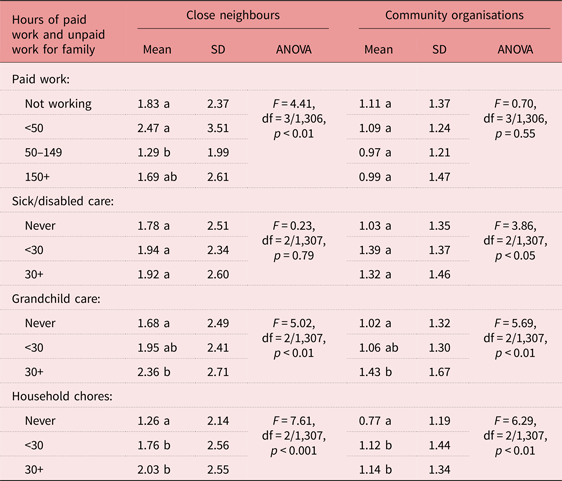
According to Table 5, those who took care of grandchildren for 30 hours or more and those who did household chores had a greater number of close neighbours and affiliated organisations than those who did not engage in these activities. Regarding paid work, while those working ‘less than 50 hours’ or ‘150 hours or more’ had almost as many close neighbours as non-workers, those working ‘50–149 hours’ had fewer. Neither close neighbours nor community organisations significantly varied across the three levels of sick/disabled care.
Mean number of close neighbours and affiliated community organisations by hours of paid work and unpaid work for family

Notes: Differences were assessed with Tamhane's T2 multiple comparison procedure. SD: standard deviation. ANOVA: analysis of variance. df: degrees of freedom.
Significance level: Each letter denotes a subset of means which do not differ significantly from each other at the 0.05 level.
In Model B2 of Table 4, two variables of close neighbours and community organisations were added. Both of them were significant for occasional and regular volunteers, suggesting that having a greater number of close neighbours and belonging to a greater number of community organisations are positively associated with being a volunteer. Provided that the complementary relationships observed in Model B1 came from having a larger community network, they would become insignificant in Model B2 where community network size was controlled. This was applicable only for grandchild care when focusing on probability of being a regular volunteer: the OR of ‘30 hours or more’ was reduced from 1.79 (CI = 1.09–2.94) in Model B1 to 1.45 (CI = 0.85–2.47) in Model B2, where it was no longer statistically significant in Model B2. In contrast, the OR of ‘less than 50 hours’ for paid work increased from 1.74 (1.02–2.95) to 1.80 (CI = 1.02–3.19) against our expectation. Those of household chores reduced slightly, but they were still statistically significant in Model B2.
Among care-givers who provided care for a sick/disabled family member at least once a month (N = 155), 46 (30%) cared for a spouse, 77 (70%) cared for a parent(s) including parent(s)-in-law and 32 (21%) cared for others such as a sibling. We replaced the hours of sick/disabled care in Model B1 in Table 4 by the relationship with care recipient (reference: non-care-giver). The ORs for occasional and regular volunteers were as follows, respectively: 0.74 (CI = 0.34–1.62) and 0.36 (CI = 0.14–0.97) for spouse, 0.97 (CI = 0.54–1.74) and 0.85 (CI = 0.44–1.61) for parent, and 3.60 (CI = 1.43–9.04) and 3.06 (CI = 1.16–8.10) for others. They suggest that spousal care-givers were less likely to be regular volunteers, whereas care-givers to others (e.g. sibling) were more likely to be occasional and regular volunteers compared with non-care-givers.
With regard to gender differences, Table 3 shows that being female did not have a significant main effect on volunteer participation when other factors were held constant. We also examined interactions with gender by paid work and total hours of unpaid work for family for Model A and also by the three types of activities for Model B, but none were significant at the 0.05 level.
Discussion
First, using the total hours enabled us to compare the effect of unpaid work for family to that of paid work with the same level of time commitment. Full-time paid workers (i.e. working 150 hours or more per month) were less likely to be a regular volunteer who volunteers at least once a month, compared to non-workers. This finding was consistent with findings in the USA that full-time paid workers are less likely to engage in longer hours of volunteering compared to part-time or non-workers (Choi Reference Choi2003; Mutchler, Burr and Caro Reference Mutchler, Burr and Caro2003; McNamara and Gonzales Reference McNamara and Gonzales2011). Regarding those who do full-time unpaid work for family, their probability of regular volunteering was not significantly different from those who do no unpaid work for family, but they were less likely to be a regular volunteer than those working fewer hours. Thus, consistent with our hypothesis, working 150 hours or more per month reduced the probability of volunteering (competing relationship), while those who worked fewer hours were equally or more likely to be regular volunteers as non-workers (complementary relationship), regardless of whether it was paid work or unpaid work for family.
However, we should stress this competing relationship was not applicable for occasional volunteering, and there were also some differences between paid work and unpaid work. For paid work, those working less than 50 hours per month were most likely to be regular volunteers, and full-time workers (150 hours or more) were least likely, whereas with unpaid work for family, those working 100–149 hours were most likely to be regular volunteers and non-workers were least likely. These results suggest that full-time level work competes with regular volunteering in time and energy allocation for both paid and unpaid work for family, but this is more so for paid work. Paid workers may have less-flexible hours and need extra time for travelling to the workplace compared with unpaid workers.
While gender roles regarding engagement in paid work and unpaid work for family exist, we did not find a significant gender difference in their association with volunteering. In contrast, previous studies using data of Australian and American samples including young and middle-aged people suggested that a negative association between employment time and volunteering was stronger for women than for men (Hook Reference Hook2004; Taniguchi Reference Taniguchi2006). Similarly, a significant negative association between full-time work and volunteering was observed only for women in a study of the Japanese young-old aged 60–74 (Lee et al. Reference Lee, Saito, Takahashi and Kai2008). Sample age differences rather than cultural differences may account for the inconsistency with our findings for Japanese older adults including those 75 years or older. Regarding unpaid work for family, some studies suggested that care-giving to sick or ageing family members competes with volunteering for women but not for men (Choi et al. Reference Choi, Burr, Mutchler and Caro2007; Taniguchi Reference Taniguchi2006), while Bulanda and Jendrek (Reference Bulanda and Jendrek2016) did not find a significant interaction between gender and grandchild care with volunteering. Considering the fact that the number of men engaging in unpaid work for family for more than 150 hours was very small in our sample (N = 22; N = 104 for women), a larger sample size is required to examine the gender differences more precisely.
Second, associations with volunteering varied by types of productive activities. Sick/disabled care and grandchild care differed in how they associate with volunteering, as we had hypothesised. A complementary relationship was observed for grandchild care and household chores, but not for sick/disabled care, when the respondents spent 30 hours or more per month on the activities. As discussed above, the relationship between volunteering and other activities will turn into a competing one if full-time level commitment is required for the activities. Our result for grandchild care is consistent with Bulanda and Jendrek's (Reference Bulanda and Jendrek2016) findings for non-co-resident grandchild care. The association between volunteering and sick/disabled care can vary depending on who the care recipient is rather than being simply based on hours of care-giving, although this should be interpreted with caution because of the small number of care-givers. Consistent with previous studies on spousal care-giving (Choi et al. Reference Choi, Burr, Mutchler and Caro2007; McNamara and Gonzales Reference McNamara and Gonzales2011), we found a competing relationship between care for a spouse and volunteering.
While our findings on grandchild care and sick/disabled care were similar to those of the USA studies, findings on household chores were inconsistent with Hook (Reference Hook2004), who reported a negative association between housework time and volunteering among Australian people including young adults. The positive association between household chores and regular volunteering remained large and significant (OR > 2.00), even after controlling for membership of community organisations in Model B2 (Table 4). This may be partly due to our measurement of volunteering which was not restricted to organisational work. Japanese people, older adults in particular, have a custom of cleaning up public spaces (e.g. street) adjacent to their house, which may be done as a part of housework. In general, ORs for household chores were higher than those of paid work, suggesting that the positive association between unpaid productive roles (i.e. work for family and work for community) is stronger than that with paid work among Japanese older adults.
Third, the complementary relationship between grandchild care and volunteering was explained by the large community network that grandparents possessed. That is, those providing substantial grandchild care are more likely to be connected to a large network which provides more opportunities for volunteering. The cross-sectional nature of the study means we cannot specify whether the wide network was established prior to or as a result of grandchild care. A complementary relationship with volunteering was also observed for less than 50 hours of paid work and household chores, but the relationship was not explained fully by having a large community network. Infrequent paid workers may have some special skills or non-community networks that are useful for volunteer work, or they may be spending fewer hours on work because of their high motivation for volunteering.
Fourth, associations between human, social, cultural capital and volunteering among Japanese older adults were similar to those in Western countries (Bulanda and Jendrek Reference Bulanda and Jendrek2016; McNamara and Gonzales Reference McNamara and Gonzales2011; Wilson and Musick Reference Wilson and Musick1997) despite assumed differences in the context of volunteer work. Higher education, better physical and subjective health, a larger social network and being more religious were associated with volunteering, at least for regular volunteers. Religious people may share a common value to help others and contribute to the community regardless of religion.
Implications for policy
As the population is ageing, how older adults can balance paid work with unpaid work is becoming increasingly important for our society. Our findings indicate that delaying retirement from full-time paid work may reduce the supply of regular volunteers in the community, probably due to time and energy constraints. Thus, policies to increase part-time work opportunities for older adults are necessary, in addition to community organisations offering a type of volunteer work in which employed people can get involved. Additionally, while part-time workers have been treated as one category in previous studies (Choi Reference Choi2003; McNamara and Gonzales Reference McNamara and Gonzales2011; Mutchler, Burr and Caro Reference Mutchler, Burr and Caro2003), our study suggested there were variations within part-time workers. Unlike part-time workers who work less than 50 hours per month, those working 50–149 hours were not more likely to volunteer than non-workers. They may be less likely to be asked to volunteer due to having fewer close neighbours (see Table 5). We should develop a strategy of providing volunteer information to such people.
Regarding full-time paid workers, a competing relationship was not found for occasional volunteers who volunteered only several times a year. Encouraging full-time workers to participate in occasional volunteering would be a reasonable first step. Considering Japanese men have been losing connections with the community due to the increase in the number of salaried men who spend long hours at the workplace (Kobayashi and Liang Reference Kobayashi and Liang2011), companies and their retired workers association could help both full-time and part-time workers experience volunteering. These measures could introduce workers to the idea of volunteering and hopefully increase their level of volunteering in later age when they transition from full-time to part-time positions or after retirement.
Moreover, we should pay attention to those who do not do household chores, as their volunteer rate was very low (Table 2) and community network was limited (Table 5). We do not know whether this finding is specific to Japanese older adults because research on household chores among older adults is limited. Although one possible reason could be functional limitations among those who did not engage in housework, reasons other than health should be considered as well because the complementary relationship with volunteering remained after controlling for physical and mental health. In order to promote volunteering among those who do not do household chores, further examination is required for factors that impede their volunteering.
Limitations
There are limitations in this study. First, longitudinal data are necessary to specify causal relationships between productive activities. Also, the competing relationships we observed in the cross-sectional data could change longitudinally. For example, spousal care-givers who have good skills and experiences for care-giving may start volunteering after the care receiver passes away. Second, we could not examine how the linkages with volunteering vary depending on types of volunteer work and employment due to limitations of the sample size. Since connections with the community network can vary depending on type of employment (e.g. self-employed or not), future research may need to consider the type of employment in addition to working hours. Third, the low response rate (54%) may affect the results. In our study, 44 per cent of respondents participated in some volunteer work in the past year, which is much higher than the rate in the Survey on Time Use and Leisure Activities (STULA) (Statistics Bureau 2017c) we sated in the introduction section. Abraham, Helms and Presser (Reference Abraham, Helms and Presser2009) showed that respondents of the American Time Use Survey (ATUS), a sub-sample of the Current Population Survey (CPS), reported much more volunteering in the CPS than those who became ATUS non-respondents, while it generally did not affect inferences about the characteristics of volunteers. Thus, the voluntary nature of our survey (NSJE) might invite greater bias on the rate of volunteering compared to the STULA, a compulsory survey, but it would have little impact on the correlates of volunteering we reported here. Even in the NSJE, only 20 per cent were regular volunteers, which means the rate would be much lower in the actual population. We need to make more effort to increase volunteers.
Declaration of contribution of authors
E.K. planned the study, performed data analysis and wrote the paper. Y.S., T.F. and J.L. helped to plan the study, including measurements, and contributed to revising the paper.
Funding
This work was supported by the Japan Society for the Promotion of Science (JSPS) KAKENHI Grant Numbers JP23243062 and JP17H02619.
Ethical approval
The study was approved by the Institutional Review Board of the Tokyo Metropolitan Institute of Gerontology (24-KENJI-344, Number 5).