I. INTRODUCTION
As a new class of thermoelectric (TE) materials, skutterudite has been greatly developed in last two decades. Around the year 1995, pioneer studies on the TE transport of binary CoSb3 were carried out and discovered promising electrical transport properties.Reference Caillat, Borshchevsky and Fleurial1, Reference Morelli, Caillat, Fleurial, Borshchevsky, Vandersande, Chen and Uher2 However, the high lattice thermal conductivity needed to be depressed for high figure of merit (ZT) value. In the subsequent efforts for this prospect, people found that, with Fe substitution on Co site or Sn substitution on Sb site, guest atoms could be filled into the Sb-icosahedra voids in the crystal cell, which could reduce the lattice thermal conductivity by more than one order.Reference Tritt, Nolas, Slack, Ehrlich, Gillespie and Cohn3, Reference Morelli and Meisner4 The obtained p-type filled skutterudites (Ce/La)Fe3CoSb12 exhibited excellent TE performance and the ZT values reached about 0.9,Reference Fleurial, Borshchevsky, Caillat, Morelli and Meisner5–Reference Sales, Mandrus, Chakoumakos, Keppens and Thompson7 which greatly stimulated people’s interest in these filled skutterudites. Shortly afterwards, some of rare earth and alkaline earth elements were found to be able to reach high filling fraction in CoSb3 even without Fe compensation.Reference Nolas, Kaeser, Littleton and Tritt8, Reference Chen, Kawahara, Tang, Goto, Hirai, Dyck, Chen and Uher9 The partial filling in CoSb3 opened an another door for pursuing outstanding n-type materials besides the traditional approaches, such as doping and changing the stoichiometric ratio.Reference Nolas, Kaeser, Littleton and Tritt8, Reference Lamberton, Bhattacharya, Littleton, Kaeser, Tedstrom, Tritt, Yang and Nolas10 Later studies mostly focused on the filling fraction limitsReference Shi, Zhang, Chen and Yang11–Reference Zhang, Shi, Mei, Xu, Chen, Yang and Meisner14 and multiple filling in CoSb3,Reference Shi, Salvador, Yang and Wang15–Reference Zhao, Wei, Zhang, Dong, Liu and Tang19 as well as nanocomposites.Reference Zhao, Shi, Chen, Zhang, Bai, Pei, Li and Goto20–Reference Xiong, Chen, Huang, Bai and Chen22 And the ZT value of n-type CoSb3-based filled skutterudites has been successfully improved as high as 1.5.
However, compared with n-type filled skutterudites, the enthusiasm and efforts on p-type skutterudites seem not so significant although p-type materials are identically important for TE application. After the studies on (Ce/La)Fe3CoSb12, recent researches on Co-rich composition, dual filling, and nanocompositeReference Tang, Chen, Goto and Hirai23–Reference Rogl, Grytsiv, Bauer, Rogl and Zehetbauer27 suggested several approaches to develop high performance p-type skutterudites. However, people find it still is a great challenge to improve ZT above unit. Thus, for further improving the performance of p-type skutterudite, some intrinsic questions need to be answered. Besides the controversy how to explain the low thermal conductivity,Reference Viennois, Girard, Koza, Mutka, Ravot, Terki, Charar and Tedenac28, Reference Koza, Johnson, Viennois, Mutka, Girard and Ravot29 the appropriate Fe/Co ratio still remains some ambiguity. In addition, how the electronic structure of the fillers affects the valence band and the TE transport of the filled skutterudite is also unclear. To explore the optimized composition and to pursue how the valence of the fillers affects the electrical properties, we systematically worked on trivalent Ce filling system CeyFexCo4−xSb12 and divalent YbReference Schnelle, Leithe-Jasper, Schmidt, Rosner, Borrmann, Burkhardt, Mydosh and Grin30 filling system YbyFexCo4−xSb12, with Fe content 1 ≤ x ≤ 4. By adjusting the filling fraction, we obtained the optimized power factor (PF) for each given Fe/Co ratio. The influences of Fe content on carrier mobility and effective mass were also discussed in detail. Considering both electrical properties and thermal conductivity, the optimized Fe composition and the filler were figured out. Some possible approaches to improve the performance of p-type skutterudites were also proposed.
II. EXPERIMENTS AND CHARACTERIZATION
The samples of RyFexCo4−xSb12 (R = Ce and Yb) were synthesized by solid state reaction and spark plasma sintering process. Powder x-ray diffraction measurements were made by using Cu Kα radiation (λ = 1.54056 Å), performed on a Rigaku Rint-2000 system (Rigaku Corporation, Tokyo, Japan). The Hall coefficient and electrical conductivity in the temperature range from 2.5 to 300 K were measured by an extraction technique (Physics Properties Measurement System, Quantum Design, San Diego, CA). High temperature electrical properties were measured by the standard four-probe method (ZEM-3, ULVAC-RIKO, Yokohama, Japan) in Ar atmosphere between 300 and 800 K. The measurements of thermal diffusivity (λ) were carried out in a flowing Ar atmosphere (LFA-427, Netzsch, Selb, Germany) and between 300 and 800 K. The thermal conductivity (κ) was calculated from the relationship κ = ρλ Cp.
III. RESULTS AND DISCUSSION
A. Electrical transport
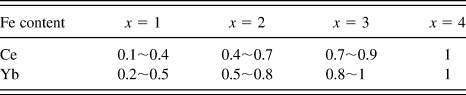
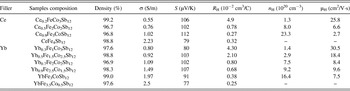
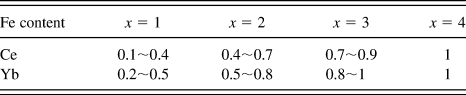
As shown in Table I, to optimize the electrical property in each Fe content composition, the nominal filling fractions of Ce and Yb are adjusted within a certain range for samples with different Fe content. Since the top of valence band is constituted by the 5p state of Sb and 3d state of the transition metal,Reference Singh and Mazin31 the variation of the filling fractions mainly affects the carrier concentration but may not change the band structure much. Thus, the optimized property at specific Fe content directly reflects the valence band character, assuming the appropriate carrier concentration could be obtained. Several optimized samples which show the best PF at given Fe content are chosen for discussion as listed in Table II, together with the transport properties data at room temperature.
The nominal filling fraction range for preparing samples RyFexCo4−xSb12.
The nominal composition, relative density, electrical conductivity σ, Seebeck coefficient S, carrier concentration n H, and mobility μ H of RyFexCo4−xSb12 at 300 K.

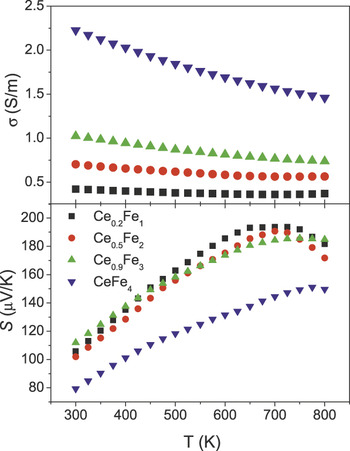
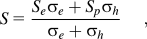
Figure 1 shows the temperature dependence of conductivity and Seebeck coefficient of Ce filling system CeyFexCo4−xSb12 from 300 to 800 K. Except the sample CeFe4Sb12, the other three compositions hold similar Seebeck coefficient values in whole temperature range, meanwhile, the conductivity increases with increasing Fe content. With increasing temperature, S values of the three samples increase and reach peaks at 700 K and then decrease. When temperature enters the intrinsic range of samples, the electrons in valence band are excited into conduction band and the transport contributions of both electron and hole should be taken into account. In this case, σ and S are represented by

Temperature dependences of the conductivity and Seebeck coefficient of CeyFexCo4−xSb12 from 300 to 800 K.

where the subscript symbols e and h represent the electron and hole, respectively. According to Eqs. (1) and (2), the opposite contributions of electron and hole to S lead to the decline at high temperature.
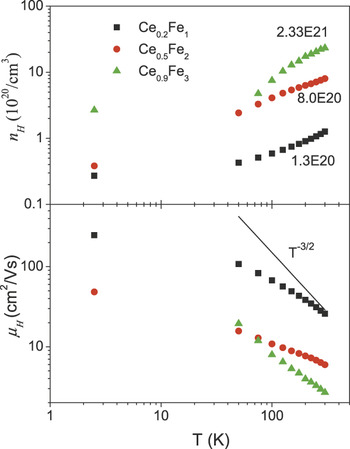
Figure 2 shows the Hall concentration and mobility data of CeyFexCo4−xSb12. Generally speaking, the Hall carrier concentration of TE materials can be obtained via the Hall coefficient R H, according to n H= r/qR H (r = 1). However, for heavily doped RFe4Sb12, the Hall formula seems to fail. Schnelle et al.Reference Schnelle, Leithe-Jasper, Rosner, Cardoso-Gil, Gumeniuk, Trots, Mydosh and Grin32 systematically studied the Hall concentration n H of full-filled skutterudites RFe4Sb12 (R = Na, K, Ca, Sr, Ba, Yb, La) and found that the calculated n H of the samples filled with low valence states atoms were smaller than those of samples filled with high valence states atoms, which represented the opposite trend against the simple charge counting rule. The reason probably is that the Fermi level goes in the valence band too deep and then Hall factor r deviates from 1 for the heavily degenerate RFe4Sb12. Thus, the Hall concentration deviates a lot from the real carrier concentration. On the other hand, with the Fe content decreasing, the Fermi level is elevated toward top of the valence band and the degeneracy also decreases. Therefore, at lower Fe content, the Hall formula n H= 1/qR H is relatively credible. Thus, the Hall concentrations of the samples with Fe content x≤3 are calculated and plotted in Fig. 2 from 2.5 to 300 K. It is clear that, the Hall carrier concentration increases with the Fe content, from 1.3 × 10Reference Zhao, Shi, Chen, Zhang, Bai, Pei, Li and Goto20 cm−3 for Ce0.2FeCo3Sb12 to 2.33 × 10Reference Li, Tang, Zhang and Uher21 cm−3 for Ce0.9Fe3CoSb12, and the mobility decreases from 25.8 to 2.7 cm2/V·s. For CeFe4Sb12, we believe it also follows the same Fe dependence of hole concentration and mobility, according to the simple charge counting rule which is supported by the high σ and low S as shown in Fig. 1. Moreover, the temperature dependence of mobility slightly deviates from the typical acoustic phonon scattering behavior T −3/2 for which are observed in n-type skutterudites. This may be due to the mixed hole scattering mechanism.Reference Dyck, Chen, Uher, Chen, Tang and Hirai33, Reference Yang, Meisner, Rawn, Wang, Chakoumakos, Martin, Nolas, Pedersen and Stalick34
Temperature dependences of the hole concentration and mobility of CeyFexCo4−xSb12 from 2.5 to 300 K.

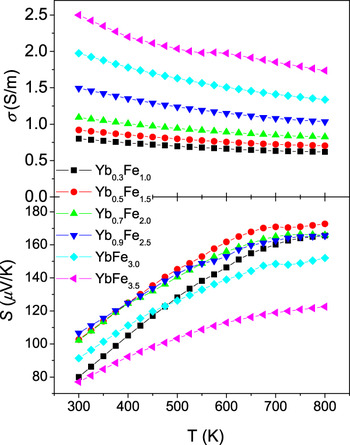
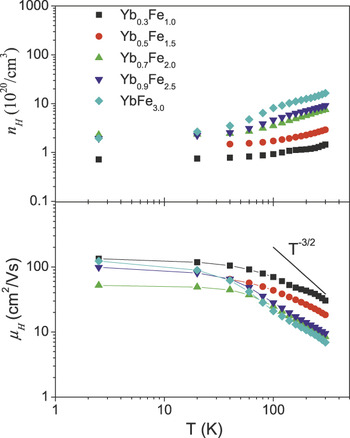
Figures 3 and 4 show the temperature dependences of electrical properties for Yb filling system YbyFexCo4−xSb12. The electrical conductivity also increases with increasing Fe content, whereas the magnitude of Seebeck coefficient starts to decrease when Fe content is higher than x = 3. In Fig. 4, similar trends in temperature dependence of mobility are observed, which indicates that the two systems possess the same carrier scattering mechanism. However, the carrier mobility of YbyFexCo4−xSb12 is slightly higher than CeyFexCo4−xSb12 system at the same Fe content, which is also demonstrated in Fig. 6.
Temperature dependences of the conductivity and Seebeck coefficient of YbyFexCo4−xSb12 from 300 to 800 K.

Temperature dependences of the hole concentration and mobility of YbyFexCo4−xSb12 from 2.5 to 300 K.

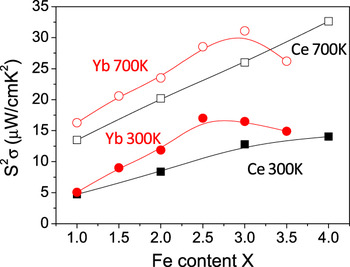
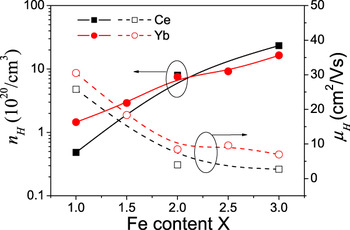
To reveal the Fe doping effect on the electrical properties, the relation between PF of the samples and Fe content is shown in Fig. 5. At low Fe content, the Yb filling samples exhibit higher PF values than Ce filling system. However, the PF of YbyFexCo4−xSb12 reaches the peak around Fe content x = 3 and then decreases. For CeyFexCo4−xSb12, the PF monotonically increases with the Fe content both at 300 and 700 K, and the sample CeFe4Sb12 has the highest PF among all samples, PF ∼35 μW/cmK2. Combined with the Seebeck coefficient data, it is clear that, when Fe content x > 3, the divalent Yb is insufficient for electron supply even in fully filling condition so that the hole concentration is too high. Figure 6 plots the Hall carrier concentration and mobility of the selected samples versus Fe content below x ≤ 3. The Hall carrier concentrations are very similar for two systems. As shown in the figure, the carrier concentration increases with Fe content but mobility greatly decreases. In single parabolic model, the PF would be in proportion to the mobility and effective mass m* of the carriers, i.e.,  .Reference Nolas, Sharp and Goldsmid35 This significant decrease of mobility implies that the effective mass of the carrier is enhanced by Fe substitution.
The power factor versus Fe content in CeyFexCo4−xSb12 and YbyFexCo4−xSb12.

The hole concentration and mobility versus Fe content in CeyFexCo4−xSb12 and YbyFexCo4−xSb12.

Based on Fermi statistics in a single parabolic band model, S and p are given by

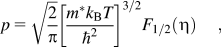
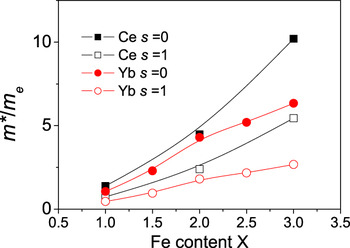
where η = E F/k BT is the reduced Fermi energy; E F is the Fermi energy; Fx is the Fermi integral of order x; and s is the exponent of the energy dependence of the hole mean free path. Assuming holes scattered by acoustic phonons, s = 0, then we estimate m* and plot the values versus Fe content in Fig. 7. With increasing Fe content, the m* increases from 1.4 to 10 me in Ce filling system and from 1.1 to 6.3 me in Yb filling system. It is necessary to notice that mixed hole scattering mechanism may exist in present systems as demonstrated by mobility behavior and in the case that holes are scattered by impurity ionic, s = 2. If we assume the intermediate value s = 1 for this mixed mechanism,Reference Yang, Meisner, Rawn, Wang, Chakoumakos, Martin, Nolas, Pedersen and Stalick34 the different m* are obtained and also plotted in Fig. 7. As shown in the figure, in both cases, m* identically increases with the Fe content in the studied systems. Previous band calculation revealed that, in pure CoSb3, the valence band maximum is the 5p band of Sb and holds very small m*.Reference Caillat, Borshchevsky and Fleurial1, Reference Singh and Pickett36 With the Fe doping, Fe 3d state of the transition metal forms another heavy band near the Fermi levelReference Sales, Mandrus, Chakoumakos, Keppens and Thompson7, Reference Singh and Mazin31 and greatly enhances the density of state and then m*. At high Fe content, the heavy hole concentration greatly increases and dominates the transport properties, which results in higher PF. Thus, among the studied samples, the CeFe4Sb12 exhibits the best electrical performance. In Fig. 7, it also demonstrates that m* of the YbyFexCo4−xSb12 system is lower than CeyFex Co4−xSb12 system at same Fe content. This indicates that the trivalent Ce filling tends to make the Fe 3d band flat compared with divalent Yb filling.
The effective mass m* versus Fe content in CeyFexCo4−xSb12 and YbyFexCo4−xSb12.

B. Thermal conductivity and ZT
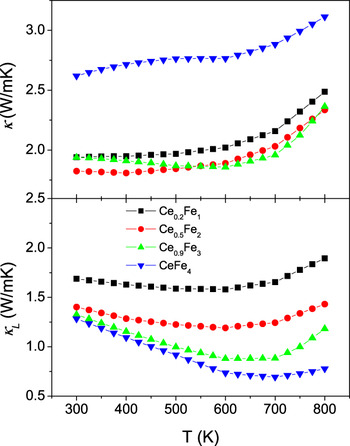
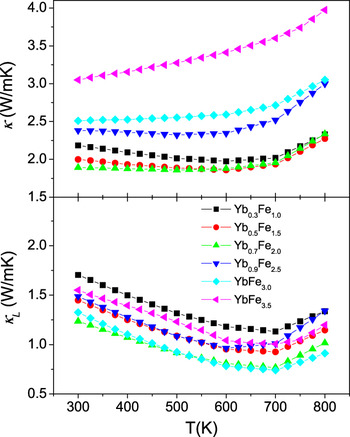
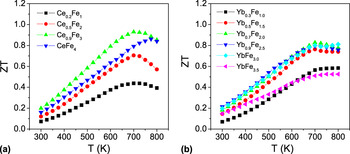
The thermal conductivities and lattice thermal conductivities of CeyFexCo4−xSb12 and YbyFexCo4−xSb12 are shown in Fig. 8 and Fig. 9, respectively. The lattice contribution is estimated by Wiedemann–Franz law (κ L = κ−LσT), with the Lorentz number L being 2.0 × 10⁻⁸ V2/K2 for the heavily doped semiconductors.Reference Li, Tang, Zhang and Uher21 In CeyFexCo4−xSb12 system, although CeFe4Sb12 shows the highest PF, the thermal conductivity does not achieve the best condition. For CeFe4Sb12, even fully filling of Ce, the hole concentration is still too high, which results in a large carrier thermal conductivity. The total thermal conductivity of CeFe4Sb12 is much higher than that of the other three samples as demonstrated in Fig. 8. Thus, as shown in Fig. 10, the ZT value only achieves 0.8 at 800 K for CeFe4Sb12 and the maximum value ZT ∼0.9 for CeyFexCo4−xSb12 is obtained at Fe content x = 3 at 700 K, i.e., Ce0.9Fe3CoSb12. The similar case also occurs in YbyFexCo4-xSb12 system, in which the maximum ZT value is obtained in sample Yb0.7Fe2Co2Sb12.
Temperature dependences of the thermal conductivity and lattice thermal conductivity of CeyFexCo4−xSb12 from 300 to 800 K.

Temperature dependences of the thermal conductivity and lattice thermal conductivity of YbyFexCo4−xSb12 from 300 to 800 K.

ZT values of (a) CeyFexCo4−xSb12 and (b) YbyFexCo4−xSb12 in temperature range from 300 to 800 K.

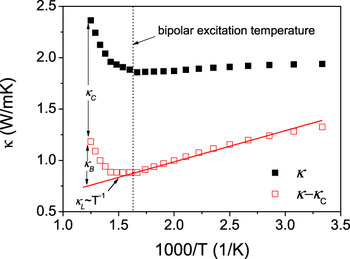
Another important feature of the calculated lattice thermal conductivity which should be paid attention to is that the values of all samples greatly increase above 700 K. Due to the intrinsic excitation as observed in the electrical property, the bipolar diffusion contribution on the thermal conductivity is very serious. The thermal conductivity contributed by the bipolar diffusion κ B can be expressed as

where the subscript symbols e and h are the electron and hole, respectively. So, at higher temperature, the heat flow is carried by three parts: carrier, lattice, and bipolar diffusion. At temperature above Debye temperature, the lattice part κ L is expected to be dominated by Umklapp phonon scattering, i.e.
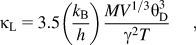
where the M is the average mass per atom, V the average atomic volume, θ D the Debye temperature, and γ the Grüneisen parameter. Thus, κ B can be extracted by κ–κ L–κ C at high temperature. Figure 11 shows the detail thermal conductivity components of Ce0.9Fe3CoSb12 at 800 K. The contributions of the carrier, lattice, and bipolar diffusion to the total thermal conductivity are estimated to be 50, 33, and 17%, respectively. The bipolar diffusion leads to a part of increase of thermal conductivity at temperature above 700 K, which obstructs higher ZT for p-type skutterudites.
Component details of thermal conductivity for Ce0.9Fe3 CoSb12 as a function of inverse temperature. The solid line is linearly fitting to the lattice thermal conductivity in temperature range from 300 to 600 K.

IV. CONCLUSIONS
In summary, systematical on the electrical transport properties of RyFexCo4−xSb12 (R = Ce and Yb) has been carried out. It is found that the carrier concentration increases with Fe content. Fe substitution for Co can enhance the effective mass of holes significantly, which is beneficial for improving electrical performance. However, due to limit of charge supply, for divalent Yb filling, the optimized hole concentration could be achieved only when Fe content is x ≤ 2. For trivalent Ce filling, partial Co is still necessary to compensate the excess holes and the optimized Fe/Co ratio is around 3:1 or 3.5:0.5. Thus, to achieve the appropriate carrier concentration and to maintain the largest density of state, the tetravalent fillers should be pursued. When temperature increases above 700 K, the bipolar diffusion greatly contributes to the total thermal conductivity and deteriorates the TE properties. To weaken the bipolar effect, one should consider enlarging the band gap of the system. Ir doping may be a favorable choice.
ACKNOWLEDGMENTS
This work was partially supported by National Natural Science Foundation of China (Project Nos. 50802109 and 50821004) and also supported by the National High Technology Research and Development Program of China (No. 2009AA03Z210).