OFFSPRING OF OEDIPUS
Oedipal themes and anxieties abound with a variety and range extending well beyond Freud's more circumscribed, yet still powerful, claim on the legend. As dramatists or as poets, philosophers or philologists, psychoanalysts or even anti-psychoanalysts, many have told their own tale of Oedipus since the days of Aeschylus, Sophocles, and Euripides, from varied perspectives and while probing distinctive concerns.Footnote 1 French authors have enjoyed strong representation in such company, whether through the Oedipus of Corneille and Cocteau, or the Anti-Oedipus of Deleuze and Guattari; and some, it could be said, have literally made their name through their own particular twist on the tale, becoming “nowhere unknown” (Oed., 8, 40, 925), like the eponymous hero himself.Footnote 2 Indeed, in 1718, a young man mounted a production at the Comédie-Française so successful that, with the publication of his Oedipe, a twenty-four-year-old François-Marie Arouet vaulted into posterity astride the sobriquet “Voltaire.”Footnote 3
However distinctive in its reimagining of the travails of Oedipus, Voltaire's production was scarcely an outlier in its choice of theme: as Susanna Braund observes, “The central reason for the French obsession with the Oedipus myth is undoubtedly the opportunity it afforded to explore the issues of the nature of kingship which preoccupied the Ancien Régime.”Footnote 4 Further fueling this Oedipal obsession were
the ravages of the plague, which were felt throughout French cities from the start of the seventeenth century and well into the eighteenth. The depictions of the plague with which both the classical plays begin [i.e. of Sophocles and Seneca] . . . emblematised a state of crisis for the French. Thebes becomes France: the afflicted citizens look to their king, the Roi-Père, for salvation from what seems to be divine punishment for the murder of their previous king, but as the king proceeds, his relationship with his citizens and with the divine are called into doubt and sometimes too his moral authority to be king.Footnote 5
Concerns over the health or vitality of the body politic and its legitimate administration—not to mention the moral authority of the king—were to remain a French obsession up to the Revolution and well beyond. Thus it could be said that Voltaire staged both an Oedipus and an eighteenth century that might serve as overture to the Oedipal tale of yet another French author whose name is perhaps nowhere unknown—Michel Foucault (1926–84).
Oedipus was to play a central, if still underappreciated, role in the first installment of Foucault's History of Sexuality (1976),Footnote 6 a work that sought to dramatize the emergence of “sexuality” in terms other than those of a momentous “Freudian break” within the framework of a repressive Victorian sexual regime.Footnote 7 Foucault had already drawn close attention to the story of Oedipus—in particular the Sophoclean Oedipus—several years earlier, both in his inaugural lecture series at the Collège de France, “The Will to Knowledge,”Footnote 8 and in subsequent lectures that expanded upon key themes drawn from the lecture of March 17, 1971.Footnote 9 When reflecting in 1973 on the recently published Anti-Oedipus of Deleuze and Guattari, Foucault observed, “In this conception, then, Oedipus is not a truth of nature, but an instrument of limitation and constraint that psychoanalysts, starting with Freud, used to contain desire, and insert it within a family structure defined by our society at a particular moment . . . Oedipus is an instrument of power.”Footnote 10 Foucault was to develop his own account of this instrumentality in the first volume of History of Sexuality, the fruition of a desire “to look behind what is claimed to be the Oedipus story” not just for “the history of a power” but, specifically, of “a political power.”Footnote 11 Furthermore, on Foucault's account both the “family structure” and the “particular moment” at which it was defined marked a clear departure from the Oedipus of the Ancien Régime, revivifying Oedipal themes with a distinctively modern sensibility and force. This updated Oedipus embodied the anxieties over endogamy of an ascendant class, the founders of “sexuality”: “We must return . . . to formulations that have long been disparaged; we must say that there is a bourgeois sexuality, and that there are class sexualtities. Or rather, that sexuality is originally, historically bourgeois.”Footnote 12 Given such an origin, Foucault's genealogy of sexuality would seek out the pathways by which the concerns of a particular class would come to penetrate the entire social body and instantiate novel circulations of power within it;Footnote 13 a genealogy that connected the city-state with the emergence of the nation-state, and a “first family” with the modern family of sexuality.Footnote 14 Thus it would be through a deployment of Oedipus in the service of a distinctively bourgeois sexuality that not just all of France, but indeed every nation in which the bourgeoisie were ascendant, would become Thebes.
Although Oedipus enjoyed a recurring role in the books and lectures associated with Foucault's tenure at the Collège de France, it was through Foucault's account of a “collective” Oedipus complex—if not the collective consciousness of just one class—that “sexuality” would become Foucault's gateway to “governmentality.”Footnote 15 It is therefore no surprise to find History of Sexuality as the hinge between the “Society Must Be Defended” (1975–6) and “Security, Territory, Population” (1977–8) lecture courses, along with the ensuing lectures on “biopolitics” and neoliberalism. Correspondingly, just as he stood at that fateful place where three paths meet, Oedipus would bring together three texts that played distinctive roles in Foucault's thought at this time: Plato's Republic, Hobbes's Leviathan, and Nietzsche's Genealogy of Morality. Foucault's engagement with these sources, and their convergence on his account of the Oedipus complex, highlight key components of Foucault's concept of “bio-power” (bio-pouvoir) and its relation to the modern state.Footnote 16
But behind all these constituents of Foucault's thought lurks the spectre of Marx. When interviewed in 1983, Foucault avowed that he had no more been a Marxist than a Freudian;Footnote 17 and yet, when interviewed in June 1975, Foucault had acknowledged, “It is impossible at the present time to write history without using a whole range of concepts directly or indirectly linked to Marx's thought and situating oneself within a horizon of thought which has been defined and described by Marx. One might even wonder what difference there could ultimately be between being a historian and being a Marxist.”Footnote 18 Thus did Foucault gauge the height of the Marxist hurdle he needed to surmount in the coming year with History of Sexuality, for the bourgeoisie provided the very framework for the “repressive hypothesis” that History of Sexuality sought to critique: “is sex hidden from us, concealed by a new sense of decency, kept under a bushel by the grim necessities of bourgeois society?”Footnote 19 Although Foucault may be said to have shared in the French intellectual left's general dissaffection with “dogmatic Marxism” post-1968, his particular concerns were highlighted by his critique of sexuality.Footnote 20 Foucault confronted a critical challenge at a much deeper level than is indicated by his engagement with familiar character types, bourgeois and proletarian: would it prove at all possible to reweave familiar strands of Marxist teleology into that Nietzschean genealogy of sexuality promised by his original French subtitle, “The Will to Know” (“La volonté de savoir”)?Footnote 21 With the distinctive constellation of texts and concepts he came to embody for Foucault, Oedipus provided key coordinates orienting Foucault's genealogical and critical projects of the mid-1970s, but it was through his account of a “collective Oedipus complex” in particular that Foucault would reclaim a properly historical and genealogical role as he saw it for the bourgeosie, freed at last from the suffocating embrace of the repressive hypothesis.
If a conventional Marxist patrimony was thus shouldered aside, one need not attribute it to Oedipal ambition. Nevertheless, with History of Sexuality, Foucault could claim his own place among those he had identified in 1969 as the “founders of discursivity,” Marx and Freud, who he reckoned to be “not just the authors of their own works. They have produced something else: the possibilities and the rules for the formation of other texts . . . They have created a possibility for something other than their discourse, yet something belonging to what they founded.”Footnote 22 We might recognize a corresponding discursive power in Foucault's genealogies of sexuality and governmentality, “an endless possibility of discourse”Footnote 23 that can be productively deployed beyond Foucault's own precise terms of reference, the better to understand his critical concerns and to explore their scope of application.
PASTORAL POWER AND THE RISE OF THE MODERN STATE
In the final part of History of Sexuality, “Right of Death and Power over Life,” Foucault addressed the peculiar efficacy of sexuality as a “political issue” integrating the disciplinary and the regulatory: “It was at the pivot of the two axes along which developed the entire political technology of life. On the one hand it was tied to the disciplines of the body . . . On the other hand, it was applied to the regulation of populations.”Footnote 24 For Foucault, the Oedipus complex likewise straddled these axes that served as conduits—both intensely personal and comprehensively public—for the currents of power on which it thrived. Foucault had begun to explore this political dimension of sexuality several years earlier. Although his Oedipus lecture of 1973 was not directly addressed either to Freud or to psychoanalysis,Footnote 25 Foucault did propose to repurpose a rather familiar Freudian theme: “there really is an Oedipus complex in our civilization. But it does not involve our unconscious and our desire.”Footnote 26 Instead, Foucault's attention was directed to the unfolding drama of the Oedipus Tyrannos itself, and to the ways in which that drama reflected the fundamental relationship between power and knowledge:
I want to show how the tragedy of Oedipus, the one we read in Sophocles . . . is representative and in a sense the founding instance of a definite type of relation between power and knowledge [savoir], between political power and knowledge [connaissance], from which our civilization is not yet emancipated . . . If there is an Oedipus complex, it operates not at the individual level but at the collective level; not in connection with desire and the unconscious but in connection with power and knowledge.Footnote 27
Thus Foucault's “Oedipus complex” corresponded with a power–knowledge complex of exceptional social and political impact that would figure prominently in what Foucault sometimes characterized as “bio-power,” and at other times in more overtly genealogical terms as “pastoral power.”
The concept of “pastoral power” was given its fullest development in the lecture series delivered in 1977–8 at the Collège de France, following Foucault's return from a sabbatical inaugurated by publication of the first installment of History of Sexuality.Footnote 28 Posthumously published in English as Security, Territory, Population,Footnote 29 these lectures concentratedly developed certain themes and historical details found throughout History of Sexuality that highlighted the gradual transfer of apparatus of power once characteristic of ecclesiastical authority to the domain of the state. Although Foucault broadly characterizes these “positive” technologies of the modern state through the term “bio-power”—in particular, those emerging in the eighteenth century in association with the political economy of the cameralists and, above all, of the physiocrats, coming into full flower over the course of the nineteenth centuryFootnote 30—it is clear from the 1977–8 lectures that he saw such developments as a latter-day transformation of “pastoral power,” which had undergone significant shifts of domain and objective as it developed institutionally over the course of its history:
The modern state is born, I think, when governmentality became a calculated and reflected practice. The Christian pastorate seems to me to be the background of this process, it being understood that . . . there was a huge gap between the Hebraic theme of the shepherd and the Christian pastorate and . . . that there will of course be a no less important and wide gap between the government or pastoral direction of individuals and communities, and the development of arts of government, the specification of a field of political intervention, from the sixteenth and seventeenth centuries.Footnote 31
The genesis of “governmentality” as a fully modern “calculated and reflected practice” thus coincides with the emergence of a political conscience newly attuned to both the opportunities and the liabilities of bio-power: although attention to both individuals and small communities would be retained at its “capillary” level of application,Footnote 32 the circulation of bio-power would be dramatically scaled up in ways both unattainable and unimaginable by its pastoral predecessors. Thus Foucault's genealogy of governmentality records a fortuitous outgrowth of the vicissitudes of social, political and religious history, and of other, profoundly consequential historical agencies besides.
With the gradual fragmentation of religious institutional authority such as Voltaire had pointedly dramatized in his Oedipe, and a corresponding emergence of increasingly centralized state powers following the Reformation, Foucault argues that the ambitions of pastoral power found new opportunity in the secular domain of the state, through significant developments in what Foucault refers to as “bio-history”:
the pressure exerted by the biological on the historical had remained very strong for thousands of years; epidemics and famine were the two great dramatic forms of this relationship that was always dominated by the menace of death. But . . . the economic—and primarily agricultural—development of the eighteenth century, and an increase in productivity and resources even more rapid than the demographic growth it encouraged, allowed a measure of relief from these profound threats: despite some renewed outbreaks, the period of great ravages from starvation and plague had come to a close before the French Revolution; death was ceasing to torment life so directly.Footnote 33
While stressing their severity and agency as powerful forces of history, Foucault nevertheless understands the threats and challenges posed by the natural world—the plagues and privations by which “the biological” exerted pressure on “the historical”—to have been met by a corresponding human agency beginning in the eighteenth century. We might envisage this agency as that embodied by Sophocles’ Oedipus, boldly stepping forth at the very outset of the drama in zealous pursuit of knowledge, through which to confront the coeval calamities of epidemic and famine afflicting his citizens:
at the same time, the development of the different fields of knowledge concerned with life in general, the improvement of agricultural techniques . . . contributed to this relaxation: a relative control over life averted some of the imminent risks of death. In the space for movement thus conquered, and broadening and organizing that space, methods of power and knowledge assumed responsibility for the life processes and undertook to control and modify them.Footnote 34
In Security, Territory, Population, Foucault highlights the statistical approach and management practices associated with this “relative control over life”—directed toward normalization of the relationships between endemic and epidemic, shortage and famine, such as were characteristic of the “mechanisms of security”Footnote 35—and with a corresponding focus on the growing political importance of the town:
if it is true that the outline of the very complex technology of securities appeared around the middle of the eighteenth century, I think that it is to the extent that the town posed new and specific economic and political problems of government technique . . . I think the integration of the town within central mechanisms of power . . . was a problem to which it really was necessary to respond with new mechanisms of power . . . Basically, the fact of the town and legitimate sovereignty had to be reconciled.Footnote 36
From the comparatively narrow political horizons of the town or polis, expanding not just to the metropolis but encompassing the state entire, the power of the natural and the agency of human knowledge thus engendered a power–knowledge complex of unprecedented political reach and social penetration.
Such developments are therefore conceived as a pronounced transformation, a genuine revolution that significantly pre-dates and properly contextualizes the apparent “Freudian break” conceived by Marcus and othersFootnote 37—a revolution that those authors somehow missed—and that likewise inaugurated a novel conceptualization of state power and its apparatus:
For the first time in history, no doubt, biological existence was reflected in political existence; the fact of living was no longer an inaccessible substrate that only emerged from time to time, amid the randomness of death and its fatality; part of it passed into knowledge's field of control and power's sphere of intervention. Power would no longer be dealing simply with legal subjects over whom the ultimate dominion was death, but with living beings, and the mastery it would be able to exercise over them would have to be applied at the level of life itself . . . If one can apply the term “bio-history” to the pressures through which the movements of life and the processes of history interfere with one another, one would have to speak of “bio-power” to designate what brought life and its mechanisms into the realm of explicit calculations and made knowledge-power an agent of transformation of human life.Footnote 38
Notwithstanding the novelty of this conception of the state—bio-power brought to bear on the multivalent factors of bio-history—Foucault emphasized in his lectures of 1977–8 that bio-power retained a crucial genealogical association with pastoral power: “pastoral power in its typology, organization, and mode of functioning . . . is doubtless something from which we have still not freed ourselves . . . There have been anti-feudal revolutions; there has never been an anti-pastoral revolution. The pastorate has not yet experienced the process of profound revolution that would have definitively expelled it from history.”Footnote 39 Whatever revolutionary changes resulted from the state's embrace of a pastoral political program, the character of that regime cannot be properly understood or assessed independently of those predecessors that prepared its modern institutions; thus the fertile genealogical associations between “pastoral power” and “bio-power” have significant bearing on the account of power developed in History of Sexuality and its follow-up, Security, Territory, Population. Moreover, a corresponding literary and philosophical genealogy of these regimes of power may be traced to Sophocles’ Oedipus Tyrannos and Plato's Republic, classics that enjoy a distinctive contemporary currency when seen through the eyes of Foucault.
THE TYRANT AND THE SHEPHERD
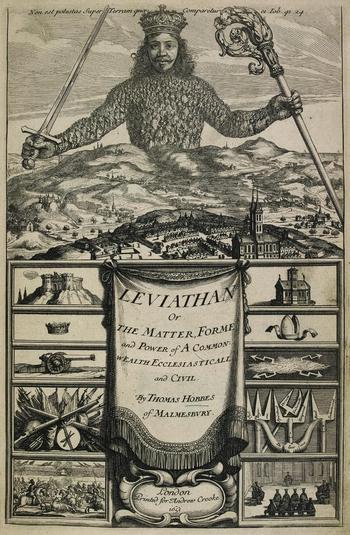
The concluding section of History of Sexuality begins by addressing what the bio-power revolution is in fact a decisive departure from, a discourse of power that Foucault has been characterizing as “juridico-discursive,” which is in turn associated with the concept of sovereignty; for, as Foucault famously observed—the French Revolution and many similar revolutions notwithstanding—“in political thought and analysis, we still have not cut off the head of the king.”Footnote 40 Foucault begins his discussion with reference to Hobbes, and one can conveniently visualize the juxtaposition of sovereign with pastoral power through a corresponding juxtaposition of the instruments of power held in the hands of the “mortal god” famously portrayed on the frontispiece of the Leviathan (Fig. 1).Footnote 41 The figure of the Leviathan—topped by what looks to be the head of a stylishly bearded Stuart king, still defiantly attached to a body literally incorporated by his subjects—wields both sword and crozier, the stylized shepherd's crook of ecclesiastical authority, and one should make no mistake that the figure is anything but right-handed: “the right which was formulated as the ‘power of life and death’ was in reality the right to take life or let live. Its symbol, after all, was the sword.”Footnote 42 Foucault then contrasts the power of classical sovereignty—the power of the sword—with power that assumes a different mantle, and wields a different instrument:
One might say that the ancient right to take life or let live was replaced by a power to foster life or disallow it to the point of death . . . death was the manner in which a terrestrial sovereignty was relieved by another, singularly more powerful sovereignty; the pageantry that surrounded it was in the category of political ceremony. Now it is over life, throughout its unfolding, that power establishes its dominion; death is power's limit, the moment that escapes it.Footnote 43
Frontispiece, Thomas Hobbes, Leviathan (London, 1651). © The British Library Board (522.k.6 frontispiece). Used with permission.

The implements of the Leviathan have thus switched hands, with the shepherd's crook of pastoral power now passing into the right hand of legitimate authority—indeed, as the fundamental instrument of power which legitimates that very authority. Ironically, it is the shepherd's crook rather than the sword that summons the specter of the tyrant.
Associations between the shepherd, the wielding of power, and the legitimacy of authority all lie close to both the dramatic and the political surfaces of the Sophoclean (rather than Senecan) Oedipus favored by Foucault. The opening scene stands prominent among the manifold ironies of the play in this very regard, the start of a series of uncloakings of information and identity. Oedipus’ very existence is owed to the intercession of two shepherds: one who took pity on his infant body—intended by his parents to be exposed for death, in response to ominous oracular revelation—and another who received and transferred him to the care of the ruling couple of Corinth, Polybus and Merope, with neither the originating nor the receiving couple aware of the transaction, a hidden passage from one court of power to another that draws a cloak of invisibility about the identity of Oedipus. The defenseless citizens of Thebes thus approach their ruler—their tyrant—as though they have been cast by circumstance before the feet of a shepherd, as vulnerable in their exposure (to famine and to plague) as Oedipus himself had once been. This pointedly raises the question of the intentions and the capabilities of the shepherd/tyrant: can he be relied upon to pursue and protect their interests, his power legitimated in this sense?
Sophocles’ crafting of the first scene therefore takes the relationship between authority and legitimacy and sets it at center stage. His Oedipus tyrannos literally initiates the play, not by moping about in private like Seneca's impotent Oedipus rex:Footnote 44 Sophocles’ restlessly virile Oedipus is immediately encountered approaching the citizenry of Thebes to see what succor he can offer them in their despair; and his independence of, and demonstrated supremacy over, other would-be leaders of the city is emphasized by a priest who recounts the feat that won Oedipus his rule. But Oedipus is also forcefully reminded that his victory over the riddling Sphinx is politically spent (“this land calls you her savior for your previous energy. That's past” (Oed. 47–8)): if he was able to save Thebes from a previous, riddling plague, his continued legitimacy as ruler—assuming that he is not indeed the hereditary chief—depends on a further heroic feat.
News of a more recent oracle is delivered by Creon (“ruler”—and thus potential rival), Jocasta's brother, revealing that the current plague and famine are correlative to a moral miasma that already pollutes Thebes, where the murderer of its previous ruler, Laius, is said to be lurking. Oedipus’ brief is to uncover the murderer concealed in their civic midst, a scapegoat through which the city might be purified both medically and morally—a peculiarly nihilistic objective, as it will turn out, and an ironic benchmark for the new ruler's selflessness. Oedipus’ role thus appears to be as much that of the doctor as of the detective, someone capable of restoring health to the body politic, if through forensic means. With this consultative and curative role, therefore, we observe the very core of a reciprocity between ruler and ruled that Foucault was to juxtapose against the juridical discourse of power relations in History of Sexuality.
The association of the ruler with the knowledgeable, healing, and nurturing physician is a leitmotif of another classical text that drew Foucault's attention, Plato's Republic: “the natural thing is for the sick person, rich or poor, to knock at the doctor's door, and for anyone who needs to be ruled to knock at the door of the one who can rule him” (Rep. 489c–d).Footnote 45 The Republic was to become a striking component of Foucault's discussion of the theme of pastoral power, although it does not appear to have been his original intention to incorporate it in this way.Footnote 46 Foucault's deep interest in classical literature—fueled at the Collège de France by colleagues such as Paul Veyne and, especially, Pierre Hadot—was notably shared by one of his central intellectual influences, the philologist Nietzsche. In an early essay, “Homers Wettkampf” (Homer's Contest, 1872), Nietzsche maintained that
the Greek knows the artist only in personal struggle . . . What, for example, is of particular artistic importance in Plato's dialogues is mostly the result of a competition with the art of the orators, the sophists, the dramatists of his time, invented for the purpose of his finally being able to say: “Look: I, too, can do what my great rivals can do; yes, I can do it better than them . . .” Only the contest made me a poet, sophist and orator.Footnote 47
We can appreciate such agon from the striking parallels that obtain between the Oedipus of Sophocles and the Republic of Plato: both works are ostensibly concerned with the purification of a city or polis, with the character of the ruler who is to maintain the health and harmony of the polis, and with the legitimacy of that ruler's authority in light of the threat of self-serving tyranny. These shared concerns recommend themselves to Foucauldian attention.
The kallipolis of the Republic is sometimes mischaracterized solely in terms of an ideal polis completely removed from its originating conception. When first asked to constitute his idea of a “just” polis, the character of Socrates imagines one in which only necessary appetites rule the souls of its inhabitants, leading him to rhapsodize over the pleasures of a rustic, literally pastoral mode of life, and prompting his interlocutors to accuse him of creating a polis for pigs (Rep. 372d). The rebuke is well intentioned, for Socrates is supposed to be addressing the possibility for a “just” city in a “real”-world context, so that he may answer a challenge presented by the supposed arch-realist, Thrasymachus, namely to establish that even in contemporary society it will be preferable to lead a life genuinely ruled by justice rather than appropriating the mere appearance of justice. Socrates responds, “the true city, in my opinion, is the one we've described, the healthy one, as it were. But let's study a city with a fever, if that's what you want” (Rep. 372e–373a, emphasis added). Here, the conventional polis is, by definition, a polis being slowly consumed by the fever of self-interest and the pursuit of luxury, and any realistic political response to such a predicament must adopt appropriate hygienic measures. The resulting kallipolis, with a professional citizen army purged of mercenary interests, was thus to be subject to a further series of “purifications” under the astute leadership of its philosophical rulers. With the kind of warrior asceticism this seems to imply—literally Spartan in many of its features, as the commentary literature has routinely observed—it might appear at first sight as though the kallipolis is a polity principally ruled by the sword, even if directed by its rulers toward a form of civic health. Why would Foucault have then addressed the Republic as the most striking, if exceptional, exemplar of the Greek conception of a pastoral power, especially when the “pastoral” appears to have been emblematic in the passage cited above (Rep. 372d) for the vain idealism that the kallipolis itself is expressly introduced to replace?Footnote 48
It could be argued that Plato's Republic, like Sophocles’ Oedipus, is yet another tale of two shepherds, but one that entails a particular critical objective in their juxtaposition: namely, the good versus the bad shepherd, the legitimate versus the illegitimate shepherd, the shepherd qua shepherd versus the wolf in shepherd's clothing. Foucault emphasizes such a juxtaposition in Hebraic sources (see, in particular, the lecture of 8 February 1978, STP), such as Ezekiel 34:2–5:
Trouble for the shepherds of Israel who feed themselves! Shepherds ought to feed their flock, yet you have fed on milk, you have dressed yourselves in wool, you have sacrificed the fattest sheep, but failed to feed the flock. You have failed to make weak sheep strong, or to care for the sick ones, or bandage the wounded ones. You have failed to bring back strays or look for the lost. On the contrary, you have ruled them cruelly and violently.Footnote 49
The self-interested form of pastoral oversight—characterized in terms of the failed physician, and amplified by the cruelty and violence of the tyrant—is then contrasted with the tireless, altruistic true shepherd: “As a shepherd keeps all his flock in view when he stands up in the middle of his scattered sheep, so shall I keep my sheep in view” (Ezekiel 34:11–12). Ezekiel's emphasis on pastoral surveillance—the looming overseer—is noteworthy given the significance that Foucault attached to surveillance practices of the modern state in Discipline and Punish (Surveiller et punir (1975)), though Foucault would significantly revisit the character of such surveillance in later work.
Although Foucault recognizes Ezekiel's juxtaposition of the good and the bad, the true and the false shepherd throughout both the Hebraic and Christian testaments, he has a further image of the shepherd in mind that he seeks to develop in Security, Territory, Population: Foucault notes that “it is the Pythagorean theme of the magistrate-shepherd, of politics as shepherding, that clearly surfaces . . . in Book One of The Republic.”Footnote 50 Just as the philosopher–ruler emerges from the ranks of the philosopher–soldier, corresponding concerns emerge about a potentially mercenary nature that would corrupt the philosopher–king or queen as much as the Guardian, a theme that likewise enjoys a pastoral biblical correlate: “I am the good shepherd: the good shepherd lays down his life for his sheep. The hired man, since . . . the sheep do not belong to him, abandons the sheep as soon as he sees a wolf coming” (John 10:11–12)—a mercenary shepherd not prepared to sacrifice himself for his flock, unlike a good shepherd such as Oedipus. Alongside Sophocles’ play, therefore, the political drama that unfolds in the Republic illuminates both the character and the means of what would become, in Foucault's view, a distinctively modern form of government.
THE POWER THAT CONCEALS ITSELF
In his lecture of 15 Februrary 1978, Foucault observes that, with Plato, “you have a whole series of texts in which the good magistrate . . . is seen as the shepherd,”Footnote 51 and that this “familiar theme” is critically engaged in the Republic.Footnote 52 When Thrasymachus mocks Socrates for maintaining a naive belief about the vocation of shepherds—namely that sheep or cattle are fattened for their own good—Socrates takes up the challenge first by referring to the techne of the physician, emphasizing essential distinctions between professions: “Surely, no doctor, insofar as he is a doctor, seeks or orders what is advantageous to himself, but what is advantageous to his patient?” (Rep. 342d). As in Ezekiel or John, Socrates then presses the same point with respect to the shepherd, and the ruler that might be likened to him: just as “shepherding is concerned only to provide what is best for the things it is set over,” so “every kind of rule, insofar as it rules, doesn't seek anything other than what is best for the things it rules and cares for” (Rep. 345d–e). Thus the shepherd provides a suitably representative figure for types of rule, legitimate or illegitimate, just or unjust. But the shepherd, both good and bad, casts a long shadow over the Republic: after all, it is a shepherd who provides the basis for one of the most famous tales of the Republic, the myth of Gyges’ ring, and, since it is in fact the ring of the ancestor of Gyges of Lydia rather than of Gyges himself (Rep. 359c), the Republic correspondingly emphasizes that it was a mere shepherd who proved capable of establishing a line of rulers—a neat characterization of Foucault's account of the career of pastoral power. What made this astonishing feat possible?
The context in which the myth is introduced is of particular significance for the Republic’s principal philosophical challenge and main line of argument: namely to establish that it is indeed in one's rational self-interest to pursue the just life, rather than cloaking oneself with the mere appearance of justice—a distinctively social form of invisibility—to pursue selfish gain through convenient, unjust means. Socrates’ interlocutor, Glaucon, suggests a kind of thought experiment through which to frame this philosophical enterprise, courtesy of a special ring of power. The ancestor of Gyges makes a curious discovery during his wanderings, encountering the corpse of a giant with a ring on its hand—a ring of invisibility (Rep. 359d–e)—with striking consequences in view of the Republic’s attention to rulership and legitimacy: “he at once arranged to become one of the messengers sent to report to the king. And when he arrived there, he seduced the king's wife, attacked the king . . . and took over the kingdom” (Rep. 360a–b). A cloak of invisibility, courtesy of a shepherd, has made possible the seduction of a queen, the murder of a king, and the usurpation of a kingdom. Parallels with Oedipus aside, this establishes the premise for Glaucon's thought experiment:
Let's suppose, then, that there were two such rings, one worn by a just and the other by an unjust person. Now, no one, it seems, would be so incorruptible that he would stay on the path of justice . . . when he could take whatever he wanted from the marketplace with impunity, go into people's houses and have sex with anyone he wished, kill or release from prison anyone he wished, and do all the other things that would make him like a god among humans.” (Rep. 360b, added emphasis)
Therefore Glaucon postulates the bad and the good shepherd together facing the prospect that, empowered with invisibility, both would behave in the same way (notably, still highlighting sexual behavior); thus Socrates must prove that, even if granted the power of invisibility, the true shepherd would nonetheless still choose to act justly rather than taking advantage of his power over others.
But this is all make-believe, and Thrasymachus the realist must be answered. Glaucon's humble shepherd becomes an autocratic ruler, the kind of individual empowered to create and maintain a real-world cloak of invisibility—namely a reputation for justice:
While doing the greatest injustice, he has nonetheless provided himself with the greatest reputation for justice. If he happens to make a slip, he must be able to put it right . . . And if force is needed, he must have the help of courage and strength and of the substantial wealth and friends with which he has provided himself. (Rep. 361a–b)
It is therefore the tyrant who will enjoy the resources necessary to render his injustice as invisible as anyone might plausibly hope for, a physical rather than mythical being who “rules his city because of his reputation for justice,” and who “marries into any family he wishes” (Rep. 362b)—conceivably even his own. However, there remains the possibility of the other kind of shepherd, who, granted such power, might plausibly use it to genuinely serve those he rules over, and it is this kind of shepherd who appears to be the model for the philosopher–ruler. The shepherding characteristics of the kallipolis are transparent, for the guardians that will make up the militia of the polis are compared to dogs that need to be suitably trained to fulfill their auxiliary task: “The most terrible and most shameful thing of all is for a shepherd to rear dogs as auxiliaries to help him with his flocks in such a way that . . . they do evil to the sheep and become like wolves instead of dogs” (Rep. 416a). Here, then, is a pastoral bulwark against homo homini lupus: it is the shepherd and his dogs who are to protect the flock from wolves, not become them.
Above all, it is in the very invisibility of the modes of power deployed by the philosopher–rulers—the close attention devoted to childhood education, to the censorship of myth and portrayal of the gods, to maintaining the appearance of a lottery in the mating festival of the guardians, and so on—that we see the tale of shepherds empowered by a ring of invisibility being enacted in an explicitly political theatre, as though the philosopher–ruler wore the ring of Gyges; and it is the very invisibility of this power, its capacity to conceal itself, that becomes the hallmark of a mature pastoral power in Foucault's history of sexuality: “power is tolerable only on condition that it mask a substantial part of itself. Its success is proportional to its ability to hide its own mechanisms.”Footnote 53 Command over truth itself epitomizes the triumph of such self-concealment; as Foucault observed, “a world subject to pastoral government . . . was a world in which there was an entire system of truth: truth taught, on the one hand, and truth hidden and extracted on the other.”Footnote 54 The ruler legitimated by the possession of truth, and empowered by controlling access to truth—a shepherding of truth itself—becomes the defining feature of the power/knowledge apparatus by which the kallipolis is constituted.
Correspondingly, the Sophoclean Oedipus virtually defines his rule in terms of the extraction of truth, his determination to possess it, even preparing by play's end to torture one of the shepherds who saved him in order to extort it. And yet, though he seeks to define his rule by a will to knowledge—and to denigrate or disempower his seeming challengers by asserting their blindness to the truth—he nevertheless struggles to establish command over it himself, and correspondingly fails as the would-be shepherd–tyrant of Thebes. The Republic’s concern with rulership legitimated in terms of power/knowledge correspondingly overshadows Sophocles’ Oedipus: given his obscured origins, one might argue that Oedipus has been rendered invisible to himself—courtesy of shepherds—and has thus been placed in a position from which he can usurp a king and seduce his wife, a witless Theban counterpart to Gyges whose ignorance grievously wounds the body politic.
In a lecture that closely pre-dated publication of History of Sexuality, Foucault addressed the relationship between tragedy, usurpation, and right in Shakespeare, drawing observations that, as we have seen, could serve just as readily for the French preoccupation with Oedipus at the dawn of pastoral state power:
Shakespeare's “historical” tragedies are tragedies about right and the king, and they are essentially centered on the problem of the usurper and dethronement, of the murder of kings and the birth of the new being who is constituted by the coronation of a king. How can an individual use violence, intrigue, murder, and war to acquire a public might that can bring about the reign of peace, justice, order, and happiness? How can illegitimacy produce law? At a time when the theory and history of right are trying to weave the unbroken continuity of public might, Shakespearean tragedy, in contrast, dwells on the wound, on the repeated injury that is inflicted on the body of the kingdom when kings die violent deaths and when illegitimate sovereigns come to the throne. I think that Shakespearean tragedy is . . . a sort of rememorialization of the problems of public right. The same could be said of French tragedy, of that of Corneille and, of course, especially Racine.[Footnote 55] Besides, in general terms, isn't Greek tragedy too always, essentially, a tragedy about right? I think that there is a fundamental, essential kinship . . . between tragedy and public right.Footnote 56
If one is reminded here of Hamlet no less than of Richard II or Henry VI, one might be correspondingly drawn to that emblematic Greek political tragedy Oedipus, which may be read no less as “a tragedy about right,” but furthermore as a tragedy about right that dwells upon a deep wound of distinctively sexual and familial dimensions. With the sudden death of a ruler who was widely acknowledged as legitimate, followed by anxieties of usurpation and illegitimacy—spurred on by the threat of capable rivals who lurk nearby—both Oedipus and Claudius, Hamlet's uncle and Denmark's take-charge king, know the value of acceptance by the deceased ruler's wife in seeking to maintain at least the appearance of a continuity of power and of right. However, Oedipus is simultaneously Hamlet and Claudius, at once legitimate heir and usurper, and he has become thus ensnared in a political antinomy because of the entangled relations within his own family. Far from being the capable shepherd of the polis, coming to the aid of his citizens while wielding concealed forms of power, he is himself the victim of concealment, naked in his ignorance before a secret that has escaped his surveillance—the secret of himself, and of his family. In Nietzsche's phrase, he has been unknown to himself, this would-be knower;Footnote 57 and, as a result, the final legitimate authority available to him is to remove himself from power, for the good shepherd to sacrifice himself.
We therefore arrive at the gateway to the Oedipus complex as Foucault reconceived it, one that “operates not at the individual level but at the collective level; not in connection with desire and the unconscious but in connection with power and knowledge.”Footnote 58 The failure of Oedipus cannot be afforded by a properly constituted pastoral power, and his legacy will prove far more than that of a mere cautionary tale; for the perils of Oedipus, both political and sexual, will provide a uniquely penetrating insight into those concerns through which the flock will come to constitute its own shepherd.
CONFESSING SOCIETY AND THE NOBILITY OF SEXUALITY
If the thematic interconnections that may be traced between Foucault's classical sources and his lectures and publications of the mid-1970s are rich, then Foucault's account of the actual emergence of “sexuality” and of a modern identity or subjectivity—that is, an identity formed as a “subject” in Foucault's senseFootnote 59—demands further, careful assessment. For Foucault, such historical developments are inseparable from the cultivation of novel techniques of governmentality, reflecting both the economic and political ascendance of a class emerging from the town and coming to dominate the entire country—in Marx and Engels's succinct formulation, “the bourgeoisie has subjected the country to the rule of the towns”Footnote 60—and the distinctive interests and obsessions this class brought to that ascendance. Foucault locates the bourgeois family at the center of this politico-economic revolution, consistent with his close attention to the bourgeoisie in the later lectures of “Society Must Be Defended”; but in History of Sexuality, he arrives at this focus through a genealogy featuring the personal relationship between confessor and penitent, and the ways in which that relationship developed from the post-Tridentine confessional of the later sixteenth century to the psychoanalytic consultation of the early twentieth. How do these characteristically intimate, interpersonal connections—in which the pastoral relationship between confessor and penitent prepares the therapeutic relationship between psychoanalyst and patient—become transformed into matters of state, and indeed come to shape the nature of the state itself?
The significance Foucault bestows upon all “confessional” modes of interaction is central to his analysis, for they demonstrate a fundamental reciprocity in power relations offering a corrective model to that of power operating as outright subjugation or extortion: the penitent or the patient “confesses” not through constraint but through conviction, persuaded that it will serve his or her interests to share desires and volitions with some other person who acts as interpreter and spiritual director, guiding both the confessant's self-understanding and course of action in light of it.Footnote 61 Foucault observes the profound impact of this model on power relations:
We have since become a singularly confessing society. The confession . . . plays a part in justice, medicine, education, family relationships, and love relations, in the most ordinary affairs of everyday life, and in the most solemn rites; one confesses one's crimes, one's sins, one's thoughts and desires, one's illnesses and troubles; one goes about telling, with the greatest precision, whatever is most difficult to tell. One confesses in public and in private, to one's parents, one's educators, one's doctor, to those one loves; one admits to oneself. . .things it would be impossible to tell anyone else, the things people write books about.Footnote 62
A new Leviathan was to emerge from these teeming seas of confession, but how did this “singularly confessing society” actually come to be, and by what means could ostensibly personal inclinations become a form of political engagement?
For Foucault, Oedipus and the First Family of Thebes would provide a theater in which the personal and the political could share both script and staging. Oedipus’ antagonist, the blind prophet Teiresias, might not obligingly serve as spiritual director to Oedipus’ self-discovery; nonetheless, Oedipus’ response to political crisis is steered toward the pursuit of self-knowledge following his confrontation with Teiresias, and more specifically toward a sexual self-knowledge, uncovering the secret of which will prove to be the key to restoring the health of the polis and its citizenry. However devastating this revelation, the tragedy of Oedipus is not his alone: the exposure of the nature of his family—possessed of a lineage so pure that it has become toxic—corresponds with a disruption to the rule of the polis itself, a correspondence marking that key obsession through which, according to History of Sexuality, a regime of sexuality came to be enthroned in the eighteenth and nineteenth centuries. For it is in the obsession of an ascendant political class with the health and vigor of its family—what will become the emblematic “first family” of the state—that Foucault discerns the political will to power embedded in sexuality.
What Foucault therefore identified as the central historical failing of the “repressive hypothesis” was its insistence upon a model of subjugation or imposition for power relations; that is, power understood as some form of action by one group upon another. This resulted in a thoroughly backward understanding of the fundamentally self-directed nature of “bourgeois asceticism”Footnote 63—an asceticism of self-empowerment—although Foucault recognizes the appeal of such a conventional perspective: “By placing the advent of the age of repression in the seventeenth century . . . one adjusts it to coincide with the development of capitalism: it becomes an integral part of the bourgeois order.”Footnote 64 The fundamental characteristic claimed on behalf of this “bourgeois order” is that it is other-directed:
if sex is so rigorously repressed, this is because it is [said to be] incompatible with a general and intensive work imperative. At a time when labor capacity was being systematically exploited, how could this capacity be allowed to dissipate itself in pleasurable pursuits, except in those—reduced to a minimum—that enabled it to reproduce itself?Footnote 65
On the received account, therefore, the target of the sexual and moral strictures of the emergent ruling class of capitalism is the laboring class: an industrial revolution thereby spawns in turn an ascetic sexual revolution—the methodical subjugation of an underclass, guided by economic imperatives—which sets the stage for a counterrevolution fueled by the pent-up ressentiment and frustrated sexuality of the oppressed. Thus the repressive hypothesis frames the narrative of a “slave revolt” in sexuality.
Against this conventional account—a tale of two revolutions and a counterrevolution—Foucault pits Marx himself, not only quoting Kapital but actually citing the source, one of those rare occasions where Foucault wished to acknowledge an explicit debt to Marx:Footnote 66 “The living conditions that were dealt to the proletariat, particularly in the first half of the nineteenth century, show there was anything but concern for its body and sex: it was of little importance whether those people lived or died, since their reproduction was something that took care of itself in any case.”Footnote 67 Accordingly, one of the principal failings of the repressive hypothesis was its incapacity to escape tired Marxist convention, and to recognize instead a genuinely productive Marxist perspective. Foucault's irony has a Nietzschean foundation, drawing upon the Genealogy of Morality in his account of the aspirations and self-fashioning of the bourgeoisie, a modern nobility not just prepared to proclaim its economic supremacy, but determined to assert political and moral leadership of the nation on the basis of a lengthy historical apprenticeship in the town and city.Footnote 68 Furthermore, it is within the context of a bourgeois will to political power that the modern concept of governmentality comes to fruition: that concept is understood by Foucault to be based on fundamentally positive, not repressive, technologies of power. Correspondingly, it is in Nietzsche's account of a positive, not nihilistic, asceticism that we find the guiding principles for the sexual self-disciplining of the bourgeosie portrayed in History of Sexuality.
In the Genealogy of Morality, the ancient Greek concept of askesis—traditionally associated with the discipline of athletic training—may be developed into many possible forms of self-renunciation, the most insidious of which is the seemingly nihilistic asceticism of the ascetic priest. However, there are significant alternatives to this nihilistic exemplar, and Nietzsche highlights the ways in which sexual renunciation could be clearly associated with the diversion of such energies toward productive pursuits, pursuits that might be as much intellectual as athletic: addressing the “chastity” of philosophers in the third treatise of the Genealogy, Nietzsche observes,
in this there is nothing of chastity out of any [mere] ascetic scruples or hatred of the senses, just as little as it is chastity when an athlete or jockey abstains from women . . . rather, it is their “motherly” instinct here that ruthlessly commands all other stores and allowances of energy, of animal vigor, for the benefit of the growing work: the greater energy then consumes the lesser one.Footnote 69
Asceticism in this sense is self-disciplinary, directed toward self-nurturing and self-empowerment—a “motherly” endeavor of the self on its own behalf—themes that Foucault would pursue with special concentration in the later volumes of History of Sexuality and in his final years of lecturing at the Collège de France.
And it is a matter of self-disciplining: according to Foucault, the fundamental error of the repressive hypothesis is to mistake bourgeois ascetic sexuality as concerned with any group other than themselves:
it was a question of techniques for maximizing life. The primary concern was not repression of the sex of the classes to be exploited, but rather the body, vigor, longevity, progeniture, and descent of the classes that “ruled.” . . . It has to be seen as the self-affirmation of one class rather than the enslavement of another: a defense, a protection, a strengthening, and an exaltation that were eventually extended to others . . . as a means of social control and political subjugation. With this investment of its own sex by a technology of power and knowledge which it itself had invented, the bourgeoisie underscored the high political price of its body, sensations, and pleasures, its well-being and survival . . . What was formed was a political ordering of life, not through an enslavement of others, but through an affirmation of self.Footnote 70
Foucault invokes that “noble” form of self-valuation highlighted in the first treatise of the Genealogy of Morality, a morality of self-affirmation that served simultaneously as a mark of social and moral distinction:
it was “the good” themselves, that is the noble, powerful, higher-ranking, and high-minded who felt and ranked themselves and their doings as good, which is to say, as of the first rank, in contrast to everything base, low-minded, common, and vulgar. Out of this pathos of distance they first took for themselves the right to create values . . .Footnote 71
The sexuality of the bourgeoisie at its inception was correspondingly attuned to a pathos of distance, and therefore characteristically uninterested in the health and vigor of the working classes: “it provided itself with a body to be cared for, protected, cultivated, and preserved from the many dangers and contacts, to be isolated from others so that it would retain its differential value”;Footnote 72 thus, “for their part, the working classes managed for a long time to escape the deployment of ‘sexuality.’”Footnote 73 They would have to await their audience with Oedipus before they, too, could be brought into the fold.
The association of the bourgeoisie with a Nietzschean psychology of the noble is anything but haphazard, for Foucault presents the initial, eighteenth-century deployment of bourgeois sexuality precisely in terms of a bulwark against class miscegenation, and as an amplification, if in striking new directions, of traditional aristocratic concerns about lineage:
The works, published in great numbers at the end of the eighteenth century, on body hygiene, the art of longevity, ways of having healthy children and of keeping them alive as long as possible, and methods for improving the human lineage . . . attest to the correlation of this concern with the body and sex to a type of “racism.” But the latter was very different from that manifested by the nobility . . . organized for basically conservative ends. It was a dynamic racism, a racism of expansion, even if it was still in a budding state, awaiting the second half of the nineteenth century to bear the fruits that we have tasted.Footnote 74
Thus the characteristic genealogical obsession of the nobility with lineage and caste distinction—with the purity of “noble blood”—was transformed into a bourgeois preoccupation with “biological, medical, or eugenic precepts,” all directed toward the flourishing of bourgeois progeny: “the bourgeoisie's ‘blood’ was its sex.”Footnote 75 This transformation marks the terminus ad quem of a very long eighteenth century and, in particular, of a focus on the family, for
[t]he family cell, in the form in which it came to be valued in the eighteenth century, made it possible for the main element of the deployment of sexuality (the feminine body, infantile precocity, the regulation of births, and . . . the specification of the perverted) to develop along its two primary dimensions: the husband–wife axis and the parents–children axis.Footnote 76
The initial “family cell” that became both object and agent of a “deployment of sexuality” was necessarily bourgeois or aristocratic, since “the most rigorous techniques were formed and . . . applied first, with greatest intensity, in the economically privileged and politically dominant classes,” for these techniques “could only have been applied to small groups of people.”Footnote 77 But it was solely the bourgeosie that proved capable of investing caste self-obsession with a dynamism that, contrary to the peculiar interests or intent of its founding investors, would subsequently infuse an entire “nation.”Footnote 78
Therefore it was above all the sexual anxieties of the bourgeois family that incited the birth of a singularly confessing society, through a ruling family with a dreadful secret:
the family broadcast the long complaint of its sexual suffering to doctors, educators, psychiatrists, priests, and pastors, to all the “experts” who would listen. It was as if it had suddenly discovered the dreadful secret of what had always been hinted at and inculcated in it: the family, the keystone of alliance, was the germ of all the misfortunes of sex. And lo and behold, from the mid-nineteenth century onward, the family engaged in searching out the slightest traces of sexuality in its midst, wrenching from itself the most difficult confessions, soliciting an audience with everyone who might know something about the matter, and opening itself unreservedly to endless examination.Footnote 79
The sexuality of the bourgeois family certainly leant itself to the disciplinary ambitions of the state,Footnote 80 but to narrow Foucault's perspective to “the panoptic gaze of the persecutory father” misses entirely that fundamental revolution in power relations envisaged by Foucault as companion to the revolution in sexuality.Footnote 81 This was a kind of purloined power, concealed to the extent that it circulated in plain view, the product of a flow of information to which all its subjects were tributary. This concealed power was legitimated and fed in turn by a concealed truth, the “truth of sex” that was the objective of a scientia sexualis and the outcome of a self-directed, Oedipal will to knowledge inspired within all its subjects. Thus “the confession became one of the West's most highly valued techniques for producing truth,”Footnote 82 the foundation for a kallipolis of sexuality.
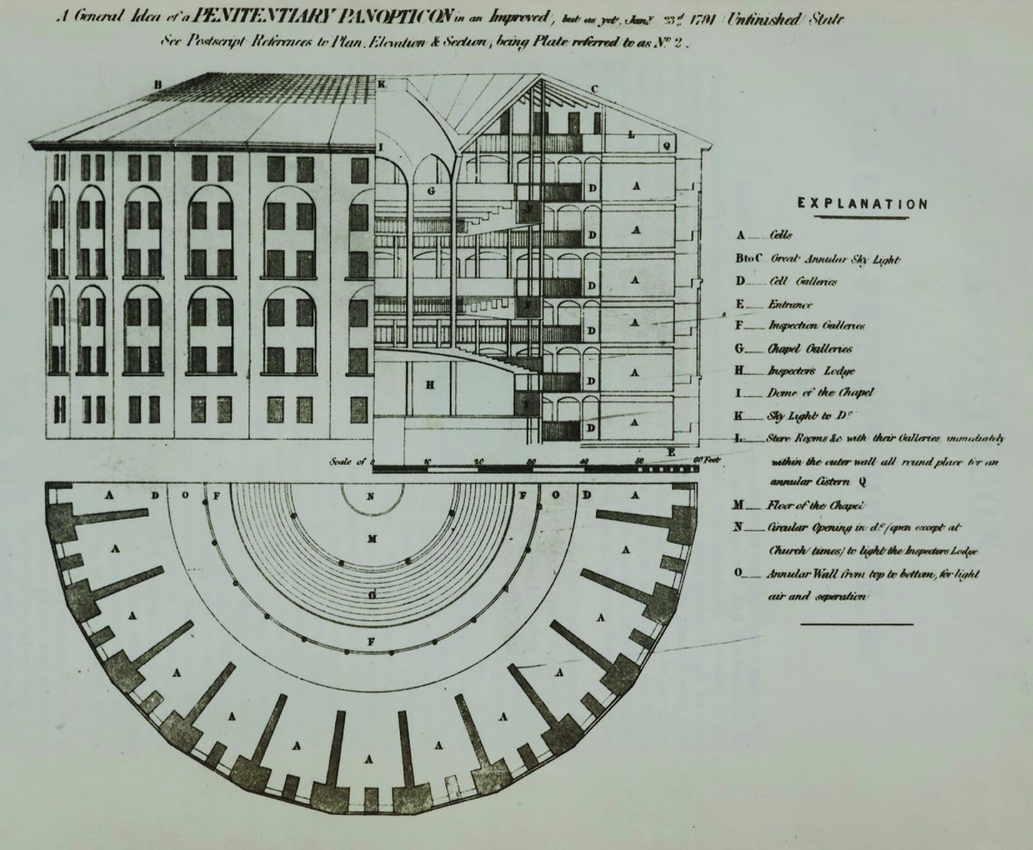
With the conscription of sexual expertise through multiple modalities of confession, exposing the intensely private before the scrutiny of public concern, the bourgeois family enshrined its own surveillance over itself, authorizing a pastoral power in which, Leviathan-like, they themselves would incorporate the great shepherd that trains its tireless eyes upon the flock. Though the sovereign had been replaced at the center of this surveillance—just as the Panopticon replaced the royal menagerie at VersaillesFootnote 83—this was not the disciplinary surveillance Foucault highlighted in Discipline and Punish, where, “in the peripheric ring, one is totally seen, without ever seeing,”Footnote 84 with the Panopticon itself become a ring of Gyges for the observer at its center (Fig. 2). A new ring of power was called for: in History of Sexuality, Foucault refers to Diderot's fable, “Les bijoux indiscrets,” in which the genie Cucufa discovers a silver ring buried in his pocket, “whose stone, when turned, makes the sexes . . . speak,”Footnote 85 a gift suitable for sultan or sovereign. This ring is a confessional ring, and thus “our problem is to know . . . on which master's finger it has been placed . . . and how it is that each one of us has become a sort of attentive and imprudent sultan with respect to his own sex and that of others.”Footnote 86 What if, together with the crozier, this “magical ring” were to be wielded by the Leviathan of pastoral power,Footnote 87 an instrument through which to elicit the testimonies of sexuality that might be drawn into the circulation of power/knowledge?
Willey Reveley, “Elevation, Section and Plan of Bentham's Panopticon Penitentiary” (Edinburgh, 1843). © The British Library Board (12274.d.1). Used with permission.

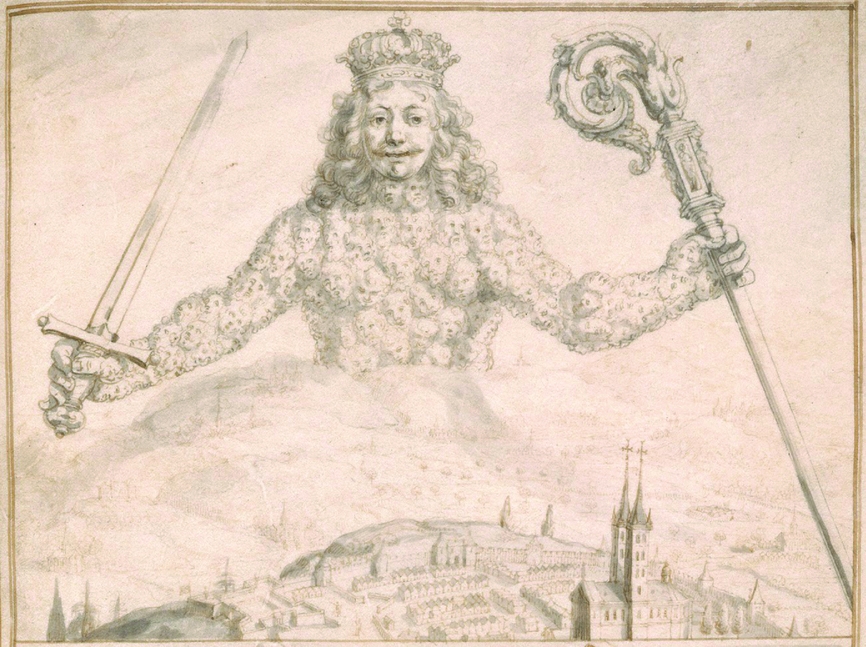
Hobbes’ original frontispiece for the Leviathan has its constituent citizenry facing into the Leviathan itself, but the pastoral Leviathan may be more suitably visualized in the handwritten copy Hobbes presented to the soon-to-be-exiled Charles II in October 1651, in which oversight resides in all citizens (Fig. 3). Immediately prior to publication of History of Sexuality, Foucault had recounted the eighteenth-century reinscription of externalized struggles between states into an internal struggle proper to the “nation” itself;Footnote 88 and how, as it sought to discern its capacities and actualize its capabilities, the nation embraced a new body politic possessed of its own will to self-knowledge, the instruments of which would increasingly serve the characteristic pursuits of bio-power:
it gave rise . . . to comprehensive measures, statistical assessments, and interventions aimed at the entire social body or at groups taken as a whole. Sex was a means of access both to the life of the body and the life of the species. It was employed as a standard for the disciplines and as a basis for regulations . . . It was put forward as the index of a society's strength, revealing of both its political energy and its biological vigor.Footnote 89
Hand-drawn frontispiece prepared for Charles II, Thomas Hobbes, Leviathan (1651). © The British Library Board (Egerton 1910, f.1). Used with permission.

This is a technology of the self expanded to the scale of the Leviathan, promoting its health and vigor; an expansion fueled by the interests and anxieties of the bourgeoisie, and made possible by their political ascendancy and the confessing society they brought to life.
In this mapping of polity over a constitution of the self—the “wound” of public right healed through a self-administration of the welfare and interests of the population—we recover that harmony between self and state sought in the kallipolis through the oversight of its great shepherd, the philosopher–ruler who best embodies the harmony of the polis. But such pastoral oversight would now become a self-surveillance and self-policing of those who would be ruled, and that shepherd of a distinctively Theban ancestry, whether the Thebes of Sophocles or of Voltaire—or even of the Republic itself;Footnote 90 for the bourgeoisie needed to vastly expand the human catchment available to this politico-sexual incorporation so that it might properly serve their ambitions, a vision for the nation that was to embrace not just a caste or a class but a population.Footnote 91 Unlike the noble guardians of the kallipolis, the family of the bourgeosie would have to provide a model that extended to all citizens,Footnote 92 and, in accomplishing that feat, they would chance to uncover the most “dreadful secret” of all.
OEDIPUS REDIVIVUS
It could be said that, in their determination to secure class vitality through the deployment of sexuality and its focus on their own family, the bourgeoisie risked too exclusive a measure of social distinction to succeed politically in the modern age. It was not enough that the bourgeois family became the First Family of sexuality: that family had to become the paradigm for all families, and on Foucault's account it was a recasting of the Oedipal drama—with the central character no less unwitting, but propelled now by actual desire—that provided the stage for such social and political apotheosis. The foundation for this development is depicted in History of Sexuality as a kind of grafting of the new family of “sexuality” onto the old family of “alliance,” enabling a juridical discourse to persist within the regime of sexuality under the auspices of taboo.
Foucault characterizes the “deployment of alliance” as fundamentally conservative, an anchor for social homeostasis: “a system of marriage, of fixation and development of kinship ties, of transmission of names and possessions,” that was “built around a system of rules defining the permitted and the forbidden, the licit and the illicit,” thus enjoying a “privileged link with the law.”Footnote 93 The deployment of sexuality, on the other hand, was “concerned with the sensations of the body, the quality of pleasures,”Footnote 94 in keeping with its roots in that solipsistic probing of the Christian confessional or pastoral; furthermore, it was fundamentally dynamic, recalling the restless, ceaselessly transformative bourgeoisie vividly characterized in the first part of the Communist Manifesto—not narrowly interested in “reproducing itself, but in proliferating, innovating, annexing, creating, and penetrating bodies in an increasingly detailed way, and in controlling populations in an increasingly comprehensive way.”Footnote 95 Nevertheless, Foucault situates the sharp contrasts between alliance and sexuality within the dialectics of genealogy:
historically, it was around and on the basis of the deployment of alliance that the deployment of sexuality was constructed. First the practice of penance, then . . . the examination of conscience and spiritual direction, was the formative nucleus . . . what was at issue to begin with at the tribunal of penance was sex insofar as it was the basis of relations; the questions posed had to do with the commerce allowed or forbidden (adultery, extramarital relations, relations with a person prohibited by blood or statute, the legitimate or illegitimate character of the act of sexual congress); then, coinciding with the new pastoral and its application in seminaries, secondary schools, and convents, there was a gradual progression away from the problematic of relations [and] toward a problematic of the “flesh,” that is, of the body, sensation, the nature of pleasure, the more secret forms of enjoyment or acquiescence. “Sexuality” was taking shape, born of a technology of power that was originally focused on alliance. Since then, it has not ceased to operate in conjunction with a system of alliance . . .Footnote 96
It was astride this chimera of alliance and sexuality, conjoined by the family, that Oedipus would reenter the sociopolitical complex.
Foucault emphasizes that the “interpenetration” of alliance and sexuality within the family may explain “a number of facts,” namely “that since the eighteenth century the family has become an obligatory locus of affects, feelings, love; that sexuality has its privileged point of development in the family; that for this reason sexuality is ‘incestuous’ from the start.”Footnote 97 With the enhanced role of the family as a kind of entrepôt for rapidly transforming and proliferating modes of social commerce, Foucault finds traditional concerns regarding incest being given new and multifaceted impetus:
[Incest] is constantly being solicited and refused; it is an object of obsession and attraction, a dreadful secret and an indispensable pivot. It is manifested as a thing that is strictly forbidden in the family insofar as the latter functions as a deployment of alliance, but it is also a thing that is continuously demanded in order for the family to be a hotbed of constant sexual incitement.Footnote 98
Here, incest appears more in the guise of Janus than of Oedipus, a gateway simultaneously to the incitements of sexuality and the prohibitions of alliance, with a capacity to integrate the anxieties attendant on both. Thus we witness the birth of a Nervous Age,
for this is the paradox of a society which, from the eighteenth century to the present, has created so many technologies of power that are foreign to the concept of law: it fears the effects and proliferations of those technologies and attempts to recode them in forms of law. If one considers the threshold of all culture to be prohibited incest, then sexuality has been, from the dawn of time, under the sway of law and right.Footnote 99
Claiming such deep, culturally transcendant roots, sexuality may therefore serve as an agent of revolution while nonetheless standing apart from outright rupture, and in any case—as Foucault wryly observes—“parents, do not be afraid to bring your children to analysis: it will teach them that in any case it is you whom they love.”Footnote 100
The historical context for the emergence of psychoanalysis—the later nineteenth century—was patently not the context of the initial, bourgeois-centric phase of the deployment of sexuality as Foucault understood it, but corresponded instead with a time when “the entire social body was [being] provided with a ‘sexual body’”:Footnote 101 among other things, this engaged “an entire politics for the protection of children, or the placing of ‘endangered’ minors under guardianship,” which furthermore corresponded with “a systematic campaign . . . organized against the kinds of incestuous practices that existed in rural areas or in certain urban quarters inaccessible to psychiatry.”Footnote 102 Under these auspices, psychoanalysis played an alleviating role for those who could gain access to it, for it “allowed individuals to express their incestuous desire in discourse.”Footnote 103 Psychoanalysis thus fulfilled a compensatory role in relation to expanding practices of population management that drew upon overtly repressive, juridical measures, prompting Foucault to observe that
the discovery of the Oedipus complex was contemporaneous with the juridical organization of loss of parental authority (in France, this was formulated in the laws of 1889 and 1898). At the moment when Freud was uncovering the nature of Dora's desire and allowing it to be put into words, preparations were being made to undo those reprehensible proximities in other social sectors; on the one hand, the father was elevated into an object of compulsory love, but on the other hand, if he was a loved one, he was at the same time a fallen one in the eyes of the law.Footnote 104
We have at last arrived at a figure who is simultaneously the sovereign and the scapegoat of sexuality, an Oedipus redivivus who is the offspring of bio-power and of the scientia sexualis, our intercessor with that great pastor–confessor to which we appeal, whether as citizens or as ourselves. We are all Thebans, our families the descendants of that First Family, and heir to its original sin.
Though the Oedipus of sexuality may not be king or rex, neither should it be mistaken for a figure impotent or benign: in the nature of its interests and the fervor of its pursuits, we may yet discern the long shadow of an Oedipus tyrannos. The codification of sexuality as transgressive knowledge, as the great secret to be uncovered, as a dangerous revelation that just might unmake its seeker, both ignited and continues to fuel that relentless incitement to know which gives the deployment of sexuality its peculiar dynamism, a forensic pursuit driven by the zeal of an Oedipus:Footnote 105
Is it not with the aim of inciting people to speak of sex that it is made to mirror . . . something akin to a secret whose discovery is imperative, a thing abusively reduced to silence, and at the same time difficult and necessary, dangerous and precious to divulge? . . . What is peculiar to modern societies, in fact, is not that they consigned sex to a shadow existence, but that they dedicated themselves to speaking of it ad infinitum, while exploiting it as the secret.Footnote 106
Like the career of Oedipus, the peculiar, indeed highly improbable career of sexuality reveals it to be the “child of chance,”Footnote 107 a genealogical phenomenon in a profoundly Nietzschean sense.Footnote 108 Its principal beneficiaries, the bourgeoisie, enjoyed such fortune courtesy of fortuitous outcome rather than by fated design or intent; least of all was it the gift of a materialist teleology with a corresponding destiny in revolution.
According to Foucault, then, our collective Oedipal complex flourishes unchecked, subject to an insatiable will to know; thus, with the discourse of sexuality—beneath the aegis of a pastoral regime that stretches between Thebes and the kallipolis, and from pasture to polis—we still have not cut off the head of the tyrant. As for that mortal god, the Leviathan of sexuality itself, though its implements may have changed hands, it nevertheless retains its sword; for the “eugenic ordering of society” when pursued “in the guise of an unrestricted state control . . . implied both the systemic genocide of others and the risk of exposing oneself to a total sacrifice.”Footnote 109 When the purification of the polis and the askesis of its guardian class at last ground the ambitions of the nation, sex may indeed prove “worth dying for.”Footnote 110