Background
Falls are the leading cause of serious accidental injury (resulting in admission to hospital for four or more days) amongst people aged 65 or more years in the United Kingdom (Cryer Reference Cryer2001). Hip fractures are an especially grave complication of falls in older adults, and result in more hospital admissions than any other type of injury (Jensen et al. Reference Jensen, Christiansen, Boesen, Hegedus and Transbol1982), which during 2000 cost the National Health Service (NHS) in England around £1.7 billion (Easterbrook et al. Reference Easterbrook, Horton, Arber and Davidson2001). There is a 10–20 per cent reduction in expected survival in the first year following a hip fracture (Cummings et al. Reference Cummings, Kelsey, Nevitt and O'Dowd1985; Magaziner et al. Reference Magaziner, Simonsick, Kashner, Hebel and Kenzora1989; Lu-Yao et al. Reference Lu-Yao, Baron, Barrett and Fisher1994), and roughly one-half of survivors never recover normal function (Magaziner et al. Reference Magaziner, Simonsick, Kashner, Hebel and Kenzora1989). Falling can also have serious psycho-social consequences, such as increased anxiety and depression, and can raise the fear of falling and reduce activity (Chandler et al. Reference Chandler, Duncan, Sanders and Sudenski1996; Lachman et al. Reference Lachman, Howland, Tennstedt, Jette, Assmann and Peterson1998; Yardley and Smith Reference Yardley and Smith2002). The prevention and management of falls in older people is a key target of the Department of Health (DOH Reference Department2001), and national guidelines on the topic have recently been produced by the UK National Institute for Health and Clinical Excellence (NICE 2004).
Older people are at particular risk of falls and fall-related injuries. Physiological changes with age, such as osteoporosis, postural instability, gait disturbances, diminished muscle strength, poor vision and cognitive impairment, as well as multiple medications, are all risk factors for falling. Environmental hazards, such as steps, stairs, beds, baths, showers, lighting, loose rugs, and the absence of grab rails and banisters, have also been identified as contributing to falls (Parker, Twemlow and Pryor Reference Parker, Twemlow and Pryor1996; Lilley, Arie and Chilvers Reference Lilley, Arie and Chilvers1995; Cryer Reference Cryer2001). Apart from the injury sustained in the fall, there are other potential consequences, such as loss of mobility, increased dependency and disability, hypothermia, pressure-related injuries and infections (DOH Reference Department2001).
In recent years, much attention in health-promotion research and in health care has focused on falls and falls prevention among older adults. In particular, several trials and systematic reviews have investigated the effectiveness of various falls-prevention strategies, and shown that effective interventions include multi-disciplinary, multi-factorial risk-factor screening and intervention programmes, muscle strength and balance training, individually-tailored home exercise programmes, home modification, T'ai Chi programmes, medication review, and the follow up of patients who have fallen (Cryer Reference Cryer2001; Easterbrook et al. Reference Easterbrook, Horton, Arber and Davidson2001; Gillespie et al. Reference Gillespie, Gillespie, Robertson, Lamb, Cumming and Rowe2003; Parker, Gillespie and Gillespie Reference Parker, Gillespie and Gillespie2005). Previous reviews have concentrated on quantitative evaluations of effectiveness, however, and have neglected the patients' views about the acceptability of the programmes. As a result, service or guideline developers have little information by which to improve acceptability or adherence.
Aims and objectives
The aim was to undertake a systematic review of the research evidence on the barriers and facilitators which influence older people's participation in, and adherence to, falls-prevention programmes and interventions, and to identify the measures that promote acceptance. The exercise was expected to identify examples of good practice. Five review questions were to be asked of each published report:
1. What influences whether older people participate in falls-prevention programmes?
2. What factors prevent older people from taking part in falls-prevention programmes?
3. What do older people perceive to be the benefits of falls-prevention programmes?
4. What interventions are effective in promoting participation in falls-prevention programmes?
5. What are the key components of successful interventions for promoting participation in falls-prevention programmes?
The search strategy and coding
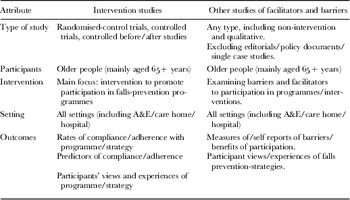
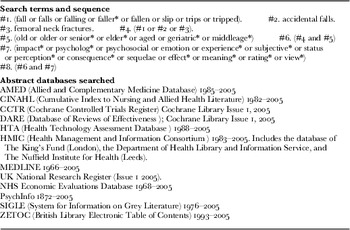
The studies of interest were those that evaluated interventions to promote adherence to, or participation in, a falls-prevention programme or strategy, and that identified the factors that influenced whether older people participated and were compliant. Further details of the inclusion criteria are provided in Table 1. We searched for all potentially relevant literature, both published and unpublished, with no date restrictions, and included relevant evidence regardless of country of origin. In order to find all potential studies we used a broad, topic-oriented approach. Methodological search filters were not used, as many non-randomised studies are not key-worded by study design (Peersman et al. Reference Peersman, Harden, Oliver and Oakley1998). The search terms were both free-text and ‘medical subject heading’ (MeSH) terms and they were combined with the appropriate Boolean operators. Details of the search terms and the databases that were searched are given in Table 2. In addition, lists of references in the selected papers were checked for otherwise unfound contributions. To identify unpublished or grey literature, we contacted field researchers and experts, including the guideline development group of NICE. The searches were conducted in January 2005.
Inclusion criteria for the systematic review

Note: A&E Accident and emergency hospital departments (=casualty wards).
The search strategy

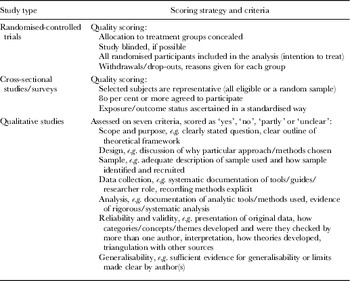
All citations identified by the above searches were downloaded into an Endnote database. Two authors independently screened the titles and abstracts against the inclusion criteria and extracted data from the full papers onto a specially designed form. Disagreements were resolved by discussion. Two reviewers independently assessed the quality of the selected studies using design assessment checklists. The quality criteria were informed by several sources (Higgins Reference Higgins and Green2006; Thomas et al. Reference Thomas, Sutcliffe, Harden, Oakley, Oliver, Rees, Brunton and Kavanagh2003; Spencer et al. Reference Spencer, Ritchie, Lewis and Dillon2003) and are similar to established tools (Mays and Pope Reference Mays and Pope1995; Giacomini and Cook Reference Giacomini and Cook2000). The core quality-assessment principles are summarised in Table 3.
Core principles of quality assessment for main study designs

The papers were categorised by study design using the following categories: randomised-controlled trial, controlled trial, before/after study (with or without control), cohort study (with or without concurrent controls), case control, survey, process evaluation and qualitative study. Process evaluations were categorised in terms of the intervention's implementation, its acceptability, and the explanations given about why an intervention was successful or unsuccessful. Non-intervention studies (cohort, case-control and cross-sectional survey designs) were differentiated by whether they aimed to identify or analyse the factors that influence adherence with falls and fracture prevention, and whether they sought older people's views about such programmes. Data were also extracted on the type, location and duration of the intervention, the characteristics of the participants and providers, the country, the main aims of the study, and the outcome measures.
The reviewed studies
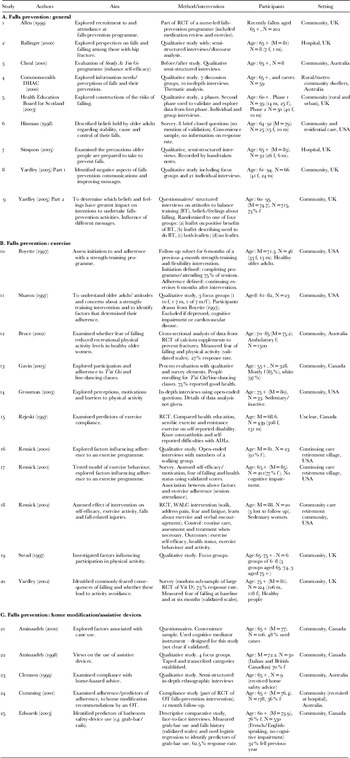
The electronic searches yielded 6,191 records from all data bases, including duplicates. Of those, 134 appeared potentially relevant and a hard copy was obtained for screening. After full text review, 24 studies met the inclusion criteria. One study (Yardley and Todd Reference Yardley and Todd2005) was in two parts using both quantitative and qualitative methods. The remaining studies were excluded because they did not meet the inclusion criteria or because the quality was poor. Details of the studies' aims, settings and methods, of the interventions (where appropriate), and of the participants are summarised in Table 4 (further details are available on request from the authors).
Summary characteristics of included studies

Notes: DHAC: Department of Health and Aged Care, Commonwealth of Australia. f: female. m: male. M=average or arithmetic mean. RCT: randomised controlled trial. Vit: Vitamin. WALC: Women against lung cancer. Full citations of the included studies are in the List of References.
Seven studies took place in the UK (Table 4, rows 1, 2, 5, 7, 8/9, 19, 20); seven in the USA (6, 10, 11, 14, 16–18); five in Australia (3, 4, 12, 23, 24); and five in Canada (13, 15, 21, 22, 25). Thirteen studies focused on people living in the community (1, 3–5, 8/9, 10–15, 19, 20); one on a combination of community dwellers and nursing/residential home residents (6); and three on people living in a continuing-care retirement village (16–18). Two studies were conducted in hospital (2, 7). Of the studies in English-speaking countries, only a few examined the health-promotion needs of non-English speaking groups (5, 21, 25). In the majority of the studies, the participants were aged 60 or more years, but in one (13) they were aged 55 or more years. The participants were variously those at high risk of falling or the ‘healthy and active’. Sample sizes ranged from eight to 89 in the qualitative studies, and from 19 to 1,500 in the quantitative studies.
Only one study (18) evaluated an intervention (more exercise) explicitly to promote adherence to, or participation in, a falls-prevention programme or strategy. Two studies were process evaluations. One (1) looked at the implementation of and adherence to a nurse-led falls-prevention programme, and the other (13) examined the acceptability to older people of line-dancing and T'ai Chi classes. The other studies all identified factors involved in older people participating or complying with falls-prevention programmes. Five of these examined older people's general views on falls and falls prevention (2, 4, 5, 6, 8), two examined specific adherence factors, such as self-efficacy (3, 12), and the rest aimed to identify the factors that influence adherence to falls and fractures prevention interventions. The following sections of the paper present the findings about three groups of studies concerned respectively with falls and falls prevention in general (N=8), exercise interventions (11), and home modifications or assistive devices, e.g. canes (5).
The methodologies and quality of the studies
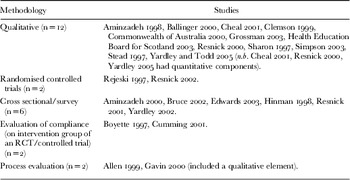
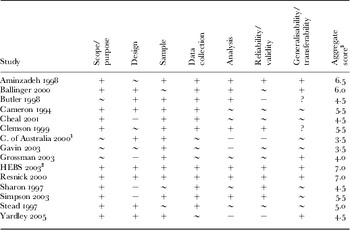
The qualitative studies employed methodologies that ranged from phenomenology to discourse analysis, although some did not make the method clear (Tables 5 and 6). In general, the studies had clearly defined aims, and gave adequate descriptions of the sampling and data collection, but there was limited evidence of sample validation, triangulation or assessments of generalisability. All examined people's views or knowledge of falls prevention or strategies to reduce falls, in most cases using semi-structured interviews and focus groups, and with the findings reported as themes and categories. Five examined perceptions, motivations and barriers to physical activity (Gavin and Myers Reference Gavin and Myers2003; Grossman and Stewart Reference Grossman and Stewart2003; Resnick and Spellbring Reference Resnick and Spellbring2000; Sharon et al. Reference Sharon, Hennessy, Brandon and Boyette1997; Stead et al. Reference Stead, Wimbush, Eadie and Teer1997), and two these same reactions to home modification or assistive devices (Aminzadeh and Edwards Reference Aminzadeh and Edwards1998; Clemson, Cusick and Fozzard Reference Clemson, Cusick and Fozzard1999), and the remainder examined more general reactions.
Methodological approaches used in included studies

Quality assessment of the qualitative studies

Notes + yes, − no, ~ partly, ? not clear. 1. Health Education Board for Scotland. 2. Department of Health and Age Care, Commonwealth of Australia. 3. Aggregate of scores for each attribute (1 for ‘yes’, 0.5 for ‘partly’).
The quantitative studies used various methods to measure or review predictors of increased exercise adherence, behaviour change, falls history, fear of falling, ability and confidence, self-efficacy, participation rates, and activity levels. Overall the quality was low to fair. Some had small sample sizes (e.g.Hinman Reference Hinman1998; Resnick Reference Resnick2002) and some reached conclusions and recommendations that were questionably supported by the data. For example, although Cheal and Clemson (Reference Cheal and Clemson2001) was treated as a qualitative study, it also had a quantitative component, but the uncontrolled ‘before and after’ design and very small sample were inadequate to assess the efficacy of the intervention. In both the randomised-controlled trials, the allocation to the samples was not fully described and neither reported a sample size calculation or an intention-to-treat analysis. Only Resnick (Reference Resnick2002) gave details of numbers lost to follow-up.
Of the surveys, two stated that they used a random sample (Bruce, Devine and Prince Reference Bruce, Devine and Prince2002; Edwards et al. Reference Edwards, Lockett, Aminzadeh and Nair2003), and three a convenience sample (Aminzadeh and Edwards Reference Aminzadeh and Edwards2000; Hinman Reference Hinman1998; Yardley and Smith Reference Yardley and Smith2002). Only three studies gave the response rates (Bruce, Devine and Prince Reference Bruce, Devine and Prince2002; Edwards et al. Reference Edwards, Lockett, Aminzadeh and Nair2003; Yardley and Smith Reference Yardley and Smith2002), none of which were over 80 per cent. Four reported that they used validated outcome measures (Bruce, Devine and Prince Reference Bruce, Devine and Prince2002; Edwards et al. Reference Edwards, Lockett, Aminzadeh and Nair2003; Resnick Reference Resnick2001; Yardley and Smith Reference Yardley and Smith2002).
Reactions to three types of intervention
General studies of falls and falls prevention
Four of the eight studies of older people's perspectives on falls and falling in this category used qualitative methods (Ballinger and Payne Reference Ballinger and Payne2000; Commonwealth of Australia 2000; Health Education Board for Scotland 2003; Simpson, Darwin and Marsh Reference Simpson, Darwin and Marsh2003) and one used quantitative methods (Hinman Reference Hinman1998). One study (Cheal and Clemson Reference Cheal and Clemson2001) used quantitative and qualitative methods to examine falls and self-efficacy, and one (Yardley and Todd Reference Yardley and Todd2005) used mixed methods to study issues around the communication of the risk of falling and prevention strategies. One study (Allen and Simpson Reference Allen and Simpson1999) was a process evaluation that explored recruitment to, and attendance at, a falls-prevention programme.
It emerged that the term ‘falls prevention’ is unfamiliar to many older people (Commonwealth of Australia 2000) and that some are unaware of the benefits of falls-prevention interventions (Simpson, Darwin and Marsh Reference Simpson, Darwin and Marsh2003). Although many people accepted that environmental and personal changes might prevent falling, they tended to advocate change for others rather than themselves (Health Education Board for Scotland 2003; Hinman Reference Hinman1998). Other issues around falls and falls prevention that were noted included stigma, denial, identity, the attribution of falls to external factors, and low health expectations.
Studies of exercise interventions
Eleven studies looked at factors that affect participation in, and adherence to, physical activity routines. Some examined exercise in general whereas others focused on specific exercise programmes such as strength training (Boyette, Sharon and Brandon Reference Boyette, Sharon and Brandon1997; Sharon et al. Reference Sharon, Hennessy, Brandon and Boyette1997), walking (Resnick and Spellbring Reference Resnick and Spellbring2000), and T'ai Chi and line dancing (Gavin and Myers Reference Gavin and Myers2003). One study examined whether fear of falling deterred physical activity (Bruce, Devine and Prince Reference Bruce, Devine and Prince2002), and a randomised controlled trial assessed the effect of an intervention to promote exercise (Resnick Reference Resnick2002). Many of the studies did not treat exercise as a falls-prevention intervention but as a challenge that promotes general health; those that did showed that many people are unaware of the benefits of exercise in preventing falls (Simpson, Darwin and Marsh Reference Simpson, Darwin and Marsh2003; Yardley and Todd Reference Yardley and Todd2005).
The factors shown to increase participation in exercise programmes were high exercise self-efficacy, past exercise history, good general health, and unimpaired functional abilities (Rejeski et al. Reference Rejeski, Brawley, Ettinger, Morgan and Thompson1997; Resnick and Spellbring Reference Resnick and Spellbring2000; Resnick Reference Resnick2001). Among the programme characteristics shown to improve adherence were: frequent bouts of activity of moderate duration (Rejeski et al. Reference Rejeski, Brawley, Ettinger, Morgan and Thompson1997), accessibility, transport, convenience, having a social dimension, strong leadership (Boyette, Sharon and Brandon Reference Boyette, Sharon and Brandon1997; Gavin and Myers Reference Gavin and Myers2003; Sharon et al. Reference Sharon, Hennessy, Brandon and Boyette1997), and exercise tailored to individual needs and capabilities (Gavin and Myers Reference Gavin and Myers2003). In addition, an intervention to help people learn about exercise and overcome barriers appeared to increase overall activity and exercise at six months, but the sample size was small and the follow-up was limited (Resnick Reference Resnick2002). The factors shown to be associated with the avoidance of exercise included greater age (Yardley and Smith Reference Yardley and Smith2002), fear of falling (Bruce, Devine and Prince Reference Bruce, Devine and Prince2002), fear of exertion (Grossman and Stewart Reference Grossman and Stewart2003), and discomfort such as pain or shortness of breath (Simpson, Darwin and Marsh Reference Simpson, Darwin and Marsh2003; Resnick and Spellbring Reference Resnick and Spellbring2000).
Studies of home modifications and assistive devices
Two studies explored factors in adherence to prescribed home modifications (Clemson, Cusick and Fozzard Reference Clemson, Cusick and Fozzard1999; Cumming et al. Reference Cumming, Thomas, Szonyi, Frampton, Salkeld and Clemson2001) and one examined the use of bathroom-safety devices such as grab-bars (Edwards et al. Reference Edwards, Lockett, Aminzadeh and Nair2003). Three of the general studies (reviewed above) also looked at home modifications (Commonwealth of Australia 2000; Hinman Reference Hinman1998; Simpson, Darwin and Marsh Reference Simpson, Darwin and Marsh2003). The other two studies (Aminzadeh and Edwards Reference Aminzadeh and Edwards1998, Reference Aminzadeh and Edwards2000) examined the factors that affect the use of assistive devices such as canes. Shared findings were that many see ‘home-health checks’ as intrusive and unnecessary, that people dislike changes to their home, and that many have a perception of low risk (Clemson, Cusick and Fozzard Reference Clemson, Cusick and Fozzard1999; Simpson, Darwin and Marsh Reference Simpson, Darwin and Marsh2003). The tendency to reject home-safety advice may be related to older people's wish to maintain their independence and control over their lives and homes (Clemson, Cusick and Fozzard Reference Clemson, Cusick and Fozzard1999). Barriers to the use of canes and walking aids included stigma, embarrassment, fear of dependence, and denial of the need. Home modifications and walking aids were more acceptable than eyesight and footwear checks, medication reviews, and balance and exercise programmes (Commonwealth of Australia 2000).
Cross-cutting themes
Barriers and facilitators
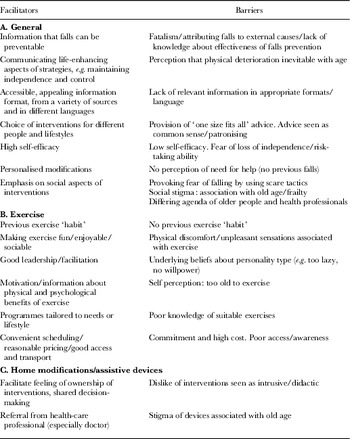
The most common barriers and facilitators relating to participation and adherence to falls-prevention programmes that were identified by two reviewers in the quantitative and qualitative studies are shown in Table 7. Among the barriers to participation and concordance, one that emerged strongly was fatalistic attitudes. Falls were often attributed to chance or bad luck and therefore not regarded as preventable. Several of the studies present similar quotations from their respondents that demonstrate this attitude, for example, ‘I don't know how you can be told how to prevent falling. You don't do it on purpose … it just happens’ (Yardley and Todd Reference Yardley and Todd2005: 16). This idea extended to people's rational for not exercising. Some respondents were reported as fatalistically believing that they were basically a lazy person or lacked willpower and therefore could not exercise (Resnick and Spellbring Reference Resnick and Spellbring2000).
Facilitators and barriers for older people participating in falls-prevention interventions

A widespread finding was the attribution of falls to external causes, and a complementary resistance to admitting ‘intrinsic’ risk factors, such as poor eyesight or dizziness (Commonwealth of Australia 2000). Instead, falls were often attributed to external causes, such as the incompetence of others or inevitable physical deterioration, over which the individual had no control (Allen and Simpson Reference Allen and Simpson1999; Ballinger and Payne Reference Ballinger and Payne2000). One of many participants' quotations that illustrated this well is found in the Health Education Board for Scotland (2003: 17) study: ‘You couldn't have prevented it; it was just the corner of the pavement or something. You know something that anybody of any age could do’. In contrast, Hinman (Reference Hinman1998) reported that 68 per cent of the participants related their falls to intrinsic rather than environmental factors, but this study had a small sample and used a brief questionnaire with closed questions that may have been leading.
Some people felt falls-prevention interventions were not appropriate for them because they had low health expectations and saw physical decline as an inevitable consequence of ageing. A characteristic expression was, ‘I did a lot of exercise in years gone by … but in recent years, no[t so]. At my age I guess I don't believe it makes a difference’ (Resnick and Spellbring Reference Resnick and Spellbring2000: 39). The opposite views were also reported. Evidently many older people reject the idea that they need falls-prevention advice or help because they see themselves as fit, healthy and able to manage (Allen and Simpson Reference Allen and Simpson1999). They may wish to distance themselves from the identity of an ‘older’ person, and see falls prevention as more relevant for ‘older’ or ‘frailer’ people (Yardley and Todd Reference Yardley and Todd2005: 13). They may, therefore, be alienated by information that is explicitly targeted at older people or that encourages participation by stereotyping older people (Aminzadeh and Edwards Reference Aminzadeh and Edwards1998; Ballinger and Payne Reference Ballinger and Payne2000; Health Education Board for Scotland 2003; Stead et al. Reference Stead, Wimbush, Eadie and Teer1997; Yardley and Todd Reference Yardley and Todd2005), and dislike advice that they see as common sense and find patronising (Yardley and Todd Reference Yardley and Todd2005: 14). Although some fit and active older people may understandably deny the impact of ageing, some of those at high risk and of those with a history of falls also saw falls-prevention advice as relevant to others not themselves (Yardley and Todd Reference Yardley and Todd2005).
Related to the issue of identity is the perception of stigma. People often felt stigmatised by interventions aimed at ‘older people’, for example canes, walking frames and grab-bars (Aminzadeh and Edwards Reference Aminzadeh and Edwards2000: 300). Pride also played a part in people being reluctant to accept advice or help (Yardley and Todd Reference Yardley and Todd2005: 14). Activities that allowed older people to defy stereotypes (e.g. intense exercise programmes) may facilitate participation (Sharon et al. Reference Sharon, Hennessy, Brandon and Boyette1997). A contradiction was found, however, between people not wanting to be seen as ‘old’ and distancing themselves from other ‘old’ people, and the fact that many valued programmes or interventions that involved contact with people of a similar age and outlook (Stead et al. Reference Stead, Wimbush, Eadie and Teer1997; Sharon et al. Reference Sharon, Hennessy, Brandon and Boyette1997).
Independence and risk negotiation
The studies confirm that many older people see independence as very important. Some disliked interventions that they saw as didactic or intrusive (Simpson, Darwin and Marsh Reference Simpson, Darwin and Marsh2003). They wanted to maintain their independence and make their own decisions and risk assessments (Clemson, Cusick and Fozzard Reference Clemson, Cusick and Fozzard1999). A Scottish participant put this well: ‘I think if you've been independent all your life, it's an embarrassment to be dependent’ (Health Education Board for Scotland 2003: 27). A fear of falling can lead to a loss of confidence, adversely affect participation in daily activities, and be a barrier to participation in interventions such as exercise (Bruce, Devine and Prince Reference Bruce, Devine and Prince2002; Cheal and Clemson Reference Cheal and Clemson2001; Grossman and Stewart Reference Grossman and Stewart2003; Yardley and Smith Reference Yardley and Smith2002). Commonly feared consequences of falling included physical damage, loss of independence, damage to identity, and embarrassment and stigma associated with falling, particularly in a public place (Health Education Board for Scotland 2003; Yardley and Smith Reference Yardley and Smith2002). Fear of falling could be made worse by hazard-reduction advice that was frightening and oppressive (Yardley and Todd Reference Yardley and Todd2005).
Social interaction and support
For some participants who disliked group activities, the social aspect of falls-prevention interventions was a barrier (Allen and Simpson Reference Allen and Simpson1999), but it seems the majority of people preferred interventions with a strong social and recreational component (Allen and Simpson Reference Allen and Simpson1999; Boyette, Sharon and Brandon Reference Boyette, Sharon and Brandon1997; Stead et al. Reference Stead, Wimbush, Eadie and Teer1997; Sharon et al. Reference Sharon, Hennessy, Brandon and Boyette1997). Social support was important at several levels. Family and friends had a role in encouraging participation in, and adherence to, falls-prevention programmes (Cameron and Quine Reference Cameron and Quine1994; Grossman and Stewart Reference Grossman and Stewart2003; Sharon et al. Reference Sharon, Hennessy, Brandon and Boyette1997). In addition, the desire to remain healthy and active so as not to be a ‘burden’ and to keep up with family and grandchildren was an incentive for some to exercise (Grossman and Stewart Reference Grossman and Stewart2003). Support from programme leaders was also important with strong leadership a facilitator to exercise adherence (Boyette, Sharon and Brandon Reference Boyette, Sharon and Brandon1997; Sharon et al. Reference Sharon, Hennessy, Brandon and Boyette1997).
Previous experience
Previous experience of falls-prevention programmes was an important factor in acceptance of and participation in the interventions, and similarly participation in and adherence to exercise was more likely among those with a history of taking exercise (Resnick and Spellbring Reference Resnick and Spellbring2000; Resnick Reference Resnick2001; Stead et al. Reference Stead, Wimbush, Eadie and Teer1997). One study found that a ‘habit’ of exercise was the strongest predictor of future exercise behaviour (Rejeski et al. Reference Rejeski, Brawley, Ettinger, Morgan and Thompson1997). There was mixed evidence about whether having fallen previously might affect attitudes towards falls prevention. Some studies found that those who had fallen before were more likely to be receptive to falls-prevention interventions (Commonwealth of Australia 2000; Edwards et al. Reference Edwards, Lockett, Aminzadeh and Nair2003), but this was not corroborated by another study (Cumming et al. Reference Cumming, Thomas, Szonyi, Frampton, Salkeld and Clemson2001).
The role of the healthcare professional
Health-care professionals, particularly physicians, emerged as important social referents for older people (Aminzadeh and Edwards Reference Aminzadeh and Edwards2000; Commonwealth of Australia 2000; Grossman and Stewart Reference Grossman and Stewart2003), although one study (Stead et al. Reference Stead, Wimbush, Eadie and Teer1997) found that they were not perceived as a credible source of information or advice on exercise. Home visits were sometimes seen as an intrusion but this reaction depended on the perceived authority of the person making the visits and recommendations: (Simpson, Darwin and Marsh Reference Simpson, Darwin and Marsh2003). Therapists and patients may not share the same agenda and perspectives about falls (Ballinger and Payne Reference Ballinger and Payne2000); that is, concordance is not present, and professionals need to take into account older people's views and understand and empathise with their risk-taking behaviour (Clemson, Cusick and Fozzard Reference Clemson, Cusick and Fozzard1999, Simpson, Darwin and Marsh Reference Simpson, Darwin and Marsh2003).
Discussion
The systematic review found 24 studies that examined some aspect of older people's attitudes towards falls prevention. Twelve used qualitative methods and the rest quantitative designs. The majority were exploratory studies and collected older people's views on falls and falls prevention. The studies identified a number of factors that affected participation in falls-prevention interventions and programmes. These included denial, fatalism, self-efficacy, past exercise habits, a fear of falling, general health and functional ability, health expectations, under-estimation of personal risk of falling, stigma, embarrassment, and the inconvenience of some assistive devices.
Of particular interest were those aspects of falls-prevention programmes that improved participation and adherence, and the studies provided evidence that social support and interaction, low intensity exercise (e.g. walking), education, and the perception that a programme was relevant and beneficial had these effects. Social support was very important in reinforcing engagement with falls-prevention interventions, both at the individual level (i.e. from health-care professionals, family, friends) and at the societal level (i.e. wider cultural norms that support the idea of older people remaining active).
Many of the themes identified by the review, e.g. identity, stigma, independence, denial of the ageing process and health expectations, concern the ways in which older people view themselves and believe they are seen by others. The social identity of older people is sometimes stigmatised, incorporating references to disability, disenfranchisement and other negative attributes. The way dependency is emphasised as a concomitant of old age is culturally constructed and historically located (Chater Reference Chater1999; McCormack Reference McCormack2003). Discrimination towards older people has been described throughout the British National Health Service and social-care services (Grimley Evans Reference Grimley Evans1997; Department of Health Reference Department2001), and is pervasive in society, which adds to older people's disempowerment (Bytheway Reference Bytheway1995; Tones Reference Tones and Kendall1998). Those working with older people to prevent falls therefore need to be aware of, and to challenge, the factors that sustain their marginalised position (Ryles Reference Ryles1999).
One of the aims of the review was to assess the effectiveness of interventions used to promote the acceptance of falls-prevention strategies and to identify examples of good practice, but only one very small study that evaluated the promotion of adherence to a falls-prevention intervention was found (Resnick Reference Resnick2002). The majority of the reviewed studies were exploratory. The facilitators of participation were identified more often by inference or by the investigators' ‘subjective synthesis’ than by a statistically significant effect from a controlled study. Many of the studies examined only beliefs and attitudes, not actual behaviour. The presented evidence allows us to speculate about the key factors in successful interventions but these need further evaluation.
Several paradoxes that are challenges for those designing falls-prevention programmes emerged from the review. On the one hand, some people reject interventions that stereotype them as ‘old’ and wishing to avoid contact with other older people, but on the other hand, many people valued interventions that involved contact with people of a similar age and outlook. Another evident challenge is how health practitioners make people aware of their potential risk of falling without causing distress or denial of the problem.
Limitations and strengths of the review
A number of the review's methodological features could influence the validity of its results. Publication and other selection biases threaten the validity of all systematic reviews, but this is a particular problem when searching for studies that used non-randomised designs. These are more difficult to identify than randomised-controlled trials, because of the diversity of designs, the absence of standardised terminology, and the limitations of key-wording or cataloguing (Peersman et al. Reference Peersman, Harden, Oliver and Oakley1998). Despite our efforts to identify all eligible published and unpublished studies, we cannot exclude the possibility that some were missed. The included studies use several different methodologies. Although methods for conducting syntheses and meta-analyses of trials are well established (Egger, Davey-Smith and Altman Reference Egger, Davey-Smith and Altman2001; Green and Higgins Reference Green and Higgins2005), several approaches have been proposed for reviewing qualitative and non-randomised studies and they are still being developed (Campbell Reference Campbell, Pound, Pope, Britten, Pill and Morgan2003; Dixon-Woods, Fitzpatrick and Roberts Reference Dixon-Woods, Fitzpatrick and Roberts2001; Harden et al. Reference Harden, Garcia, Oliver, Rees, Shepherd, Brunton and Oakley2004).
There are also issues around quality assessment, both in terms of which quality criteria should be used and how that information should be applied to the review findings (Dixon-Woods Fitzpatrick and Roberts Reference Dixon-Woods, Fitzpatrick and Roberts2001; Sandelowski, Docherty and Emden Reference Sandelowski, Docherty and Emden1997). In addition, there is no consensus on whether studies should be weighted by design and quality. Therefore, although we critically appraised the qualitative studies in the review, we did not use this information to exclude studies or weight the results. More work is needed on the tools and procedures for quality assessments of qualitative studies in systematic reviews. Despite these issues, a narrative synthesis provides a valuable overview of evidence from disparate studies, and usefully identifies the contributions of such studies to the evidence base. In particular, it collates the evidence about patient perspectives on falls prevention, which have been neglected in the development and implementation of the interventions.
The generalisability of the review findings must be considered. The studies in this review sampled older people from both community and extended-care settings. Although a few attempted to assess the efficacy of an intervention or reported associations with very few respondents, the majority had acceptable sample sizes. In addition, although some of the studies acknowledged the problems of generalisation, there was impressive consistency in the prominent themes. On the other hand, few participants were from non-English speaking backgrounds, there were few data on gender or social-class differences, and those with cognitive impairments were usually excluded.
Conclusions
Much research has been done on which interventions are effective in preventing falls and there have been systematic reviews (Cryer Reference Cryer2001; Easterbrook et al. Reference Easterbrook, Horton, Arber and Davidson2001; Gillespie et al. Reference Gillespie, Gillespie, Robertson, Lamb, Cumming and Rowe2003; Parker, Gillespie and Gillespie Reference Parker, Gillespie and Gillespie2005), but the little evidence of the factors that influence participation and long-term adherence has not previously been collated. Gender and ethnicity may affect attitudes towards and participation in falls-prevention strategies but there is no research on these factors (Horton Reference Horton2002). Currently, the health-care and other professionals that are developing or providing falls-prevention services have little knowledge of either older people's views or the barriers to their participation that older people perceive. Further research that raises understanding of the factors that influence older people's ambivalence towards falls-prevention interventions and that promote their continuing involvement will improve service design and effectiveness.
Acknowledgements
This work was as part of a larger project, ‘Facilitators and barriers to older people accepting and complying with interventions to reduce falling and fractures’, that was funded by the Department of Health for England through the Accidental Injury Prevention Programme. The views expressed in the publication are those of the authors and not necessarily those of the Department of Health.