Introduction
Neurocognitive weaknesses across many cognitive domains are commonly reported with PTSD (Qureshi et al., Reference Qureshi, Long, Bradshaw, Pyne, Magruder, Kimbrell and Kunik2011; Scott et al., Reference Scott, Matt, Wrocklage, Crnich, Jordan, Southwick and Schweinsburg2015) and are important clinically as they are associated with poorer psychosocial and occupational functioning (Geuze, Vermetten, de Kloet, Hijman, & Westenberg, Reference Geuze, Vermetten, de Kloet, Hijman and Westenberg2009; Wrocklage et al., Reference Wrocklage, Schweinsburg, Krystal, Trejo, Roy, Weisser and Scott2016). There has been a recent emphasis on weaknesses in executive functions (Polak, Witteveen, Reitsma, & Olff, Reference Polak, Witteveen, Reitsma and Olff2012), although this finding is not universal (Qureshi et al., Reference Qureshi, Long, Bradshaw, Pyne, Magruder, Kimbrell and Kunik2011). Response inhibition and set switching are executive functions that are emphasized frequently (Aupperle, Melrose, Stein, & Paulus, Reference Aupperle, Melrose, Stein and Paulus2012; Leskin & White, Reference Leskin and White2007; Shucard, McCabe, & Szymanski, Reference Shucard, McCabe and Szymanski2008; Swick, Honzel, Larsen, Ashley, & Justus, Reference Swick, Honzel, Larsen, Ashley and Justus2012).
However, these findings are somewhat equivocal with some studies reporting very subtle findings (Leskin & White, Reference Leskin and White2007), some reporting deficits across other domains as well (Aupperle, Melrose, et al., Reference Aupperle, Melrose, Stein and Paulus2012; Gilbertson et al., Reference Gilbertson, Paulus, Williston, Gurvits, Lasko, Pitman and Orr2006; Stricker, Keller, Castillo, & Haaland, Reference Stricker, Keller, Castillo and Haaland2015; Wrocklage et al., Reference Wrocklage, Schweinsburg, Krystal, Trejo, Roy, Weisser and Scott2016), and other studies reporting impairment in one, but not all measures of inhibition/switching (Shucard et al., Reference Shucard, McCabe and Szymanski2008; Swick et al., Reference Swick, Honzel, Larsen, Ashley and Justus2012; Wrocklage et al., Reference Wrocklage, Schweinsburg, Krystal, Trejo, Roy, Weisser and Scott2016). Finally, inhibition difficulties in PTSD are more commonly reported with paradigms that use emotionally salient stimuli, such as the Emotional Stroop (Aupperle, Melrose, et al., Reference Aupperle, Melrose, Stein and Paulus2012). However, despite the greater sensitivity of such emotional paradigms, problems with inhibition in PTSD have been linked to hypoactivation of inferior frontal regions whether neutral stimuli (Falconer et al., Reference Falconer, Bryant, Felmingham, Kemp, Gordon, Peduto and Williams2008) or emotionally salient stimuli (Hayes, LaBar, Petty, McCarthy, & Morey, Reference Hayes, LaBar, Petty, McCarthy and Morey2009) were used.
Some researchers have suggested that weaker inhibition abilities may be partly responsible for some of the core PTSD symptoms, such as re-experiencing or hyperreactivity to trauma stimuli (Aupperle, Melrose, et al., Reference Aupperle, Melrose, Stein and Paulus2012). Therefore, even if neurocognitive weaknesses in PTSD are not specific to executive functions, and in particular to inhibition/switching, these weaknesses are thought to have particularly significant clinical implications. For example, such baseline neurocognitive weaknesses may make it more difficult for the trauma survivor to inhibit emotional responses to the trauma stimuli/reminders and to substitute more adaptive responses. Importantly, these are two of the goals of evidence-based PTSD psychotherapies, such as cognitive processing therapy and exposure (Institute of Medicine, 2008; Mohlman & Gorman, Reference Mohlman and Gorman2005; VA/DoD Clinical Practice Guideline for the Management of Post-Traumatic Stress, 2003). Furthermore, difficulty inhibiting such responses may also make it more likely that the individual will rely upon avoidant behaviors, thus increasing the probability that PTSD symptoms will be perpetuated.
The executive function theory of PTSD would also predict that individuals with poorer baseline inhibition/switching would be less able to benefit from the strategies taught in trauma-focused psychotherapies that emphasize inhibition of learned emotional responses and substitution of more adaptive responses to improve PTSD symptoms. Furthermore, we expect when these skills are successfully taught in the context of PTSD treatment, they might generalize to emotionally neutral inhibition/switching tasks reflecting a more general improvement in cognitive control. Therefore, relative to other neurocognitive measures, we predict that inhibition/switching should show greater improvement than other neurocognitive functions when psychotherapy is effective.
We are aware of only three studies that have examined neurocognition in the context of psychotherapy for PTSD (Nijdam, de Vries, Gersons, & Olff, Reference Nijdam, de Vries, Gersons and Olff2015; Walter, Palmieri, & Gunstad, Reference Walter, Palmieri and Gunstad2010; Wild & Gur, Reference Wild and Gur2008). All of these PTSD studies used individual psychotherapy. The study by Wild and Gur (Reference Wild and Gur2008) and the study by Nijdam et al. (Reference Nijdam, de Vries, Gersons and Olff2015) focused on the influence of baseline neurocognitive functioning on psychotherapy outcome. The study by Wild and Gur (Reference Wild and Gur2008) included eight sessions of cognitive behavior therapy and found that relative to those who did not recover (n=7) those who recovered (n=16) had significantly higher pre-treatment story recall performance.
The study by Nijdam et al. (Reference Nijdam, de Vries, Gersons and Olff2015) randomized 127 individuals to a mean of 10 sessions of trauma-focused psychotherapy (eye movement desensitization and reprocessing therapy or cognitive behavior therapy) and reported that better pre-treatment list learning and story recall were associated with greater treatment efficacy for both types of psychotherapy. Therefore, both of these studies show that better pre-treatment learning and memory was associated with better psychological treatment outcome in PTSD. The study by Nijdam et al. (Reference Nijdam, de Vries, Gersons and Olff2015) speculated that better learning/memory improves the patient’s ability to effectively remember the details of the trauma experience resulting in better ability to benefit from imaginal exposure and cognitive restructuring to reconsolidate the experience in a different way. However, executive functioning was not examined in either study.
The third PTSD study (Walter et al., Reference Walter, Palmieri and Gunstad2010) focused on change in executive functions with successful psychotherapy; they used various combinations of cognitive behavior therapy, cognitive processing therapy (Resick & Schnicke, Reference Resick and Schnicke1993), and prolonged exposure (Foa, Hembree, & Rothbaum, Reference Foa, Hembree and Rothbaum2007) (mean duration: 10 sessions). They showed that the change in an omnibus executive function measure that included inhibition/switching (Delis Kaplan Executive Functioning System number letter switching time and errors, Stroop Color-Word interference) marginally improved (p=.06) in 15 therapy completers who showed significant improvement in PTSD symptoms. However, when individual neurocognitive measures were examined, only one (DKEFS number letter switching time) of three inhibition/switching measures significantly improved. The small sample size and the absence of non-executive neurocognitive measures precluded more specific conclusions.
The current study expands on these previous investigations by examining verbal learning and memory as well as inhibition/switching in the context of a PTSD psychotherapy study. We also included working memory, another aspect of executive function, to determine if the findings with regard to executive functions were specific to inhibition/switching or were present in both domains of executive functioning. Furthermore, unlike two of the three PTSD studies the present study provided the same type of psychotherapy to all participants with control for therapist adherence.
The 16 weeks of therapy included three modules [cognitive restructuring based on cognitive processing therapy (Resick & Schnicke, Reference Resick and Schnicke1993), exposure therapy based on prolonged exposure (Foa et al., Reference Foa, Hembree and Rothbaum2007), and skills training (Lange, Jakubowski, & McGovern, Reference Lange, Jakubowski and McGovern1976)] that were counterbalanced across participants (Castillo et al., Reference Castillo, Chee, Nason, Keller, C’de Baca, Qualls and Keane2016). Cognitive and exposure therapies were included because they have been shown to be effective psychotherapies for PTSD, and one of the purposes of this treatment study was to determine if these therapies would be effective if administered in a group format. Finally, we restricted our sample to female veterans, given the increasing number of female veterans seeking services for PTSD (Street, Vogt, & Dutra, Reference Street, Vogt and Dutra2009) and the limited number of neurocognitive studies in this group (Stricker et al., Reference Stricker, Keller, Castillo and Haaland2015).
The purposes of this study were to determine: (1) if better pre-treatment inhibition/switching, learning/memory, or both were associated with better response to psychotherapy; and (2) if better response to treatment was associated with greater improvement in inhibition/switching relative to learning/memory and working memory.
Methods
Participants
We recruited from a sample of 56 Operation Enduring Freedom/Operation Iraqi Freedom era U.S. female veterans with PTSD who were participating in a PTSD treatment trial (Castillo et al., Reference Castillo, Chee, Nason, Keller, C’de Baca, Qualls and Keane2016). Individuals were excluded for current/lifetime diagnosis of psychotic disorder (n=1), self-reported learning disability (n=6), current substance abuse (n=0), and all neurologic diagnoses (n=0) except self-reported mild traumatic brain injury (mTBI). None of our participants reported a TBI that was greater than mild. One participant was excluded from the sample for questionable symptom validity [score below 45 on trial 1 of the Test of Memory and Malingering (Hilsabeck, Gordon, Hietpas-Wilson, & Zartman, Reference Hilsabeck, Gordon, Hietpas-Wilson and Zartman2011; Tombaugh, Reference Tombaugh1997)]. Only participants with complete neuropsychological data from both evaluations were included, which resulted in a final sample of 42 participants.
Procedures
All participants met DSM-IV diagnostic criteria for PTSD and completed psychological questionnaires, interviews, and a neuropsychological battery 1 to 2 weeks before and after 16 weeks of group psychotherapy with three individuals in each group (see Castillo et al., Reference Castillo, Chee, Nason, Keller, C’de Baca, Qualls and Keane2016 for details). Each participant completed one introductory session, five of exposure therapy (Foa et al., Reference Foa, Hembree and Rothbaum2007), five of cognitive restructuring therapy (Resick & Schnicke, Reference Resick and Schnicke1993), four of behavioral skills training (Lange et al., Reference Lange, Jakubowski and McGovern1976), and one concluding session. Each participant identified an index trauma that would be the focus of both exposure and cognitive restructuring therapies. All participants provided informed consent and received compensation for participation. The study was approved by the Department of Defense (DoD) and the Institutional Review Board of the New Mexico VAHCS.
Measures
We administered the Clinician-Administered PTSD Scale (CAPS) (Blake et al., Reference Blake, Weathers, Nagy, Kaloupek, Gusman, Charney and Keane1995) for PTSD diagnosis and the Structured Clinical Interview of Diagnosis (First, Spitzer, Gibbon, & Williams, Reference First, Spitzer, Gibbon and Williams2002) for co-morbid psychiatric disorders, the Life Events Checklist (Gray, Litz, Hsu, & Lombardo, Reference Gray, Litz, Hsu and Lombardo2004), the Beck Depression Inventory- II (Beck, Steer, & Brown, Reference Beck, Steer and Brown1996), and the Alcohol Use Disorders Identification Test, AUDIT (Allen, Litten, Fertig, & Babor, Reference Allen, Litten, Fertig and Babor1997). Traumatic brain injury (TBI) was assessed with a modified version of the Boston Assessment of TBI - Lifetime, a self-report measure (Fortier et al., Reference Fortier, Amick, Grande, McGlynn, Kenna, Morra and McGlinchey2013), which was based on a change in neurologic status at the time of the worst TBI (Mild Traumatic Brain Injury Committee of the Head Injury Interdisciplinary Special Interest Group of the American Congress of Rehabilitation Medicine, 1993).
The neuropsychological assessment used published tests with demonstrated reliability and validity to obtain domain scores. Raw scores for all primary measures were transformed to Z-scores using published age-corrected norms. The Z-scores from individual measures within each domain were averaged to obtain a domain Z-score.
Wechsler Test of Adult Reading (WTAR) (PsychCorp, 2001) estimated premorbid intelligence.
California Verbal Learning Test-II (CVLT-II) (Delis, Kramer, Kaplan, & Ober, Reference Delis, Kramer, Kaplan and Ober2000) examined verbal learning and memory. A composite measure of verbal learning from a previous PTSD study (Gilbertson et al., Reference Gilbertson, Paulus, Williston, Gurvits, Lasko, Pitman and Orr2006) was used. It used measures from the CVLT that demonstrated factor loadings greater than .40. It was calculated using the mean Z-score of the following measures from the CVLT-II: List A Total Recall, List B Recall, Short Delay Free and Cued Recall, Long Delay Free and Cued Recall, Across-Trial Recall Consistency, Percent Recency Recall, Semantic Clustering, Recognition Hits, and percent change in recall between Short Delay Free Recall and Trial 5 Recall (Cronbach’s alpha=.73).
Two components of executive functioning were measured. Inhibition/Switching (Cronbach’s α=.70) was calculated from two subtests of the Delis-Kaplan Executive Function System (Delis, Kaplan, & Kramer, Reference Delis, Kaplan and Kramer2001), including Color-Word Inhibition, which presents color words in the same or different print color and requires the participant to rapidly name the color of the print, and Color-Word Switching, which adds a requirements to switch between naming the color of the print or reading the color word on cue. Working memory (Cronbach’s α=.73) included the average of Digit Span Backward, Digit Span Sequencing, and Arithmetic from the WAIS-IV (Wechsler, Reference Wechsler2008).
Data Analysis
Hierarchical regression analyses were used to answer both questions using CAPS change from pre- to post-treatment as the dependent measure. Neurocognitive change scores were calculated as post-treatment minus pretreatment so positive scores indicated improved performance. To make the directions of correlations easier to interpret, we calculated CAPS change as pre-treatment minus post-treatment, so that a positive change score indicated a reduction in PTSD symptoms. This regression approach did not require controlling for potential confounding variables (baseline CAPS, BDI, estimated IQ) because none of these variables were significantly correlated with CAPS change (r’s=.12–.24; p’s=.13–.45).
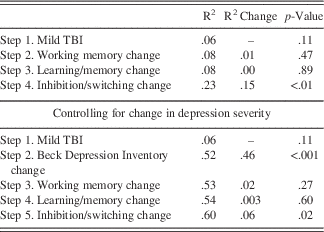
However, working memory was entered in all regressions because it contributes to learning/memory and because it is another aspect of executive functioning. For all hierarchical regression analyses, mTBI was entered as step 1 to control for its possible influence. Even though mTBI did not increase neurocognitive weaknesses at baseline in this PTSD sample (Stricker et al., Reference Stricker, Keller, Castillo and Haaland2015), the influence of comorbid mTBI in PTSD is still not fully understood (Dolan et al., Reference Dolan, Martindale, Robinson, Kimbrel, Meyer, Kruse and Gulliver2012). Working memory, learning/memory, and inhibition/switching were entered at different steps, depending upon the analysis. To assess the impact of pre-treatment neurocognition on treatment outcome, the first regression included pre-treatment scores for each neurocognitive domain. To assess the relationship between neurocognitive change and treatment outcome, the second regression included change scores in each of the neurocognitive domains.
Results
Sample Clinical and Demographic Features
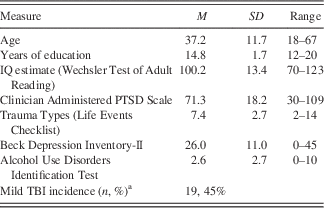
The group’s estimated IQ was within the average range, and, as anticipated, this group, which met criteria for a PTSD diagnosis, reported exposure to many different types of trauma, and a clinically significant number of PTSD and depression symptoms, which were highly correlated (r=.45; p=.003) (Table 1). Sexual trauma alone or in combination with combat trauma was the most common trauma type (n=34; 81%), including those reporting sexual trauma only (n=15; 36%), or combat and sexual trauma (n=19; 45%); eight participants (19%) reported combat trauma alone. Of those reporting sexual trauma, 6 reported both childhood and adult trauma, 25 reported adult-only trauma, and 3 reported childhood-only trauma.
Group (N=42) characteristics based on pre-treatment evaluation

a Mild TBI based upon self-report using the Boston Assessment of TBI–Lifetime.
Other traumas included transportation accidents (n=34), the death of someone close (n=18), physical assault (n=33), natural disaster (n=23), serious accident or injury (n=15), weapon assault (n=15), and fire/explosion (n=17). Half of the sample was on psychotropic medications before psychotherapy, primarily antidepressants [selective serotonin reuptake inhibitor (SSRI) or other antidepressants, n=20], but also prazosin (n=6), benzodiazepines (n=6), hypnotics (n=3), atypical antipsychotics (n=3), or mood stabilizers (n=1) at the pre-treatment evaluation. Seven patients’ medications changed during treatment: three had a medication discontinued (hypnotic or SSRI), two added an SSRI, and two had medication substitutions (one substituted a benzodiazepine for an SSRI and a mood stabilizer and one substituted Abilify for an SSRI). Therefore, 14% of the sample had a medication change, and the changes were relatively minor for most and unlikely to influence our group findings.
As reported previously in a somewhat larger group (Castillo et al., Reference Castillo, Chee, Nason, Keller, C’de Baca, Qualls and Keane2016), PTSD symptoms improved significantly (p<.001 for CAPS improvement) after treatment. In addition, in our sample the magnitude of PTSD improvement was not correlated with baseline PTSD severity (r=.20; p=.20), and baseline PTSD severity was not correlated significantly with baseline neurocognitive functioning (working memory, learning/memory, or inhibition/switching; r=−.096 to .019; p=.546 to .904). Correlation tables are provided in electronic supplementary tables examining the relationships between pre-treatment psychological and neurocognitive measures (Supplementary Table 1) and between changes in psychological and neurocognitive measures (Supplementary Table 2).
Impact of Pre-treatment Learning/Memory and Inhibition/Switching on Treatment Efficacy
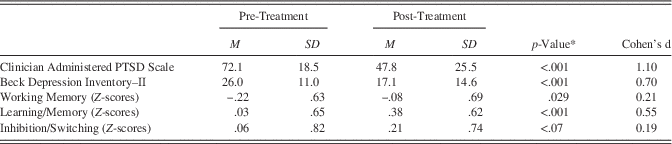
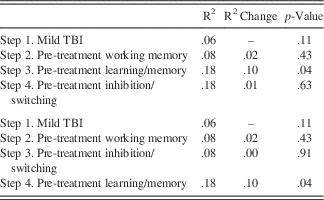
Table 2 contains pre- and post-treatment means and standard deviations for the psychological and neurocognitive variables for the entire sample. As can be seen, after treatment, there were significant improvements in PTSD severity, depression severity, and two of the three neurocognitive domains (learning/memory and working memory) with marginal evidence for improvement in the third domain (inhibition/switching). We entered mTBI (step 1), pre-treatment working memory (step 2), pre-treatment Learning/Memory (step 3), and pre-treatment Inhibition/Switching (step 4) in a hierarchical regression as predictors of treatment response (CAPS change). As can be seen in Table 3, only pre-treatment learning/memory predicted treatment efficacy regardless of the entry order for learning/memory and inhibition/switching. The hierarchical regression demonstrated no significant effects for mTBI, supporting the conclusion that, in this sample, the presence of mTBI did not account for significant variance in treatment outcome.
Psychological symptoms and neurocognitive changes pre- and post-treatment

* Paired-samples t-test comparing pre-treatment versus post-treatment.
Hierarchical regression assessing the relationship between pre-treatment neurocognitive performance and treatment efficacy (change in CAPS) switching entry of learning/memory and inhibition/switching

Relationship between Treatment Efficacy and Improved Inhibition/Switching
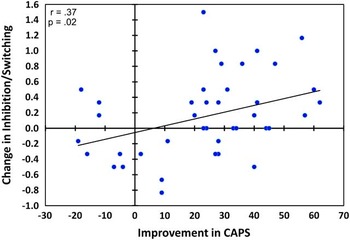
As can be seen in Table 4, mTBI and changes in working memory and in learning/memory were not associated with improvement in PTSD symptoms. However, improvement in inhibition/switching was associated with better PTSD treatment outcome even when the improvement in depression was taken into account. Figure 1 illustrates the relationship between improvement in inhibition/switching and PTSD improvement and also shows that most of the sample (31 of 42) met criteria for having a clinically significant response to treatment as defined as a change in CAPs of more than 10 points (Schnurr et al., Reference Schnurr, Friedman, Engel, Foa, Shea, Chow and Bernardy2007).
The relationship between improvement in the CAPS and in inhibition/switching from pre-treatment to post-treatment.

Hierarchical regression assessing the relationship between neurocognitive changes and treatment efficacy (change in CAPS) with and without depression severity control

Discussion
Impact of Pre-treatment Learning/Memory and Inhibition/Switching on Treatment Efficacy
Our pre-treatment findings are consistent with previous studies (Nijdam et al., Reference Nijdam, de Vries, Gersons and Olff2015; Wild & Gur, Reference Wild and Gur2008) and demonstrate that better pre-treatment learning/memory predicted better PTSD treatment response. We extended the previous findings by showing that this effect was specific to learning/memory as its relationship with treatment success was present even when inhibition/switching and working memory were taken into account. This is important because both working memory and executive functions correlate with learning/memory performance (Stricker et al., Reference Stricker, Keller, Castillo and Haaland2015; Vasterling, Brailey, Constans, & Sutker, Reference Vasterling, Brailey, Constans and Sutker1998; Vasterling et al., Reference Vasterling, Duke, Brailey, Constans, Allain and Sutker2002), including in this sample (r=.44; p=.003 for working memory, r=.34; p=.028 for inhibition/switching).
Our findings in the context of the two previously published studies examining the influence of pre-treatment learning/memory on PTSD treatment outcome (Nijdam et al., Reference Nijdam, de Vries, Gersons and Olff2015; Walter et al., Reference Walter, Palmieri and Gunstad2010; Wild & Gur, Reference Wild and Gur2008) are part of a growing interest in understanding the neurocognitive and biological mechanisms impacting different PTSD psychotherapies with the eventual hope of better individualizing therapeutic referrals. The mechanism by which learning/memory predicts psychotherapeutic efficacy is not entirely clear. Some have speculated that most trauma-focused psychotherapies rely on the patient’s ability to focus on intrusive memories and remember the details of the trauma experience in the context of imaginal exposure with the goal of cognitively restructuring the memory and substituting incompatible responses, such as relaxation (Nijdam et al., Reference Nijdam, de Vries, Gersons and Olff2015). Therefore, it is thought that successful therapy relies on reconsolidating the memory of the traumatic experience in a different way, and this would suggest that better learning/memory before treatment might result in better treatment outcome. While this explanation makes sense, it has not been directly studied.
The fact that pre-treatment inhibition/switching was not predictive of treatment outcome is contrary to executive function theories of PTSD (Aupperle, Melrose, et al., Reference Aupperle, Melrose, Stein and Paulus2012) and our prediction. This finding is also inconsistent with a previous study of generalized anxiety disorder (Mohlman & Gorman, Reference Mohlman and Gorman2005), which found that poorer baseline executive functions were associated with poorer response to cognitive behavior therapy. Importantly, in addition to measures of inhibition/switching (Stroop Color Word Inhibition), they also examined flexible problem solving (Number of categories on the Wisconsin Card Sort and Matrix Reasoning from the WAIS III), which was not included in the present study.
Of interest, a recent study in older depressed patients is consistent with an opposing hypothesis (Goodkind et al., Reference Goodkind, Gallagher-Thompson, Thompson, Kesler, Anker, Flournoy and O’Hara2015) that lower pre-treatment ability to switch sets was associated with better response to treatment. These authors spectulated that this finding was related to the ability of cognitive behavior therapy to have a greater effect teaching patients to switch to more adaptive responses when the patient’s switching ability was poorer at the beginning of treatment. Therefore, those with worse switching ability benefitted more from what is taught in cognitive behavior therapy, and those with more normal switching abilities before treatment had less to learn. Our data do not support this alternative hypothesis, but these contradictory results suggest that this issue deserves further study.
Relationship between Treatment Efficacy and Improved Inhibition/Switching
Our findings show that improvement in PTSD symptoms following a multi-faceted intervention was also associated with significant improvement in the measure we labeled inhibition/switching. In contrast, changes in PTSD symptoms were not associated with significant changes in measures of learning/memory or working memory. Consistent with our hypothesis, improvement was seen only in the inhibition/switching aspect of executive functioning even though working memory and learning/memory are commonly reported weaknesses or deficits in PTSD (Brewin, Kleiner, Vasterling, & Field, Reference Brewin, Kleiner, Vasterling and Field2007; Scott et al., Reference Scott, Matt, Wrocklage, Crnich, Jordan, Southwick and Schweinsburg2015; Stricker et al., Reference Stricker, Keller, Castillo and Haaland2015).
Moreover, the current study controlled for treatment fidelity and type of psychotherapeutic treatment across all participants, like one of the PTSD psychotherapy studies (Nijdam et al., Reference Nijdam, de Vries, Gersons and Olff2015) but not the other two (Walter et al., Reference Walter, Palmieri and Gunstad2010; Wild & Gur, Reference Wild and Gur2008). Finally, the psychotherapy modalities we used included exposure and cognitive therapies, both of which are considered effective psychotherapies for PTSD in an individual format (Foa et al., Reference Foa, Hembree and Rothbaum2007; Institute of Medicine, 2008; Schnurr et al., Reference Schnurr, Friedman, Engel, Foa, Shea, Chow and Bernardy2007).
It is unlikely that higher PTSD and depressive symptomatology before treatment may account for these findings, since these factors were not significantly correlated with PTSD symptom improvement. Furthermore, inhibition/switching improvement appears to be specific to improvement in PTSD symptom improvement even when improvement in depressive symptoms was taken into account. Our findings suggest that the improvement is specific to inhibition/switching and not associated with cognitive improvement in working memory or learning/memory since our regression controlled for changes in these domains.
This finding is consistent with theoretical models of anxiety and neurocognition. One model (Aupperle, Melrose, et al., Reference Aupperle, Melrose, Stein and Paulus2012) links PTSD symptoms to a failure to disengage or inhibit responses to salient trauma-related stimuli and to switch attention to non-trauma stimuli. In fact, one study showed lower PTSD symptoms were associated with greater activation in lateral prefrontal cortex (Aupperle, Allard, et al., Reference Aupperle, Allard, Grimes, Simmons, Flagan, Behrooznia and Stein2012), which is an important neural substrate for inhibition/switching (Aron, Monsell, Sahakian, & Robbins, Reference Aron, Monsell, Sahakian and Robbins2004). However, while some brain activation findings were correlated with PTSD severity, neurocognitive performance was not (Aupperle, Allard, et al., Reference Aupperle, Allard, Grimes, Simmons, Flagan, Behrooznia and Stein2012).
More specifically, greater dorsolateral prefrontal activation was associated with better Digit Symbol performance and lower PTSD symptoms in a group of women with PTSD, but Digit Symbol performance (and all of their neurocognitive measures including Delis Kaplan Color Word Inhibition) was not correlated with PTSD severity. This lack of relationship is similar to our finding of no significant relationship between pre-treatment PTSD severity and our three neurocognitive domains, which is consistent with some reports (Stein, Kennedy, & Twamley, Reference Stein, Kennedy and Twamley2002; Twamley, Hami, & Stein, Reference Twamley, Hami and Stein2004) but not others (Falconer et al., Reference Falconer, Bryant, Felmingham, Kemp, Gordon, Peduto and Williams2008; Leskin & White, Reference Leskin and White2007; Nijdam et al., Reference Nijdam, de Vries, Gersons and Olff2015; Vasterling et al., Reference Vasterling, Brailey, Constans and Sutker1998, Reference Vasterling, Duke, Brailey, Constans, Allain and Sutker2002).
These inconsistencies appear to be associated with methodological differences including the heterogeneity of executive function measures, their varying sensitivity, and sample differences including sample size. While there are also inconsistencies in whether executive function weaknesses are present when comparing PTSD groups with trauma or non-trauma controls (Polak et al., Reference Polak, Witteveen, Reitsma and Olff2012; Qureshi et al., Reference Qureshi, Long, Bradshaw, Pyne, Magruder, Kimbrell and Kunik2011), such weaknesses are more common than in analyses examining the correlations between neurocognitive weaknesses and PTSD severity. Some researchers have hypothesized that subtle executive weaknesses predispose a person to develop and maintain PTSD symptoms, but our findings are more in line with a different relationship, namely improvement in PTSD severity is associated with improved inhibition/switching. Our findings cannot determine whether PTSD improvement causes inhibition/switching improvement, whether inhibition/switching improvement causes PTSD improvement, or whether both are due to a third factor that we have not measured.
But then again, our findings are consistent with psychotherapeutic studies that use attention bias modification training (Amir, Beard, Burns, & Bomyea, Reference Amir, Beard, Burns and Bomyea2009; Kuckertz et al., Reference Kuckertz, Amir, Boffa, Warren, Rindt, Norman and McLay2014). These studies showed decreases in social anxiety or PTSD after attention bias modification training (Amir et al., Reference Amir, Beard, Burns and Bomyea2009; Kuckertz et al., Reference Kuckertz, Amir, Boffa, Warren, Rindt, Norman and McLay2014), which trains patients to inhibit attention to threatening stimuli and switch attention to non-threatening stimuli. Such training has been associated with improved attentional bias (Kuckertz et al., Reference Kuckertz, Amir, Boffa, Warren, Rindt, Norman and McLay2014) and decreased anxiety, decreased activation in emotional processing circuits, and increased activation in cognitive control circuits (Taylor et al., Reference Taylor, Aupperle, Flagan, Simmons, Amir, Stein and Paulus2013).
Limitations
The present results must be interpreted in the context of the study’s limitations. First, we did not include a no-treatment PTSD group. Therefore, we were not able to rule out the possibility that improvement in inhibition/switching was related to the passage of time or a practice effect. However, inhibition/switching was the only domain that was associated with PTSD symptom improvement, even though all neurocognitive performances improved over time. This makes it less likely that time or practice effects can explain the specificity of inhibition/switching to PTSD symptom improvement.
Second, we were unable to examine the separate neurocognitive effects for the three treatment modalities because post-therapy assessment was done after the entire treatment sequence. One PTSD treatment study (Nijdam et al., Reference Nijdam, de Vries, Gersons and Olff2015) found similar effects of pre-treatment learning/memory performance on treatment outcome for two types of trauma-focussed psychotherapy (cognitive behavior therapy and eye movement desensitization and reprocessing therapy). Future research should examine this issue to enhance our ability to individualize therapeutic recommendations for PTSD.
Third, as our sample was all women, the generalizability of the findings to a male sample are not known. However, previous neurocognitive studies in all male or female samples have reported similar findings, although no direct comparisons are available (Stricker et al., Reference Stricker, Keller, Castillo and Haaland2015), especially in the context of neurocognition and psychotherapy success. So, while there is no reason to believe there would be differences in men and women, this issue deserves further examination, especially as it may relate to individualizing therapeutic recommendations.
Fourth, while this study is one of the largest studies of its kind in PTSD, the issues mentioned above and other important questions (e.g., effect of trauma type) were not examined due to small sample size and the complexity of such analyses. As a result, we did not enter potentially important independent variables (e.g., pre-treatment CAPs and BDI) into the overall regressions with the justification that neither was correlated with CAPs change, the dependent variable.
Finally, we also constructed domain scores to minimize the number of analyses, and we elected not to examine separately each measure that comprised the domain because of the need to correct for multiple comparisons and low power.
Clinical and Theoretical Implications
The two most commonly used evidence-based psychotherapies for PTSD are cognitive processing therapy (Resick & Schnicke, Reference Resick and Schnicke1993) and prolonged exposure (Foa et al., Reference Foa, Hembree and Rothbaum2007). While effective, their overall success rates are relatively low. For example, prolonged exposure has relatively low success rates and high drop out rates in U.S. veterans as evidenced by a recent survey where nearly 30% dropped out before completion, and 46% continued to meet criteria for PTSD even if they completed treatment (Eftekhari et al., Reference Eftekhari, Ruzek, Crowley, Rosen, Greenbaum and Karlin2013). Thus, there is a need to consider other therapeutic strategies, and our data suggest that the impact of neurocognitive treatments to enhance learning/memory before evidence-based psychotherapies should be explored. Treatments to modify negative attentional biases have been shown to increase the therapeutic efficacy of prolonged exposure or cognitive processing therapy in PTSD (Kuckertz et al., Reference Kuckertz, Amir, Boffa, Warren, Rindt, Norman and McLay2014), but we are unaware of the use of neurocognitive training to enhance learning/memory in PTSD before more traditional psychotherapeutic treatment.
From the treatment perspective, our findings suggest that PTSD patients who improve with psychotherapy are more likely to show improved inhibition/switching even in a non-emotional context, which suggests a more general impact of psychotherapy. Such improvement could impact daily functioning more broadly just as poorer memory is associated with poorer social and occupational functioning in PTSD (Geuze et al., Reference Geuze, Vermetten, de Kloet, Hijman and Westenberg2009; Wrocklage et al., Reference Wrocklage, Schweinsburg, Krystal, Trejo, Roy, Weisser and Scott2016). Future studies will be needed to determine whether neurocognitive improvement in inhibition/switching is associated with neural changes in prefrontal cognitive control circuits, emotional processing circuits, or both as was demonstrated in anxiety patients after attention modification training (Taylor et al., Reference Taylor, Aupperle, Flagan, Simmons, Amir, Stein and Paulus2013). In addition, future work should determine if such changes in inhibition/switching generalize to other areas of functioning and whether inhibition and switching separately influence treatment outcome.
Our findings that inhibition/switching was the only neurocognitive measure that improved with successful psychotherapeutic treatment for PTSD is partly consistent with current theories that executive functions are important for the maintenance of PTSD symptoms (Aupperle, Melrose, et al., Reference Aupperle, Melrose, Stein and Paulus2012). The theory’s predictions that executive function weaknesses would predispose a person to maintain PTSD symptoms were not supported as neither of the baseline executive measures (working memory, inhibition/switching) were associated with treatment efficacy. Therefore, while our primary finding is consistent with the executive theory of PTSD, this lack of association between pre-treatment executive functions and therapeutic efficacy is not. Rather, our findings are more consistent with a reciprocal relationship between improvement in PTSD severity and inhibition/switching. Future research should disambiguate whether response inhibition versus switching improve with psychotherapy by using experimental tasks that are more unidimensional (DeGutis et al., Reference DeGutis, Esterman, McCulloch, Rosenblatt, Milberg and McGlinchey2015) and may be more sensitive and specific. These results should also be extended by incorporating the examination of inhibition and switching abilities in an emotional context and the inclusion of functional imaging to better specify the neural substrates for these findings.
Acknowledgments
Study supported by the Department of Defense (D.C., grant number PT074309, Award number W81XWH-08-2-0022); Department of Veterans Affairs (K.Y.H., Career Scientist Award); and Research Service at the NMVAHCS (K.Y.H.), which approved the study design, but required no additional approvals. None of the authors had any potential conflicts of interest. This work was completed with support from the Veterans Health Administration. The views are those of the authors and do not necessarily represent the views of the Department of Veterans Affairs.
Supplementary material
To view supplementary material for this article, please visit http://dx.doi.org/10.1017/S1355617716000424