

1. Introduction
How can we explain the destabilising monetary policies of the interwar years? In 1922, at the Genoa Conference, international experts pondered on how to reconstruct an international monetary system based on gold. They proposed to generalise the gold exchange standard, a mechanism that allowed central banks to hold, as part of their cover reserves, foreign assets denominated in gold convertible currencies. The new system intended to prevent world deflation by reducing the risk of monetary gold scarcity (Bank for International Settlements 1932; Hawtrey Reference Hawtrey1922). Looking back, however, what we notice is the huge gap between target and achievement. The policies adopted within the gold exchange standard were strong transmission channels for the Great Depression (Bernanke Reference Bernanke2000; Eichengreen Reference Eichengreen1992; Temin Reference Temin1989, Reference Temin1993).
This article looks at the foreign reserves policy of one of the important players in the fall of the gold exchange standard: France. French monetary policy in the late 1920s aroused widespread criticism because it was uncooperative. Many authors have highlighted the deflationary backlash of French policy and its role in the Great Depression (Bernanke and Mihov Reference Bernanke, Mihov and Bernanke2000; Eichengreen Reference Eichengreen1992; Johnson Reference Johnson1997; Nurkse Reference Nurkse1944).
This article proposes a new interpretation of French actions during this period. It provides a detailed description of exchange reserves policy, based on original monthly data on the Bank of France's foreign portfolio composition between 1928 and 1936. Using historical literature and new archival documents, it identifies the motivations behind reserves decisions.
The Bank of France's foreign reserves policy can be interpreted as the portfolio choice of a large player on the foreign exchange market. Its international reserves were allocated between sterling, dollar and gold. Reserves policy was guided by the desire to limit the risk of capital loss. From 1929 to 1931, when Britain's commitment to the gold standard was considered doubtful, the Bank of France rebalanced its portfolio in favour of gold and the dollar. After 1931, the dollar's gold adherence was in turn questioned. The Bank's policy thus turned to complete liquidation of foreign holdings. However, given its sheer volume of holdings, the Bank of France was also subject to the backlash of its own actions on the exchange market. As the pound's weakness worsened at the end of 1930, the Bank was in a trap: it could not continue liquidating its pounds without precipitating a sterling collapse and a huge exchange loss for itself. The Bank therefore started supporting sterling. The loss it endured as a consequence of British devaluation in September 1931 gravely endangered its financial health and independence from the French government.
The remainder of the article is structured as follows. Section 2 is a survey of literature on French reserves policy in the gold exchange standard. Section 3 describes Bank of France portfolio choices in detail. Section 4 is a pound and dollar credibility test. Section 5 proposes a new interpretation of the Bank of France's actions considering its position as a large player on the market. Finally, Section 6 gives conclusions and policy implications.
2. Foreign reserves, France and the Great Depression: a survey
2.1. Reserves policies in the Genoa system
Accounts of the interwar years’ gold standard often describe an unstable system, with little credibility, undermined by non-cooperative, deflation-inducing reserves policies (Bernanke Reference Bernanke2000; Eichengreen Reference Eichengreen1990, Reference Eichengreen1992; Eichengreen and Sachs Reference Eichengreen and Sachs1985; Temin Reference Temin1989, Reference Temin1993). Most countries that stabilised their currencies during the 1920s adopted the gold exchange standard: they allowed their central banks to hold part of their backing reserves in gold convertible currencies. As a consequence, the global volume of foreign reserves, held mainly in sterling and dollars, increased (Eichengreen and Flandreau Reference Eichengreen and Flandreau2009; Bank for International Settlements 1932; Mlynarski Reference Mlynarski1929; Nurkse Reference Nurkse1944). The system aimed to avoid the worldwide lack of gold then feared by the Genoa experts (Hawtrey Reference Hawtrey1922).
But the international monetary system soon became a transmission channel for monetary contraction. One of the problems arose from parity choices made during the stabilisation years. The pound, which had been stabilised at its pre-war gold parity, was considered overvalued compared to other currencies like the franc and reichsmark (Keynes Reference Keynes1925). A second problem was that gold holdings worldwide were very unequally distributed, due to gold accumulation by France and the US (League of Nations 1932; Eichengreen Reference Eichengreen1990).Footnote 1 On top of all this, difficulties in the international monetary system were worsened by non-cooperative monetary policies aimed at attracting gold (Eichengreen Reference Eichengreen1992). The gold exchange standard suffered from a deflation bias (Eichengreen Reference Eichengreen1984).
To what extent did these factors undermine confidence? Recent literature addresses this question by testing the credibility of gold adherence for sterling and the dollar (Hallwood, MacDonald and Marsh Reference Hallwood, MacDonald, Marsh, Bayoumi, Eichengreen and Taylor1996, Reference Hallwood, MacDonald and Marsh1997, Reference Hallwood, MacDonald and Marsh2000; Hallwood and Marsh Reference Hallwood and Marsh2004). This literature concludes that both currencies, even sterling, retained credibility until the very last minute (July 1931).
2.2. French reserves policy in the gold exchange standard
French reserves policy played an important role in gold exchange standard developments. When the franc was de facto stabilised in 1926, the French government mandated the Bank of France to buy foreign exchange on the market, so as to avoid excessive currency appreciation (Blancheton Reference Blancheton2001).Footnote 2 As a result, France accumulated a bulging portfolio of foreign holdings between 1926 and 1928. When gold convertibility was re-established on 25 June 1928, the country held more than half of the world's volume of foreign reserves (Nurkse Reference Nurkse1944).Footnote 3
Over subsequent years, French policy was severely criticised by its contemporaries. Before the 1931 sterling crisis, France was criticised for hoarding gold, causing the pound's difficulties on the exchange market. Hawtrey (Reference Hawtrey1932) reproached the Bank of France for its insufficient monetary expansion. Einzig (Reference Einzig1932) even accused it of destabilising the pound through direct market sales. Recent literature also highlights the deflationary consequences of French gold policy between 1926 and 1932. In particular, many authors have shown that the Bank of France's international reserves rebalancing in favour of gold had drastic consequences on the global economy (Nurkse Reference Nurkse1944; Kindleberger Reference Kindleberger1986; Eichengreen Reference Eichengreen1992; Bernanke and Mihov Reference Bernanke, Mihov and Bernanke2000).Footnote 4 Johnson (1997) goes so far as to consider France's reserves strategy as the main cause of the Great Depression.
2.3. Motivations at the Bank of France level
Why would an important player in the international monetary system engage in a policy that had such dramatic consequences? The Bank of France's motivations have been investigated by various authors. Paul Einzig (Reference Einzig1932) stated that French monetary authorities were using reserves as ‘a fighting fund’ in their financial war against Britain. This vision of a deliberately aggressive Bank of France is, however, extreme and several authors have proposed other explanations. For Bouvier (Reference Bouvier and Bouvier1989), the Bank wanted to re-constitute large gold reserves as part of an overall strategy, which aimed at making Paris a major financial centre.Footnote 5 According to Mouré (Reference Mouré1991; Reference Mouré2002), Bank of France officials were reluctant to accept the gold exchange standard principles, because they believed in the virtues of the classical gold standard as an adjustment mechanism. They were prey to a ‘gold standard illusion’ (Mouré Reference Mouré2002).
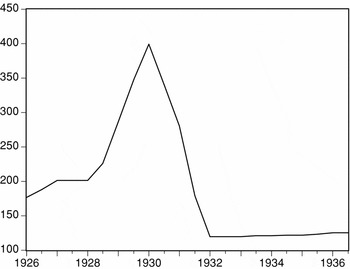
But historians have also noted that putting the reserves policy into practice was complex. If the goal was gold accumulation, various secondary objectives and institutional constraints also had to be considered. Bouvier (Reference Bouvier and Bouvier1989) and Mouré (Reference Mouré1991, Reference Mouré2002) both point out that the Bank of France delayed its foreign reserves conversions until the British devaluation of 1931. Two reasons would explain this conduct. First, the Bank was concerned by foreign criticism of its actions, and did not wish to shake the international monetary system too brusquely. Second, foreign reserves were a substantial source of income. As a private institution, the Bank of France was constantly concerned with its financial situation. When ownership of its foreign portfolio was transferred from the State to the Bank in 1928, the dividend paid to its shareholders was substantially increased (Figure 1).Footnote 6 So profit considerations may explain the Bank's initial passivity about its foreign portfolio.
Bank of France's dividend (in francs), 1926–36

3. Description of portfolio choice
3.1. Currency composition of the French foreign reserves: evolution
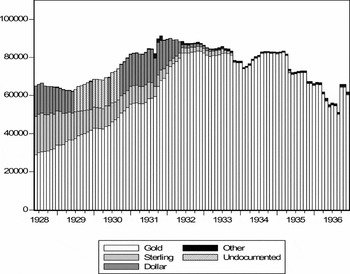
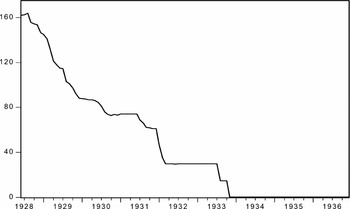
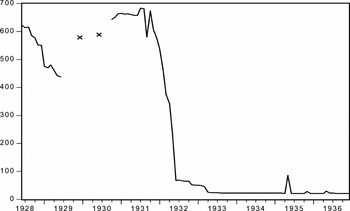
These statements are based on observation of the total amounts of reserves. Movements within the reserves, in contrast, have never been precisely documented. Therefore, I combined several documents from the Bank of France's archives and constructed a monthly dataset on the foreign reserves currency composition between June 1928 and December 1936.Footnote 7Figure 2 shows the composition of international reserves (gold and foreign reserves). Figures 3 and 4 show the evolution of the sterling and dollar portfolios. The Bank of France held almost all of its foreign reserves in dollars and pounds. Although the global volume of foreign assets remained stable before 1931, the Bank's policy was far from passive during this period: from June 1929 onwards, the Bank clearly rebalanced its portfolio from sterling to dollar. Pound sales were then halted from October 1930 to July 1931. After the sterling crisis, the Bank's policy turned to complete liquidation of its foreign assets.Footnote 8
Currency composition of the Bank of France's reserves (in francs m), 1928–36

Bank of France's sterling assets (in £ m), 1928–36

Bank of France's dollar assets (in $ m), 1928–36

3.2. Were the sterling sales politically motivated?
The evidence validates Einzig's (1932) views that the Bank of France was selling pounds in the years before the sterling crisis. But Einzig's hypothesis that these sales were motivated by a deliberate attempt to weaken the pound neglects the impact of the sterling crisis on the Bank of France itself. As a consequence of the pound's devaluation, the Bank had to register a capital loss of 2.35 billion francs on its sterling holdings. This amount represented twice the available capital and reserves.Footnote 9 The loss put the Bank of France into a very difficult situation. At the Bank of England, an observer noted that it might have come close to a ‘technical act of bankruptcy’. Support from the state was certainly obtainable, but at the price of painful concessions, and the Bank surely would have had to cut its dividend.Footnote 10 In the end, the French Treasury agreed to cover the loss (Mouré Reference Mouré1991, pp. 65–79).Footnote 11 But the Bank paid dearly for this rescue operation. The dividends were substantially reduced over subsequent years (Figure 1), and the Bank had to give up its foreign reserves policy independence.Footnote 12 Thus, the impact of the sterling crisis on the Bank of France was dramatic. This makes us sceptical as to any deliberately pound-weakening actions.
3.3 Risk management at the Bank of France
Another possibility is that the Bank liquidated its pounds to reduce risk exposure. Several archival documents show that exchange risk was a determining factor in reserves management. In December 1928, the Bank's General Council decided to create an insurance fund against foreign portfolio risks. According to the governor, Emile Moreau, allocating resources to this fund was ‘one of the most important tasks’Footnote 13 that the Bank of France had to tackle. Moreau's successor, Clément Moret, seems to have shared these concerns over exchange risk. In the detailed speech he gave to the Council in September 1930 on foreign portfolio management, the new governor emphasised that the Bank bore ‘the entire risks of this whole mass of exchange’ even if ‘it did, on the other hand, receive all of its income’. According to Moret, risk management was the determining factor in choosing the reserves currency composition.Footnote 14 There is also strong evidence of a growing concern at the Bank of France over a sterling collapse. A note to the finance minister on 17 October 1929 mentioned ‘world-wide concern about the future of the British currency’ According to the note, ‘people [were] even wondering if the Bank of England's metallic reserves [were] sufficient to durably guarantee the sterling pound's gold convertibility’.Footnote 15 In view of these statements, the observed allocation strategy seems very coherent. As of 1929, the Bank of France feared that Britain would devalue. In order to avoid an exchange loss, it sold its pounds, and bought dollars.
4. Credibility of the gold exchange standard's reserve currencies: a test
4.1. Pound and dollar devaluation expectations: simple measurements
However, the Bank of France's concerns over the pound's future are in sharp contrast with findings from the recent literature. Indeed, Hallwood, MacDonald and Marsh (Reference Hawtrey1997) and Hallwood and Marsh (Reference Hallwood and Marsh2004) have tested the credibility of sterling's gold adherence, using alternatively interest rate differential between London and New York and dollar/sterling forward exchange rates. They conclude that the pound remained credible until July 1931.Footnote 16 Was the Bank of France, therefore, going against the market?
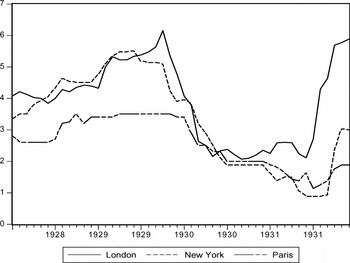
The pound's credibility has always been assessed according to the dollar/sterling market. However, simple observation of private discount rates in Paris, London and New York shows that the Paris rate from January 1928 to January 1930 was consistently weaker than the other two rates (Figure 5).Footnote 17 The reference currency for evaluating exchange risks over this period might therefore be the franc, and not the dollar. Private interest rate data in Paris are sporadic and we cannot use them to get a more precise indicator of dollar and pound exchange risks. However, the ‘Cours des Changes’ registers conserved in the Bank of France's archives contain weekly quotations of the franc/sterling and franc/dollar forward exchange rates on the Paris market. Assuming covered interest parity, we can use them to construct simple indicators, similar to those presented in the literature, of the expected depreciation of each of these two currencies relative to the franc. I rely here on two different measures. The first one is the (annualised) spread between the forward and spot exchange rates (‘simple method’). The second one is Svensson's (Reference Svensson1993) ‘drift adjusted’ indicator of devaluation expectations, which corrects for mean-reversion of the exchange rate (see Appendix A.2).Footnote 18
Private discount rates, London, Paris and New York (in %), 1928–31

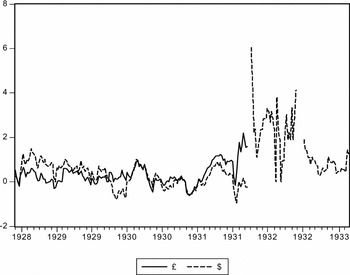
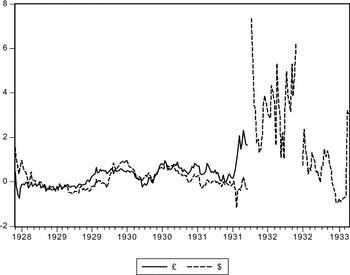
Figures 6 and 7 show the evolution of these two indicators, for the pound and dollar, from June 1928 to March 1933. The drift-adjusted indicator plotted in Figure 7 can be compared precisely to the measure presented by Hallwood and Marsh (Reference Hallwood and Marsh2004), to evaluate the pound's credibility, except that here, it is calculated on the franc/sterling rather than on the dollar/sterling market. But the message remains the same. Devaluation expectations seem very slight for both currencies over the 1928 to 1931 period. Neither of the two indicators allows discerning between pound and dollar until the summer of 1931.Footnote 19
Depreciation expectations of the pound and dollar (in %, annualised), simple method, June 1928 − February 1933

Realignment expectations of the pound and dollar (in %, annualised), drift adjustment method, June 1928 − February 1933

4.2. Sterling and dollar in a mean-variance framework
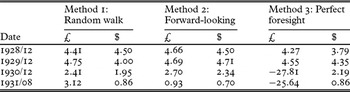
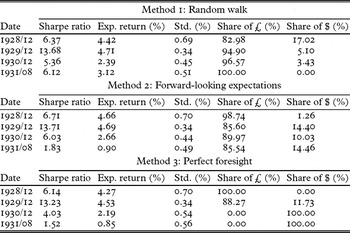
Present-day central banks also manage risks and profits on their reserves, and for this purpose, they usually rely on mean variance optimisations (Fischer and Lie Reference Fischer, Lie, Bernadell, Cardon, Coche, Diebold and Manganelli2004; Papaioannou, Portes and Siourounis Reference Papaioannou, Portes and Siourounis2006). Could the Bank of France's decision to hold more dollars and fewer pounds also be explained through a portfolio model calibrated on historical data? To answer this question, Appendix A.3 presents a simple mean variance framework. The model is a simple version of the CAPM, in which an investor (the Bank of France) allocates its portfolio between a risk-free asset, gold, and two risky assets, the pound and the dollar. The Bank is assumed to minimise portfolio variance for a certain desired level of return. The model allows one to predict the unique optimal combination of the risky assets in the portfolio: the market portfolio. Optimisations are run for four different dates: December 1928, 1929 and 1930, and August 1931. The model is calibrated using historical variances (two-year time window) of weekly returns (in francs) on prime bankers’ acceptances in London and New York. As in Papaioannou, Portes and Siourounis (Reference Papaioannou, Portes and Siourounis2006), expected returns are set according to three alternative hypotheses: firstly, the exchange rate is assumed to follow a random walk; second, expectations are assumed to be forward-looking; and lastly, the Bank of France is assumed to enjoy perfect foresight.
Tables 1.1 and 1.2 present the calibration parameters. Variances of returns on sterling and dollar assets are both weak and close to each other. Returns in both currencies are also strongly correlated. Table 2 presents the market portfolio's characteristics at each date. Optimal sterling and dollar portfolio shares are presented. The results are again in contradiction with the Bank of France's actions. Unless we assume that the Bank had perfect knowledge of future exchange rate movements, it should have held more pounds and fewer dollars in its portfolio. This is because the two currencies appeared as close substitutes, and the expected return on sterling was slightly higher.
Calibrating the portfolio model
1.1. Standard deviations and correlations of past returns/two-year time-window

Source: Author's computations (see text and Appendix A.3). Standard deviations are annualised.
Expected returns on the pound and dollar

Source: Author's computations (see text and Appendix A.3).
Market portfolio characteristics

Source: Author's computations (see text and Appendix A.3). Standard deviations are annualised.
4.3. Are we sure that the pound was credible before 1931? A new view
So, neither forward-looking measures of devaluation expectations nor mean variance portfolio optimisations calibrated on historical data justify the Bank of France's preference for the dollar from 1929 to 1931. In that case, how can we explain the fears expressed about the pound? Recent literature has shown that exchange rate movements in a gold standard system can be modelled as in a target zone (Hallwood et al. Reference Hallwood, MacDonald, Marsh, Bayoumi, Eichengreen and Taylor1996). The exchange rate between two gold-convertible currencies can be considered to fluctuate around its parity (defined by the official price of gold in each of the two currencies) and within a band defined by gold import and export points. Target zone theory has several implications. First, under the null hypothesis of perfect credibility of the target zone, the market should never expect the exchange rate to leave the band, and the forward rate should always stay within it (Svensson Reference Svensson1991). Also, expectations within the band should be stabilising. When the spot exchange rate comes close to the upper limit, the market should expect it to fall. Inversely, if the exchange rate comes close to the lower limit, the market should expect it to rise. This is the honeymoon effect (Krugman Reference Krugman1987).
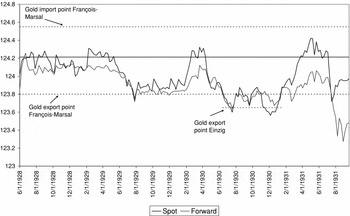
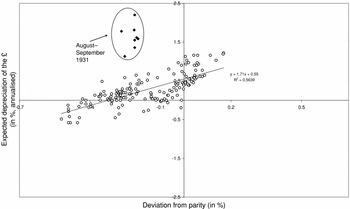
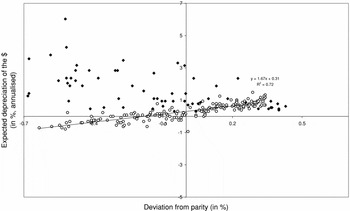
Pound credibility. Were these conditions respected for sterling and the dollar during the gold exchange standard years? Figures 8 and 9 present weekly Paris quotations of the franc/sterling and franc/dollar spot and forward exchange rates (in francs per unit of foreign currency), in relation to official parities and gold points. Let's look at the franc/sterling market first. Figure 8 does not validate Svensson's ‘100% credibility test’. The forward rate crossed the lower limit defined by the gold export point towards France for the first time in July 1929. In June 1930, gold points were altered by the Bank of England's decision to only deliver gold at a standard fineness of 0.9162/3. Since the Bank of France did not accept gold beneath a 0.995 degree of fineness, arbitrageurs had to pay refining costs and the gold export point was brought down (Einzig Reference Einzig1937, p. 259). In January 1931, the Bank of France finally decided to accept gold at a 0.900 degree of fineness, and the fluctuation band shrank again. The spot pound appreciated, but the forward rate crossed the band's lower limit in February again.Footnote 20 Most importantly, expectations of exchange rate movements were not mean-reverting. Figure 10 represents sterling depreciation expectations (‘simple method’) as a function of the spot exchange rate deviation from its parity. Circles correspond to the June 1928 − July 1931 period, lozenges to the August−September 1931 period. Under the credibility hypothesis, a weak pound (relative to parity) should be associated with an appreciation expectation, and a strong pound with a depreciation expectation. The points should thus be situated either in the upper right-hand window, or in the lower left-hand window of the graph. In Figure 10, however, most of the points are situated in the graph's upper left window, indicating that no honeymoon effect was at play. The pound was usually quoted below parity without the market expecting its future appreciation. The target zone was therefore not credible.
Spot and forward exchange rates on the franc/sterling Paris market, June 1928 − September 1931

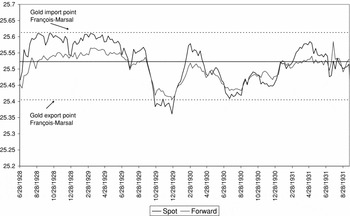
Spot and forward exchange rates on the franc/dollar Paris market, June 1928 − September 1931

Credibility of the pound sterling, pre- vs post-sterling attack

Dollar credibility. Figure 9 shows that the dollar didn't suffer from that type of credibility issue. The franc/dollar spot rate did cross the band's lower limit several times between the Wall Street crash and January 1930. But the market considered this situation to be transitory, and the forward rate remained within the band throughout the whole June 1928 − September 1931 period. The mean reversion condition was also much better respected for the dollar than for the pound. On Figure 11, a pendant of Figure 10 for the franc/dollar market, small circles correspond to the months from June 1928 to September 1931. Most of them are distributed in line with the predictions of target zone theory. It was only after the sterling crisis that dollar credibility was, in turn, questioned, as shown by the distribution of the lozenges on the graph, which correspond to the months from October 1931 to February 1933.
Credibility of the US dollar, pre- vs post-sterling collapse

Dollar and pound credibility in the French financial press. Contemporaries seem to have been very aware of this pound–dollar hierarchy. In the financial weekly L'Economiste Français, there were frequent references to the pound's poor credibility. The weekly spoke of ‘the ongoing weakness of the British pound’ on 6 July 1929. It then mentioned ‘fears . . . on the solidity of British currency’ (21 September 1929), and ‘a certain mistrust’ of sterling (5 October 1929). On 10 January 1930, the sterling difficulties were attributed to ‘a question of confidence’. The rise in the spot pound between January and July 1931 did not reassure the weekly. It noted that, ‘in international circles, a feeling of distrust persist[ed] on the future of British currency’ (7 March 1931). Comments on the dollar, in contrast, did not show this kind of concern. Even when the franc/dollar spot rate crossed the gold export point after the collapse of the Wall Street market, the journal was not concerned, attributing this movement to ‘dollar demands from unfortunate speculators who have adjustments to pay’ (2 November 1929). On 25 October 1930, it reaffirmed its confidence in the dollar: ‘America's wealth and reserves are such that, in spite of the crisis, many European capitalists are still going to New York to find refuge’. The Bank of France's preference for the dollar was therefore shared by the market. From as early as 1929 on, the pound was not credible anymore. Maintaining a high volume of sterling assets would thus have implied considerable risk-taking for the Bank.
5. A large player's portfolio choice
5.1. Cooperation at the Bank of France
One unanswered question still remains on this account. If the Bank of France had expected the sterling crisis, why did it lose so much money from it? Several elements indicate a sudden change in the Bank's attitude towards the pound in autumn 1930. First, sterling liquidations were halted between October 1930 and June 1931 (Figure 3). The Bank even intervened on the exchange market in November and December 1930 in order to support the pound.Footnote 21 It also offered French commercial banks a repo operation (a spot franc sale secured by a forward purchase), so as to prevent them from selling their foreign holdings. Lastly, a 25 million pound credit was granted to the Bank of England in July 1931 (Mouré Reference Mouré1991, pp. 66–9). At the same time, the Bank of France clearly did not want to increase its risk exposure. In the repo operation with the French banks, it was, by definition, insured against exchange risk. Likewise, in the direct interventions, the Bank sold off any exchange acquired as soon as the pound was a little stronger. Lastly, the credit granted to the Bank of England in July 1931 took the form of commercial bills ‘discounted at a fixed exchange rate’.Footnote 22
5.2. Interpreting cooperation: the large player's self-interest
Why did the Bank of France suddenly become cooperative in the final months before the sterling crisis? This change in attitude can be explained considering the Bank's special position on the market: it was a huge holder of sterling assets. At the close of 1931, its sterling portfolio was still worth 50 per cent of the Bank of England's gold reserves.Footnote 23 Several elements show that the Bank was indeed always acting with its big player position in mind. When the French Senate's Finance Commission, which was investigating the loss endured after the sterling crisis, asked the Bank officials whether they had been prudent enough, they replied: ‘We seized every chance we could to liquidate our sterling pound holdings’ but ‘circumstances were far from favouring full implementation of this policy.’ The Bank said it did not want to ‘provoke the depreciation of a currency in which it had considerable holdings’, reminding the Commission that it ‘would have been the first to suffer’ from a sterling collapse.Footnote 24 These comments show that the Bank was conscious of the possible backlash of its own actions on the exchange market. From autumn 1930 onwards, the Bank was in a trap. Since it couldn't continue liquidating sterling, the only workable option left was to support it.
6. Conclusions and policy implications
This article has brought a number of new results. Firstly, using new data on spot and forward exchange rates on the Paris market, it has proposed a simple credibility test on the two major gold exchange standard reserves currencies. I have shown that sterling credibility was weak from 1929 on, while the dollar's gold adherence was questioned from 1931 on. Eichengreen (Reference Eichengreen1992) has described the interwar gold standard instability as resulting from a credibility issue. Indeed, the gold exchange standard depended on the stability of the international currencies held as central bank reserves. As early as 1929, however, the credibility of one of the two major reserves currencies was questioned.
I have concentrated on France; French reserves policy had important repercussions on the international monetary system. Recent literature has described the Bank of France's policy failure of this period as resulting from a mistaken vision of economic mechanisms. In contrast, I have shown that the Bank's reserves policy was guided by the will to limit exchange risk. This motive explains both its currency allocation strategy during 1929 and 1930 and its cooperative attitude towards Britain in the final months before the sterling crisis.
The Bank of France's actions can be interpreted in the context of the debate over central bank cooperation. Eichengreen (Reference Eichengreen1992) has argued that one reason for the interwar monetary instability was the lack of cooperation between central banks. Nineteenth-century central banks were much more ready to cooperate. On the other hand, Flandreau (Reference Flandreau1997) has claimed that central bank cooperation was only occasional during the classical gold standard era: actually, central banks cooperated only when it was in their own interest to do so. Cooperation at the Bank of France during 1931 was also self-interested: the Bank's motivation in supporting the pound was primarily to avoid an exchange loss for itself. Of course, one can still speculate on what the pound's fate would have been, had the Bank of France not liquidated its sterling assets between 1928 and 1930. However, given sterling's poor credibility, this strategy would have involved considerable risk-taking. The Bank of France was simply not in a position to offer such a high level of cooperation, given its private-bank, low-capital status.
This article also has important implications for the recent policy debate. Over eight decades after the Genoa Conference, exchange reserves are still central to the international monetary system. Throughout the 2000s, emerging and developing economies have acquired substantial amounts of foreign holdings, mainly in dollars (Aizenman and Lee Reference Aizenman and Lee2006, Reference Aizenman and Lee2007; Rodrik Reference Rodrik2006). The perspective of major evolutions in these countries’ reserves currency composition has recently caused concern over the stability of the dollar. On the one hand, there is the fear of non-cooperative action caused by political tension. On the other hand, profitability seems, more than ever, to be a determining factor in reserves allocation strategies, as attested by the creation of sovereign wealth funds. China, the largest holder of foreign reserves, recently announced its will to diversify its holdings. But its behaviour also seems to be highly constrained by the necessity of not provoking a dollar crash, which would obviously result in a huge capital loss for the People's Bank of China.Footnote 25 The gold exchange standard episode shows that these are not new issues. French experience of the early 1930s reveals that when the credibility of reserves currencies is questioned, foreign reserves can be an instability factor for the international monetary system, and a burden for the holder.
Acknowledgements
I am especially grateful to Marc Flandreau for his strong encouragement and continuous support. I also thank Jorge Braga de Macedo, Barry Eichengreen, Rui Esteves, Giovanni Federico, Harold James, Pierre Sicsic, Stefano Ugolini, seminar participants at the European University Institute in Florence and participants at the Past, Present and Policy 3 Conference in Genoa for comments on an earlier draft. Archivists at the Bank of France and Bank of England provided helpful support. Hospitality from the European University Institute and the University of California, Berkeley and funding from the CEPR's Research Training Network ‘Unifying the European Experience’ and Fulbright programme are gratefully acknowledged. All errors are mine.
Appendix A.1. Data and sources
I. Currency composition of foreign exchange reserves
Data for the currency composition of foreign exchange reserves (see Section 3) have been collected from the Bank of France's archives.
Total amount of foreign exchange reserves
The total amount of foreign exchange reserves was not distinguishable before 1928 in the Bank's accountability. Indeed, most of the foreign assets held under the regime of the law of 7 August 1926 were included in the ‘Other’ entry of the Bank's published balance sheet. Only after the legal stabilisation of June 1928 did foreign exchange reserves become really identifiable (PVCG, 23 June 1928). They were composed of two elements appearing as two distinct entries: the entry ‘Disponibilités à vue à l'étranger’ regrouped all demand deposits with foreign banks; the entry ‘Effets négociables et autres emplois à court terme à l'étranger’ corresponded to the portfolio of short-term foreign bills and time deposits. Foreign bills’ maturity never exceeded three months (PVCG, 25 September 1930). These amounts are reported at a weekly frequency in Situation hebdomadaire de la Banque de France, and are available on the Bank of France's website (Annhis).
Reserves currency composition
The reserves currency composition did not appear in the Bank of France's published balance sheet. A monthly database has been constructed based on various documents found in the Bank of France's archives:
• June 1928 − May 1929 (weekly)
Archives, Bank of France: 13979199403/162.
‘Change: Gestion du Portefeuille de Devises’ (handwritten document).
Weekly data on total holdings in pounds sterling, US dollars and Swiss francs. Values given in French francs.
• June 1929 − June 1930 (semi-annual)
Archives, Bank of France: 1463200401/64.
Direction du Service Bancaire Etranger, semi-annual re-evaluations, ‘Disponibilités à vue à l'étranger’ and ‘Effets négociables et autres emplois à court terme à l'étranger’.
Reports providing detailed composition of the Bank's foreign portfolio. The reports list all accounts with foreign banks as well as short-term foreign bills. All values given both in French francs and units of foreign currency.
• June 1929 − September 1930 (monthly, pounds only)
Archives, Bank of France: 1397199403/163.
Direction du Service Bancaire Etranger, ‘Situation des comptes en livres sterling’, 3 December 1931.
Monthly data on total sterling holdings. Data given in pounds.
• October 1930 − May 1940 (monthly)
Archives, Bank of France: 1495200501/493 (October 1930 − March 1937) and 1495200501/445 (April 1937 − May 1940).
Direction du Service Bancaire Etranger, monthly reports, ‘Disponibilités à vue à l'étranger’, ‘Effets négociables et autres emplois à court terme à l'étranger’.
Monthly reports established by the Direction du Service Bancaire Etranger and intended for the Comité des Livres et Portefeuilles (see Section 3). These reports are available from October 1930 to May 1940. All values given both in French francs and units of foreign currency.
II. Gold reserve
• 1928–36 (weekly)
Bank of France, Situation hebdomadaire de la Banque de France (1928–36),
Balance sheet entry: ‘Encaisse or’. Weekly series downloadable on the Bank of France's website (Annhis).
III. Bank of France's dividend
• 1926–36 (semi-annual)
Bank of France, Bilan annuel, ‘Résultats des opérations de la Banque’.
Entry: ‘Dividende brut par action’.
IV. Exchange rates
• 1926–36 (weekly)
Archives, Bank of France: 1377200101/8 (1928); 1377200101/9 (1929–31); 1377200101/10 (1932–4); 1377200101/11 (1935–6).
Cours des Changes (handwritten registers)
Quotations of the franc/pound and franc/dollar exchange rates (spot and forward) on the Paris market.
V. Interest rates
London, three-month bankers’ drafts:
• 1926–36 (weekly)
The Economist (various issues)
New York, three-month bankers’ acceptances:
• 1926–36 (weekly)
Board of Governors of the Federal Reserve System (Reference Blancheton1943), Banking and Monetary Statistics, 1919–1941, ‘Money rates and related statistics’, pp. 450–9.
Paris, private discount rate:
• 1926–30 (monthly)
International Conference of Economic Services (1934), International Abstract of Economic Statistics, 1919–1930, London: International Conference of Economic Services.
• 1930–6 (monthly)
International Statistical Institute, Permanent Office (1938), International Abstract of Economic Statistics, 1931–1936, The Hague: International Statistical Institute.
VI. Other sources
Bank of France:
Archives de la Banque de France (Archives, BdF)
Procès-verbaux du Conseil Général de la Banque de France (PVCG).
Bank of England:
Bank of England's Archives. (Archives, BoE)
Journal Officiel de la République Française:
Lois et décrets
Débats Parlementaires, Chambre des Représentants
Articles in the financial press:
L'Economiste Français
Financial Times
Appendix A.2. Devaluation expectations: alternative methodologies
This appendix presents the two alternative methodologies used in Section 4.1 for estimating devaluation expectations.
Simple method
Suppose f t+3mi,t is the log of the three-months forward exchange rate between currency i and the franc at date t, and s i,t is the log of the spot exchange rate (in francs per unit of foreign currency). Assuming ‘exchange market efficiency’, the (annualised) expected depreciation of currency i against the franc can be calculated as:
![\begin{equation}
Exp_{\it depr, i, t} = \big(f_{i, t}^{t + 3m} - s_{i, t} \big)^* (- 400)
\end{equation}
?></alt-text>
</graphic>
</disp-formula>
</sec>
<sec id="sec8-2">
<title>Drift-adjustment method</title>
<p>Svensson's (<xref ref-type="bibr" xlink:href="ref48">1993</xref>) ‘drift-adjustment method’ allows distinguishing, in the appreciation or depreciation expectations of a currency fluctuating inside a band, the part due to expected exchange rate movements within the band, and the part due to a ‘realignment expectation’. Suppose the spot exchange rate follows a mean-reverting process of the following type:
<disp-formula id="eqn2">
<label>(2)</label>
<graphic name="S136149160999013X_eqn2">
<alt-text><
where α1 is less than zero. α0 and α1 can be estimated. The (annualised) ‘realignment expectation’, which adjusts for mean-reversion, is given by:


The following table shows the results of the estimation of equation (2) for both the pound and dollar. The equation is estimated on data covering the period 1 June 1928 − 18 September 1931 for the pound and 1 June 1928 − 24 February 1933 for the dollar. The estimated parameters are used for constructing the indicators in Figure 7.
Appendix A.3. Mean-variance framework
This appendix presents the portfolio model used in Section 4.2.Footnote 26 The model considers the problem of an investor seeking minimal variance on her portfolio for a given level of return (Markowitz Reference Markowitz1952, Reference Markowitz1987). There are two risky assets/currencies: sterling and dollar, and one zero-return, zero-variance risk-free asset: gold.
(A) Efficient frontier of the risky assets’ portfolio
Suppose first that the investor wants to allocate its portfolio between sterling and dollar only. The optimisation problem, then, can be written as:

subject to:



where w s and w d are, respectively, the shares of sterling and dollar assets in the portfolio, μs and μd the rates of return on those assets, σ2s and σ2d the variances of the rates of return, σsd the covariance between the rates of return on both currencies, E the expectation operator, and  the desired level of return. The set of optimal portfolios (the efficient frontier) is found by minimizing (4) subject to (5), (6) and (7), for different levels of desired return .
(B)
Finding the market portfolio
If the investor is allowed to include a risk-free asset in her portfolio, the optimal combination of sterling and dollar becomes unique. It is given by the market portfolio, which is found by maximising the Sharpe ratio:
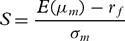
where E(μm) and σm are the market portfolio's expected return and standard deviation, and r f=0.
(C) Calibration
Variances and covariances
Variances and covariances of the risky assets are estimated using historical data on weekly returns (in francs) on prime bankers’ acceptances in London and New York. The benchmark period is a two-year time-window.Footnote 27
Expected returns
As in Papaioannou, Portes and Siourounis (2006), the expected return is set as the sum of the interest rate and the expected exchange rate variation.Footnote 28 Three hypotheses are made as to expected exchange rates variations:
(1) Random walk: when the exchange rate is assumed to follow a random walk with mean zero, the expected rate of return is equal to the interest rate.
(2) Forward-looking expectations: expected exchange rate variations are described by equation (1) of Appendix A.2.
(3) Perfect foresight: expected exchange rate variations are set as equal to one year realised variations.
Table 1 reports the calibration parameters for four different dates (December 1928, 1929, 1930 and August 1931). Optimisation results are presented in Table 2. The table discloses the Sharpe ratio, as well as the market portfolio's annualised standard deviation, expected return, and optimal sterling and dollar shares.