Introduction
Since the introduction of the stapedectomy technique by Shea in 1956, the primary measures of surgical success have been air–bone gap (ABG) closure and improvement of air conduction thresholds in the operated ear. Publications from early stapedectomy series reported success rates of more than 90 per cent for ABG closure to within 10 dB.Reference Sheehy, Nelson and House1–Reference Hough3 These reports established stapes surgery as the surgical treatment of choice for conductive hearing loss in otosclerosis, and fostered high patient expectations. However, following three decades of modern stapes surgery, questions have arisen regarding the functional benefit of stapedectomy.
In 1985, Smyth and Patterson correlated the perceived success of surgical treatment of conductive hearing loss, for patients and for surgeons. They found a dichotomy, whereby the technical success of surgery was not always commensurate with the patient's perceived auditory improvement. The most significant factors in patient satisfaction were post-operative air conduction thresholds below 30 dB and an interaural difference of less than 15 dB, as opposed to the previous measure of ABG closure. Based on these findings, Toner and SmythReference Toner and Smyth5 coined the ‘15/30 dB rule of thumb’ (also know as the ‘Belfast rule of thumb’) method for evaluation of bilateral post-operative success. Furthermore, in 1991 Browning et al. Reference Browning, Gatehouse and Swan6 suggested another method of reporting success, whereby pre- and post-operative air conduction thresholds in both the operated and non-operated ears were plotted. This method was termed the Glasgow benefit plot.
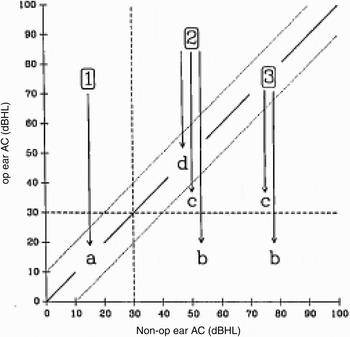
The Glasgow benefit plot groups patients into three major categories according to their pre-operative hearing impairment: either unilateral, bilateral asymmetrical or bilateral symmetrical (Figure 1). The projected outcomes of surgery are different for each group; therefore, determination of success is considered for each group individually, so as to prevent misleading combined results. Meaningful comparisons between different series are maximised when the audiometric data of each group are evaluated separately.Reference Browning, Gatehouse and Swan6–Reference Browning8
Glasgow benefit plot showing potential changes from pre-operative impairment group to post-operative impairment category, representing different types of benefit. 1 = unilateral hearing loss, 2 = bilateral asymmetric hearing loss, 3 = bilateral symmetric hearing loss, a = bilateral serviceable hearing, b = unilateral serviceable hearing, c = bilateral asymmetric hearing impairment with operated ear converted to the better hearing ear, d = bilateral symmetric hearing impairment.; non-op = non-operated ear; op ear = operated ear; AC = air conduction

Bilateral hearing status remains rarely discussed in stapes surgery reports.Reference Smyth9 A search of indexed medical literature in the Medline® and PubMed® databases revealed that, of 3412 publications on the surgical treatment of otosclerosis to date, binaural hearing function was used as a keyword in only 83 (2 per cent). Hearing in the non-operated ear was purposefully evaluated in only 21 of these 83 studies; the remaining 62 publications focused primarily on the results of bilateral surgery. A limited number of publications have used the Glasgow benefit plot for presenting the results of middle-ear surgery, and within these there is a contradictory distribution of surgical success. These inconsistencies seem to result from the summation of unilateral and bilateral cases and of primary and revision procedures, and subsequent averaging of the whole series.
The present study included unilateral primary stapedotomy cases evaluated using the Glasgow benefit plot pre-operative categories of unilateral, bilateral asymmetrical and bilateral symmetrical hearing impairment, to avoid incongruity. The results of 394 bilateral stapedotomies are analysed in a separate study.
The aims of this study were twofold: (1) to evaluate both technical and functional results of a large series of stapedotomy cases, using the Glasgow benefit plot and the American Academy of Otolaryngology, Head and Neck Surgery Committee on Hearing and Equilibrium guidelines10 for reporting the results of conductive hearing loss treatment; and (2) to analyse the effect of pre-operative hearing impairment type on post-operative hearing levels after stapedotomy.
Patients and methods
We reviewed medical records relating to 1369 consecutive stapedotomies performed by one surgeon (the senior author, JJH) from 1991 to 2006. Of these 1369 cases, 89 were revision stapedotomies and 46 were performed for congenital stapes fixation. Eighty-nine cases were excluded from the study due to incomplete data. This left 1145 primary stapedotomy procedures performed in patients with otosclerosis; 751 unilateral and 394 bilateral procedures. The audiometric results of these 751 patients undergoing unilateral stapedotomy were analysed in the current study. Patients comprised 437 (58 per cent) women and 314 (42 per cent) men, and had a mean age of 46 years (standard deviation (SD) 12 years).
The patients' mean pre-operative hearing level was 54 dB (SD 14 dB), being calculated as the pure tone average (PTA) for the frequencies 0.5, 1, 2 and 3 kHz. The patients' mean pre-operative ABG was 29 dB (SD 9 dB). One hundred and forty-four (19 per cent) patients were treated for severe or profound hearing loss (defined as a pre-operative hearing level of ≥71 dB).
Stapedotomy was performed using the reverse-order techniqueReference Smyth11, Reference Fisch12 via a per-meatal approach. A modified Cawthorne (0.3 mm diameter) prosthesis was used until 2002, in 409 cases. Thereafter, a modified Causse (0.4 mm diameter) prosthesis was used, in 342 procedures. A 0.4 mm (for Cawthorne prostheses) or 0.5 mm (for Causse prostheses) fenestra was made in the footplate using graduated hand perforators. The adjunctive use of an Argon beam laser (Lumenis, Salt Lake City, Utah, USA), delivered via an Endo Otoprobe™ (Iridex, Mountain View, California, USA) was introduced in 2000. A modification of the reverse-order technique was made in conjunction with the introduction of the laser: the Argon laser was used to vaporise the stapedial tendon and posterior crus of the stapes prior to commencing footplate fenestration. The laser was also used to initiate footplate fenestration by providing a ‘set-hole’ for the perforators; fenestration was then completed using graduated perforators. These laser-assisted procedures were undertaken in 343 patients.
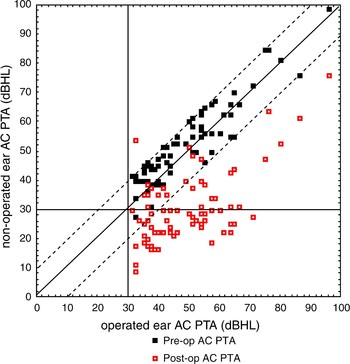
Outcomes were analysed according to the 1995 American Academy of Otolaryngology, Head and Neck Surgery Committee on Hearing and Equilibrium guidelines,10 and the Glasgow benefit plot. Both operated and non-operated ears were tested at 0.5, 1, 2, 3, 4, 6, 8 and 12 kHz for air conduction, and at 0.5, 1, 2, 3 and 4 kHz for bone conduction. Some of the patient testing pre-dated the 1995 American Academy guidelines; therefore, 3 kHz results were not available for all patients. In these cases, 3 kHz thresholds were calculated as an average of thresholds for 2 and 4 kHz, allowing uniform presentation of audiometric data, according to the American Academy guidelines. The mean pre-operative PTA for air conduction and bone conduction, and the ABG values at 0.5, 1, 2 and 3 kHz, were compared with their corresponding post-operative values. Post-operative bone conduction thresholds were used to calculate post-operative ABG values. In addition to reporting the results of air conduction, bone conduction and ABG gain, we used the Glasgow benefit plot to produce a visual representation of bilateral hearing status in each individual case. Normal hearing was defined as an air conduction PTA threshold of ≤30 dB, according to the method of Belfast rule of thumbReference Smyth and Patterson4,Reference Toner and Smyth5,Reference Smyth11 who adopted the ‘Belfast rule of thumb’ to define socially acceptable hearing. Symmetrical hearing was defined as an interaural difference of ≤10 dB, as proposed by the Glasgow benefit plot method. Based on these criteria, patients were grouped into three major categories according to their pre-operative hearing impairment: group one, with unilateral hearing impairment (481 patients); group two, with bilateral asymmetrical hearing impairment (166 patients), and group three, with bilateral symmetrical hearing impairment (104 patients). Pre- and post-operative air conduction PTAs in the operated ears were plotted on the vertical axis against corresponding air conduction thresholds in non-operated ears on the horizontal axis.
The database was analysed using Statistica 6.0 software (StatSoft, Tulsa, Oklahoma, USA). Statistical analysis was conducted to compare pre- and post-operative values, using the paired t-test, for air conduction, bone conduction, PTA, ABG and air conduction gain. The effects of pre-operative hearing impairment type and pre-operative bone conduction on the achievement of post-operative symmetrical, socially acceptable hearing were evaluated with the Pearson correlation test . The criterion selected for statistical significance was p < 0.05.
Results
Conventional analysis
Closure of air–bone gap
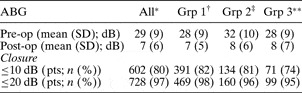
Table I summarises the patients' pre- and post-operative ABG and percentage ABG closure, collectively and by pre-operative hearing impairment type. A mean post-operative ABG of 7.5 dB was achieved in each group despite pre-operative differences between the groups, with the largest pre-operative ABG being 32 dB in group two.
Air–bone gap data in study patients

See text for explanation of groups. n=*751, †481, ‡166 and **104. ABG = air–bone gap; grp = group; pre-op = pre-operative; post-op = post-operative; SD = standard deviation; pts = patients
Improvement in air conduction thresholds
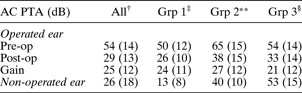
Post-operatively, a significant improvement in air conduction thresholds was demonstrated in all groups (p < 0.001). Patients with bilateral asymmetrical hearing impairment had the most severe pre-operative hearing loss, with mean air conduction thresholds of 65 dB in the operated ear and 40 dB in the non-operated ear. The post-operative air conduction thresholds in this group were also poorer than in the unilateral hearing impairment and bilateral symmetrical hearing impairment groups, despite a greater air conduction gain of 27 dB (compared with 24 and 21 dB in the two latter groups, respectively) (Table II).
Air conduction pure tone average* data in study patients
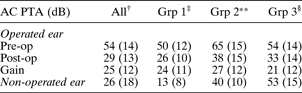
Data represent means (standard deviations). See text for explanation of groups.
* At 0.5, 1, 2 and 3 kHz. n=†751, ‡481, **166 and §104. AC PTA = air conduction pure tone average; grp = group; pre-op = pre-operative; post-op = post-operative
Pre- and post-operative bone conduction
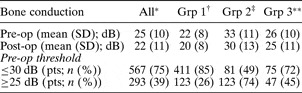
Pre-operative bone conduction thresholds were analysed to identify cases in which normal hearing was achievable. The highest proportion of normal cochlear reserve was found in the unilateral hearing impairment group, in 411 (85 per cent) patients. The highest proportion of mixed hearing loss was found in the bilateral asymmetrical hearing impairment group; 123 (74 per cent) patients had bone conduction thresholds of ≥25 dB (Table III).
Bone conduction data in study patients

See text for explanation of groups. n=*751, †481, ‡166 and **104. Grp = group; pre-op = pre-operative; post-op = post-operative; SD = standard deviation; pts = patients
Post-operative normal hearing
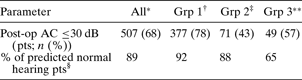
The proportions of patients with post-operative normal hearing are presented in Table IV. Pearson test analysis demonstrated that normal post-operative air conduction (Table IV) correlated highly with normal pre-operative bone conduction (Table III) (Pearson correlation coefficient r = 0.7).
Post-operative normal hearing data in study patients
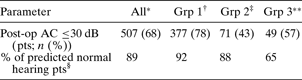
See text for explanation of groups. n=*751, †481, ‡166 and **104. §Percentage of patients with pre-operative bone conduction ≤30 dB having post-operative (post-op) air conduction (AC) ≤30 dB. Grp = group; pts = patients
Post-operative symmetrical hearing
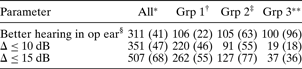
The distribution of post-operative bilateral symmetrical hearing is demonstrated in Table V. Pearson test analysis demonstrated that the type of pre-operative hearing impairment correlated highly with post-operative symmetrical hearing (r = 0.75).
Post-operative symmetrical hearing data in study patients
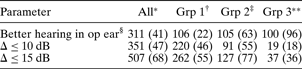
Data represent patient numbers (percentages). See text for explanation of groups. n=*751, †481, ‡166 and **104. §As per air conduction pure tone averages (AC PTAs). Δ = interaural AC PTA difference. Grp = group; op = operated
Glasgow benefit plot analysis
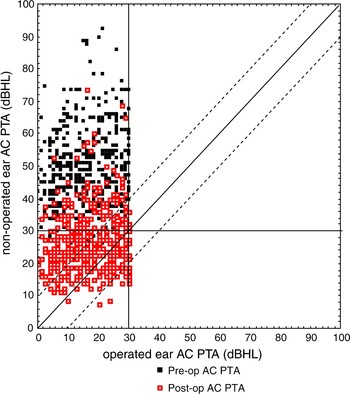
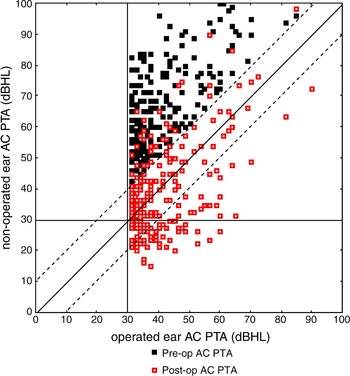
Figures 2, 3 and 4 demonstrate the pre- and post-operative air conduction PTAs for the three groups.
Glasgow benefit plot for group one results (unilateral hearing impairment; n = 481). Pre-op = pre-operative; post-op = post-operative; AC PTA = air conduction pure tone average

Glasgow benefit plot for group two results (bilateral asymmetrical hearing impairment; n = 166). Pre-op = pre-operative; post-op = post-operative; AC PTA = air conduction pure tone average

Glasgow benefit plot for group three results (bilateral symmetrical hearing impairment; n = 104). Pre-op = pre-operative; post-op = post-operative; AC PTA = air conduction pure tone average

Post-operative normal hearing
A post-operative air conduction PTA of <30 dB in the operated ear was achieved in 507 (68 per cent) of all patients. This included 89 per cent of patients with pre-operative bone conduction thresholds of ≤30 dB, in whom normal hearing could be predicted to be achievable. Patients with unilateral hearing impairment demonstrated the best post-operative PTA results, while those with bilateral asymmetrical hearing impairment demonstrated the least success (Table IV).
Post-operative symmetrical hearing
Table V summarises patients' post-operative bilateral hearing PTAs. The operated ear became the better hearing ear in 41 per cent of all patients; however, this was the case in 96 per cent of the patients with pre-operative bilateral symmetrical hearing impairment. Symmetrical hearing was obtained in 47 per cent of all patients. By comparison, if an inter-aural difference of 15 dB or less is regarded as symmetrical hearing, it was achieved in 68 per cent of all patients. The most striking difference was found in the bilateral symmetrical hearing impairment group, in which a twofold increase in post-operative symmetrical hearing was observed. In the unilateral hearing impairment group, post-operative hearing was found to be symmetrical in only 55 per cent of patients, but bilaterally normal in 78 per cent (Table IV). This apparent discrepancy can be explained by the fact that the mean air conduction PTA for the non-operated ear in this group was 13 dB (Table II); therefore, patients with post-operative hearing thresholds of >28 dB but ≤30 dB were considered to have bilateral normal hearing, despite an interaural difference formally exceeding 15 dB.
Discussion
Stapes surgery is generally considered the most successful middle-ear procedure for correction of conductive hearing loss. This conclusion is based on publications reporting stapedectomy success rates approaching 85–95 per cent of cases.Reference Sheehy, Nelson and House1–Reference Hough3, Reference Shea13–Reference Shea, Sanabria and Smyth15 In these studies, success is defined as the improvement of air conduction thresholds and ABG closure in the operated ear. This technical approach to the assessment of surgical outcomes does not consider overall hearing status based on bilateral auditory input. The Glasgow benefit plot, created with the patient's bilateral hearing in mind, is considered a functional method for reporting the benefits of middle-ear surgery. The current study employed the Glasgow benefit plot, in addition to technical methods, to evaluate the results of stapedotomy. Pre-operative and post-operative bone conduction and air conduction PTAs for both the operated and non-operated ears were calculated to evaluate the effect of pre-operative hearing impairment type on surgical success, as defined by Glasgow benefit plot criteria for normal and symmetrical hearing.
To date, the Glasgow benefit plot has been used in 19 studies indexed in the Medline and PubMed database. Ten publications have employed the Glasgow benefit plot to analyse surgical success in cases of chronic otitis media, tympanosclerosis and otitis media with effusion. Nine studies have used the Glasgow benefit plot to investigate stapes surgery. Four reports have evaluated the results of unilateral proceduresReference Huang and Stanley16–Reference Caces and Braccini19 and three the results of bilateral procedures.Reference Porter, Zeitoun and Brookes20–Reference Schmerber, Karkas, Righini and Chahine22 One study presented results for combined data from unilateral and bilateral cases,Reference Persson, Harder and Magnuson23 and another discussed revision stapedectomy.Reference Magliulo, Cristofari and Terranova24
The outcome of revision stapes surgery is usually less successful than that of primary stapedectomy.Reference Glasscock, McKennan and Levine25–Reference Gros, Vatovec, Zargi and Jenko27 In the case of bilateral disease, it is customary to operate first on the ear with worse hearing thresholds. Therefore, the chances of achieving bilateral normal hearing in unilateral and bilateral surgery are substantially different, and one cannot directly compare the functional results of primary and revision procedures, or of unilateral and bilateral procedures. As Browning et al. emphasised in their original paper,Reference Browning, Gatehouse and Swan6 reporting the average results of an entire surgical series would make it impossible to calculate the differences between different patient populations within that series. Despite this, some authors use the Glasgow benefit plot to evaluate the success of mixed series, thereby combining the overall results of different patient populations. In order to circumvent the ambiguity that may arise from this method of evaluation, the present study considered the outcomes of each pre-operative group separately. This method was consistent with Browning's position, and used the Glasgow benefit plot as it was originally designed to be applied.
Previous unilateral stapedotomy series, using conventional assessment means, have demonstrated ABG closure to <10 dB in 50 per cent of cases in Browning and colleagues' series,Reference Browning, Gatehouse and Swan6 in 65 per cent in Huang and Stanley's series,Reference Huang and Stanley16 and in 74 per cent of the 509 cases reported by Persson et al. Reference Persson, Harder and Magnuson23 Recovery of air conduction PTAs demonstrated less variability: an air conduction gain of 28 dB was found by Browning et al.,Reference Browning, Gatehouse and Swan6 27 dB by Persson et al.,Reference Persson, Harder and Magnuson23 29 dB by Huang and Stanley,Reference Huang and Stanley16 and 24 dB by Caces and Braccini.Reference Caces and Braccini19 The current study found ABG closure to <10 dB in 80 per cent of all cases, and an air conduction PTA gain of 25 dB (SD 12 dB); this is equal or superior to other series using the same evaluation criteria. Air–bone gap closure to <10 dB was demonstrated in 82 per cent of unilateral hearing impairment patients, in 81 per cent of bilateral asymmetrical hearing impairment patients and in 74 per cent of bilateral symmetrical hearing impairment patients (Table I). Post-operative air conduction PTAs were better in the unilateral hearing impairment group (26 dB, SD 10 dB) than in the bilateral asymmetrical hearing impairment group (38 dB, SD 15 dB) or the bilateral symmetrical hearing impairment group (33 dB, SD 14 dB) (Table II). As previously reported, clinical improvement correlates better with post-operative air conduction levels than with post-operative ABG values.Reference Lundman, Mendel, Bagger-Sjoback and Rosenhall28
The current study established that the probability of normal post-operative air conduction thresholds was directly related to the type of pre-operative hearing impairment, as defined by Glasgow benefit plot criteria. Superior outcomes were demonstrated in unilateral hearing impairment patients, 78 per cent of whom achieved normal hearing in the operated ear. Forty-three per cent of bilateral asymmetrical hearing impairment patients achieved post-operative thresholds better than 30 dB. A similar distribution of success, as evaluated by the Glasgow benefit plot, was found by Szymanski et al.,Reference Szymanski, Siwiec and Golabek17 who noted post-operative normal hearing in 79 and 46 per cent of unilateral hearing impairment patients and bilateral asymmetrical hearing impairment patients, respectively. Our findings are also consistent with those of Persson et al., Reference Persson, Harder and Magnuson23 who found normal hearing in 70 per cent of unilateral hearing impairment patients but in only 36 per cent of bilateral asymmetrical hearing impairment patients. Similarly, Lundman et al. Reference Lundman, Mendel, Bagger-Sjoback and Rosenhall28 reported severe post-operative hearing disability in about one-third of otosclerosis patients with bilateral hearing loss, despite good results from unilateral surgery. In the current study, the pre-operative air conduction thresholds and proportions of mixed hearing loss were highest in bilateral asymmetrical hearing impairment patients, intermediate in bilateral symmetrical hearing impairment patients, and lowest in unilateral hearing impairment patients. Therefore, knowledge of stapedotomy success rates in patients with different types of hearing impairment may be helpful in pre-operative counselling.
Pre-operative bone thresholds are usually considered the limiting factor for achievable post-operative air conduction improvement.Reference De Bruijn, Tange and Dreschler29 The post-operative changes in bone conduction thresholds caused by otosclerosis were initially described by CarhartReference Carhart30 and Davis and Silverman.Reference Davis and Silverman31 More recent reports have demonstrated better post-operative results in patients with good pre-operative cochlear reserve.Reference Satar, Sen, Karahatay, Birkent and Yetiser32 Moscillo et al. Reference Moscillo, Imperiali, Carra, Catapano and Motta33 evaluated bone conduction threshold changes following stapedectomy, and found greater improvement in bone conduction thresholds in younger patients; they concluded that normal bone conduction thresholds were a prerequisite for successful surgical outcome. In addition, Ramsay and LinthicumReference Ramsay and Linthicum34 found that patients with pre-operative mixed hearing loss more frequently suffered profound post-operative sensorineural hearing loss (SNHL). However, the controversy over using pre-operative bone conduction for prognostic purposes remains. The 1995 American Academy of Otolaryngology, Head and Neck Surgery guidelines, which use post-operative bone conduction thresholds for ABG calculation, have been criticised because bone conduction thresholds can change unpredictably.Reference Black35 For example, bone conduction thresholds may either improve, due to Carhart's effect, as a result of successful mobilisation of the ossicular chain, or worsen as a result of surgical trauma.Reference Cook, Krishnan and Fagan36–Reference Soudry, Sulkes, Attias and Naegris39 Bone conduction audiometry may have limitations owing to difficulties with masking, especially in cases of severe bilateral conductive hearing impairment.Reference Giles, Browning and Gatehouse40
The current study identified the best pre- and post-operative bone conduction thresholds in unilateral hearing impairment patients, and the worst such parameters in bilateral asymmetrical hearing impairment patients, who would probably require post-operative hearing aids (Table III). This is in agreement with our finding of the highest proportion of mixed hearing loss in the bilateral asymmetrical hearing impairment group, and the highest proportion of post-operative normal hearing in the unilateral hearing impairment group. Therefore, a combination of the quantification of Carhart's effect, based on pre-operative bone conduction,Reference Cook, Krishnan and Fagan36 together with the known incidence of SNHL in the series, enabled reasonably accurate prediction of post-operative results. Further investigation of the predictive value of pre-operative bone conduction threshold, using the Glasgow benefit plot, is ongoing in our department. Future research will compare the predicted and actual results of stapedotomy.
Many authors have tried to identify prognostic factors for successful middle-ear surgery by analysing pre-operative audiometric data and operative findings. Gerard et al. Reference Gerard, Serry and Gersdorff41 studied the outcomes of 147 primary stapedotomies, reporting ABG closure to <10 dB in 60 per cent of cases, but did not detect any factor that was predictive for post-operative hearing thresholds. Blakley et al. Reference Blakley, Kim and VanCamp42 found improved outcomes in patients with less severe pre-operative hearing loss, and concluded that pre-operative hearing thresholds predicted post-operative hearing. Ueda et al. Reference Ueda, Miyazawa, Asahi and Yanagita43 investigated pre-operative ABG, and found that a smaller pre-operative ABG resulted in better post-operative ABG closure. Therefore, if one considers only technical success in the operated ear, better pre-operative air conduction thresholds and smaller ABGs are associated with more successful surgical outcomes.
The patient's assessment of the benefits of surgery may not always match that of the surgeon. For example, a patient with very severe hearing loss may experience a large functional benefit from surgery. BrowningReference Browning44 concluded that the magnitude of air conduction threshold change was more important for patient satisfaction than the achievement of technically normal hearing in the operated ear. Patients with pre-operative bilateral hearing impairment report a greater benefit from surgery than do those with unilateral hearing impairment, provided the hearing threshold of the operated ear is better than that of the non-operated ear. Following analysis of patients' reports of surgical benefit, BrowningReference Browning44 removed the horizontal 30 dB line from the modified Glasgow benefit plot.Reference Browning44 Further modification of the Glasgow benefit plot has recently been reported by Schmerber et al.,Reference Schmerber, Karkas, Righini and Chahine22 who proposed the quartile benefit plot. This plot includes the additional criteria of ABG closure to <10 dB and absence of post-operative SNHL, providing a more sensitive measurement of both the technical and functional benefits of stapes surgery. From an historical perspective, increasingly comprehensive assessments of audiometric outcomes have resulted in shrinking success rates: from 85–95 per cent in series reported by the ‘fathers of stapes surgery’,Reference Sheehy, Nelson and House1–Reference Hough3, Reference Shea13–Reference Shea, Sanabria and Smyth15 to 78 per cent when evaluated by the ‘Belfast rule of thumb’, to 62 per cent when assessed with the Glasgow benefit plot,Reference Toner and Smyth5 and finally to 39 per cent when calculated by the quartile benefit plot.Reference Schmerber, Karkas, Righini and Chahine22 The imposition of more stringent criteria for evaluation of surgical results has led to lower success rates.
The definitions of technical success used by current methods, however, are limited by a focus on the achievement of hearing levels of a certain number of decibels in one or both ears. Evaluation of the benefit of treatment is more complex, and additional methods assessing the patient's quality of life are needed to provide more balanced final answers.Reference Meyer and Megerian45 Ramsay noted that even patients with excellent audiometric results frequently presented with symptoms of noise intolerance and sound distortion, which negatively affected their subjective estimate of surgical benefit.Reference Ramsay, Karkkainen and Palva46 This observation is also supported by Hall et al.,Reference Hall, Grose and Pillsbury47 who demonstrated that some patients with normal pure tone thresholds after stapedotomy continued to experience significant hearing disability due to abnormal binaural hearing function. A recent study on the quality of perceived sound following stapedotomy found that audiometric improvement does not always correlate with an improvement in sound perception.Reference Tan, Grolman, Tange and Fokkens48 This study also found that patients with post-operative air conduction PTAs of <30 dB had better handicap scores than those with air conduction PTAs of >30 dB. This is in agreement with the results of other studies which have demonstrated that improvement in post-operative hearing thresholds results in better speech recognition scores and, subsequently, in better quality of life.Reference Lippy, Burkey and Arkis49, Reference Stewart50 Therefore, using a patient's pre-operative hearing impairment to predict their surgical outcome enables pre-operative counselling to be better oriented towards patient expectations. For practical purposes, the combination of conventional methods and pre-operative bone conduction PTAs (as per the Glasgow benefit plot) provides a working tool enabling reasonably accurate prediction of post-operative hearing. This combination of technical and functional criteria also allows meaningful comparison of surgical techniques, and contributes to the improved quality of future research.
• Stapedectomy was introduced by Shea in 1956; since then, the primary measures of surgical success have been air–bone gap closure and improvement of air conduction threshold in the operated ear
• This study investigated the largest reported series of primary stapedotomies evaluated with the Glasgow benefit plot
• Bilateral post-operative hearing function was found to depend on the type of pre-operative hearing impairment
• Pre-operative bone conduction thresholds, corrected for Carhart's effect, are useful for predicting post-operative air conduction in stapedotomy candidates
Conclusions
In this study, a group of 751 patients undergoing primary unilateral stapedotomy was simultaneously evaluated according to the 1995 American Academy of Otolaryngology, Head and Neck Surgery guidelines and the Glasgow benefit plot criteria. The addition of the Glasgow benefit plot criteria to conventional parameters enabled detailed representation of bilateral hearing in each case, and identification of successes and failures. The best functional results were demonstrated in patients with unilateral hearing impairment. Socially acceptable hearing was achieved in 78 per cent of patients with unilateral conductive hearing loss. Patients with bilateral symmetrical hearing loss were more likely to benefit from second ear surgery, in terms of achieving bilateral, symmetrical, serviceable hearing. Patients with bilateral, asymmetrical, mixed hearing loss would probably require post-operative rehabilitation with hearing aids. Bilateral post-operative hearing function depended on the type of pre-operative hearing impairment. Pre-operative bone conduction thresholds, corrected for Carhart's effect, can be used to predict post-operative air conduction thresholds in stapedotomy candidates.