Introduction
For the past several decades, structural coloration mechanisms of bird feathers,[Reference Prum, Torres, Williamson and Dyck1] which bear various short-range-ordered microstructures,[Reference Shi, Yin, Zhang, Liu, Zi and Zhao2] have attracted much attention, especially with the rapid development of photonic crystals.[Reference Vukusic and Sambles3–Reference John5] To date, the relationship between feather structures and coloration[Reference Noh, Liew, Saranathan, Mochrie, Prum, Dufresne and Cao6, Reference Kinoshita, Yoshioka and Miyazaki7] has not yet been fully clarified, hindering the development of novel feather-inspired applications in controlling light propagation. Since coloration behaviors are drastically related to the refractive index (RI) of materials, some groups have attempted to directly replicate the original feather structures of β-keratin into high-RI materials (e.g., SiO2,[Reference Shi, Yin, Zhang, Liu, Zi and Zhao2] TiO2,[Reference Shi, Yin, Zhang, Liu, Zi and Zhao2] ZnO,[Reference Han, Su, Zhang, Dong, Zhang and Zhang8] and CdS[Reference Han, Su, Song, Gu, Zhang and Jang9]) to test a broad range of present-day theoretical hypotheses. However, these sol–gel methods are time-consuming (in days)[Reference Han, Su, Zhang, Dong, Zhang and Zhang8] and contain many steps (5 to 12).[Reference Shi, Yin, Zhang, Liu, Zi and Zhao2, Reference Han, Su, Zhang, Dong, Zhang and Zhang8, Reference Han, Su, Song, Gu, Zhang and Jang9] Inspired by a cosmetic preparation route developed in ancient Egypt more than 4000 years ago,[Reference Walter, Welcomme, Hallegot, Zaluzec, Deeb, Castaing, Veyssiere, Breniaux, Leveque and Tsoucaris10] we report in this paper a rapid way of producing ‘PbS bird feathers’; this method comprises only two steps (sulfhydrylation plus in situ PbS formation) and can be completed within 2 h. Since the cations of Pb, Cd, Ag, and Cu can easily combine with sulfur to form sulfides with small solubility products, our ‘feather-dyeing’ methods have potential to be extended to the fast fabrication of other sulfide replicas of feathers with RI ranging from 3.92 (PbS) to 1.45 (CuS).
Experimental
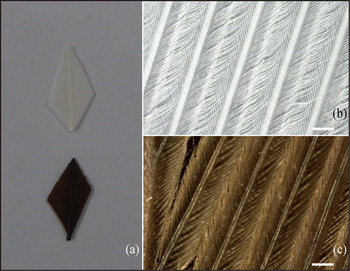
To synthesize PbS feathers, 50 mg cleaned white flight feathers[Reference Yu, Wu, Widelitz and Chuong11] of domestic pigeons (Columbia livia domestica) were first immersed in a 50 mL 2,3-dimercaptosuccinic acid (DMSA)[Reference Aposhian and Aposhian12] and ethanol solution (20:1, w/v) for 30 min in a water bath with the temperature kept at 80 °C, and were then thoroughly rinsed in ethanol and water. The feathers were then transferred into the saturated PbO solution in calcium hydroxide (1:1, w/v)[Reference Walter, Welcomme, Hallegot, Zaluzec, Deeb, Castaing, Veyssiere, Breniaux, Leveque and Tsoucaris10] in the water bath at 80 °C for 60 min. The as-synthesized PbS feathers were then taken out and subjected to ultrasonic cleaning for 3 min. It was easily seen that the color of the feathers changed from white to black, as shown in Fig. 1.
Optical micrograph of original pigeon feathers and PbS feathers. (a) Digital camera image of original pigeon feathers (white) and PbS feathers (black). (b) Optical micrograph of original feathers. (c) Optical micrograph of PbS feathers. Scale bars: 100 µm.

Scanning electron microscopy (SEM) images were taken using an FEI FEG 250 scanning electron microscope, which was operated at an acceleration voltage of 20.0 kV and equipped with the capability for energy-dispersive X-ray spectrometry (EDS) analysis (Oxford Instruments, UK 80 mm2 detector). Samples were subjected to Au sputtering before observation. A high-resolution transmission electron microscopy (HRTEM) study was conducted using an FEI Jeol JEM-2100 (Jeol JEM-2100: JEOL Ltd., Japan) transmission electron microscope (200 kV). X-ray diffraction (XRD) results were recorded using a Rigaku D/max 2550 (Rigaku D/max 2550 (CuKa): Rigaku, Japan) (CuKα) instrument at a scan rate of 4°/min. Fourier transform infrared spectroscopy (FTIR) analyses were conducted using a Perkin Elmer Spectrum 100 instrument (Perkin Elmer Spectrum 100 instrument: Perkin Elmer, Inc.) using samples ground to powder and compressed into KBr pellets.
Results and discussion
It has been reported that ancient Egyptians used to apply PbS nano-particles to dye hair dozens of centuries ago.[Reference Walter, Welcomme, Hallegot, Zaluzec, Deeb, Castaing, Veyssiere, Breniaux, Leveque and Tsoucaris10] Although such a method has been discarded previously because of its toxicity,[Reference Stohs and Bagchi13] the facile and time-saving nature of ‘hair-dyeing’ can still benefit state-of-the-art applications owing to the similarity of the composition (keratin) of human hair and avian feathers.[Reference Weiss and Kirchner14] Similar to human hair, bird feathers have a filament–matrix texture.[Reference Fraser and Parry15] The conformation of the poly-peptide chain in the ordered filaments is based on the β-pleated sheet, with the inner surface densely covered by hydrophobic residues and the outer surface populated by charged residues and cysteine ones.[Reference Fraser and Parry15, Reference Fraser and Parry16] At a molecular level, there is a high concentration of cysteine residues (7–20% of the total number of amino acid residues).[Reference Vasconcelos, Freddi and Cavaco-Paulo17] Although sulfur-rich peptides in the matrix that surrounds supramolecular-organized keratin proteins can serve as nanoscale reactors, achieving ‘intact PbS feathers’ requires more reactive sites to generate continuous PbS layers as compared with a simple hair-dyeing process.[Reference Walter, Welcomme, Hallegot, Zaluzec, Deeb, Castaing, Veyssiere, Breniaux, Leveque and Tsoucaris10] In Ref. Reference Walter, Welcomme, Hallegot, Zaluzec, Deeb, Castaing, Veyssiere, Breniaux, Leveque and Tsoucaris10, the sample was simply treated for 3 days. Hence, to improve efficiency, our synthesis route contains a sulfhydrylation process followed by PbS deposition via in situ reaction in solution. For arousing more sulfhydryl sites on the β-keratin of avian feathers, we first chose DMSA dissolved in ethanol as a precursor for sulfhydrylation. Pb2+ ions were then provided by the PbO saturated solution in calcium hydroxide.[Reference Walter, Welcomme, Hallegot, Zaluzec, Deeb, Castaing, Veyssiere, Breniaux, Leveque and Tsoucaris10] Generally, Pb2+ transforms into Pb(OH)2 deposits and impedes the reaction. For the saturated calcium hydroxide solution, it is easy to maintain a constant pH, ensuring stability of the reaction system.
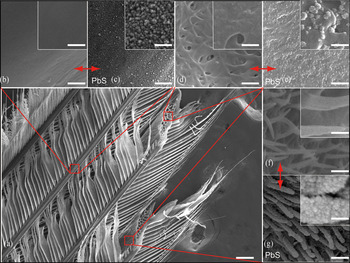
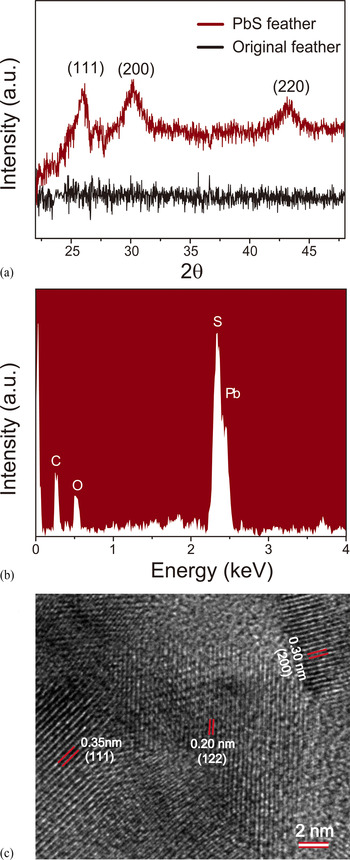
Figure 2 compares the morphologies of as-synthesized PbS feathers with their original counterparts. The main components of the artificial feather were confirmed to be PbS [XRD results, Fig. 3(a)], with an average crystallite size of ~15.6 nm (calculated with the Scherrer formula). Such results were also confirmed by the EDS results [Fig. 3(b)] and also the HRTEM analysis [Fig. 3(c)]. These continuous PbS nano-particles were formed across the feather surface and the PbS feathers faithfully inherited the morphologies of different feather parts. Such conformality could even be observed in the inner parts of the feather structures,[Reference Prum and Dyck18–Reference Prum, Torres, Williamson and Dyck20] which were manually cut open for observation after the PbS formation [Fig. 2(e)].
Comparison of the morphologies between original pigeon feathers and PbS feathers. (a) Pigeon feather. (b), (d), (f) Close-up view of the original pigeon feather at (b) barbs, (d) the inner part of medulla, and (f) barb ramus. (c), (e), (g) The corresponding areas of (b), (d), (f) on PbS feathers. Continuous and uniform PbS layers were formed therein. Scale bars: (a) 80 µm; (b)–(g) 800 nm and (insets) 200 nm.

Characterization of as-synthesized PbS feathers. (a) XRD results confirmed the generation of PbS. The average crystallite size of PbS was calculated to be 15.6 nm. (b) EDS results. (c) HRTEM observation of the PbS nano-particles.

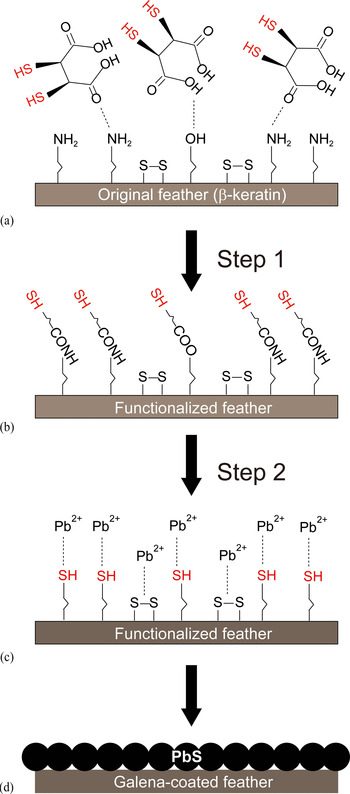
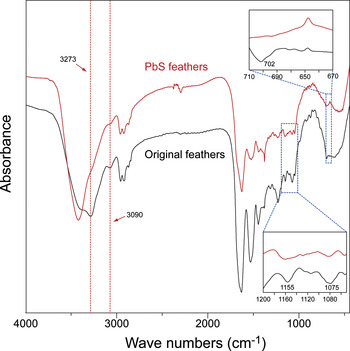
The fabrication mechanism is demonstrated in Fig. 4. We observed the morphologies of the feathers processed under different times and found that it took ˜60 min for the formation of a continuous PbS layer (Supplementary Fig. S1 online). Compared with the reaction time (3 days) reported in Ref. Reference Walter, Welcomme, Hallegot, Zaluzec, Deeb, Castaing, Veyssiere, Breniaux, Leveque and Tsoucaris10, the entire reaction time presented here was only 2 h owing to the sulfhydrylation process and the higher reaction temperature (80 °C versus room temperature in Ref. Reference Walter, Welcomme, Hallegot, Zaluzec, Deeb, Castaing, Veyssiere, Breniaux, Leveque and Tsoucaris10). In step 1 [Fig. 4], amino groups of β-keratin combined with carboxyls of DMSA and thus activated the original feather with sulfhydryls [Fig. 4(b)]. This process could be identified in the FTIR spectra (Fig. 5), where absorption peaks at 3273 and 3090 cm−1 that correspond to the vibration of the groups –NH2 and –NH3+ decreased for the PbS feathers as compared with their original counterparts. Moreover, DMSA contains many carboxyls that tend to react with hydroxyls of feathers [Fig. 4(b)]. As proved by the FTIR spectra (Fig. 5), the peaks at 1155 and 1075 cm−1 that correspond to the vibration of the C–OH group decreased for PbS feathers. Such a reaction also helps in the settling of sulfhydryls. In general, the sulfhydryls formed in step 1 presented a large number of reactive positions for in situ PbS formation (Step 2) owing to the high affinity of lead for sulfhydryls [Fig. 4(c)]. As shown in Fig. 5, the peak at 702 cm−1 (vibration of C–S) drastically decreased for PbS feathers, which indicated that the element of S in β-keratin reacted with the Pb2+, yielding the PbS nano-particles observed in Figs. 2 and 3.
Schematic illustration of the synthesis route. (a) DMSA molecules introduced to original feathers; (b) sulfhydrylated feathers; (c) high affinity of Pb2+ for sulfhydryls; (d) as-synthesized PbS feathers. Steps 1 and 2 denote the processes of sulfhydrylation and in situ PbS formation, respectively.

FTIR analyses of original feathers and their PbS counterparts.

Conclusions
We have demonstrated a simple two-step process for producing ‘PbS bird feathers’ inspired by an ancient hair-dyeing method; this method can be completed within 2 h just like what happened in the daily life of the ancient Egyptians. Compared with the methods of previous works, the number of synthesis steps (5 to 12) and time consumption (in days) are significantly lower. The morphologies of original feathers are well preserved owing to the continuous and uniform PbS nano-particle layers. Our method has potential to be extended to the fast fabrication of other functional sulfides with hierarchical microstructures of avian feathers. As one of the bio-templating strategies,[Reference Aguirre, Reguera and Stein21–Reference Tan, Gu, Xu, Zang, Liu, Zhang, Liu, Zhu, Su, Feng, Fan and Zhang25] this work may help promote research into the optical applications inspired by these nature-constructed fine structures, which are effective in controlling light but are too complicated to fabricate otherwise.
Acknowledgments
This work was supported by the National Natural Science Foundation of China (grant numbers 51131004 and 51171110), the National Basic Research Program of China (973 Program, grant number 2012CB619600), the Shanghai Science and Technology Committee (grant number 10JC1407600), and the Cultivation Fund for Excellent Doctoral Thesis of Shanghai Jiao Tong University. X.Z. acknowledges financial support from the Third Shanghai Innovation Experiment Program for Undergraduate Students and the Participation in Research Program (PRP) of Shanghai Jiao Tong University.
Y.T., F.Z. and P.O. have contributed equally to this work.
Supplementary materials
For supplementary materials of this article, please visit http://dx.doi.org/10.1557/mrc.2013.2