

The legal framework for prosecuting and punishing international crimes, such as war crimes and crimes against humanity, relies on a core assumption: that such acts are different from domestic crimes in some fundamental and legally significant way. This received wisdom is reflected in the unique range of institutions with jurisdiction to prosecute international crimes. Ordinarily, we assume that crimes should be punished by a limited set of entities—specifically, the courts of the states with some factual connection to the crime or criminal (the courts of the “nexus state”). International crimes, in contrast, can be prosecuted by multiple institutions. Not only does the nexus state have jurisdiction to prosecute, but so too do the courts of foreign states that lack any factual connection to the offense. Likewise, in certain circumstances, international tribunals have jurisdiction over international crimes. Together, these “non-nexus institutions” (the courts of foreign states and international tribunals) establish a far broader range of sites for the prosecution of international crimes than for domestic offenses. For instance, if a Rwandan murders a fellow citizen in Rwanda, the crime can only be tried by Rwandan courts. In contrast, a Rwandan militant who killed a fellow citizen as part of the 1994 genocide in Rwanda can also be tried by a foreign courtFootnote 1 or by an international tribunal.Footnote 2
This jurisdictional framework is antithetical to the way we normally think about criminal prosecution and punishment. Typically, the punishment of crime is understood to concern a community's standards of law and order: it is the response of a particular polity that experiences a wrong; it is a reply to a violation of that group's norms. As Antony Duff would put it, the prosecution of crime is paradigmatically the calling to account of a citizen by her political community.Footnote 3 Yet a defining characteristic of international criminal justice—the possibility of punishment beyond the nexus state—challenges this central intuition regarding the nature and purpose of criminal punishment.
With this in mind, this Article considers foundational, but insufficiently interrogated, questions about the existing system of international criminal law: What is distinct about international crimes that could justify trial and punishment beyond the nexus state? And what is the basis for the authority of non-nexus institutions to prosecute and punish perpetrators of international crimes? These questions go to the heart of the legitimacy of the international criminal justice system and require us to consider whether the system we have in place can be justified. In this Article, I suggest that novel answers to these questions can be found in the history of international criminal law.
While scholars are currently engaged in an ongoing debate over what makes international crimes distinct from domestic crimes, there is nevertheless a degree of consensus in contemporary legal doctrine about which offenses count as international crimes subject to the jurisdiction of non-nexus institutions.Footnote 4 Today, the category of international crime generally refers to the offenses subject to the jurisdiction of the International Criminal Court (ICC) and other international criminal tribunals: crimes against humanity, war crimes, and genocide.Footnote 5 But the category of international crime has not been static over time.Footnote 6
Over the course of history, lawyers, state officials, judges, and others have viewed a range of different offenses to be the primary or paradigmatic international crimes. Since the late eighteenth century, in fact, there have been three such periods, each defined by a focus on a distinct archetype of international offense. In the first period, spanning the late eighteenth century to the early twentieth century, the paradigmatic international crime was piracy. During the second era, both leading up to and in the wake of World War II, the paradigm was reoriented around crimes against peace (in essence, waging illegal war). In the third era, during the final decades of the twentieth century, the paradigm of international crime shifted to the human security crimes that we currently consider to be the quintessential international crimes (war crimes, crimes against humanity, and genocide).Footnote 7 During these different periods, international law has identified three different international criminals who seem to bear little resemblance to one another: the pirate, the invading general, and the genocidaire. However, each era has produced a similar response to this category of international crime: permitting punishment by institutions beyond the nexus state.
These changes in the character of international crime render all the more difficult any effort to develop a coherent account of what defines international crimes and distinguishes them from domestic crimes. However, it is worth considering what these historical shifts in the concept of international crime might tell us about the distinct character of international offenses and the possible basis upon which non-nexus institutions could rightfully punish such crimes. Indeed, I suggest that the best answers to these questions are, in fact, generated by these transitions in the idea of international crime over time—rather than in spite of these changes.
This becomes clear when we consider the broader context in which these changes have occurred. Throughout the three eras of international criminal law, international society has been structured as a legal order of sovereign states—or a sovereign order—which itself has undergone a series of significant transitions. As I will demonstrate, the changes in international crime relate to changes in the nature of the sovereign order in a significant way. Specifically, the paradigmatic international offenses emblematic of each era violated the core constitutional or organizing principles around which the system of sovereign states was structured in each period. In this sense, I argue, international offenses are best understood as “crimes against the sovereign order” of their era. What ultimately distinguishes international crimes from domestic ones is that international crimes undermine the ordering of international society into a system of sovereign states. And when this fundamental connection between international crime and the changing nature of the sovereign order is established, the three international criminals of modern history seem more like brothers-in-arms than perfect strangers. Moreover, identifying the connection to the constitutional principles of the sovereign order also suggests a potential justification for why the punishment of international crimes beyond the nexus state might be legitimate.
This Article proceeds in three parts. I begin in Part I by explaining the need for an account of the authority of non-nexus institutions to prosecute and punish international crimes. I argue that a theory of authority to punish is essential to the legitimacy of a system of criminal law, and that due to the distinct jurisdictional framework for prosecuting international crimes, it would be insufficient to simply rely on existing justifications developed in domestic criminal law theory.
In Part II, I review the three leading explanations of what distinguishes international crimes from their domestic counterparts and justifies the unusual authority to punish international offenses: the Humanity Theory, the Gravity Theory, and the State Failure Theory. I argue that, when examined closely, these accounts fall short on the criteria of justification and fit: they are neither able to capture the doctrine nor to justify the structure of international criminal punishment.
Finally, in Part III, I introduce my novel approach: international offenses should be understood as crimes against the sovereign order. I provide a brief overview of the historical development of the concept of international crime and explain how changes in what qualifies as an international crime reflect changes in the nature of the sovereign order. I explain how this connection provides the basis for developing a new theory of what differentiates and defines international offenses and justifies the unique authority to punish such acts.Footnote 8 I also explain how this account is not simply justificatory, but also critical: by delineating what justifies international criminal punishment this account provides new resources to critique practices that falls short of this standard.
I. The Authority to Punish and the Challenge of International Criminal Law
The question of what justifies the right to punish international crimes has been one of the central debates of international criminal law theory over the past decade.Footnote 9 Commentators have generally agreed that in light of the distinct scope of jurisdiction to punish international offenses, we need a unique account of the authority to punish such crimes. However, it is worth clarifying both what it means to say that the jurisdictional scope of international criminal law is distinct or unusual, and why this should concern us as a normative matter. These factors, I argue, suggest a structure for how we should pose the questions of what might justify international criminal punishment and how we should assess plausible answers to this question.
The Unique Jurisdictional Framework of International Criminal Law
For domestic crimes, a state's criminal jurisdiction is ordinarily limited (as a matter of doctrine) to cases where the state has a factual connection to the crime or offender.Footnote 10 Most often, particularly in common law countries, the state's basis for jurisdiction is grounded in a territorial nexus, permitting jurisdiction over crimes that take place (entirely or in part) on its territory. And, in a practice more prevalent within the civil law tradition, the state also can exercise jurisdiction based on a nationality nexus, permitting jurisdiction over cases where the perpetrator is a national of the state.Footnote 11
In contrast, international crimes are prosecuted and punished by a variety of institutions. In addition to the nexus state, international crimes are prosecuted by international criminal courts and tribunals such as the ad hoc tribunals created by the United Nations for Rwanda and the former Yugoslavia, and the treaty-based International Criminal Court.Footnote 12 And international crimes are also tried by the courts of foreign states (i.e., non-nexus states), which have incorporated expanded jurisdiction over such acts into their criminal codes pursuant to universal jurisdiction.Footnote 13
This unique framework—the multiple sites of potential jurisdiction that arise over international offenses—has increasingly been recognized in scholarship and jurisprudence as a distinct international criminal justice system. For example, Kai Ambos argues that the creation of the International Criminal Court institutionalized “a single penal system of the international community—understood as a major group of States bound together by common values.” Moreover, he notes, the Court “represents only one—the supranational—element of the new ‘International Criminal Justice System’ which, in turn, may be conceived as an instrument of global (judicial) governance operating through legalization and formalization.”Footnote 14 Likewise, Robert Cryer identifies an international criminal justice system in which, along with international tribunals, “national courts are acting as organs of global justice in prosecuting international crimes.”Footnote 15 And famously, Judges Higgins, Kooijmans, and Buergenthal recognize this phenomenon in the International Court of Justice's Arrest Warrant Case. Their oft-quoted separate opinion notes that “the international consensus that the perpetrators of international crimes should not go unpunished is being advanced by a flexible strategy, in which newly established international criminal tribunals, treaty obligations and national courts all have their part to play.”Footnote 16
However, despite language in the above statements suggesting that this framework is a contemporary development, the existence of the framework is not entirely new. Rather, there has long been an unusual jurisdictional regime in place for certain offenses grounded in their distinct status as “international.” Specifically, over the past two centuries, a regime of expanded criminal jurisdiction has been used to punish international crimes that centered first on piracy and then on crimes against peace, before the contemporary turn to human security crimes.Footnote 17 Whether these earlier categories of offenses remain international crimes is a matter of debate today;Footnote 18 nevertheless, they were once at the core of what we thought of as international crime and they persist at the periphery.Footnote 19
As with the substance of international criminal law, the precise manifestation of its jurisdictional framework has fluctuated. At times, prosecutions before the courts of non-nexus states were the central element of this regime, and in some periods international tribunals have been its central feature. However, across these eras it has been consistently accepted as a matter of doctrine that the international character of a certain class of crimes justified an exception to the ordinary rules of criminal jurisdiction.Footnote 20
The Right to Punish and the Challenge of International Criminal Punishment
The unique scope of international criminal jurisdiction poses a number of important justificatory challenges,Footnote 21 but here I am concerned with one in particular: the challenge it poses for claims of the right or authority to punish.
At its core, whether in the domestic or international context, criminal justice is structured around the ultimate imposition of punishment on the offender. The coercion that such punishment involves, through imprisonment, fines, or other restrictive measures, entails the sort of hard treatment that would be wrongful or criminal itself, were it not sanctioned as criminal punishment. It is for this reason that George Fletcher suggests that the “central question” of criminal law must be how to “justify[] the use of the state's coercive power against free and autonomous persons.”Footnote 22 Similarly, Alan Brudner argues that the fundamental concern of criminal law must be how the coercion inherent in all “judicial punishment” can be “reconciled” with the “freedom and inviolable worth of the individual agent.”Footnote 23 Ultimately, Brudner suggests, criminal law theory should be understood as one “part of a political theory of rightful coercion.”Footnote 24
This question of what justifies the state's right to punish is distinct from simply considering what constitutes a defensible aim of punishment.Footnote 25 We might well think that there is utility in punishing, for instance, if it contributes to the deterrence of crime.Footnote 26 Or we might think that punishment is a deserved response to moral wrongdoing, as Michael Moore proposes in his moral retributivist account of criminal punishment, or as Antony Duff advocates in his account of criminal law as a regime of moral censure.Footnote 27 Or perhaps we might think it is possible to weave both the aims of utility and moral retribution together, as H.L.A. Hart famously suggests in his combined theory of punishment.Footnote 28 However, simply because punishment might be deserved or might be utility maximizing, “it does not follow—without an appropriate theory of state power—that the state should … use its power to impose it on the offender.”Footnote 29 After all, as private individuals we do not have the right to lock up another person simply because we think they deserve it or because it might be useful to do so.Footnote 30 Yet if we cannot act on these reasons to punish individually, the question arises as to why the state should have the right to do so in the context of criminal justice.Footnote 31
Recognizing this fact, several contemporary criminal law scholars have proposed theories that approach the issue of criminal punishment as a question of the state's authority to coerce.Footnote 32 For instance, for Brudner and Malcolm Thorburn, the state's right to punish is justified as part of a framework that affirms the status of public law or public authority as the ultimate arbiter of relations among individuals within the state.Footnote 33 Similarly, Alejandro Chehtman proposes a theory of the state's power to punish that is grounded in the interest those on the state's territory have in a system of criminal law remaining in force among them.Footnote 34
Such theories, however, are anchored in the paradigm of domestic criminal punishment. As a result, they rely on the existence of connections between the state and a crime that the doctrine ordinarily requires for jurisdiction—that is, they set out justifications for the state's authority to punish that assume that an offense was perpetrated by the punishing state's citizens or that a crime occurred on the state's territory.Footnote 35
At first blush, the reliance of domestic criminal law theories on a connection to territory or nationality poses a challenge for justifying international criminal punishment.Footnote 36 Such theories, cannot justify the jurisdictional framework at the heart of international criminal law structured around the possibility of punishment by non-nexus institutions. These theories cannot explain why a foreign institution (a non-nexus state or international tribunal) would have the right to punish an international crime, as such institutions lack the relevant connections to the offense and offender.
Thus, if we think that the core question of criminal law—as Fletcher, Brudner, and others argue—is what justifies coercion of the offender, the limits of the existing theories of criminal punishment point to a fundamental problem for international criminal justice. These limits suggest that we need a unique justification for the nature of the right to punish international crimes; absent such justification, we may need to consider whether such punishment can be justified at all.
Some Preliminaries: Clarifying the Question
Before moving forward, it is important to clarify the precise question I aim to address here. First, in assessing whether the structure of international criminal punishment can indeed be justified, I am specifically concerned with what might explain the authority of a foreign institution to punish from the perspective of the accused individual. That is: What justifies the right of an entity to deny the liberty of the offender through criminal punishment?Footnote 37 An explanation for this aspect of the right to prosecute and punish—the justification vis-à-vis the accused—could be described as a “personal jurisdiction justification.” Such an explanation is an essential aspect of understanding international criminal law as a framework involving the prosecution and punishment of a given accused.
As such, my focus is not on what might be called an “interstate justification”—a justification directed toward the nexus state, to explain why it does not possess exclusive jurisdiction over the matter. As the nexus state would ordinarily have discretion to choose how to address criminal law matters as an aspect of its authority to govern, some have suggested international criminal prosecutions by non-nexus institutions could be seen to interfere with the authority of the nexus state.Footnote 38 In response, many contributions to international criminal law theory focus on the need to justify such interference.Footnote 39 While important, such interstate justifications do not explain why the punishment of a particular individual might be justified and thus are not my focus here.
Second, my inquiry into the justification for international criminal punishment should be distinguished from the question of the aims or objectives of such punishment in the abstract.Footnote 40 International criminal law scholarship has long explored whether international criminal punishment should (or can or does) deter crime, amount to retribution, express community values, establish an account of history, and the like.Footnote 41 However, this debate seems to either assume or bracket the question of a particular institution's authority to engage in criminal punishment. Contributions to this debate, while crucial in helping interrogate the general question of whether we should turn to modes of criminal punishment in the face of international crimes, nevertheless start from the assumption that an institution with a right or authority to punish is available to undertake such punishment.Footnote 42
Finally, as noted above, I am concerned with understanding what might justify the authority of non-nexus institutions generally (in which I include both foreign courts and international tribunals) to punish international crimes. Some might question the decision to examine these two sorts of institutions as one category. In particular, some scholars argue that, while the authority to punish international crimes possessed by foreign courts might require a novel explanation, the authority underpinning international tribunals does not. Most international tribunals (including the International Criminal Court) do not act on the basis of universal jurisdiction; rather, their jurisdiction is limited to conduct committed on the territory, or by the nationals, of the states that have ratified the treaties creating such courts.Footnote 43 Thus, some suggest, the explanation for what justifies the authority of international tribunals to punish is quite simple: it reflects a delegation to international tribunals of the jurisdiction that member states already possess.Footnote 44
However, I start from the position that the authority of both foreign courts and international tribunals requires a novel normative justification.Footnote 45 There are several reasons to take this approach. First, as a descriptive matter, the officials who created these international tribunals and the judges hearing the cases before them (from Nuremberg, to the UN ad hoc tribunals, to the International Criminal Court), have gone to great pains to establish that the crimes included in the jurisdiction of these courts are international offenses.Footnote 46 For these drafters and judges, what justified prosecuting such conduct before an international tribunal was its distinct status as an international crime—the same status that has been invoked to justify recognizing universal jurisdiction for the same class of offenses. One would think that if such international tribunals are best understood as simply exercising the delegated nationality or territorial jurisdiction of member states, the status of the relevant crimes as international would be very much beside the point.Footnote 47
Second, as scholars such as David Luban, Ambos, and many others have recognized, delegation is an insufficient justification for the authority of international criminal courts as a normative matter.Footnote 48 As Luban has stressed, without further explanation as to why international tribunals themselves possess the authority to prosecute and punish, it is unclear what differentiates such tribunals from any third party to the relationship between state and citizen.Footnote 49 And we generally think it would be problematic for the state to delegate the ability to prosecute and punish conduct (or enforce the law more generally) to private parties.Footnote 50 After all, permitting private persons to enforce the law would violate the principle that all persons are equal, and that consequently no one individual should be permitted to use coercive force against another.Footnote 51 There are certainly reasons why we might think that international criminal tribunals are not simply private parties; however, substantiating this premise demands asking what makes international tribunals (and foreign states) distinct from private persons and what makes international crimes the appropriate subject matter for such institutions to address. These are the foundational questions at the core of this Article.
Requirements of an Account of International Criminal Punishment
With those particulars set out, we can turn to the question of what a justification of international criminal punish should entail. My focus in this Article is whether the current structure of international criminal punishment can or cannot be justified; thus, the relevant starting point is to examine the law as it exists, rather than considering an ideal framework from first principles. To this end, I adopt a loosely interpretivist approach, assessing whether we can provide a principled account of the existing law.Footnote 52 Such an approach does not entail acting as an apologist for the current law—an important caveat in light of the robust and important critiques of international criminal justice which have been articulated over the years. Even if we can identify a normative justification for the framework that is currently in place, we should view this as a basis from which to critically assess, reform, and develop the law.Footnote 53
Pursuing an interpretivist approach entails considering how a potential account of international criminal punishment fares on the metrics of justification and fit. A theory must set out a defensible normative justification of the authority to punish international crimes. And this justification must fit the legal doctrine, accurately capturing the law.Footnote 54 In the particular context of international criminal punishment, the question of fit can be understood to entail two distinct but related components: the criteria of distinctiveness and breadth.
To determine if a theory can justify the unusual treatment of international offenses, we need to consider whether it provides a clear account of the characteristics that distinguish international crimes from domestic crimes and thus could potentially justify the extended scope of international criminal punishment.Footnote 55 Of course, it may well be that an account of what distinguishes international crimes will not match the doctrine precisely; there may be uncertain cases around the edges. In fact, a plausible theory could point to such instances as reasons to reform the doctrine and to recognize either more or fewer crimes as “international.” Nevertheless, there would seem to be a problem if a proposed account points to a particular quality as the defining character of international crime and the basis for international punishment, but this quality is shared by quintessential domestic crimes (such as murder, theft, or assault). Such a theory does not have the explanatory power to tell us what is, in fact, unique about international offenses and why we might justifiably treat such crimes differently. I refer to this criterion as the standard of distinctiveness: a theory must provide an explanation of what distinguishes international crimes from domestic crimes.
In addition, we should consider how well a theory of international criminal punishment captures the full breadth of crimes recognized as international. This includes the contemporary crimes of genocide, crimes against humanity, and war crimes, and the previously recognized core international offenses of crimes against peace and piracy. This is not to say that a theory must account for all crimes recognized in the doctrine as international, but there are two reasons to assess the comprehensiveness of an account. First, if a proposed theory addresses only a subset of those crimes recognized as international (e.g. it addresses crimes against humanity, but not war crimes), this leaves the treatment of certain international crimes unexplained. In such a context, we must seek a further explanation for jurisdiction over these other categories of international crime, or consider whether only a subset of international criminal punishment can actually be justified. Second, as the law has treated these various international crimes in the same unusual way, we should consider whether a parsimonious account of this legal framework is possible.Footnote 56 I refer to the ability of a theory to address this factor as the standard of breadth: we should assess how well a theory of international criminal law captures the full breadth of crimes which the doctrine recognizes as international.
With these criteria in mind, we can examine whether existing theories of international criminal punishment can justify the jurisdictional framework over international crimes.
II. The Leading Theories of International Criminal Law
Over the last decade, various scholars have sought to explain the unusual authority of non-nexus institutions to punish international crimes. In doing so, they have proposed several accounts of what distinguishes international crimes from domestic crimes and therefore justifies the differing treatment of the two categories. The leading theories can be divided into three major camps. The first justifies the right to punish international crimes through an appeal to the concept of humanity. The theorists who develop this account take the categorization of certain offenses as crimes against humanity literally.Footnote 57 The fact that these crimes attack humanity, they argue, justifies endowing humanity as a whole with a right to punish such offenses. The second distinguishes international crimes from domestic offenses on the basis of their gravity or severity. Non-nexus institutions have jurisdiction over international crimes, these scholars assert, because they are the most grave or heinous crimes. And the third justifies international criminal punishment on the basis of state failure: international offenses are properly subject to the jurisdiction of non-nexus institutions due to the connection between these crimes and the failure of the nexus state to govern. In this part, I consider how these three approaches fare on the requirements of fit (including both distinctiveness and breadth) and justification.
Humanity Theories of International Criminal Law
The leading versions of the Humanity Theory—set out by Larry May, David Luban, and Antony Duff—each describe the relationship between international crime and the idea of humanity in a different way. While Duff sees international crimes as moral wrongs of distinct “concern” to humanity, May and Luban view international crimes as acts with a distinct impact on humanity (either harming or violating it).Footnote 58
A Theory of Accountability to the Community of Humanity
Duff's theory of international criminal punishment builds on his influential view of domestic criminal law.Footnote 59 For Duff, crimes are a particular class of moral wrongs: “they are [moral] wrongs that concern the ‘public’, i.e., all members of the polity, in virtue of their shared membership.”Footnote 60 Thus, criminal law is a particular instance of the broader category of rules by which individuals are called to account for moral wrongdoing—as a family member can be called to account by the family for a moral wrong within the family.Footnote 61 His account is fundamentally relational: criminal law (like all modes of calling to account) is concerned with the relationship between a defendant and a particular normative community. A defendant is not simply responsible for something but also to some particular entity.Footnote 62
Ordinarily, the proper authority to “call [a perpetrator] to account” through criminal law is the polity of which the defendant is a member or where he or she committed the offense, since a crime is a wrong against the political community.Footnote 63 Thus, the adjudication of international crimes by non-nexus institutions poses a serious challenge for Duff, since the offender being called to account may have no connections to the punishing state or tribunal. Duff acknowledges that, to justify the authority of non-nexus institutions to call perpetrators to account, international crimes must represent a different sort of moral wrong from ordinary crimes.Footnote 64 To this end, he suggests, they are best seen as moral wrongs of concern to the normative community of “humanity” considered as a whole.Footnote 65 He describes the distinction between domestic and international crimes as follows:
Many wrongdoings, committed in polities not our own, are not our business: we can be moved by them, regret them, wish that they were not committed; but we lack the standing to call their perpetrators to answer for them. … Some kinds of wrongs [namely international crimes], however, should concern us, and are properly our business simply in virtue of our shared humanity with their victims (and their perpetrators); for such wrongs the perpetrators must answer not just to their local community, but to humanity.Footnote 66
Specifically, the paradigmatic offenses of this latter category include crimes against humanity—that is, wrongful conduct undertaken as part of a widespread or systematic attack on a civilian population.Footnote 67
The question then, for Duff, is: What defines the community of humanity so conceived? What are its identifying features that could help us understand why certain crimes concern humanity, while others are merely the concern of a domestic polity? While recognizing this is a challenging task, he suggests that we can determine “what we owe to each other, by way of respect and concern, in virtue simply of our shared humanity.”Footnote 68 His most concrete articulation of this premise is the idea of a “shared life” that binds us all: “We can also talk, cautiously, of a shared life: of lives structured, albeit in profoundly different ways, by such central human concerns as birth, life, and death; of the needs that flow from our social or political nature; of sharing the earth as a natural (and fragile) environment.”Footnote 69 While he does not develop the argument much beyond this preliminary claim, this helps us to see how the concerns of humanity and distinct moral obligations we owe each other as humans might be conceived.
The observation that international criminal law might be concerned with robustly cosmopolitan values and the basic rights we owe one another as humans seems to be an important and accurate one. Despite this promising insight, however, it is unclear how Duff's definition might meet the standard of distinctiveness—distinguishing international crimes from domestic ones. To defend his claim, Duff needs an account of the sorts of moral obligations we owe all individuals in the world and how these differ from those we owe our fellow citizen. But his notion of a shared life of humanity highlights how difficult it is to parse this divide. This idea of a shared life certainly points to a common experience of humanity, centered around birth, life, and death. Yet, this seems to obscure the distinction between international crimes and basic domestic offenses more than it clarifies it. Would not a single murder be the quintessential crime of concern to humanity against the core element of this “shared life”? Yet a single murder is a domestic offense, not an international one—among those Duff himself insists are the sole concern of the polity.Footnote 70 This is more than a matter of uncertain borderline cases: it suggests an internal inconsistency at the heart of Duff's account. Indeed, as Chehtman notes, if we have global moral obligations justifying trial and punishment by the “human community,” it is unclear what “normative work … belonging to a political community” could be left to do on Duff's theory of criminal law.Footnote 71
And although Duff's theory seems to be overinclusive in one sense (in failing to explain what distinguishes international crimes from basic domestic crimes), it also seems underinclusive in another—in its inability to address the breadth of international criminal law. While framing his account as one addressing international criminal law generally, he focuses most of his analysis on crimes against humanity and intrastate war crimes. Jurisdiction over war crimes committed in an international armed conflict and the crime of aggression (the modern incarnation of crimes against peace), he suggests, does not raise the same justificatory challenges because the impact of such offenses “is genuinely international.”Footnote 72 Yet the case for international or universal jurisdiction over such “genuinely international” acts is far less straightforward than he implies. The mere fact that such acts cross borders does not tell us why they fall within the jurisdiction of all the states of the world as opposed to those states affected by the interstate conduct. This shortcoming seems particularly acute in Duff's account, which is otherwise concerned with identifying the precise relationship between the offender and the community that possesses jurisdiction to punish.Footnote 73
Finally, Duff's justification for international punishment suffers from a limitation endemic to his theory of criminal law as a whole. The core of his justification for criminal trials and punishment is the fact that (international) crimes are a class of moral wrongs and (international) criminal justice is a form of calling one another to account for moral wrongs. Yet this is insufficient to justify criminal punishment. As Thorburn observes, “we might all be entitled to criticise others for their moral failings as we see fit, but it would be a crime for any of us to take it upon ourselves to … impose any … standard forms of criminal punishment on another person [in response to such failings].”Footnote 74 The key question that Duff does not fully answer is: What makes the polity (in the domestic criminal sphere) or humanity (in the international criminal sphere) different, such that these entities can respond to such crimes by denying the liberty of the wrongdoer?
A Theory of Impact on Humanity
Rather than attempting to delineate how humanity is concerned with international offenses, May and Luban focus on the manner in which international crimes have a distinct impact on humanity. May, for instance, argues that crimes against humanity and genocide—which he views as the “paradigmatic international crimes”—are distinctly international because “in some sense, humanity is harmed when these crimes are perpetrated.”Footnote 75 International tribunals are justified in punishing such conduct because it runs afoul of what he describes as the “international harm principle.” This principle, he implies, plays a role akin to Mill's domestic equivalent.Footnote 76 On the basis of the international harm principle, May argues, “[i]n international criminal law, harms that are prosecuted should [be those that] affect a public … [namely,] the world community, or humanity.”Footnote 77 The key question then, is: In what way do these paradigmatic international crimes harm humanity, such that the international harm principle could justify punishment?
May argues that crimes against humanity and genocide involve either “group-based harm” (directed at an individual on the basis of “non-individualized characteristics”) or “group-based perpetration” (committed by the state or state-like groups). Such acts harm humanity because they reduce the individual to a mere representative of a racial, ethnic, or other such group to which she belongs.Footnote 78 And “[i]f an individual person is treated according to group-characteristics that are out of that person's control, there is a straightforward assault on that person's humanity. It is as if the individuality of the person were being ignored.”Footnote 79
Luban, like May, begins his account of international crimes with crimes against humanity, and also advocates taking the phrase “against humanity” literally. However, he offers a more robust argument for doing so. For one, he recognizes that the term “humanity” entails two distinct meanings: “humanness” (i.e., aspects of what it means to be human) and “all of humankind” (i.e., the concept of humanity as a whole).Footnote 80 The category of offenses recognized as “crimes against humanity” in the law, he argues, violates humanity in both senses. First, such acts attack a core element of what it means to be human, namely our status as “political animals.” This status, Luban argues, arises from our distinct dual character as both self-interested individuals, on the one hand, and deeply social, group-dependent beings, on the other.Footnote 81 In light of this dual nature, we are reliant on political organization to mediate the inevitable tension between group and individual. Crimes against humanity attack this dual quality of our humanness: they target the individual based purely on her membership in a group, denying her individuality; and they simultaneously attack the bond to our social and cultural groups, threatening our innate need to connect with others.Footnote 82 Moreover, such crimes are particularly insidious because they attack these two defining aspects of humanness through the political structures (i.e., by perpetration through the state or other organizations) upon which we ordinarily depend to address the tension between individual and group.Footnote 83
Second, Luban observes that to justify universal jurisdiction, he cannot merely explain how such crimes attack a quality of humanness. Rather he also needs to explain why such an attack would justify the standing to punish of all humankind (the second meaning of “humanity” that he identifies). The fact that a core quality of humanness is violated, Luban insightfully observes, does not in itself explain why humankind has a right to punish.Footnote 84 In making the link to humankind, however, Luban's conception of what is distinct about crimes against humanity starts to look very similar to May's. We all have a global interest in addressing crimes against humanity, Luban argues, because “in a world where crimes against humanity proceed unchecked, each of us could become the object of murder or persecution solely on the basis of group affiliations we are powerless to change.”Footnote 85 In short, international crimes justify universal jurisdiction because they involve group-based violence, of which all members of humankind are at risk. In the face of such acts, he argues, every one of us (as members of humankind) has a vigilante-like standing to punish because the offender's crime justifies a universal “withdrawal of social protection.”Footnote 86 Procedural fairness usually demands that states and international tribunals act as our proxy, such that, in practice, we do not punish in our personal capacity as vigilantes. However, the authority to punish derives from each of us as individuals.Footnote 87
May and Luban's accounts make an important contribution to our conception of international criminal law. There is much to be said for May's suggestion that international criminal law is (and ought to be) concerned with the denial of the status of others as moral equals. Likewise, Luban seems to be correct in his core insight regarding the connection between international crimes and the essential role that the state and other political structures play in ordering relationships among persons in a rightful way. These characteristics do seem to reflect elements of those crimes we identify as international, especially the contemporary category of human security crimes on which both scholars focus. Yet the ways in which May and Luban develop these insights ultimately fare poorly on the criteria of fit and justification, leaving us without a viable explanation for what might justify our international criminal law framework.
On the standard of distinctiveness, both accounts are unable to fully explain what distinguishes international and domestic offenses, and could thus justify the unusual treatment of international crimes. For May and Luban, the distinct quality of crimes against humanity arises from the way they target the individual on the basis of a group identity. For May, this denies the victims’ individuality; for Luban, it leaves us all at risk of victimization, justifying a universal interest in the matter held by all individuals. Yet attempting to define the scope of international criminal law on this basis would go far beyond what Luban and May intend to capture, and would fail to reflect the divide between international crimes and domestic crimes.
For example, their conception of international crime would seem to justify international authority to punish hate crimes committed on the basis of race or gender, as such conduct also targets the victim based on group identity. However, such acts are widely considered to be domestic crimes.Footnote 88 More dramatically, their conception would also seem to capture all crimes committed on a random basis, without a particular victim in mind. We are all universally at risk of falling victim to random crimes (Luban's standard for an international crime),Footnote 89 and by treating the victim as a stand-in for the group of “humans” in its entirety these crimes seems to deny our individuality altogether (May's standard for an international crime). Yet such random crimes are classified as domestic offenses, as May and Luban seem to believe they should be. In fact, May argues that random crimes such as these should be seen as the exemplar domestic crimes; for him these acts are at the core of what the state, rather than the international community, should punish.Footnote 90 Thus, such crimes demonstrate that his explanation for why we should treat his paradigmatic international crimes differently than domestic crimes does not hold up—it fails to identify what truly sets these crimes apart.Footnote 91
On the standard of breadth, both accounts have potential. While I have focused on their discussion of crimes against humanity, both scholars suggest that their account can be extended to address a range of international crimes—including war crimes, genocide, and the crime of aggression. While there may be reasons to question this claim, their theories endeavor to address the breadth of international criminal law.Footnote 92
Most fundamentally, however, their appeals to humanity fall short in their justification for international punishment. Thus, even if they could tell us what is distinct about international crimes, they cannot explain what justifies the unusual right of international tribunals or foreign courts to punish such acts. May suggests that his analogy to the “harm principle” can justify an international tribunal's standing to punish an accused;Footnote 93 however, the domestic harm principle he relies on does not, in fact, justify a right to punish. Rather it sets a limit on the scope of what should be criminalized to that which harms others—the right to punish must come from a separate theory of authority.Footnote 94
Likewise, even accepting Luban's claim that perpetrating an international crime results in the offender's global loss of protection against punishment,Footnote 95 forfeiture of protection alone does not explain why we would all possess a right to punish. Even if all members of humankind have an interest in such crimes, as Luban suggests, we need an account of why such an interest grounds a right to deprive another of liberty.Footnote 96 Luban might respond that procedural fairness of the institutions involved plays a role in justifying their standing to punish. However, the fact that an entity abides by the requirements of procedural fairness does not explain why it has jurisdiction over an individual or a right to punish her in the first place.Footnote 97
Taken together, the Humanity Theorists offer us several key contributions: May's insight that international crimes may be related to our individual moral worth; Luban's claim that such crimes might be connected to the importance of arranging our relationships with other persons through political communities; and Duff's suggestion that these wrongs concern the basic obligations that we owe each other as humans. The Humanity Theorists’ proposed accounts cannot, however, explain how such invocations of “humanity” can distinguish international crimes from domestic ones or what justifies international or universal authority to punish an individual perpetrator.
Gravity Theories of International Criminal Law
A second approach to distinguishing international and domestic crimes in order to justify international criminal punishment seeks to draw a comparison of degree rather than kind. According to the Gravity Theorists, international offenses are simply more grave, more heinous, or more severe than ordinary criminal conduct.Footnote 98 As a result, the international community should have a right to punish such acts. These theorists vary in their explanations for why the international community has this right to punish. Some argue that severe crimes can be analogized to piracy (the “first” international crime) and thus should be the concern of the international community in the same manner; others assert that it is simply a matter of justice that such serious crimes should be punished by any entity that can do so.
Scholars espousing the “piracy analogy” begin by observing that piracy has historically been treated as a crime over which states possessed universal authority to punish. Contemporary international crimes can be analogized to piracy, they argue, on the basis that all are particularly grave or heinous.Footnote 99 Thus, proponents suggest, the exercise of universal authority to punish contemporary international crimes can be viewed as legitimate.Footnote 100 Kenneth Randall's argument typifies this approach. Randall argues that the authority of all states to punish pirates “relies on the fundamental nature of piratical offenses,” specifically that piracy entails “particularly heinous or wicked acts of violence or depredation.” Thus, the “legitimacy of extending universal jurisdiction” to other international crimes (such as war crimes or crimes against humanity) “may depend upon the strength of the analogy between those offenses and piracy.”Footnote 101 His argument focuses in particular on the justification for “an exception to [the nexus] state's exclusive sovereignty” (an interstate justification);Footnote 102 it does not explain, however, how this justifies jurisdiction over an individual accused.
Other arguments based on the grave or heinous character of international crimes do not rely on an analogy to piracy. Rather, their proponents argue that the interests of justice require that the international community exercise jurisdiction to punish the most severe crimes.Footnote 103 For instance, Sean Murphy takes as a given that acts such as crimes against humanity “are so heinous” that “the entire community of humankind has an interest in their punishment.”Footnote 104 Similarly, Michael Giudice and Andrew Schaeffer suggest that what justifies the unique authority to punish international crimes is their “grave nature:”Footnote 105 international crimes are distinctly “egregious wrongs” or “egregious moral wrongs.”Footnote 106 On their account, “[u]niversal jurisdiction … emphasize[s] that crimes of the most serious nature—genocide, torture, etc.—need to be addressed.”Footnote 107 Assuming that such acts “need to be addressed” on the basis of their gravity, Giudice and Schaeffer propose a theory of authority to punish grounded in an account of a “duty to govern.” Those institutions best placed to achieve the common good (in this case punishing international crimes) should have a duty to govern these matters and the political power to pursue those ends. Since international courts are best situated to punish international crimes, they have a duty to govern such matters and the consequent authority of governance.Footnote 108
On the ground of distinctiveness, however, both versions of the Gravity Theory cannot distinguish between international crimes and domestic crimes. Consider first the piracy analogy. As a historical matter, the claim that international criminalization of piracy was based on heinousness is incorrect. The same conduct that was criminalized as “piracy” was permitted historically as acceptable privateering if the actor received a state licence or a letter of marque.Footnote 109 Thus, there was nothing inherent in the form of conduct that was grave or heinous.Footnote 110 Indeed, piracy was not (and is not) a particularly heinous crime as crimes go.Footnote 111 Piracy involves cases of theft, assault, or murder on the high seas. If one were to derive a standard of severity or heinousness justifying international authority to punish from piracy, it is unclear why it would not also justify non-nexus institutions punishing all acts of theft, assault, and murder that are ordinarily subject solely to domestic jurisdiction. The piracy analogy based in heinousness is thus unable to maintain a clear distinction between what we recognize as international and domestic offenses.
Even unencumbered by the piracy analogy, the Gravity Theory falls short in providing a clear basis to distinguish international crimes from domestic crimes. As a metric of degree, rather than of kind, it is unclear where the boundary between grave and ordinary should be located. A gravity standard fails to provide a clear principle by which to determine which acts are properly the concern of non-nexus institutions and which should be the exclusive concern of the nexus state. Thus, it is perhaps unsurprising that, as Meg deGuzman argues, the threshold of “gravity” has been invoked by practitioners and scholars to mask the real challenge of identifying what quality, in fact, does or should distinguish international crimes from domestic crimes. Reliance on this ambiguity, she suggests, has been detrimental to the debate over the parameters of the field.Footnote 112
In practice, gravity indeed seems a poor metric to explain the boundaries of international criminal law. There are many domestic crimes—such as serial killings, a particularly atrocious murder, or hate crimes—that would by most definitions be far more grave than many core international crimes (e.g. the war crime of pillaging (theft in war) or a single murder of a civilian by a combatant in a time of war).Footnote 113 More to the point, the constitutive act of many international crimes is identical to many domestic crimes (e.g. murder of a civilian by a combatant and the domestic crime of murder; pillage of property and the domestic crime of theft), casting doubt on an argument that they differ fundamentally by gravity.Footnote 114 For these reasons, Gravity Theorists also cannot account for the full breadth of the offenses categorized as international crimes.
Most problematic, however, are the Gravity Theorists’ underlying justifications for the unique scope of international criminal punishment. Most accounts that rely on the piracy analogy assume that non-nexus institutions’ punishment of piracy is legitimate because it represents longstanding practice, suggesting this in itself can justify contemporary punishment of other international crimes. However, in making this assumption, theorists fail to interrogate whether the historic punishment of piracy was itself normatively justifiable. And, ultimately, as demonstrated by Randall's argument above, when they examine this question, such theories focus on an interstate justification (addressing the question of why the nexus state might not have exclusive jurisdiction), without providing a personal jurisdiction justification to explain the right of the punishing state to deny the liberty of the accused.
Finally, as Anthony Sammons notes, the basic Gravity Theory (unconnected to piracy) seems to assume that the mere fact that an act is particularly “bad” justifies the jurisdiction of any state to punish it; as he stresses, such logic “is flawed and lacks a sound foundational basis for the assertion of jurisdiction.”Footnote 115 Even Giudice and Schaeffer's more developed argument starts from the premise that, because of their gravity, international crimes need to be addressed at the international level, with the only live question being one of distributing authority over this public good as efficiently as possible.Footnote 116 This fails to explain, however, what the basis of this need is; how the gravity of such acts makes responding to them a distinctly international public good; or why such a need can justify a distinctly international distribution of such authority that does not exist for domestic crimes. Thus, Gravity Theorists ultimately fail to provide a viable explanation for what justifies the existing structure of international criminal law.
State Failure Theories of International Criminal Law
A third line of scholars argues that what distinguishes international crimes from domestic crimes and justifies the unique right to punish held by non-nexus institutions is the connection between such offenses and the failure of the nexus state to govern. The most important contributions to the State Failure Theory are set out by Win-chiat Lee and Alejendro Chehtman.Footnote 117
For Lee, the class of what he calls “international crimes proper,” over which universal jurisdiction is justified, is only a subset of those recognized in the doctrine—it includes, in particular, those crimes against humanity and acts of genocide that take place within the borders of a single state. What justifies universal jurisdiction over such acts is that they “involve the violation of the conditions of the legitimate authority of the state.”Footnote 118 This is because such crimes involve instances of “serious harm” that the state perpetrates against its citizens, condones through non-prosecution, or is unable to prosecute.Footnote 119 The state's involvement (or its failure to act) is what justifies the universal jurisdiction to punish. The state, for Lee, “exists at the very least to protect individuals from harm by others” and the legitimacy of its authority turns on its ability to do so.Footnote 120 When the state is involved in or acquiesces to the infliction of harm on its citizens, it forfeits its claim to exclusive jurisdiction over the relevant offenses.Footnote 121
Lee's suggestion that international crimes do, or should, relate to the state's minimum governance obligations is insightful, especially with respect to the contemporary category of human security crimes, which seem to relate to disorder within the territorial state. It is particularly helpful in explaining why the nexus state may not possess exclusive authority over such matters. However, it is not immediately clear why it might justify a right to punish possessed by non-nexus institutions.
Thus, it is perhaps unsurprising that the authority of foreign courts and international tribunals to punish is, for Lee, “really nothing more than the corollary of the state's loss of legitimacy in monopolizing adjudication and punishment.”Footnote 122 The right of non-nexus institutions to punish is based on what he describes as “a duty of justice,” which requires “at least insofar as certain kinds of serious harm are concerned” that there is a framework in place to ensure “deterrence of and accountability” for such crimes.Footnote 123 This universal authority to punish exists “almost by default” because—despite the absence of the authority of the nexus state—“it is still morally important” to “prevent impunity and provide deterrence.”Footnote 124 When this duty cannot be fulfilled by the nexus state, foreign states or international tribunals “capable of adjudicating justly” may exercise jurisdiction over such crimes.Footnote 125
The core of Lee's claim is that international crimes are distinct in the way they violate the state's legitimacy conditions. Yet, Lee seems to set different standards for state legitimacy, on the one hand (preventing any “harm” to those on its territory), and international crime, on the other (“serious harm” in which the state is involved or fails to punish), which creates a bit of a challenge when assessing the fit of his theory to the doctrine.Footnote 126 Both standards, however, seem to raise problems from the perspective of distinctiveness. If state involvement in or failure to punish any “harm” constituted an international crime, the resulting category of international crime would be extensive, as many offenses resulting in harm (both “serious” and not) regularly go undetected and/or unprosecuted.Footnote 127 This would not be consistent with the doctrinal divide between international crimes and domestic crimes.Footnote 128 However, if we take “serious harm” to represent what Lee intends to be the standard for international crime, we run into the same concerns regarding the gravity approach discussed above. Indeed, as Lee himself recognizes, a metric of gravity does not reflect the accepted doctrinal distinction between international and domestic crimes nor the standard he hopes to set.Footnote 129 Thus, the idea of state failure, as Lee defines it, seems a poor measure for distinguishing international crimes from domestic ones—both in terms of the subset of international crimes he identifies and the category more broadly.
With respect to breadth, Lee does not purport to provide a theory that addresses all international crimes; rather, his account is meant, in part, as a critique of the scope of extraterritorial criminal prosecution. He does not think that, for instance, crimes against humanity and war crimes perpetrated in a cross-border context should be treated as international crimes under his definition.Footnote 130 The crime of aggression and piracy would be excluded as well, as such acts do not entail harm by a government against its own citizens.Footnote 131 Thus, as Lee acknowledges, his account is not intended to justify the existing international criminal law framework as a whole.
Nevertheless, even if his account provided a clear sense of what constitutes an international crime (at least within the subset he endorses), it fails to justify an international right to punish. The core of his argument concerns an interstate justification (as opposed to a personal jurisdiction justification), which explains what might justify the nexus state's loss of exclusive jurisdiction over such crimes. His justification for the right of the prosecuting tribunal to punish an individual who perpetrates an international crime, however, is less developed. Lee suggests that the right is justified by a general interest in ending impunity and deterring crime. Yet as discussed above, an account of this sort is insufficient on its own to justify the denial of a perpetrator's liberty.Footnote 132 We may recognize the utility in a particular goal (such as deterrence); however, without an account of the source of a non-nexus institution's right to coerce the offender, its ability to contribute to such a goal is not enough to justify its authority to punish.Footnote 133
The second principal State Failure Theorist, Chehtman, also proposes an account of non-nexus institutions’ power to punish international crimes that is tied to the nexus state's failure to govern within its territory.Footnote 134 In the domestic context, Chehtman argues, the Hohfeldian power of the state to punish domestic crimes is derived from the collective interest the state's inhabitants have in there being a system of criminal law in force within the territory of the state.Footnote 135 Such a system of criminal law contributes to the population's sense of dignity and security as rights-bearers and gives rise to a collective interest that “is arguably sufficiently important to confer upon the state the power to punish.”Footnote 136 While an offender would ordinarily possess a claim right against the sort of hard treatment that punishment entails, by committing a crime she forfeits this right against the territorial state—justifying the Hohfeldian liberty of the state to punish (alongside its power to punish).Footnote 137 This power and liberty to punish, Chehtman argues, is ordinarily restricted to acts that take place on the state's territory for several reasons. The most important being the population of each state has an interest in self-government and thus a Hohfeldian immunity from interference by foreign prosecution.Footnote 138
The unusual universal right to punish international crimes arises, he argues, because such acts are different. The features of genocide, crimes against humanity, and war crimes are such that a legal prohibition on such conduct could not be in force if jurisdiction to punish were restricted to the territorial state.Footnote 139 Crimes against humanity, for instance, entail rights violations in the context of a widespread or systematic attack. In such situations, “it will necessarily be the case that [the territorial state] is either responsible for perpetrating, instigating, or allowing [the crimes], or is simply unable to do anything about them.”Footnote 140 And war crimes involve situations where the attacking state would be unlikely to prosecute its own soldier, and where it would be “almost impossible for the [d]efending [s]tate to … seize the … accused.”Footnote 141 Thus for there to be a system of law over such matters in force within the state, concurrent extraterritorial jurisdiction is necessary.Footnote 142
In such situations, the territorial community's interest in self-governance, and its usual immunity from the interference by foreign prosecutions, would be outweighed by its interest in seeing the law upheld through prosecution elsewhere.Footnote 143 Alongside the absence of such immunity, a universal power of foreign states to punish is derived from the interests that the individuals within the countries where international crimes are being committed have in there being an international legal prohibition in force.Footnote 144 This collective interest “by itself might be considered sufficiently important to warrant conferring upon every state … a power—that is universal in scope—to punish an individual for these offences.”Footnote 145
Chehtman's observation that international criminal jurisdiction should relate to the existence of a legal order among individuals within the territorial state is an extremely compelling one. His claim builds upon Lee's account in a helpful way: showing that international crimes are connected not simply to the state's failure to maintain order in some generally sense, but specifically to its failure to uphold and enforce a legal order. And, indeed, contemporary international crimes do seem to relate the failure of the state to ensure that the law is enforced within its borders.
On distinctiveness, however, Chehtman's argument as to how this principle helps to distinguish international and domestic crimes rests on a series of assumptions that are less certain than he suggests. Take, for instance, the claim that what distinguishes international crimes is that their prohibition cannot be in force in the territorial state, and thus such prohibitions by their very nature require concurrent enforcement elsewhere. On this point, Chehtman arguably seems to underestimate the possibility that national legal systems could prosecute international crimes (especially considering the fact that the contemporary international criminal law framework relies heavily on the possibility of domestic trials).Footnote 146 It is also uncertain whether there is a distinctly universal interest in the enforcement of international crimes. Chehtman grounds the universal power to punish international crimes in the fact that “there are a vast number of people in different parts of the world who share a collective interest” in international criminal prohibitions being in force.Footnote 147 However, it is not self-evident that there is less of a collective interest in the prohibition of domestic crimes such as murder or assault being enforced universally. As Chehtman himself observes in a different context, “for a vast majority of the world's population the chances of being a victim of any … municipal offence[] are far greater than those of being victim of a [crime against humanity].”Footnote 148 More is necessary to substantiate his account of how international crimes differ from domestic ones.Footnote 149
In addition, even if Chehtman's theory provided a clear account of what distinguishes international crimes from domestic ones, his justification for the unusual right to punish international crimes seems to leave two crucial points unexplained. First, as with his justification for domestic punishment, a further explanation is necessary to explain precisely, as Altman puts the point, what “license[s] the inference from interest to normative powers.”Footnote 150 It is not wholly clear, for instance, what connects the interests of victims of international crimes around the world to the power of all the states of the world to punish.Footnote 151 Second, Chehtman is careful in the context of domestic criminal punishment to justify both the state's Hohfeldian power to punish generally and its liberty to punish a particular offender.Footnote 152 To punish based on a power without a liberty, he stresses, “would be to act impermissibly.”Footnote 153 However, he does not address the question of the liberty to punish the offender in the context of international criminal punishment. Significantly, in the domestic context, he argues that the offender's forfeiture of his right to be free from punishment (justifying the state's liberty) is a forfeiture against the territorial state alone—rather than against the world at large—based on the offender's failure to meet legal obligations demanded by that particular state.Footnote 154 This seems to leave a key question unanswered: How can we explain the offender's loss of her right against hard treatment to the entire world at large?
Ultimately, the State Failure Theorists’ insight that international crimes relate to “the legitimacy of the political authority of states,” as Lee puts it, and the existence of a legal system in force among individuals within the state, as Chehtman puts it, captures something important about the nature of these crimes. However, their accounts are unable to explain how a connection to state failure distinguishes international crimes from domestic ones or how it might ground a justification of an international right to punish.
Conclusion on the Leading Theories of International Criminal Law
The unusual jurisdictional framework of international criminal punishment demands an account of what is distinct about international crimes that could justify the unusual scope of the right to punish such acts. However, the three leading theories addressing this question fall short of providing answers that fit the doctrine and explain such authority. Thus, we are left without a fully developed justification for the existing framework for prosecuting international crimes. The absence of a viable account of authority to punish suggests the need for an alternative account of the nature of international crime.
III. Crimes Against the Sovereign Order
In this Part, I propose a new account of what distinguishes international crimes from domestic crimes and, consequently, what justifies the unique authority possessed by non-nexus institutions to punish such acts. This account argues that international crimes represent violations of the evolving, organizing principles of the sovereign order of states. In what follows, I outline a novel historical account of the development of the international criminal law to demonstrate this relationship between international crime and the sovereign order. The discussion here simply introduces the historical claim, which I develop at length in future contributions.Footnote 155 I conclude by examining what this account might tell us about the normative justifications for punishment and other implications for the field.
My account of crimes against the sovereign order contributes to three key debates in international criminal law scholarship. These debates concern the field's (1) conceptual coherence and defining character, (2) normative justifiability, and (3) historical development. First, I provide a thread that ties together three seemingly unrelated archetypal international crimes, offering a coherent interpretation of what sets those crimes apart from domestic ones. Second, I draw on this account to introduce a novel justification for international criminal punishment. Finally, I offer a revised understanding of international criminal law's history, building on a burgeoning debate concerning the periodization of the field and clarifying the timeline and relationship among these periods.
Core International Principles Theories of International Criminal Law
In addition to the three accounts discussed in Part II, there is a fourth, less developed theory that seeks to differentiate international and domestic crimes. Proponents of what I label the Core International Principles Theory argue that international crimes might be distinct because they violate foundational principles of the international legal order.
In 1950, for instance, Georg Schwarzenberger proposed such an approach in the “The Problem of an International Criminal Law.” He famously identified six common meanings of the term “international criminal law”—largely dealing with the interstate aspects of criminal law that we might now describe as transnational criminal law or mutual legal assistance.Footnote 156 Schwarzenberger was skeptical about the existence of a category of law corresponding to his sixth use of the term, “International Criminal Law in the Material Sense of the Word”—criminal offenses under international law itself.Footnote 157 However, if such a category did exist, he observed, it would include those acts that concern “the very roots of international society.” Making the analogy to domestic criminal law, he opined that “[i]n any social group in which a criminal law exists the highest values and interests are protected by rules of criminal law. International crimes would, therefore, be in all likelihood only acts of subjects or objects of international law which strike at the very roots of international society.”Footnote 158
More recent scholarship, including the leading accounts of Cherif Bassiouni and Antonio Cassese, similarly draws on the intuition that international crimes violate core international principles. Bassiouni, for example, asserts that included among four disjunctive conditions that determine whether a crime should be classified as international are: “(a) [t]he prohibited conduct affects a significant international interest; [or] (b) [t]he prohibited conduct constitutes egregious conduct deemed offensive to the commonly shared values of the world community.”Footnote 159 Likewise, Cassese's four conjunctive conditions for “the notion of international crimes” include the fact that “[s]uch rules are intended to protect values considered important by the whole international community.”Footnote 160
While intuitively compelling, existing contributions to the Core International Principles Theory are ultimately unhelpful for the questions raised by this Article. First, these accounts are thin on substance; it is not clear on the face of such claims what precisely constitutes the “shared values” of the global community referenced by Bassiouni or “roots of international society” described by Schwarzenberger, or how we would identify such principles.
More importantly, the proponents of a Core International Principles Theory are best seen as only offering an account of what might explain the criminalization of certain conduct at the international level. They do not offer an account of what justifies international criminal punishment. On this front, Core International Principles accounts differ from those offered by the Humanity, Gravity, and State Failure Theorists in that the latter offer a theory of the distinct character of international crime as a basis to explain the unique authority to punish such acts.Footnote 161 In contrast, Core International Principles Scholars, such as Cassese and Bassiouni, offer a largely descriptive account of international criminal law, without relating such qualities to any justification for the unique jurisdictional treatment of these crimes.Footnote 162
Nevertheless, building on the idea of a connection between international crimes and core international principles may be fruitful in answering the question of what justifies international authority to punish. We first need, however, a robust account of what, in fact, constitute core international principles and why, in order to understand the nature of international criminal law's relationship with such principles. A sense of where to look for these principles emerges from a review of the historic development of international criminal law itself.
Crimes Against the Sovereign Order: Connecting International Crime and Sovereignty
The concept of international crime has shifted dramatically at several points over the past three centuries. During this time, the legal framework that accepted the punishment of certain crimes beyond the nexus state due to their international character has focused on three distinct types of offenses in three different periods: first on piracy; then on the waging of illegal war; and finally on human security offenses such as war crimes and crimes against humanity. These changes in the nature of international crime are difficult to explain on the three leading accounts of what justifies the unique scope of international criminal punishment. Indeed, the disparate character of the three archetypal international criminals of the past two centuries—the pirate, the invading general, and the genocidaire—raises the question of whether a coherent account of the concept of international criminal law can be offered. I argue, however, that the best explanation of what distinguishes international crimes from domestic ones and justifies their punishment can be identified by examining these transitions in the idea of international crime.
Considering the broader context in which these shifts in international criminal law occurred can help clarify the function of international criminal law across these periods. Specifically, the three inflection points in the paradigm of international crime trace a series of fundamental transitions in the role of the sovereign state in the international system.Footnote 163 There have been three core eras of this sovereign order, each defined by a central organizing principle: the global diffusion of the modern territorial state in the late eighteenth and nineteenth centuries; the crystallization of the state as a peaceful and permanent entity in the wake of the Kellogg-Briand Pact in 1928; and the recognition that sovereignty obligates the state to protect certain basic rights of individuals (namely to protect what I have described as human security) within its territory in the final decades of the twentieth century. As I explain below, the changes in international crime are related to these changes in the nature of the sovereign order in a significant way. Specifically, the paradigmatic international offenses of each era violate the core constitutional or organizing principles around which the system of sovereign states was structured in each period.
We can trace the idea of crimes against the sovereign order back to the late eighteenth century. There is a long and rich history of international law (as the law of nations, jus gentium, and other conceptions) that pre-dates this moment; however, this is the first period in which we can truly talk of an emerging “global legal order,” one that had begun to be governed by a unified international regime.Footnote 164 This entailed a process of both forceful imposition of the law by colonial and imperial powers, and appropriation of the law by those peoples and states targeted by imperial expansion, which resulted in something akin to a universalized international law and the “establishment of the sovereign states system.”Footnote 165 Thus, this era seems an apt moment from which to begin to examine what international criminal law has meant in the modern era, and to try to understand what connects the pirate, the invading general, and the genocidaire.
During the first period of modern international criminal law, the Long Nineteenth Century (from the late eighteenth to early twentieth century), the pirate—a non-state actor using force at sea was viewed as the paradigmatic international criminal.Footnote 166 In the words of Judge Moore of the Permanent Court of International Justice, “[p]iracy by law of nations, in its jurisdictional aspects, [was] sui generis.”Footnote 167
What was the context in which piracy emerged as the paradigmatic international crime? During the Long Nineteenth Century, there was a parallel change in the nature of the sovereign order. In David Kennedy's words, it was during this period that consensus emerged around “one sovereignty and one international law”; this was when, “[a]ll forms of government were assimilated to the territorial state.”Footnote 168 From the perspective of international law, sovereignty was consolidated in the state qua territorial state. The state became a single territorial entity, with an identity as a single sovereign on the international plane.Footnote 169 This notion of sovereignty represented a transition from prior eras defined by plural understandings of the division of sovereign authority and sovereign identity.Footnote 170
This change in sovereignty provides crucial context through which to understand piracy's status as an international crime. In the centuries immediately prior to the widespread criminalization of piracy in the late eighteenth century, “piracy was a legitimate practice in the early European state system.” As the consolidated vision of state sovereignty took hold, however, there was a parallel “change in the state's attitude from one in which individual violence was an exploitable resource to one in which it was a practice to be eliminated.”Footnote 171
We can understand piracy as a fundamental challenge to the core condition of the sovereign order centered on the consolidation of sovereignty in the territorial state. The distinctive feature of piracy, Janice Thomson observes, was the use of force in a manner that rejected territorial sovereign authority: “[Pirates] expressly rejected any ties to their home state. … The true basis of their unity was … their refusal to recognize themselves as being subject to the sovereign authority of any state.”Footnote 172 As William Edward Hall put the point in his leading treatise of the time, “[a] pirate either belongs to no state or organised political society, or by the nature of his act has shown his intention and his power to reject the authority of that to which he is properly subject.”Footnote 173
Insofar as pirates were viewed not to be subject to the authority of any state, the pirate's forceful conduct on the high seas (through acts such as murder or theft) implied that coercive action could be taken outside of the state system.Footnote 174 What “brought [on] … the full weight of the international legal system,” Kennedy argues, is that “the pirate [was] an individual not submitting to the jurisdiction of a state.”Footnote 175 The pirate's conduct beyond and in denial of states’ exclusive purview over coercive force violated the organizing principle of the emerging sovereign order. As Robert Elliot Mills has put the point, “[t]he pirate thus represents a world in which sovereignty does not obtain.”Footnote 176
The second period of international criminal law, during the Interwar and Nuremberg Era, saw the emergence of a new archetypal international criminal: the invading general waging war. In the centuries prior, the right to wage war was a sovereign prerogative.Footnote 177 The use of force by one state against another was the way that states legally settled disputes, claimed territory, and enforced their rights.Footnote 178 As Oona Hathaway and Scott Shapiro have argued, this changed with the signing of the Kellogg-Briand Pact in 1928.Footnote 179 The widely ratified treaty called for the prohibition of war and led in turn to the crystallization of borders;Footnote 180 the treaty and a series of related developments in the Interwar Era generated a wholesale transformation of the international legal order.Footnote 181 These events brought about a dramatic change in the nature of the system of sovereign states. The international order was no longer merely defined by the consolidation of authority in states whose boundaries (and existence) were changeable through war. Rather, international law defined the sovereign state as a newly stable and externally pacific entity. As British Attorney-General Sir Hartley Shawcross described the legacy of the Pact shortly after, “The right of war was no longer the essence of sovereignty.”Footnote 182
It was in this context that judges, state officials, and lawyers identified a new paradigmatic international crime at the heart of the post-World War II Nuremberg and Tokyo trials: crimes against peace. While state officials had rejected efforts to criminalize war mere decades earlier in the wake of World War I,Footnote 183 the Nuremberg Tribunal now declared waging war to be the “supreme international crime.”Footnote 184 Once again, this new international crime is best understood as the act that violated the organizing principle of its era's sovereign order. By pursuing an interstate war, the Nuremberg Era's international criminal violated the new organizing principle of a world of peaceful and territorially stable states. Indeed, in justifying the recognition of war as an international crime—and as the “supreme international crime”—proponents turned back to the influence of the Pact.Footnote 185
While other crimes were prosecuted in the Nuremberg Era (namely war crimes and crimes against humanityFootnote 186), their status as international offenses was conditioned on an association with the paradigmatic international crime of waging interstate war.Footnote 187 Short of this association, such offenses were not the concern of the international community. As Justice Robert Jackson, the American delegate to the London Conference drafting the Nuremberg Charter, stated at the Conference regarding crimes against humanity:
The reason that this program of extermination of Jews and the destruction of the rights of minorities becomes an international concern is this: it is a part of a plan for making an illegal war. Unless we have a war connection as a basis for reaching them, I would think we have no basis for dealing with atrocities.Footnote 188
This premise was reflected in the jurisprudence of the post-war international criminal tribunals, which required a nexus between a war crime or crime against humanity and an interstate war in order to treat the act as an international offense.Footnote 189 It was similarly reflected in the post-war Geneva Conventions, which limited universal jurisdiction over war crimes to those acts that took place in an interstate war.Footnote 190 In short, a crime was only international (and subject to the jurisdiction of a non-nexus institution) if it was related to a violation of the core condition of the period's sovereign order: the new regime of stable and externally peaceful sovereign entities. While popular (and even legal) memory often recalls Nuremberg as a trial about atrocity, at the time such crimes were viewed to be secondary. International criminal law—in the eyes of the judges, drafters, and lawyers of the time—was concerned with responding to, preventing, and regulating violations of interstate peace.Footnote 191
Finally, in the Contemporary Era (spanning the final decades of the twentieth century), a new paradigm of international criminal law emerged, concerned with human security crimes such as war crimes, crimes against humanity, and genocide. Again, the changes in international criminal law run parallel to a shift in the idea of the sovereign order. A slow change in the prevailing idea of sovereignty began shortly after World War II,Footnote 192 toward one conditioned on obligations to protect human rights.Footnote 193 While gradual, this transition was so influential that, by 1990, Michael Reisman argued that to use “terms like ‘sovereignty’ without relating them to the human rights conditions within the states under discussion” is to use such terms “anachronistically.”Footnote 194
This shift in the idea of sovereignty crystalized in the notion of “sovereignty as responsibility” during the 1990s.Footnote 195 Those proposing the term did not purport to be redefining sovereignty, but rather to be describing a transition in the idea of sovereignty that had been taking place over the prior decades.Footnote 196 This new conception of the state defines sovereignty not simply as a grant of control, but also an obligation to protect those on one's territory from particular rights violations. Officials and scholars considered various standards for what sort of protection was required by this new idea of sovereignty over the decade. The initial threshold, for instance, focused on “gross violations of the rights of masses of people,”Footnote 197 but the standard was eventually formalized in the years that followed as requiring a state to protect individuals from war crimes, crimes against humanity, genocide, and ethnic cleansing.Footnote 198 A state's very status as a sovereign entity with authority over its territory required that it neither engage in nor permit such acts; the purpose of distributing sovereign authority among state entities, on this new account, was to facilitate the conditions in which the rights of individuals would be secure. This new sovereign order based on the idea of core internal sovereign responsibilities represented a transition from the prior periods in which the organizing principles of the sovereign order were largely concerned with conduct external to the state.Footnote 199
A similar gradual shift in the idea of international criminal law took place over the decades that followed World War II.Footnote 200 However, it was not until 1990s that officials, lawyers, judges, and scholars identified a new paradigm of international criminal law that focused on human security: crimes against humanity, war crimes, and genocide. This transition is evident in the statutes of contemporary international courts and tribunals, and in cases before the courts of foreign states.Footnote 201 Notably, judges of international criminal courts and drafters of these court's statutes pointed to the changing constitutional principles of the international legal order—as one newly concerned with sovereign responsibility—to justify the recognition of this new notion of international crime. Famously, in justifying the transition of international criminal law away from its focus on war, the Tadić Appeals Chamber of the International Criminal Tribunal for the former Yugoslavia spoke of the transition in international law, in which a concern with interstate relations “has been gradually supplanted by a human-being-oriented approach.”Footnote 202 This transition, the judges held, justified recognizing international jurisdiction over war crimes that take took place in a non-international armed conflict even though such crimes were unrelated to a breach of interstate peace.Footnote 203 And delegates at the Rome Conference where the Statute of the International Criminal Court was drafted, justified a focus on human security crimes on the basis that the proposed Court ought to “ensure that State sovereignty became a concept of responsibility and international cooperation rather than an obstacle to the enjoyment of universal human rights.”Footnote 204
This new period of international criminal law represented a dramatic shift from the past. Despite superficial similarities, the current international criminal law project arguably “has very little to do with Nuremberg.”Footnote 205 In fact, the International Criminal Court's potential exercise of jurisdiction over the modern incarnation of Nuremberg's supreme crime of waging war—the crime of aggression—has itself engendered a great deal of debate and resistance.Footnote 206 Leading scholars have suggested that this crime, previously the paradigmatic offense of the Nuremberg Era, is a distraction from the Court's primary work of “ensur[ing] accountability for perpetrators of war crimes, crimes against humanity, and genocide.”Footnote 207 Even advocates of international criminal jurisdiction over the crime of aggression have sought to reframe the crime's significance within the new paradigm of human security. They have argued that it is because the crime of aggression is, in fact, so deeply connected with the human security concerns underpinning the contemporary international criminal law framework that it is properly addressed as an international crime.Footnote 208
In the Contemporary Era, as previously noted, the best explanation of the character of international crime is through its relationship with the sovereign order. The perpetration of international human security crimes violates the reconceived international organizing principle of sovereignty as responsibility, which establishes a world of states each protecting basic rights within their borders. When acts of genocide, crimes against humanity, or war crimes are committed by state officials on that state's territory, or when a territorial state is unable or unwilling to prevent such crimes from being committed on its territory by non-state actors or foreign states, there is a break in the link of the chain of the sovereign order. The contemporary international criminal (whether a state actor or non-state actorFootnote 209) violates the very protection of rights that the distribution of sovereign authority is meant to secure.
The parallel transformations of international criminal law and shifts in conception of the sovereign order can be set out as follows:
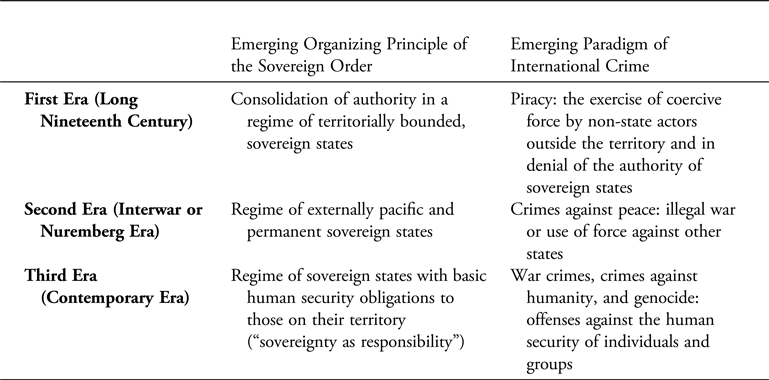
In sum, the changes in international crime over the past two centuries are related to changes in the sovereign order in an important way: the paradigmatic international offenses of each era violate the organizing principles around which the system of sovereign states was structured in each period.Footnote 210 The pirate's exercise of unauthorized non-state force challenged the consolidation of sovereign authority in territorial states. The general's illegal war challenged the newly peaceful order of the Kellogg-Briand Pact. And the genocidaire challenged a world composed of states protecting the basic rights of those within their territory. In this sense, international offenses are best understood as crimes against the sovereign order of their era. What ultimately distinguishes international crimes from domestic ones, in other words, is that international crimes undermine the structure of international society as a system of sovereign states.
In turn, the prosecution of these crimes might be viewed as maintaining or reasserting the parameters of this sovereign order. This account of international criminal law suggests a relationship between international crime and sovereignty that is radically different than that most scholars have proposed. In its simplest conception, the prosecution of international crimes is ordinarily seen to be an infringement on sovereignty—an intrusion into the exclusive domestic domain of the sovereign state.Footnote 211 In contrast, on the conception offered here, the prosecution of such crimes helps to secure the international regime of sovereign states itself.
The Nature of the Claim
The historical claim I propose is not a causal one; I do not purport to establish that the changes in ideas of sovereignty caused the changes in international crime. This is not to say that a causal connection between these two concepts cannot be established. Indeed, the brief overview of the historical developments above reveals quite vivid examples of how new ways of thinking about sovereignty influenced the reasoning of key actors who developed the international criminal justice system. At crucial moments, state officials, lawyers, and judges pointed to changes in the organizing principle of their era's sovereign order to justify changes in the parameters of international criminal law. At times, such principles were invoked to limit those acts identified as international crimes, excluding conduct that did not violate the prevailing principle of the era.Footnote 212 At other times, changes in such principles were invoked to expand the scope of international criminal law to include new offenses.Footnote 213
Notwithstanding this suggestive evidence, several plausible alternative explanations might be offered for this connection.Footnote 214 For instance, it may be that the changes in sovereignty and international crimes are best understood as the result of other forces in each of these eras; alternatively, ideas of both sovereignty and international criminal law may have evolved in tandem or in dialogue.Footnote 215
Rather than a causal claim, the historical claim here is conceptual and doctrinal. I seek to develop an account of the contemporaneous parallel developments of the legal concepts of sovereignty and international criminal law. And I do so to show that the idea of crimes against the sovereign order provides the best way to understand the character of international offenses and to understand what has distinguished international crimes from domestic crimes.
Toward a Theory of Crimes Against the Sovereign Order
The connection between international crime and the organizing principles of the sovereign order helps us build upon the basic claim of the Core International Principles Theorists; it explains—doctrinally, historically, and conceptually—how international crimes, in fact, “strike at the very roots of international society.”Footnote 216 And in doing so it helps us see how international crimes are distinct from domestic ones. However, on its own, this connection does not explain whether the unusual structure of international criminal punishment might be justified. In this section, I explain how recognizing the connection between international crime and sovereignty directs us toward a possible justificatory basis for the punishment of international crimes beyond the nexus state. Here, I provide an initial sketch of the basic idea, setting the stage for further exploration in future work.
In developing an account of international authority to punish, it is helpful to begin by returning to theories of domestic authority to punish introduced above. One such line of scholarship, which might be described as the “Public Authority Account” of criminal law, seems particularly helpful here. The Public Authority Account, developed by scholars such as Thorburn, is unique in conceptualizing the authority to punish crimes as related to the distinct status of the state.Footnote 217 In light of the connection I identify between state sovereignty and international crime, this account seems an apt starting point to develop a theory of international criminal punishment.
Proponents of the Public Authority Account of domestic criminal law begin by pointing to the unique role the state plays in organizing relations among individuals in the political community. By setting out laws that apply to us all equally, the state establishes “basic rules according to which people shall organise their shared lives together in the jurisdiction.”Footnote 218 Public Authority Scholars contrast this structure of rule of law with rule by might—where the rules regarding how we treat each other are determined by each of us individually, and we are each subject to domination by the powerful. The state's ability to secure the rule of law, they argue, creates a condition in which each of us can interact as equals in a way that we could not without it.Footnote 219
On this account, the commission of a crime is an attack on this fundamental structure of equality and dignity under the law: “the offender challenges the most basic promise of the rule of law: that we will never be subject to the arbitrary will of others, but only to the general laws that are the product of the legitimate public authority.”Footnote 220 Criminal punishment is justified on the basis that it reaffirms the state's status as a public authority in the face of a criminal offense. It ensures that the rule of law remains the final word on how we treat each other; it sets the terms under which we can interact as equals, so that an individual's might alone does not determine how can we treat one another.Footnote 221 This provides a theory of what could justify the authority to punish. Although it is derived from practice, it should be seen not as a simple descriptive statement of how states function but a standard from which to evaluate the ways in which they should.
We can build on this theory of domestic criminal law to help explain why the particular relationship between international crime and state sovereignty might give rise to international authority to punish. The state plays a fundamental role in the Public Authority Account of criminal punishment. However, proponents of this account largely leave to one side the question of conditions beyond the state. The state, so central to their theory, sometimes seems to sit in the ether of the state of nature beyond its borders. Recognizing that the state does not exist in a vacuum raises the question as to whether there are global conditions that must be met to ensure the state's existence, as these theorists define it.Footnote 222 For instance, might there be challenges to the rule of law within the state that emerge from beyond it? And if one person is entitled to have her rights protected within the legal order of the state, what about everyone else around the world? Do they possess an equal right to live within some state?
Understanding international offenses as crimes against the sovereign order offers novel insight to these questions. The three constitutional principles identified above as defining the legal order of sovereign states seem, cumulatively, to be plausible candidates for the global conditions necessary to ensure the conceptual possibility of the state.Footnote 223 To recall once again, these principles call for: (1) consolidating all sovereign authority in territorial states; (2) organizing the world into externally peaceful and permanent states; and (3) organizing the world into states meeting the obligations of sovereignty as responsibility. Taken together, these principles arguably set out the external conditions necessary both to facilitate the state's internal status as a public authority and to structure the world into a system of public authorities, each securing the equal status of individuals under the rule of law within their own jurisdiction. Consolidating sovereign authority exclusively in territorial states seeks to ensure that all coercive power in the world is that of a state, and thus all individuals are subject only to the authority of states rather than to the arbitrary force of private persons.Footnote 224 Organizing the system of states around interstate peace seeks to ensure that the legal order of the state is not undermined by the arbitrary force entailed by foreign military intervention.Footnote 225 And obligating the sovereign state to secure basic rights against systemic violations seeks to ensure that each state provides a minimum level of legal order within its territory.Footnote 226
These three organizing principles also help to identify why the distinct scope of authority to punish international crimes might be legitimate. As explained above, international offenses violate the three international organizing principles of the system of sovereign states and thus challenge the possibility of an international order organized around to these standards. The state operating as a public authority is necessary to secure the equal status of individuals under the rule of law. And the system of states organized around these three international organizing principles constitutes the background conditions necessary for the state to operate as a public authority. Thus, international crimes might be seen to violate the principles that form the global conditions securing the equal status of individuals under the rule of law. And if the state's domestic authority is justified on the basis that it can secure the equality of individuals within the state under the rule of law, perhaps the same is true at the international level. Thus, on the premise that the international legal order among sovereign states secures the fundamental equality and dignity of all individuals under the law, such an order might give rise to a legitimate right by each public authority to use punishment to maintain it.
Specifically, the state's internal purpose of securing relations among equal persons under law might be viewed as a particularized version of a cosmopolitan duty of the same sort. Such a cosmopolitan duty would require that the state act in a manner that ensures that all individuals in the world are in a condition consistent with their status as equal persons.Footnote 227 The domestic Public Authority Account suggests that individuals have both a right and an obligation to structure their interactions with others through the state's public authority to ensure that their mutual equality is respected.Footnote 228 So too all individuals of the world might be thought to have a duty and right to interact with others through a system of states composed of public authorities, each with the legitimate entitlement to maintain the law constituting that framework.Footnote 229 The best way to fulfill this cosmopolitan duty is for each state to secure the rule of law within its own community; however, there may be instances where this requires enforcing the rule of law on a global basis—in particular, in response to the commission of international crimes.Footnote 230
This, of course, is only a preliminary sketch of what the justification for international criminal punishment might look like; however, it provides a new way of thinking about what qualities might distinguish international crimes from domestic crimes and why this might justify the unusual scope of international criminal jurisdiction.Footnote 231 This is not to suggest that all instances of international criminal punishment reflect this premise in practice. However, “this account provides an ideal conception of what [international] criminal punishment ought to be” that can guide our understanding of the field's development and limitations.Footnote 232
Indeed, setting out this standard for how international criminal law might legitimately function helps us see where current practice deviates from this standard and offers resources to critique it.Footnote 233 In other words, such an account points to the conditions under which international criminal punishment could be justified—conditions that may or may not currently exist. It also helps to demonstrate that the role of international criminal punishment, even if justifiable, is a limited one. Criminal law on the domestic Public Authority Account (and the international extension of it) aims to bring the legal order back to the condition that preceded its violation. It seeks to reaffirm the legal structure that was in place before the breach; it does not attempt to change the legal order itself. Thus, if our starting place today, as a consequence of history, is something other than a framework facilitating global relations among equal persons, we cannot turn to international criminal law to change this reality. Instead, we must look elsewhere to achieve change to the status quo and must consider whether international criminal punishment is justifiable in the absence of such change.Footnote 234
My account also reflects some of the promising insights of the theories examined in Part II. It highlights how, by putting these contributions into conversation with each other, we can overcome some of the shortcomings of each theory considered individually. Understanding international offenses as crimes against the sovereign order reflects the premises that a justification for international criminal punishment should: (1) recognize the cosmopolitan concern with the equality and dignity of all persons evident in Humanity Theorists’ accounts; and (2) recognize that international crimes involve some aberration in the ordinary role that the state (and its legal order) is meant to play evident in the State Failure Theorists’ account (as well as Luban's account, to an extent).Footnote 235 However, the connection between the account I have proposed and that of the Gravity Theorists is less robust. Perhaps the best way of understanding the relationship between my account and the Gravity Theories is that my theory suggests that any difference in severity between domestic and international crimes is best viewed as epiphenomenal rather than definitional: if international crimes are those that violate the constitutional principles of the sovereign order, it is not surprising that such acts will often have grave effects.
Finally, my proposed theory more effectively satisfies the fit requirements of breadth and distinctiveness than the alternative theories. As suggested in the brief discussion of the history of the field above, the idea of crimes against the sovereign order captures (and is rooted in) the full breadth of the doctrine. We can see this in the relationship between piracy and the organizing principle of territorially bounded states, waging illegal war and the principle of peaceful and permanent states, and human security crimes and the principle of sovereignty as responsibility. On the criteria of distinctiveness, my account offers a workable basis to distinguish between domestic offenses and international offenses. Unlike international crimes, domestic crimes (such as murder, assault, or theft) do not violate the consolidation of sovereign authority in territorial states, they do not violate interstate peace, and they do not violate the standard of sovereignty as responsibility.
Thus, as I have begun to explain in this initial articulation of the idea, the theory of crimes against the sovereign order provides a conception of what defines international crime that seems to more accurately reflect the distinction between international crimes and domestic crimes in practice, and to capture the breadth of international criminal law doctrine. And it seems to point to a plausible account of what might justify international criminal punishment. It provides, in other words, a possible resolution to the legitimacy problem at the core of international criminal law.
Conclusion
This Article has argued that the structure of international criminal law raises a unique challenge for theories of the right to punish crime, and that leading theories of international criminal law have failed to meet this challenge. To address this shortcoming, I have proposed a new account of international criminal law: international offenses should be understood as crimes against the sovereign order. This account, informed by a novel reading of the history of the field, explains that international crimes have developed over time in a manner that tracks the organizing principles of the sovereign order. Specifically, the perpetration of such crimes has threatened the very possibility of an international order structured as a system of sovereign states. I have sketched out the relationship between the parallel development of the sovereign order and international criminal law over recent centuries and explained why such changes support viewing international offenses as crimes against the sovereign order. This account, I have suggested, points to a plausible justification for the unique right to punish international crimes: international criminal punishment might be justified on the basis that upholding the system of states is necessary to secure the rule of law within each state.
This Article represents the first contribution to a broader project seeking to rethink the history and justifications of international criminal law. In future contributions, I develop the historical account offered here with a thorough examination of archival research, international criminal law jurisprudence, and secondary sources, and I expand upon the theory of punishment proposed. I also consider several implications that follow from this account. For instance, understanding international offenses as crimes against the sovereign order clarifies a number of questions about the what, why, and where of international criminal law. This account provides new insight into doctrinal disagreements concerning what we should define as international crime at present and going forward, such as the debates concerning the status of economic and social rights as the focus of international criminal prohibitions and ongoing debates over the status of the crime of aggression.Footnote 236 Such an account also speaks to one of the core debates in international criminal law scholarship that I noted earlier: the objectives to be pursued through punishment, speaking to why we punish international crimes.Footnote 237 And finally, this account provides insight into where we should prosecute international crimes. Namely, it points to new significance for the principle of complementarity—the admissibility standard for cases before the International Criminal Court—and suggests that this principle should be the threshold for the admissibility of all international criminal prosecutions.Footnote 238 However, the most important implication of this theory may be the answer it offers to the core legitimacy challenge of international criminal law—providing a sense of what might justify, and limit, the framework of international criminal law that exists today.


