Implications
High temperatures cause behavioral and physiological changes with deleterious effects on animal welfare. Heat stress causes productivity losses, which decrease the profitability of the production system. However, the adoption of practices by farmers to minimize heat load on animals is not widespread, especially in the subtropics. The provision of shade for cows can mitigate problems caused by solar radiation, helping to maintain behavioral and physiological patterns, even in a high altitude subtropical environment.
Introduction
The increase in milk consumption and world interest in increasing animal welfare raises concerns on how to improve milk production and minimize environmental aspects that may cause discomfort to dairy cows (Lambertz et al., Reference Köppen2014). Cattle in tropical and subtropical climates, especially those raised at pasture, can be exposed to high solar radiation, air temperature and relative humidity, as well as rain and wind speeds above their thermal comfort zone. The intensification of livestock production reduces individual space and access to natural protection such as shade against stressful environmental factors, which often hinders the ability of animals to cope with these conditions, making them more susceptible to heat stress, resulting in physiological and metabolic changes that can compromise productive performance and health (Schütz et al., Reference Schütz, Cox and Tucker2014). Moreover, advances made in animal nutrition and breeding have resulted in significant increases in milk production, which result in higher metabolic heat production, and therefore increased needs for heat dissipation (Silanikove, Reference Silanikove2000; Baumgard and Rhoads, Reference Baumgard and Rhoads2012; Renaudeau et al., Reference Renaudeau, Collin, Yahav, de Basilio, Gourdine and Collier2012).
In high altitude subtropical areas, wind speed contributes to heat dissipation of animals by convective processes, but may be counteracted by high levels of humidity, which reduces the dissipation of body heat by evaporative means. Evaporative cooling is the main manner for heat loss when ambient temperature is higher than the body temperature, and this process is most efficient when relative humidity is low (Kadzere et al., Reference Kadzere, Murphy, Silanikove and Maltz2002; Renaudeau et al., Reference Renaudeau, Collin, Yahav, de Basilio, Gourdine and Collier2012). On the other hand, provision of shade mitigates solar radiation and reduce body temperature (Mitlohner et al., Reference Mitlohner, Morrow, Dailey, Wilson, Galyean, Miller and Mc Glone2001; Kendall et al., Reference Kendall, Verkerk, Webster and Tucker2006; Tucker et al., Reference Tucker, Rogers and Shutz2008), helping animals to cope with heat. However, it does not change air temperature or humidity and therefore may not change heat loss (Renaudeau et al., Reference Renaudeau, Collin, Yahav, de Basilio, Gourdine and Collier2012).
The hypothesis of this study is that animals’ behavior as well as their physiological and productive attributes are altered favorably by providing shade even in a high altitude subtropical climate. The objective of this study was to investigate changes in behavioral, physiological and productive attributes of lactating dairy cows with or without access to shade during the hot season in a high altitude subtropical climate.
Material and methods
Local description, animals and management
This study was approved by the Ethics Committee on Animal Use of Federal University of Rio Grande do Sul, project number 21901. The experiment was conducted in the summer, over a 5-day period (28 January to 1 February; days 0 to 4), at the dairy unit of the University of Santa Catarina State (UDESC-CAV), located in the city of Lages – SC, Brazil (latitude −27°48'58", longitude 50°19'34", altitude of 950 m above the sea level). Mean relative humidity is ∼79.3%. The climate is classified as humid subtropical temperate climate, coded as Cfb (Köppen, Reference Kendall, Verkerk, Webster and Tucker1931). This climate is encountered at high elevations in certain subtropical and tropical areas.
Cows were selected from the dairy unit herd to constitute a homogeneous group with regards to initial milk production, age, breed, lactation period and somatic cell count. Fourteen lactating cows were used, 10 Holstein and four crossbred Holstein×Jersey, all from a herd grazing with free access to natural shade before the study. Selected cows, regardless of genotype, had mostly a black hair coat.
Cows were divided into two groups with seven cows each: five Holstein and two crossbred Holstein×Jersey per group. On the 1st day of the experimental period, cows of the group without access to shade (WSH) weighed 549±115 kg of BW, presented 2.8±0.3 body condition score (BCS), yielded 22.3±6.1 kg milk/day and had 146±72 days in milk (DIM). Cows of the group with free access to shade (SH) weighed 526±78 kg of BW, presented 2.8±0.3 BCS, yielded 24.1±5.2 kg milk/day and had 125±79 DIM.
Initially cows were all placed into two paddocks with rectangular shape, located side by side (A and B) with 0.8 ha each, both composed of Sudan (Sorghum sudanense L.) and Papuã (Brachiaria plantaginea) grasses. At one end of the paddocks (shorter side of therectangle) there were Eucalyptus trees (Eucalyptus coolabah) with more than 5 m high in rows 3 m apart, which could provide more than 10 m2 of shade/cow. During the adaptation phase (14 days) and on the 1st experimental day (day 0), all cows had free access to shade throughout the day – both by being under the trees or by the shade projected by them according to solar movement. From the 2nd day on (days 1, 2, 3, 4), one group of cows continued to have access to shade (paddock A), whereas the other group did not (paddock B). Cows in the paddock B were prevented from free access to shade by moving the fence line behind the projection of the tree’s shadow. Thus, there was no shade provided by the trees in this paddock during the whole day. However, cows in the paddock B could have very limited shade as they laid down under other animals’ body or stand behind the fence posts. Paddocks A and B remained with ∼0.8 ha each one.
Cows were milked twice daily at 0700 and 1800 h (Greenwich mean time (GMT)−0200 h) in a herringbone parlor. Concentrate (6 kg/cow per day) was supplied before the two milkings and was composed of 200 g/kg soybean meal, 750 g/kg ground corn, 30 g/kg mineral mix (g/kg min Ca 190, P 60, S 20, Mg 20, K 35, Na 70, in MG/kg Co 15, Cu 700, Cr 10, Fe 700, I 40, Mn 1600, Se 19, Zn 2500, IU/kg vitamin A 2×10⁵, vitamin D3 5×10⁴, vitamin E 1500, F(max) 600 and 20 g/kg sodium bicarbonate. The concentrate contained 880 g DM, 160 g CP, 80 g NDF and 750 g TDN/kg.
Behavior measurement
Each cow was visually observed for 5 days (days 0 to 4), from sunrise (0530 h, GMT−0200 h) to sunset (2100 h, GMT−0200 h). Time spent in ingestive activities as ruminating, resting (no jaw movements) and grazing as well as time spent standing, lying, walking, walking with head down or with head up, near to the water trough (at least one animal’s leg within an imaginary quadrangular area with an area of ∼4 m2), seeking shade (animal moving to find shade behind another cow or remaining in the shadow made by another cow), and grazing were estimated using 10 min instantaneous scan sampling (Martin and Bateson, Reference Martin and Bateson1993). It was assumed that cows performed the same activity between observations, thus the number of observations in a given activity was multiplied by 10 (minutes between observations) to estimate time spent on each activity throughout the day. Cows were considered eating if feed (grass or supplements) was being ingested or could be seen in the mouth. Rumination was defined as chewing movements without fresh feed in the mouth, regurgitation of feed or both. Cows were considered lying if their flank was in contact with the ground and standing if not.
Behaviors were not recorded during the periods of displacement of animals to and from the milking parlor, milking and when animals were in the barn receiving concentrate. Behavioral attributes were recorded for 660 min/day. Further, ruminating and resting times were combined with posture (standing or lying) to highlight in which position these behaviors were performed.
The following activities were observed continuously and recorded whenever they occurred: water ingestion, competition for shade (attempts to displace other animal from the shade), competition for water (attempts to displace other animal from the trough) and aggressive interactions (actions of intimidation or confrontation with other animals, disregarding competition for shade or water trough). The animals in different treatments had visual contact with each other.
The volume of water consumed by each group of cows was measured daily with water meters. Water troughs were placed in the sunny part of the paddocks. As measurements were collective, results of the water intake are presented descriptively as an arithmetical mean of the two troughs/paddock per day.
Performance, productive and physiological traits
BW, milk production and BCS were evaluated on days 0 and 4. Weighing was performed before the morning milking and BCS was assigned to animals in a 1 to 5 scale (Edmonson et al., Reference Edmonson, Lean, Weaver, Farver and Webster1989). Milk production was measured at every milking during the entire experimental period with the use of milk meters.
Respiratory and heart rates, body temperature of cows and number of ruminal movements were assessed daily before afternoon milking. Body temperature (RT) was measured using a clinical veterinary thermometer inserted near the wall of the rectum of the animal for 3 min. Heart rate (HR – beats per minute) and respiratory rate (RR – breaths per minute) were measured using a stethoscope and stopwatch for 30 s and multiplying the result by two to obtain these results in minutes. Panting score (Mader et al., Reference Mader, Davis and Brown-Brandl2006) was assigned daily in the field at 1300 h (GMT−0200 h) and 1700 h (GMT−0200 h) in a 1 to 4 scale, in which zero=no panting and four=severe panting.
Pasture sampling
Before the start of the trial, pasture was sampled in five grazing sites, which were selected after observing grazing behavior of cows. Pasture within the measuring frame (20 cm×20 cm) was hand clipped at grazing height, avoiding dung spots. The contents of dry matter, CP, crude fiber, ether extract and ash were determined (Association of Official Analytical Chemists (AOAC), 2004). Pasture in the paddock with shade contained 171 g/kg DM of CP, 208 g/kg of crude fiber and 691 g/kg of TDN while pasture in the paddock without shade contained 156 g/kg DM of CP, 224 g/kg of crude fiber and 712 g/kg of TDN.
Meteorological variables
The measurement of air temperature and relative humidity was performed by portable data logger (model HT-500) weather station placed 1.5 m above the ground and installed in the shaded area of paddock A and in the sunny area of paddock B. The temperature–humidity index (THI) was used as an indicator of thermal comfort and was calculated using the air temperature and humidity measured at 0900 (GMT−0200 h), 1500 (GMT−0200 h) and 2100 h (GMT−0200 h), for all experimental days using the formula (Johnson et al., Reference Johnson, Ragsdale, Berry and Shanklin1962):
 $$\eqalign{{\rm THI}=\,&(1.8{\times}{\rm Tdb}{\plus}32){\minus}[(0.{\rm 55}{\minus}0.00{\rm 55}{\times}{\rm RH}){\times}\cr &({\rm 1}.{\rm 8}{\times}{\rm Tdb}-26.8)]$$
where Tdb=dry bulb temperature in °C and RH=relative humidity (%).
Statistical analysis
Water intake and meteorological variables are presented descriptively as they were measured for each group of cows (two groups), on each day. Data were analyzed by univariate variance analysis with cows as the experimental units. Day 0, when all cows had access to shade was used as a covariate. PROC MIXED was used to evaluate a model: attribute=day+treatment+(day×treatment)+genotype+(day×genotype)+(treatment×genotype)+(treatment×day×genotype)+experimental error; method=REML, covariance matrix=CS, repeated=day. Mean separation was performed by using the PDIFF procedure. Adjusted means for the effect of treatment (shade×without shade), P-values for treatment, day and interaction between day and treatment are presented in Tables 1 and 2. The significance criterion was taken as P<0.05 and tendency was taken as P<0.10.
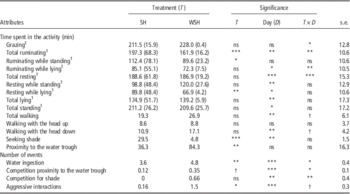
Time spent in behavioral activities (min) and number of behavioral events performed by lactating dairy cows with (SH) or without access to shade (WSH)

ns=not significant, †P<0.10, *P<0.05, **P<0.01, ***P<0.001.
1 Values in the brackets are the proportion of time (%) that each activity was performed in the shade. Cows in the paddock without access to natural shade provided by Eucalyptus trees could have very limited shade under other animals’ body or shade projection of their bodies or behind the fence posts.
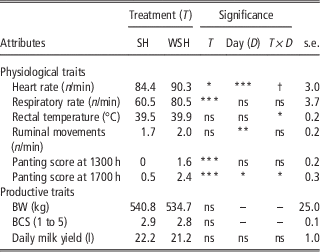
Physiological and productive traits of lactating dairy cows with (SH) or without access to shade (WSH)

BCS=body condition score.
ns=not significant, †P<0.10, *P<0.05, **P<0.01, ***P<0.001.
Results
Wide variations in temperature and relative humidity were observed between morning, afternoon and night as well as between days, but moderate differences were observed between areas with and without shade (Figure 1). In general, temperature and THI were lower at 0900 h (GMT−0200 h) compared with those at 1500 h (GMT−0200 h), measurements at 2100 h (GMT−0200 h) were intermediary and slightly lower in shaded than in the unshaded paddock. For relative humidity, the lowest values generally occurred at 1500 h (GMT−0200 h) and in paddocks without shade. On days 1, 2 and 4, THI values at 1500 and 2100 h were the highest. On the same days, mean water intakes were 72.9, 80, 77.1 and 58.6, 80 and 81.4 l/cow per day for cows without and with access to shade, respectively.
Air temperature (a), relative humidity (b) and temperature–humidity index (THI) (c) measured in the paddocks with and without shade at 0900 h (■), 1500 h (▲) and 2100 h (●) (GMT−0200 h). THI=(1.8×Tdb+32)−[(0.55−0.0055×RH)×(1.8×Tdb−26.8)]. *Tdb=dry bulb temperature (°C); **RH=relative humidity (%).

We did not detect significant interactions between genotype and day of measurements or genotype and treatment or triple interaction (P>0.10). Holstein×Jersey crossbreeds showed higher values for total time spent ruminating while lying (93.8 v. 63.7 min (±10.5); P<0.05), but lower values for time spent resting while standing (95.1 v. 123.7 min (±12.9); P<0.05) and rectal temperature (39.5°C v. 39.9°C (±0.2); P<0.05) compared with pure Holstein. Holstein×Jersey crossbreeds tended to present lower values for time spent walking with the head down (9.5 v. 18.4 min (±4.7); P<0.10), HR (84.7 v. 90 (±3.0) beats/min; P<0.10), but tended to present higher values for number of competition events near the water trough (0.4 v. 0.1 (±0.1); P<0.10) compared with pure Holstein cows.
Significant effects for treatment were detected for time spent in resting while lying, ruminating while standing, proximity to the water trough, seeking shade, number of aggression events, HR, RR, panting score at 1300 h. Cows without access to shade showed lower time spent resting while lying, ruminating while standing, seeking shade but they spent more time in the proximity to the water trough, higher number of aggression events, HR and RR and panting score at 1300 h. On the other hand, access to shade did not change time spent walking with the head up, total lying time, total standing time, ruminating while lying, resting while standing, as well as BW, BCS, MY and number of rumen movements (Tables 1 and 2).
Some significant interactions (P<0.05) were detected between treatment and days of measurements (Tables 1 and 2). Time spent in grazing, total ruminating, total resting, as well as the number of behavioral events as water ingestion, competition for the water trough, competition for shade varied between groups with and without access to shade within days of measurements. Cows with access to shade showed higher values for grazing time on day 4 (232.5 v. 180.4 min (±25.6); P<0.05), total time spent ruminating on days 1 (194.1 v. 154.6 min (±21.2); P<0.05) and 4 (168.5 v. 74.0 min (±21.2); P<0.05), but lower values for number of water ingestion events on days 1(2.7 v. 5.0 (±0.8); P<0.05) and 4 (4.5 v. 7.1 (±0.8); P<0.05), number of competition events near the water trough (0.1×0.8 (±0.2); P<0.05) and for shade (0.1 v. 2 (±0.5); P<0.05) on day 4 as well as lower total time spent resting on day 4 (178.3 v. 304.3 min (±30.5); P<0.05), rectal temperature on days 2 (39.1×40.0°C (±0.5); P<0.05) and 4 (39.4×40.2°C (±0.5); P<0.05) and panting score at 1700 h on days 1 (0.6 v. 2.4 (±0.5); P<0.05), 3 (0.4 v. 2.3 (±0.5); P<0.05) and 4 (0.5 v. 3.6 (±0.5); P<0.05) compared with cows without access to shade. Cows with no shade tended to show higher total time spent walking (28.2 v. 7.0 min (±10); P>0.10) on day 2, and walking with head down (34.1 v. 146.2 min (±7.3); P>0.10) on day 1.
Grazing was mainly performed in the sunny part of the paddock, even by cows with access to shade, which spent ∼85% of their grazing time exposed to the sun. Cows with access to shade showed ∼68% and 62% of their ruminating and resting times in the shaded part of the paddock. Cows with access to shade spent ∼76% and 52% of their standing and lying down times in the shaded part of the paddock. Independent of treatment, all cows spent more time ruminating and resting in the standing position than in recumbence.
Discussion
This trial was conducted with a restricted number of cows and moreover cows were deprived of access to shade during a short period (4 days), precluding cows of developing adaptation behaviors to cope with heat stress and shade deprivation. Considering this, the acute effects of heat stress combined with shade deprivation should be taken into account. Some behavioral and physiological traits were consistently different between treatments as time spent resting while lying, ruminating while standing, near the water trough, seeking shade, number of aggression events, HR and RR and panting score at 1300 h, indicating their importance for the cows to cope with heat stress and privation of shade. In the other hand, some behavioral traits which were not different between treatments, as time spent walking with the head up, total lying time, total standing time, ruminating while lying, resting while standing were not used as part of the animal’s strategy to increase heat losses, reduce heat production or radiation load.
As the cattle were kept under natural grazing conditions and meteorological conditions varied between days, the effect of access to shade for some attributes changed between days of measurements, as significant interactions between treatment and days were detected. Overall, cows with no access to shade changed behavioral attributes in an attempt to deal with heat stress and lack of shade increasing time spent near the water trough and decreasing total time spent ruminating, time spent ruminating while standing, grazing and resting while lying mainly on days with higher THI in the afternoon, such as days 1 and 4. It has been reported (Tucker et al., Reference Tucker, Rogers and Shutz2008; Renaudeau et al., Reference Renaudeau, Collin, Yahav, de Basilio, Gourdine and Collier2012) that cows try to cope with heat stress by reducing heat production or heat load and increasing heat loss to the environment.
Strategies commonly used to increase heat loss include increasing time spent standing or lying over cold and wet surfaces. Cows cope with dehydration by increasing ingestion of water. In order to decrease heat load cows seek shade. Reduced heat production is usually achieved with decreased feed intake, less physical activity as walking or ruminating and lowered milk production (Silanikove, Reference Silanikove2000; Berman, Reference Berman2011; Renaudeau et al., Reference Renaudeau, Collin, Yahav, de Basilio, Gourdine and Collier2012). The choice of which strategy to be used may change depending on weather conditions and on the cow’s own characteristics, such as size, body surface, hair coat length and color, as well as metabolic rate (McManus et al., Reference McManus, Castanheira, Paiva, Louvandini, Fiorvanti, Paludo, Oliveira and Corrêa2011).
Although the present study was performed with a limited number of cows, Holstein×Jersey crossbreeds seemed to be more tolerant to heat stress compared with pure Holstein, as they showed lower body temperatures and respiration rates despite similar average values for MY (Holstein v. Jersey crossbreeds: 22.4 l/day v. Holstein: 21.3 l/day), DIM (130 v. 130 days), BW (537 v. 538 kg) and BCS (2.82 v. 2.84). The cows used in this study, regardless of genotype, had mostly a black coat. This greater heat tolerance of crossbreeds is possibly indicative of hybrid vigor, as pointed out by Liang et al. (Reference Lambertz, Sanker and Gauly2013) and McManus et al. (Reference McManus, Paim, Louvandini, Paula and Bernal2014).
The region where the present trial was conducted presents large amplitude of temperature range between diurnal and nocturnal phases of the day. Variations of air temperature and relative humidity observed in this study support this assertion (Figure 1). Taking this into consideration, one may expect beneficial effects of natural cooling during the nocturnal phase on productive traits exhibited during the diurnal phase (Silanikove et al., Reference Silanikove, Shapiro and Shinder2009). Indeed, milk yield was statistically similar for the two groups regardless of access to shade. In the other hand, reduction in milk yield of cows under heat stress has been reported by several authors (West et al., Reference West, Mullinix and Bernard2003; Soriani et al., Reference Soriani, Panella and Calamari2013) and is related to lower DMI and metabolic alterations such as increased energy expenditure by non-mammary tissues (Baumgard and Rhoads, Reference Baumgard and Rhoads2012). The finding that, in the present study, cows deprived of shade did not reduced MY may be due to the moderate milk yield of the cows (West et al., Reference West, Mullinix and Bernard2003) or because the thermal stress was not sufficiently severe or of too short duration to affect production. It may also be that cows deprived of shade with a moderate MY could partially compensate DMI due to the previously referred beneficial effect of cooling during the night (Kadzere et al., Reference Kadzere, Murphy, Silanikove and Maltz2002; Silanikove et al., Reference Silanikove, Shapiro and Shinder2009) compared with animals of higher yield potential, which are more sensitive to heat stress (Silanikove, Reference Silanikove2000; Kadzere et al., Reference Kadzere, Murphy, Silanikove and Maltz2002). Besides that, the similarity in milk production may be due to the moderate milk yield of the cows (West et al., Reference West, Mullinix and Bernard2003) – animals of higher yield potential are more sensitive to heat stress (Silanikove, Reference Silanikove2000; Kadzere et al., Reference Kadzere, Murphy, Silanikove and Maltz2002) – or because the thermal stress was not sufficiently severe or of too short duration to affect production.
The severity of heat stress depends on diurnal and nocturnal fluctuations of temperatures. If ambient temperature has values below 21°C overnight for 3 to 6 h, the animal has the opportunity to dissipate the heat gained during the day (Muller et al., Reference Muller, Botha and Smith1994; West et al., Reference West, Mullinix and Bernard2003; Silanikove et al., Reference Silanikove, Shapiro and Shinder2009), which may allow for similar DMI and MY. In the present study, ambient temperature showed values below 21°C for at least 8 h during the nocturnal period, except on day 4, when temperature was above 21°C during the night.
Natural cooling during the night did not eliminate changes in the physiological traits in the cows without access to shade, as their HR and RR and panting score measured at 1300 h were higher and body temperature and panting score measured at 1700 h were higher especially on days with highest THI, such as days 1 and 4. Also natural cooling did not eliminate changes in the behavior of cows without shade that were linked with water ingestion and social behavior as they increased the time of permanence near the water trough, number of aggressions besides water ingestion events on days 1 and 4. On the hottest day (day 4), when deprived of shade, cows reduced the time spent grazing and ruminating, but increased total time spent resting, as well as the number of competition events for shade and water.
All cows might be considered heat stressed during the diurnal phase of whole trial if we take into account that their mean body temperature was at above values reported for un-heat-stressed animals: 38°C to 39.3°C (Muller et al., Reference Muller, Botha and Smith1994; Kadzere et al., Reference Kadzere, Murphy, Silanikove and Maltz2002). When temperature and humidity increase, evapotranspiration pathways such as panting and respiration rate increase, but as the heat dissipation mechanisms become insufficient, animals cannot control their body temperature and may be affected by hyperthermia (Morais et al., Reference Morais, Maia, Silva, Vasconcelos and Lima2008).
Increase in panting score and RR was expected since at temperatures above the minimal critical temperature heat loss via non-evaporative ways progressively loses importance and losses due to peripheral vascular dilation and evapotranspiration become increasingly more important (Kadzere et al., Reference Kadzere, Murphy, Silanikove and Maltz2002). In this sense, cows that could access shade presented average RRs of 60.5, while those without access to shade showed values above 80. In the present study, increased values for panting and RR score of cows without access to shade occurred due to exposure to the sun, increasing their heat load.
The animals without access to shade stayed longer in the proximity to the water trough and showed higher number of water ingestion episodes on days 1 and 4, probably coping with dehydration caused by the increased sweating, RR and salivation (Atrian and Shahryar, Reference Atrian and Shahryar2012). This is in agreement with previous studies (Murphy et al., Reference Murphy, Davis and McCoy1983; Schütz et al., Reference Schütz, Cox and Tucker2014) and is related to the increased body fluid loss.
Although heat stress is usually linked to reduced physical activity, cows with no access to shade showed higher time spent walking on day 2 and walking with the head down on day 1, which may be related to the stress and discomfort caused by solar radiation associated with the novelty of being deprived from shade.
The fact that privation of shade did not alter time spent ruminating while lying but decreased time spent ruminating while standing was related to the expressive reduction of rumination activity. Cows preferred to ruminate while standing compared with ruminating while lying (87.8 v. 46.9 min) when they were in the shaded part of the paddock, probably to increase convective losses. In the other side, when those cows were in the sunny part of the paddock, they preferred to ruminate while lying compared with ruminating while standing (34.1 v. 11.5 min) probably to increase exposed surface of their body in contact with the ground and enhance conduction of heat loss to the environment. Cows’ preference for standing posture was already noticed by Soriani et al. (Reference Soriani, Panella and Calamari2013) and Allen et al. (2015) but not by Schütz et al. (Reference Schütz, Cox and Tucker2014).
The lower time spent grazing on day 4 noticed for cows deprived of shade is probably due to the higher temperatures during the day and beginning of the night, when the behaviors were observed. Pasture at the paddock without shade contained 10% less CP and more 8% of NDF than pasture of the paddock with shade, but we believe those differences did not affect our results since we detected significant differences in grazing just on the last day of the trial and ruminating time was lower precisely for cows grazing pasture with higher NDF.
The higher resting time noticed for cows deprived of shade on day 4 is probably related to the strategy of animals to reduce physical activities (West et al., Reference West, Mullinix and Bernard2003) that increase heat production, that is, walking, grazing and ruminating; results might also be related to the increment in water intake episodes and time spent near the water trough. A negative relationship between ruminating time (total or diurnal) with THI and RR has been reported previously (Moallem et al., Reference Moallem, Altmark, Lehrer and Arieli2010; Soriani et al., Reference Soriani, Panella and Calamari2013), although other authors did not report significant effects of providing shade upon behavior (Tucker et al., Reference Tucker, Rogers and Shutz2008).
The absence of an effect of access to shade on total time spent standing and lying was unexpected as some studies reported increase in time spent standing to increase heat dissipation by convection (Anderson et al., Reference Anderson, Bradford, Harner, Tucker, Choi, Allen, Hall, Rungruang, Collier and Smith2013) while others (Tucker et al., Reference Tucker, Rogers and Shutz2008; Schütz et al., Reference Schütz, Rogers, Poulouin, Cox and Tucker2010) have reported that increased standing time is partly attributed to insufficient cow shade. This was not the case in the present study as cows had more than 10 m2 each of available shade. On the other hand, Allen et al. (Reference Allen, Hall, Collier and Smith2015) observed that at a core body temperature equal to 38.9°C, there was a 50% likelihood that a cow would be standing, which highlights the importance of this behavior in the cooling of animals.
The increase in the competition events for shade and at the water trough was mainly expressed by the Holstein×Jersey crossbreeds and it was probably motivated by the need to decrease body temperature, as well as involving frustration and anxiety, which were observed during the 4 days of shade deprivation. Increased aggression was also noticed by Schütz et al. (Reference Schütz, Rogers, Poulouin, Cox and Tucker2010). In the present study, cows from different treatments had visual contact with each other, so cows without access to shade might have enhanced their frustration by seeing the other cows freely accessing shade.
In general, as severity of heat stress increased, cows exhibited increasingly more changes in physiological and behavioral attributes, notably those related to dissipation of heat and those related to anxiety and frustration, as noticed on day 4. Cows may compete for resources that can mitigate heat stress, such as water and shade, to the point where the benefits outweigh the costs.
Conclusions
Access to shade, even in moderate conditions of heat stress, affects the physiological and behavioral attributes of cows at pasture. Heat stress as indicated by the change of physiological attributes alters social and ingestive behavior of grazing cows.
Acknowledgments
The study was supported with FAPESC grant (Fundação de Apoio à Pesquisa do Estado de Santa Catarina) and it was performed with the collaboration of UDESC – Universidade do Estado de Santa Catarina and its employees and students.