Introduction
The incidence of dementia is a major public health problem in aging populations. In developing countries such as Brazil, where the elderly population has increased explosively, the socio-economic status is still low and the illiteracy rate is still high, one can expect an “epidemic” of dementia in the near future. Epidemiologic studies have demonstrated that 5% on average of an aged population will exhibit dementia over 65 years of age, particularly Alzheimer's disease, whose main risk factor is advancing age (Qiu et al., Reference Qiu, De Ronchi and Fratiglioni2007). In a Brazilian study, the prevalence rate of dementia was 7% within the community-dwelling elderly people older than 65 years (Nitrini et al., Reference Nitrini2004).
It is estimated that there are currently 24.3 million people stricken with dementia, with 4.6 million new cases each year; thus, the projection for 2040 is 81.1 million people with dementia. Most of these elderly people with dementia would be found in developing countries; that is, on the basis of 60% in 2001, the projection for 2040 is 71% of individuals with dementia living in these countries (Qiu et al., Reference Qiu, De Ronchi and Fratiglioni2007).
Because there are few therapeutic alternatives available, and knowing that better treatment efficiency is achieved with early diagnosis, it is vital to identify risk groups prone to develop dementia, so that a positive public health policy can be worked out. Besides, there would be great benefit to the public health programs if the speed of dementia conversion could be substantially delayed, and modifiable risk factors were controlled on time.
The Clinical Dementia Rating (CDR; Hughes et al., Reference Hughes, Berg, Danziger, Coben and Martin1982; Morris, Reference Morris1993) is a tool that enables us to classify different degrees of dementia (CDR 1, 2, or 3). In addition, CDR also gives us the opportunity to identify normal cases (CDR = 0) and questionable cases (CDR = 0.5). Cases are considered questionable if neither they are described as normal any longer nor they have the signs of dementia, and thereby they may correspond to the Mild Cognitive Impairment (MCI) category (Ames et al., Reference Ames2006). In other epidemiological studies, questionable cases appeared in a group with a higher conversion rate to dementia (Daly et al., Reference Daly, Zaitchik, Copeland, Schmahmann, Gunther and Albert2000; Farias et al., Reference Farias, Mungas, Reed, Harvey and DeCarli2009).
This study revaluated, cognitively, individuals from a cohort of elderly people (70+) living in a middle-class neighborhood of a large urban area in São Paulo, Brazil (Ramos et al., Reference Ramos, Simões and Albert2001; Montaño and Ramos, Reference Montaño and Ramos2005). The aim of the study was to check the conversion rate (CR) to dementia of elderly individuals free of the disease in an urban center in Brazil and to analyze baseline characteristics, in order to identify factors associated with the conversion and to determine whether CDR is able to predict which individuals have a high likelihood of converting to dementia.
Methods
Study design and participants
This was a prospective population study, part of an urban elderly cohort (EPIDOSO) started in 1991 in the city of São Paulo, Brazil, with 1,667 subjects (Ramos et al., Reference Ramos1998). The survivors after 8 years, totaling 440 individuals aged 70 years or older, were reassessed cognitively with the Mini-Mental State Examination (MMSE; Folstein et al., Reference Folstein, Folstein and Mchugh1975). A subsample (n = 156) was drawn for a prevalence study of dementia, which included a medical diagnosis. Due to limited resources, it was included in the survey everyone scoring less than 26 in the MMSE (n = 108), to increase sensibility for dementia, and a random subsample of those scoring 27 or more (n = 48) – where none had a diagnosis of dementia. The prevalence (7.1%) could be calculated by extrapolating the results for the whole cohort (Montaño and Ramos, Reference Montaño and Ramos2005).
Measures
A short Neuropsychological Battery (NPB) was applied, with only three cognitive tests that had previously shown to have little influence of literacy status (Montaño and Ramos, Reference Montaño and Ramos2005): word list memory and recall (Ruff et al., Reference Ruff, Light and Quayhagen1989), verbal fluency test (saying animal classes) (Rosen, Reference Rosen1980), and drawing a clock first without any clue, then drawing it with a clue (Shulman and Silver, Reference Shulman, Shedletsky and Silver1986). Functional capacity was assessed by the activities of daily living (ADL), vascular risk factors (referred morbidity: diabetes, hypertension, dyslipidemia, smoking, etc.; Breteler, Reference Breteler2000), and mental health, using a screening for mental health impairment (Mental Health Screening Questionnaire, MHSQ), previously validated in Portuguese (Blay et al., Reference Blay, Ramos and Mari1988).
Cognitive status was classified by the CDR, using a semi-structured interview, validated in Brazil (Montaño and Ramos, Reference Montaño and Ramos2005). The respondents were relatives or caregivers who were aware of both past and present routines of the elderly people, looking for changes that could indicate cognitive losses, avoiding the education bias of the elderly people. Using the scoring rules set up by Morris (Reference Morris1993), each of the six cognitive–behavioral categories of the CDR (memory, orientation, judgment, social relations, hobbies, and self-care) received one of four possible scores: 0 (normal), 0.5 (questionable), 1 (mildly impaired), 2 (moderately impaired), and 3 (severely impaired). A global score was obtained through a qualitative analysis of all the categories that classify each individual in “normal (0),” “questionable (0.5),” “mild (1),” “moderate (2),” and “severe dementia (3).” The sum of the boxes scores of all categories was considered another independent variable ranging from 0 to 18 points. The CDR was applied blind for dementia diagnosis.
The diagnosis of dementia was obtained by a trained geriatrician, according to the National Institute of Neurological and Communicative Disorders and Stroke–Alzheimer's Disease and Related Disorders Association (NINCDS–ADRDA; McKhann et al., Reference McKhann, Drachman, Folstein, Katzman, Price and Stadian1984). The doctor was blind for all the other variables included in the survey.
After approximately two-and-a-half years, all the survivors in the subsample were recalled and reassessed.
Statistical analysis
The crude conversion rate to dementia was calculated by taking into account the exposure time of each individual (person-years). The cumulative conversion rates were compared among demographic characteristics (gender, age, class, and education) and initial health status characteristics (NPB, ADL, MHSQ, presence of vascular risk factor and initial CDR and sum of the boxes scores), utilizing the Poisson regression method in the univariate analysis; and the exposure time (natural logarithm) was considered an offset variable. For each variable, the conversion hazard ratio (HR) was calculated with a 95% confidence interval (Cameron and Trivedi, Reference Cameron and Trivedi1998; Hilbe, Reference Hilbe2007).
The multivariate analysis for the outcome conversion to dementia, controlling for the initial characteristics of those re-evaluated, was also carried out using the Poisson regression. A stepwise backward method was utilized to verify which of the baseline variables better predicted conversion to dementia. Two models were considered: the CDR with two categories (0 and 0.5) and the CDR with three categories (0; 0.5 with box ≤1, and 0.5 with box >1).
Concerning the individuals who were at risk of conversion but who were not reassessed due to decease or refusal, their initial characteristics were compared with those who were reassessed. The variance analysis and the policotomic logistic regression were also utilized to make sure the evaluation status (evaluated, refusal, or decease) did not introduce any bias (Cameron and Trivedi, Reference Cameron and Trivedi1998; Hilbe, Reference Hilbe2007).
For data analysis, version 15.0 for the microcomputer of SPSS was used, and the established significance level was 0.05.
Results
The flow chart (Figure 1) shows the distribution of the 156 individuals assessed at baseline, and the 125 individuals at risk of conversion. After an average two-and-a-half years, 80 subjects were reassessed, excluding the deceased ones, refusals, and those already demented.
Distribution of the 156 individuals according to the response rate (reassessment, refusal, and disease). The asterisk indicates cognitive status at baseline.

Among those at risk of conversion, the majority was women (72.5%) and the average age was 80.7 years. Most individuals (78.8%) had less than 8 years of schooling, whereas 18.8% were illiterate. Almost half the participants (43.7%) showed an altered NPB and 16.2% referred dependency in the ADL. In 16.3% of the participants, the MHSQ was altered and 71.2% had a present vascular risk factor. The CDR classified 50% of the individuals as questionable, and within these, 30% had sum of the boxes scores greater than 1.
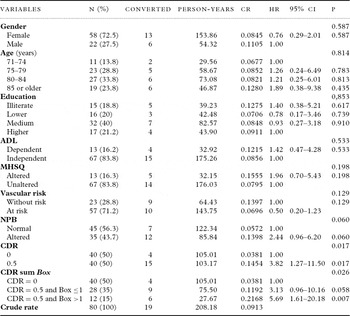
Table 1 shows the CR according to the initial baseline characteristics, calculated by taking into account the time of exposure of individuals (person-years). The HR for conversion was calculated for each variable.
Conversion rate to dementia and HR for independent variables

ADL: activities of daily living; CDR: Clinical Dementia Rating; CI: confidence interval; CR: conversion rate; HR: hazard ratio; MHSQ: Mental Health Screening Questionnaire; NPB: Neuropsychological Battery.
The crude CR was 91.3/1,000 person-years, taking into account the follow-up time of each individual. Although the selection of the sample at baseline included only 48 participants among 480 cases of MMSE > 26 and 108 with MMSE ≤ 26, among the 80 reassessed, 41% had a high baseline score and 59% a low baseline score of the MMSE. Conversion rates between both groups were not significantly different (data not presented).
There were no significant differences between genders, among age groups and among levels of education, although there was a greater tendency to conversion at an older age (85 and older) or with a lower level of education. The health-related variables – functional capacity, performance at NPB, MHSQ score, and the presence of vascular risk factor – did not influence conversion rates in univariate and multivariate analyses (Table 1).
The initial CDR, however, significantly influenced conversion rates. Within those with a CDR of 0, only 10% converted (38.1/1,000 person-years), while among those with a CDR of 0.5, 37.5% converted to dementia (145.4/1,000 person-years). Among those with a CDR of 0.5 and sum of boxes greater than 1, 50% of the subjects converted (216.8/1,000 person-years), while those with the sum of boxes scores less than or equal to 1, only 32.1% converted (119.2/1,000 person-years).
In relation to CDR = 0, the HR for CDR = 0.5 was significantly higher (3.82). Including the sum of the boxes in the analysis, the HR for CDR = 0.5 with sum of the boxes scores ≤1 was 3.1, while the HR for CDR = 0.5 with sum of the boxes scores >1 was 5.7. Only the HR for 0.5 with sum of the boxes scores >1 was significantly higher than the HR for CDR = 0.
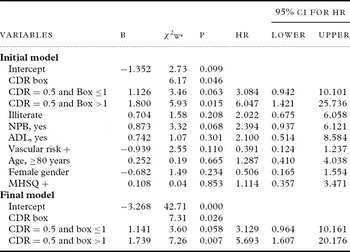
In the multivariate analysis, the only variable that independently predicted conversion to dementia was the CDR classification, with or without the sum of the boxes being taken into account (Table 2).
Initial and final model of the multivariate analysis (Poisson regression) with CDR sum of the boxes scores

*χ2W: Wald χ2 with one degrees of freedom for: illiterate, NPB changed (yes), impaired functional capacity (ADL yes), present vascular risk (+), age ≥80 years, female gender, mental health change (MHSQ+), CDR = 0.5 with Box ≤1 and CDR = 0.5 with Box >1. Wald χ2 with two degrees of freedom for CDR box.
ADL: activities of daily living; CI: confidence interval; CDR: Clinical Dementia Rating; CR: conversion rate; HR: hazard ratio; MHSQ: Mental Health Screening Questionnaire; NPB: Neuropsychological Battery.
With respect to losses by disease (21 patients) or refusal (24 individuals) among those at risk of conversion, the initial characteristics (gender, age, NPB, vascular risk, CDR, and CDR box) of the non-reassessed individuals were compared with the initial characteristics of the reassessed ones, according to variance analysis and the policotomic regression. No significant differences were found between them, suggesting that the losses did not introduce any important bias.
Discussion
This work carried out part of the first Brazilian cohort study with elderly people in a large urban center. Validating an instrument to classify the cognitive status was the initial concern once valid instruments are needed due to the large number of elderly people with dementia in Brazil. The CDR was considered adequate for this population in a previous study (Montaño and Ramos, Reference Montaño and Ramos2005) without meaningful interference of the education level, which, for most of the elderly people evaluated, was low, and this instrument does not depend on scores that are validated for different populations.
In this subsample of the cohort, the crude rate of conversion was 91.3/1,000 person-years. This conversion rate was high because of the old age of the participants, but it might have been overestimated because not all the participants of the cohort were evaluated at baseline. That is why conversion rate was referred for the cohort instead of dementia incidence. In this study, there were no significant differences among age groups, although a tendency for higher conversion rate among the very old was observed. The lack of significance might be due to the high average age of the cohort, diminishing the number of age groups and the possible differences among them. As far as schooling is concerned, there were no statistically significant differences in the conversion rates among the different levels of education, although a greater tendency to conversion was recorded among the illiterate. This lack of differences by educational level was probably due to the fact that the average schooling of the studied population was higher than the Brazilian population in general, as the study included mostly individuals from the middle class with better socio-economic status.
The Canadian Study of Health and Aging (CHSA; Lindsay et al., Reference Lindsay2002) followed a large number of elderly people living in the community or being cared in institutions, and for the non-demented population of 80–84 years, it estimated an incidence rate of 42/1,000 person-years; for the age group of 85 years and older, the rate was 106.5. Similar findings were seen in prospective American studies (Ganguli et al., Reference Ganguli, Dodge, Chen, Belle and Dekosky2000; Kukull et al., Reference Kukull2002). In one Brazilian study, the incidence rate of dementia was 13.8/1,000 person-years within the elderly community older than 65 years, increasing as age advances (Nitrini et al., Reference Nitrini2004). Regarding schooling, compared with this study, similar results were obtained in a Brazilian study (Nitrini et al., Reference Nitrini2004) and in a study conducted among African Americans (Callahan et al., Reference Callahan, Kathleen, Hui, Musick, Unverzagt and Hendrie1996).
No significant differences in conversion rates were found between male and female subjects in this study, but there was no gender-specific correlation in conversion rates in many studies (Kukull et al., Reference Kukull2002; Lindsay et al., Reference Lindsay2002; Nitrini et al., Reference Nitrini2004), although some European studies observed an increased incidence of dementia in women, especially among the very elderly population (Ravaglia et al., Reference Ravaglia2005).
Despite the nearly significant difference between the altered and unaltered NPB, this variable did not remain in the final multivariate model, because if the assumption that the performance on neuropsychological tests indicates the individual's cognitive status, researchers would have to consider that the performance on such tests is strongly influenced by the prior intellectual capacity or education of the individuals (Jager et al., Reference Jager, Hogervorst, Combrinck and Budge2003). Although other factors are widely agreed as risk factors for dementia (Breteler, Reference Breteler2000; Lindsay et al., Reference Lindsay2002; Ravaglia et al., Reference Ravaglia2005), they did not influence conversion rates in this study.
On the contrary, the CR for CDR = 0 was smaller than for CDR = 0.5, and even smaller than CDR = 0.5 with sum of the boxes >1. These findings demonstrate that individuals with CDR = 0.5 convert to dementia more than normal ones (with CDR = 0), especially when several CDR categories are compromised or the sum of the boxes score is higher. Note that when CDR = 0 and CDR = 0.5 with a sum of boxes ≤1 were compared, no significant differences were found in conversion rates, that is, the fewer the domains affected, the closer they are to normality. However, if the CDR presented more affected domains, it would be closer to dementia or conversion – the HR for CDR = 0.5 with sum of boxes >1 was 5.69, which corroborates that the greater the number of compromised cognitive domains of a person, the higher the likelihood of converting to dementia.
In the multivariate analysis, the classification by the CDR was the only independent variable that remained in the final model explaining the conversion rates. In another model that considered the CDR classification by the sum of the boxes score, this was also the only variable that remained in the final model. Therefore, it was possible to identify one independent variable that contributed to conversion to dementia: CDR classification. Maybe, owing to small-size sample, there was no other significant variable and it was the main limitation of this study.
The Poisson regression model was chosen so that person–time rate of conversion could be reported as in a similar study (Dickerson et al., Reference Dickerson2007). The Poisson regression model was modeled through generalized linear models as described earlier. The results were equivalent to those obtained through the use of an exponential survival model. Other models were tried, from logistic to survival models (exponential to Cox). The Cox model with CDR gave an HR of 3.6 for CDR = 0.5. All models resulted in the same final model (CDR = 0.5 significance) with marginal effects of age. However, this sample size was small to detect the age trend. Apparently, in this study, individuals with CDR = 0.5 had increased chances of conversion with age, whereas individuals with CDR = 0 also had the same conversion rate as age increased.
The CDR = 0.5 may, in fact, correspond to the MCI or precocious dementia (Ames et al., Reference Ames2006; Petersen Reference Petersen2007; O'Bryant et al., Reference O'Bryant2008). It is a heterogeneous group in which the number of cognitive domains affected significantly influences the conversion rate (Daly et al., Reference Daly, Zaitchik, Copeland, Schmahmann, Gunther and Albert2000; Lam et al., Reference Lam2008; Ganguli et al., Reference Ganguli2011).
Daly et al. (Reference Daly, Zaitchik, Copeland, Schmahmann, Gunther and Albert2000) and Farias et al. (Reference Farias, Mungas, Reed, Harvey and DeCarli2009) also found the classification of CDR at baseline as the only variable that independently predicted conversion to dementia. However, in this study, although this fact has also been observed, the HR to conversion was established, and it was almost six times greater for CDR = 0.5, with several domains compromised, than for CDR = 0.
In conclusion, level 0.5 in the CDR scale independently indicates an increased risk of converting to dementia, in an objective manner. This instrument minimizes educational bias and enables researchers to identify, with a low cost measure, a high-risk group for developing the dementia syndrome, especially if several categories of the CDR are impaired. On the basis of these results, it would be worth including this instrument in regular clinical practice, enabling health promotion actions and preventive measures for risk groups at the primary healthcare level in Brazil.
Conflict of interest
None.
Description of authors’ roles
Maria Beatriz Marcondes Macedo Montaño, MD, PhD, formulated the research questions, designed and carried out the study, analyzed the data, and wrote the paper. Solange Andreoni, PhD, was responsible for the statistical design of the study and for carrying out the statistical analysis. Luiz Roberto Ramos, MD, PhD, supervised all the phases of the research and assisted with writing of the paper.