ʿAbdallāh ibn Masʿūd (henceforward: Ibn Masʿūd) is a genuine representative of the social and political revolution brought about by the Prophet Muḥammad. He died in 32/653.Footnote 2 According to a family member (his brother's grandson), he was at that time 63 years old.Footnote 3 His humble origin notwithstanding, he reached the highest level of the early Islamic administration and accumulated great wealth.Footnote 4 His offspring included leading members of society, one of them the historian al-Masʿūdī.Footnote 5
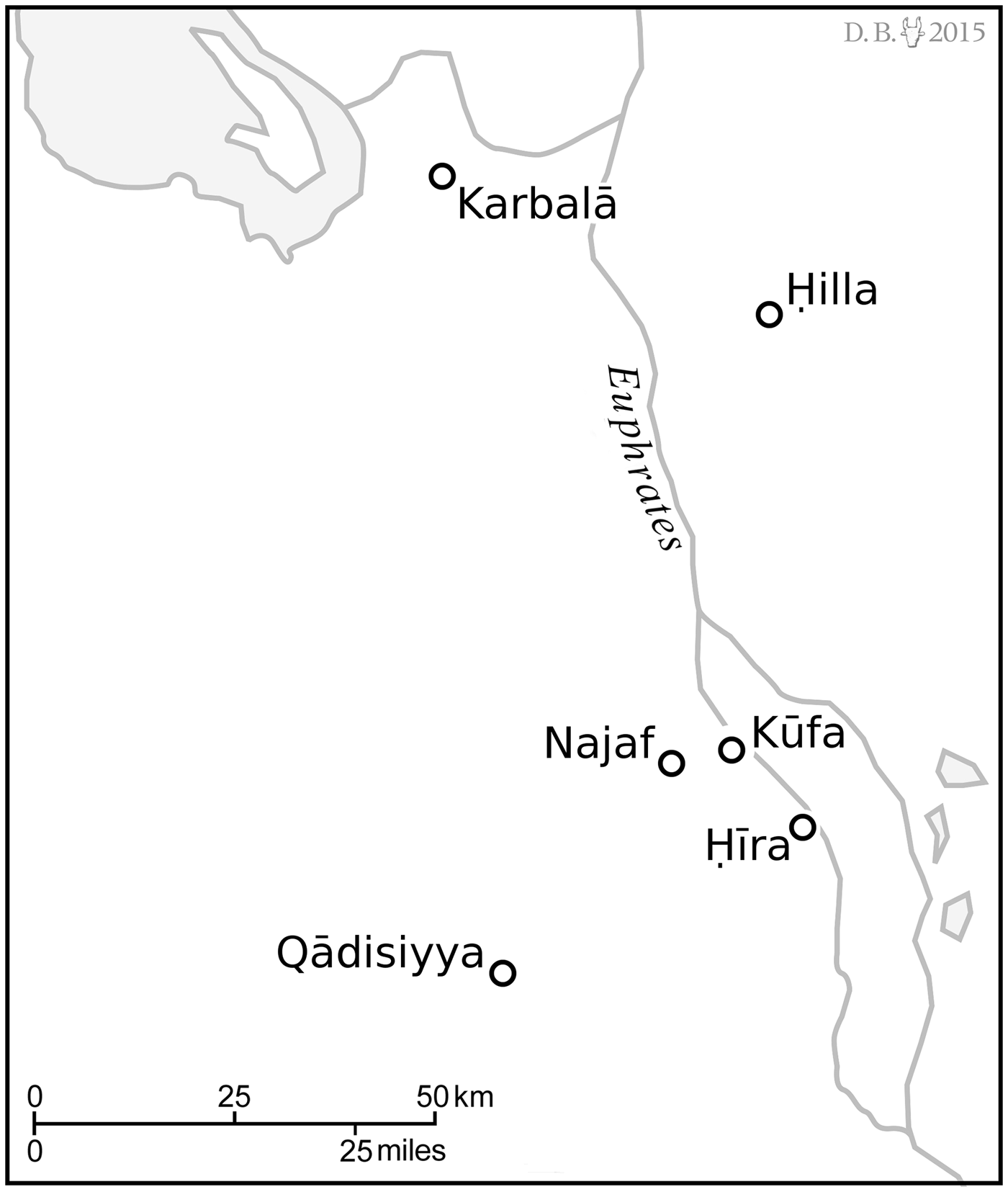
What follows deals with Ibn Masʿūd's landed properties, most of which were in south-western Iraq, more specifically in the Kūfa-Ḥīra-Najaf-Qādisiyya area (see Figure 1). The study of land ownership puts us, so to speak, on firm ground.Footnote 6 It also immunizes us against reading hagiography as if it were historiography and averts unrealistic perceptions regarding the leading figures of the turbulent first decades of Islam. As one might expect, the upheavals of that period brought about a major transfer of land titles to leading members of the emerging Muslim elite. Revenues from landed property (and from various economic ventures) provided Ṭalḥa and Zubayr, among others, with the means to wage expensive, internecine wars. Many trustworthy facts can be extracted from the “mountain of material”Footnote 7 available to us from primary sources. Such facts are usually detached from any biased and conflicting claims that are often found in the sources. They contribute to a better understanding of early Islamic history, while shedding light on the social and political tensions created by the unequal divisions of wealth.
Map of the Kūfa-Ḥīra-Najaf-Qādisiyya area

wa-bi-Rādhān mā bi-Rādhān
Rādhān figures prominently in an article published in 1974 by Moshe Gil about a network of Jewish merchants called the Rādhānites (in Arabic: al-Rādhāniyya).Footnote 8 The last section of his article (314–22) deals with their provenance. According to Gil's convincing argument, the name Rādhāniyya goes back to a place called Rāhdhān. He refers to the Rādhān(ān/yn/āt) region east of the Tigris, not far from Baghdad. However, as we shall see, there was another Rādhān, near Kūfa, which is hidden away in Gil's own evidence. Whether the Rādhānite merchants came from the Kūfan Rādhān remains an open question.
Let us begin with an utterance which Gil attributes to Muḥammad, although its latter part goes back to Ibn Masʿūd. According to Gil:
Rādhān was even a symbol of fertile soil in the conquered countries. A tradition ascribed to the Prophet warns the believers against coveting property and lands for the desires of the world: “what is in al-Madīna is in al-Madīna and what is in Rādhān is in Rādhān”.Footnote 9
Gil comments on this, saying:
Later Muslim traditionalists interpreted this tradition in a different way, explaining that it referred to a place called Rādhān, in the vicinity of al-Madīna, thus Samʿānī, Ansāb ...; Samhūdī, Wafāʾ..., who cites al-Majd, who is al-Fīrūzābādī..., but it is not extant in his Qāmūs; the source of the idea that Rādhān is near al-Madīna can only be in the above-mentioned tradition, otherwise Samhūdī, who lived in al-Madīna, would have known about it and told about it.
The tradition in question that exists in several versions is made of two parts. In the first part, Ibn Masʿūd quotes Muḥammad's utterance prohibiting the ownership of an estate for fear that it might whet its owner's appetite for this world (lā tattakhidhū l-ḍayʿa fa-targhabū fī l-dunyā). In the second part, Ibn Masʿūd apologetically points to his own estates in Rādhān and in Medina: wa-bi-Rādhān mā bi-Rādhān wa-bi-l-Madīna mā bi-l-Madīna.Footnote 10
However, there was no Rādhān near Medina.Footnote 11 Fīrūzābādī’s book, quoted by Samhūdī, is not the former's al-Qāmūs al-muḥīṭ but his al-Maghānim al-muṭāba fī maʿālim ṭāba.Footnote 12 In addition, contrary to Nawawī’s opinion (see below), Ibn Masʿūd's saying wa-bi-Rādhān mā bi-Rādhān wa-bi-l-Madīna mā bi-l-Madīna does not turn Rādhān into “a symbol of the fertile soil in the conquered countries” but reflects, as has already been mentioned, Ibn Masʿūd's contrition. Samhūdī (d. 911/1505) does have an entry on Rādhān in the geographical section of his history of Medina, Wafāʾ al-wafā bi-akhbār dār al-muṣṭafā.Footnote 13 He quotes Majd al-Dīn al-Fīrūzābādī’s (d. 817/1415) entry on Rādhān. Samhūdī also quotes Nawawī in the same entry (in his Tahdhīb al-asmāʾ – in this case without attrtibution; however, Nawawī is often quoted by Samhūdī with proper acknowledgement), according to whom Ibn Masʿūd's comment bi-Rādhān mā bi-Rādhān – arbaʿan [i.e. Ibn Masʿūd repeated it four times] – wa-bi-l-Madīna mā bi-l-Madīna has nothing to do with his ownership of estates in these places. According to Nawawī, ownership of an estate is prohibited, “especially if you own an estate in Rādhān or in Medina. Ibn Masʿūd singled them out for their great value and for the people's desire for them” (khaṣṣahumā li-nafāsatihimā wa-kathrati l-raghba fīhimā).Footnote 14 However, this is not a general statement in their praise, but a regretful reference by Ibn Masʿūd to his own non-compliance with Muḥammad's ruling.
In another version of Muḥammad's statement, he prohibited the abundance of children and property (nahā rasūlu llāh ʿani l-tabaqqur fī l-ahl wa-l-māl). More significantly, according to a variant of this version, Ibn Masʿūd reacted by referring to the three families (i.e. households) he had: one in Medina, one in Rādhān and one in “so-and-so” (inna lī thalāthata ahlīna, ahl bi-l-Madīna wa-ahl bi-Rādhān wa-ahl bi-kadhā).Footnote 15 One assumes that most of the time he lived in Kūfa as an absentee landlord. The place name hidden under “so-and-so” must have been censored because it involved some embarrassment. Ibn Masʿūd's offspring lived in Kūfa (wa-ʿaqibuhu bi-l-Kūfa),Footnote 16 but there was nothing embarrassing about Kūfa where Ibn Masʿūd owned two courts (see below).
Regardless of whether or not Ibn Masʿūd actually said these words, those who quoted them (or put them in his mouth) must have related them to well-known facts. Only a person who actually owned plenty of landed property (and had several households) could have uttered them. While Ibn Masʿūd's disciples were no doubt more interested in their teacher's state of mind than in social history, we may use their reminiscences out of their original context.
The ḥadīth transmitter al-Walīd ibn Kathīr ibn Sinān (see above, n. 11), whose floruit dates to the latter half of the second/eighth century, leads us to evidence regarding Ibn Masʿūd's Rādhān. In addition to the tribal nisba al-Muzanī (after the Muzayna tribe) al-Walīd had two non-tribal nisbas, namely al-Madanī and al-Rādhānī. The fact that he lived in KūfaFootnote 17 – some refer to him as al-KūfīFootnote 18 – is linked to the nisba al-Rādhānī. Actually he did not live inside Kūfa but just outside of it (kāna yaskunu khārijan mina l-Kūfa).Footnote 19 Ibn Ḥajar says that after having quoted Muḥammad's instruction, Ibn Masʿūd admitted his own blunder (istadraka ʿalā nafsihi), referring to his two estates in Medina and in Rādhān, and his two families, one in Kūfa and the other in Rādhān. More significantly, Ibn Ḥajar adds that Rādhān is a place on the outskirts of Kūfa (makān khārija l-Kūfa).Footnote 20
A place located khārijan mina l-Kūfa/khārija l-Kūfa must have been just outside of Kūfa. These phrases also suggest another place near Kūfa, namely al-Nukhayla, which was khārijan mina l-Kūfa Footnote 21 or just outside of it. Once you passed al-Nukhayla, you could see the houses of Kūfa.Footnote 22 When Muʿāwiya arrived in Kūfa (accompanied by Syrian spiritual functionaries, i.e. quṣṣāṣ and qurrāʾ) to negotiate with al-Ḥasan ibn ʿAlī the latter's relinquishing of his claim to rule, he encamped between al-Nukhayla and the Kūfan dār al-rizq Footnote 23 or the storehouse of provisions near the Kūfa bridge. If the Rādhān of Ibn Masʿūd and of al-Walīd ibn Kathīr were just outside of Kūfa, the place name may have disappeared, or nearly so, because Kūfa expanded and swallowed it.
Ibn Masʿūd's four courts, two in Kūfa and two in Medina
The courts belong in the discussion of Ibn Masʿūd's landed property, although they are probably unrelated to his utterance wa-bi-Rādhān mā bi-Rādhān wa-bi-l-Madīna mā bi-l-Madīna, which relates to agricultural land. This is shown by a variant of the tabaqqur version that refers to his date palms in Yathrib (Medina) and in Rādhān.Footnote 24
In Kūfa, Ibn Masʿūd owned two courts.Footnote 25 When ʿUmar ibn al-Khaṭṭāb sent him to Kūfa to serve as mentor and state official (muʿalliman wa-wazīran), he built a court for himself near the Friday mosque.Footnote 26 A moralistic account has it that Ibn Masʿūd invited ʿAmmār ibn Yāsir (the then governor of Kūfa) to look at it. ʿAmmār praised its solidity (banayta shadīdan) but poured cold water on Ibn Masʿūd's enthusiasm, telling him that he would die soon.Footnote 27
Ibn Masʿūd's other court in Kūfa was in a place that was later called al-Ramāda, amidst his tribe, the Hudhayl.Footnote 28 It must have been a spacious court, since it provided quarters for people from outside Kūfa when the area around the Friday mosque was too small to accommodate them.Footnote 29
Ibn Masʿūd's home (manzil) was in the place called today al-Ramāda, between the [territory of the] Thaqīf and the oil sellers. It was too far for him [from the centre, i.e. the Friday mosque], so he asked for [the caliph's] permission to take over land for his court [near the mosque], saying, I am a guest of the Muslims (fa-ʾstaʾdhana fī mawḍiʿ dārihi wa-qāla anā min aḍyāfi l-muslimīna). He lived in his court and turned his [former] court into a boarding place for guests (dār al-ḍiyāfa). The guests lived in his court in [the territory of the] Hudhayl when the area around the mosque was too small to accommodate them.Footnote 30
There is no indication that when he made his court available for guests, he relinquished its ownership.
Ibn Masʿūd also had two courts in Medina. One of them was built at the time of ʿUmar ibn al-Khaṭṭāb, who gave it his blessing.Footnote 31 Ibn Masʿūd's court was called dār al-qurrāʾ and touched upon the Prophet's mosque. When ʿUmar ibn ʿAbd al-ʿAzīz enlarged the mosque at the time of the caliph al-Walīd ibn ʿAbd al-Malik, part of Ibn Masʿūd's court (together with several other courts) was incorporated in it. The remaining part of the court was included in the Prophet's mosque in a later enlargement by the ʿAbbāsid caliph al-Mahdī.Footnote 32 Ibn Masʿūd's other Medinan court was near the market, as we learn from the description of the building in which the caliph Hishām ibn ʿAbd al-Malik incorporated the market.Footnote 33
An estate in the Saylaḥīn district “on the way to Qādisiyya”
Let us return to Ibn Masʿūd's landed property in south-western Iraq. He owned an estate on the way to Qādisiyya. This famous Qādisiyya, or Qādisiyyat al-Kūfa, was the south-western boundary of Iraq.Footnote 34 Alternatively, al-ʿUdhayb, several miles south-west of Qādisiyya is sometimes identified as the boundary of Iraq's agricultural area (Sawād),Footnote 35 more precisely the Sawād al-KūfaFootnote 36 or the agricultural land included in Kūfa's jurisdiction. After the Friday prayers (in Kūfa), Ibn Masʿūd went to his estate en route to Qādisiyya (fa-rakiba ʿAbdullāh ... ilā ḍayʿa lahu dūna l-Qādisiyya). On his way there he prayed two rakʿas at Nahr al-Ḥīra. He may have prayed at qanṭarat al-Ḥīra (i.e. the bridge built over the Ḥīra irrigation canal) which is mentioned elsewhere as the place where Ibn Masʿūd prayed two rakʿas when he was on his way to Mecca. Both accounts about his prayers are linked to Ibn Masʿūd's mawlā or manumitted slave ʿUmayr Abū ʿImrān. Reportedly ʿImrān's mother was Ibn Masʿūd's slave girl or concubine (surriyya) who was living with his manumitted slave ʿUmayr.Footnote 37 The estate in question was near the main road and its produce could easily be sold to travellers as they were starting their journey to the Arabian Peninsula. This same estate (aqbala ʿAbdullāh min ḍayʿatihi llatī dūna l-Qādisiyya) appears – again in a legal context – in connection with the question of whether or not pilgrims on their way to Mecca may utter the talbiya (“Here I am”, the pilgrims’ repeated invocation) before entering the sacred state of iḥrām.Footnote 38 In this case Ibn Masʿūd was reportedly going in the opposite direction, namely from his estate on the way to Qādisiyya to Kūfa, when at Najaf he met people uttering the talbiya. “Nahr al-Ḥīra” of the former account is replaced here by Najaf. According to another account, Ibn Masʿūd met the people who were uttering the talbiya at al-Sāliḥīn.Footnote 39
This form of the place name (al-Sāliḥīn means literally “the defecators”) must have been created by popular etymology. Other forms of the place name are al-Sālaḥīn and al-Saylaḥīn, which is the most common one (and is given precedence henceforth). After the assassination of the caliph ʿUmar, Ibn Masʿūd, among other wealthy Kūfans, gave up his annual salary (ʿaṭāʾ) and bought an estate in Rādhān. When Ibn Masʿūd died, his bequest included 90,000 mithqāl (of gold or silver), slaves, goods (ʿurūḍ) and livestock in al-Saylaḥīn.Footnote 40 The text is somewhat ambiguous, but it appears that not only the livestock but also the slaves and the goods were in Saylaḥīn. In other words, Ibn Masʿūd had an estate in Rādhān and another in Saylaḥīn.
Saylaḥīn, Ḥīra and Kūfa are combined in an account of Ibn Masʿūd's journey from Saylaḥīn (called here Sālaḥīn) to Kūfa. He was accompanied (fa-ṣaḥibahu) by dahāqīn from Ḥīra, i.e. “landed aristocrats”/village or town chiefs. At the entrace to Kūfa they took another route, and to the astonishment of his companion (ʿAlqama ibn Qays al-NakhaʿīFootnote 41) Ibn Masʿūd saluted the infidels (fa-atbaʿahumu l-salām).Footnote 42 The legal question involved here is whether or not it was legitimate to salute them. However, we are only interested in the place names. At this point it should be remarked that as often happens with place namesFootnote 43 (including that of Rādhān), there was another Saylaḥīn in Iraq, namely between Baghdad and Anbār (present-day Fallūja). The latter Saylaḥīn was four farsakhs (c. 24 km) from Baghdad and eight farsakhs (c. 48 km) from Anbār.Footnote 44
We return to the south-western Saylaḥīn. Several decades before the Conquests, Khusro granted the rustāq or rural area of Saylaḥīn, among other estates, to the king of Ḥīra, al-Nuʿmān ibn al-Mundhir. He also granted him an estate that was later called after its Muslim owners Qaṭāʾiʿ Banī Ṭalḥa or the estates of Ṭalḥa ibn ʿUbaydallāh's children. Sanām Ṭabāq, later called Ṭabāq al-Sālim, was also among Khusro's grants. The Saylaḥīn rural area in the west of Furāt Nistar included (possibly in a certain administrative division) two canals: Nahr Yūsuf and Nahr al-Ṣinnayn.Footnote 45 (It will presently be argued that Saylaḥīn was also called al-Nahrayn after these two canals.) The details concerning Khusro's grant indicate that Ibn Masʿūd's estate in Saylaḥīn was originally part of the Sassanian crown domains (categorized under Islam as ṣawāfī lands). Al-Ṣinnayn, having an irrigation canal and grain fields (mazāriʿ), was among the places (manāzil) owned by the king of Ḥīra, al-Mundhir. The caliph ʿUthmān reportedly sold it to Ṭalḥa ibn ʿUbaydallāh.Footnote 46 It was probably identical with the above-mentioned Qaṭāʾiʿ Banī Ṭalḥa and the Nashāstaj (see below).
Ibn Masʿūd had a special arrangement with the previous owner of the kharāj land that he owned: the latter spared him the payment of the kharāj tax and the cultivation of the land.Footnote 47 Ibn Masʿūd's division of the crop was confirmed by Providence. In a story ascribed to Ibn Masʿūd himself, a mysterious voice inside a rain cloud (ʿanāna) guided it to a field of a certain righteous man. The cloud burst above the man's field because of his just division of the crop: one third went back to the land (i.e. to the sharecropper), one third went to alms and the remaining third went to his family. The source of this account, Masrūq ibn al-Ajdaʿ al-Hamdānī, reported that Ibn Masʿūd would send him every year to his land in Rādhān (i.e. when the crop was gathered), where he would follow the same practice in the division of the crop.Footnote 48
In a parallel account there are two alternative place names: Masrūq concluded the story of the righteous man by reporting that Ibn Masʿūd sent him (i.e. Masrūq) to his land in Zabārā – or, according to another source, to Saylaḥīn (al-Sāl(a/i)ḥīn).Footnote 49 Qanṭarat Zabārā or the Zabārā bridge was just outside of Kūfa,Footnote 50 and the place that gave the bridge its name was on the eastern side of the Euphrates.Footnote 51 Ibn Masʿūd may have owned an estate in Zabārā as well. One account has it that the Kūfan Abū Wāʾil Shaqīq ibn Salama was sent by Ibn Masʿūd to an unnamed village (i.e. a village-estate) of his. The righteous man of the above account is identified in this account as one of the Children of Israel.Footnote 52
Some comments on Ibn Masʿūd's neighbours should be mentioned here. The Qaṭāʾiʿ Banī Ṭalḥa, previously known as al-Nashāstaj (or al-Nashāstak), were near Saylaḥīn and Qaryat Hurmuz: Mūsā, son of Ṭalḥa ibn ʿUbaydallāh, reported that Ibn Masʿūd and Saʿd ibn Abī Waqqāṣ – the latter received from the caliph ʿUthmān Qaryat Hurmuz – were his neighbours and used to lease their land for one third or one fourth of the crop. Mūsā’s land, al-Nashāstaj, was granted by the caliph ʿUthmān to his father Ṭalḥa.Footnote 53 Ṭalḥa tried to purchase al-Nashāstaj, also called Nashāstaj Banī Ṭalḥa, “the one that is near Saylaḥīn” at the time of the caliph ʿUmar. He told the caliph of the wonderful land he bought (arḍ muʿjiba). The latter asked him ironically whether he had bought it from the people of Kūfa or from the people of Qādisiyya (i.e. all the warriors who were entitled to a share in the conquered land). ʿUmar declared the acquisition void because the land was considered fayʾ or communal property (i.e. to be preserved for future generations, as opposed to ghanīma, real booty).Footnote 54 Initially, we are told, ʿUmar intended to divide the land of the Sawād among the warriors. But when a census showed that each warrior was to receive three fallāḥīn, he gave up his intention, reportedly adopting ʿAlī’s advice. He sent ʿUthmān ibn Ḥunayf to Iraq; he imposed on the fallāḥīn 48, 24 and 12 dirhams annually, according to their wealth.Footnote 55 Under the caliph ʿUthmān the obstacles were removed when he succumbed to pressure from a small circle of influential figures, including state officials. In a pro-ʿUthmān apologetic account, it is reported that the influential figures demanded to be compensated for the land they had left behind in the Ḥijāz and Tihāma, whereby ʿUthmān would grant them land in Kūfa and Baṣra.Footnote 56
Al-Nahrayn and al-Saylaḥīn
Al-Nahrayn is yet another place name linked to Ibn Masʿūd. An account about ʿUthmān's grants going back to the above-mentioned Mūsā ibn Ṭalḥa exists in several versions, two of which concern us here:
1. ʿUthmān granted Ibn Masʿūd al-Nahrayn, Saʿd ibn Abī Waqqāṣ – Qaryat Hurmuz; ʿAmmār ibn Yāsir – Istīniyā, and Khabbāb ibn al-Aratt – Ṣaʿnabā. Mūsā ibn Ṭalḥa referred to the practice of Ibn Masʿūd and Saʿd, who were his neighbours (fa-kilā jārayya), of leasing their land for one third or one fourth of the crop.Footnote 57
2. Another version states more accurately that Ibn Masʿūd received from ʿUthmān an estate in al-Nahrayn (i.e. not the whole of al-Nahrayn). All the recipients of estates were Mūsā’s neighbours (fa-kullun jārun), and two of them, Ibn Masʿūd and Saʿd, were leasing their land for a third or a fourth of the crop.Footnote 58
The region of al-Nahrayn was one of the very first regions conquered by the Muslims in Iraq. Following a Muslim raid on al-Nahrayn, the raiders were surrounded by the Sassanians between al-Nahrayn and IṣṭīmiyāFootnote 59 (probably identical to the above-mentioned Istīniyā). Later, Khālid ibn al-Walīd sent financial officers (ʿummāl al-kharāj; they were supposed to collect jizya – the terms seem to be used indiscriminately) to the following regions: one was sent to the upper part of the administrative unit (aʿlā l-ʿamal) at Falālīj, one to Bāniqyā and Basmā, one (Bashīr ibn al-Khaṣāṣiyya) to al-Nahrayn where he settled in al-Kuwayfa (“the small Kūfa”) in Bānabūrā (i.e. in the area of ḤīraFootnote 60), one to Nistar (probably identical to the above-mentioned Furāt Nistar) and finally one to Rūdhmistān.Footnote 61 Saylaḥīn is not listed, although it was no doubt close to Nistar and Rūdhmistān: these three districts were in the Lower Bihqubādh.Footnote 62 Our al-Nahrayn was at the edge of the “tongue of land” inserted into the countryside on which Kūfa, and earlier Ḥīra, were located.Footnote 63 The “tongue” is identical to ẓahr al-Kūfa, or the elevated tract of land outside Kūfa that extended from al-Nahrayn to ʿAyn Banī l-Ḥadhdhāʾ. The part of it that was close to the Euphrates was called al-Milṭāṭ, while the other part that was close to the Ṭaff (the oases region bordering on the desert) was called al-NijāfFootnote 64 (plural form of Najaf). Elsewhere, al-Milṭāṭ is defined as the area between Kūfa and Ḥīra.Footnote 65 Obviously al-Nahrayn was at the Najaf/Nijāf end. Our al-Nahrayn must not be confused with another al-Nahrayn which was further north in al-Bihqubādh al-Aʿlā or the Upper Bihqubādh.Footnote 66 The Upper Bihqubādh was separated from the Lower Bihqubādh in which our al-Nahrayn was located, by the Middle Bihqubādh. The northern al-Nahrayn is therefore irrelevant for us here.Footnote 67
Al-Nahrayn or “the two canals” may well have been the old name of Saylaḥīn which, as has already been mentioned, included two canals, Nahr Yūsuf and Nahr al-Ṣinnayn. In this case, Ibn Masʿūd's estate in al-Nahrayn was identical with his estate in Saylaḥīn.
In one administrative division of Iraq, the districts (ṭassūj, pl. ṭasāsīj) of Saylaḥīn, Hurmuzjird and Nistar were among the five districts of the Lower Bihqubādh. The other two were Furāt Bādaqlā and Rudhmistān.Footnote 68 In another administrative division, Saylaḥīn and Furāt Bādaqlā seem to count as one district. Besides Hurmuzjird and Nistar, we also find in this other division the districts of Kūfa and Ḥīra as part of the Lower Bihqubādh.Footnote 69 One of these two districts could equate to Rūdhmistān in the division containing five districts. The Saylaḥīn district included the estates of al-Khawarnaq and Ṭīzanābādh.Footnote 70 Al-Nuʿmān ibn al-Mundhir levied the taxes on the former, indicating that it was among the domain lands which he received from the Sassanians.Footnote 71 The latter estate was ʿUthmān's grant to al-Ashʿath ibn Qays al-Kindī. It was one mile from Qādisiyya.Footnote 72
During the Conquests, on the eve of the battle of Buwayb, a force led by al-Muthannā penetrated Furāt Bādaqlā (probably the first point one reached upon entering the Sawād via Qādisiyya) and advanced through the middle of the Sawād to al-Nahrayn, then to al-Khawarnaq, then to al-Buwayb, which was on the western bank of the Euphrates, where Kūfa was later built. Two other forces took the Najaf and the Qādisiyya-Jawf routes, respectively.Footnote 73 In other words, al-Nahrayn was the next point after Furāt Bādaqlā for someone crossing from the desert into the sown. At the time of the caliph al-Walīd ibn Yazīd (r. 125/743-126/744), Furāt Bādaqlā, Ṭīzanābādh, al-Falālīj, Bābil and Sūrā were still producing high-quality wine.Footnote 74
That al-Nahrayn is identical to Saylaḥīn is also borne out by the fact that the two place names interchange. Reportedly, the lord of Saylaḥīn (ṣāḥib al-Saylaḥīn), Murra ibn Sharāḥīl, sent the caliph ʿAlī ibn Abī Ṭālib (who made Kūfa his capital in 36/657) a young non-Arab enslaved woman (jāriya). However, ʿAlī sent her back after he had found out that she was married. Murra bought her marriage contract from her husband for 500 dirham and sent her again to the caliph, who accepted the gift.Footnote 75 (Unsurprisingly, Murra often transmitted ḥadīth on the authority of his neighbour Ibn Masʿūd who had died before ʿAlī ascended the throne.) Another account going back to the Kūfan Ibrāhīm al-NakhaʿīFootnote 76 has it that Sharāḥīl ibn Murra (this is another version regarding the official's name) was ʿAlī’s financial officer/tax collector at al-Nahrayn (kāna ʿāmilan li-ʿAlī ʿalā l-Nahrayn).Footnote 77
Conclusions
The place name Rādhān has led us to investigate Ibn Masʿūd's landed property that included both courts and estates in south-western Iraq and in Medina. Modern technology saves us time: the retrieval of evidence from thousands of primary sources takes seconds. After all, the collection of evidence is the most time-consuming phase in research.
As to the Rādhānite (al-Rādhāniyya) Jewish merchants, their name probably points to their place of origin rather than their headquarters. One could therefore argue that the Rādhān near Kūfa (which may have become a quarter of Kūfa) is not inferior to the Rādhān(ān/yn/āt) region near Baghdad as their presumed provenance. However, the choice between the two Iraqi Rādhāns will have to be determined on the basis of more evidence.