This article addresses three traits of Mayan hieroglyphic orthography: semantic determinatives, semantic classifiers, and full phonetic complementation of logograms. The first trait, semantic determinatives, has received very little attention to date, with a few original exceptions (Justeson Reference Justeson1986:447–449; Kelley Reference Kelley1976:206–211; Schele Reference Schele1983:19–21), as well as a recent claim that such signs are not a productive category of the script at all (Zender Reference Zender1999). The second trait, semantic classifiers, has only recently been recognized as a useful orthographic category in Mayan writing (Hopkins Reference Hopkins1994; Hopkins and Josserand Reference Hopkins and Josserand1999). The third trait has not, to this author's knowledge, received a detailed or even cursory treatment in previous literature, except for a passing mention by Houston and Coe (Reference Houston and Coe2003:154), who assert, without elaboration, that “pattern of fully syllabic spellings accompanied by logographs is no longer thought to characterize Maya writing.” Thus, there is a current need for discussion of these orthographic principles aimed at testing their validity and promoting their systematic study and accounting in the decipherment process. It is a well known and accepted fact that such conventions characterize a plurality of scripts from the Old World, such as Sumerian, Egyptian, Chinese, Hittite, Luvian, and Elamite, among others—scripts that share many structural characteristics with Mayan. Consequently, it is a worthwhile pursuit not only to investigate such traits for the sake of more fully understanding Mayan script, but also to elaborate a basis for diachronic and synchronic comparisons with similar scripts elsewhere. This paper argues that such traits do characterize Mayan writing and that it is possible to study them both synchronically, from a functional perspective, and diachroniconically, with the goal of understanding not only the evolution of the script but also the scribal practices and associated cognitive processes responsible for such evolution.
COMPARATIVE AND THEORETICAL FRAMEWORK
Before presenting the framework used in this paper, a few notational preliminaries are in order. I follow the transcription conventions of Mayan signs using catalog numbers proposed by Thompson (Reference Thompson1962:31–34) and Macri and Looper (Reference Macri and Looper2003:363–375), and the transliteration conventions of Mayan sign values proposed by Fox and Justeson (Reference Fox, Justeson, Justeson and Campbell1984), which include, among others, the following: the use of bold minuscule letters for syllabograms, which consist of consonant–vowel (CV) phonetic values (e.g., T25/AA1 ka); the use of bold majuscule letters for logograms, which represent CVC roots (e.g., T544/XQ3 K'IN ‘day, sun’) or CVCVC words (e.g., KAB'AN ‘earthquake [day name])’; and the use of superscript labels to represent semantic determiners and semantic classifiers (e.g., ROYAL.HEADBAND’AJAW, or RH’AJAW, for short, for the use of the royal headband determinative on T1008 to represent ’ajaw ‘lord, ruler’), among others. I use <?> to represent the glottal stop that is often represented in practical orthographies with <’>. Also, the literature on Old World scripts shows a proliferation of terms to refer to the orthographic categories discussed here. For consistency the following are used: semantograms, semantic classifiers, and semantic determinatives. A semantogram is a type of sign with semantic value only; it may be either a classifier or a determinative. Semantic classifiers are adjacent to a logographic, logophonetic, or phonetic spelling of a word; they do not disambiguate between alternative readings of such spellings but simply indicate, visually, what the semantic category or domain of the spelled word is. Semantic determinatives are placed adjacent to a logographic, logophonetic, or phonetic spelling of a word; they disambiguate between alternative orthographic values—not necessarily only between alternative words spelled out by the same sign or sequence of signs, but more specifically between alternative orthographic values, of whatever type, of the same sign or sequence of signs. The term logophonetic is used above, rather than logosyllabic, to include scripts without syllabograms but with phonetic signs of other types, which may be used in conjunction with logograms to spell a word. For example, Egyptian uses logograms and consonantal signs, often in combination, while Mayan uses logograms and syllabograms, often also in combination, resulting in two types of mixed logophonetic spellings. The term logosyllabic is used to refer to mixed spellings in Mayan and other scripts with logographic and syllabographic signs. One last clarification: semantograms are not ideograms. Semantograms are not read aloud but, instead, are used in direct association with signs that are read aloud—whether logograms or syllabograms. They are also optional to a lesser or greater extent. Ideograms, according to the traditional definition, are signs that convey an idea only and that can be used on their own to convey that idea. In the latter case, ideograms cannot be considered optional as semantograms are and are not currently known to exist in Mayan writing.
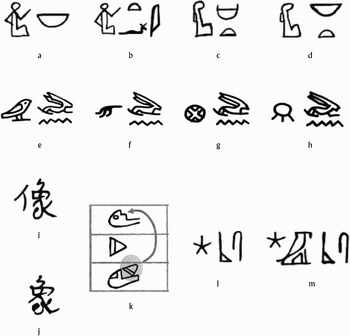
The framework presented here is derived from a review of the relevant practices in other scripts, followed by a discussion of general and specific characteristics and the elaboration of an adequate terminology to account for such characteristics. With regard to Egyptian writing, Davies (Reference Davies and Hooker1998:104) refers to semantic classifiers as “eneric determiners” or “taxograms.” These assign a semantic domain or category to an adjacent, usually preceding spelling of a word, whether logographic or phonetic in nature. Figure 1a–b shows the use of the classifier MAN to indicate that the spelled-out words refer to male persons: j-tMAN for jt ‘father’ and nbMAN for nb ‘lord’. In neither case is the classifier MAN, depicting a seated man, read aloud, as if used logographically, for the intended reading was not ‘father man’ or ‘lord man’, but simply ‘father’ and ‘lord’, respectively. Similarly, Figure 1c shows the spelling ’m-tWOMAN for ’m.t ‘wife’, while Figure 1d shows the spelling nb-tWOMAN for nb.t ‘lady, mistress’. In this case, too, the classifier WOMAN is not pronounced. It is merely a visual cue, classifying the phonetically spelled word as to its semantic domain, just as is the case of the classifier MAN. Davies (Reference Davies and Hooker1998:106) suggests that semantic classifiers used thus could have served to facilitate reading of a text. Rather than having to recognize a word by first putting together the phonetic spelling and then, from context, determining what the correct reading for that spelling would be in a given situation, the classifier sign—always a pictorial sign that could be used logographically on its own in other contexts—would allow the reader to immediately identify the correct domain of the intended word. A common type of classifier was the oval cartouche that was used to frame proper names of individuals and some gods. It allowed the reader to immediately identify visually the location of such proper names.
Cross-script comparative examples. (a) Egyptian spelling: jtMAN for jt ‘father’; (b) Egyptian spelling: jtMAN for jt ‘father’; (c) Egyptian spelling: ’m-tWOMAN for ‘m.t ‘wife’; (d) Egyptian spelling: nb-tWOMAN for nb.t ‘lady, mistress’; (e) Egyptian spelling: w-nEVIL.BIRD ‘mistake’; (f) Egyptian spelling: w-nLOCK.OF.HAIR ‘bald’; (g) Egyptian spelling: w-nCITY ‘Hermopolis’; (h) Egyptian spelling: w-nSUN.RAYS ‘light’; (i) Chinese: hsiang MAN ‘image’; (j) Chinese: hsiang ‘elephant’; (k) Sumerian logogram, KU ‘to eat’, formed as semantic compound by juxtaposition of two signs with their own logographic values—HEAD and BREAD; (l) Egyptian partial logophonetic spelling of ‘star’ as s-b-SBZ; (m) Egyptian full logophonetic spelling of ‘star’ as s-b-Z-SBZ.

Egyptian also employs semantic determinatives, referred to as “determiners” by Davies (Reference Davies and Hooker1998); signs that are used to disambiguate otherwise homophonous spellings by indexing, semantically, the domain of the intended word. These are similar to semantic classifiers and, like classifiers, they are not read aloud. The difference lies in that a given semantic classifier may be applied to a host of different spellings of different words that belong to the same category (e.g., MAN with the spellings for ‘father’ and ‘lord’; WOMAN with the spellings for ‘wife’ and ‘lady, mistress’), while a given semantic determinative could in principle be applied to a single spelling to disambiguate between two possible readings of the same spelling (Davies Reference Davies and Hooker1998:106), for one, and more generally, their function was one of disambiguation between homophonous spellings (not necessarily homophonous words, which may have differed in their vowels, which the script did not represent), not classification per se. For instance, the phonetic spelling w-n could spell a multitude of words, among them those in Figure 1e–h: w-nEVIL.BIRD ‘mistake’, w-nLOCK.OF.HAIR ‘bald’, w-nCITY ‘Hermopolis’, and w-nSUN.RAYS ‘light’. Chinese writing developed similar conventions. An example, in Figure 1i–j, shows the use of the sign MAN to disambiguate the otherwise homophonous hsiang MAN ‘image’ from hsiang ‘elephant’. The logogram itself is originally an ELEPHANT sign, which explains why the determinative MAN was added to the sign to index the homophonous hsiang ‘image’ instead. Mayan writing typically does not use semantic determinatives in this way. For example, the spelling T561.23 (XH3.1G1) CHAN-na could represent pre-Ch'olan *cha’n ‘sky’, *chaan ‘snake’, or *chan ‘four’. Thus, such spellings would have been ideal for disambiguation by means of a semantic determinative. However, in actuality there is no example where a semantic determinative is used with such spelling. T561.23 CHAN-na could be used to spell any of these three lexemes, and so could T/AC6 CHAN ‘snake’, and T1010/SN4 or IV/004 CHAN ‘four’ (Houston Reference Houston1984; Lounsbury Reference Lounsbury, Justeson and Campbell1984). As shown below, semantic determinatives had a different function in Mayan; to distinguish between types of orthographic values, such as between a logographic value and a syllabographic value, as with the case of SPHERULEST710/MZS CHOK ‘to throw down’ versus T710/MZR ye, or to distinguish between values of the same logogram with very different phonetic realizations, such as between MOLEPC4 XIB' ‘male’ versus T1008 WINIK ‘man, person’.
Another type of orthographic convention needs to be discussed. This is the case of logographic signs composed of two other pictorially motivated signs, often themselves logograms when used separately in other contexts, that together yield a third value, typically a logographic value, that is contextually associated with the pictorial or logographic values of the separate signs. Rogers (Reference Rogers2005:89) refers to these as semantic compounds. Zender (Reference Zender1999) refers to such signs in Mayan as composite signs, as discussed below. Figure lk is a typical example, this time from Sumerian Cuneiform, where two logograms, the first SAG ‘head’, depicting a person's head, and the second NINDA ‘bread’, depicting a piece of bread, are put together in a contextually appropriate arrangement, with the sign BREAD placed on the mouth of the HEAD sign to derive the new logographic value KU ‘to eat’. Sumerian shows other examples, such as the compound sign for NAN ‘drink’, consisting of the signs SAG ‘head’ and A ‘water’, arranged also in a contextually appropriate manner. Another example is made up by the signs MUNUS ‘woman’ and KUR ‘mountain’, combined into a compound sign read GEME ‘female slave’, probably because “slaves typically came from the mountain ranges to the East” (Rogers Reference Rogers2005:91). At first, this may not seem to be a case of semantic classifiers or determinatives until the facts are considered more carefully. The SAG ‘head’ sign, for instance, serves to indicate the semantic category or domain of both the NAN ‘drink’ and KU ‘to eat’ logograms; they are both actions carried out with the mouth. Thus, it is a semantic classifier. The A ‘water’ and NINDA ‘bread’ signs, at the same time, serve to distinguish or disambiguate between related alternatives—between actions carried out with the mouth—by “determining” one as ‘drinking’ and the other as ‘eating’, respectively. Thus, they function as semantic determinatives.
At this time it is necessary to bring mixed spellings, those consisting of logograms and phonetic complements, into the picture, particularly in relation to the practice of full phonetic complementation of logograms. An illustrative case is that of Luvian (Melchert Reference Melchert and Woodard2004:578). The logogram COW representing /wawi:s/, could be spelled with phonetic complements as follows; COW-wi/wa-sa~COWwi/wa-wi/wa-sa. (Luvian Hieroglyphic writing did not have separate CV signs to distinguish between /i/ and /a/ vowels; hence, the sign wi/wa was read as either wi or wa depending on context.) The first example is a case of a logogram followed by a partial phonetic spelling (COW-wi/wa-sa). Luvian specialists regard the second example (COWwi/wa-wi/wa-sa) as a case of the logogram COW being used as a “semantic determinative.” According to Melchert (personal communication 2004), the logogram COW was used as a determinative for semantically related items (e.g., ‘cow’ or ‘bull’). This function agrees, then, with that of semantograms defined above as semantic classifiers, not “determinatives,” a term that has clearly been used rather loosely in the literature on writing systems until relatively recently (Rogers Reference Rogers2005). As Melchert has also explained, these semantic classifiers were not obligatory, so one may find a word spelled out phonetically without a preceding determinative, or a logogram followed by a partial phonetic spelling as a complement. Hawkins (Reference Hawkins and Melchert2003:158, 163) notes a basic difference in usage between the “Empire” and “Late” script in the case of Luvian script. He notes that they are not only of “more widespread use [in] the Late period,” but that in such period “it is somewhat more difficult to distinguish between actual determinatives and logograms with more than one reading, especially given the Late Hierolyphic practice, unusual in Cuneiform, of following a logogram with a full phonetic writing.”
Akkadian also uses semantograms as semantic classifiers, not as determinatives. Words spelled logographically or syllabographically may both take classifiers (Huehnergard and Woods Reference Huehnergard, Woods and Woodard2004). Classifiers were optional, and when present they were silent. An example is WOOD, which was used before signs representing wooden objects, as in the spelling WOODGU.ZA (i.e., WOOD-THRONE) = kussûm ‘throne’. Also, out of the known Akkadian sign inventory of about 600 signs, only 19 determinatives were in common use. This is more interesting when one considers that out of the total inventory of signs, only a small subset is known for any specific period of time. Old Babylonian used about 150 signs, for example, as pointed out by Huehnergard and Woods (Reference Huehnergard, Woods and Woodard2004:220).
Yet another example is the case of Elamite. Stolper (Reference Stolper and Woodard2004:66) points out that in Elamite, “most determinatives precede the word they qualify,” although at least one is postposed. In addition, determinatives, which served as classifiers of semantic domains, are also derived from the larger class of logographic signs, but they may have alternative syllabographic values as well. Because of these factors, it is not clear that Elamite readers relied on the presence of signs that could be used as semantic determinatives for the purpose of word division, since a determinative could potentially be used with a syllabographic value, for example.
Egyptian also shows mixed spellings—that is, spellings involving phonetic signs (which spell consonants in the case of Egyptian) and logograms. This is not that different from the logosyllabic spelling principle in Mayan. Figure 1l–m offers two examples: the first, a partial logo-consonantal spelling, s-b-SBZ, and the second, a full logo-consonantal spelling, s-b-Z-SBZ, both for sbZ ‘star’. Interestingly, in Egyptian, semantic classifiers and determinatives are often used in combination with purely phonetic spellings of words, typically spelled out in full. Thus, examples of full phonetic spellings associated with otherwise logographic signs should be of interest to Mayan epigraphers. In scripts such as Egyptian, such spellings are quite commonly associated with semantograms, not just logograms.
Based on this evidence, several conclusions can be drawn. Where semantic determiners are concerned, it can be said that their primary function is to distinguish at least one lexical orthographic value of a sign from another—as with the case of Chinese hsiang ‘elephant’ and hsiang MAN ‘image’, both based on the same logogram, a logogram originally based on the sign ELEPHANT. Where semantic classifiers are concerned, their primary function is to assign a spelling—whether a logographic or phonetic one—a semantic domain, possibly to accelerate the reader's ease of recognition of the intended value. Finally, evidence from other scripts suggests that we should expect Mayan writing to contain examples of logograms associated with full phonetic spellings of their referents.
FULL PHONETIC COMPLEMENTATION IN MAYAN SCRIPT
Epigraphers have been aware of this type of spelling for some time, but it has yet to receive close attention. In fact, some epigraphers have recently denied that such spellings exist or that they are of any significance. In their review and critique of Justeson and Kaufman's (Reference Justeson and Kaufman1993, Reference Justeson and Kaufman1997) proposed decipherment of Epi-Olmec/Isthmian writing, Houston and Coe (Reference Houston and Coe2003:154) state the following:
Inexplicable forms are compelled by [Justeson and Kaufman's (Reference Justeson and Kaufman1993)] decipherment [of Epi-Olmec writing], such as phonetic complements for numbers of star signs, which would seem to be inherently obvious in their value, or full phonetic spellings of words before logographic spellings of the same. … In no case do Maya glyphs require such elaborations to confirm the spelling of “star” signs. Moreover, and contrary to a proposal made in the 1970s by Floyd Lounsbury, this last pattern of fully syllabic spellings accompanied by logographs is no longer thought to characterize Maya writing, and there is very little reason to think that such redundancy would occur in Isthmian [Epi-Olmec].
This claim is unusual and unsupported, for no author has ever systematically sought such spellings, much less described them at length. Regardless of the situation in Epi-Olmec/Isthmian writing, a systematic, though not necessarily thorough, search by the present author has yielded several cases in which ancient Mayan scribes chose to provide full phonetic complements to a logogram representing the same referent as the full phonetic spelling, as shown below. Kelley (Reference Kelley1976:176), for his part, identified at least one example of this type of spelling—that of the month name Mac as ma-MAK-ka, which he transcribed as (ma)mac(caca), for he assumed at the time that doubled signs were likely not repeated for aesthetic purposes but were instead “functional.” Interestingly, Kelley also addressed the alleged problem of “redundancy,” in reaction to Thompson's (Reference Thompson1963:137–138) assessment of such a reading as a “great exaggeration,” by stating: “[Thompson] suggests that this would be a great exaggeration—a suggestion with which I must agree, only pointing out that it is the Mayas' exaggeration, not mine” (Kelley Reference Kelley1976:176).
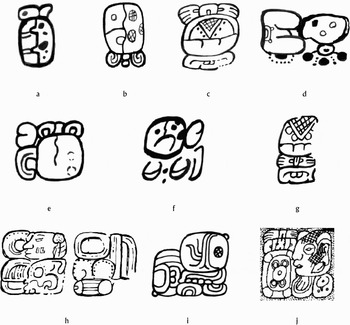
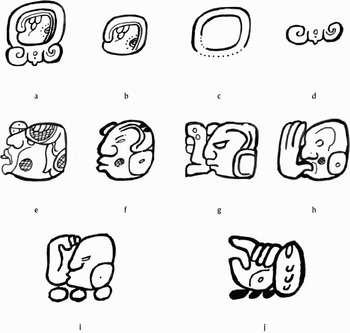
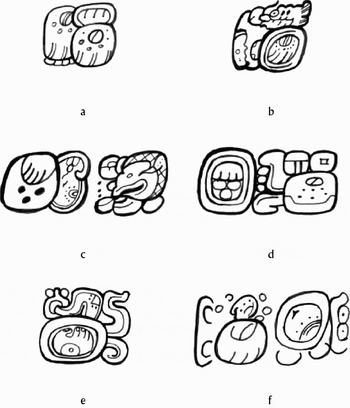
Normally, a phonetic complement is graphically preposed (prefixed or superfixed) or graphically postposed (suffixed or subfixed) to a logogram, as shown in Figure 2a–b. There are even examples where a preposed phonetic complement and a postposed phonetic complement occur simultaneously (Figure 2c), where T566 MAN appears with preposed (superfixed) ma- and postposed (subfixed) –na. Another, relatively common example of such arrangement is wi-WINIK-ki, for winik ‘man, person’, not illustrated here. The case of (ma-)MAN(-na) is different, however, from cases such as (wi-)WINIK(-ki), in that the former is a case of full phonetic complementation, meaning that the whole word is spelled out phonetically, while the second example is not, given that there is no ni sign to provide the ni sequence of winik.
From the point of view of visual organization of signs, yet another type of mixed spelling is possible in Mayan writing and is attested widely in other scripts with both logographic and phonetic signs. In this third type, scribes applied phonetic complements in full either before or after an otherwise logographic sign, as opposed to both before and after the logogram (Mora-Marín Reference Mora-Marín2001:75). An example from the Dresden Codex (Figure 1d) shows ’EM(I)-’e-mi for ehm-i-Ø descend-PLN-3sABS ‘s/he/it goes/comes down’ (Schele and Grube Reference Schele and Grube1997). The logogram, T227a, is followed by two phonetic signs that serve both as phonetic complements and to spell the plain status suffix –i. This example should alert epigraphers to the possibility of logosyllabic spellings of verbs of the form LOGOGRAM-CV-CV in which the syllabographic sequence is not spelling a suffix or sequence of suffixes (e.g., HUL-li for hul-i ‘it/s/he arrived here’, CHUM-wa-ni for chum-wan-i ‘it/s/he sat down’) but the whole verb by itself. Also, certain spellings of T539/645 WAY ‘alter ego; shape-shifter’, seen in Figure 1e–f. One may find it as wa-ya-WAY or WAY-wa-ya. Clearly, epigraphers have had no trouble recognizing the practice involved. In fact, these spellings were crucial to the decipherment of T539 as WAY ‘alter ego; shape-shifter’, achieved independently by Grube (Schele and Freidel Reference Schele and Freidel1990), on the one hand, and by Houston and Stuart (Reference Houston and Stuart1989), on the other. Another example is that of T566 MAN, a sign whose meaning is still unclear but that appears in one instance as MAN-ma-na (Figure 1g), contrasting with the case shown above as ma-MAN-na in Figure 1c only in the placement of the syllabograms with respect to the logogram.
Another clear example is found at Bonampak (Figure 2h), where one finds logographic T1000a,b/1001c/1002 ’IX(IK) followed by purely syllabographic ’i-xi. If one reads the female head T1000a,b/1001c/1002 as ’IXIK (Stuart et al. Reference Stuart, Houston and Robertson1999; Wagner Reference Wagner2003), then the ’i-xi sequence still functions as a phonetic complementation sequence—one showing abbreviation or underspelling. Hopkins (personal communication 2006) has offered a different interpretation: the sequence could be two separate titles, rather than one, read K'UHUL-’IXIK, ’i-xi K'AN-to-ko ‘Holy Lady, Ms. K'an Tok’. I agree with Hopkins that this is certainly a plausible interpretation. But if the first interpretation is correct, this would be another case of postposed, full phonetic complementation in the sense that the scribe meant to spell out phonetically the whole word after its corresponding logogram, whether the final consonant was underspelled or not (though this would not have been the case if we assume T1000a,b/1001c/1002 was simply ’IX in this context). This example could provide evidence for a different interpretation of the orthographic function of this type of spelling, which might suggest that scribes were not conceptualizing them as cases of a semantic classifier followed by a word representing a member of its semantic domain.
(a) Example of preposed phonetic complementation: (wa-)WAY; (b) example of postposed phonetic complementation: WAY(-ya). Drawings by the author after Houston and Stuart Reference Houston and Stuart1989:3, Figure 1; (c) example of logogram with preposed and postposed phonetic complements on Palenque Temple XIV Tablet: (ma-)MAN(-na). Drawing by the author after drawing by Linda Schele (www.famsi.org); (d) Example of logogram with postposed phonetic complements: ’EM(I)-’e-mi. Dresden Codex 20b. After Kingsborough version (www.famsi.org/mayawriting/codices); (e) example of logogram with preposed phonetic complements: (wa-ya-)WAY; (f) example of logogram with postposed phonetic complements: WAY(-wa-ya). Drawings by the author after Houston and Stuart Reference Houston and Stuart1989:3, Figure 1; (g) example of logogram with postposed phonetic complements: MAN(-ma-na), Yaxchilan. Drawing by the author after drawing by Linda Schele (no. 6201, www.famsi.org); (h) example of K'UHUL-’IX(-’i-xi) K'AN-to-ko. Bonampak Sculptured Stone 4:G2-H2. Drawing by the author after detail from a drawing by Ian Graham in Wagner Reference Wagner2003:2; (i) spelling of ’u-’UNIW-ni-wa for uniw ‘14th month name’ on Dos Pilas Stela 8. Drawing by the author; (j) spelling K'INICH-[JANAB']PAKAL-pa-ka-la on the West Tablet of the Temple of Inscriptions at Palenque. Detail of a drawing by Linda Schele.

Two more examples are worth considering. One is the frequent spelling of Pacal, the king of Palenque, as PAKAL-pa-ka-la, with the SHIELD logogram containing the JANAB' logogram as an infix (Figure 2i). More is said about this example below. Another example, reminiscent of the ma-MAN-na spelling (Figure 2c), is that of the month name uniw as ’u-’UNIW-ni-wa (Figure 2j), an example that should lead us to expect the future finding of spellings such as wi-WINIK-ni-ki.
We may classify the different kinds of phonetic complementation of logograms in Mayan as follows:
(1) PHONETIC COMPLEMENTATION TYPOLOGY IN MAYAN
a. Partial Phonetic Complementation
b. Complete Phonetic Complementation
i. Pre-posed and post-posed phonetic complements:
ii. Pre-posed phonetic complements:
i. wa-ya-WAY (Figure 2e)
iii. Post-posed phonetic complements:
iv. (Special cases: Infixed phonetic complements, not discussed here)
All of these examples are cases where a logogram is immediately adjacent to a full phonetic spelling equal to that of the logogram's referent. In Egyptian writing, this could be a case of a logogram with a complete phonetic spelling or a case of a semantogram either determining or classifying the referent of a phonetically spelled-out word. In Luvian, Akkadian, and Elamite it would be considered a case of a word categorized by a semantic classifier. Which of the three options is the case for Mayan? For a classifier function, one would expect the classifier to be associated with other words of the same category. For a semantic determinative, one would expect a disambiguating function, typically a disambiguation of homophonous or nearly homophonous words that are otherwise unrelated semantically or, alternatively, a disambiguation of different types of orthographic values—for example, one of them logographic and the other syllabographic. For a simple logosyllabic spelling, one might expect negative evidence for the other two options. And, of course, this is where the most dramatic implication for decipherment is found. If some of the logograms found in association with full phonetic spellings are being used as semantic determinatives or classifiers, then the epigrapher might be misled by such full phonetic spellings into thinking that they correspond to the value of the logogram itself. Many decipherments of the lexical values of logograms have been arrived at through associated phonetic complements—including full phonetic complements, as with the case of wa-ya-WAY and WAY-wa-ya in Houston and Stuart (Reference Houston and Stuart1989).
SEMANTIC CLASSIFIERS IN MAYAN
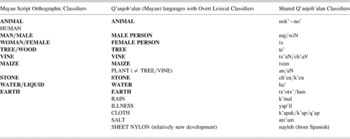
The argument for the existence of signs in Mayan writing that are used to classify other signs into semantic domains—as semantic classifiers—has recently been given strong support by Hopkins (Reference Hopkins1994) and Hopkins and Josserand (Reference Hopkins and Josserand1999). If these authors are correct, semantic classifiers are so pervasive in the script that epigraphers have taken them for granted. They are present in logographic signs, in which case they provide orthographic information about the semantic domain of the referent of the logogram, and in syllabographic signs, in which case they provide iconographic information about the iconic referents of the signs—but no information whatsoever about the phonetic value, since by definition semantic classifiers are divorced from phoneticism. Hopkins and Josserand (Reference Hopkins and Josserand1999:4) correlate the 10 semantic classifiers they have identified for Classic period Lowland Mayan texts, listed in Table 1, with the system of noun classifiers found in some Mayan languages, such as the Greater Q'anjob'alan languages (Chuj, Jakaltek, Q'anjob'al), which contain between them about 15 categories.
Comparison of glyphic and linguistic classifiers by Hopkins and Josserand (Reference Hopkins and Josserand1999:4)

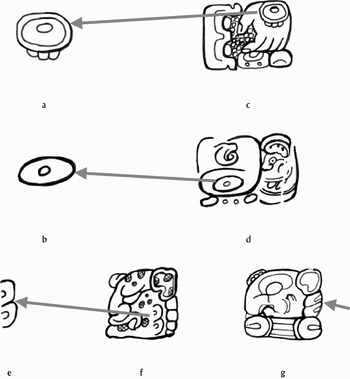
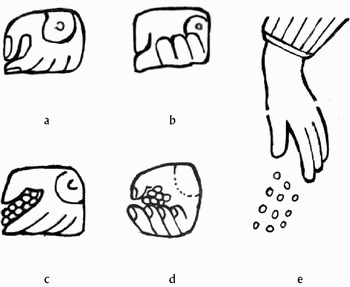
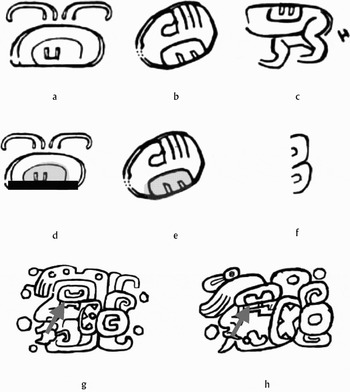
Hopkins and Josserand (Reference Hopkins and Josserand1999) note that while this classification system is overtly grammaticized in the noun system of the Greater Q'anjob'alan languages, it may also have been present in a more grammatically covert fashion in other Mayan languages, including the Ch'olan-Tzeltalan languages of the scribes who innovated the script. Figure 3a–d shows the use of a circular element that is apparently a semantic classifier for ‘(part of a) human’ (Hopkins Reference Hopkins1994:2) since it appears in signs—whether logographic or syllabographic—that iconically depict body parts. Hopkins and Josserand (Reference Hopkins and Josserand1999) have identified 10 such signs, including a DOUBLE.NOTCHED element seen in Figure 3e that seems to classify animals such as jaguars (Figure 3f) and rats (Figure 3g), as well as bats, among a few others.
(a) Example of circular element; (b) another example of circular element; (c) use of circular element inside T710 CHOK ‘to throw down’; (d) use of circular element on part corresponding to thigh on sign that depicts a torso and bent leg in seated posture (T644 CHUM ‘seated’). Drawings from Bricker Reference Bricker1986:Figures 163, 187; (e) double-notched element; (f) use on B'ALAM ‘jaguar’; (g) use on main sign (depicting a rat) of ch'o-ko ‘rat’ spelling (separate, logographic reading of RAT.HEAD sign as CH'OK has not been demonstrated). Drawings from Hopkins and Josserand Reference Hopkins and Josserand1999:Figure 12.

There are two points worth emphasizing. First, the semantic classifiers identified by Hopkins (Reference Hopkins1994) and Hopkins and Josserand (Reference Hopkins and Josserand1999) apply extensively to logograms and syllabograms but do not have disambiguating functions. Thus, T529 can be transliterated as STONEWITZ ‘hill, mountain’. Also, T710, whether used syllabographically as ye or logographically as CHOK ‘to throw down’, shows the HUMAN classifier (i.e., HUMANye/CHOK). Similarly, T644 can be transliterated as HUMANCHUM ‘to be seated’. Below it is suggested that, in the development of a script, semantic classifiers are more likely to precede semantic determinatives. If so, one would expect to find very few semantic determinatives in the earliest texts, given that they show perhaps only a handful of semantic classifiers such as the reflection bands (indicative of objects with polished surfaces such as jade, obsidian, any stone, etc.), but that is a topic for further research.
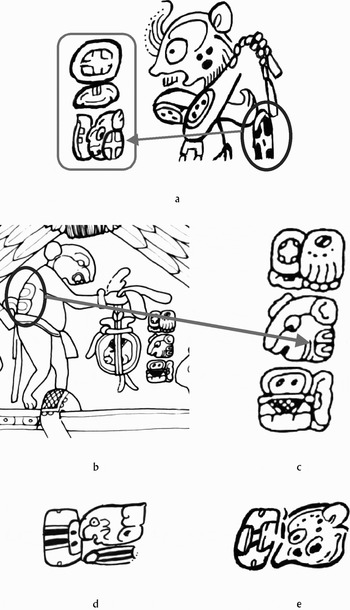
A possible example of a semantic classifier associated with a fully phonetic spelling of a term is found in a stucco panel from Tonina (Figure 4). In Figure 4c, the caption placed in front of a pictorial depiction of a pocket gopher is read K'AN-na-b'a for k'an-al b'a ‘yellow pocket gopher’ attested in Tzeltal (Bricker Reference Bricker1986:136). This thus shows a purely phonetic spelling of ‘gopher’. Interestingly, the second glyph block of the caption is T758, which is iconically MOUSE/RAT and has the syllabographic value ch'o; this syllabographic value was undoubtedly derived acrophonically from Proto-Ch'olan *ch'ohok ‘rat’ (Mora-Marín Reference Mora-Marín2003). Evidence for this is found in spellings of the common expression T758:110 CHAK-ch'o-ko for chak ch'ok ‘Great Youth’, where *ch'ok ‘sprout (and by metaphoric extension, youth)’, a term that is completely unrelated to *ch'ohok ‘rat’, as in Figure 4d. In some alternative spellings of this epithet, one finds simply T758 ch'o with no T110 ko, as in Figure 4d; these spellings with T758 ch'o alone suggest a logographic value CH'OK ‘youth, young’, via a rebus-spelling practice based on the near-homophony between Proto-Ch'olan *ch'ohok ‘rat’ and *ch'ok ‘sprout’. (It is quite likely, therefore, that a logographic value CH'OHOK ‘rat’, based on iconic transparency, could exist for T758 as well.) In Figure 4a, one finds K'AN-na B'AH, with T757 GOPHER, used logographically as B'AH ‘gopher’ and (through rebus) as B'AH ‘self, head, top, first’. In this instance, there is no following T758; it is followed instead by *’u-wa-WAY-ya ‘(the) alter ego of’. The absence of T758 from this alternative spelling of the term for ‘yellow pocket gopher’ as K'AN-na-B'AH strongly suggests that it was not pronounced in the Tonina example. Also, the corresponding term for ‘yellow pocket gopher’ is attested as k'anal b'a in Tzeltal (Bricker Reference Bricker1986:136), not as k'anal ba ch'o, which is what one would expect if T758 ch'o/RAT were supposed to be read aloud in the Tonina example. (Kaufman [Reference Kaufman1972:101] reconstructs Proto-Tzeltalan *ch'oh ‘rata, ratón’, which would be cognate with Proto-Ch'olan *ch'ohok.) This example is sufficiently constrained orthographically (spelling variation showing presence and absence of T758) and linguistically (Tzeltal attestation) to suggest that T758 was used as a semantic classifier RODENT in the Tonina example. This is a strong case for a semantic classifier involving a phonetic spelling (i.e., K'AN-na b'a, where b'a is purely phonetic for b'ah ‘gopher’) and, in this case, a following classifier (i.e., K'AN-na b'aRODENT). Perhaps T758 was used as a classifier in the spelling K'AN-na-b'a in Figure 4c because the spelling is phonetic (i.e., T501 b'a for b'a(h) ‘gopher’) rather than logographic, as with T757 B'AH in K'AN-na B'AH in Figure 4a, which already uses T757 GOPHER as the logogram B'AH for b'a(h) ‘gopher’. The case also suggests that the T281 K'AN ‘yellow, precious’ logogram typically present inside T757 B'AH/b'a functions as a semantic classifier that specifies the biological identity of the iconographic referent of the glyph, even in contexts where it is not spelling the word for ‘gopher’ but is simply used to spell b'ah ‘head, image, top’ or a phonetic sequence /b'a/—which constitute the vast majority of uses of T757. As summarized above, other scripts show examples of semantic classifiers that are attested with very few words, however spelled (logographically or phonetically), sometimes even with a single word. This may be the case with the use of T281 as an infix to T757.
(a) Detail from Tonina stucco wall: K'AN-na-b'a ?CH'OHOK xa-MAN-na. Drawing by Linda Schele (no. 6505, www.famsi.org); (b) detail from polychrome vase K2023: K'AN-na B'AH. Drawing by the author based on details of photographs in Kerr (Reference Kerr2007); (c) Tonina stucco wall glyphic caption K'AN-na-b’a?CH’OHOK xa-MAN-na. Detail of drawing by Linda Schele (no. 6505, www.famsi.org); (d) detail from K2796: CHAK-ch'o-ko ‘Great Youth’; (e) detail from K530: CHAK-?CH'OK ‘Great Youth’. Drawing by the author based on details of photographs in Kerr (2007).

THE CASE FOR SEMANTIC DETERMINATIVES
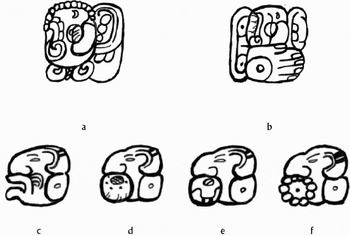
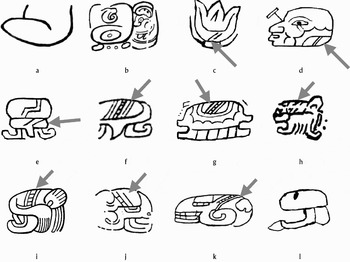
To date, only a few signs are regarded as examples of semantic determinatives in Mayan writing. Kelley (Reference Kelley1976:150) suggests that T122, a sign that depicts smoke, may have functioned as a semantic determinative in certain cases, particularly in the spelling of the word *k'ahk' ‘fire’ as T122:669, as opposed to spellings such as T669:669 k'a-k'a, where the word was spelled out in full. Following this analysis, T122:669 would be read SMOKEk'a for k'ahk' ‘fire’. Bricker (Reference Bricker1986:11–12) has suggested that T503, logographic ’IK' ‘wind’, could also function as a semantic sign when infixed inside T668, syllabographic cha, to distinguish it from T669a, syllabographic k'a. The disambiguation would be semantic; T503 would be associated with wind, and therefore with storms, rain, lightning, the domain of the Rain God, CHAHUK or CHAK, chahuk/chahk ‘rain’. Perhaps the two best examples are the day sign cartouche and pedestal (Justeson Reference Justeson1978, Reference Justeson1986; Figure 5a), used with T528 CHAHUK/CHAK ‘rain, lightning’ (Figure 5b). Neither was obligatory. While monumental inscriptions typically require the cartouche (Figure 5c), and frequently show the pedestal (Figure 5d), painted texts on murals, pottery, and the codices often lack the pedestal, and in the codices at least, they may also lack the cartouche. Schele (Reference Schele1983) has also proposed that the ROYAL.HEADBAND sign was a semantic determinative; when placed on the glyph depicting the head of a man or a vulture, it would index the value ’AJAW ‘lord, ruler’ (Figure 5e)—hence, the appropriateness of the transcription ROYAL.HEADBAND’AJAW ‘lord, ruler’, or RH’AJAW ‘lord, ruler’ for short.
However, there are other examples of the use of semantic determinatives in Mayan writing used for orthographic disambiguation. One is illustrated by the use of the generic male head sign that corresponds approximately to T1008 (Figure 5f), which Zender (Reference Zender1999) has described as a basic element of a variety of composite signs with different values: WINIK, XIB', KELEM, and ’AJAW. The case of ’AJAW is an addition to this set that I propose in this paper. This sign is made up of the generic male head sign plus the royal headband semantic determinative to be read RH’AJAW ‘lord, ruler’ (Figure 5e). Similarly, when T117 wi is added as a phonetic complement (i.e., determinative), one obtains another value: wi-WINIK ‘person, man’ (Figure 5g). Zender (Reference Zender1999) also notes that T220e is used with T1008, which probably has the value KELEM ‘youth, young’ in this context (Figure 5h). This is based on the assumed graphemic equivalency between T220e and T770; the latter sign (first sign in Figure 5j), which is iconically a HAND sign, has been deciphered as a syllabogram ke. Therefore, the examples of T220e, also iconically a HAND sign, found before T1008 as KELEM are thought to read ke-KELEM (Figure 5i). Of course, there is evidence for the substitutional relationship between spellings such as ke-le-ma and the proposed logogram KELEM, which I do not dispute, especially since such a proposal is supported by at least two examples of the logogram subfixed by T74 ma. Note, however, that the HAND sign used with T1008—namely, T220e—is not identical to T770 ke: T220e is shaped and placed with respect to T1008 in such a way that the resulting composite sign seems to depict a thumb-sucking child, suggesting that it is used as a semantic classifier—that is, to relate the generic male head to the concept ‘youth’—and raises the question of whether T220e is really equivalent to T770 ke. To my knowledge, T220e is only used in the T220e-KELEM context (i.e. as THUMB.SUCKINGKELEM or TSKELEM for short). T770 ke is used elsewhere, as seen in the contrast between the logographic (with T220e) and syllabographic (with T770) spellings of the term in Figure 5j.
(a) T528 as KAWAK/CHAHUK inside day-sign cartouche and pedestal; (b) T528 as logographic TUN ‘stone’ or syllabographic ku when outside cartouche and pedestal; (c) day-sign cartouche; (d) day-sign pedestal. Drawings by the author after Zender Reference Zender1999:Figure 14. Examples of generic male head sign with semantic or phonetic determinatives: (e) royal headband semantic determinative: HEADBAND’AJAW; (f) T117 wi as phonetic determinative or complement: wi-WINIK; (g) ke as semantic and phonetic determinative: ke-KELEM. Drawings by the author after Zender Reference Zender1999:Figure 16; (h) T220-KELEM-ma on Xcalumkin Panel 6; (i) ke-le-ma on. Drawings by the author after Zender Reference Zender1999:Figure 16; [j] ke-le-ma spelling on unprovenienced pottery vessel.

T1008, the generic male head, was a potentially polyvalent sign that required a phonetic or semantic determinative for disambiguation. The default logographic value of this sign, when lacking the spot on the cheek, may have been WINIK ‘man, person’ (Figure 5g) rather than XIB' ‘male’, since the latter reading seems to require the spot on the cheek (Figure 5f). The spot on the cheek therefore may have been a semantic determinative for the reading XIB' ‘male’ of T1008: SPOTXIB' ‘male’. I have yet to find evidence to suggest that T1008 was also a semantic classifier by itself, as T1000a,b/1001c/1002 may have been. Evidence could come in the form of spellings such as T1008-wi-ni-ki contrasting with spellings such as T1008-’a-ja-wa, but I know of no such spellings. Hence, I use asterisks—for example, *T1008-wi-ni-ki, *T1008-’a-ja-wa—to indicate that such spellings are unattested but might be possible if T1008 is in fact a semantic classifier.
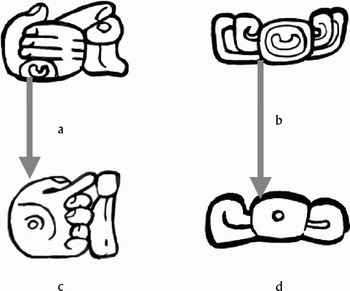
Another interesting example is that of T710 (Figure 6). As a plain hand, T710 has a syllabographic value ye (Figure 6a–b), probably derived acrophonically from ye’ ‘to grab with, to carry by the hand’ (Aulie and Aulie 1998:158), as Hopkins (personal communication 2006) has observed, but when the SPHERULES icon is present, T710 has the logographic value CHOK ‘to throw (down)’ (Figure 6c–d), even if the hand gesture is identical to that used for the syllabogram ye. There are very few instances where T710 lacks the spherules but must nonetheless be read as CHOK. These are very rare, and from context is it is always clear that CHOK rather than ye was meant. However, there are no cases, to my knowledge, of T710 meant to be read as ye in which the spherules are present. Thus, a better way to transliterate the logographic version is SPHERULESCHOK.
(a) T710 as syllabogram ye: Back view of hand; (b) T710 as syllabogram ye: Front view of hand; (c) T710 as logogram SPHERULESCHOK: Back view of hand; (d) T710 as logogram SPHERULESCHOK: Front view of hand; (e) pictorial representation of “throwing” or “scattering” act from Aguateca Stela 1 showing SPHERULES icon. All drawings by the author after unpublished drawings by Ian Graham.

An example that is similar to T710 is that of T740 (Figure 7a). This sign has two unrelated orthographic functions and values: logographic SIJ(YAJ) for sihj(-yaj) ‘to be born’ and syllabographic hu. It is likely that T740 SIJ(YAJ) ‘be born’ actually depicts a frog, while T740 hu depicts an iguana. Consequently, their iconic similarity may be due to graphic convergence, a possibility that requires and deserves future diachronic testing. T740 as SIJ(YAJ), the FROG sign, shows a foam-like substance around the mouth. T740 as hu, the IGUANA sign, does not have a foam-like motif. There are exceptions: there are cases of T740 as SIJ(YAJ) with no foam-like motif. However, to my knowledge, there are no cases of T740 as hu with the foam-like motif. The hu value, deciphered by Grube, is widely regarded as derived acrophonically from Proto-Ch'olan *huj ‘iguana’. Thus, the sign most likely depicts an iguana. The foam-like motif, often found in iconographic depictions of frogs, generally distinguishes the two values, and is used on the sign with a logographic value, and thus T740 should be distinguished as follows: FOAMSIJ(YAJ) and hu.
T740 in its two functions. (a) FOAMT740 in spelling of FOAMSIJYAJ-ya-ja; (b) T740 in spelling of hu-na ‘paper (headband)’. Drawings by Linda Schele. Example of T528 by itself and with semantic determinatives. (c) T128 as logogram TI’; (d) T128[501] ’UK' ‘to drink’; (e) T128[506] WE’ ‘to eat’; (f) T128[582] NUN (unclear meaning). Drawings by the author after Zender Reference Zender1999:Figure 20.

Another example is illustrated by the use of T501, T506, and T582, which had logographic (i.e. T501 HA’, T506 WAJ, T582 MO’/mo) and syllabographic (e.g. T501 b'a, T582 mo) readings of their own. However, these signs could be subfixed to T128, or inserted in the personified form (head-version) of T128, which by itself had the logographic reading TI’ ‘mouth; end’ (Figure 7c), as Stuart (Reference Stuart1997) and Zender (Reference Zender1999) have shown. In such cases, these signs disambiguated one of at least three possible readings (there were perhaps two other signs that were distinguished by the insertion of one sign in the mouth of a personified T128 sign): T128[501] ’UK' ‘to drink’ (Figure 7d), T128[569] WE’ ‘to eat’ (Figure 7e), and NUN of unclear meaning (Figure 7f). Thus, in these contexts these signs served as semantic determinatives used for disambiguation. At the same time, the personified T128 head with its mouth open, which by itself represents TI’ ‘mouth; end’, is clearly also a semantic classifier, since it refers to different activities related in some way or another with the mouth. Neither of the component signs in this graphic compound is read aloud by itself, but instead they determine the reading that the two of them have together.
Zender (Reference Zender1999) has pointed out that these uses correspond closely to the Sumerian composite signs, where, in one instance, a number of different signs (e.g., FOOD, WATER) are placed in the mouth of a head-shaped sign (i.e., HEAD) to produce a number of different logographic readings (e.g., EAT, DRINK). Zender (Reference Zender1999:70) uses the term relational units to refer to the Mayan examples, basing it on the common cross-script strategy whereby “organizations of graphic units also commonly represent linguistic units” (Justeson Reference Justeson1978:49). He argues that such relational units are not semantic determinatives. However, his claim is based on an assumption that is unwarranted: he assumes that semantic determinatives serve to semantically disambiguate two or more otherwise homophonous readings of a logogram, and suggests that this is the case in all the scripts where semantic determinatives are used (Zender 1999:42).
Based on this narrow definition of semantic determinatives and their function, Zender (Reference Zender1999) has called into question whether such signs exist in Mayan writing. As discussed above, while some scripts do use semantic determinatives in this way, that is to disambiguate between homophonous readings of a logogram, as in the Egyptian Hieroglyphic case, this is not the only way, in many cases not even the more common way, in which many scripts use semantic signs. Some scripts use semantic signs to classify semantic domains (semantic classifiers); disambiguation (by means of semantic determinatives) is not their primary function. Egyptian Hieroglyphic has semantic classifiers in addition to semantic determinatives. Thus, a broader definition of semantic signs that allows for both determinative (disambiguating) and classifier functions is sufficient to solve the problem. Also, a broader definition of semantic determinatives is required by the cases discussed above; one where disambiguation is the key, whether it is between a logogram and a syllabogram, or between two different logographic values of the same sign. The crucial point is that such determinatives be used for semantic disambiguation.
Zender (Reference Zender1999:42–43) also suggests that scripts with semantic determinatives require a large number of signs, more than the few hundred that are estimated to have been in use by Mayan scribes at any one time (Grube Reference Grube, Robertson and Fields1994). Nevertheless, there are several facets of Mayan writing and other scripts that suggest this is not the case; some of these are acknowledged by Zender (1999). First, a single Mayan sign can be polyvalent, a fact that means that there are many more orthographic values in the system than there are signs for: thus T528 could have the logographic values TUN ‘stone’, CHAHUK/KAWAK ‘lightning’, as well as the syllabographic value ku. As can be seen with the examples from Figure 5 above, the day sign cartouche and pedestal are diagnostic (i.e., semantic determinatives) of the use of T528 as a day sign. Without them, T528 could have any one of the readings ku/TUN/HAB', but not normally CHAHUK/KAWAK ‘lightning’. Zender (Reference Zender1999) points out that there are examples of day signs used with their corresponding cartouches (in one example even a day sign pedestal) outside of day sign contexts. He discusses the cases of DAYT501 used as b'a, as in the spelling of b'a-ka-b'a, and DAYT524 used as HIX in the spelling of ’IX(IK)-HIX-WITZ-’AJAW, otherwise spelled also as HIX-WITZ-’AJAW.
Second, the argument for the total number of signs in the script as a crucial factor influencing the existence of semantic determinatives is also lessened by cases where signs with values of their own could be used as relational units to combine into composite signs with new values of their own: thus T60 hi and T528 ku/TUN/CHAHUK/KAWAK/HAB' could be combined graphically as T60:528 and the result was a new composite sign with the syllabographic value hi, deciphered by David Stuart. Zender (Reference Zender1999:72) himself notes that these facts (polyvalence, use of signs as relational units to compose new signs) make it very difficult to determine a figure that accurately represents the total number of signs in the script:
When [composite signs are] considered in tandem with polyphony, one has to wonder whether the apparent number of signs in a script are at all related to the number of unique word/concept-signs that a writing system actually has recourse to.
In fact, cross-script comparison suggests that the number of signs in a script has nothing to do with the existence or frequency of use of semantic determinatives. As mentioned, Melchert (personal communication 2004) observes that the total number of Hieroglyphic Luvian signs is about 500, of which only about 200–300 were in use at any given time, yet just about every logogram in the script could be used as a semantic classifier. In the case of Elamite writing, a cuneiform script, “only 100–140 signs are attested” for any period, yet it also made use of semantic determinatives or classifiers (Stolper Reference Stolper and Woodard2004:67). In both scripts, the classifier signs belonged to the same class of signs used as logograms and, in some cases, to the class of signs used as syllabograms. In such scripts, as in Mayan, a single sign could serve multiple functions.
Zender (Reference Zender1999) uses another piece of evidence to argue against a class of semantic determinatives in Mayan writing. He discusses the uses of the day-sign cartouche (hereafter, DAY), which has been regarded as the prime example of a semantic determinative in Mayan writing, in contexts where it clearly did not have a calendrical function. The day-sign pedestal is probably a more reliable diagnostic than the day-sign cartouche. To my knowledge there is only one instance of a day sign used with a day-sign pedestal in a non-calendrical context, namely, T524 in a proper name of the same lady whose name is partly illustrated in Figure 8d. Normally, a sign such as T501 could have the values b'a or IMIX ‘first day of ritual calendar’. However, scribes distinguished the functions of this sign by means of the day-sign cartouche. In a calendrical context, T501 uses the day-sign cartouche (i.e., DAYT501 for DAYIMIX, not DAYb'a), while in a non-calendrical context, T501 does not use the day-sign cartouche (i.e., T501 for b'a). Zender points out that there are instances in which both T501 b'a/DAYIMIX and T524 HIX/DAYJAGUAR were used in non-calendrical contexts, with their day-sign cartouches as DAYb'a and DAYHIX, respectively (Figure 8).
Uses of cartouches outside day0sign context. (a) Typical spelling of title b'a-ka-b'a; (b) rare spelling of title b'a-ka-DAYb'a with cartouched T501 sign; (c) spelling of title HIX-WITZ ’a-’AJAW-wa; (d) spelling of same title as DAYHIX-wi-tzi ’AJAW. Drawings by the author after Zender Reference Zender1999:Figure 8; (e) Glyph D2 on Bonampak Panel. Drawing by the author after Schele Reference Schele1982:130; (f) Palenque Tablet of the Cross Incensario. Drawing by the author after Schele and Mathews Reference Schele and Mathews1979:281.

In at least one instance, T671 chi/DAYMANIK is used with the day-sign cartouche in a non-calendrical context (as DAYchi) (Figure 8e), in the spelling of ’OCH-chi-K'AK' ‘s/he fire entered’, and in at least one instance, T528 ku/TUN/DAYCHAHUK//DAYKAWAK is also used with the day-sign cartouche in a non-calendrical context (as DAYTUN) (Figure 8f). However, such examples are extremely rare. Further, they are unlikely to cause ambiguity due to their contexts. DAYb'a was used in the spelling of b'a-ka- DAYb'a, a very frequent title that almost always appears at the end of a nominal phrase containing several titles and epithets. If we compare this example with the dozens of instances in which the distinction was maintained, we must conclude that these rare occurrences were probably of a playful nature rather than a dissolution of the distinction between the calendrical and non-calendrical contexts of the set of signs used as day signs.
DIACHRONIC DEVELOPMENT
The earliest Mayan texts do not show the widespread use of semantic classifiers one sees in later texts. For example, the likely predecessor of T644 CHUM attested in the Dumbarton Oaks quartzite pectoral (Figure 9a), which dates to the Late Preclassic period (400 b.c.–a.d. 200) does not bear the semantic classifier for HUMAN that T644 bears in Classic period texts (Figure 9b), as pointed out by Hopkins and Josserand (Reference Hopkins and Josserand1999).
In fact, it is not clear that the Dumbarton Oaks quartzite pectoral, undoubtedly one of the earliest Mayan texts, bears any semantic classifiers. One likely candidate is the so-called REFLECTION sign that is used on objects with polished surfaces (Figure 9c–f). It is in fact present on the pectoral, and its evolution can be traced in later texts. The T757 GOPHER sign was discussed earlier in relation to its common infix T281 K'AN ‘yellow, precious’, which Bricker (Reference Bricker1986:136) had analyzed as a silent marker used to specify the species of gopher, the yellow pocket gopher, that T757 depicts iconically. The earliest occurrences of this sign do not bear such an infix (Figure 9g–k), also suggesting that it was a later, possibly Early Classic, addition.
(a) Glyph A5 on Dumbarton Oaks quartzite pectoral. Drawing by the author; (b) Classic-period SIT/SEATED glyph. Drawing from Bricker Reference Bricker1986:Figure 187; (c) Glyph A3 on Dumbarton Oaks quartzite pectoral; (d) Glyph 2 on unprovenienced clamshell jade effigy pectoral (K763); (e) Glyph A1 on the Dumbarton Oaks quartzite pectoral; (f) Glyph B1 on a jade plaque from Costa Rica; (g) Glyph C2 on Pearlman conch shell text; (h) Glyph A5 on diorite axe from Hatzcap Ceel; (i) Glyph B1b on slate mirror-back disk from Jade Museum in Costa Rica; (j) Glyph A3b on tubular jade bead from the Sacred Cenote at Chichen Itza; (k) Glyph A1b on Brooklyn Museum of art pectoral jadeite mask; (l) Glyph D5 on the Dumbarton Oaks quartzite pectoral. All drawings by the author.

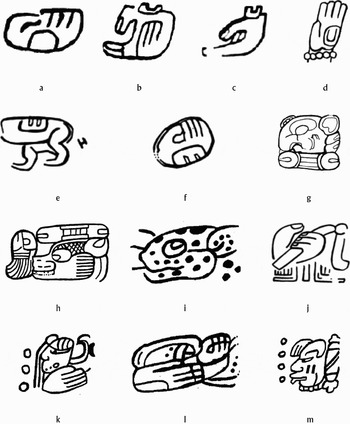
As for the distinction between the HUMAN and ANIMAL classifiers, an interesting pattern emerges when it is studied diachronically. As noted earlier, Hopkins and Josserand (Reference Hopkins and Josserand1999) propose a circular element to classify a HUMAN category, while a double-notched element seems to classify an ANIMAL category. This distinction is not present in the earliest texts. For instance, the likely T671 chi hand on the Dumbarton Oaks pectoral (Figure 10a) shows a cartouche with no elements inside of it. Nor is there evidence that one once existed but has worn off. There is not a single example on that text of a U- or II-shaped element inside a human or animal sign. Other Late Preclassic texts provide evidence for the U-shaped element on human body parts, particularly hands (Figure 10b–d) or for the II-element on both human and animal body parts (Figure 10e–f). But where do these U- and II-shaped elements come from, and how do they lead to the circular and double-notched elements from the Classic period? Before proceeding along this vein, one more observation is necessary: the HUMAN and ANIMAL classifiers were still not common during the Early Classic period, as can be seen in several cases of the B'ALAM ‘jaguar’ glyph (Figure 10h–i) and cases of signs depicting human hands (Figure 10j–l). However, there are interesting cases of other classifiers that are not commonly seen, such as a possible case of the numeral sign FOUR used as a classifier for the Sun God glyph, K'INICH (Figure 10m), the same glyph that was used as the head variant of the numeral ‘four’.
(a) Glyph B1a on Dumbarton Oaks quartzite pectoral; (b) glyph on Pomona Flare; (c) glyph on carved stone bowl; (d) glyph on Brooklyn Museum of Art pectoral jadeite mask; (e) glyph on steatite were-jaguar figurine; (f) glyph on steatite were-jaguar figurine; (g) glyph ch'o-ko with II-shaped element; (h) spelling CHAK-ka-B'ALAM on slate mirror-back disk from Jade Museum in Costa Rica; (i) B'ALAM ‘jaguar’ glyph on Early Classic jade pendant from Costa Rica; (j) Glyph A2 on Dumbarton Oaks jade celt fragment; (k) Glyph A2 on Early Classic jade pendant from Costa Rica; (l) Glyph A8 on Early Classic jade pendant from Costa Rica; (m) Glyph A6 on Early Classic jade pendant from Costa Rica. All drawings by the author.

In Figure 10e–g, a similarity between the ANIMAL, double-notched classifier and the II-shaped element of the early texts, found with both animal and human body parts, can be appreciated. Here I argue that animal (Figure 10e) and human (Figure 10f) icons were labeled the same during the Late Preclassic period. The question, then, is: how did they become distinct in later texts?
Part of the answer lies in Lacadena's (Reference Lacadena Garcia-Gallo1995) seminal study of Mayan paleography, in which he describes an analogical change that spread across all the possible graphic environments, between about a.d. 500 and 600, and that involved all signs that contained a U-shaped iconic element, which changed to an O-shaped iconic element (Figure 11).
Signs for TSUTS ‘to finish’ and yu. (a–b) Early Classic forms with U-shaped elements; (c–d) later forms with O-shaped elements. Drawings from Lacadena 1996:210–211.

As suggested in Mora-Marín (Reference Mora-Marín2001), this change apparently took place at different times in the iconographic and glyphic systems. In the iconographic system, the change happened earlier. In fact, a state of variation is observed by a.d. 200 in examples such as the Pomona Flare, as in the iconic elements of the head glyph for K'INICH ‘Sun God’ (Figure 12a–b). This example serves as an iconographic precursor to the later glyphic changes described by Lacadena (Figure 12c–d). Evidence from the Pearlman conch shell, an unprovenienced text that may date to a.d. 400–500 (Schele and Miller Reference Schele and Miller1986), indicates variation in the glyphic system between normal U-shaped elements (Figure 12e) in glyphs and U-shaped elements that show closing into an O-shaped element (Figure 12f).
Variation between U- and O-shaped elements in pictorial art (iconography) and the glyphic system. (a–b) Glyph for K'INICH ‘Sun God’ on the Pomona jade earflare. Drawings by the author; (c–d) examples of T62 yu. Drawings from Lacadena 1996:210–211; (e–f) glyphs from the Pearlman Conch Shell showing U-shaped elements. Drawings by the author.

The second part of the puzzle can be solved by noting that, in the text on the steatite were-jaguar figurine, the U-shaped element clearly visible on one sign (Figure 13a) is very similar to the II-shaped element present on a human hand sign (Figure 13b) and a beheaded jaguar sign (Figure 13c). It is not hard to visualize how the U-shaped element in Figure 13a could easily lead to the II-shaped element if it were placed along the outline of the enclosing cartouche instead of right in its center (Figure 13d–e). Consequently, it is possible that the II-shaped element was simply an artistic variant of the U-shaped element. Significantly, this variation between the II-shaped and U-shaped elements would explain why the Early Classic period human signs use the U-shaped element, when the Late Preclassic period apparently used a II-shaped element. They were both variants of the same, basic sign, but one of the variants was discontinued—for human body parts, at least—while it remained in use for animals. Thus, the double-notched element that classifies animals (Figure 13f) was derived from the II-shaped element that was formerly a variant of the U-shaped element. We are dealing here with a process analogous to a case of phonemic split as defined in historical linguistics. Supporting evidence for this hypothesis is found in the existing variation in the Pomona Flare, as seen in Figure 13g–h, where the U-shaped element is seen fully contained within a cartouche in one case (Figure 13g), but only partly so in the other case (Figure 13h), in which the U-shaped element was placed long the outline of the cartouche.
Origin of II-shaped element (ANIMAL classifier). (a–c) Glyphs on the steatite were-jaguar figurine; (d) glyph on were-jaguar figurine showing presumed variant of U-shaped element; (e) glyph on were-jaguar figurine highlighting similarity with the presumed variant in the preceding figure; (f) double-notched element (ANIMAL classifier) of Late Classic texts; (g) iconic use of U-shaped element showing it inside a cartouche without touching the cartouche's border. Drawing of detail from Pomona Flare by the author; (h) iconic use of U-shaped element showing it inside a cartouche touching the cartouche's border. Drawing of detail from Pomona Flare by author.

What this evidence suggests is that semantic classifiers have developed in tandem with both the iconographic and the glyphic systems. The iconographic variation between U-shaped and O-shaped elements served as the motivation for the eventual change of U-shaped to O-shaped elements in the glyphic system. And this change apparently led to a split of the U- and II-shaped elements, formerly simple variants, to a distinction between O-shaped element for HUMAN and II-shaped elements for ANIMAL.
CONCLUSIONS AND FUTURE RESEARCH
I propose that Mayan scribes distinguished between semantic determinatives (e.g., day-sign cartouche and pedestal; royal headband; T501 vs. T506 when used in combination with T128 TI’ ‘mouth; end’) used to distinguish logographic values of signs from other values, on the one hand, and, on the other, semantic classifiers that could be generic (e.g., CIRCLE for ‘human’, CABAN.CURL for ‘earth’) or specific (e.g., T251 K'AN inside T757 B'AH). A plurality of semantic classifiers probably exists, recruited from the ranks of logographic signs in most cases but also, perhaps, from more commonly iconographic signs. Such signs need to be discovered and catalogued not only because epigraphers need to take them into account in the process of decipherment, but also because they can offer a great deal of insight into the historical development of the script.
The data discussed here have a number of implications for the historical development of Mayan writing. One is the possibility that semantic classifiers and determiners could be reinterpreted as logographic signs, which could then be thought of (synchronically and diachronically) in compositional terms—that is, in terms of relational units. This is suggested by the expressions based on T1008, which served as the compositional base for a variety of glyphs such as RH’AJAW and TSKELEM. These apparently were understood as logograms themselves, given the use of phonetic determinatives attached to the semantic determiner + base compounded logogram (e.g., RH’AJAW-wa, TSKELEM-ma). And while a graphic composition such as T117.1008 wi-PERSON (Figure 10c), involving a logogram preceded by a phonetic determiner, was apparently not made into a compounded logogram itself, there is evidence of “frozen spellings” or “templates” that were based on a sequence of syllabograms which were apparently reinterpreted as a compounded logogram (e.g., chu[ku]-ka-ja rather than chu-ka-ja, both for chuk-aj; ch'o[ko]-ko rather than ch'o-ko, both for ch'ok ‘youth, sprout’) on which additional syllabograms would be added to spell necessary suffixes, as discussed by Zender (Reference Zender1999) and Tokovinine and Davletshin (Reference Tokovinine and Davletshin2001).
More work is needed to identify spellings of the various types discussed here, especially of cases of full phonetic spellings that precede or follow a logogram. Such spellings are indicative of the use of semantic determinatives and classifiers in other scripts around the world. However, additional contextual analysis in Mayan texts is needed to determine whether they can be described as cases of logograms preceded or followed by full phonetic complements or as cases of semantic signs disambiguating or classifying a phonetically spelled word. What is clear is that statements suggesting that a “pattern of fully syllabic spellings accompanied by logographs is no longer thought to characterize Maya writing” (Houston and Coe Reference Houston and Coe2003:154) are rather premature, and the topic should be problematized and approached systematically, without biases, for not only are such spellings typical of logophonetic scripts, and not exaggerations of scholars, but merely intentional “exaggerations” of the scribes themselves (Kelley Reference Kelley1976:176).
RESUMEN
El presente artículo discute una práctica de deletreo fonético en la escritura jeroglífica maya que no ha recibido suficiente atención: el uso de complementos fonéticos que delimitan en forma completa la lectura de un logograma (por ejemplo, wa-WAY-ya, wa-ya-WAY, WAY-wa-ya, para representar *way, “nagual, brujo”), en vez de hacerlo en forma parcial (wa-WAY, WAY-ya), la cual fue la práctica estandarizada. La práctica en cuestión es particularmente inusual cuando los complementos fonéticos se anteponen o posponen por completo al logograma. Tal práctica es común en sistemas de escritura del Viejo Mundo, como en la escritura jeroglífica egipcia, en los cuales se le ha concebido como práctica diagnóstica de la presencia de semantogramas—signos mudos que categorizan los referentes pictóricos, pero no necesariamente lingüísticos—de los logograms con los cuales están asociados en el texto. Además, también se propone una distinción entre dos tipos de semantogramas, o signos de función puramente semántica: determinativos semánticos, los cuales distinguen entre dos valores ortográficos de un mismo signo dado (T710 ye vs. INCIENSOT710 CHOK para representar *chok, “arrojar (hacia abajo)”), y clasificadores semánticos, los cuales simplemente categorizan a un objeto pictórico (HUMANO en partes del cuerpo humano vs. ANIMAL en partes del cuerpo de un animal). Finalmente se proponen varios ejemplos de cada tipo de signo, e incluso se ofrece un bosquejo de la evolución de varias grafías desde el punto de vista de clasificación de signos propuesto en este artículo.
ACKNOWLEDGMENTS
I am grateful to Lloyd Anderson, Nicholas Hopkins, and Martha Macri for their significant input, which has helped me improve the tone and methodological intelligibility of this paper.
The referees for this journal have made numerous observations and clarifications that have also helped to refine the paper. And last, I thank H. Craig Melchert for his comments regarding the nature of Luvian classifiers. Any deficiencies that remain are entirely mine.