Introduction
Recent research has begun to explore substance use in those who are at risk of developing psychosis. These young people have been described as being at clinical high risk (CHR) or ultra high risk of psychosis. The CHR state is characterized by the presence of subthreshold psychotic symptoms, brief intermittent psychotic symptoms, or family history of psychosis and recent decline in functioning (McGlashan et al. Reference McGlashan, Walsh and Woods2010). Interest in substance use in this population has developed, first, because it is well established that people with schizophrenia and other psychotic disorders have increased rates of substance use relative to the general population (Regier et al. Reference Regier, Farmer, Rae, Locke, Keith, Judd and Goodwin1990), and second, there has been an increase in epidemiological studies suggesting a role for cannabis in the onset of psychosis (Caspi et al. Reference Caspi, Moffitt, Cannon, McClay, Murray, Harrington, Taylor, Arseneault, Williams, Braithwaite, Poulton and Craig2005; Moore et al. Reference Moore, Zammit, Lingford-Hughes, Barnes, Jones, Burke and Lewis2007; Kuepper et al. Reference Kuepper, van Os, Lieb, Wittchen, Hofler and Henquet2011; Fusar-Poli et al. Reference Fusar-Poli, Bonoldi, Yung, Borgwardt, Kempton, Valmaggia, Barale, Caverzasi and McGuire2012).
A recent review of the literature (Addington et al. Reference Addington, Case, Saleem, Auther, Cornblatt and Cadenhead2014) reported on 10 studies evaluating substance use in CHR samples. Cannabis, alcohol and tobacco were consistently reported as the most commonly used substances. The use of other substances including hallucinogens, opioids, sedatives, stimulants, amphetamines, ecstasy and solvents was either negligible or absent. Cannabis and tobacco use was reportedly higher than in healthy controls (Auther et al. Reference Auther, McLaughlin, Carrion, Nagachandran, Correll and Cornblatt2012), with similar rates observed amongst those experiencing a first episode of psychosis (Addington & Addington, Reference Addington and Addington2007; Barnett et al. Reference Barnett, Werners, Secher, Hill, Brazil, Masson, Pernet, Kirkbride, Murray, Bullmore and Jones2007; Cooper et al. Reference Cooper, Mancuso, Borland, Slade, Galletly and Castle2012). Interestingly, only two of the CHR studies reported a relationship between substance use and transition to psychosis (Kristensen & Cadenhead, Reference Kristensen and Cadenhead2007; Cannon et al. Reference Cannon, Cadenhead, Cornblatt, Woods, Addington, Walker, Seidman, Perkins, Tsuang, McGlashan and Heinssen2008) whereas others reported no significant relationships between use severity and later transition to psychosis (Phillips et al. Reference Phillips, Curry, Yung, Yuen, Adlard and McGorry2002; Ruhrmann et al. Reference Ruhrmann, Schultze-Lutter, Salokangas, Heinimaa, Linszen, Dingemans, Birchwood, Patterson, Juckel, Heinz, Morrison, Lewis, von Reventlow and Klosterkotter2010; Thompson et al. Reference Thompson, Nelson and Yung2011; Auther et al. Reference Auther, McLaughlin, Carrion, Nagachandran, Correll and Cornblatt2012). These results were supported in a newly published study (Buchy et al. Reference Buchy, Perkins, Woods, Liu and Addington2014) that demonstrated that substance abuse did not contribute to the transition to psychosis in CHR youth.
There are several limitations with current studies examining substance use in those at CHR of psychosis (Addington et al. Reference Addington, Case, Saleem, Auther, Cornblatt and Cadenhead2014). First, the majority of studies lack details on the severity and frequency of substance use. Second, only one study included a healthy comparison group (Auther et al. Reference Auther, McLaughlin, Carrion, Nagachandran, Correll and Cornblatt2012), leaving unclear the prevalence of substance use in CHR youth relative to youth in the general population. Third, little is known about the change in substance use over time in this population. Fourth, in studies examining the substance use–transition to psychosis link, some recorded patterns of cannabis use only (Korver et al. Reference Korver, Nieman, Becker, van de Fliert, Dingemans, de Haan, Spiering, Schmitz and Linszen2010) whereas other studies grouped the use of any substance into one variable (Cannon et al. Reference Cannon, Cadenhead, Cornblatt, Woods, Addington, Walker, Seidman, Perkins, Tsuang, McGlashan and Heinssen2008; Thompson et al. Reference Thompson, Nelson and Yung2011). Fifth, studies that reported on smaller sample sizes may be underpowered to detect an effect of substance use on transition to psychosis. Further details on cannabis use in particular also deserve further evaluation as there are some results suggesting that cannabis use may be related to severity of attenuated psychotic symptoms (Corcoran et al. Reference Corcoran, Kimhy, Stanford, Khan, Walsh, Thompson, Schobel, Harkavy-Friedman, Goetz, Colibazzi, Cressman and Malaspina2008; Korver et al. Reference Korver, Nieman, Becker, van de Fliert, Dingemans, de Haan, Spiering, Schmitz and Linszen2010).
The aim of the present study was to evaluate in a large sample of CHR youth: (1) the prevalence, severity and frequency of substance use, as well as a more detailed assessment of cannabis use, relative to a healthy control group; (2) the relationship between substance use and participant demographics as well as severity of attenuated psychotic symptoms and negative symptoms; (3) change in substance use over a 1-year period; (4) substance use between those who made the transition to psychosis and those who did not; and (5) substance use amongst different groups defined by their clinical outcome after 2 years in the study, i.e. those who made the transition to psychosis, with those who did not but still have attenuated psychotic symptoms and with those whose attenuated psychotic symptoms are in remission.
Method
Participants
All participants were recruited as part of the eight-site North American Prodrome Longitudinal Study 2 (NAPLS-2) (Addington et al. Reference Addington, Cadenhead, Cornblatt, Mathalon, McGlashan, Perkins, Seidman, Tsuang, Walker, Woods, Addington and Cannon2012) which was established to investigate predictors and mechanisms of transition to psychosis. As described in Addington et al. (Reference Addington, Cadenhead, Cornblatt, Mathalon, McGlashan, Perkins, Seidman, Tsuang, Walker, Woods, Addington and Cannon2012) all participants are help-seekers and are responding to similar recruitment strategies across sites. The final NAPLS-2 sample consists of 765 CHR participants and 280 healthy controls. This paper reports on the 735 CHR participants (423 male, 312 female) and 278 healthy controls (140 male, 138 female) who completed baseline substance use assessments. All CHR participants were required to meet the Criteria of Prodromal Syndromes (COPS) using the Structured Interview for Prodromal Syndromes (SIPS) (McGlashan et al. Reference McGlashan, Walsh and Woods2010). Participants were excluded if they met criteria for any current or lifetime Axis I psychotic disorder, intelligence quotient <70 based on the Wechsler Abbreviated Scale of Intelligence (Wechsler, Reference Wechsler1999), past or current history of central nervous system disorder or Diagnostic and Statistical Manual of Mental Disorder, 4th edition (DSM-IV) criteria for current substance dependence disorder. Control participants were also excluded if they had a first-degree relative with a current or past psychotic disorder or any other disorder involving psychotic symptoms, could not meet criteria for any prodromal syndrome, any current or past psychotic disorder or a cluster A personality disorder diagnosis, and could not be currently using psychotropic medication. A more detailed description of participant details is provided elsewhere (Addington et al. Reference Addington, Cadenhead, Cornblatt, Mathalon, McGlashan, Perkins, Seidman, Tsuang, Walker, Woods, Addington and Cannon2012).
A proportion of those individuals (362 CHR participants, 142 healthy controls) who had completed the final 2-year assessment of the NAPLS-2 project and provided Alcohol and Drug Use Scale (AUS/DUS; Drake et al. Reference Drake, Mueser, McHugo, Sederer and Dickey1996) ratings were included in order to examine the association of baseline substance use to later clinical outcome, i.e. clinical status at the 2-year follow-up. This smaller sample included 90 participants (58 male, 32 female) who had made the transition to psychosis.
Informed consent was obtained from those who met criteria and were judged fully competent to give consent. Parental consent was obtained from parents/guardians of participants who were under the age of 16 years. The study was approved by the institutional review boards of all eight NAPLS-2 sites.
Measures
The SIPS and the Scale for Assessment of Prodromal Symptoms (SOPS) (McGlashan et al. Reference McGlashan, Walsh and Woods2010) were used to assess criteria for a prodromal syndrome and severity of attenuated positive symptoms and negative symptoms. The Structured Clinical Interview for DSM-IV (SCID; First et al. Reference First, Spitzer, Gibbon and Williams1998) was used to assess for current and lifetime substance abuse and dependence.
Alcohol and drug use was rated using the AUS/DUS (Drake et al. Reference Drake, Mueser, McHugo, Sederer and Dickey1996) which records severity (1 = abstinent, 2 = use without impairment, 3 = abuse, 4 = dependence) and frequency of use (0 = no use, 1 = once or twice per month, 2 = 3–4 times per month, 3 = 1–2 times per week, 4 = 3–4 times per week, 5 = almost daily) in the last month. Frequency of tobacco use was the only item rated differently (0 = no use, 1 = occasionally, 2 = less than 10 per day, 3 = 11–25 per day, 4 = more than 25 per day). Ratings were collected for tobacco, alcohol, marijuana, cocaine, opiates, phencyclidine (PCP), amphetamines, methylenedioxy-methylamphetamine (MDMA), γ-hydroxybutyric acid (GHB), huffing (inhaling glue, other volatiles), hallucinogens, and other drugs. Based on commonly used measures and interview questions in the literature (Arseneault et al. Reference Arseneault, Cannon, Poulton, Murray, Caspi and Moffitt2002; Caspi et al. Reference Caspi, Moffitt, Cannon, McClay, Murray, Harrington, Taylor, Arseneault, Williams, Braithwaite, Poulton and Craig2005; Henquet et al. Reference Henquet, Krabbendam, Spauwen, Kaplan, Lieb, Wittchen and van Os2005) we also enquired if cannabis had ever been used, how many times it had been used across one's lifetime, whether use was current and/or past, age at first use, frequency and pattern of use, environment of use (socially or alone), and time of day most frequently used (morning, evening, both).
Clinical status at the 2-year follow-up was determined in the following way: (1) healthy control (has never met criteria for a prodromal risk syndrome); (2) remission (scores of 2 or less on the five positive symptoms on the SOPS scale); (3) symptomatic (not currently meeting criteria for a prodromal risk syndrome but having ratings of 3–5 on any one of the five positive symptoms on the SOPS); (4) prodromal progression [currently meeting criteria for one of the at-risk syndromes; Attenuated Positive Symptom State (APSS), Genetic Risk and Deterioration (GRD), Brief Intermittent Psychotic State (BIPS)]; and (5) psychotic (currently meeting criteria for a psychotic disorder or evidencing scores of 6 on one or more positive symptoms of the SOPS).
Statistical analysis
We used χ2 or Fisher's exact analyses for categorical variables and t tests for continuous variables to compare CHR and control groups on demographics variables. The use of substances other than alcohol, tobacco or cannabis was either minimal or absent; therefore the use of these substances was not considered further in statistical analyses. Spearman's correlations were used to measure associations of cannabis use with demographics and symptom severity. Linear regression was used to determine predictors of continuous dependent variables. To account for any missing data and intra-participant correlation over time, mixed modeling was used to examine the group and time effects on AUS/DUS tobacco, alcohol and cannabis scores at baseline. In our sample of 362 CHR and 142 control participants who had been followed for 24 months, the Kruskal–Wallis test was used to compare the five groups based on 2-year clinical status (1 = healthy control; 2 = remission; 3 = symptomatic; 4 = prodromal progression; 5 = psychotic) on baseline substance use. We also compared those who had made the transition to psychosis with those who had not on baseline substance use using the Mann–Whitney test. The critical p value for the AUS/DUS analyses was set to p = 0.017 following Bonferroni correction for multiple comparisons of the three substances. Statistical analyses were conducted using SPSS 20.0 (USA).
Procedures
All eight sites (Emory University, Harvard University, University of Calgary, University of California at Los Angeles, University of California at San Diego, University of North Carolina at Chapel Hill, Yale University, and Zucker Hillside Hospital) recruited CHR individuals and controls. Raters were experienced research clinicians who demonstrated adequate reliability at routine reliability checks. ‘Gold standard’ post-training agreement on the critical threshold for determining initial eligibility and subsequent transition status based on the SIPS was excellent (κ = 0.90). The principal investigator, clinical psychiatrist or psychologist at each site conducted a comprehensive clinical assessment to determine if entry criteria were met. J.A. chaired weekly conference calls to review criteria for all individuals admitted to the study. Clinical assessments that included the AUS/DUS and the SOPS were conducted at baseline, and at 6 and 12 months. The study protocols and informed consents were reviewed and approved by the ethical review boards of all eight study sites.
Results
Demographics
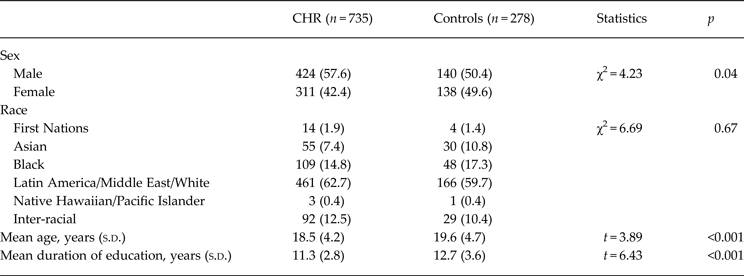
As summarized in Table 1, control participants were older, had more males and more years of education than those of the CHR group.
Demographic and clinical characteristics of the groups

Data are given as number of participants (percentage) unless otherwise indicated.
CHR, Clinical high risk; s.d., standard deviation.
SCID diagnoses
Of the participants, 55 (7.5%) CHR and two (0.8%) control participants met DSM-IV criteria for a current substance use disorder (χ2 = 17.04, p < 0.001, ϕ = 0.13). Cannabis abuse (0.4%) and dependence in remission (0.4%) were the only current diagnoses in the control group. Current diagnoses in CHR participants included cannabis (abuse, 3.3%; dependence in remission, 1.8%), alcohol (abuse, 2.0%; dependence in remission, 1.1%), amphetamine (abuse, 0.1%; dependence in remission, 0.1%), cocaine dependence in remission (0.1%), hallucinogen abuse (0.1%), other (0.4%) and polysubstance dependence in remission (0.1%).
For these individuals, it appeared at initial screening that they did not have a substance use problem; however, at the later baseline assessment when rated with the SCID it became apparent that they met criteria for a diagnosable substance use disorder. As the total n's for alcohol and cannabis dependence were relatively small these participants were included in statistical analyses.
AUS/DUS ratings at baseline
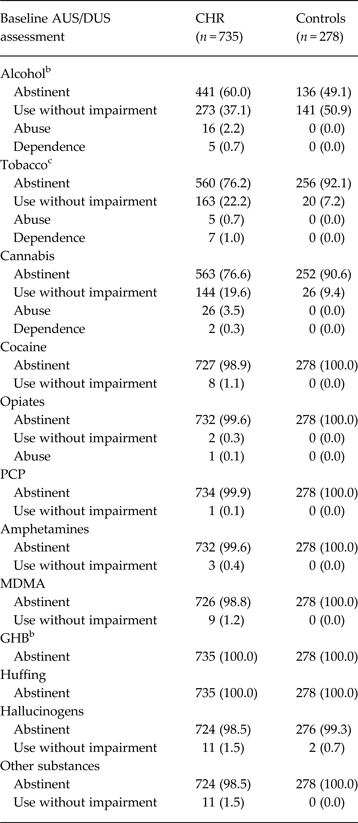
The use of substances other than alcohol, tobacco or cannabis was either minimal or absent; therefore the use of these substances was not considered further in relation to demographics, SOPS positive symptoms, transition to psychosis or clinical outcome. However, rates of use of all substances are presented in Table 2. When considering substance use severity as determined by the AUS/DUS, in the entire sample, males had significantly higher baseline tobacco (p < 0.01) and cannabis use (p < 0.01), but not alcohol use (p = 0.82). Being older significantly correlated with increased tobacco (r = 0.14, p < 0.001, r 2 = 0.02), alcohol (r = 0.39, p < 0.001, r 2 = 0.15) and cannabis use at baseline (r = 0.07, p < 0.05, r 2 = 0.004).
Severity of substance use as measured with the AUS/DUS at baseline in CHR participants and controls a

Data are given as number of participants (percentage).
AUS/DUS, Alcohol and Drug Use Scale; CHR, clinical high risk; PCP, phencyclidine; MDMA, methylenedioxy-methylamphetamine; GHB, γ-hydroxybutyric acid.
a Only ratings that were endorsed have been included in this table.
b Data were missing for one participant in the control group.
c Data were missing for two participants in the control group.
Alcohol use at baseline did not differ between males and females in either the CHR or control group (CHR, χ2 = 0.80, p = 0.85; controls, χ2 = 1.91, p = 0.17). Significant correlations were observed between participants’ age and alcohol use in both the CHR and control groups (CHR, r = 0.36, p < 0.001; controls, r = 0.48, p < 0.001).
For the CHR group, SOPS total attenuated positive symptom score significantly correlated with baseline tobacco use (r = 0.08, p < 0.05, r 2 = 0.006) and cannabis use (r = 0.12, p < 0.01, r 2 = 0.01), but not alcohol use (r = −0.07, p = 0.07). Cannabis use did not significantly correlate with SOPS total negative symptoms, (r = −0.007, p = 0.85). The correlation between tobacco use and SOPS total attenuated positive symptom score was non-significant when controlling statistically for cannabis use (r = 0.03, p = 0.38). The correlation between cannabis and SOPS total attenuated positive symptom score remained significant when entering tobacco use as a covariate (r = 0.10, p = 0.009, r 2 = 0.01).
Alcohol was the most frequently reported substance consumed by both CHR and control participants. Cannabis was reported as the most widely used illicit drug in both groups.
Course of substance use in the control and CHR groups based on AUS/DUS ratings
AUS/DUS ratings were available for 188 controls and 502 CHR participants at the 6-month assessment, and 197 controls and 393 CHR participants at the 12-month assessment.
Mixed modeling of tobacco scores showed that the CHR group had higher tobacco use severity compared with controls as revealed by a significant main effect of group [F = 39.2, degrees of freedom (df) = 1, 966.6; p < 0.001] (Fig. 1). The effect of time was non-significant (F = 0.04, df = 2, 1126.8; p = 0.96). No significant changes in tobacco use were observed over any time points in either group. Adding cannabis use as a covariate did not change interpretation of results.
Substance use ratings for the clinical high risk (CHR) and healthy control groups for (a) tobacco, (b) alcohol and (c) cannabis. Values are means, with standard errors represented by vertical bars. AUS/DUS, Alcohol and Drug Use Scale.

Results of mixed modeling of alcohol use indicated that the control group had higher alcohol use compared with the CHR group as indicated by a significant group effect (F = 5.5, df = 1, 970.8; p = 0.02) (Fig. 1). The main effect of time was non-significant (F = 1.9, df = 2, 1216.9; p = 0.15). Over the follow-up period, controls had significantly higher alcohol use at the 12-month assessment compared with baseline (p < 0.01). No significant changes in alcohol use were observed over any time points in the CHR group.
Finally, mixed modeling showed that cannabis use was significantly higher in the CHR group compared with controls (F = 27.9, df = 1, 970.5; p < 0.001) (Fig. 1). The main effect of time did not achieve significance (F = 0.53, df = 2, 1202.1; p = 0.59). No significant changes in cannabis use were observed over any time point in either group. Adding tobacco use as a covariate did not change interpretation of results. As a further test, we conducted linear mixed models to explore whether any of the attenuated psychotic symptoms covaried with substance use over the three time points. However, because use of these substances did not change over time, whereas there was significant improvement in attenuated positive symptoms (typically in the first 6 months), there was no covariation between substance use and individual attenuated psychotic symptoms.
Cannabis use questionnaire
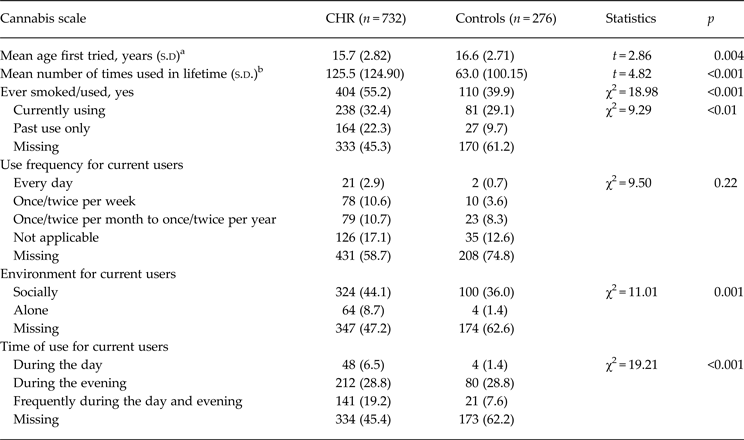
Cannabis use data were missing for two controls and three CHR participants. As presented in Table 3, the CHR group was significantly younger than controls when participants first tried cannabis. The mean number of times that individuals had used cannabis across their lifetime was higher in the CHR group relative to the control group, as was the number of people who had ever smoked or used cannabis. The CHR group was more likely to currently use alone and during the day than controls. Groups did not differ on use frequency.
Rates and patterns of cannabis use over lifetime by group

Data are given as number of participants (percentage) unless otherwise indicated.
CHR, Clinical high risk; s.d., standard deviation.
a Excludes participants who had never used cannabis.
b Excludes never-users.
Use of multiple substances
AUS/DUS substances reported to be most commonly used together were cannabis, alcohol and tobacco. In the CHR group, of those participants who used cannabis within the past month (n = 172), 130 (75.6%) also reported using alcohol, and 95 (55.2%) reported using tobacco. Of CHR participants who used alcohol in the past month (n = 294), 122 (41.5%) also reported using tobacco and 130 (44.2%) also reported using cannabis. Co-morbid use of other substances was either negligible or absent.
Relationship between substance use and clinical status at end of study
The sample of 504 participants who had completed the 24-month end-of-study assessment and had provided AUS/DUS ratings at baseline consisted of 142 healthy controls, 109 CHR participants in remission, 92 symptomatic CHR participants, 71 CHR participants who met criteria for prodromal progression and 90 who were psychotic. Results of the Kruskal–Wallis analysis indicated that the groups significantly differed on tobacco (χ2 = 19.60, p = 0.001, η 2 = 0.04) and cannabis use (χ2 = 14.41, p = 0.006, η 2 = 0.03), but not on alcohol use (χ2 = 4.97, p = 0.29). Considering tobacco, post-hoc tests indicated lower use in controls as compared with CHR participants who met criteria for prodromal progression (p < 0.001), who were symptomatic (p = 0.004) and who were psychotic (p < 0.001). For cannabis use, post-hoc tests showed that controls had significantly lower use than CHR participants who were symptomatic (p = 0.005), in remission (p = 0.01) and were psychotic (p < 0.001). For the analysis of tobacco, controls had significantly lower use of tobacco than people who were prodromal progression, while controlling for cannabis use (p = 0.001). For the analysis of cannabis, controls had significantly lower use of cannabis than people who were psychotic, while controlling for tobacco use (p = 0.007).
Comparison of the 90 who made the transition to psychosis with the 272 CHR participants who did not demonstrated no differences in tobacco use severity or frequency (U = 11 495.5, p = 0.24; U = 11 638.0, p = 0.35, respectively); alcohol use severity or frequency (U = 12 019.0, p = 0.76, U = 12 196.0, p = 0.95, respectively), or cannabis use severity (U = 11 341.0, p = 0.16) or frequency (U = 114 689.5, p = 0.24). These results of the analysis of tobacco remained non-significant when controlling for cannabis use (p = 0.007). Similarly, the analysis of cannabis was also non-significant when controlling for tobacco use (p = 0.007). Age at first use of cannabis did not significantly differ between these two groups (t = 0.85, p = 0.40).
All t tests and χ2 tests survived Bonferroni correction for 13 multiple comparisons, except for the analysis of cannabis ever smoked: yes/no (p = 0.01), in Table 3.
Discussion
Several noteworthy findings emerged from this prospective study in youth at CHR of psychosis. First, CHR participants endorsed significantly higher cannabis and tobacco use, and lower mean severity of alcohol use, at baseline and over a 1-year period compared with controls. As reported previously, the use of other illicit drugs was relatively rare (Addington et al. Reference Addington, Case, Saleem, Auther, Cornblatt and Cadenhead2014). Second, relative to controls, CHR youth had higher lifetime prevalence and frequency of cannabis use, were significantly younger at age of first use, and were more likely to use during the day than evening and alone than socially. Third, baseline substance use could not differentiate participants who later transitioned to psychosis from those who did not transition. Finally, CHR participants who met criteria for a symptomatic, prodromal progression or psychotic clinical outcome at the 2-year assessment reported greater use of tobacco at baseline than controls but not CHR participants in remission.
This study found that 32.4% of CHR participants were currently using cannabis, which falls in the mid-range of previously published data (Phillips et al. Reference Phillips, Curry, Yung, Yuen, Adlard and McGorry2002; Dragt et al. Reference Dragt, Nieman, Becker, van de Fliert, Dingemans, de Haan, van Amelsvoort and Linszen2010; Korver et al. Reference Korver, Nieman, Becker, van de Fliert, Dingemans, de Haan, Spiering, Schmitz and Linszen2010; Gill et al. Reference Gill, Poe, Azimov, Ben-David, Vadhan, Girgis, Moore, Cressman and Corcoran2013). However, 5.15% of CHR subjects met criteria for a cannabis use disorder which is similar to some (Corcoran et al. Reference Corcoran, Kimhy, Stanford, Khan, Walsh, Thompson, Schobel, Harkavy-Friedman, Goetz, Colibazzi, Cressman and Malaspina2008) but lower than most previously published reports (Kristensen & Cadenhead, Reference Kuepper, van Os, Lieb, Wittchen, Hofler and Henquet2007; Machielsen et al. Reference Machielsen, van der Sluis and de Haan2010; Dragt et al. Reference Dragt, Nieman, Schultze-Lutter, van der Meer, Becker, de Haan, Dingemans, Birchwood, Patterson, Salokangas, Heinimaa, Heinz, Juckel, Graf von Reventlow, French, Stevens, Ruhrmann, Klosterkötter and Linszen2012), probably due to the exclusion of participants with a substance use disorder in the current NAPLS-2 cohort. The results complement previous works that have established a higher lifetime history of cannabis in CHR subjects compared with controls (Auther et al. Reference Auther, McLaughlin, Carrion, Nagachandran, Correll and Cornblatt2012; Stowkowy & Addington, Reference Stowkowy and Addington2013).
The results of this study support a growing literature on elevated rates of tobacco use in youth at CHR for psychosis relative to non-clinical youth (Addington et al. Reference Addington, Case, Saleem, Auther, Cornblatt and Cadenhead2014), and a previous study documenting heightened cannabis use in CHR youth relative to controls (Auther et al. Reference Auther, McLaughlin, Carrion, Nagachandran, Correll and Cornblatt2012). These analyses augment prior research by documenting that this pattern persists across the first year after inclusion into a CHR for psychosis research program. Very recent data suggest that one reason for continued use of cannabis in CHR individuals could be to ‘enhance mood’ (e.g. makes you feel good, to get high) (Gill et al. Reference Gill, Poe, Azimov, Ben-David, Vadhan, Girgis, Moore, Cressman and Corcoran2013), and this has also been reported in people with psychoses (Spencer et al. Reference Spencer, Castle and Michie2002; Thornton et al. Reference Thornton, Baker, Johnson, Kay-Lambkin and Lewin2012). A secondary motivation may be related to social motives (e.g. it is what most of my friends do, it makes social gatherings more enjoyable), although this may be less applicable to our current sample given their preference to use alone rather than socially. Alternatively, social motives may be an impetus of alcohol use (Thornton et al. Reference Thornton, Baker, Johnson, Kay-Lambkin and Lewin2012). Cannabis use was also found to be significantly associated with increased attenuated psychotic symptoms in our CHR participants; however, the strength of this relationship was weak (Dancey & Reidy, Reference Dancey and Reidy2004) and may reflect an overpowered CHR sample. Moreover, there is little evidence to suggest that CHR participants use cannabis to ‘self-medicate’ their subthreshold psychotic symptoms (Gill et al. Reference Gill, Poe, Azimov, Ben-David, Vadhan, Girgis, Moore, Cressman and Corcoran2013). In any case, future work on this topic may want to track longitudinal cannabis use in tandem with self-reported motives for cannabis use in CHR individuals.
Results from the additional cannabis items revealed that CHR subjects were more likely to use alone and during the day as compared with controls who were more likely to use in a social context and at evening. Here it is relevant to note that CHR youth also endorsed lower alcohol use than controls. This combination of results (i.e. lesser alcohol consumption, solitary cannabis use and daytime use) may indicate lower sociability in general in these individuals (Thornton et al. Reference Thornton, Baker, Johnson, Kay-Lambkin and Lewin2012). There is evidence in schizophrenia samples that patients’ readiness to change may be an important factor in their willingness to decrease cannabis use or engage in substance use treatment interventions (Kolliakou et al. Reference Kolliakou, Joseph, Ismail, Atakan and Murray2011). Although the present work focuses on youth at risk of psychotic disorders, and not schizophrenia per se, it may be interesting to evaluate CHR participants’ readiness to change this problematic behavior, and the role of factors such as motivation, recognition and ambivalence (Miller & Tonigan, Reference Miller and Tonigan1996) in this population may be of interest for future research, and may facilitate the development of more effective prevention and intervention strategies.
Baseline substance use did not differ in CHR participants who transitioned to psychosis as compared with those who did not transition, which is supported by the current literature on this topic (Addington et al. Reference Addington, Case, Saleem, Auther, Cornblatt and Cadenhead2014). In particular, the present investigation is the fourth large study to find that baseline cannabis use does not predict psychosis onset (Phillips et al. Reference Phillips, Curry, Yung, Yuen, Adlard and McGorry2002; Auther et al. Reference Auther, McLaughlin, Carrion, Nagachandran, Correll and Cornblatt2012; Buchy et al. Reference Buchy, Perkins, Woods, Liu and Addington2014). Moreover, age at first cannabis use did not differ between CHR participants who transitioned to psychosis and those who did not. However, the analysis is based on very few observations for ‘abuse’ or ‘dependence’, so their contribution is probably unremarkable. Samples of CHR participants with heavier substance use may provide larger representations in these categories, which may provide more meaningful conclusions about heavy substance use and transition to psychosis. Interestingly, retrospective data have indicated that progression to daily cannabis use prior to the onset of psychosis may be linked to an elevated risk of onset of psychotic symptoms (Compton et al. Reference Compton, Kelley, Ramsay, Pringle, Goulding, Esterberg, Stewart and Walker2009; Clausen et al. Reference Clausen, Hjorthoj, Thorup, Jeppesen, Petersen, Bertelsen and Nordentoft2014). In this regard, change in use severity may be an important factor in the transition to psychosis, and may be potentially informative for future research.
Much research has focused on the impact of substance use on transition to psychosis in CHR individuals. Our analysis of the effects of baseline substance use on 2-year clinical state permitted the observation that cannabis use and tobacco use are differentially represented across qualitatively distinct clinical outcome groups. In particular, our findings suggest that cannabis exposure exerts a negative impact in some CHR participants, particularly in people on the pathway toward a symptomatic or psychotic clinical outcome, but also in those who achieved remission. Therefore, contradictory claims that substance use is (Kristensen & Cadenhead, Reference Kristensen and Cadenhead2007; Cannon et al. Reference Cannon, Cadenhead, Cornblatt, Woods, Addington, Walker, Seidman, Perkins, Tsuang, McGlashan and Heinssen2008) or is not (Phillips et al. Reference Phillips, Curry, Yung, Yuen, Adlard and McGorry2002; Ruhrmann et al. Reference Ruhrmann, Schultze-Lutter, Salokangas, Heinimaa, Linszen, Dingemans, Birchwood, Patterson, Juckel, Heinz, Morrison, Lewis, von Reventlow and Klosterkotter2010; Thompson et al. Reference Thompson, Nelson and Yung2011; Auther et al. Reference Auther, McLaughlin, Carrion, Nagachandran, Correll and Cornblatt2012) a reliable factor for transition to psychosis may be explained by the fact that a dichotomous CHR group (transitioned, did not transition) was evaluated without considering the heterogeneity of prodromal clinical state over time.
These results should be considered in the context of several methodological limitations. Individuals at CHR for psychosis are difficult to find; thus, there may be limitations in sampling as the sample consists of all help-seekers that sites could possibly recruit, which may have implications for the external validity of the results. Details on cannabis use including type and dosage were not collected and therefore their potential impact on psychosis onset or clinical outcome cannot be determined. Limited observations for ‘abuse’ or ‘dependence’ were recorded for alcohol, cannabis and tobacco due to exclusion criteria, and this may limit an ability to detect a contribution of heavy substance use to psychotic transition and/or clinical outcome. Missing substance use data at the 6- and 12-month assessments should also be noted as a limitation. Alcohol, tobacco and cannabis were the most commonly used substances together, leaving unclear the relative contribution of these variables to clinical outcome. Urine toxicology data would have also provided important biological information on cannabis use in the sample. Moreover, as with other studies in psychiatry comparing cases with controls, in the present multi-site study we cannot control for background genetic and environmental variation which might otherwise explain the observed association. Nevertheless, the results expand an accumulating literature describing higher baseline substance use rates, and now a stable 12-month progression, in CHR as compared with healthy comparison subjects. Moreover, the results point to the impact of baseline cannabis and tobacco use on 2-year clinical outcome. A recent stream of research has identified early developmental adversities including trauma and stress in adolescents as a moderator of the effects of cannabis use on psychotic experiences, as well as the trajectory of psychotic experiences in cannabis users who later develop psychosis (Henquet et al. Reference Henquet, Di Forti, Morrison, Kuepper and Murray2008), and may be of interest in future work on substance use in youth at CHR for psychosis.
In conclusion, CHR participants used more cannabis and tobacco and less alcohol at baseline and over 1 year compared with controls. CHR participants also had higher lifetime prevalence and frequency of cannabis use, began using cannabis at a younger age, and were more likely to use during the day than evening and alone than socially. Substance use was similar across CHR participants who did and did not transition to psychosis. Finally, after 2 years in the study, CHR participants with a symptomatic, prodromal progression or psychotic clinical outcome reported greater tobacco use at baseline than controls, though only the latter survived when controlling for cannabis use. CHR participants with a psychotic clinical outcome after 2 years had significantly higher baseline cannabis use than controls when adjusting for cannabis use.
Acknowledgements
This study was supported by the National Institute of Mental Health (NIMH) [grant U01MH081984 to J.A.; grants U01 MH081928; P50 MH080272; Commonwealth of Massachusetts SCDMH82101008006 to L.J.S.; grants R01 MH60720, U01 MH082022 and K24 MH76191 to K.S.C.; grant U01MH081902 to T.D.C.; P50 MH066286 (Prodromal Core) to C.E.B.; grant U01MH082004 to D.O.P.; grant U01MH081988 to E.F.W.; grant U01MH08022 to S.W.W.; and UO1 MH081857-05 grant to B.A.C.]. The NIMH had no further role in study design; in the collection, analysis and interpretation of data; in the writing of the report; and in the decision to submit the paper for publication.
We would like to thank: J. Stowkowy, T. Raedler, L. McGregor, D. Marulanda, L. Legere, L. Liu, C. Marshall, E. Falukozi, E. Fitton, L. McAusland and K. Smith (University of Calgary); T. Alderman, K. Shafer, I. Domingues, A. Hurria and H. Mirzakhanian (UCSD); B. Walsh, J. Saksa, N. Santamauro, A. Carlson, J. Kenney and B. Roman (Yale University); K. Woodberry, A. J. Giuliano, W. Stone, J. M. Rodenhiser, L. Tucker, R. Serur, G. Min and R. Szent-Imrey (Beth Israel Deaconess Medical Center/Harvard); C. Bearden, P. Bachman, J. Zinberg, S. DeSilva, A. Andaya and S. Uguryan (UCLA); J. Brasfield and H. Trotman (Emory University); A. Pelletier, K. Lansing, H. Mates, J. Nieri, B. Landaas, K. Graham, E. Rothman, J. Hurta and Y. Sierra (University of North Carolina); and A. Auther, R. Carrion, M. McLaughlin and R. Olsen (Zucker Hillside Hospital).