





1 Introduction
This paper proposes a re-conceptualization of Smith’s theory of human behavior, as explicated in The Theory of Moral Sentiments [hereafter: TMS]. This paper undertakes the re-conceptualization with the aid of rational choice theory as defined by mainstream economists. The proposed re-conceptualization shows that Smith’s morality and sentiments are inextricable aspects of the process of rational decision-making. The payoff of this re-conceptualization is the articulation of a theory of choice that allows researchers from at least three separate disciplines – namely, (moral) psychology, deontological philosophy, and (utilitarian) economics – to communicate using a common framework.
The proposed theory of choice stands on a framework consisting of two sets of distinctions. The first set distinguishes two different moments of rational choice, while the second encompasses four different genera of satisfactions:
-
(1) The Rationality Set: This paper differentiates between two moments of rational decision-making. The first is about deciding the optimal action/choice/behavior while the second is about commanding such a decision that involves judging the self (or the principal under focus) regarding the command.
-
(2) The Satisfaction Set: This paper distinguishes among four genera of satisfaction. It reserves the term “substantive satisfaction” to denote the utility generated by everyday consumption of goods such as food, clothes, entertainment, and shelter. It restricts the term “transcendent satisfaction” to signify the utility engendered by friendship-and-love and by the pursuit of aspired goals. It confines the term “self-possession satisfaction” to indicate the warm glow arising as a by-product of commanding the best choice. This choice can be the avoidance of opportunism and temptations – or can be the avoidance of obsessive bonding and attachments. It dedicates the term “worthiness satisfaction” to denote the by-product feeling of suppressing toxic preferences such as self-aggrandizement and malevolence.
In the proposed framework, the theory of rational choice plays a pivotal role. This paper defines rational choice in the standard sense (see Gilboa Reference Gilboa2010): decision makers (DMs) change their actions in the direction of improvement, in response to changes of income, wealth, prices of goods, beliefs, and institution-governed constraints.
Before explicating the two sets of distinctions, we need to situate TMS within the Scottish Enlightenment and, more broadly, along the works of other thinkers who have advanced the modernity project. Frazer (Reference Frazer2007, Reference Frazer2010) grounds the modernity project on the moral psychology of Hume and other Scottish sentimentalists. Hanley (Reference Hanley2017) takes a bolder step. He identifies a similarity in the thrust of the work of four major thinkers of the modernity project, who are not necessarily sentimentalists. He calls them the “four Horsemen”: Smith, Rousseau, Kant, and Hume. These four thinkers have, in different ways, acknowledged love in the sense of the yearning to belong to a community and bond with family members and even the nation and humanity. However, for the four Horsemen, love is no longer the critical pillar of the modern social and political orders. At the heart of the modernity project, following Hanley’s rendition of the four Horsemen, is the expungement of love as a necessary cement of such orders. The modernity project, following Hanley’s thesis, aims to precisely show that reason, in the sense of making and deliberating among options in light of consequences, is the ultimate cement. The modern orderly pattern of commerce can serve as the exemplar of such orders.
In fact, Smith (e.g., Reference Smith, Raphael and Macfie1759/Reference Smith, Raphael and Macfie1976, pp. 220–222) explicitly restricted the importance of love to pre-modern social and political orders. In the modern world, where reason and contract reign supreme, the social and political orders can be built on self-interest and sympathy. For Smith, however, self-interest is nothing but sympathy with the self: as much as one is motivated to sympathize with others, one is motivated to sympathize with the self. The only difference is that, as Smith (Reference Smith, Raphael and Macfie1976, p. 219; Khalil Reference Khalil1990) explains, one’s sympathy with the self is usually more intense than one’s sympathy with others. This difference is justifiable given that prima facie one knows about one’s own needs more than what others know. Thus, the modern social and political orders can be built exclusively on sympathy broadly construed. While love continues to operate in the modern world, it is not an essential pillar.
Section 2 elaborates on the project of the four Horsemen. Section 3 initiates the paper with “The Adam Smith Problem.” To solve this problem, Section 4 proposes the two-sets framework mentioned above. The payoff of this framework, as Section 5 shows, is the identification of six different meanings of “sympathy” in TMS. Sections 6 and 7 detail the first set regarding the two moments of rationality. Sections 8–11 discuss the second set regarding the four genera of satisfaction. Section 12 concludes.
2 Superseding the four Horsemen
The study of the four Horsemen, and the corollary discussion below of “The Adam Smith Problem,” promise to lay a clear ground for the proposed second set of distinctions – namely, distinguishing four genera of satisfaction. This second set of distinctions should help us in making sense of TMS, specifically showing how far Smith’s theory is cohesive. It should assist us in superseding the four Horsemen by acknowledging the critical role of friendship-and-love even in the modern social and political orders, i.e., it cannot occupy a secondary role.
The four Horsemen differ with respect to the operation of reason, where Kant, for example, downplays the role of sympathy while Smith stresses it. What matters most is the evolution of the concept of self-interest: While the schoolman of the Middle Ages generally regard self-interest as vice that must be regulated by education, the four Horsemen and especially Smith came to appreciate it. Hirschman (Reference Hirschman, Adelman and Sen1977/2013) offers a great account of this evolution in his study of the social and political theories of the 18th century, especially focusing on Smith’s.
While the intellectual biography of Smith (see Phillipson Reference Phillipson2012) is outside the focus of this paper, what is pertinent here is Smith’s view of self-interest. Smith was highly critical of Mandeville’s system. For Smith (Reference Smith, Raphael and Macfie1976, p. 308), this system seemed “to take away altogether the distinction between vice and virtue” – i.e., to conflate selfishness (vice) with self-interest (virtue). Smith and other figures of the Scottish Enlightenment of the 18th Century (see Berry Reference Berry1997; Broadie and Smith Reference Broadie and Smith2019) did not conceive the pursuit of self-interest per se as vice. For these thinkers, as Hirschman shows, the pursuit of self-interest is the cornerstone of undertaking responsible actions. There is no longer a need for the Church and its teachings to restrain the passions, where passions are viewed as the source of irresponsible, impetuous, and reckless behavior. For Smith and others discussed by Hirschman, the pursuit of self-interest is sufficient to restrain the passions. In light of Hirschman’s work, we can see how social and political theories of the 18th century managed to weave together reason, on the one hand, and interest, on the other hand, in a seamless web.
For the four Horsemen, “interests” and “reasons” are the fiber that make up the fabric of the modern world order. In contrast, “love” is no longer a necessary element in this foundation. When we witness activities related to altruism, altruism is not based on love in the first place. It is rather the outcome of charity based on interest calculation (see Khalil Reference Khalil2004, Reference Khalil2023a). In altruistic giving, the DM under focus sympathizes with the beneficiary as a result of copying what the beneficiary is experiencing. Once the DM compares the copy to her own situation, she may judge that it is suitable to part with some of her resources to the beneficiary. Each of the Horsemen called the alternative to love by a different name. It is “sympathy” for Smith, “pity” for Rousseau, “humanity” for Hume, and “goodwill” for Kant.
This paper does not obey the maxim of the four Horseman. It does not relegate friendship-and-love – what permeates the constitutional fabric of communities and nations – to a secondary role. To the contrary, this paper effectively resuscitates the important role of friendship-and-love from, ironically, some overlooked corners of TMS.
While this paper discusses friendship-and-love, this paper’s main focus is how such a transcendent satisfaction differs from the other three genera of satisfaction. This paper shows the difference while neither digressing into the neuro-psycho basis of friendship-and-love nor discussing its socio-economic impact.
It is sufficient, however, to note the large literature on friendship-and-love, bonding, and intimacy across many disciplines. Philosophers have been analyzing love since the inception of philosophy itself (e.g., Campos Reference Campos and Adrienne2019; Jeske Reference Jeske and Martin2019; Vasiliou Reference Vasiliou, Grau and Smuts2024). More recently, many philosophers have highlighted friendship-and-love as the basis of restructuring normativity (e.g., Driver Reference Driver, Grau and Smuts2024; Frankfurt Reference Frankfurt and Martin2019; Garcia Reference Garcia and Martin2019; Löschke Reference Löschke and Jeske2023). In the biology literature, Blumenthal and Young (Reference Blumenthal and Young2023) uncover the neurobiology of bonding in humans and rodents (see also Fisher et al. Reference Fisher, Aron and Brown2006; Miller and Rodgers Reference Miller and Lee Rodgers2001). The psychiatric literature – e.g., Olds and Schwartz (Reference Olds and Schwartz2009, pp. 159–174) – link the rise of the mental health industry to the increasing social disconnection and alienation in modern life.
Furthermore, some psychologists – e.g., Brown and Brown (Reference Brown and Michael Brown2006) and Fletcher et al. (Reference Fletcher, Simpson, Campbell and Overall2015) – provide a utilitarian explanation: love is an “overarching” emotion regulation mechanism that ultimately stems from the need to reciprocate help or to solidify pair bonding. In contrast, a few economists start from a non-economist/utilitarian framework. For example, Schor (Reference Schor1998) argues that the lack of bonding or social connectedness has enhanced consumerism, leading to low saving rates in the United States. Likewise, Frank (Reference Frank1999) demonstrates how the race after luxury consumption has failed to secure happiness (see also Nettle Reference Nettle2006).Footnote 1
3 “The Adam Smith Problem”
There has been a revival of interest in Adam Smith’s theory of conduct in the past few decades.Footnote 2 We can trace the revival to the momentous “Introduction” penned by the editors, D.D. Raphael and A.L. Macfie, of the variorum Glasgow edition of TMS (Smith Reference Smith, Raphael and Macfie1976, Introduction, pp. 1–52). Among other issues, the editors attempted to solve “The Adam Smith Problem” – the presumed inconsistency of Smith’s two major books (see Dickey Reference Dickey1986; Nieli Reference Nieli1986; Teichgraeber III Reference Teichgraeber III1981).Footnote 3 In The Wealth of Nations, Smith highlights, if not celebrates, the self-interest motive. In The Theory of Moral Sentiments, Smith highlights, and clearly celebrates, the sympathy motive understood as the interest of humans in the wellbeing of others. For the editors, there would be no inconsistency if we interpret Smith’s “sympathy” as about judgment – i.e., not about motives (what economists call “preferences”). For the editors, the impartial spectator in TMS mainly judges the action of others regarding their propriety, i.e., whether they are of high pitch or excessiveness. The function of the impartial spectator has little to do with motives.
This paper registers an alternative interpretation. It argues that the impartial spectator performs both functions in TMS: as a decider regarding which motives take priority, on the one hand, and as a judge regarding whether the DM has commanded the proper pitch or intensity of action, on the other hand. Unfortunately, Smith did not clearly differentiate the two functions; he did not sharply set the decider function apart from the commander/judge function.
To stress this difference, this paper calls the decider function the “impartial-spectator-as-decider” and the judge function the “impartial-spectator-as-commander.” As a commander, the impartial spectator commands the choice that the impartial-spectator-as-decider has determined to be the best choice (Khalil Reference Khalil2010; see also Brébana and Jaffro Reference Brébana and Jaffro2026) .
The editors of the variorum Glasgow edition of TMS, in effect, deemphasized the impartial-spectator-as-decider while overemphasized the impartial-spectator-as-commander. Once the editors stressed the impartial-spectator-as-commander, there is no need to worry about inconsistency of motives. The motives can be self-interest or sympathy understood as altruism and kindness. Furthermore, the motives can be meritorious in the sense of being free from toxic preferences.
The editors effectively oriented Smith scholarship into a direction that need not focus on human motives. For the editors, DMs are ultimately socialized by their society’s social norms. That is, at first approximation, DMs have no preferences of their own. Given that they want the approval of the impartial-spectator-as-commander, they are ready to adopt any motive. Given that sympathy is about the enforcement of social norms, theorists need not worry about any inconsistency between Smith’s two works.
The editors advance a theory of action that is effectively indistinguishable from a theory prominent in classical sociology, as especially expressed in the work of George Herbert Mead (1934/2015) and came to be known as “symbolic interactionism” (e.g., Charmaz et al. Reference Charmaz, Harris and Irvine2019). It basically argues that the image of the self is greatly coined by the social role that the individual occupies in society. Although this view is involved as it appeals to psychological processes of the formation of the self and identity, it is ultimately a socialization view, which Macfie (Reference Macfie1967) articulated prior to co-authoring the famous “Introduction” mentioned above (see Khalil Reference Khalil1990).
Many Smith scholars (e.g., Heilbroner 1982; Smith and Wilson Reference Smith and Wilson2014, Reference Smith and Wilson2019; Sugden Reference Sugden2002) have adopted the socialization interpretation of Smith’s theory of action. The socialization model, however, is unequivocally foreign to Smith’s theory, as amply shown in different papers (Khalil Reference Khalil2017b, Reference Khalil2023a, Reference Khalil2024d, Reference Khalil2025b). Indeed, to support his socialization interpretation of Smith, Sugden quotes texts from early editions of the TMS, i.e., what Smith discarded in later editions (see Khalil Reference Khalil2023a). It must have been the case that Smith realized that the supplanted texts were ambiguous: they might suggest a socialization interpretation. The new texts, which Smith added in later editions, clearly stress that the motives, which shape the impartial-spectator-as-decider, are not the outcome of socialization. That is, what motivates the DM under focus is not (or should not be) the quest of social approval or the applause of the audience.
Furthermore, when the DM wants to command the decided choices, the DM is not commanded by an external impartial spectator. Rather, the impartial-spectator-as-commander turns out, after all, conscience, i.e., what has all along inhabited the breast. Conscience, or what Smith (Reference Smith, Raphael and Macfie1976, p. 129) calls the “tribunal within the breast,” is capable of guiding the DM because she applies the same rules that she used to judge the actions of other from an impartial station.
As this paper shows below, we can annul The Adam Smith Problem without inviting an interpretation that is alien to Smith’s theory, namely, the presentation of Smith’s sympathy as the micro mechanism of socialization. We can supersede The Adam Smith Problem by acknowledging the impartial-spectator-as-decider – which should allow us to conceive the impartial-spectator-as-commander in the proper light. Namely, the commander function of the impartial spectator does not open the door for the socialized view of human action.
4 The two-sets framework: two sets of distinctions
The distinction between the two functions of the impartial spectator is only one of two sets of distinctions. The other set, as already mentioned, identifies four genera of preferences (satisfaction). The proposed two sets, which engender two functions of the impartial spectator and four genera of satisfaction, can be named the “two-sets framework.”
4.2 The rationality set: two moments of rationality
This paper identifies two different moments of rational choice. To use Smith’s concept of the “impartial spectator,” such a spectator exhibits two moments of rationality, as a decider and as a commander:
-
1. The Impartial-Spectator-as-Decider: The rational DM acts as a decider between competing opportunities, options, beliefs, or preferences to produce the best choice, either in terms of optimality or in terms of being free from toxic preferences (worthiness).
-
2. The Impartial-Spectator-as-Commander: The rational DM is motivated to “do the right thing” – whether the right thing is the optimal choice or the worthy end (i.e., toxic-free end).Footnote 4
4.3 The satisfaction set: four-way taxonomy of satisfaction
This paper proposes a four-way distinction of genera of satisfaction:
-
1. Substantive Satisfaction: The consumption of food, clothing, housing, entertainment, and so on, enhance “substantive satisfaction” insofar as such consumption is about pecuniary/material utility.
-
2. Transcendent Satisfaction: The consumption of food, clothing, housing, entertainment, and most importantly, leisure enhance “transcendent satisfaction” insofar as such consumption is dedicated to nurture bonding with family and friends, on the one hand, and to sustain the DM while pursuing an aspired goal, on the other hand.
-
3. Self-Possession Satisfaction: Choices that fend off weakness of will (temptations) regarding promises and obligations occasion integrity satisfaction. Further, choices that eschew excessive bonding and obsessions regarding aspired goals occasion dignity satisfaction. This paper employs the term “self-possession satisfaction” to denote both (integrity and dignity) – as integrity and dignity are by-product, warm glow for doing the right thing in the sense of helping the DM to maintain self-possession against reckless acts and obsessive behavior.
-
4. Worthiness Satisfaction: Choices that suppress toxic preferences (self-aggrandizement and malevolence) are also about doing the right thing in the sense of rejecting any toxic preferences. These choices give rise to “worthiness satisfaction” – which is also a by-product, warm glow feeling that expresses one’s sense of value-in-itself.
The next section justifies the proposed two-sets framework by unpacking six different meanings of sympathy in TMS.
5 Justifying the two-sets framework: six meanings of “fellow-feeling”
Smith (Reference Smith, Raphael and Macfie1976, p. 10) alerts the reader at the outset of TMS, in the fifth paragraph, that he uses the term “sympathy” in the broadest sense, to denote “our fellow-feeling with any passion whatever.” This paper identifies six meanings of sympathy. Indeed, this paper recommends using the term “fellow-feeling” in the portmanteau sense, i.e., to denote any meaning of sympathy, while restricting the term “sympathy” to denote only one meaning. This meaning is the approbation (judgment) of an emotion or choice/action, i.e., to the function impartial-spectator-as-commander.
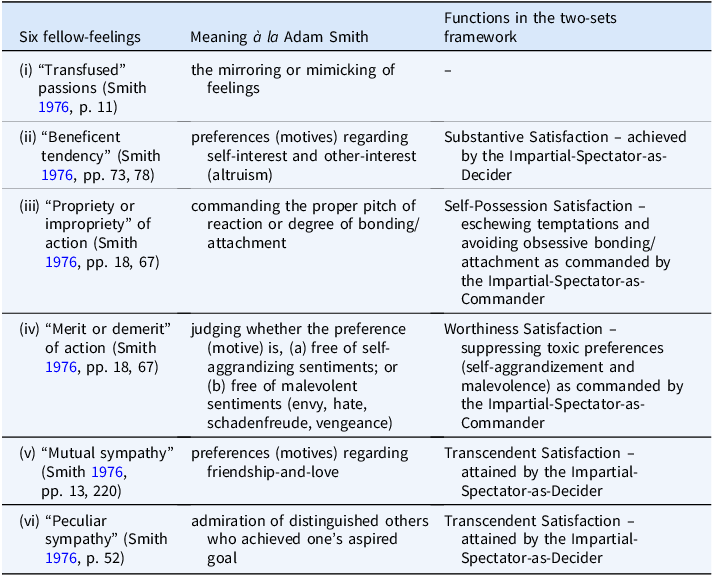
As enumerated elsewhere (see Khalil Reference Khalil2023b), Table 1 sums up the six meanings of fellow-feeling. The first column lists the particular words that Smith employs for each particular meaning. The second column indicates Smith’s meaning of such particular words. The third column, which is the task of this paper, connects Smith’s meaning to the proposed two-sets framework, i.e., what moment of rationality is operative and what genus of satisfaction is under focus.
Six Meanings of fellow-feeling

Table 1. Long description
The table has three columns and six rows. The first column lists specific terms related to fellow-feeling, the second column describes the meanings of these terms, and the third column explains their functions in a two-sets framework. Row 1: Transfused passions, the mirroring or mimicking of feelings, no function listed. Row 2: Beneficent tendency, preferences regarding self-interest and other-interest, Substantive Satisfaction achieved by the Impartial-Spectator-as-Decider. Row 3: Propriety or impropriety of action, commanding the proper pitch of reaction or degree of bonding/attachment, Self-Possession Satisfaction eschewing temptations and avoiding obsessive bonding/attachment as commanded by the Impartial-Spectator-as-Commander. Row 4: Merit or demerit of action, judging whether the preference is free of self-aggrandizing sentiments or free of malevolent sentiments, Worthiness Satisfaction suppressing toxic preferences as commanded by the Impartial-Spectator-as-Commander. Row 5: Mutual sympathy, preferences regarding friendship-and-love, Transcendent Satisfaction attained by the Impartial-Spectator-as-Decider. Row 6: Peculiar sympathy, admiration of distinguished others who achieved one’s aspired goal, Transcendent Satisfaction attained by the Impartial-Spectator-as-Decider.
6 The first moment of rationality: the impartial-spectator-as-decider
Regarding the impartial-spectator-as-decider, she identifies the best choice, whether satisfying substantive or transcendent aims. However, the road of determining the best choice is often difficult. Behavioral decision scientists and behavioral economists have uncovered a myriad of anomalous choices, i.e., choices that are not the best or at least appear to be suboptimal from the standpoint of standard rational choice (e.g., Dhami Reference Dhami2017; Kahneman Reference Kahneman2011; Kahneman and Tversky Reference Kahneman and Tversky2000). Some critics of rational choice theory have gone further: it is impossible for humans to operate according to the axioms of rational choice theory (e.g., Gigerenzer et al. Reference Gigerenzer, Hertwig and Pachur2011; Simon Reference Simon and Latsis1976).
It falls outside the scope of this paper to discuss the various criticisms that rational choice theory faces. It is sufficient to state that rational choice theory can – with the exception of deviations from rationality prompted by being in the state of anxiety – successfully address the anomalies uncovered by behavioral decision sciences to varying degrees of success (see Khalil Reference Khalil2022b, Reference Khalil2025d, Reference Khalil2026a; Khalil and Amin Reference Khalil and Amin2023). That is, rational choice theory is a robust approach to the study of human behavior.
In fact, rational choice theory is sufficiently robust to make sense of Smith’s theory – the task of this paper. As studied below, the impartial-spectator-as-commander urges the DM under focus to carry out an action without excessiveness, i.e., the action must be proper. For such recommendation to exist, the proper action must have been decided. The (external) impartial-spectator-as-commander and the DM under focus must have already agreed what is the best option, whether in terms of efficiency (optimality) or in terms of being toxic-free. If there is a gap between the external commander and the DM under focus, it is only between what is the best option, which is already decided, and what the DM under focus is tempted to do, i.e., as a result of a luring suboptimal or destructive action.
What makes up the options or the content on which the impartial-spectator-as-commander and the DM under focus agree? At the start of Section II of Book VI, Smith affirms that DMs are first obligated to take care of their own wellbeing. Assuming that they are adults, they know what pleases them and what aches them more than the spectators. What spectators know about the DM under focus is through sympathy. Such sympathy produces “shadow” images that cannot be as accurate as the original sensations:
EVERY man, as the Stoics used to say, is first and principally recommended to his own care; and every man is certainly, in every respect, fitter and abler to take care of himself than of any other person. Every man feels his own pleasures and his own pains more sensibly than those of other people. The former are the original sensations; the latter the reflected or sympathetic images of those sensations. The former may be said to be the substance; the latter the shadow (Smith Reference Smith, Raphael and Macfie1976, p. 219).
As pointed out above, with respect to Smith’s (Reference Smith, Raphael and Macfie1976, p. 308) critique of Mandeville’s system, the pursuit of own interest does not exclude considering the interest of others. Indeed, the first sentence of TMS affirms that own interest is not the only concern of humans:
How selfish soever man may be supposed, there are evidently some principles in his nature, which interest him in the fortune of others, and render their happiness necessary to him, though he derives nothing from it except the pleasure of seeing it (Reference Smith, Raphael and Macfie1976, p. 9).
Smith clarifies – again in Section II of Book VI – that humans are interested in the wellbeing of others in different degrees, depending on the degree of familiarity:
After himself, the members of his own family, those who usually live in the same house with him, his parents, his children, his brothers and sisters, are naturally the objects of his warmest affections. They are naturally and usually the persons upon whose happiness or misery his conduct must have the greatest influence. He is more habituated to sympathize with them. He knows better how every thing is likely to affect them, and his sympathy with them is more precise and determinate, than it can be with the greater part of other people. It approaches nearer, in short, to what he feels for himself (Smith Reference Smith, Raphael and Macfie1976, p. 219).
In addition to familiarity, Smith registers another factor that explains why humans express, at varying degrees, interest in the wellbeing of others. What matters also is the situation of the recipient of care. Given that children need more care than adults, parents expend more time and effort in caring for their children than for their parents:
This sympathy too, and the affections which are founded on it, are by nature more strongly directed towards his children than towards his parents, and his tenderness for the former seems generally a more active principle, than his reverence and gratitude towards the latter (Smith Reference Smith, Raphael and Macfie1976, p. 219).
To put it in a more formal language, the DM under focus as well as the impartial-spectator-as-decider have the same preferences. The DM and her proxy, the impartial spectator, want to advance the wellbeing of the self and the wellbeing of others about whom the DM cares, where the intensity of these preferences vary according to familiarity and the comparative needs of the potential beneficiaries. Given the priorities of the DM under focus, the impartial-spectator-as-decider can identify what is the best action.
The best choice is not limited to prioritizing the preferences related to substantive interest calculations. The best choice also includes actions aimed to satisfy preferences regarding what is called above “transcendent satisfactions.” Transcendent satisfactions include love and fondness of others (Smith Reference Smith, Raphael and Macfie1976, pp. 31–34). They also include actions related to the pursuit of aspired goals, i.e., to attain distinction and status higher than the default distinction and status (Smith Reference Smith, Raphael and Macfie1976, pp. 50–52).
The link between substantive and transcendent preferences is intricate – if not difficult to analyze as both genera of preferences might be incommensurable (Khalil et al. Reference Khalil, Aimone, Houser, Wang, Martinez and Qian2021; Khalil Reference Khalil2024a). While this paper cannot discuss this link, it is sufficient to record that Smith (Reference Smith, Raphael and Macfie1976, pp. 13–16, 50–52) acknowledged that the motives of DMs are not limited to the pursuit of (substantive) interests (whether self-interest or altruism); they also include the pursuit of transcendent satisfactions.
7 The second moment of rationality: the impartial-spectator-as-commander
Smith’s rendition of the “impartial spectator” was influenced by Hume’s theory of the “judicious spectator” (Hume Reference Hume, Nortonm and Norton1739/2000, Reference Hume1777/1970; see Slote Reference Slote2010). Nevertheless, Smith’s theory departs from Hume’s sentimentalism in one remarkable way (see Ilyes Reference Ilyes and Maibom2019; Khalil Reference Khalil2026b). Namely, Smith argues that many if not most acts of sympathy hinge on judgments regarding whether the observed behavior is proper. Smith (Reference Smith, Raphael and Macfie1976, p. 11) stresses the role of judgment at the outset of TMS, in the sixth and seventh paragraphs, after paying homage Hume’s theory, which stresses that sympathy is mainly about mimicking, i.e., do not involve judgment.
Smith’s stress on judgment informs the proposed distinction between the impartial-spectator-as-decider and the impartial-spectator-as-commander. As commander, the impartial spectator urges the DM under focus to command the “right thing” – i.e., as determined by the impartial-spectator-as-decider. The actual behavior of the DM is improper unless it matches the decision made by the impartial-spectator-as-decider.
Smith (Reference Smith, Raphael and Macfie1976, pp. 18, 67) defined the “propriety and impropriety” judgment of action as the examination of the pitch or severity of the decision in relation to the cause. Smith offers a micro-analysis to this effect. Let us suppose that the principal under focus does not act rationally. For example, she gets very excited upon encountering food. Such excitement leads her to over-indulge and eat excessively. The impartial spectator cannot go along with such non-rational choice. That is, the impartial spectator cannot experience the feeling or utility of the principal under focus (the DM). Fellow-feeling cannot take place.
However, the principal welcomes the approbation of the impartial-spectator-as-commander. After all, the impartial spectator’s judgment is a proxy of the principal’s. When the principal approves the action of the principal, the principal must have carried out the best choice. In order to receive the approbation, the principal must lower the pitch of excitement to a level that allows the impartial spectator to enter the principal’s station and, consequently, experience the original excitement.
In short, for the DM under focus to receive approval of the impartial-spectator-as-commander, she has to act rationally, i.e., exhibit an action that is proportional to the cause. The impartial-spectator-as-decider must have already, as mentioned above, determined what is the optimum action in relation to the cause. She also must have already determined what is meritorious action, i.e., the one free from toxic preferences.
Approbation regarding proportionality is the core textbook definition of rational choice. People must not act recklessly, impetuously, and carelessly. People must not allow the pitch of their reactions to incentives to be non-proportional (i.e., non-rational) – if they care about capturing the best wellbeing possible (see Khalil Reference Khalil2010).
Standard economics is clearly successful in identifying the right (optimal) choice with respect to substantive satisfaction, where proportionality of action can be measured in relation to incentives. Such incentives are external causes.
However, there are no such external causes with respect to transcendent satisfactions. When the DM becomes fond of another human being, a non-human animal, or even a place in nature such as a mountain, there are no external incentives. Likewise, when the DM strives to achieve an aspired goal, such as learning a skill or building a business, there are no external incentives. The emotion associated with either love or aspiration is the reward itself. Given that there is no apparent cost for love or aspiration, standard economics, at first approximation, seems unsuited to identify what is the right (optimal) choice with respect to transcendent satisfaction.
However, as TMS shows, love and aspiration have costs. As shown below, these costs are internal to the pursuit itself: they are the hurt feelings and painful disappointments that the DM often encounter with each pursuit. Thus, the standard tools of economics can be applied to the analysis of what is the optimal intensity of love and what is the optimal degree of aspiration. The optimal degrees must, at the margin, equalize the expected elation arising from love and aspiration with the expect cost of hurt feelings.
Let us say that the DM or her proxy, the impartial-spectator-as-decider, determines that the optimal degree of desire regarding aspiration (A) or the optimal degree of bonding (B) is A* or B*, respectively. If the principal expresses a degree in excess or in recess of A* or B*, the impartial-spectator-as-commander censures the principal through un-sympathy. To gain the sympathy of the impartial-spectator-as-commander, the DM has to either lower or increase the intensity of A or B so that they match A* or B*.
The impartial-spectator-as-commander loses raison d’être in a world where people do not suffer from weakness of will (see Khalil Reference Khalil and Altman2017a). If people automatically, i.e., without any disruptions, command what the impartial-spectator-as-decider has determined, there would be no need for the impartial-spectator-as-commander. This means that the more important player in fellow-feeling is the impartial spectator-as-decider. What matters is making decisions regarding the given preferences, as shown next with respect to substantive satisfaction.
8 The first genus of satisfaction: substantive satisfaction
As defined here, substantive satisfaction is the product of consuming substantive goods such as food insofar it satiates hunger and clothing insofar it affords warmth. Substantive satisfaction is what economists regard as wellbeing, utility, or welfare. Economists have used these terms equivalently and sometimes to indicate the inclusion of one or more of these variables: air pollution, crime level, neighborhood quality, job satisfaction, physical and mental health, and national security.
Economists also consider altruism a substantive satisfaction – which escapes many critics of rational choice theory (e.g., Gintis et al. Reference Gintis, Bowles, Boyd and Fehr2005; Jolls et al. Reference Jolls, Sunstein and Thaler1998). These critics relegate altruism to a separate realm – supposing that altruism is contrary to self-interest. For Smith, as shown above, the concern with the wellbeing of familiar people lies on a continuum with the concern with one’s own wellbeing.
Smith did not use the term “altruism.” He rather used the term “beneficent tendency” (Smith Reference Smith, Raphael and Macfie1976, pp. 73, 78–91). For Smith, humans have beneficent tendency to enhance, ceteris paribus, the interest of others. Our beneficent tendency entails actions, although with greater intensity, to enhance our own interest. Smith (Reference Smith, Raphael and Macfie1976, pp. 219–227) goes to great lengths to show that “self-interest” is a virtue.
When we have a benefactor who wants to increase the interest of beneficiaries, the quantity of help must be efficient. Given that the potential benefactor must also attend self-interest, such benefactor cannot help others without considering the circumstances. There is no law-like dictum that she should help others in all circumstances. The altruist must consider familiarity, her budget (i.e., constraints) relative to the budget of the beneficiary, and the relative cost of the offered help (see Khalil Reference Khalil1999, Reference Khalil2026b). Otherwise, the help would be suboptimal if not totally foolish, as when the benefit accrued by the beneficiary is miniscule in comparison to the toil and trouble of the benefactor.
In the calculation of the altruistic act, the impartial-spectator-as-decider stands at a distant, impartial station. The distance of the station from the beneficiary is a function of familiarity. In the impartial station, the impartial-spectator-as-decider gauges the wellbeing of the beneficiary in comparison to the DM’s without any favoritism toward either station. In addition, the impartial-spectator-as-decider considers relative prices in the determination of the optimum amount of help. Such rational decision process captures Smith’s view of how self-interest and other-interest (altruism) lie along a continuum (Khalil Reference Khalil1990).
9 The second genus of satisfaction: transcendent satisfaction
As defined here, transcendent satisfaction is the product of dedicating time and effort to nurture friendships. It is also the product of dedicating time and effort to the pursuit of aspired goals. While both dedications afford a meaning to one’s life, i.e., allowing to transcend everyday activity, they differ.
9.1 Transcendent satisfaction as bonding
Smith employs the term “mutual sympathy” to denote bonding with friends (Smith Reference Smith, Raphael and Macfie1976, pp. 13–16), “love” to indicate bonding with family members (Smith Reference Smith, Raphael and Macfie1976, pp. 31–34, 38–40), and “habitual sympathy” to represent bonding with clan/tribe members (Smith Reference Smith, Raphael and Macfie1976, pp. 220–221; see Khalil Reference Khalil2025a). While Smith’s scholars have generally discussed Smith’s concepts of “mutual sympathy,” “love,” and “habitual sympathy” (e.g., Hanley Reference Hanley2019), they have largely considered them as subsidiaries of fellow-feeling in general. They failed to sharply identify mutual sympathy as a different kind of fellow-feeling, as stated in Table 1 above.
There is one exception (as far as I am aware). Sugden (Reference Sugden2002) regards mutual sympathy the key to understanding TMS as a whole, including Smith’s sympathy and what he calls “empathy.” In fact, he regards sympathy and empathy as secondary emotions, emotions to be subordinate to mutual sympathy. In this manner, Sugden goes to the opposite pole. He stresses the concept “mutual sympathy” at the expense of other kinds of fellow-feelings.
As detailed elsewhere (Khalil Reference Khalil2023a), it is not either/or: It is neither that mutual sympathy, the fellow-feeling of love, reigns supreme over all other fellow-feelings – nor that sympathy is the fellow-feeling that reigns over all other fellow-feelings.
9.2 Transcendent satisfaction as aspiration
Smith discusses aspiration, and the consequent sentiment of admiration, in a chapter titled “Of the origin of Ambition, and of the distinction of Rank” (Smith Reference Smith, Raphael and Macfie1976, pp. 50–61; see Khalil Reference Khalil2025a). In the first sentence of this chapter, Smith attributes aspiration to the desire of the DM to receive the applause of the public. However, as argued elsewhere (Khalil Reference Khalil2023a), this attribution is circular: What determines the objective which the public applauds? Starting that humans seek attention and praise of the public does not free us from explaining why the public prefers one goal over another for the DM to strive towards. We cannot explain the desire to excel by the fact that spectators applaud those who attempt to succeed. We would be back to the first question.
In any case, Smith swiftly corrects himself in the same paragraph. He proceeds in the following sentences to attribute aspiration to the human condition: it is part of being alive to seek aspired goals – to the point of preferring death over being robbed of aspiration.
Aspiration for Smith is part of the human quest after an image of the self that transcends the objective current trajectory of the person (see Khalil Reference Khalil2005, Reference Khalil2019). However, most people usually feel that they have failed to realize their dreams. Hence, they usually commence to admire others who achieved what they would have liked to achieve. In addition, such admiration, as long as it is not excessive (suboptimal), entails industry and entrepreneurship that lead to investment, economic growth, and prosperity (Smith Reference Smith, Raphael and Macfie1976), pp. 53–66; see (see Khalil Reference Khalil1997a, Reference Khalil2005).
It is apt to call aspiration that entails admiration “transcendent.” The fellow-feeling of attachment to a higher goal, and admiration for those who achieve it, transcend biological boundary, i.e., what is sensory and immediate. However, the afforded transcendent satisfaction differs from self-possession satisfaction, as discussed next.
10 The third genus of satisfaction: self-possession satisfaction
As defined here, self-possession satisfaction arises as a by-product of carrying out the recommendation of the impartial-spectator-as-commander. Hence, unlike the other two genera (substantive and transcendent satisfactions), DMs do not (or should not) pursue self-possession satisfaction as a goal in-itself.
Self-possession satisfactions take two forms: integrity and dignity. While integrity preserves the self against tempting substantive satisfactions, dignity preserves the self against tempting pursuits of love and other transcendent attachments.
10.1 Integrity satisfaction for eschewing tempting substantive appetites
As mentioned above, Smith (Reference Smith, Raphael and Macfie1976, pp. 18, 67) defines the “propriety and impropriety” judgment as concerned with the proportionality of the observed emotion/action. The impartial-spectator-as-commander aims to persuade the DM under focus to act properly. When such action concerns the pitch of choice regarding external incentives, the incentives are usually substantive goods. This paper registers that when the DM succeeds in controlling substantive appetites, i.e., executing the rational option, she must experience a warm glow. Such an experience, let us call it “integrity satisfaction,” expresses self-possession. Self-possession lets the DM feel that he has completed the circle and, hence, enjoy the integrity of the self that is in addition to the attained (substantive) wellbeing (Khalil Reference Khalil1997b, Reference Khalil2010, Reference Khalil2015).
Even when the DM feels an “intrinsic” motivation to finish a task – such as cleaning the rest of the house once he started with the living room – the motive is still the enjoyment of a substantive good, a clean house. The intrinsic motivation is about carrying out a promise, made usually to the self, to execute what the impartial-spectator-as-commander is urging the DM to do. Thus, intrinsic motivation, at least in examples similar to cleaning the house, is not about the pursuit of an aspired goal, a transcendent pursuit.
The DM wants to command the optimal activity to keep the house clean, to save, to exercise, or to invest in human capital for-itself. She feels obligated to perform for the benefit in-itself. Although she feels integrity once the command is accomplished, such feeling is a by-product. Hence, integrity in-itself is not (or should not be) the objective. It is true that integrity satisfaction usually sustains the DM in carrying the effort, but this should not be mistaken as if it is the primary cause of making the effort. Therefore, the warm glow of integrity cannot enter as an element in the cost-benefit calculation of the optimal decision. Otherwise, one would be undertaking excessive saving or an excessive exercise regime, activities that harm wellbeing.
Indeed, the pursuit of warm glow for itself amounts to sentimental foolishness (see Khalil Reference Khalil1999, Reference Khalil and Altman2017a). For example, yielding to the temptation of excessive exercise (such as weight-lifting) or excessive altruism occasions supposed warm-glow (supposed integrity). However, such yielding engenders suboptimal wellbeing.
10.2 Integrity satisfaction for eschewing dishonesty, unfairness, and double standards
As evident from the psychology literature, DMs are ready to incur substantive costs to sustain their self-image of honesty and fairness – what the literature calls “equity theory” (e.g., Baron Reference Baron2008, Ch. 17) and “inequity aversion” (Fehr and Schmidt Reference Fehr and Schmidt1999). People are also ready to step in as third-parties to defend the rights of others – what the literature calls “altruistic punishment” (Marlowe et al. Reference Marlowe, Colette, Abigail, Clark, Alexander, Camilo, Jean, Michael, Edwins, Joseph, Natalie, Carolyn, Richard and David2008). People are even ready to lie to themselves – i.e., self-deception which Smith (Reference Smith, Raphael and Macfie1976, pp. 156–161; Khalil Reference Khalil2009) acknowledges – in the attempt to avoid the appearance of practicing double standards (see Khalil Reference Khalil2016, Reference Khalil2017c).
To avoid double standards, the impartial-spectator-as-commander, who is a proxy of the DM under focus, should use the same standard in judging the self as in judging others. The DM would experience integrity satisfaction when he acts according to a single standard.
Smith did not use the term “double standards.” However, the rejection of double standards, which occasions integrity satisfaction, is a critical pillar in Smith’s theory. This is evident when he added the following subtitle to the 4th edition of TMS:
An Essay towards an Analysis of the Principles by which Men naturally judge concerning the Conduct and Character, first of their Neighbours, and afterwards of themselves (Smith Reference Smith1853).
In this added subtitle, Smith is speaking loud and clear: when people judge the “Conduct and Character” of their neighbors, they turn around and use (or should use) the same standard in judging “themselves.” When people disapprove suboptimal/dishonest actions taken by others, they should also regulate their own actions using the same standard. The avoidance of double-standard judgments is the core of conscience-based actions.
Indeed, Raphael (Reference Raphael2007) maintains that the account of conscience is the main impetus of Smith’s TMS. Conscience for Smith is the outcome of experience. We form from experience the recommended (optimal) acts when we judge the propriety of the actions of others. We act conscientiously when we apply the same standard of propriety regarding our own actions.
Likewise for Hanley (Reference Hanley2009), Smith maintains that people’s quest after honesty leads to the major virtues such as magnanimity and beneficence. Also for Schliesser (Reference Schliesser2017), Smith’s impartial spectator, which operates within one’s breast, subjects the DM to honest self-scrutiny. Such scrutiny is important for conducting contracts and undertaking exchange in the modern market-centered commercial society. Indeed, as Khalil and Feltovich (Reference Khalil and Feltovich2018) show in an experiment, people demand sincerity and are ready, with some costs to themselves, to punish dishonesty in the form of what the literature calls “self-licensing” (e.g., Merritt et al. Reference Merritt, Effron and Monin2010).
While sincerity, responsibility, or conscientiousness is a central pillar of Smith’s TMS, a question remains that this paper cannot answer (see Khalil Reference Khalil2026c, Reference Khalil2026d). Assuming that we are capable of impartially judging our own action, does Smith succeed in accounting for conscience? Does the mere fact that we can impartially censure our own misdeeds explain why we want to avoid misdeeds? Does the fact that we want to act fairly and honestly, as we demand others to do the same, explain why we want to be sincere, fair, and honest?
10.3 Dignity satisfaction for eschewing obsessive bonding
It is not common in the Smith scholarship literature to invoke Smith’s (Reference Smith, Raphael and Macfie1976, pp. 18, 67) “propriety and impropriety” judgment regarding the pursuit of friendship-and-love. However, the propriety judgment, which examines proportionality of the act relative to the cause, is apt to study such transcendent satisfaction. This is the case even when the cause, namely, love or affection, is internal.
As discussed above, Smith welcomes love and fondness. He considers them the foundation of happy family life (Smith Reference Smith, Raphael and Macfie1976, pp. 31–34). Smith (Reference Smith, Raphael and Macfie1976, pp. 220–222) reserved a special term, “habitual sympathy,” to characterize the bonding of family members. Indeed, Smith (Reference Smith, Raphael and Macfie1976, pp. 13–16) dedicated a chapter at the outset of TMS to discuss friendship-and-love, which he called “mutual sympathy.” He wanted to distinguish “mutual sympathy” from the familiar “sympathy.” As the first paragraph of this dedicated chapter clearly states, familiar sympathy consisted of motives than animate altruism (i.e., substantive motives) and mimicking/copying of original emotions (see Khalil Reference Khalil2023a).
However, as noted above, Smith (Reference Smith, Raphael and Macfie1976, pp. 38–40) was greatly alarmed by excessive bonding. Such bonding originates upheavals of the emotions to the point of misery. It also invites others to manipulate and exploit those who exhibit excessive friendship-and-love (see Khalil Reference Khalil2025c).
Although Smith does not mention the propriety judgment, i.e., the function of the impartial-spectator-as-commander, such function is implied in Smith’s fear of love (Smith Reference Smith, Raphael and Macfie1976, pp. 38–40). Such impartial spectator needs to command excessive bonding. The impartial-spectator-as-commander must step in to allow the DM under focus to regain a needed sense of boundary in her fondness of others. The containment of excessive bonding allows the DM under focus to experience a warm glow. Such warm glow, let us call it “dignity satisfaction” (see Khalil Reference Khalil2024b, Reference Khalil2024c), expresses self-possession. Self-possession in the form of dignity lets the DM feel that she has preserved the center of the self.
For one thing, the moderation of bonding allows the DM to avoid ridicule, or at least self-ridicule for being credulous. When the DM re-gains self-possession via the avoidance of ridicule, she experiences dignity satisfaction.
10.3 Dignity satisfaction for eschewing obsessive aspiration
Smith’s propriety judgment also applies to another kind of excessiveness, the obsession with aspired goals. Propriety judgment is apt regarding aspiration because aspiration also involves proportionality. Here, the examined proportionality is the dedicated effort to the goal, i.e., the cost, and the internal cause, i.e., the pursued joy of tenacious pursuit of goals.
As discussed above, Smith (Reference Smith, Raphael and Macfie1976, pp. 50–51) welcomes the pursuit of goals, i.e., what are beyond one’s default station or rank in society. He considers aspiration as inextricably connected to being alive. He finds it normal for people to admire those who succeed in achieving the aspired goals, calling such admiration “peculiar sympathy” (Smith Reference Smith, Raphael and Macfie1976, p. 52). He even reasons that such admiration is at the origin of rank in society and, hence, the basis of political order (Khalil Reference Khalil2005, Reference Khalil2025a; Smith Reference Smith, Raphael and Macfie1976, pp. 53–66).
However, as mentioned above, Smith stresses the specter of excessive aspiration, and consequently, excessive admiration. For him, the specter is justified as obsession with distinction or achievement of goals invite the “adulation” of the rich-and-powerful to the extent that low-rank people exhibit “obsequiousness” to their superiors (Smith Reference Smith, Raphael and Macfie1976, p. 52).
Such a specter locates the function of the impartial-spectator-as-commander. Although Smith does not discuss the function explicitly, the impartial-spectator-as-commander must contain excessive aspiration and the consequent obsequiousness to the rich-and-powerful. The containment would allow the DM under focus to regain autonomy, i.e., a desired separateness from superiors. This would entail reducing aspiration to a reasonable level, as recommended by the impartial-spectator-as-commander. This would enable the DM to avoid ridicule or at least self-ridicule. Professing moderate goals and avoiding the attempt to join excessively high-rank groups allows the DM to enjoy a warm glow.
The warm glow arising from (rational) non-obsessive aspiration is similar to the dignity satisfaction emerging from (rational) non-obsessive bonding with friends and loved ones. Similar to dignity arising from rational bonding, dignity arising from rational aspiration promises self-possession satisfaction, i.e., the enjoyment of the DM to regain the center of the self.
11 The fourth genus of satisfaction: worthiness satisfaction
As defined here, worthiness satisfaction arises as a by-product of suppressing toxic preferences. Similar to self-possession satisfaction, therefore, DMs do not (or should not) pursue worthiness satisfaction as a goal in-itself.
Worthiness satisfaction consists of two types – each arising from the suppression of its respective toxic preference. This suppression is the function of the impartial-spectator-as-commander using Smith’s merit/demerit judgment. Before discussing these two types of worthiness satisfaction, we need to delineate the merit/demerit judgment from the propriety/impropriety judgment in TMS.
11.1 Worthiness satisfaction for eschewing toxic preferences
In Part II of TMS, Smith (Reference Smith, Raphael and Macfie1976, pp. 67–70) maintains that the impartial spectator judges actions on the basis of their “merit and demerit,” i.e., intentions rather than consequences. This is not a digression in TMS, as Smith (Reference Smith, Raphael and Macfie1976, p. 18) alerts us early in TMS about the “merit and demerit” judgment. He specifically states, in both texts, that the “merit and demerit” judgment differs from the “propriety and impropriety” judgment, the one that occasions self-possession (integrity and dignity) satisfaction.
Smith lays out the contrast of the propriety and merit judgments side-by-side. However, this should not suggest that they are symmetrical judgments. The approbation of propriety-of-action is about the impartial-spectator-as-commander in the function of encouraging the execution of optimal options regarding either substantive or transcendent satisfaction. The impartial-spectator-as-commander should prompt the DM to execute the option that is already determined to be the best according to the optimality criterion. The approbation of merit-of-action is also about the function of the impartial-spectator-as-commander. However, in this function, she acts as a guard that prohibits actions when they are motivated by toxic preferences. While the propriety-of-action judgment is about undertaking positive choices, the merit-of-action judgment is about prohibiting negative choices.
Such prohibition proceeds by assessing the choice’s intention: Is the choice motivated by toxic preferences – totally disregarding the contingent benefit that someone may accrue from the act? If it is free, it is for Smith “meritorious” in the sense that it genuinely worthy – what the impartial-spectator-as-commander would recommend.
Note, the judgment of merit-of-action cannot be about proportionality, as whether an act is motivated by toxic preferences is a binary judgment. Either it is or it is not. That is, the act subjected to merit judgment is indivisible: it cannot be divided and assessed in different quantities as is usually the case for acts that sustain substantive and transcendent satisfactions.
One qualification: it is true that many judgments regarding substantive satisfactions are about honesty and promise keeping – and those are also about binary judgment. One cannot be 40% or 63% keeper of a promise. However, prior to taking the commitment to keep a promise or be honest, the DM has done the calculation at the margin relating to whether to make the promise in the first place. The DM does not make such marginal calculation with respect to toxic preferences. They are the subject of binary judgments without any calculation.
11.2 Toxic preferences: self-aggrandizement
One kind of toxic intention is the set of actions motivated by self-aggrandizement. Smith took an anti-consequentialist stand when he insisted, e.g., that a “benefactor” who gives donations to a poor person to enhance self-aggrandizement, such as the applause of external spectators, is a non-meritorious act (Smith Reference Smith, Raphael and Macfie1976, pp. 68–69). This is the case even when the poor person benefits in the substantive sense from actions motivated by self-aggrandizement.
The poor person usually express gratitude toward the “fake” benefactor – even when he knows that the “benefactor” is motivated by self-aggrandizement. The impartial spectator, however, does not (and should not) adopt the position of the poor person, i.e., express gratitude. For Smith, the impartial spectator should withhold approval of the poor persons’s gratitude sentiment, which effectively amounts to judging the act of the benefactor as non-meritorious.
The withholding of approbation can be extended to cases where the self-aggrandizing actor is conferring benefits on the self – i.e., the case of vanity, ostentatious consumption, or conspicuous display of wealth (see Khalil Reference Khalil2000). Smith (Reference Smith, Raphael and Macfie1976, pp. 255–259) reserved harsh words regarding vanity and other ostentatious choices – despite the fact that actual spectators may praise such choices and celebrate self-aggrandizing behavior (see Frank Reference Frank1999; Khalil Reference Khalil2023c). For Smith, the impartial spectator does not (and should not) go along with the non-meritorious sentiments of such misguided spectators. This is the case even when the vain person derives some substantive benefits from the clothes and trinkets intended as an ostentatious display.
11.3 Toxic preferences: malevolence
For Smith, another kind of toxic preference is malevolence. Smith explicitly mentions one form of malevolence, “malicious pleasure” or what we call today “schadenfreude” (see Dupuy Reference Dupuy2006; Smith Reference Smith, Raphael and Macfie1976, p. 68). The impartial spectator would judge acts motivated by schadenfreude, envy, and vengeance as non-meritorious and, hence, withhold any approbation. Furthermore, if the impartial spectator witnesses a person who accidentally benefited from a vice- or malevolence-based act and, consequently, expressed gratitude, the impartial spectator will disapprove of such a sentiment irrespective of the size of the benefit.
While acts motivated by malice and dark emotions (vice) need investigation, this paper cannot discuss them. It is sufficient to note, however, that we should distinguish malevolence from dishonesty and double standards discussed above. As already mentioned, even when acts of honesty are judged on a binary basis, the promised act of honesty must have undergone cost-benefit calculation prior to its adoption as a commitment. In contrast, toxic-based acts are never evaluated according to cost-benefit calculation. The DM is committed to deny such acts as the premise of any action.
Furthermore, we should distinguish malevolence from self-aggrandizement – despite the fact that Smith (Reference Smith, Raphael and Macfie1976, pp. 68–69) discusses them under the umbrella of non-meritorious, toxic preferences (motives). When the DM takes an action to aggrandize the ego, she (or the subject of the action) inadvertently also enjoys some satisfaction in one sense or another. In contrast, when the DM takes an action to satisfy dark, malicious preferences, the other (or the self in some instances) usually sustains pain in one sense or another.
12 Conclusion
Smith’s Theory of Moral Sentiments (TMS) employs three disparate aspects of human behavior – namely, rationality, emotions, and morality – to construct a coherent theoretical apparatus.
TMS employs rational choice when it discusses the dual functions of the impartial spectator: the function of deciding what is the best option and the function of commanding such option.
TMS employs the emotions when it commences with the notion of sympathy as simple copying of the emotions of others but, in turn, such copying often involves the micro-level mechanism of judgment. TMS indeed identifies two kinds of judgment: the judgment of propriety and the judgment of merit. The judgment of propriety examines actions in terms of benefit in relation to the cause in terms of cost. The judgment of merit examines actions in the negative sense, making sure they are not motivated by toxic preferences such as self-aggrandizement and malevolence.
TMS employs morality in two ways: invisible and tangible. The invisible way is when TMS characterizes the pursuit of substantive goods (such as self-interest and altruism) and the pursuit of transcendent goods (such as love and aspiration) as beneficial. Such pursuits are central to the wellbeing of the DM under focus, central to her flourishing in communities of friendship-and love, and central for her prosperity arising from the pursuit of aspired goals. The moral aspects of such pursuits are invisible because Smith need not invoke any abstract moral dictum or axiom to show the benefit of avoiding recklessness, attending to the needs of others, loving friends and family members, or yearning for higher distinction and status in life.
The tangible way is when TMS characterizes toxic-based actions as categorically non-meritorious or non-worthy. Smith does not explain why toxic preferences – namely, self-aggrandizement and malevolence – are emphatically objectionable. Everyday people intuitively abhor vanity. Everyday people spontaneously reject emotions/actions motivated by envy, schadenfreude, malice and other dark emotions. Still, it behooves Adam Smith to explain why. The explanation of why raises new challenges that future research must undertake. The major question is whether the starting point of Smith, namely, the sentiments, is a sufficient ground to develop a theory of why toxic-based actions are objectionable.
Data availability statement
The entry does not include any data of any kind.
Acknowledgements
The paper benefited from the comments of two anonymous reviewers, the editorial help of Maks Sipowicz, and the assistance of AJE’s curie editorial support. The usual caveat applies.
Financial support
Open Access funding provided by the Qatar National Library
Competing interests
The author has no conflicts of interest of any kind.

 Open access

