To what base uses we may return, Horatio!
Why may not imagination trace the noble dust
Of Alexander, till he find it stopping a bung-hole?
Hamlet 5.1. 202-04
As Tennyson's “little Hamlet,”Maud (1855) posits a speaker who, like Hamlet, confronts the ignominious fate of dead remains.Footnote 1Maud's speaker contemplates such remains as bone, hair, shell, and he experiences his world as one composed of hard inorganic matter, such things as rocks, gems, flint, stone, coal, and gold. While Maud's imagery of “stones, and hard substances” has been read as signifying the speaker's desire “unnaturally to harden himself into insensibility” (Killham 231, 235), I argue that these substances benefit from being read in the context of Tennyson's wider understanding of geological processes.Footnote 2 Along with highlighting these materials, the text's imagery focuses on processes of fossilisation, while Maud's characters appear to be in the grip of an insidious petrification. Despite the preoccupation with geological materials and processes, the poem has received little critical attention in these terms. Dennis R. Dean, for example, whose Tennyson and Geology (1985) is still the most rigorous study of the sources of Tennyson's knowledge of geology, does not detect a geological register in the poem, arguing that by the time Tennyson began to write Maud, he was “relatively at ease with the geological world” (Dean 21). I argue, however, that Maud reveals that Tennyson was anything but “at ease” with geology. While In Memoriam (1851) wrestles with religious doubt that is both initiated, and, to some extent, alleviated by geological theories, it finally affirms the transcendence of spirit over matter.Footnote 3Maud, conversely, gravitates towards the ground, concerning itself with the corporal remains of life and with the agents of change that operate on all matter. Influenced by his reading of geology, and particularly Charles Lyell's provocative writings on the embedding and fossilisation of organic material in strata in his Principles of Geology (1830–33) volume 2, Tennyson's poem probes the taphonomic processes that result in the incorporation of dead remains and even living flesh into the geological system.
I begin with a re-examination of a number of sources for Tennyson's geological and palaeontological thinking, as while a few of these have already been suggested, important sources have been missed, sources that allow for a comprehensive re-reading of the whole poem in terms of these disciplines. I use the term remains because while I argue that Maud's tropology is largely geological, the text embraces a more general notion of remains that includes along with fossils, the more recent remains of the dead, for example, the ring made from his mother's hair that Maud's brother wears, as well as such objects as the “rock” that represents the father, that “fell with him when he fell” (I: 8), the empty shell of Part II, and the “jewel-print” of Maud's feet (I: 890) that, like a fossil imprint, offers the speaker the desired object via the contemplation of its conspicuous absence.Footnote 4 I argue that these are readable relics and fragments that allow the speaker to reconstruct the past as a narrative in the present, a narrative that in turn constructs the poem. In this Tennyson was experimenting with the “powerful new methods of comparative anatomy” that had proved so innovative in the recovery of remote and alien forms of life from fossil fragments (Martin Rudwick, Fossils 107). Provocatively, Tennyson's friend Richard Owen (the most celebrated British comparative anatomist of his time) asserted that through the application of the principles of comparative anatomy, practitioners “have been enabled to restore and reconstruct . . . species that have been blotted out of the book of life” (Lectures 2: 3). At times the speaker's gaze is similar to that of the palaeontologist who reinvests remains with meaning in an attempt to “restore” the dead and write them back into the “book of life.” The second section of the paper examines the speaker's interaction with remains and offers a close reading of the speaker's own readings and reconstructions of the objects he confronts.
Developed in Paris by Georges Cuvier working in the early part of the nineteenth century, the methods of comparative anatomy were successfully adopted in Britain by Richard Owen and the surgeon and geologist Gideon Mantell.Footnote 5 Extraordinary claims were made for the new science: for example, Mantell, in his The Wonders of Geology (1838), asserted that dead species might be “reassembled . . . with as much clearness and certainty as if they were living and before us” (1: 128).Footnote 6 However, the ability to “reassemble” extinct species relied on the comparative anatomist's skill in reading fossil fragments, as Mantell suggested, “To a person uninstructed in this science, the specimens before us would appear a confused medley of bones and of osseous fragments, . . . to him they would appear as unintelligible as were the hieroglyphics of Egypt, before Young and Champollion explained their mysterious import” (1: 127). The comparative anatomist had to “decipher what fossil bones meant. Their significance was not self-evident; it had to be “read”, as it were, in the language of anatomy, a language that had to be learned like any other” (Rudwick, Cuvier 174). Cuvier had claimed that “comparative anatomy has reached such a point of perfection that, after inspecting a single bone, one can often determine the class, and sometimes even the genus of the animal to which it belonged.” This works because bones “are always in a necessary relation to all the other parts,” so that “one can infer the whole from any one of them” (Rudwick, Cuvier 36).Footnote 7 Reading remains, thus, relied on articulating them through existing narratives of “class” and “genus.” As Mantell wrote, “It is only by acquaintance with the structure of the living forms around us, and by acquiring an intimate knowledge of their osseous frame-work or skeleton, that we can hope to decipher the hand-writing on the rock” (127). The analogy with reading and writing is an important one, as it draws attention to the textual nature of the process of reconstructing the past, and to how without the existing narratives of anatomy, remains are merely “a confused medley” of unreadable fragments. Thus, the task of re-writing the dead back into the “book of life” entails assimilating remains into contemporary taxonomic and teleological contexts, writing them, in other words, into the meaningful narratives of the present.
Virginia Zimmerman, in her illuminating study of the relationship between nineteenth-century geology, archaeology, and literature, points out how geologists, palaeontologists and archaeologists “fashioned narratives out of fragmented remains,” and notes that their “authority, rooted in . . . [the] ability to read well, lends similar authority to any reader – with the ability to interpret comes narrative authority” (2, 38). In Maud, remains provide a means to (re)write the past in the contexts of the present. The speaker reads remains as a way of rewriting the fragmented remnants of a past that presents itself to him as a “confused medley” of events. Remains allow him not only to rewrite the past into a narrative that is sympathetic to his perception of events, but also to claim authorship and therefore authority over the past. The speaker's compulsion to reconstruct remains (as expressed, for example, in his attempt to reconstruct the “little living will” (II: 62) of the shell) is the compulsion towards narrative, and towards the dynamic production of a textualised self that is spatially and temporally posited in the continuum of narrative flow. Thus for the speaker of the poem, reading remains is not only a way of writing the object back into being, but also a way of writing the self into being.Footnote 8
At other times, however, remains serve a different purpose for the poem's rhetoric. They are used to emphasise that all living things, and even entire civilisations, will inevitability become the remains that a future age will contemplate. And Maud articulates specific concerns not only for how the past is read from its remains, but also for how future generations will read the remains of the present age, an anxiety implicit in the text's disturbing figuration of processes of petrification and fossilisation occurring in the present. Just as geological catastrophe had arrested Pompeii at a moment in time that laid bare for future generations its less heroic quotidian concerns, petrification in Maud encodes an anxiety about how contemporary remains, similarly arrested in time, might be read by future generations and what these remains may say about the present Mammon worshiping world.
As Zimmerman suggests, the contemplation of remains “forces the observer to redefine himself in relation to . . . [an] ever-expanding time scale and to imagine his own end as a similar artefact” (14). The speaker of Maud imagines not only how the present age will be read in the future, but also how his own organic remains might be read, or, more troublingly, how they might not be read, how they might, in fact, be “blotted out of the book of life.” Such fears stem not only from concerns about the type of readable signs that remains leave behind them, but also from the way narratives constructed of remains raise questions about interpretation itself, as such narratives are the constructions of the present and are therefore arbitrary and unreliable indicators of the past; they are, in fact, merely the present observer's projection of meaning over the empty space of the past. The methods used in comparative anatomy typify this as fossil fragments can only be understood within an acknowledged system: it is an episteme that rests on the premise that the reconstruction of organised bodies from fossil remains is possible through reference to other organised bodies: reconstructing remains, as already suggested, is, in fact, the act of constructing the past within the taxonomic narratives of the present.
Remains are in themselves tangible memorials of the missing self, as John M. Ulrich puts it; “material remains are the provocative remnants of a past once vibrant and living, but in and of themselves, such remains are just that remains -partial, dead, silent, and other” (45). For Maud's speaker, for whom remains become the materials of narrative recovery, the problem he confronts is that such remains signify in themselves silence and death, thus the narratives they construct only compound his sense of himself as dissociated from a real and living world, as “nameless” (I: 119) and as already dead. Thus, where In Memoriam geology's effectively expanded individual grief into a grief for the collective extinction of the species, Maud's geology expands the speaker's personal crisis into a wider existential experience of meaninglessness. The speaker's psychological crisis finds expression through the confrontation with geological processes and images, and while Lyell's writings are largely responsible for initiating such a crisis, they also offer a solution of kinds to the problem of recovering the past, as I discuss at the end of the paper, a solution at least to the speaker's specific fear that his own remains might not leave a readable trace.
Sources
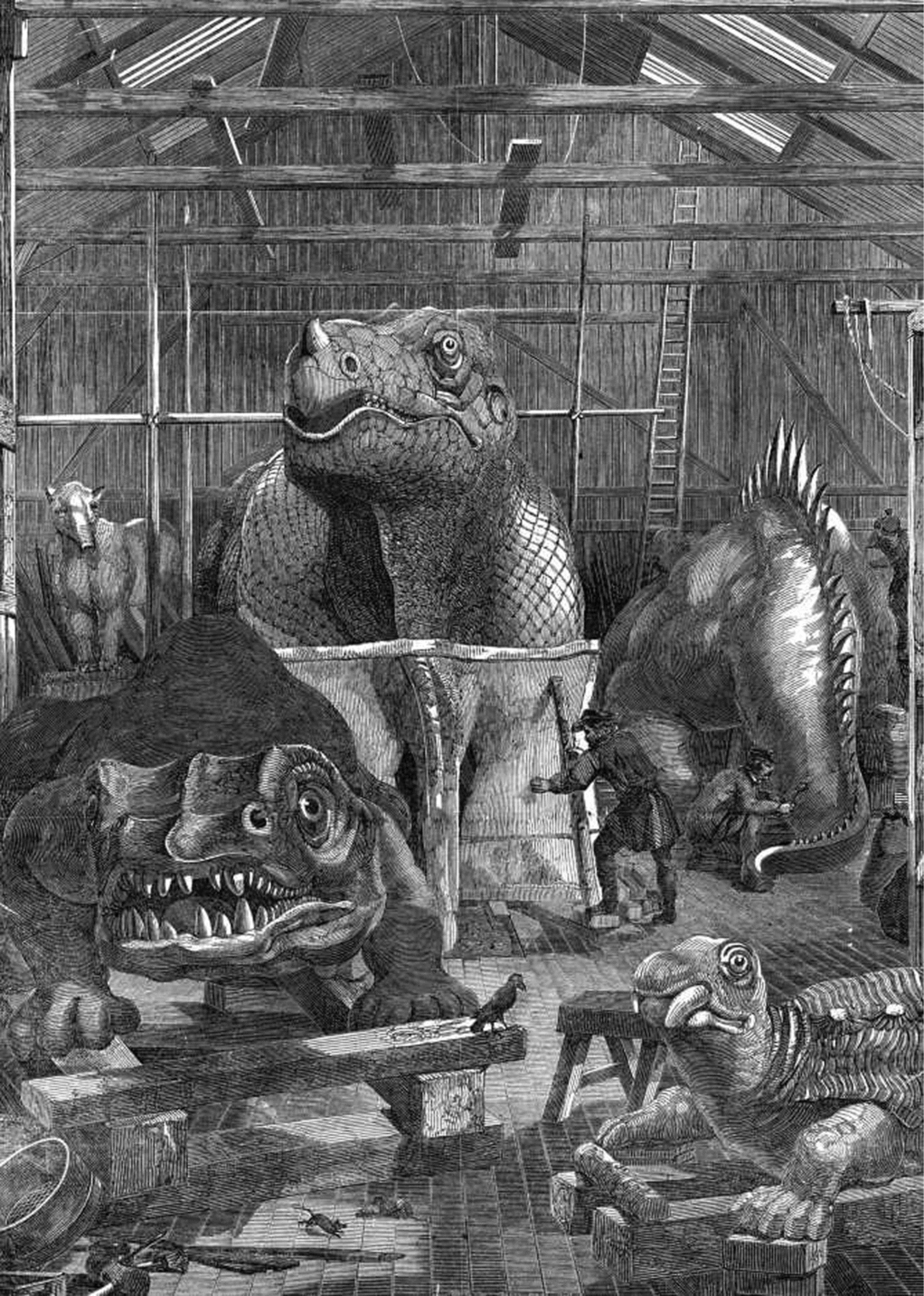
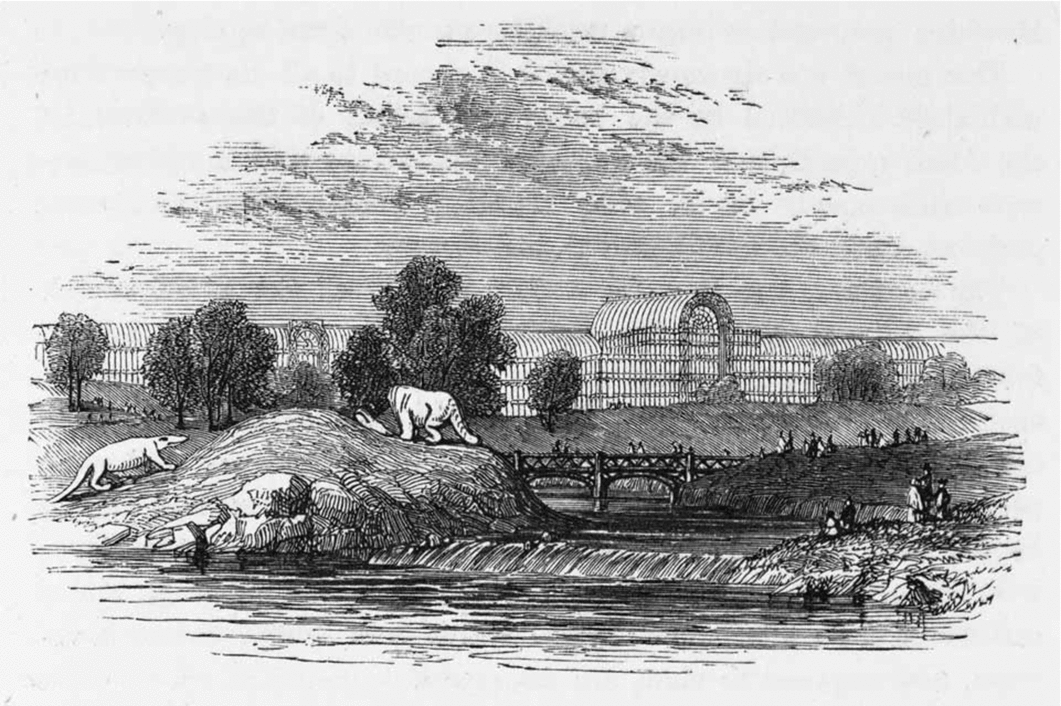
Maud's preoccupation with remains was the result of a conflation of themes and images that Tennyson explored in the months leading up to his writing of the poem. Geology was never far from Tennyson's thoughts and he was a sophisticated reader of geological theory. In November 1853 (a year before he sat down to write Maud) the family moved to Farringford on the Isle of Wight, where Tennyson furthered his interest in geology and “trudged out with the local geologist, Keeping, on many a long expedition” (Memoirs 1: 366). On the 19th of May 1854, on a trip to the mainland, Tennyson pre-viewed the Crystal Palace Exhibition at Sydenham, just weeks before the official opening, writing to his wife that it was “certainly a marvellous place” (Lang and Shannon 2: 90). The spectacular potential of the emerging sciences of comparative anatomy and archaeology to recover the past were powerfully represented in the exhibition, and of all its wonders, Tennyson notes that he was “much pleased with the Pompeian house and with the Iguanodons and Ic[h]thyosaurs” (Lang and Shannon 2: 90).Footnote 9 The latter were the first life-size reconstructions of prehistoric animals ever to be exhibited, and were created by the sculptor Benjamin Waterhouse Hawkins under the direction of Richard Owen (Figure 10).Footnote 10 Tennyson had met Owen for the first time some two years previously (according to Owen's diary) on August 6th 1852, and Owen was to become Tennyson's companion on geological field trips in later years on the Isle of Wight (Owen, Life 1: 388–89). The iguanodon and ichthyosaurs were placed, along with reconstructions of other extinct animals, on “Islands in the Geological Lake,” which had been constructed to represent five geological epochs complete with corresponding rock formations and strata (Figure 11). As Owen explained in the exhibition guide, the purpose was to “demonstrate the order of succession, or superposition, of these layers or strata, and to exhibit, restored in form and bulk, as when they lived, the most remarkable and characteristic of the extinct animals and plants of each stratum” (Inhabitants 7). The reconstructions provided a fabulously exotic spectacle that must have thrilled Tennyson's geologically-orientated imagination and that offered him a remarkable confrontation with the power of comparative anatomy to, as Owen had put it, “restore and reconstruct . . . species that been blotted out of the book of life.” As Paul Turner notes, Owen's pre-historic figures reappear as Maud's “monstrous eft” who was “of old the Lord and Master of Earth” (136).Footnote 11
“Extinct Animals Model-Room, at the Crystal Palace, Sydenham.” Illustration from the Illustrated London News (31 Dec. 1853), 600.

Illustration from Richard Owen, Geology and Inhabitants of the Ancient World. (London: Crystal Palace Library, and Bradford & Evans, 1854), 5.
The reconstructions, Owen admitted, might “by some . . . be thought, perhaps, too bold.” However, they were justified, he claimed, by the way they demonstrated the “successive periods, during which many races of animated beings, distinct both from those of other periods and from those now living, have successively peopled the land and the waters” (Inhabitants 7). The exhibition thus illustrated and emphasised the “discovery of the law of succession of animal life on this planet,” a law that Owen suggests comparative anatomy proves (Owen, Lectures 2: 3).Footnote 12 The vista of succession did not end, however, with the animal reconstructions. Inside the Crystal Palace, ten stunning architectural and historical “‘restorations’ of buried empires” were on show in the successive Courts. The “Courts were to be a main feature of ‘the education of the eye’, to form a three-dimensional and full-colour encyclopaedia of the ‘complete history of civilisation’” (Piggott 67). Thus, they continued the depiction of successive “masters” of the earth in reconstructions of the art and architecture of past cultures, and in turn, helped to weave geological history into more recent human history in the minds of visitors. The exhibition emphasised a continual succession of animal types and human civilisations in the way it left unrecorded the aeons of geological time that divided Hawkins's dinosaurs from each other and from the world of the modern viewer. It collapsed time, visually enforcing Owen's “law of succession,” in which an unvarying and regular law of the rise and fall of “races of animate beings” works through the whole of earth's history (Inhabitants 7).
Owen's vision of continual succession, however, was a troublesome one, as while the Crystal Palace proclaimed the mid-Victorians’ consummate ability to read the past from its remains and thus their assumed mastery over the past, it also suggested a law at work in the nature of things from which the they could not extricate themselves. In this way, the exhibition encouraged them to extrapolate Owen's vision of succession and to envisage their own inevitable extinction. Zimmerman demonstrates how the Victorians were acutely aware of the fate of their own civilisation as the potential ancient relic of the future, as extensive building work across the capital, in what Zimmerman calls “accidental archaeology,” increasingly revealed London's buried Roman past (97–142). Such discoveries demonstrated how the land is peopled successively, since not only was London once the scene of Roman otherness, but the monsters of an inconceivably distant past had also once roamed the land on which London now stood. Nancy Rose Marshall also points out that the Palace's journey in time was in reverse: “Moving away from the displays of present civilisation and human history in the Palace, the visitor travelled further back in time, as he or she crossed the grounds, a temporal regression characterized as a movement into the wilderness.” Thus, she argues, “the park's backward spatial model of time” encouraged “thoughts about human extinction” (289, 296).Footnote 13 The Crystal Palace also emphasised how access to history in geological, palaeontological, and archaeological terms relied upon excavating and reading the fragments and relics of a buried past, as all things successively gravitate towards the ground and are embedded in the earth's strata to become the matter upon which future worlds are built.
Inside the Crystal Palace, in the Nineveh Court, Tennyson would have seen reproductions of the winged Assyrian bull discovered by A. H. Layard, which, as critics have noted, gave him his description of Maud's brother, “That oil'd and curl'd Assyrian Bull” (I: 233).Footnote 14 Tennyson read Layard's Nineveh and its Remains (1849) in the summer of 1852 (Memoir 1: 356).Footnote 15 The Nineveh Court had a particular resonance for Victorians, as Assyria was “associated in contemporary minds” with the “biblical books of Kings and Chronicles, and the prophecies of Isaiah and Jeremiah about desolation” (Piggott 111).Footnote 16 The Nineveh Court “was a monument to imperial power and pride” and its remains were seen as a “prophetic memento mori of the possible demise of the British Empire.” Similarly, the Pompeian Court (which particularly pleased Tennyson, and had the added drama of the city's tragic fall to geological catastrophe) was presented as a warning against decadent materialism. The Courts generally “suggested a certain politics of empire, a philosophy and even a morality: the fall of proud, wealthy and luxurious civilisations” (Piggott 75). Visitors, many of who would have been familiar with Edward Bulwer-Lytton's hugely popular The Last Days of Pompeii (1836), were “told that Pompeii was the fashionable resort of a hedonistic class” and that “it would be helpful to think of it as the ‘Worthing of Italy’” (Piggott 100). The fate of Pompeii, in which organic material and even living individuals were apparently turned to stone, seemed a fitting Nemesis for a sensual and luxurious age. Rather erroneously, visitors were told, “Nineveh for all its pride fell in a day and it took only an hour for the sybaritic Pompeii to be buried in ash” (Piggott 75). Thus, the grindingly slow progress towards civilisation was juxtaposed against the astonishing rapidity with which such progress is apparently undone.
Maud clearly draws on the rhetoric and narratives that the Crystal Palace implied, depicting a terminally materialistic age heading towards a manifestly geological fate. In the absence of Vesuvius, Maud's nineteenth-century geological catastrophe involves an acceleration of geological time through which the text envisages petrification as occurring in the present. The age is presumably already morally dead; its soft parts, the human heart, for example, having been turned to stone. The speaker predicts early in the poem that “Sooner or later” he “too may passively take the print / Of the golden age,” which will make his “heart as a millstone” and “set” his “face as a flint” (I: 29-31). He is “Gorgonised . . . from head to foot” by Maud's brother's “stony British stare” (I: 464-65): his heart is “half-turn'd to stone,” and is repeatedly described as made of stone (I: 267, 268; II: 132,136). The unnatural speed with which fossilisation occurs parallels the increasing “lust for gold” (III: 39) which “gorgonises” and deadens all the characters of the poem in its valuing of dead geological materials such as coal and gold above the living. Maud's characters appear to be already dead, and if not already petrified, they either seem to be in danger of slipping into the system of dead remains, or else they are represented by geological matter. Maud's brother is a “flint” (I: 740), a “lump of earth” (I: 537), and just as the speaker's father is represented by the “rock that fell with him when he fell,” so Maud's mother, “mute in her grave,” is signified by “her image in marble above” (I: 158). Maud herself, who is described as “dead perfection” (I: 83), is consistently equated with inorganic substances, being “gemlike” (I: 95), a “jewel” (I: 352), a “precious stone” (I: 498). Thus, she already belongs to a world of geological substances, her worth measured not in terms of human values, but geologically and economically. If Maud is represented by those geological materials that are most rare and coveted, then the poor are represented by more mundane matter. Fed with bread adulterated with “chalk and alum and plaster” (I: 39), the poor are undergoing processes of petrification as they are slowly mineralised in a macabre transformation of living flesh into geological material. Thus, Maud depicts a fittingly geological destruction for the “Wretchedest age since time began” (II: 259). The ruin of the present world accedes to the inevitability of Owen's law of succession: Maud's world is already solidifying, fixing its character into remains that will be read by the proficient reader (by a new “Lord and Master of the Earth”) as the telling remnants of a materially-oriented and morally defunct age.
The Crystal Palace exhibition visibly confirmed what Tennyson already knew from his reading of Lyell's Principles; that all life and all human artefacts are inhumed within the folds of the earth's strata as it relentlessly shifts through geological time.Footnote 17 Lyell offered provocative visions of petrification and fossilisation, sometimes extrapolating the effects of geological processes in the present to visualise a distant future in which the present world is reduced to inorganic material. For example, contemplating deep time Lyell writes:
Let us suppose that at some future time the Mediterranean should form a gulf of a great ocean, and that the tidal current should encroach on the shores of Campania, as it now advances on the eastern coast of England: the geologist will then behold the towns already buried, and many more which will inevitably be entombed hereafter, laid open in the steep cliffs, where he will discover streets superimposed above each other, with thick intervening strata of tuff or lava. (1: 359-60)
Here, streets become strata, in a passage that suggests how successive civilisations become subsumed into the earth while new manifestations of civilisation succeed them in a continual layering. Lyell goes on to suggest that, “Among the ruins will be seen skeletons of men, and impressions of the human form stamped in solid rock of tuff” (1: 360). Mantell goes further, conjuring a distant future in which towns and cities will be constructed from materials that contain traces of the present human world.
The occurrence of human skeletons in modern limestone . . . incontestably prove[s] that enduring memorials of the present state of animated nature will be transmitted to future ages. When the beds of the existing sea shall be elevated above the waters, and covered with woods and forest – when the deltas of our rivers shall be converted into fertile tracts, and become the sites of towns and cities – we cannot doubt that in the materials extracted for their edifices, the then existing races of mankind will discover indelible records of the physical history of our times, long after all traces of those stupendous works, upon which we vainly attempt to confer immortality, shall have disappeared (Wonders 1: 114–15).
Here, organic traces of the age are incorporated into the geological system, which in turn becomes the building materials that will raise new cities in an incomprehensibly distant future, suggesting it is the dead remains of the Victorians themselves that endure through time, not the great works of architecture or engineering designed with posterity in mind.
Even more disturbing, perhaps, was Thomas Carlyle's vision of remains and the readable history they leave behind. Carlylean “moral and social concerns” can be traced throughout Maud, as Michael Timko has shown (61). However, the confluence of their thinking in terms of geological processes has not been noted. Like Tennyson, Carlyle was also influenced by Owen's comparative anatomy and Lyell's geology, as John Ulrich has strikingly demonstrated.Footnote 18 In Carlyle's “Bog of Lindsey,” which was posthumously published, but written “most likely . . . in the latter half of 1843” (Ulrich 45) (a time when Tennyson “was in the habit of walking out with Carlyle at night” and when they had “long and free discussions on every conceivable subject”), Carlyle provocatively evokes the successive layering of history as strata (Memoirs 1: 267).Footnote 19 For example, he writes:
. . .the leafy, blossoming, high-towering past century”, “becomes but a stratum of peat . . . the brightest century the world ever saw will sink in this fashion; and thou and I, and the longest-skirted potentates of the Earth, – our memories and sovereignties, and all our garnitures and businesses, will one day be dug up quite indistinguishable, and dried peaceably as a scantling of cheap fuel” (Carlyle, Historical 64).
Here, the “great diversity of the past [is] compressed and homogenized” (Ulrich 47) and nothing distinguishable remains; all life, reduced to its lowest carbon common denominator, becomes merely fodder for the fire.Footnote 20
Lyell writes in detail in the second volume of Principles on processes of fossilisation, discussing, for example, the various sites where ancient human remains had been found in the early stages of fossilisation, and Tennyson seems to have been interested in observing such phenomena at first hand, and keen to make literary use of his observations. Susan Shatto notes that in August, shortly after his visit to Sydenham, he journeyed to Glastonbury, Wells, and Cheddar “to gather materials and ideas . . . for his long-meditated Arthurian epic” (17). Here, he explored a cave at Wookey Hole. He notes, however, it was “not quite what I wanted to see, tho’ very grim” (Memoir 1: 377). What he expected clearly came from his reading of Lyell, as Lyell specifically records how “human skeletons have . . . been found in the cave of Wookey Hole . . . dispersed through reddish mud and clay . . . some of them united by stalagmite into a firm osseous breccias” (Principles 2: 224). The “reddish mud and clay” of this cave was typical of sites in which human or animal remains are found in the process of fossilisation, and Lyell frequently notes the “reddish calcareous earth” (2: 223), the “red osseous mud” (2: 224), the “red breccias” or the “blood-red colour” (2: 221) of strata at such sites. The cave, “tho’ very grim,” was, apparently, not quite as lurid as Tennyson had hoped. Returning to Farringford with the Crystal Palace and Wookey Hole fresh in his mind, Tennyson “worked at ‘Maud’ morning and evening, sitting in his hard high-backed wooden chair in his little room at the top of the house” (Memoir 1: 377). From here he wrote Maud's arresting and emphatic opening lyric:
The “dreadful hollow,” of course, is the site where the body of the speaker's father is found. Critics have commented on how the lines evoke a vividly sexualised landscape. As Jonathan Wordsworth noted in 1974, “once it has been pointed out it is difficult not to see the details of the first two lines . . . in terms of the female body” (qtd. in Slinn 68 n10).Footnote 21 However, this resonant reading has tended to obscure the possibility of other interpretations, particularly in the light of Tennyson's reading of Lyell and his visit to the Wookey cave. The “red-ribb'd ledges [that] drip with a silent horror of blood” encode the geological reality that the earth is essentially composed of the dead remains of organic life. They can be linked to the “reddish mud and clay” of the Wookey Hole cave in which it was possible to find human bones. Also, on the Isle of Wight in the years after the publication of Maud, Tennyson explored what he called the “red cliff” for fossils with Richard Owen, writing afterwards to Owen: “we cannot afford to lose your brains . . . not at least till all our lizards are dug out, and this stretch of red cliff which I see from the attic windows no longer needs interpretation” (Lang and Shannon 2: 406–08).Visible from the window of his attic study (the room in which Tennyson wrote much of Maud), the “red cliff,” as Dean points out, is “an unusually interesting formation at Brook Bay of upturned ferruginous clays, sandstones, and shales capped by horizontal layers of gravel, clay and loam,” and an area rich in dinosaur fossils (Dean 22). Emily Tennyson also makes reference in her diary to the “red cliff” and “the wonderful dragon” that Owen made “out of the bones and scales” there found, suggesting that the “red cliff” was for the Tennysons the name given to this specific place of great palaeontological significance (Dean 22). The “reddish mud” of the Wookey Hole cave and the fossil rich “red cliff” Tennyson viewed while he wrote these lines combined to create the image of the “red-ribb'd ledges.” In this reading the “dreadful hollow” is akin to the Wookey Hole cave and similar sites: it is not only a bloody site of death, but also the place where the peculiar (and “very grim”) processes of fossilisation occur; where an aggregate of bones and mud harden into rock through the pun in which the “red-ribb'd ledges” are indeed ridges of rib bones distributed through “reddish mud and clay.”
The speaker's concern for remains begins with his anguished contemplation of his father's remains found in the “ghastly pit.” Appropriately the body fills the “pit” left by the “gutted mine” (I: 338) that was emptied out in the making of the “new made lord[’s]” wealth. The fate of the body, which is “Mangled, and flatten'd, and crush'd, and dinted into the ground” (I: 7), evokes a type of fossilisation whereby, as Lyell explains, organic material is “squeezed down and flattened” in the making of coal (Lyell, Elements 428). Thus, the body appears to replenish the coal that is “all turn'd into gold” (I: 340) in a fitting exchange that exposes how the present age values dead remains above living individuals. Coal itself is the dead remains of organic life transformed in the process known as carbonisation, the early stages of which Carlyle alludes to in his vision of a future in which “thou and I,” subsumed into the peat bog, are reduced to “cheap fuel.” In carbonisation, as Lyell describes, “Sometimes only obscure or unintelligible impressions are left, and the lapidifying process has often effaced not only the characters by which the species, but even those whereby the class might be determined” (Principles 1: 147-48). Remains are thus flattened, crushed and reduced to a carbon trace, a state in which taxonomic divisions become difficult or impossible to detect. The “characters,” the readable signs that link past remains to the present (comparative anatomy's narratives of “class” and “genus”) are here effaced, and therefore cannot be read. The “Mangled,” “flatten'd,” “crush'd, and dinted” body of the father is thus divested of social identity; the demarcations of “class” are squeezed out of his remains, as he loses his footing in the social hierarchy and descends into the abyss of the “dreadful hollow.” From here, the father cannot be restored and reconstructed, as his remains leave an unreadable trace, a circumstance acknowledged by the speaker who expresses a concern that his father's good reputation will fail to be recorded: “his honest fame should at least by me be maintained” (I: 18). The decline of the speaker's own authority (his alienation from society, his namelessness and madness) point, however, to his inability to read, to re-write, and therefore to recover the father within the wider, shared social narratives of respectability and honour.
Carlyle, also connecting the mechanical actions of geological processes with the propensity of remains to lose their readability, writes of how “Generation under generation . . . and all higher generations press upon the lower, squeezing them ever thinner” (Historical 64). The squeezing and thinning out of remains and their increasing lack of distinguishability makes the recovery of the past impossible. The land in Maud has already been divested of meaning; the father's remains, which should be incorporated into “the dust of our heroic ancestors” (Carlyle, Latter-Day 27), fails to record a heroic history of the present for future generations to read. Moreover, the land has been emptied out in the lust for coal and gold, a state of being that is the consequence of the greed and “Villainy” (I: 17) of Maud's father, and more generally of industrial capitalism, represented by the new-made lord's grandfather, whose coal-fuelled fortune has been made in the creation of the “ghastly pit.” It is this greed and villainy that led the speaker's father to the suicide's grave, and thus to the “dreadful hollow” and the “ghastly pit” of anonymity, where his battered remains, bereft of their honourable status, leave an unreadable and unrecoverable trace.Footnote 22 Thus, while the father's “honest fame” goes unrecorded, the petrification that overtakes Maud's living characters leaves legible traces of an age deadened by, and insensible to, its own greed and villainy.
Lyell quotes Byron to evoke a sense of the land as comprised of dead remains, “The dust we tread upon was once alive!” further commenting:
How faint an idea does this exclamation of the poet convey of the real wonders of nature! for here we discover proofs that the calcareous and siliceous dust of which hills are composed has not only been once alive, but almost every particle, albeit invisible to the naked eye, still retains the organic structure which, at periods of time incalculably remote, was impressed upon it by the powers of life. (Elements 56–57)
Owen makes an equally striking point in the Crystal Palace exhibition catalogue: “Chalk, immense as are the masses in which it has been deposited, owes its origin to living actions; every particle of it once circulated in the blood or vital juices of certain species of animals” (Inhabitants 9). Cuvier too, writing of coal, suggests the “imposing – even terrible – spectacle – as that of these remains of life, forming almost all the ground on which we tread” (Rudwick, Cuvier 125). Not merely the receptacle of corporal remains, the earth is comprised entirely of dead remains processed into a state of indistinguishability under the grinding wheels of geological time. The “dreadful hollow,” the “ghastly pit,” and the “red-ribb'd ledges [that] drip with a silent horror of blood” all encode this macabre reality. They suggest not only that dead remains of life form “almost all the ground on which we tread,” but also that these remains represent an infinitude of forgotten lives, the countless dead remains, from the dead father to the “little living will” (II: 62) that once inhabited the empty shell, all unceremoniously commingling, all essentially and irredeemably lost in myriad accumulations over immeasurable time. In this sense Maud's remains record the levelling effect of geological processes and point to the ultimate breakdown of the distinctions of biological and social hierarchies. They remind the reader that, as Hamlet knew; the dust of the great may one day stop a “bung-hole.”
More troubling, however, is that the body in the pit is “His who had given me life – Oh father! Oh God!” (I: 6) indicating not only the death of the earthly father, but also the divine Father. Both are annihilated by geology: the physical father whose geologically processed remains fail to leave a readable trace, and God the father, whose revealed truth is shown to be false by geological timescales and rendered absurd by the evidence of the rocks. Absence characterises both, as geology effectively empties them out leaving only the “dreadful hollow.” This condition is indicated by the voice of “Echo” (I: 4), which not only foregrounds the deficiency of the speaker's personal narrative, but also suggests a wider crisis specifically initiated by the geological enterprise itself. As a reflection of sound waves on hard surfaces the echo is the enquiring geologist's voice directed towards the rocks and stones of a hard and uncomforting geological world. The answer of Echo, and the conclusion of geology, is that death is the unequivocal law of nature, an answer that is all the more poignant as it represents the geologist's own voice reflected back to him. Thus, while the echo acting in a hollow represents the speaker's effort to overlay the “silent horror of blood” (I: 3) with the hum of human meaning, it only foregrounds a more profound sense of meaninglessness at the centre of being, one that can never be filled.
Reading Remains
Maud's speaker attempts to make sense of those past events that have resulted in his present circumstances. Like Hamlet, he is traumatised by the death of his father, dissociated from a world in which he has “hardly mixt” (I: 265) and in danger of descending into madness. His interaction with remains is paradoxically both a way of keeping a grip on the material world, as well as the source of his anxiety, as, on the one hand, remains shape his narrative of self and give meaning to his existence, while on the other, they dramatically undercut his sense of self-presence in the absence they foreground. The self that develops from reading remains is increasingly experienced by the speaker as a self devoid of substance, as a self that is as bereft of meaning and as lifeless as the remains from which it is constructed. Thus the speaker cannot avoid madness, as while the escape from the object world (the desire to bury himself in himself) is a symptom of his dissociation from the phenomenal world, the self constructed in his reading of remains is one that is sick and riddled with existential angst.
There are moments in Maud, however, when the “dreadful hollow” of the speaker's existence is dispelled; when, for example, remains appear charged with meaning and able to offer full presence. These are the moments when the speaker encounters readable remains that can be reconstructed into self-affirming narratives, as in Part I when Maud's “happy yes” (I: 579) results in the speaker's heighten emotional excitement:
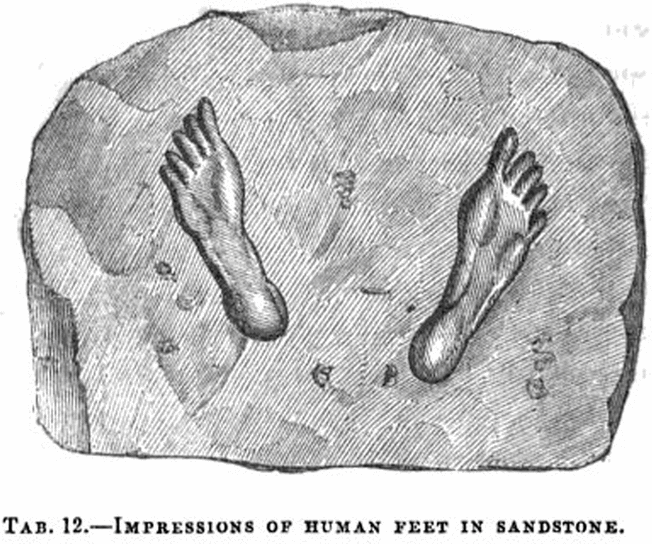
Here, love leaves its trace in the form of the “jewel-print” of Maud's feet that are “set” like precious fossil imprints, and like a fossil imprint, the “jewel-print” carries the potential for reconstruction. Mantell, for example, discusses what he believed to be the ancient impressions of human feet found in sandstone: the “prints,” he writes, present the “perfect impress of the feet and toes, exhibiting the form of the muscles, and the flexures of the skin” (Figure 12). A narrative can be read from such remains; stature can be deduced, the individual's “upright” and “easy” stance can be determined (Wonders 1: 76). Similarly, the jewel-print of Maud's feet leaves signs that also yield a narrative, signs that can be followed and that lead to the “woody hollows” and “valleys of Paradise” where the “dreadful hollow” is filled by the living presence of the lovers. The “jewel-print” is ostensibly able to bring the signified into full presence in the reconstruction of the physical woman, the shape of her foot, the colour of her eyes. At the same time, however, the “jewel-print” unavoidably points the way to the “hollows” and “valleys” that gesture towards the inescapable absence that the fossil imprint inevitably indicates, thus the speaker's faith in the power of remains to recover what is missing is subtly undermined by a more fundamental sense of the vacuity that remains signify. The “jewel-print” is itself a “hollow” space and nothing fills it, the observer merely projects meaning over its void. What the “jewel-print” reconstructs is the speaker's idealised narrative of Maud, while it simultaneously indicates her utter absence.
“IMPRESSIONS OF HUMAN FEET IN SANDSTONE.” Illustration from Gideon Mantell, The Wonders of Geology: Or, A Familiar Exposition of Geological Phenomena. Vol. 1. (London: Relfe and Fletcher, 1838): 79.
In another heightened moment the speaker imagines his own remains resurrected by the power of love, when, in the rapturous final lyric of Part I, Maud is imbued with the capacity to re-animate the speaker's dust:
Here, the speaker's remains are the materials for reconstruction as Maud's presence, in an unconscious acknowledgement of the vital role of the “other” in the self's self-awareness, is invested with the power to seemingly bring the speaker into full presence. In the manner of the reconstruction of fossil remains carried out by comparative anatomists, the speaker's “earth” is fleshed out, his “dust” remade, and the heart that was dead (the “poor heart of stone”) even while the speaker lived, is dynamically aroused and flushed through with the purple and red that are the true colours of the heart's veins and arteries.Footnote 23
Such ecstasy, of course, is short lived, and immediately following this episode is the crisis and decent into madness of Part II. Remains now appear as indicators of absence that can be filled only by the observer's gaze. The inability of remains to recover what is missing or dead, as well as the dead world they signify, lies behind the speaker's impulse is to bury himself within himself. Relinquishing the material world for the inner self, however, leaves the speaker disconnected from the temporal and spatial nexus of narrative (the self, in other words, constructed through interaction with the object world) and in consequence, his narrative and his sense of self break down. Just as the object needs an observer without which it “slips away into oblivion” (Zimmerman, 134), without remains the speaker loses his narrative of self, is “blotted out of the book of life” (Owen, Lectures 2: 3), and descends into the “dreadful hollow” of the dissociated self. Here, the temporal and spatial co-ordinates of narrative are dangerously close to disappearing altogether, both for the speaker, who experiences various degrees of madness, and for the poem itself, which is so often characterised by critics in terms of its fragmentary form and disjointed plot.
This scenario is played out in Maud's shell lyric of Part II (II: 49-77). The speaker's interaction with the shell is perhaps the poem's most overt reconstruction in the mode of comparative anatomy, and, like so much of Maud, as Turner notes, it was written in response to Tennyson's reading of Lyell's Principles.Footnote 24 Remains offer the speaker a narrative hook on to the phenomenal world; drawn to the shell after the crisis of the ill-fated duel, the speaker contemplates his relationship to it.
It is precisely at the point when the intensity of his mental anxiety threatens to “drown” out the phenomenal world, that the speaker recognises how the shell, along with other objects (“little things” in comparison to the deep world of the inner self) offer him the possibility of narrative recovery. The shell is what remains of the “living will” and as such, it provides negative evidence of a past presence that, in the fashion of comparative anatomy, the speaker feels compelled to reconstruct. The compulsion comes from his tacit understanding that it is his narrative of the shell that not only ostensibly recovers the “little living will,” but that also gives him shape and meaning. The contemplation of the shell results in a tentative narrative: the speaker wonders, did the “little living will / That made it stir on the shore” “stand” at “a diamond door” in a “rainbow frill,” did it push a “golden foot or a fairy horn” through a “dim water-world” (II: 62-68). With the recovery of the “living will” comes the recovery of the speaker's sense of himself as a player in the object world, enabling him to “strike on a sharper sense.” Thus, like the “Echo” (I: 4) in the “dreadful hollow,” his narrative of the empty shell rebounds back to him to fill the “hollow” of his own self. However, as his own voice reflected back to him from dead remains, the narrative of self thus constructed ultimately only compounds his sense of emptiness and meaninglessness; the speaker's narrative cannot recover the “living will,” and like the voice of Echo, his words return to him only “death” (I: 4). The paradox is that while the shell allows him to “strike on a sharper sense” of self and to momentarily surface from the objectless “dreadful hollow,” it is an object that speaks to him of his own future as remains, and of the dead world of meaningless objects to which he himself and all life must ultimately submit.
The validity of the speaker's narrative is brought into question when, in the same moment of reflective clarity that allowed him to “strike on a sharper sense” of self, he recalls Maud's dying brother:
The hair fashioned into a memorial ring is another example of the way organic remains keep the speaker anchored in the object world by offering him materials for narrative construction. However, it is an object that has the potential to disrupt the general rhetorical thrust of the poem as it problematises the speaker's rendering of Maud's brother as a “dandy-despot” (I: 231), a “Sultan” (I: 790) and a “oil'd and curl'd Assyrian bull” (I: 233). Hair jewellery, as Deborah Lutz points out, “had its own narrative” (128), and the sentimental ring feeds into Maud's own account of her brother as “rough but kind,” and as her steadfast “nurse” (I: 759). It speaks of the possibility of other narratives, of, for example, the affecting narrative of a son's love for his mother. The ring is also only one of a number, “For he had many,” suggesting any number of potential narratives threaten to disrupt the speaker's shaping of a history in keeping with his perception of events. Like all memorial relics, a ring of hair may have had “value only to a handful of people, or even to just one, and if that one died, then the relic became . . . of worth to no one” (Lutz 129). With the death of the brother, both mother and brother slip further into the past: the ring is no longer a trace to be interpreted by the brother and it cannot be read as the brother once read it. It is noticed by the speaker, yet the meaning invested in it by Maud's brother is no longer available; the ring instead encircles a vacant space, another “dreadful hollow” upon which an observer may project any number of meanings, while its original significance is wholly lost. The speaker's contempt for the brother's many rings betrays his unreliability as a reader of remains, and serves to demonstrate the ambiguity of the object and the subjective and arbitrary nature of the interpretation.
Remains present the speaker with the unthinkable; the absence of self. They serve a dual role in bringing the speaker (his narrative of himself) into being while they also poignantly demonstrate the condition in which consciousness faces both the impossibility and the inevitability of non-existence. In the madhouse canto of Part II, the speaker projects his consciousness onto his own future remains envisaged as subsumed into the geological system and embedded like a fossil in strata beneath the city streets.
Here, the speaker's predilection for the “selfish grave” (I: 559) is realised in his burial in the “suicide's grave at the cross-roads of the street” (Thesing 17), and, like his father, who made “false haste to the grave” (I: 58), the speaker's “bones” do not undergo any common process of decomposition, rather they are beaten and flattened into the ground in actions that once again draw attention to processes of fossilisation. The “hoofs of the horses [that] beat, / Beat” upon the speaker's “scalp and brain,” the incessant action of the “wheels” and the never-ending “stream of passing feet,” all perform the same flattening, crushing, dinting actions that in a Lyellian manner appeared to divest the father's remains of its characters and class. The living world, as in Carlyle's description, “press[es] upon the lower, squeezing them ever thinner” (Historical 64), removing the dead from the reach of history. Thus, while the speaker “cr[ies] to the steps above” (II: 339) his head, he cannot be heard, as his dishonourable remains, like his father's, leave no readable trace.
The speaker's fate recalls Lyell's and Mantell's extraordinary extrapolation of geological processes that attempts to show in what ways the human remains of the present world may come to be integrated into the cities of the future. Incorporated into the world of inorganic matter, the speaker enters the “ghastly pit” of geological time and fittingly from this position human time is vastly accelerated. The business of human existence appears as a frenzied rush of “driving, hurrying, marrying, burying;” a flickering and relentless succession of births and deaths.Footnote 25 The speaker's bones, like the “skeletons of men” that Lyell suggests are “stamped in solid rock” (1: 360), are beaten into the city streets to form yet new stratum upon which the fleeting lives of future generations play out.
Already “Gorgonised,” his heart “half-turn'd to stone,” the speaker's inhumation in the strata completes the process of fossilisation, except, that is, that in this terrible state of being, he remains conscious. The “rough grave” is not the longed for “still cavern deep” (II: 236) where the speaker envisaged his troubled consciousness stilled by the geological processes that would fix it into a stony breccias, as he laments, “I thought the dead had peace, but it is not so” (II: 253), rather, as Lyell's text suggestively states, in the process of fossilisation remains are “imprisoned in solid strata [where] they may remain throughout whole geological epochs before they again become subservient to the purposes of life” (Principle 2: 189). The real life of matter, it would seem, begins with death, and, in keeping with Maud's internal logic, while the speaker's consciousness lives on, the living men that occupy the city appear to be already dead: “Ever about me the dead men go / And then to hear a dead man chatter / Is enough to drive one mad” (II: 256-58). In a world devoid of spiritual meaning, where the “churches have kill'd their Christ” (II: 267), where coal and gold are valued above the living individual, where men are fed with “chalk” and “alum,” truly “only the ledger lives” (I: 35). The appearance of life, the “chatter” and “babble” of men, belies an absence of soul, a “dreadful hollow” beneath the flesh that suggests the living body is already bereft of meaningful life. Thus, Maud envisages a geologically-oriented nightmare in which the morally and spiritually dead confront an afterlife that imprisons them within their own material remains. With no soul to transcend the body, consciousness becomes enmeshed within processes of fossilisation in a horrifying parody in which divine eternal life becomes instead a material damnation of perpetual geological process.
The Speaker's Readable Remains
Sifting through Maud's remains the speaker finds meaning to be merely the reflection of the observer's subjectivity over blank materiality. Part III, however, attempts to fill the absence encoded in the “dreadful hollow” and the “ghastly pit” by restoring faith in the existence of extrinsic meaning, by investing, in other words, in a narrative that ostensibly transcends the self, a shared narrative that can indelibly imprint itself on the speaker's remains and will be legible for all time. Such a narrative is found in the rhetoric of nationalism and war, and the rallying cry that sees the “heart of the people beat with one desire” (III: 49). War answers the speaker's specific concerns about his own remains and what may or may not be read from them. It promises to confer upon his remains a narrative of honour and heroism, thus avoiding the suicide's grave and the dishonourable fate of the father's remains.
Fittingly, it is Lyell's geological text that offers a solution to the problems it initiated. Lyell investigates “in what manner the mortal remains of man and the works of his hands may be permanently preserved” (Principles 2: 253), and highlights war as offering a unique pathway into the fossil record. Perishing at sea, Lyell suggests, offers particularly favourable conditions for the preservation of the human form, and specifically for those who go down in the wreck of a man-of-war. In these cases “cannon, shot, and other warlike stores, may press down with their weight the timbers of the vessel when they decay, and beneath these and the metallic substances the bones of man may be preserved” (2: 256). Crucially, it is the paraphernalia of war itself that guarantees the immorality of human remains as the bones of fighting men are flattened, compacted and preserved under the pressure of sunken weaponry. Appropriately, those who perish are “crush'd” (III: 44), like the speaker's father, in language foregrounding actions conducive to fossilisation, and yet unlike the ignominious fate of the father's remains, remains found in these circumstances speak distinctly and specifically of what is in Maud's rhetoric, self-sacrifice that bestows the highest honour. Lyell notes that, “During our last great struggle with France, thirty-two of our own ships of the line went to the bottom. . . . In everyone of these ships were batteries of cannon constructed of iron or brass, whereof a great number had the dates and places of their manufacture upon them in letters cast in metal” (2: 256). Such artefacts not only leave lasting and unequivocal narratives literally written into the materials of war, in Lyell's envisaging of men thus entombed, those narratives are imprinted and incorporated into their remains. Thus for the speaker, war fills the empty space of his imagined future remains with a narrative that writes itself into the heroic body preserving it for all time. Lyell “anticipate[s] with confidence” that those fortuitous remains crushed beneath the artefacts of war “will continue to exist when a great part of the present mountains, continents, and seas have disappeared” (2, 271). War bestows its seemingly meaningful narrative, not only on the speaker's remains, but on the remains of the age, offering a type of immortality that for the speaker tell of the “Honour that cannot die” (I: 177). This final illusion ends Maud, as the speaker stands on the “giant deck” of a warship bound for the “Black and the Baltic deep,” for “battle, and seas of death” (III: 34, 51, 37), and, it would seem, for a very specific form of immortality in the fossilisation and preservation of the speaker's own heroic and eminently readable remains.