In recent decades, scholars have identified a wide array of factors that affect the intensity of insurgency (violent or not) against governments. Insurgency may depend on political opportunities (McAdam Reference McAdam1999) and the cohesiveness of states (Skocpol Reference Skocpol1979). It may also be affected by a challenger's ability to mobilize resources (McCarthy and Zald Reference McCarthy and Zald1977 [1973]; Tilly Reference Tilly1978) and craft attractive frames (Snow et al. Reference Snow, Rochford, Worden and Benford1986). Powerful collective identities may also play a role (Polletta and Jasper Reference Polletta and Jasper2001).
Political parties, however, have received much less attention as shapers of insurgency levels. This is surprising given the centrality of parties in the political life of Western nations during the last century and a half. Parties aggregate societal demands, are the main players in elections, and provide the personnel that, once in government, decides about public policies. Hence, it is likely that they also affect disruptive, noninstitutionalized collective action against authorities.
This article explores how party systems shape the intensity of armed insurgency against national governments. Its most general contribution is to “bring parties back in” to the study of insurgency. My general question is why insurgency levels vary across countries, and I address it by comparing four Latin American countries with different levels of insurgency (Chile, Colombia, Costa Rica, and Uruguay) from approximately 1820 to 1910. While the central governments of Colombia and Uruguay faced frequent and intense armed insurgency, those of Chile and Costa Rica remained significantly less disturbed. Why?
I argue that part of the answer lays in the characteristics of party systems. In Uruguay and Colombia, the early development of “polarized bipartisms”—two-party systems that polarize along ideological and/or affective lines—created the grievances and oppositional identities that fueled insurgency across the century. Chile and Costa Rica, however, developed a type of multiparty system in which all parties could secure some power quotas but no one was capable of governing alone. This favored flexible and shifting coalitions among parties that prevented polarization and made insurgency unattractive relative to nonviolent strategies of political competition. This leads to the second contribution of the article—to show that bipartisms may promote political instability rather than stability, as has been argued in the literature for decades. I do not argue that bipartism always promotes insurgency and that multipartism always reduces it, but only that this may happen under the conditions specified in the following text.
By insurgency I refer to events in which national or regional leaders mobilize social groups to engage in warfare aimed at replacing central government authorities. In the countries I study, these leaders could be disgruntled military officers, high-level politicians, independence heroes, local patriarchs, landowners, merchants, or intellectuals. Disregarding their class, status, or previous trajectory, in most cases they were tied to political parties. They mostly mobilized adult male peasants—although urbanites could be mobilized too. I focus on national-level insurgencies—those that spread to wide sectors of the national territory—and exclude the elusive universe of local revolts. I also exclude mutinies, coups, and military plots (which usually involved little or no popular mobilization at all) and international wars.
I explore nineteenth-century Latin America, a region and time rarely seen in insurgency studies. As Wickham-Crowley states (Reference Wickham-Crowley1992: xiii), “Latin America has usually remained the ‘forgotten region’ when general theories of revolutions are put forth”—especially, I would add, its nineteenth century (but see López-Alves Reference López-Alves2001 for an exception). This is surprising given its proverbial characterization as an uninterrupted stream of chaos and violence (e.g., Morner Reference Morner1960: 295). I show that such characterization must be nuanced—not every country was equally prone to insurgency. I also claim that this region and time provides an interesting opportunity for exploring the role of parties in insurgency because insurgencies were often carried out by party leaders. Additionally, the understudied world of nineteenth-century Latin American parties offers an opportunity to revise some classic assumptions about political parties in general—assumptions that were mostly formulated having in mind twentieth-century European and North American parties.
The Outcome: Variations in Insurgency Levels
After achieving independence from Spain in the 1820s and 1830s, domestic Latin American leaders attempted to build republics across most of the emancipated territory. They faced the challenge of forming representative democracies in a region that lacked a strong tradition of representative government (Valenzuela 2006) and at a time in which international models of democracy to be emulated were underdeveloped (Huntington Reference Huntington1993). In this precarious institutional context, the competition for power among former independence leaders, combined with class, religious, and regional divisions among the national populations, created a fertile soil for armed insurgencies against governments (Halperín Donghi Reference Halperín Donghi1993 for a general treatment).
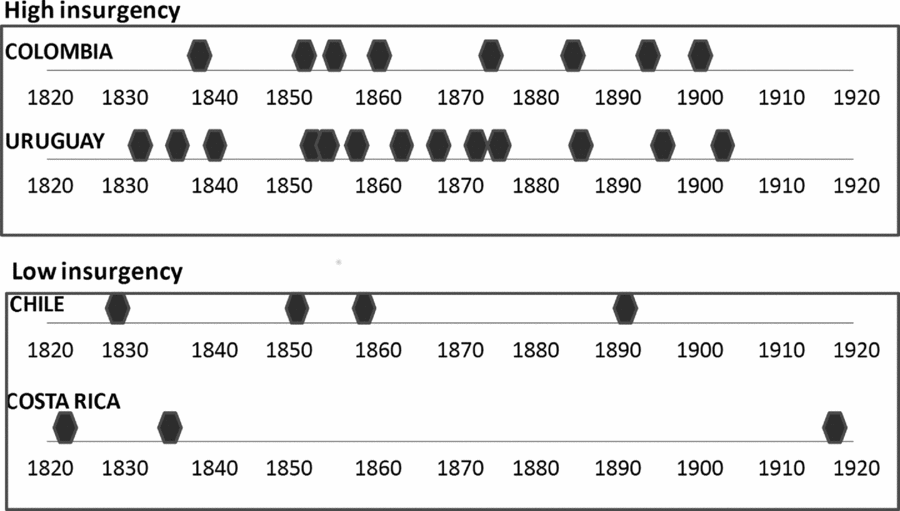
Interestingly, not all countries were equally prone to insurgency. This is shown in figure 1, which depicts the outcome I try to explain. Colombia and Uruguay were high-insurgency countries. They had 8 and 13 insurgencies (respectively) in the period under study. But Chile had only four insurgencies and Costa Rica just three. The difference is not only in the sheer number of events: detailed analysis of each insurgency (available under request) suggests that Colombian and Uruguayan insurgencies were typically longer, and resulted in deeper social and economic damage, than Chilean and Costa Rican ones.
The outcome to be explained: High- and low-insurgency cases in nineteenth-century Latin America.

I emphasize the role of political parties and party systems as proximate triggers of insurgency because research on insurgency and protest typically ignores parties, and because the actions of party leaders were immediate causes of insurgencies—most insurgencies were organized and carried out by parties. But as with any complex historical phenomenon many other factors are at play, and they may operate at earlier stages than parties in the causal chain leading to insurgency. I address additional explanations before the conclusions section. Rather than providing an exhaustive treatment of these factors—let alone to assess their relative explanatory power—my aim is just to underscore that party systems are important for understanding insurgency in nineteenth-century Latin America. After discussing the scant attention given to parties by insurgency scholars, I develop an argument linking party systems to insurgency levels, present the evidence for the four cases, and conclude.
No Parties in Insurgency Theories
Political parties and party systems received surprisingly little attention in theories about the causes of insurgency (e.g., social movements, revolutions, riots, and revolts). This partially stemmed from the implicit assumption that parties and insurgent movements were different social animals. In the social movements literature, Tilly's (Reference Tilly1978) influential “polity model” differentiates between polity members—who have low-cost access to political decisions—and challengers—who do not. Political parties, especially those with the largest support in the electorate, are polity members. Movements are challengers: they press from the margins of the polity, resort to disruptive protest to reach their goals, and only occasionally have substantial political impact (Giugni Reference Giugni1998). Tilly's polity model has heavily influenced scholars studying social movements in postwar liberal democracies, and with good reason: in such context movements are not mainstream political actors. Parties could therefore be safely dismissed from theorization. At most, they were conceptualized as movement allies opening “political opportunities” for social mobilization (e.g., Democrats and the civil rights movement).
During the last decade some scholars have begun to challenge the assumption that parties and movements are sharply different animals (Goldstone Reference Goldstone and Goldstone2003; Kitschelt Reference Kitschelt1989; Van Cott Reference Van Cott2005). While valuable, these approaches do not take sufficient distance from the polity model to be useful for nineteenth-century Latin America. Parties and movements may actually be getting closer to each other, but the very way of framing the issue already assumes that they are different entities. As will be seen in the following text, in my cases parties lead insurgencies. The most institutionalized actors—those who win elections, occupy the executive branch, and control the armed forces—may shortly after lead the less institutionalized action—lethal, destructive armed insurgency.
The major studies on revolutions also give scant attention to parties and party systems (Goldstone Reference Goldstone1991; Goodwin Reference Goodwin2001; Skocpol Reference Skocpol1979; Tilly 1993). Parties may appear in case narratives (e.g., Paige Reference Paige1975: 320ff.; Wickham-Crowley Reference Wickham-Crowley1992: 37–42, 142) but disappear in theory chapters. This is easy to understand in studies about, say, the 1640 or 1688 English revolutions or the 1789 French Revolution because revolutionary movements were not parties and/or parties did not exist or were very incipient at that time. But parties did play a relevant role in many twentieth-century revolutions (e.g., Russia in 1917 or China in 1949) and independence movements (e.g., India, Indonesia, and South Africa), yet researchers failed to integrate them into their theoretical frameworks.
The Argument
Why should parties and party systems matter for understanding variations in insurgency? Political parties are political groups that compete in elections for placing their candidates in public office positions (LaPalombara and Anderson Reference LaPalombara, Jeffrey, Hawkesworth and Kogan1992: 394; Sartori Reference Sartori2005 [1976]: 56). Most nineteenth-century Latin American parties looked similar to the conservative and liberal “bourgeois parties” studied by Duverger (Reference Duverger1984). They were created and directed by economic and political notables who were chosen by their talents, resources, skills, and connections (labor parties emerged only late in the century). Party leaders could often mobilize popular masses for political action (including armed insurgency), but these were not mass parties such as those emerging in Europe and Latin America in the twentieth century (e.g., working-class or populist parties). The important point is that insurgencies were generally staged by disgruntled mainstream parties—those that used to have control the executive power or at least that used to have an important share of congressional seats.
If parties were the main organizational vehicles for insurgency, could cross-country differences in parties and party systems explain variations in insurgency levels? By “party systems” I refer to “the system of interactions resulting from inter-party competition” (Sartori Reference Sartori2005 [1976]: 39; italics in the original). While there are many types of party systems, I focus on the distinction between two-party systems and multiparty systems.
Two-party systems exist when “[t]wo parties compete for an absolute majority that is within the reach of either” (ibid.: 112) and when there is the expectation of alternation, that is, “that the margin between the two major parties is close enough, or that there is sufficient credibility to the expectation that the party in opposition has a chance to oust the governing party.” Multiparty systems contain more than two parties and may adopt different forms. Thus, moderate pluralism comprises between three to five relevant parties with little ideological distance among them, which are therefore guided by centripetal competition. However, polarized pluralism comprises five or more parties with a high ideological distance, centrifugal competition, irresponsible oppositions, and antiparty systems. Regarding the number of parties, for my purposes the relevant distinction is that between party systems composed by two parties and systems composed by more than two parties. Although Sartori ignored nineteenth-century Latin America when building this typology, his concepts are suggestive for analyzing my cases.
The Classic Hypothesis
Inspired by the British and American experiences, until the 1970s most scholars argued that bipartism resulted in more political stability and a better capacity for peacefully processing conflicts than multipartism (Duverger Reference Duverger1984; Mainwaring Reference Mainwaring1993: 219; Neumann Reference Neumann and Calanchini Urroz1992: 29–30). Sartori claimed that bipartism tends to create consensus because its competitive mechanics generate a “conflict-minimising bent” (Sartori Reference Sartori2005 [1976]: 170). Conversely, systems of “polarized pluralism,” which have several parties and several poles of conflict, encourage “immoderate or extremist politics”—eventually including armed insurgency. This happens because these systems have center parties that, in their attempts to outdo left or right parties, lead “to a crescendo of escalation and extremisation” that end up in polarization (ibid.: 120).
Downs (Reference Downs1957) made a strong case for expecting bipartism to promote stability. In such a system, both left and right parties can safely move to the center of the spectrum in the search of median voters without risking losing voters on their own side of the spectrum. Centripetal competition prevents polarization and grants stability. Conversely, multiparty systems encourage centrifugal dynamics (and therefore polarization and instability) because party supporters have better defined ideologies and punish parties that move opportunistically across the political spectrum.
There are other reasons for expecting stability in two-party systems. Single-party cabinets (which are more common in two-party systems) should lead to stable and effective policies to a greater extent than coalitional multiparty governments (Lijphart Reference Lijphart2000: 72). Also, in two-party systems, “[h]igh-entry barriers keep radical actors out of the party system” (Mainwaring Reference Mainwaring1993: 200). This favors stable majorities and responsible parties that avoid violent confrontation. Conversely, multiparty systems would be unlikely to create such responsible majorities, as interest groups press their parties to the extremes of the ideological spectrum (Neumann Reference Neumann and Calanchini Urroz1992: 29–30; see also Mainwaring Reference Mainwaring1993).
But Multiparty Systems May Engender Stability
The assertion that multipartism leads to instability was empirically challenged in the 1970s, as it became clear that many small European democracies with multiparty systems were nonetheless extraordinarily stable (Lijphart Reference Lijphart1968). In such “plural societies”—epitomized by the Netherlands—multiparty systems better represent the ethnic, religious, and linguistic diversity of the population. Multipartism also promotes stability because, in the absence of a single party that controls the government, it encourages alternative coalitions, predisposing parties to centripetal competition. Also, government rotation after elections often means only a partial change in the composition of the coalition in government, which is better for stability than the dramatic changes ensuing in bipartisms (Lijphart Reference Lijphart2000: 17). I use the expression flexible multipartism for naming this kind of situations. Lijphart's important finding that consociational democracies (which typically have multipartism) have lower levels of turmoil and political deaths than majoritarian ones (which often have bipartism) is consistent with these arguments (ibid.: ch. 15). Yet to date we do not know if this also applies to a different context such as nineteenth-century Latin America.
And Bipartism May Engender Instability: Polarized Bipartism
Lijphart and others asserted that multipartism did not necessarily lead to polarization and instability, but they were less clear about the implicit part of the statement—namely, that bipartism might do so. Yet Sartori was aware that bipartisms could polarize and become unstable. He wrote that “the smaller the spread of opinion, the smoother the functioning of two-partism. Conversely, the greater the ideological distance, the more a two-party format is dysfunctional. Therefore, it is misleading to assert that two-party systems always work” (Sartori Reference Sartori2005 [1976]: 170). Likewise, Linz asserted that in societies with deep ethnic, linguistic, or left-right divisions, a congress in which a small number of parties are represented could become polarized (Linz Reference Linz and Godoy Arcaya1990: 93–94). And Neumann (Reference Neumann and Calanchini Urroz1992: 30) noted that “[t]he main divisions that resulted from the slavery problem in the United States broke during some time the efficacy of its bi-partisan system.” This perspective, however, was not further developed in the literature. I argue that, under conditions specified in the following text, bipartism can polarize and increase political instability, leading to higher levels of armed insurgency. To capture this situation, I propose a new category of party—polarized bipartism. By combining two parties and high ideological and/or affective distance, polarized bipartism fills an “empty space” in Sartori's typology.
Polarization usually refers to the degree of ideological distance between parties in a system. High polarization means that parties have a “distinctly doctrinaire, principled, and high-flown way of focusing political issues [thanks to which they] disagree not only on policies but also, and more importantly, on principles and fundamentals” (Sartori Reference Sartori2005 [1976]: 121). Divisions “are likely to be very deep,. . . consensus is surely low, and. . . the legitimacy of the political system is widely questioned” (ibid.: 120). Conversely, low polarization means low ideological distance and the presence of pragmatic parties.
Sartori also claims that polarization occurs when there is “a highly emotive involvement in politics” (ibid.: 121). This suggests that one might differentiate between “ideological polarization”—when the distance among parties refers to uncompromisable principles and basic cognitive and moral assumptions about the social and political world—and “affective polarization”—when the distance comes from deep negative emotions (e.g., hate and anger) about each other (Jasper Reference Jasper1998). Ideological and affective polarization should be associated but, as shown by the Uruguayan case in the following text, the latter may occur in the absence of the former. In any event, a polarized party system should provide the grievances needed for sustained insurgency to a greater extent than a nonpolarized one.
Why would bipartisms polarize to a greater degree than multipartisms and fuel insurgency? I advance three reasons. First, two parties simplify the process of blame attribution (Javeline Reference Javeline2003) compared to multiparty systems. Politics often involves making one's adversary look guilty of people's problems. When several parties exist, each party has the possibility of allocating the blame among many adversaries. Yet in two-party systems all the blame must be placed on the other party, which may be accused of ineffectiveness, malfeasance, and any other sin of the world. This generates deep animosities, solidifies intraparty identities, and creates oppositional “we/them” identities (Polletta and Jasper Reference Polletta and Jasper2001)—in a nutshell, affective polarization. In turn, this may lead parties to develop diverging discourses, strategies, and platforms with the purpose of differentiating from each other—eventually leading to, or increasing, ideological polarization. In this context, interparty cooperation becomes unlikely—or, if occurring, remains short-lived and inconsequential. For excluded oppositions, insurgency appears more attractive than pacific strategies of competition.
The second reason has to do with the political exclusion of oppositions. While flexible multipartism encourages coalitions among different parties for the sheer imperative of forming congressional majorities, incumbents in two-party systems can in principle govern alone, thus having the possibility of excluding the adversary. In two-party systems incumbent leaders may believe (and sometimes with good reason) that opposition members will not favor their policies and programs. Thus they will have few incentives to invite them to seat in cabinets or public agencies. Additionally, under circumstances that were not infrequent in nineteenth-century Latin America, incumbents could limit the access of opposition members to elective positions through electoral manipulation and fraud (Posada-Carbó Reference Posada-Carbó2000 for a historical review). Politically asphyxiated opposition members may develop negative feelings toward the incumbent, thereby increasing affective polarization. And with the purpose of justifying such feelings, in public discourses they may amplify their programmatic differences with the incumbent party, thus increasing ideological polarization.
The third reason has to do with the type of conflict structuring political competition. To a large extent, the hypothesis that two-party systems are stable is based on Downs's theory of the median voter, which assumes the existence of a left-right continuum based on “material” issues such as the role of the government on the economy and redistribution toward the working classes. Because such conflicts can be solved through what Lipset and Rokkan (1967: 10–11) call “rational bargaining,” they favor moderate attitudes among party elites and encourage a large proportion of the electorate to locate itself in the middle positions of the continuum. Lipset and Rokkan, however, also refer to conflicts based on “ideological oppositions.” These generate an intensive
identification with the “we” group, and [an] uncompromising. . . rejection of the “they” group. [These are] the typical “friend-foe” oppositions of tight-knit religious or ideological movements to the surrounding community. The conflict is no longer over specific gains or losses but over conceptions of moral right and over the interpretation of history and human destiny; membership is no longer a matter of multiple affiliation in many directions, but a diffuse “24-hour” commitment. (ibid.: 11)
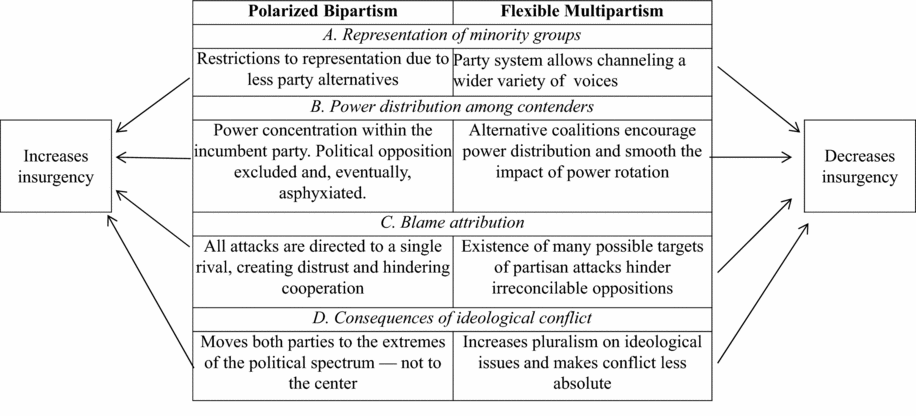
When conflict is “ideological,” it is unlikely that political leaders find a large body of floating voters in the middle of the spectrum as Downs assumes. Because the electorate is already polarized, party leaders will be encouraged to reinforce their foundational views instead of moving to the center. They will strive to show they are principled, irreducible, and genuine, increasing polarization and eventually insurgency. Figure 2 summarizes the argument.
Summary of the argument.

Scope Conditions
Clearly, my argument does not apply to all historical contexts. In the contemporary United States, the Republican and Democratic parties may polarize without this resulting in an armed insurgency. The argument becomes plausible as long as two conditions are met.
First, political regimes should be “semidemocracies”—laying somewhere between authoritarianisms and full democracies (Bogaards Reference Bogaards2009; Collier and Levitsky Reference Collier and Levitsky1997; Levitsky and Way Reference Levitsky and Way2002). Because my argument requires the existence of parties that routinely compete in elections with the realistic hope of attaining power, it does not apply to fully authoritarian or totalitarian regimes. But because these parties may eventually resort to violence, the argument is more plausible in contexts lacking the channels for processing peacefully the tensions derived from party polarization (such as free, fair, and inclusive elections, and respect for political rights and civil liberties). Thus, my argument is better suited when there are suffrage restrictions to sizable segments of the adult population, electoral fraud is not uncommon, and civil and political rights are not guaranteed. This may apply not only to most nineteenth-century Latin American republics but also (leaving aside restrictions to enfranchisement) to some nations in Eastern Europe, Africa, and Asia. This raises the possibility (which cannot be explored in this article) that the argument “travels” beyond my four cases.
The second scope condition is that states do not command an overwhelmingly superior amount of logistic and military resources than potential challengers. In contemporary states with high territorial penetration, efficient taxation systems, professional bureaucracies, and well-funded armies, party polarization rarely results in armed insurgency simply because disgruntled actors are aware that they cannot topple the government by force. Yet when polarization occurs in infrastructurally weak states, armed insurgency becomes a more attractive strategy for challengers (Goodwin Reference Goodwin2001). Weak states appear not only in nineteenth-century Latin America (Centeno Reference Centeno2003) but also in many African and Middle Eastern countries nowadays (Rotberg Reference Rotberg2010).
Case Selection
For exploring the impact of party systems on insurgency levels in nineteenth-century Latin America I chose four cases: Chile, Colombia, Costa Rica, and Uruguay. I selected them for four reasons—the first two related to their differences and the latter two related to their similarities. First, in the Latin American context the insurgency levels of these countries differ dramatically (as noted in figure 1), therefore providing enough variation in the dependent variable for addressing my research question. I reached this conclusion after ranking all Latin American countries according to an “insurgency score” that reflects the number, duration, and intensity of insurgencies from independence (typically in the 1820s) to approximately 1920 (scores are available under request). For identifying such insurgencies and building the score I resorted to general history books about each country. Chile (with an insurgency score of 12) and Costa Rica (with a score of 7) were among the countries with the lowest levels of insurgency. Conversely, Colombia and Uruguay were among those with the highest scores (46 and 60, respectively). Second, after some preliminary research I realized that their party systems were also quite different, therefore providing substantial variation in that respect.
Despite these differences these countries are comparable in two senses. First, during the nineteenth century they all had created party systems in which parties regularly competed in elections under a republican constitutional framework. This last condition excludes other Latin American countries that were either monarchies (e.g., Brazil), tyrannies (e.g., Paraguay), or had electoral party competition in paper but not in substance (e.g., Argentina, especially under Juan Manuel de Rosas). Second, these countries were also broadly comparable because, as a result of the legacy of Spanish colonialism, they shared the same cultural, linguistic, and religious background, yet none of them were colonial centers. Based on historical narratives, the next section illustrates the theoretical argument presented in the preceding text. I start with the two high-insurgency cases.
Country Narratives
High Insurgency I: Colombia
Nineteenth-century Colombia provides a clear example of how polarized bipartism can drive intense insurgency for almost a century. Almost all Colombian insurgencies were carried out by one of its two enduring political parties, the Liberals (who rebelled in 1860, 1854, 1885, 1895, and 1899) and the Conservatives (who did so in 1851 and 1876–77; the 1842 insurgency took place at a time in which parties were still in an embryonic stage). Colombian bipartism emerged in the 1830s after the conflict between two independence heroes (Simón Bolívar and Francisco de Paula Santander). It soon polarized along both affective and ideological lines, therefore providing the motivation for turning insurgency into a regular political strategy.
Ideological polarization resulted from the different views that Colombian parties held about how society should be organized, especially regarding the influence of the Catholic Church and the distribution of power across the territory and governmental bodies. Regarding religion, the Conservative Party favored the preservation of the role of the Church in the administration of schools, marriages, funerals, cemeteries, and public records, while the Liberal Party struggled for reducing its competences and resources. Regarding power distribution, Conservatives promoted centralization—they wanted the executive to concentrate political power as well as legal, economic, and military resources—while Liberals strived for distributing them to other bodies such as provincial governments or the Congress. Party alignments regarding power distribution, however, were less consistent than those regarding religion (Bushnell 1993; Safford and Palacios Reference Safford and Palacios2002: 155–56).
Ideological polarization was accompanied by affective polarization. Since their beginnings, Liberals and Conservatives developed strong oppositional identities and negative emotions against each other. At the mass level, civil society organizations linked to each party promoted the use of party colors—red for Liberals, blue for Conservatives. They organized street fights with sticks and whips as well as home burnings (Henao and Arrubla Reference Henao and Arrubla1984, 2: 198). Passions were so violent that families divided across party lines could end up killing each other (Jaramillo Reference Jaramillo Uribe and Ocampo1996: 304–7). Friendships and enmities forged in the heat of party conflicts could last forever (Ortiz Mesa Reference Mesa, Javier and Javier Ortíz Mesa2005: 66). Partisanship permeated social life to the point that, according to Deas (Reference Deas1993: 209), by the early 1860s few people did not have definite loyalties to one or the other party. Reciprocal epithets were another dimension of party animosity, with Liberals calling Conservatives “Goths,” “servile,” and “die-hards,” and the latter calling the former “subversive” and “factious” (Ortiz Mesa Reference Mesa, Javier and Javier Ortíz Mesa2005: 66).
Party polarization fueled insurgency across the century, but where did it come from? The origins of Colombian parties can be traced to the conflict between independence heroes Francisco de Paula Santander (precursor of Liberals) and Simón Bolívar (precursor of Conservatives) over religious and power distribution issues. Santander, who governed Colombia between 1819 and 1827—while Bolívar was abroad completing the independence struggle—suppressed small convents, suspended the ecclesiastical charter, and introduced Jeremy Bentham's anticlerical teachings in the education curricula, eliciting disaffection in clerical circles (Bushnell Reference Bushnell1991: 32; 1993: 57; Tirado Mejía Reference Tirado Mejía and Posada-Carbó1999: 353). Bolívar, in power between 1828 and 1830, reversed Santander's anticlerical reforms, thus gaining Church support. And moved by the belief that the new republics needed a strong hand to avoid anarchy, he also attempted (unsuccessfully) to create a kind constitutional monarchy (Safford and Palacios Reference Safford and Palacios2002: 121–26).
The ideological differences between Santander and Bolívar during the 1820s structured the genetic code of Colombian parties. In the following decades these differences led to enduring alliances between centralists and clericals (under the Conservative label) and federalists and anticlericals (Liberals). These alliances were solidified by frequent electoral contests for local and national positions and a vibrant and stinging press, which developed on each side (Posada Carbó 2008).
Furthermore, polarization was accentuated due to a series of policy swings in the following decades. In the 1830s presidents Santander (again in power) and Márquez reversed Bolívar's proclerical measures, leading by the end of the decade to the War of the Supremes, which pitted radical liberals against conservatives and Church supporters. Yet Herrán's conservative administration (1841–45) removed Bentham again from the curriculum, allowed Jesuits (expelled in 1767) to return to Colombia, and centralized power from the provincial assemblies and the Congress to the executive (Bushnell 1993: 96; Henao and Arrubla Reference Henao and Arrubla1984, 2: 179ff.).
The year 1845 inaugurated a long period of Liberal dominance that lasted until 1884—with just a brief Conservative hiatus between 1855 and 1861. In the 1850s, Liberal governments again expelled the Jesuits, suppressed the ecclesiastical charter, and transferred the naming of priests from the upper clergy to the more malleable parish town meetings. Conservatives reacted with the 1851 insurgency but they were defeated. This paved the way for the legalization of divorce, the recognition of civil marriage, and, by the 1860s, a drastic reduction of the economic power of the Church (Bushnell 1993: 109; Henao and Arrubla Reference Henao and Arrubla1984: 212–13). The secularizing educational reform of the 1870s led to a new conservative insurgency in 1876, which was again defeated (Henao and Arrubla Reference Henao and Arrubla1984; Safford and Palacios Reference Safford and Palacios2002: 205). Liberals also decentralized power through two new constitutions, one in 1853—which created a federal system and decentralized taxes and expenditures—and a more radical one in 1863—which divided the national territory into nine states and assigned to them huge economic, legislative, administrative, and military attributions (Orlando Melo Reference Orlando Melo and Tirado Mejía1989).
The Conservative momentum came in 1884 (and lasted until the 1930s), when Rafael Núñez reached power and implemented a massive conservative program called “The Regeneration”—in allusion to the Liberal “excesses” of prior decades. Núñez centralized power in the hands of the national government and strengthened as much as he could the position of the Church, restoring its control over education and cemeteries and returning property seized by Liberal governments (Bushnell 1993: 144ff.; Safford and Palacios Reference Safford and Palacios2002: 245). This directly contravened Liberals' ideological precepts and past policies. Perhaps even more important for nurturing affective polarization, Núñez excluded Liberals from local governments by allowing the president to appoint governors, which in turn named all the mayors. And through electoral manipulation and voter intimidation, he also excluded Liberals from Congress—from 1886 to 1900 only two Liberals sat in it (Mazzuca and Robinson 2006). Liberals reacted with three insurgencies in 1885, 1895, and 1899.
It is true that, at times, there were attempts to prevent armed uprisings, yet they were generally ineffective. For instance, Conservative Vice President Marroquín (who replaced President Sanclemente during a few months in 1898) tried to liberalize the press and reform the electoral system with the purpose of including the Liberals in Congress. He also abolished the “Law of the Horses,” which allowed all sorts of repression to the opposition. But these attempts proved inconsequential as he was soon removed from power by uncompromising Conservatives (Henao and Arrubla Reference Henao and Arrubla1984; Mazzuca and Robinson Reference Mazzuca and James2006). This paved the way for the massively destructive Thousand Days War (1899–1902). And when Marroquín became president in 1900, he continued with Caro and Sanclemente's “hard line” toward the opposition.
In sum, the Colombian case evidences that bipartism not always leads to moderation and stability. Rather, bipartism may polarize on both affective and ideological grounds when incumbents exclude the opposition on grounds seen as illegitimate, reciprocal demonization fosters distrust, and the incumbent party promotes policies that are antithetical to those preferred by the opposition party. Through these mechanisms, polarized bipartisms promote high insurgency.
High Insurgency II: Uruguay
With 13 armed insurgencies against the central government from independence (in the late 1820s) until 1904, there is little doubt that Uruguay—a small republic located South of Brazil and East of Argentina—qualifies as a high-insurgency case. Uruguay illustrates how a bipartism that polarizes along affective (rather than ideological) lines can contribute to high insurgency. The party system was composed by the Red and White parties, enduring political collectivities created in the mid-1830s that, to date, bid for power. Reds and Whites were at the core of nineteenth-century insurgencies: almost all of them consisted of Whites rebelling against Red governments (as happened in 1832–34, 1854, 1863–65, 1868, 1872, 1897, and 1904) or vice versa (as in 1836–38, 1853, and 1858). The two exceptions took place in 1875 and 1886, when patrician factions from both parties allied and launched unsuccessful challenges that were quickly defeated.
The polarization of Uruguayan bipartism was more affective than ideological (and this stands in contrast with Colombia, where ideological polarization was notorious). Regarding affective polarization, party supporters forged deep feelings of hostility against each other and developed strong we/them identities that fueled insurgency across the century. These identities spread in the cities and in the countryside, among men and women, and were instilled since childhood. Parties acted like fundamentalist religious communities in many respects, building life-long friendships among same-party members. But they also caused family divisions and motivated bloody revenges among neighbors with opposing party loyalties (see examples in Chasteen Reference Chasteen1995: 136; Rama Reference Rama1972: 98; Zum Felde Reference Zum Felde1963: 86–87). Interestingly, affective polarization was not accompanied by ideological polarization. At least at the elite level, Reds and Whites had similar views regarding religion, power distribution, and economic policy. And the racial and class composition of their rank-and-file members was relatively similar.
How did Uruguayan parties come to polarize? Similar to the case of Colombia, the Red and White parties resulted in the late 1830s from the personal antagonism between two former independence leaders enjoying substantial clienteles. These were Fructuoso Rivera (founder of the Red Party) and Manuel Oribe (White Party). They clashed after Oribe denounced the corrupt practices of Rivera while he was president (1830–34). This antagonism led to an armed conflict in 1836 and was deepened by the end of the decade, when both leaders joined different international alliances in the conflict called the “Big War.” Whites allied with Buenos Aires Governor Juan Manuel de Rosas while Reds joined forces with Brazil, the Argentinean Unitarians (enemies of Rosas), and, secondarily, British and French fleets located in nearby seas (Maiztegui Casas Reference Casas and Lincoln2005; Pivel Devoto Reference Pivel Devoto1994).
Important for understanding the pattern of affective polarization without ideological polarization, the Red's and the White's divergences regarding international allies were not rooted in different ideologies or social attributes. Rather, they resulted from strategic considerations during certain junctures in a rapidly changing political environment. The war led to a decade-long territorial split in which the Reds controlled the country capital (Montevideo) and Whites controlled much of the countryside. During that time each political party become more cohesive both organizationally and symbolically. Party elites in both camps built their respective governing bodies, strengthened their links to rank-and-file followers, solidified collective identities, and developed intense grievances against each other (Zum Felde Reference Zum Felde1963).
The legacies of Oribe and Rivera proved enduring. They continued after the Big War ended in 1851, leading to the regrouping of the territory under a “pink” coalition government, and also after both mythical leaders passed away in the mid-1850s. Despite timid attempts of urban party elites to erase party divisions (the fusionismo, or fusion politics period), the conflict deepened from the 1860s onward and fueled insurgency for the rest of the century (Reyes Abadie and Vázquez Romero Reference Reyes Abadie and Romero1998). Several factors linked to Uruguay's polarized bipartism account for this fact.
First, attributions of blame were invariably directed to the single adversary, that is, the other party. This happened, for instance, when the Whites blamed the Reds for signing a secret treaty with Brazil during the Big War. The treaty ceded to Brazil northern Uruguayan lands, committed subsequent Uruguayan governments to pay a loan at a high interest rate, and imposed taxes that damaged Uruguayan salted meat houses. Conversely, the Reds blamed the Whites for the massacre that took place in a confusing episode in 1858. Red insurgents were captured by White militias and killed, even though they had apparently given up under promise that their lives would be respected (Maiztegui Casas Reference Casas and Lincoln2005; Reyes Abadie and Vázquez Romero Reference Reyes Abadie and Romero1998).
Second, affective polarization was fueled by political exclusion. While in the first three decades after independence both parties alternated in power, in 1865 the Reds toppled by force a White government and seized power for the next nine decades. As soon as they reached power in 1865 the Reds removed White public officers, university professors, and diplomats from their positions. They also engaged in manifold strategies of electoral intervention that ranged from manipulating the civil registry or harassing opposition voters to stealing or stuffing ballot boxes. The result was that Whites ended up with a low share of congressional seats. This was not seen as a problem for the Red President Lorenzo Batlle, who after reaching power in 1868 claimed that he would “govern with my party and for my party” (Maiztegui Casas Reference Casas and Lincoln2005, 2: 24).
Because the president of the country was chosen by the General Assembly, exclusion from Congress meant that Whites had no chance of reaching the national government by peaceful means. This was intolerable for a party that believed to represent at least half of the population. In 1872, after a White insurgency, both parties reached an informal agreement that ceded the Whites control over a few departments. But the agreement depended on the will of each Colorado president—it was too ad hoc to act as a functional equivalent of the Chilean or Costa Rican flexible multipartisms. Intransigent Red presidents such as Herrera y Obes and Batlle y Ordóñez were unwilling to honor it (Maiztegui Casas Reference Casas and Lincoln2005, 2; Reyes Abadie and Vázquez Romero Reference Reyes Abadie and Romero1998). Instead of moving to the center, as the median voter theorem expects for two-party systems, political exclusion led the Whites to reaffirm their identity by sharpening their opposition to the Reds. This fueled the White insurgencies of 1872, 1897, and 1904, in all three of which the rebels were militarily defeated.
In sum, in Uruguay the antagonism of two former independence leaders who got entangled in international alliances led to a decade-long territorial split of the country. The result was a two-party system whose members were more divided by opposing collective identities and affections than by doctrines and ideas. This case shows that ideological polarization is not a necessary condition for insurgency. Affective polarization by itself can recurrently move party leaders to use violent means for reaching power.
Low Insurgency I: Chile
Why did Chile have fewer and less destructive insurgencies than Colombia and Uruguay (see figure 1)? My answer focuses on differences in party systems. While Chile had insurgencies in 1829–30, 1851, and 1859, from the 1860s onward insurgency disappeared (with the exception of 1891, explained in the following text). I claim that, to a large extent, this resulted from the development of a centripetal multiparty system that allowed all significant political groups to gain some power (in the form of congressional and eventually cabinet seats) and promoted a pattern of flexible and shifting coalitions. This rendered insurgency less attractive than pacific strategies of political competition such as elections or bargaining. The contrast with polarized bipartism is dramatic.
After independence, however, the nascent political landscape presaged polarization. From the 1820s to the 1840s Chilean political elites split in two groups—a liberal group that promoted anticlericalism, more attributions to the Congress, and decentralization, and a conservative group with opposite stances in all three respects (Scully Reference Scully1992; Valenzuela 1995). This “significant process of polarization of political forces” (Valenzuela 2008: 56), which accounts to a large extent for the insurgencies of 1829–30, 1851, and 1859, might have evolved into polarized bipartism and fueled intense insurgency in forthcoming decades. Yet some critical events, absent in Uruguay and Colombia, shifted the path toward flexible multipartism and low insurgency.
Specifically, four parties with varied political positions emerged in Chile by the late 1850s. First, in the late 1840s, under the conservative government of President Manuel Bulnes, a quarrel among ministers Varas and Montt, on the one hand, and Minister Vial, on the other hand, led the latter to resign and form the original nucleus of the Liberal Party. By being founded “on the basis of intraelite political conflict. . . the ideological profile of the party would be characterized in the future by the absence of clear-cut doctrinal commitments” (Scully Reference Scully1992: 28; also Valenzuela Reference Valenzuela1985: 81).
A few years later, a conflict between the Catholic Church and the conservative government of President Manuel Montt over a minor question—the “sacristan controversy”—resulted in two additional parties. One was the Conservative Party, which protected the interests of the Church and was committed to the defense of a Catholic moral order. The other one was the National Party, created by supporters of President Montt, which favored power centralization (therefore differing from the Liberal Party) yet struggled for limiting the influence of the Church (therefore differing from the Conservative Party) (Scully Reference Scully1992: 32–38; Valenzuela 1995: 17). And in 1858 some members of the Liberal Party, disgusted by the cooperation between their party and the Conservatives, formed the Radical Party, which adopted a vehemently anticlerical stance (Scully Reference Scully1992: 41; Valenzuela 2008: 51). By the late 1850s this new multiparty system had replaced the previous bipolarity of liberal and conservative factions that, had it persisted, might have evolved into a polarized bipartism similar to Colombia's.
This multiparty system proved to be extremely effective at preventing insurgencies for the rest of the century. How was that possible given the presumed tendencies toward polarization in multiparty systems, and given the fact that Chilean parties had different stances on important issues like religion or power centralization? Electoral competition took place among several parties, none of which was powerful enough to govern without the help of others. This had a key implication: it promoted interparty cooperation. Already since the late 1850s, any party interested in gaining seats or passing laws had no other choice than allying with other parties. For instance, Radicals and Nationals allied in 1861 to oppose the alliance between Liberals and Conservatives. And Conservatives, Radicals, and some Liberals cooperated in 1874 for passing electoral reform legislation (Valenzuela Reference Valenzuela1985: 54–55). Even during the period of conservative domination (1831–61), official lists were not “single-colored.” Rather, they used to include prominent Liberals such as Victorino Lastarria. The same happened during the Liberal dominance in the rest of the century (Valenzuela 2008: 49).
After a reform in 1890 reduced the interference of the executive power in electoral outcomes, the Liberal Party could not reach the government without the support of either Radicals or Conservatives, becoming even more prone than before to ally with them (Valenzuela 1995: 27–28). In fact, Scully asserts that in the second half of the century the Liberals played a key role in containing centrifugal competition and avoiding polarization, because they acted as a “broker between the extremes to hold the party system together” (Scully Reference Scully1992: 9). Even the strongly ideological Democratic Party—the first important workers party in Chile, created in 1887—engaged in electoral pacts with Liberals, Radicals, and exceptionally with Conservatives (Valenzuela 1996: 9).
These alliances yielded partial benefits to everybody. Data presented by Valenzuela (2008: 58) shows that government opponents used to win several seats in the deputy chamber, and that tight electoral results were not uncommon. After 1861, opposition leaders became used to being seated in Congress. Oftentimes they also became cabinet members. This stands in sharp contrast, for instance, with the exclusion of Colombian Liberals during the Conservative governments of the end of the century. That these arrangements were not bulletproof was evidenced by the 1891 insurgency. It pitted President José Manuel Balmaceda and his followers against a broad coalition of politicians from all parties, who were aggrieved by an intransigence never seen before in a Chilean president.
In sum, from 1861 onward Chile developed a flexible multipartism that, while not erasing the substantive ideological differences among parties, did encourage cooperation among them. As Valenzuela (Reference Valenzuela1985: 72) states, “the opposition could access power inasmuch as they could persuade the president that they had to be included in the [official lists that would create the] governmental majority.” This prevented the creation of a large and excluded political bloc that perceived insurgency as the only way of achieving power, as happened in Colombia's and Uruguay's polarized bipartisms.
Low Insurgency II: Costa Rica
Costa Rica, a small Central American country that became independent in 1821, is our second low-insurgency case. It only had three insurgencies—in 1823, 1835, and 1918–19—that were brief and involved little destruction. Why does Costa Rica differ so much from Colombia and Uruguay? Again, part of the answer lays in its party system—specifically, a multiparty system created in the late 1880s whose members were very similar to each other in ideological and programmatic preferences as well as in their collective identities.
Similar to Chile, Costa Rica did not look like a low-insurgency country before the creation of political parties. There were insurgencies in 1823 and 1835, which resulted from conflicts among its main cities. In 1823, in the aftermath of independence, the cities of San José and Alajuela clashed against Cartago and Heredia due to differences regarding Costa Rica's annexation to the short-lived Mexican Empire (Monge Alfaro Reference Monge Alfaro1980: 184–86; Obregón Loría Reference Obregón Loría1981: 19–20). And in 1835 the cities of Cartago, Heredia, and Alajuela rebelled against the capital San José. They did so because Braulio Carrillo, the head of state (located in San José), was implementing secularizing reforms, and because he opposed the periodic rotation of the country's capital across the main cities (Monge Alfaro Reference Monge Alfaro1980: 193; Obregón Loría Reference Obregón Loría1981: 33, 42).
Given these antecedents, one could expect that political parties linked to the main cities would develop and polarize around religious and power distribution issues to fuel insurgency in a Colombian-like fashion. Yet this outcome was avoided for two reasons. First, from the late 1830s onward, Carrillo and his successors centralized the legal, political, and military resources of the country in the capital San José. This rendered the other cities unlikely to achieve power through violence (Vega Carballo Reference Carballo and Luis1981). The second reason, which is central to my argument, has to do with parties.
The first Costa Rican political parties crystallized around the 1889 electoral contest, much later than in my other countries. They were the Constitutional Democratic Party, which emerged with the immediate purpose of avoiding the election of the official candidate, and the Liberal Progressive Party, which “emerged as a response of the government to the opposition” (Salazar Mora and Salazar Mora Reference Salazar Mora and Salazar Mora1991: 15). But different from Uruguay and Colombia, where the two foundational parties became permanent elements of the political landscape, Costa Rican ones dismembered soon after birth and reshuffled in the eve of the 1893 election. The Liberal Party became the People's Party, which disbanded in 1897, and the Constitutional Party gave rise to three new parties—the proreligious Catholic Union, the protosocialist Independent Democrats, and the Civil Party. Yet these second-generation parties soon dismembered too, and by the end of the century two new parties emerged—the Republican Party and the National Union Party (Salazar Mora Reference Salazar Mora1990: 141; Salazar Mora and Salazar Mora Reference Salazar Mora and Salazar Mora1991: 14–23; Vargas González Reference Vargas González2005: 57).
The important point is that six of these parties—the Constitutional Democratic, Liberal Progressive, Civil Party, Republican Party, National Union Party, and People's Party—were not collective projects based on differentiated policy programs. They were little more than electoral machines aiming at putting their candidates in power. As Salazar Mora and Salazar Mora (Reference Salazar Mora and Salazar Mora1991: 14) claim, “They were personalistic groups which disappeared when their leaders withdraw from politics. Personalism was so strong that their followers identify themselves not with the name of the party, but with that of their candidate” (e.g., Fernandistas for the followers of Fernández, Jimenistas for the followers of Jiménez, and so on). Also, the two parties that aimed at representing broader societal groups soon disappeared: the Catholic Union was banned in 1895, hindering polarization toward a conservative pole, and the working-class Independent Democrats vanished after its founder passed away in 1897, therefore hindering polarization toward a leftist pole.
The surviving parties were composed by members of the coffee elite that ruled the country, and who agreed around a common framework of liberal values and programs (Stone Reference Stone1982: 227). They emphasized secularization, the defense of private property, and the promotion of free enterprise and foreign investment (Salazar Mora and Salazar Mora Reference Salazar Mora and Salazar Mora1991: 16, 30). This “allowed a series of pacts and electoral alliances among rival parties, only with the purpose of obtaining power” (ibid.: 14, 15–23 for examples; also Monge Alfaro Reference Monge Alfaro1980: 252–54). Such a complex web of alliances hindered affective and ideological polarization, created stakes in the political system among all relevant actors, and ultimately made insurgency less attractive as a strategy for achieving power. Consistent with this, the 1918–19 insurgency did not involve political parties. Rather, it was a multiclass civil uprising against the repressive dictatorship and patrimonial practices of General Federico Tinoco that was ousted not through armed action but through pacific civilian protests (Molina and Palmer Reference Molina and Palmer2005: 78; Monge Alfaro Reference Monge Alfaro1980: 271).
Why did Costa Rican parties not polarize? The comparison with Uruguay and especially Colombia yields three factors that help answering this question. First, in Costa Rica a religious cleavage pitting clericals against anticlericals—which was decisive for Colombia's polarization—emerged late in the century and was comparatively weak. Because Costa Rica had a marginal position in Central America's colonial system, Spain had no incentives to funnel abundant resources to establish strong Catholic institutions there. After independence, this resulted in a tiny and humble clergy that was not only weak to resist liberal reformers, but also had little wealth and privileges that liberals could take advantage of (República de Costa Rica Reference Rica1901: 338; Salazar Mora Reference Salazar Mora1990: 261). Additionally, liberal reformers were more interested in economic rather than religious liberalism, and until the 1880s secularizing reforms were mild (Díaz Arias Reference Díaz Arias2005; Monge Alfaro Reference Monge Alfaro1980: 180ff; Salazar Mora Reference Salazar Mora and de la Cruz1989, Reference Salazar Mora1990; Vega Carballo Reference Carballo and Luis1981: 86).
Second, while in Colombia territorial fragmentation fueled party polarization along the centralist-federalist divide, in Costa Rica the conflicts among cities—which account for the insurgencies of 1823 and 1835—were tamed early. This happened due to the previously mentioned process of state consolidation led by the capital San José from the late 1830s onward. Therefore, the parties that emerged in the 1880s could not resurrect the parochial claims of the 1820s and 1830s for structuring conflict—too much time had passed. Early state consolidation also hindered the kind of territorial division that, from 1872 to 1904, pitted Uruguay's northeastern leaders of the White Party against the Red administrations that controlled the capital of Montevideo.
Finally, a peculiar factor that conspired against party polarization in Costa Rica is the previously mentioned consensus among political and economic elites regarding the model of development. Such consensus originated in the 1840s, when Costa Rica dramatically increased its overseas coffee exports. Elites agreed that national development should center on coffee production by small and medium farmers. Farmers sold the “golden bean” (as coffee was called) to processing units owned by coffee barons, who refined it before selling it abroad and making a juicy profit (Gudmundson Reference Gudmundson1983; Vega Carballo Reference Carballo and Luis1981). There also was agreement about the need of privatizing lands, improving efficiency, and removing obstacles for international trade. This consensus left little room for party polarization around economic issues and rendered insurgency an unattractive political strategy. As Molina and Palmer (Reference Molina and Palmer2005: 53) note, “The country's early economic expansion offered greater opportunities for social ascent than did military prowess.”
Additional Factors
Insurgency is a multicausal phenomenon: factors other than political parties were obviously at play in nineteenth-century Latin America. In the following text I review some potentially relevant additional factors, assess their usefulness for my empirical puzzle, and note how they relate to my argument.
First, the literature points at the role of state strength in facilitating or curtailing insurgency. States with high territorial penetration, professionalized bureaucracies, and well-funded military forces increase the cost of launching insurgency and decrease its chances of success (Fearon and Laitin Reference Fearon and Laitin2003; Goodwin Reference Goodwin2001; Tilly Reference Tilly1978). State strength matters to some extent in my cases. For instance, it is impossible to understand low insurgency in Costa Rica without considering the early state-building efforts during the Carrillo era. Between 1835 and 1842, President Braulio Carrillo strengthened the military and assured their loyalty to the central government. He also beheaded local powers through institutional and political reforms (Molina and Palmer Reference Molina and Palmer2005). While Carrillo did not create a modern state by twentieth-century standards, such measures discouraged armed insurgencies for decades.
State strength, however, has limitations as a factor for explaining insurgency. Between 1875 and 1880 Uruguayan president Lorenzo Latorre imposed a strict discipline in the countryside, modernized the weaponry of the military, and expanded communication networks. Yet massive insurgencies took place in 1897 and 1904 (Chasteen Reference Chasteen1995; Maiztegui Casas Reference Casas and Lincoln2005). Likewise, in the 1880s, Colombian president Rafael Núñez replaced the hyperfederalist Colombian state by a quite centralized one whose army enjoyed state-of-the-art weapons and advanced tactical training (Bushnell 1993). Yet serious insurgencies took place in 1885, 1895, and 1899–1902. Party systems provide an answer to this puzzle. In both Colombia and Uruguay, decades-long legacies of polarized bipartism provided the collective grievances needed for persistent insurgency—even against states considerably stronger than in the past.
Second, researchers have emphasized the relevance of political regimes. According to Hegre et al. (Reference Hegre, Ellingsen, Gleditsch and Gates2001), insurgency is less likely under rigid autocracies (which make insurgency materially unviable) or full democracies (which channel grievances institutionally) than under “transitional” or semicompetitive democracies (which cannot do either). My cases do not allow a full test of this claim because they were essentially semicompetitive regimes during the period under study (there is not enough variation in this variable). On the one hand, there was political competition in the form of frequent and regular elections at the national and local levels, a vibrant public sphere in which candidates tried to persuade voters through public speeches and newspapers, and a plethora of political organizations and movements. On the other hand, enfranchisement was restricted to (generally well-off) men, electoral fraud and violence around the ballot boxes were not rare, and governments occasionally jailed or exiled incisive governmental opponents (Posada-Carbó Reference Posada-Carbó2000; Valenzuela 2006).
Besides this general characterization, the notions of flexible multipartism and polarized bipartism have different implications regarding the “degree of democracy” of a regime, and therefore they can be related to Hegre et al.'s (2001) argument. As noted in figure 2, flexible multipartism is better than polarized bipartism for representing minority groups, distributing power among contenders, fostering trust, and preventing polarization—and this is why the former discourages insurgency compared to the latter. From this standpoint, my argument is consistent with the hypothesis that more open and democratic settings reduce insurgency.
Third, a massive quantitative literature—mostly based on twentieth-century developing countries—states that higher levels of economic inequality and ethnic heterogeneity provide a fertile soil for the development of mass collective grievances that propel insurgencies and civil wars (Cederman et al. Reference Cederman, Weidmann and Gleditsch2011; Gurr Reference Gurr1970; Muller Reference Muller1985; Sambanis Reference Sambanis2002 for a review). Despite its valuable contributions, this literature is not well suited for my research question. This literature conceives insurgencies as challenges that the popular classes (or deprived ethnic groups) launch against political elites. My insurgencies, however, were sparked by social and political elites against other, governing elites. Economic or ethnic grievances among the popular classes barely appear in the historical descriptions of the motivations for rebellion among my cases.
This allows understanding why Uruguay evinced so much insurgency across the century despite being racially and ethnically very homogeneous and apparently quite equalitarian in socioeconomic terms. It would be a mistake to construe the conflict between the White Party and the Red Party as a class or ethnic conflict, and the same applies for the conflicts between Liberals and Conservatives in Colombia, Chile, and Costa Rica. In my cases at least, insurgency resulted from conflicts among parties headed by political elites—mass grievances were not the driving force. Besides that, unfortunately there are no comparable measures of economic inequality across my cases and time period for testing this hypothesis—measures of ethnic heterogeneity could be devised with some effort though.
Fourth, another potential explanation (whose roots can be traced to Lipset and Rokkan Reference Lipset, Rokkan, Lipset and Rokkan1967) has to do with the structure of postcolonial political cleavages. Deep and superimposing cleavage structures should create irreconcilable oppositions and increase insurgency; weak and/or cross-cutting cleavages should reduce tensions and therefore insurgency. This perspective nicely complements mine. Postcolonial political cleavages shaped party systems, allowing going one step back in the causal chain. For instance, soon after independence Colombian political elites were divided along two questions: whether to reduce or maintain the role of the Catholic Church in politics and society, and the extent to which political and administrative power should be centralized (territorially in the capital and institutionally in the executive) or decentralized by giving more power to the regions and Congress (Bushnell 1993; Safford and Palacios Reference Safford and Palacios2002). These cleavages tended to superimpose each other: those favoring decentralization generally wanted to reduce the role of the Church, and those favoring centralization usually wanted to heighten it. The former soon formed the Liberal Party; the latter grouped under the Conservative label. The story was different in Costa Rica, where postcolonial cleavages were weak. Religious tensions did not erupt until the 1880s, differences about power centralization disappeared early only (after Carrillo's centralizing policies), and national elites shared a common vision about the model of economic development that the country should pursue. This ambiguous cleavage structure discouraged a polarized party system.
My point, however, is that in contexts in which parties are the main vehicles of insurgency, cleavage structures matter only indirectly—as long as they are reflected in party systems. As Lipset and Rokkan (Reference Lipset, Rokkan, Lipset and Rokkan1967) warned, cleavages do not always express themselves in the political struggle, and in that case they remain inconsequential for insurgency. In that respect, one could say that party systems have a more “direct” impact on insurgency, but both perspectives are, of course, complementary.
Fifth, some research posits that the intervention of foreign powers in domestic issues could weaken state authorities and empower would-be rebels, thus making insurgencies and wars more likely and lasting (Elbadawi and Sambanis Reference Elbadawi and Sambanis2000). The usefulness of this argument for my cases is limited. Uruguay is the one where it resonates most. During the Big War (1839–51) four international powers—France, Britain, Argentina, and Brazil—send their soldiers and diplomats into Uruguayan territory, creating chaos and destruction in ways that set negative prospects for future political stability. However, much of that impact was indirect—it took place through a process of consolidation of party rivalries. After a decade of war controlling different parts of the national territory, Reds and Whites reemerged more cohesive and self-assured than ever—ready to engage in a polarized bipartism that, as I claim, was key for fueling intense insurgency in the decades to come (Maiztegui Casas Reference Casas and Lincoln2005, 1).
But foreign intervention had little relationship with insurgency besides Uruguay. Colombia had high insurgency and polarized bipartism, but no significant foreign interventions took place during the period under study. Costa Rica suffered from foreign invasions in 1842 and 1856–57. They unleashed armed reactions against invaders, but not against domestic governments. If any, invasions strengthened national unity. Finally, the case of Chile is interesting because it suggests that important international conflagrations do not trigger insurgency if a flexible multiparty system is in place. While the War of the Pacific—staged against Peru and Bolivia between 1879 and 1883—intensified conflicts among congressional factions and led to minor revolts in the streets, freedom of expression and association were never endangered, and the first presidential elections after the war took place peacefully (Collier and Sater Reference Collier and Sater2004).
Finally, because geographic and demographic features may affect political outcomes (Diamond Reference Diamond1998; Goldstone Reference Goldstone1991), one may wonder whether variations in territorial and population size, climate, and geographical location could account for variations in insurgency across my cases. These factors, however, do not seem very useful. Both Costa Rica and Uruguay had a comparatively small territory and a small population, yet their insurgency records varied widely. Chile and Colombia were the two largest and most populous countries among my cases, yet they clearly differ regarding insurgency levels. Chile and Uruguay are southern countries with temperate climate, yet they differ much in my outcome. The same happens with Costa Rica and Colombia, located close to the equator. Insurgency is a political phenomenon; if geography and demography did play a role, it would be a very indirect one that needs further research to be revealed.
In sum, these additional factors vary in their relevance for answering my research question. Also, they relate in different ways to my argument—some complement it, some have little relationship to it. Ultimately, my point is that for understanding variations in insurgency we have to consider the role of political parties (which, to reiterate, cannot either provide a full answer by themselves).
Conclusions
Parties and party systems have been a classic area of inquiry for political scientists, but insurgency theories have given little attention to them. This is surprising given the scholarly consensus that insurgency is a political phenomenon and that parties are a central component of modern politics. Accordingly, this article focused on the role of parties and party systems in explaining variations in insurgency levels across four nineteenth-century Latin American countries. My general argument is that two-party systems may polarize around affective and/or ideological lines, therefore leading to intense insurgency, while multiparty systems may offer partial gains to all actors, therefore creating stakes in the system and producing centripetal competition that decreases insurgency.
This theoretical argument derives from debates about parties and political instability (and I consider insurgency as a dimension of instability). The classical hypothesis is that bipartism promotes centripetal competition, consensual policies, and stability. But my category of “polarized bipartism,” which results from a generalization of the main attributes of the Uruguayan and Colombian party systems in the nineteenth century, suggests that this may not always be the case. First, bipartism may simplify the process of blame attribution, favoring the consolidation of deep we/them oppositional identities. Second, by allowing the incumbent party to govern alone, it may lead to an almost complete exclusion of the opposition party from power, therefore increasing the attractiveness of insurgency vis-à-vis pacific strategies. Finally, by precluding the creation of third parties that share views with the two other parties on different dimensions, bipartism may encourage parties to move to the extremes of the political spectrum, reducing common grounds for understandings and ultimately favoring insurgency.
The other side of the classical hypothesis is that multipartism produces polarization and instability. However, an examination of nineteenth-century Chile and Costa Rica suggests several reasons why multipartism could avoid polarization and reduce insurgency compared to bipartism. Multipartism may promote varied and shifting coalitions that allocate partial shares of power among many competitors, creating stakes in stability across the political spectrum. It may delay the formation of oppositional identities because it provides parties with multiple targets for directing their criticisms. And by allowing center parties to act as “joints” that foster centripetal competition, multipartism may reduce polarization and decrease the attractiveness of insurgency. I call this “flexible multipartism.”
Besides “bringing parties back in” to the study of insurgency, this article could contribute to the insurgency literature in two additional ways. First, the notion of “affective polarization” suggests that parties may contribute to the creation of the collective grievances that motivate insurgency. Grievances, which were central components in classical theories of social movements (e.g., Gurr Reference Gurr1970), were relegated by resource mobilization and political process theorists during the 1970s and 1980s, but it has resurfaced in more recent research (e.g., McVeigh Reference McVeigh2006). Second, the article suggests that political process and political opportunity theories should incorporate parties and party systems to their explanatory models in more systematic ways. Parties shape insurgency not only through the creation of opportunities for challengers, but also by providing the organizational vehicles employed by aggrieved groups. When parties—rather than social or revolutionary movements—are the vehicles of insurgency, well-organized parties may mean a greater potential for insurgency.
Acknowledgments
The author thanks J. Samuel Valenzuela, Rory McVeigh, and the reviewers and editors of Social Science History for excellent comments and suggestions. He also appreciates the support of the Centre for Social Conflict and Cohesion Studies (Chilean grant CONICYT/FONDAP/15130009).