


In the months before the 1790 Fête de la fédération, Bernard Poyet, a royal city architect in Paris, wrote a pamphlet detailing his plans for the festival. It was scheduled for the one-year anniversary of the taking of the Bastille. Poyet complemented his more pragmatic suggestions with a theory of the special functioning of the festival in the new era of liberty:
Remember that under the reign of despotism, men defied one another, having no common interest, hid themselves from one another, did not know one another, and gathered, so to speak, within their own families, the only rallying point … Despotic government … created that fatal egoism which separated and corrupted them. Public festivals motivated by great consideration for the common good have this particular feature in common: that the sentiment of each becomes the sentiment of all by a kind of electrification [électrisation], against which even the most perverse men cannot defend themselves.Footnote 1
This article takes as its starting point the architect Poyet's curious choice of the word ‘electrification’ as a way to explain the central mechanism of the Fête de la fédération. It is organized around the following questions. Why did it occur to the architect to imagine the revolutionary festival in general and the Fête de la fédération in particular as affecting a ‘kind of electrification’? What did Poyet mobilize by his recourse to the scientific concept of électrisation? What light can the scientific meanings of ‘electrification’ in 1790 bring to our understanding of the Fête de la fédération, and how were those meanings transformed or preserved as electricity became a political metaphor in the early French Revolution?
Poyet's rhetorical appropriation of the language of electricity in planning the 1790 festival illustrates a specific, concrete intersection between electrical science and revolutionary politics. Since Newton, electricity had been thought to have great cosmological significance. A century of natural-philosophical inquiry analogized the electrical fluid to a host of phenomena – fire, heat, light, and gravity – in pursuit of a universal fluid or ether, evidence of a kind of cosmic organizing principle, or, as Newton had it, the evidence of God's hand in the world. By mid-century, the mysterious electrical fluid or ether could be stored and deployed by a skilled experimenter. Over the 1770s and 1780s, interest in both atmospheric and medical applications for electricity grew, especially in France. Poyet imagined the 1790 Fête de la fédération in terms of électrisation at the same time as Luigi Galvani was completing his groundbreaking work on what he called ‘animal electricity’.Footnote 2 Poyet imagined a revolutionary festival électrisation just as Galvani put the finishing touches on his thesis on animal electricity in 1790, to be published a year later as De viribus electricitatis in motu musculari commentarius. The theory of animal electricity proposed that electricity ran through animal bodies as a vital ether, implying that it was physiologically necessary for liveliness and movement, even life itself. The theory confirmed suspicions that some natural philsophers, mesmerists and medico-electrical practitioners had harboured for the previous two decades. What, then, can French revolutionary festival ‘electrification’ tell us about how revolutionary audiences understood how they, as human beings, functioned in relation to the physical world, a crucial question in the context of a revolution that claimed to remake positive law along the lines of laws of nature?
Part I of the following article begins by making the case for a microhistory of the moment of intersection between eighteenth-century electricity and eighteenth-century democratic revolution, electricity, radicalism and the conceptual links between them. I argue that without an investigation of the contemporary scientific meaning of electricity, the figure of revolutionary électrisation remains illegible to modern readers. The second section of the article considers the novelty of political electricity as a French revolutionary rhetorical invention.Footnote 3 In the third section, I reconstruct an image of how Poyet might have come across electricity prior to his use of the term in his proposal for the 1790 Fête de la fédération. Finally, in the last section, I situate Poyet's electrification in the political context of the early French Revolution and the revolutionary festival. I argue that the purported political radicalism of electricity in the late eighteenth century is undercut by its rhetorical use in the revolution. For Poyet, the manipulability of electricity, the possibility of its deployment by a skilled operator of the Leyden jar or the lightning rod, for instance, coupled with its vogueish therapeutic uses and the nascent theory of animal electricity, made it a ready expression of the kind of top-down emotional transformation that appealed to the authorities in charge of the 1790 Paris Fête de la fédération. Thus, while electricity may have been associated with liberatory, radical politics in a broader sense, political electricity in the context of the early revolution was more concerned with order and authority than with liberty or popular sovereignty. In the context of the early French revolutionary moment, electricity, in spite of its radical associations, in fact indicated new possibilities for authority, for control and for order.
Illegible electricity, radical electricity
The following article focuses on Bernard Poyet's use of the term électrisation to shed light on an unexplored political facet of electrical science in the late eighteenth century. In the political theory of the revolutionary festival, the festival was democratic and liberatory, a spontaneous display of revolutionary feeling in which there was no distinction between actor and spectator. Poyet's striking electrical theory of the festival cut against this idea in favour of a scientifically grounded image of forced consensus via electrification. In thinking in terms of political electricity, Poyet evoked a vitalistic force with the power to bring about the kind of political consensus that the Fête de la fédération aimed to consecrate. The case illustrates how festival planners used contemporary scientific concepts to try to reconcile revolutionary spontaneity with authority and order.
Historians have occasionally quoted Bernard Poyet in passing, themselves leveraging the suggestive power of ‘a kind of electrification’ to explain how contemporaries thought about revolutionary festivals and assuming that Poyet's électrisation is already legible to a modern reader. I argue, however, that electricity in this context is in fact illegible to a modern reader, unless it is considered within the context of contemporary eighteenth-century natural philosophy. Because of the centrality of électrisation to Poyet's understanding of what the festival is and does, electricity needs first to be historicized in terms of contemporary science; only then can Poyet's ‘a kind of electrification’ become legible.Footnote 4
Scholarly work on the science of electricity in the late eighteenth century, meanwhile, has tended to associate electrical science broadly with radical politics. The personal politics of ‘electricians’ of the anglophone world, especially Benjamin Franklin and Joseph Priestley, give electricity a radical cast, while historians contrast their politics with those of more conservative or equivocal figures in the francophone world, such as Nollet and Coulomb.Footnote 5 Cultural historians of science have argued that electricity entered the nineteenth century as ‘the science of atheists, materialists, political radicals and revolutionaries’, having ‘acquired a decidedly republican valence’ through the crucible of the French Revolution.Footnote 6 Because its focus is elsewhere, this nuanced and careful scholarship has a tendency to invoke the French Revolution as a black box, passing over the fact that the revolution involved a complicated spectrum of political valances. Electricity's purported political radicality calls for an analysis of electrical language in particular revolutionary contexts.
Electricity meets revolution in scholarship that looks specifically at French revolutionary figures whose Old Regime careers brought them into contact with the phenomenon, in particular Jean-Paul Marat and Maximilien Robespierre. Jessica Riskin, for example, has examined Robespierre's successful defence of M. de Vissery de Bois-Valé's right to install a lightning rod on his house, against the wishes of a pious neighbour, one of the young lawyer's first big cases.Footnote 7 Marat's pre-revolutionary vitalism colours his amateur natural-philosophical writings on electricity. As Keith Baker suggests, electricity and vitalism likely influenced Marat's politics in ways yet to be examined.Footnote 8 For the Marquis de Sade, literature provided another kind of experimental space for theories of a universal electric fluid, which appears to mediate relations between apathy and energy in his characters, and which scholars have identified as a particularly ‘Sade-ian electrobiology’.Footnote 9 The politics of this literary concept of electricity remain ripe for investigation, while Sade's personal politics have been more thoroughly examined. Likewise, in recent scholarly work on the Galvani–Volta controversy at the end of the eighteenth century, politics often appears in the form of political allegiances of the main actors, especially Napoleon's endorsement of Volta's side of the argument, and Galvani's resistance to both Volta and Napoleonic domination of Italy.Footnote 10 Through the individual political views of well-known natural philosophers and electricians, writers and politicians whose work made use of electrical images and concepts, electricity is endowed with political meaning in scholarship at this intersection. But what about the politics or political affordances of electricity itself?
Some scholarship at the nexus of science and politics argues that lay scientific enthusiasm in the decades before the revolution had a significant effect on radical politics. Robert Darnton's work on mesmerism connects Mesmer's mysterious therapeutic treatments to popular enthusiasm for both science and radical politics, arguing that, rather than reading Rousseau's Social Contract, most literate French people came into contact with revolutionary ideas precisely through fashionable philosophies like mesmerism. Mesmerism became, in the hands of radical practitioners, a ‘camouflaged political theory’, Darnton writes.Footnote 11 Jessica Riskin writes about the resonance for mid-century physiocrats like Turgot of Benjamin Franklin's new theory of electricity, in which shocks, Leyden jar discharges, and lightning bolts restored balance to an unbalanced situation in which one side had too much electricity and the other side too little. Bringing electricity and politics together on a theoretical level, Riskin points to electricity as a natural model for physiocratic economic thought.Footnote 12 Mary Ashburn Miller finds this same Franklinist rebalancing playing out in the lightning metaphor of popular sovereignty common in the radical phase of the French Revolution, in which lightning expressed a destructive clearing of the ground for regeneration. Mary Fairclough argues that eighteenth-century electrical science, often interpreted as a symbol of enlightenment, in fact stood for obscurity and incomprehensibility.Footnote 13 Fairclough's work on the Romantic crowd makes a case for sympathy as a key element in Romantic interpretations of sentimental ‘contagion’, emphasizing its disruptive social force. Electricity is often a metaphor for this force, especially in the context of Romantic readings of revolutionary crowds.Footnote 14
The link between eighteenth-century electricity and revolutionary politics, however, has not been analysed in terms of specific revolutionary moments. This article uses Poyet's électrisation as a case study, to bring historical precision to the link suggested by the historiography surveyed above. Poyet was not a well-known natural philosopher, nor a particularly radical political actor, but an architect concerned with plying his trade; the politics of his ‘kind of electrification’ are drawn not from his personal politics, but from the fraught political moment of the Fête de la fédération, and from the clash between the bottom-up theory of the revolutionary festival and the top-down control over the festival desired by authorities keen to cement their power in the new order, and keen to channel the memory of the Bastille into a consecration of their own authority.
Figurative electricity as revolutionary invention
Though already a well-developed political metaphor in the context of the American Revolution, as the work of James Delbourgo shows us, electricity took on a new and different meaning in the French Revolution, in part because of a shift in emphasis within electrical science between the American and French Revolutions. Political electricity was a late arrival in France, appearing later than its metaphorical counterparts in the anglophone world. Perhaps because of stronger royal sponsorship of and control over scientific pursuits in France, especially on the part of the Royal Society of Medicine and its efforts to stamp out mesmerism and other forms of charlatanry, it took an earth-shattering revolution to decouple l’électricité from associations with royal power and to reveal other metaphorical affordances. To contemporaries of the French Revolution, electricity appeared as a brand-new figure of speech, one of many French revolutionary neologisms. Michel Delon has noted how the word électriser came to have new meaning over the late Enlightenment and revolutionary periods.Footnote 15 This is attested to by a 1795 dictionary which appeared in print in the Saxon city of Göttingen. It was a dictionary of the French language, but not the kind that aimed at comprehensiveness. Nor was it concerned with hovering on a separate plane from political matters. It was rather, as its title explained, a ‘new dictionary containing expressions newly created by the French People’, with doubled emphasis on novelty, a supplement to the official Dictionnaire of the Académie française ‘and all other Vocabularies’. The dictionary contained not only neologisms, but also words given entirely new meanings in the crucible of political upheaval. Alongside entries on revolution, guillotine and sansculottide was a trio of terms lifted from one of the frontiers and obsessions of eighteenth-century natural philosophy: électrique, électriser, s’électriser:
ELECTRIC. Adj. This adjective, which before referred only to electrifiable bodies, is also used to express movements and tremors of the soul. (The electric fire, which sets the hearts of the Soldiers of liberty ablaze. In fighting for liberty, they say, they have fulfilled the duties of nature and reason.)
TO ELECTRIFY. V. This verb is used in the same way as the adjective to express great movements of the soul and the tremors that they make others feel in animating the same fervour. (The news of the victories electrified all the hearts of the defenders of the country … The intrepid defenders of the country covered in honourable wounds need only to appear in public scenes to electrify them by their presence. Victory electrified the People. It was the necessity of mounting a defence that electrified the courage and the energy of the Roman People, multiplying its force a hundredfold, turning it into a Colossus.)Footnote 16
With his entry on the new meaning of electricity, Leonard Snetlage, the dictionary's author and compiler, made note of a rhetorical innovation. In the course of revolution, electricity had taken on new meaning as an expression of movements of the soul and the heart: the electricity of patriotic tremors, communicable from one to another, was the ultimate source of revolutionary energy and action. Though ‘energy’ was, like electricity, not the same concept as it is today, nevertheless the many instances in which electrical language appears alongside énergie indicates a close conceptual association. Snetlage's examples place électrisation in a military context, perhaps because this was the form the French Revolution took from the perspective of a scholar in Göttingen. Soldiers’ hearts are electrified; news of victory and the sight of veteran's wounds electrify others.
The 1795 Nouveau dictionnaire français contenant les expressions de nouvelle création du peuple français draws our attention to how rhetorical invention might function as a point of intersection between politics and natural philosophy. As he compiled his dictionary, Snetlage observed that among a host of linguistic innovations a new electricity had appeared in the French language, no longer referring exclusively to ‘electrifiable bodies’, i.e. material objects to which electricity could be applied by contact with the stored charge of a Leyden jar, but to the patriotic stirring of souls and hearts, expressed figuratively. Was Snetlage right in attributing the new electricity to the revolutionary French people? Giacomo Casanova, in a parodic commentary on Snetlage's dictionary published in 1797, noted that he liked électriser more than enthousiasmer, ‘which is, however, French, and is worthy of having been French for ages’. Casanova downplayed the need for the invention of a new kind of French enthusiasm called ‘electrification’, when the old enthusiasm worked perfectly well.Footnote 17 The criticism echoed Casanova's critique of Snetlage's compilation as a whole; what Snetlage had created was hardly a dictionary, Casanova complained, but rather an ‘enumeration of five or six dozen bizarre words, the list of which you give to the public, informing them of the definition and of the many baroque meanings which have been annexed to them’.Footnote 18 True dictionary or not, Snetlage's Nouveau dictionnaire français attests to, if not a new word, then a new meaning which had, over the course of the French Revolution, attached itself to an electrical vocabulary.
Recent scholarship tracks the development of a specifically political language of electricity decades earlier in the anglophone world. Joseph Priestley wrote in 1774 that ‘the English hierarchy (if there be anything unsound in its constitution) has every reason to tremble even at an air pump, or an electrical machine’.Footnote 19 American revolutionaries developed, Delbourgo writes, a ‘unique language of electrical politics which compared the sudden onrush of republican feeling to ecstatic bodily experiences of electricity’.Footnote 20 And in his 1791 poem The Economy of Vegetation, Erasmus Darwin wrote of the American Revolution, sparked by Franklin: ‘The patriot-flame with quick contagion ran, / Hill lighted hill, and man electrised man’. In the poem, the French colossus sleeps, his limbs trapped in the Bastille, when, ‘touched by the patriot-flame, he rent amazed, his flimsy bonds, and round and round him gazed’.Footnote 21 The anglophone world of the eighteenth century had its own political electricity, connected both to republican ecstasies in the American context, and to expressions of either fear or wonderment at the electric communicability of revolutionary energy.
In the French context, a new language of revolutionary electricity came into being with the revolution, semantically linked to revolutionary sentiment and revolutionary war. Tracking the frequency of electrical language in the national parliamentary archives illustrates the case; a search of digitized national parliamentary minutes between 1782 and 1804 gives a loose sense of the frequency with which electrical language can be found. The general contour of the frequency of electrical language in these archives shows scattered electrical language in the first several years of the revolution. Electrical language is much more consistently used through 1793, peaking in the first four months of the terror. Months before the fall of Robespierre in the summer of 1794 comes a steep decline.
Instances of electri* in the Archives parlementaires by year and month. Search performed through the joint Bibliothèque nationale de France and Stanford University digitized archives parlementaires from 1782 to 1804. Given imperfect text recognition, this graph should be taken as approximate. The search term used is électri*.
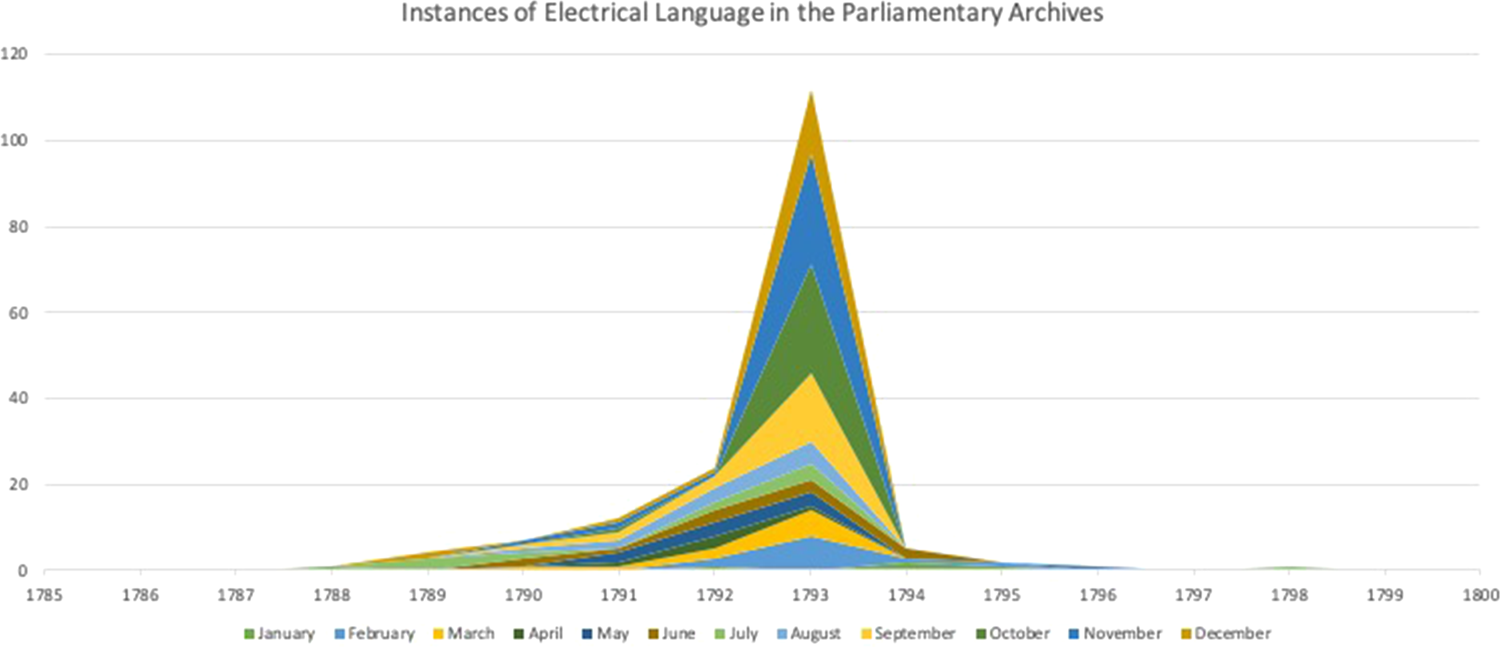
With the possible exception of late 1793, it would be overstating the case to say that ‘electricity’ and ‘electrify’ were commonly used words. It is also clear that electricity was a distinctly revolutionary rhetorical figure, which cropped up in parliamentary minutes only after 1789. Electricity blazes through the legislative minutes in a distinct pattern. Political matters were ‘electrical’ and ‘electrifying’ in the years before and especially during the Terror, but such language did not make its way onto the floors of the parlements of the Old Regime before 1789, nor those of the legislature after 1794.
A closer analysis of each of these instances reveals a shift in meaning from the first few years of the revolution to the period of the greatest frequency. The electrical language of 1793 is more metaphorical, flatter and further divorced from its origins in natural philosophy than early instances, such as Poyet's. Jacobin representatives write to each other of the work of ‘electrifying’ the people, the armies, the countryside, making it clear that this was a word that stood for a specific kind of political work, easily understood by other Jacobin representatives. Representative André Dumont, sent on mission to quell the counterrevolution in the Somme, describes the electrical activities he expected of his colleague, sent to the same city before him: ‘Citizen colleagues, I guarded the city of Peronne till the end, believing that my colleague Debrel had electrified it, and that all its citizens were at the height of the Revolution. But alas! Such was my surprise to discover a second Coblentz’.Footnote 22 Electrification had become shorthand for bringing revolutionary feeling throughout the country. An ‘electrified’ city meant a city on board with revolution; an un-electrified city, such as the one Dumont found, remained counterrevolutionary. ‘After having electrified souls’, reads another such example, ‘the [Jacobin] emissaries will collect, on the part of the wealthy farmers and manufacturers, the tithe of their herds, their wines, their fodder, and their fabrics’.Footnote 23 Electrisation is paired here with tax-collecting as part of the duty of Jacobin emissaries sent from Paris to, in this case, Carcassonne; it is self-explanatory, almost banal. More than a hundred such examples indicate that électrisation had become, by 1793, an easy expression of revolutionary missionizing.
Compare this to Poyet's more detailed description of ‘a kind of electricity’ by which an irresistible, sentimental consensus is reached. In 1790, revolutionary electricity was a proto-figurative language which still required couching and explanation to be comprehensible. The Jacobin examples illustrate the interest of the more inchoate revolutionary électrisation of a moment like 1790. What did revolutionary électrisation look like before it became a Jacobin shorthand for revolutionary missionizing? To answer this question, I return to the passage in which royal architect Bernard Poyet took up electricity in Snetlage's new sense and placed it at the centre of his theory of the new public festival.
Festival électrisation
This is how every soul, moved, carried by an electrification [électrisation] against which the most perverse men can hardly defend themselves, brings back those profound memories that make the exercise of duties – more precious than the enjoyment of rights – less arduous. This is how, at the great, touching reunion of 14 July 1790, thousands of citizens hurrying from every corner of the empire displayed only one sentiment, that of common love of country and of liberty.Footnote 24
When, in the spring of 1790, he wrote that the distinguishing feature of a public festival was ‘that the sentiment of each becomes the sentiment of all by a kind of electrification’, Bernard Poyet was on a rhetorical cutting edge. Assuming that Poyet himself furnished the word, how did he come by this language? In the following section, I investigate five contexts: Poyet's background, the rhetoric and framing of his other architectural proposals, the forms his pre-revolutionary encounters with electricity are likely to have taken, the contemporary natural-philosophical conception of electricity, and the political stakes of the festivals for which electrical language was deployed. Poyet was not a man of strong political convictions. But his changeable politics, as evidenced in his free adaptation of his proposed structures to correspond to prevailing political winds, makes him a rather ideal mirror for what électrisation signified in the broader political culture; in Poyet's proposal, we see electricity leveraged in an eighteenth-century version of a sales pitch to the powers-that-be.
Bernard Poyet was born in 1742 in Dijon and died in 1824 in Paris. As a young student of Charles de Wailly, he won second place in the prestigious Prix de l'architecture (now known as the Prix de Rome) in 1768 and travelled to Italy, a trip which had a profound influence on him, judging from the Roman architectural forms – columns, amphitheatres and circuses – that loom large in his proposals from the 1770s until the end of his life. His best-known project is the colonnade of the Palais Bourbon, which now houses the Assemblée nationale. The Bibliothèque nationale, meanwhile, conserves Poyet's printed proposals from the fifty-six years between Poyet's trip to Rome and his death at the age of eighty-two, plans for circuses, memorial columns, hospitals and bridges, the majority of which were never built. Across decades of proposals, the political framings Poyet employs shift dramatically while the proposed structures themselves change little. Poyet has pet projects; architectural fixations; and habitual ways of thinking about people in space; of movement of air and sound; of aesthetic effects on crowds, audiences, and other large groups of people. These are a constant across the decades. Poyet lifts language directly from one proposal to another, plugging identical wording into diametrically opposed political frameworks. The effect is striking. The structures themselves appear timeless and unchanging, not in spite but because of how easily they are framed and reframed, toggling from revolutionary, to Napoleonic, to monarchical signification.
In 1806, for example, Poyet proposed a hundred-metre column situated by Pont Neuf at the western tip of the Ile de la Cité, to serve as a monument to the glory of Napoleon. Describing ‘my column’, Poyet wrote, ‘its height will give it the advantage of launching from its capital fireworks of a livelier effect than those which they launch from Saint Agnes in Rome’. ‘And’, he continued, ‘with the help of the openwork shields, one will be able to illuminate it all around in an instant’.Footnote 25 Ten years later, Poyet proposed another column, three hundred feet tall, on Montmartre, similar in every way to the one imagined for Napoleon – except that Napoleon was no longer in power. Instead the column would celebrate the return of Louis XVIII. ‘The statue of Saint Louis’, wrote Poyet, ‘would crown this column, the height of which would give it the advantage of launching from its capital, without danger to the public, fireworks of a richer effect than those which they launch from Saint Agnes in Rome’. He continued, ‘And, with the help of the openwork of the circular gallery, one will be able to illuminate it all around in an instant, during public festivities’.Footnote 26 The images and tropes are nearly identical, the slight rhetorical restructuring and an exchange of adjectives – richer for livelier – make the similarity even starker. Both accounts end rapturously with descriptions of ‘this column of fire’ (in 1816), ‘this fiery column, like a meteor’, the reflection of its light reflected in the river (in 1806). The effect on the people would be ‘unique, ravishing’ (1806), or ‘marvelous’ (1816).Footnote 27
Why are we interested in Poyet's recycled images? Because festive ‘electrification’ is one of them. The word électrisation appears just twice in Poyet's proposals, once in 1790, and again in 1792. Both times it appears with reference to the memory – a year old in 1790, three years old in 1792 – of the taking of the Bastille. It is a flash in the pan in terms of Poyet's (or again perhaps a secretary's) rhetorical habits, appearing only within this two-year window. Electrisation is tied specifically to the Bastille, the federation, and the 14 July anniversary, and in decades of proposals which are otherwise highly repetitive, appears only in this context.
Like Napoleon's and Louis XVIII's column, électrisation in 1790 and in 1792 have much in common. In both, électrisation has interior effects, on ‘sentiment’ in 1790 and on ‘soul’ in 1792. In both cases, it translates individual interiority to collective, shared interiority. Thus by électrisation the sentiment of each becomes the sentiment of all (in 1790), and by électrisation each soul is ‘moved, carried’ in the same direction (in 1792). Then there is the striking repeated image of ‘perverse men’, whose resistance electricity handily overcomes in both cases. The idea of electrical force against which no one can defend themselves is the most closely preserved from 1790 to 1792. These, then, are common elements – interiority, collective effect, and the overcoming of perverse resistance. What scientific conceptualization of electricity corresponds to such a function? To answer this question requires a precise historical reconstruction: in what form would Poyet have encountered électrisation in the pre-revolutionary world that would inform his use of the idea in his proposal? I argue here that the électrisation Poyet would have encountered in 1770s and 1780s Paris would have taken one of two forms: (1) showmanly electrification before a noble and bourgeois audience, or (2) therapeutic electrification, by the late 1780s mostly practised on the sick and the poor, often in hospitals.Footnote 28 Poyet may well have come into contact with both. Much scholarship in the history of science over the past decades has emphasized how epistemologically important spectacle, entertainment and an enlightened variety of wonder were within late eighteenth-century scientific culture. Electrical shows are prime examples of this phenomenon, and there is no doubt that the emerging science of electricity reached a certain segment of the public by this means.Footnote 29 The simultaneous edification and entertainment of the electrical demonstration would have found an echo in the revolutionary festival.
There is also much evidence for electricity as primarily a medical technology in the popular imagination of late eighteenth-century France. François Zanetti writes that ‘by 1780, virtually every Parisian would have heard of the use of electricity to cure nervous disorders such as paralysis’. Practitioners had received government sanction to advertise their techniques in the Journal de Paris. Footnote 30 Christine Blondel writes of a strong French tradition of medical electrification revived in the 1780s, and points out that Luigi Galvani took the term ‘animal electricity’ from one of its French expositors, the Abbé Pierre Bertholon.Footnote 31 In the epilogue to Electricity in the 17th and 18th Centuries: A Study of Early Modern Physics, J.L. Heilbron tracks the rise in frequency of articles categorized as ‘medical electricity’ by the end of the century, surpassing those he categorizes as ‘traditional electricity’. Between 1789 and 1797, there were seven times as many articles on medical electricity as there were on traditional electricity, i.e. what would today be classed as physics. Thus, Heilbron writes, ‘a major shift of interest occurred in the late 1780s and early 1790s in favour of animal and medical electricity, and electrochemistry’.Footnote 32 In the pre-revolutionary decades, then, Galvani was not the only one at work on theorizing the natural electricity of animal and human bodies. Multiple theories of animal electricity coincided with the growing popularity of medical electricity, based on a general theory that the human body was naturally electrical.Footnote 33 At the same time, atmospheric electricity was subject to great interest in connection not only with natural disasters like earthquakes, but also with new miasma theories which connected air composition to health. This connection between electro-medicine and atmospheric science led to political efforts at reform in hospital and prison design.Footnote 34
It is possible that Poyet had seen electrical demonstrations aimed at an enlightened public; it is perhaps even more likely that he had encountered electricity of a medical kind in the years leading up to the revolution. In 1785, Poyet developed a proposal to replace Hôtel-Dieu, a Parisian hospital well known to be overcrowded, with a massive new circular building of his own design. Parisian hospitals were increasingly the theatres of therapeutic electrification in the 1780s and 1790s and served as the sites of government-sponsored trials of electrotherapy. Poyet's encounter with electrification may well have taken place in this specific context: practised on the poor who ended up in the dreadful hospital conditions that Poyet promised to alleviate. There they were conscripted as experimental populations by veteran electro-medical practitioners like Mauduyt de la Varenne, who over the course of the decade shifted his practice from his own private quarters to a hospital in Saint-Denis. By the 1780s, writes Zanetti, ‘collective electrical treatments were only used for the poor in hospitals or charitable institutions and were primarily conceived of as knowledge-gathering technologies’.Footnote 35 The hospitalization of electro-medicine only strengthened the relationship between experimental electrical therapies and the French government. Electro-medical practitioner Masars de Cazeles paints a picture of mutually reinforcing governmental sponsorship:
The protection and the support that the Government accorded to the first attempts at Medical Electricity could be read as simple encouragement which proves nothing about its efficacy. But the Royal Society of Medicine's welcoming of the details presented by Mauduyt of the many effects that this new agent, and the publication of these details ordered and funded by the Government itself, leave no doubt that this phenomenon, which has commanded such interest and curiosity in experimental medicine, has the right to be included among the arts of healing.Footnote 36
It was with the sanction of the government and the Royal Academy that electrotherapy secured legitimacy as a healing technique.
A committee from the Académie royale des sciences – including Lavoisier, Laplace, Coulomb and Condorcet – rejected Poyet's proposal in November 1786. Though a great improvement over the current Hôtel-Dieu, ‘the most uncomfortable and the least sanitary of all hospitals’, Poyet's circular hospital, they wrote, ‘is too big and has the drawback of gathering too many sick people in the same place’.Footnote 37 The verdict of the academy highlights several of Poyet's preoccupations: great gatherings of people in one place, the circulation of the air, circular buildings. The amphitheatre imagined for 14 July shared with the Hôtel-Dieu project all of these features: it was to be an enormous circular building situated on the Champ de Mars, capable of accommodating ‘350,000, not counting the National Guards and the troupes de ligne’ who would be present for the civil sermon. Concerns over order and surveillance run through Poyet's proposal:
In a festival of this kind, the most important thing is to gather the greatest number of people together, because there every spectator will become an actor in the most august scene; to avoid disorder and indecency, for silence and respectful contemplation, the spectators must be comfortably seated. It will also be necessary to construct an enclosure, easy to guard, for the maintenance of good order, which will never be observed by an enormous crowd unless precautions are taken.Footnote 38
Electricity enters, then, in the context of these preoccupations: that crowds be seated, silent and respectful, avoiding any disorder. To this end, the festival had to be enclosed, indoors, so that the circulation of the electrical ether might bring about a unanimity of sentiments among the hundreds of thousands of attendees.
If électrisation occurred to Poyet in connection with the Hôtel-Dieu project, this would suggest several things about its particular context: that the electricity in question was of a therapeutic kind, that it was administered collectively, and that it occurred indoors, in an environment designed to bring large groups of people to order. In this connection a parallel could be drawn between the experimental population of the hospital, which would have been exclusively poor and sick, and the festival crowd gathered to commemorate the storming of the Bastille. Electrisation is thus not, as we might assume, a free-floating associative metaphor, but should be understood with reference to the kind of controlled scientific process that would have taken place in the hospital trials of the 1780s.
Another layer must be added here. Medical electricity was one form in which Poyet might have encountered électrisation in the decades before the revolution, and the likelihood of this encounter is increased by the fact of his Hôtel-Dieu project. But as a member of an educated class of Parisians, he may well have witnessed électrisation in the form of a scientific demonstration. Over the course of the eighteenth century, a repertory was developed to show to best advantage the flashier properties of the mysterious electrical fluid – attraction, repulsion, emitting of light, and delivering of shocks. James Delbourgo has argued that in the development of this repertory over the course of the eighteenth century, the body became the primary instrument of the electrical showman. Of particular importance was the body of the audience member, whose senses and pain bore direct witness to the power of electricity and proved the reality of its effects. Concurrently, the electrical body underwent several reconceptualizations: in the 1740s an ‘opaque tool for displaying electrical effects’, by the 1780s the body was ‘transparently, inherently electrical’. Delbourgo traces this change: at the beginning of the century, electrical knowledge was made using the body as an important scientific instrument. By century's end, electricity was seen as part and parcel of bodies themselves.Footnote 39
One of the most popular electrical demonstrations performed in late eighteenth-century France, pioneered by the Abbé Nollet at mid-century, involved passing a shock from a charged Leyden jar through a chain of people holding hands. The first and last person in the chain would complete a circuit by touching differently charged parts of the apparatus. In the best-known instances of the demonstration, Nollet passed an electrical shock through 180 soldiers and two hundred Carthusian monks for a royal audience. According to some reports, he later surpassed six hundred people in one human chain.Footnote 40 Nollet, the foremost French expert on electricity at the time, saw his mechanical interpretation of electricity composed of a universal fluid, flowing in opposite directions (which he called effluence and affluence), replaced by Benjamin Franklin's theory of positively and negatively charged atmospheres, analogous to a financial system of credit and debit. But even as the système Nollet was eclipsed, mid-century techniques of illustration like the electrified chain of people holding hands remained. It is possible that Poyet had been part of an electrified circle of the kind Nollet was known for, and thus had felt the shock himself, as it passed instantaneously from hand to hand. Or if he did not directly experience it, Poyet and people in his milieu would likely have known of this kind of demonstration, what it looked like, what it involved, and what effects it produced. In either case, when they imagined a ‘kind of electrification’ by which ‘the sentiment of each becomes the sentiment of all’, Poyet's elite audience drew upon the pre-revolutionary cultural touchstone of the electrical human chain.
Whether therapeutic or edifying, directly experienced, witnessed, or heard about, Poyet's festival electricity was rooted in the specific forms in which electricity was widely encountered in the 1770s and 1780s in France. What about the theoretical side of electrical science? The analysis of ‘revolutionary electricity’ requires a picture of what electricity was at the moment when it was taken up into revolutionary political discourse. And not just for ‘electricians’, as natural philosophers, wandering lecturers and enthusiasts at work on electricity were called, but for an eighteenth-century person who simply knew the word and had an idea of what it meant. What would a hypothetical, educated someone in France in 1788 have pictured when they heard the word ‘electricity’? What about electricity made it conceptually available as an expression of revolutionary energy?
The natural philosophy of electricity in the eighteenth century might most accurately be defined by its plurality. In the early eighteenth century, electricity could be thought of as ‘artificial’ or ‘natural’. Artificial electricity could be generated manually and stored in a container known as a Leyden jar, starting in mid-century. Natural electricity referred to the electricity of lightning or the electricity of living bodies. Benjamin Franklin's famous kite experiment around mid-century, in which he used lightning to charge a Leyden jar, proved that ‘artificial’ and ‘natural’ electricity behaved in the same way, and were essentially the same substance. Meanwhile, medical electricity, the practice of gentle application of artificially generated electricity to treat various nervous ailments, developed into an elaborate and fashionable practice. Combining all of the elements of the ideal ‘audience-relation’ of eighteenth-century science – the experimenter-controlled experience, the privileging of wonder and the dash of aesthetic sublimity – the electro-medical seance was perhaps the predominant form in which electrical natural philosophy was practised, and, as noted, was a likely model for Poyet's imagining of the revolutionary festival.Footnote 41 Electric medicine was, however, itself distinct from the study of animal electricity which developed later in the century. Luigi Galvani and others worked toward a theory that animal bodies generated their own electricity, quite apart from what might be externally applied to them as a medical practice; thus medical electricity and animal electricity were distinct fields of electrical investigation.
In 1785, Charles Coulomb proved that the electrical fluid, like gravity, followed an inverse square law in which force was inversely proportional to distance. In 1791, Luigi Galvani published De Viribus Electricitatis in Motu Musculari Commentarius, which described a series of meticulous experiments on frogs in search of ‘animal electricity’. Though their immediate focuses and methodologies were quite different, Coulomb and Galvani had something in common: in both cases electrical science worked analogically. The theories of animal electricity and electricity that worked like gravity made sense only within the broader system of imponderable fluids by which the natural world was understood.Footnote 42 Though their number varied, these fluids proliferated toward the century's end. Fire, magnetism, light and radiant heat were usually among them. Electricity was typically understood as another such fluid, analogous to the others. The laws by which electricity operated, therefore, were potentially knowable via analogy to other such substances. J.L. Heilbron argues that the results achieved with Coulomb's impossibly delicate torsion balance, expressed in suspiciously round numbers and through a notoriously difficult-to-replicate set of experiments, testify to the expectation among French electricians that electricity would turn out to be analogous to gravity.Footnote 43 Peter Heering confirms this idea, concluding, after reproducing Coulomb's experiments at the historical physics laboratory at the University of Oldenburg, that ‘Coulomb did not get the data he published in his memoir by measurement’.Footnote 44 In fact, Heering argues, scepticism over Coulomb's proof productively spurred nineteenth-century physicists on in their work on electricity and magnetism.Footnote 45 Thus Coulomb's torsion balance experiments on the inverse square law of the electrical fluid are less an experimental proof than a historical one, which indicates that this analogy between electricity and gravity was suspected widely enough to need only the shakiest proof to become an accepted fact. As Simon Schaffer points out, a Newtonian framework in which experimental phenomena were supposed to evidence a deity at work in the world led to this system of analogies and identifications across the various ‘active powers’; electricity's identification with fire, phlogiston, light, nervous fluid ‘formed part of a practice in which it was essential to connect powers with divine action and then produce them from matter’.Footnote 46
Understanding the system of imponderable fluids undergirding late eighteenth-century natural philosophy and the epistemological importance of analogy within this system is key to understanding what electricity meant when it entered French revolutionary political discourse. If Poyet's électrisation is understood as more analogy than metaphor, and if analogy was an epistemologically privileged way of thinking about electricity, this brings political electricity closer to contemporary science. The theory of active matter strengthened and gave special purpose to analogical bridges between electricity and fire, heat, light and gravity. New political languages of électricité and électrisation were thus grounded in a natural philosophy in which analogous ethers were the source of action and movement. The structure of the material world, the laws by which its analogous ethers and material phenomena functioned, and the composition of its living beings had important implications for contemporary politics. What Poyet's electrical language pinpoints is not so much a moment of transfer between two distinct discursive realms, but rather a moment of epistemological overlap. Within this area of overlap, by analogy, natural-philosophical knowledge of how the electrical fluid functioned was tantamount to knowledge of how political electricity functioned.
Returning to our examples, how does the context of a natural-philosophical system of analogous ethers and fluids change how we understand the électrisation of the festivals of the early revolution? Therapeutic electricity and electricity in analogy to a panoply of other natural phenomena, even evidence of a kind of divine presence in the world, form the conceptual background against which Bernard Poyet's curious new figure of speech must be read. Turning to the passage from the architect's 1792 proposal, we can now read electricity as a Newtonian ether, working on analogy to radiant heat, light and gravity:
This is how every soul, moved, carried by an electrification [électrisation] against which the most perverse men can hardly defend themselves, brings back those profound memories that make the exercise of duties – more precious than the enjoyment of rights – less arduous. This is how, at the great, touching reunion of 14 July 1790, thousands of citizens hurrying from every corner of the empire displayed only one sentiment, that of common love of country and of liberty.Footnote 47
As in 1790, électrisation homogenizes sentiment, overcoming ‘perverse’ resistance. The ‘exercise of duties’, though ‘arduous’, is made easier through électrisation, and through the return of memory it causes. Electrisation moves and carries the soul. On the one hand, we can think of this language of the movement of souls as metaphorical. But thinking in terms of mechanics and cognition rather than in terms of figurative language alone, Poyet's electricity describes both the desired political meaning of the festival and the physical workings of collective sentiment. In other words, in the world of eighteenth-century natural philosophy, it was plausible that atmospheric electricity could affect political sentiment, because sentiment was literally electrical. The festival surroundings (especially the enormous arena Poyet hoped to build) would ideally be capable of generating and channelling the electrical sentiments of the assembled citizens. When Poyet described a ‘kind of electrification’ happening at the Fête de la fédération, therefore, there is a sense in which he meant this literally.
Shock and consensus
The 1790 Fête de la fédération in Paris culminated in a civic oath, to be taken at the very same moment everywhere across France. The festival drew so-called fédérés from every corner of the hexagon to the centre, some making weeks-long journeys on foot. In Paris, a Mass was held, a Te Deum was played, and celebrants were received at the ‘altar of the patrie’ on the Champ de Mars, after a long military procession, which included battalions of young children and old men. Proposals to include women confederates in the procession on the model of earlier provincial federative festivals were rejected. The festival culminated in what was meant to be a mise en scène of the unity of people, National Assembly, and king, demonstrating a mutual commitment to the revolutionary project of national reconstitution and regeneration. Lafayette administered the oath to a reluctant king under stormy skies, in a wide amphitheatre hastily constructed by the fédérés themselves when city contractors fell short.
This festival consecrated the revolution's foundational act of popular violence with an official stamp. Today the anniversary of the taking of the Bastille is celebrated officially with a military parade, but, in its first iteration, it took momentum from the many quasi-mythic, spontaneous federative festivals celebrated in provincial cities and villages from July 1789 into the spring of 1790, sometimes mixed with anti-seigneurial violence. The Paris festival, however, did not suggest violence. It was also – unlike the provincial federations that had gone before – planned well in advance and orchestrated from above. In her study of French revolutionary festivals, Mona Ozouf writes that the issuing of a standard oath clinched the ‘conservative’ character of the Paris festival:
With this official oath, handed down throughout the kingdom by the municipality of Paris, which insisted that it be spoken ‘in concert and at the same moment by all the inhabitants and in every part of this empire,’ the spirit of organization triumphed in the festival. Sometimes, indeed, the festival was seen as no more than an ‘oath taking’ – in other words, as a return to order.Footnote 48
Order and organization over spontaneity, rainy skies, a bored and sleepy king: perhaps this combination explains the disappointment famously felt by Mirabeau and others attending the festival.Footnote 49 Even Michelet, who writes on the spontaneous provincial federations in a state of literary ecstasy, writes of the Paris festival as if the moment of total national unity has passed, and uses it to foreshadow the divisive revolutionary events to come:
Farewell to the period of expectation, aspiration, and desire, when everybody dreamed and longed for this day … Here it is at last! What do we desire more? Why all this uneasiness? … Alas! the experience of the world teaches us this sad fact … that union too often diminishes in unity.Footnote 50
The official Parisian federation could only fall short of what it was meant to achieve – a sublime, simultaneous union of all hearts and minds, and the end of the revolution. In fact, a profound disunity of hearts and minds was already evident, and as we know the revolution did not end there.
Rousseau had directed whoever would try to instigate a true festival to ‘let the spectators become an entertainment to themselves’, with ‘nothing, if you please’, as the festival's object. ‘Plant a stake crowned with flowers in the middle of a square’, he wrote, ‘gather the people together there, and you will have a festival’. As to the audience, ‘make them actors themselves; do it so that each sees and loves himself in the others so that all will be better united’.Footnote 51 Michelet echoed this Rousseauian vision of communion in his descriptions of the provincial festivals leading up to the Paris Fête de la fédération: ‘no one was a mere spectator; all were actors, from the centenarian to the new-born infant; and the latter more so than any’.Footnote 52 The designers of the Paris festival took this concept seriously, but they needed to have a way to orchestrate a spontaneous, regenerative festival from above. In the midst of these contradictory needs, electricity makes its entrance. In the same pamphlet in which he leaves the key action of the festival up to ‘a kind of electrification’, Bernard Poyet also wrote of plans to seat 140,000 of the expected guests in chairs, the better to police them. The proposal focuses on a proposal to build a massive indoor arena for this purpose on the Champ de Mars. The passage we have been considering, in the context of the plan as a whole, is a rare theoretical musing. But situated within an otherwise dry and pragmatic proposal, the invocation of ‘a kind of electrification’ does the work of expressing the crucial element: the miraculous action of federation. In many ways Poyet's électrisation echoes the festival communion that Rousseau describes. The idea of the ‘sentiment of each’ becoming the ‘sentiment of all’ echoes Rousseau's ‘each sees and loves himself in the others’. Poyet and those who read his proposal were likely to have at some point stood in a circle with others, held hands, and felt the electrical shock, and when Poyet searched for a way to express the special function of the festival, he landed on a ‘kind of electrification’. Thus electrical experiment and Rousseauian festival communion came together in a powerful analogy.
How do we read the politics of électrisation in this context? In part this depends on the political meaning of the memory of the taking of the Bastille, and the use made of this foundational memory in subsequent attempts to turn the insurrectionary nature of the original event into something controlled enough to anchor a new order. The festival that could do this had to be both spontaneous and planned. It had to celebrate the popular coup of 14 July 1789 while foreclosing on the possibility of popular violence in 1790. Most importantly, as a precondition for everything else the revolution might achieve, difference or ‘perversity’ in sentiment had to be overcome, and unanimity forged. While the legislature made laws for the people, the festival, Ozouf suggests, made the people for the laws:
Men were individuals, in theory all identical, all equal, but solitary. It was now the task of the legislator to connect them, a task that all the utopias of the century took up with relish. The men of the revolution also took on the task of finding an efficacious form of association for beings whom they thought of as having returned to the isolation of nature … The festival is therapeutic, a reconstruction, as in the utopias of the eighteenth century, of a social bond that has come undone.Footnote 53
If the revolutionary festival was therapeutic, the Fête de la fédération was especially so. Here the task the festival planner took up was to take innumerable individuals, stripped to atoms with the destruction of estates and distinctions, and design a ceremony that would bind them together. A powerful reconstitutive therapy was required in order to recover a lost social bond, a mesmerist seance writ large, on the scale of the patrie itself.
What better method of reconstruction than a natural-philosophical force, a universal ether that coursed through the animal bodies of each individual attendee, or as the Marquis de Sade put it, ‘the only soul admitted by modern philosophers’: electricity?Footnote 54 Keeping in mind the close conceptual relationship between medical therapy, healing and electricity in the last decades of the eighteenth century, we can see how electricity might have suggested itself as a compelling encapsulation of this therapeutic function. Mesmerist seances, purporting to produce ecstatic, healing unity via an experimenter's control over a universal fluid, probably played a role in laying the groundwork for such a connection. The medical electric shock, applied to the body, had a violent and salutary effect, though its precise mechanism was a mystery. Likewise, in the planner's imagination, the electric shock that propagated through the festival crowd might have the potency to heal and reorder a social body. If festive electricity was a kind of therapy, what disorder did it heal? Poyet contrasts the shared sentiment of the electrified festival with conditions ‘under the reign of despotism’, in which ‘men defied one another, having no common interest, hid themselves from one another, did not know one another, and gathered, so to speak, within their own families, the only rallying point … Despotic government … created that fatal egoism which separated and corrupted them’.Footnote 55 Here a medical lens suggests that the language of ‘corruption’ and ‘fatal egoism’ might apply to physical bodies and political bodies at once. The structure of the political body has real, potentially corrupting or ‘fatal’ effects on the lives of the people living in it. The image is claustrophobic; the men of the Old Regime are hidden away in families, and their separation breeds corruption. Contrast this, Poyet suggests, with the instantaneous togetherness affected by the healthy électrisation of the festival.
As Ronald Schechter has recently argued with respect to the idea of ‘terror’ in the French Revolution, and as Miller argues in a chapter on lightning in her book A Natural History of Revolution: Violence and Nature in the French Revolutionary Imagination, the idea of a therapeutic destruction or a therapeutic terror informed the Jacobin narrative in 1793–4. Miller in particular argues that the idea of the natural, necessary, regenerative shock of the lightning bolt justified the violence of the radical phase of the revolution.Footnote 56 What did the idea of therapeutic électrisation justify? What did it illuminate and what did it obscure? Mary Fairclough argues that ‘electrical language rarely signals confidence in enlightenment or progress at this period [1740–1840]. Electrical imagery and ideas are not used to account for such phenomena but rather to signal mystery and opacity’.Footnote 57 Poyet's électrisation conveniently mystifies the exercise of top-down, bourgeois control at the centre of the official, conservative commemoration of 1790. Tapping into what would have been shared cultural knowledge of both medical electricity, as practised privately and on the poor in hospitals, and the edifying entertainment of itinerant electricians, festival électrisation calls to mind the controlled administration of a salutary electric shock to the body politic.
The moment of intersection I have focused on here illustrates a broader point: that revolutionary political thought was grounded in a particular scientific understanding of human sentiment, life, movement and energy. Understanding that grounding reveals the intertwining of French revolutionary rhetoric with a specifically medical, etherial and therapeutic electricity, which conditioned revolutionary political thought about energy and action.Footnote 58 Electricity, neither the most frequently invoked nor the most prominent rhetorical figure of political speech in the early 1790s, is, however, especially revealing because of a set of unique political affordances of electrical science at the end of the eighteenth century. Before the invention of the Voltaic pile in 1800, before Oersted's unification of electricity and magnetism in the 1820s, before electricity was harnessed by the forces of industrialization and state power, electricity entered political discourse as a subtle ether, intimately related to and working powerfully on the human body, understood directly through the senses and pain of that body.Footnote 59 It is thus an illuminating case of epistemological overlap. As Michel Delon has argued, French Enlightenment understandings of vital energy in nature, in medicine and in the make-up of people contributed to the emergence of an abstract notion of energy that privileged the individual over the collective, in parallel to the passage from the eighteenth century to the nineteenth.Footnote 60 Taking a similar approach, I argue that natural-philosophical notions undergirded revolutionary politics. In the case study at the centre of this article, the conservative character of the Fête de la fédération and the concerns of the architect complicate purportedly ‘radical’ electricity.
When Poyet invoked electricity in the context of federation, it was not a metaphor, but a metaphor in the making. Poyet's electricity was quite literally an ethereal fluid, with mysterious power over body and mind. It ran through the bodies of human beings, through the vessels of the nerves, and through the fingertips, from one person to another. Within the parameters of the kind of analogical thinking which characterized natural philosophy at the time, it was reasonable to think of a real electricity at work in the atmosphere of Poyet's amphitheatre, an electricity borne of the simultaneous oath taking that was the centrepiece of the Fête de la fédération. In the context of a festival which emphasized top-down order and consensus around a new sovereign power, électrisation occurred to Poyet, I argue, precisely because it offered a way to circumvent the individual will. Revolutionary électrisation tapped into the inexorable, natural forces of the body; ‘perversity’ of mind irresistibly, instantaneously overcome, the sentiment of each becoming the sentiment of all, just as those holding hands when the Leyden jar was discharged all felt the same shock.
Acknowledgements
For crucial feedback I wish to thank my two anonymous referees, Paul Friedland, Rachel Weil, Suman Seth, Claudia Verhoeven, Jessica Riskin, my graduate writing group, the participants and organizers of the Cornell History Graduate Colloquium, the participants and organizers of the Yale French Studies Graduate Conference, and the fellows at the Society for the Humanities at Cornell, where I presented earlier versions of this paper. I also thank Sophie Wahnich and the Institut interdisciplinaire d'anthropologie du contemporain at the École des hautes études en sciences sociales for critical institutional support in France. Research for this article was funded by Cornell University's Department of History, the Einaudi Center for International Studies, the Michele Sicca Research Fund, Cornell's Society for the Humanities and the Andrew J. Mellon Foundation.



