INTRODUCTION
Pearl millet is an important food security crop in Sub-Saharan Africa. In Burkina Faso, it is a major cereal crop and staple food, cultivated under rain fed condition, predominantly in the Sahel and the North-Sudan zones, the driest part of the country. It is the second cereal crop after sorghum in terms of production area, with about 1.2 million ha (FAOSTAT, 2016). However, grain yields are low, usually below 700 kg ha−1 because of the low soil fertility, low and irregularly distributed rainfall and inadequate field management system. In addition to the environmental constraints that negatively influence crop production, such low yield of pearl millet is also accountable to the lack of highly productive improved cultivars, such as hybrids and the poor adoption of the few open pollinating varieties (OPVs) developed through research. In general, conventional plant breeding based on creation of variability, selection and testing of new varieties, has been more beneficial to farmers in high-potential environments and to those that have significant resources to modify their environment to suit new cultivars. But this research was not profitable to poor resource farmers who cannot afford to improve soil fertility of their fields through the application of external inputs and cannot risk a replacement of their traditional varieties even though yield potential is low (Ceccarelli and Grando, Reference Ceccarelli and Grando2007). Farmers in marginal production environments need high yielding pearl millet varieties adapted to their production environment that meet their preferences. Adaptation of new varieties to the ecological zones where they are cultivated is determinant for adoption. However, other factors such as economic constraints, promotion of the technology and perception of the adopters could explain adoption decisions (Adesina and Zinnah, Reference Adesina and Zinnah1993). In order to enhance adoption of new varieties, there is a need to investigate and understand the factors that could limit adoption of new technologies in rural area.
Several study reported that farmer's participation to plant breeding has improve the acceptability of bred varieties in difficult environments by including their preferences in breeding objectives (Ceccarelli et al., 2009). Farmers’ participation in rice breeding in Nepal has led to the identification of a preferred variety that was rapidly adopted (Sthapit et al., Reference Sthapit, Joshi and Witcombe1996). By involving farmers, Weltzien et al. (Reference Weltzien, Whitaker and Anders1996) identified grain and stover yield as the most preferred traits in pearl millet in Rajasthan in India. In Burkina Faso participatory varietal evaluation of advanced improved pearl millet OPVs has led to the identification of a farmers’ preferred variety, MISARI-1, that was released in 2012 and widely adopted (Drabo Reference Drabo2016). Those examples clearly establish that farmers must be involved to the breeding goals setting so that the new improved varieties that will be developed respond to the constraints prevailing in the production areas and correspond to their preferences. In another words, pearl millet breeding has to be oriented by farmer's needs (Witcombe et al., Reference Witcombe, Joshi, Gyawali, Musa, Johansen, Virk and Sthapit2005, Reference Witcombe, Gyawali, Sunwar, Sthapit and Joshi2006). Identification of farmers needs could be done through several approaches either separately or in combination. However, participatory rural appraisal method allows better incorporation of farmers’ knowledge and identification of research priorities. Discussion with farmers about their field management practices, production goals, occurring changes and factors that cause them could be important information for defining target production environment for a breeding program (Weltzien et al., Reference Weltzien, Whitaker and Anders1996). This study aims to identify farmers’ preferences for pearl millet varieties and production constraints in the major production environments of Burkina Faso.
MATERIALS AND METHODS
Study area
The study was conducted in 2015 in two agro-ecological zones in Burkina Faso, where pearl millet is largely cultivated. Sahel zone (annual average rainfall < 600 mm) and North-Sudan zone (annual average rainfall 600–900 mm). Four villages were selected, two in each agro-ecology for this study. The selection criteria of villages were based on the presence of farmer's organization.
Sampling procedure
The Sahel and the North-Sudan zones were selected for this study to represent the major pearl millet production area in Burkina Faso. Two districts were selected in each agro-ecological zone. Thirty farmers were selected across districts in each zone based on their experience of about 10 years in pearl millet production for the semi-structured survey. In addition, four focus group discussions were held with a group of 15–16 farmers. In total, 61 farmers including 42 men and 19 women were involved in this survey.
Data collection and analysis
Data collection was facilitated by the extension agents and farmers’ organization in the district by creating contact with local people, mobilizing farmers to participate to the group discussion and providing the list of farmer qualified for the semi-structured survey. Two complementary approaches were used during this study. Individual farmers were surveyed using a semi-structured questionnaire to collect information on pearl millet production constraints and farmer's preferences for pearl millet varieties. This was to enable each individual farmer to express his opinion independently. Four focus group discussions were also held by meeting farmer groups in each district to solicit new information, confirm data collected, and to have a consensus on the ranking of constraints and preferred traits. A checklist was designed around two points: identification of farmer's preferences for pearl millet varieties and constraints to pearl millet production. The technique employed consisted of listing constraints and preferred traits and analysing using pair-wise ranking. To allow farmers to answer questions objectively, reference samples were used during the survey. Concerning farmers’ preferences for individual traits in pearl millet, different pearl millet plant types (dwarf to tall), panicle types (very short to very long, narrow to wide, bristle and non-bristle), grain size (small and large), and grain colour (white, grey and yellow) were exhibited to farmers. For the production constraint, photographs of some constraints such as drought effect, downy mildew symptoms, Striga hermonthica and its damage, smut, rust were shown to the farmers and they were also solicited to add any other constraints that they face. Throughout the discussion a local facilitator guided the process and enumerators took notes.
Statistical analysis was done on data collected from the structured questionnaire using SPSS 20.0. Shapiro–Wilk test for Normality (Shapiro and Wilk, Reference Shapiro and Wilk1965) was performed on the variable and then, pair-wise method was used to prioritize the constraints listed by the different groups.
RESULTS
Farmers’ preferences for traits in pearl millet cultivars
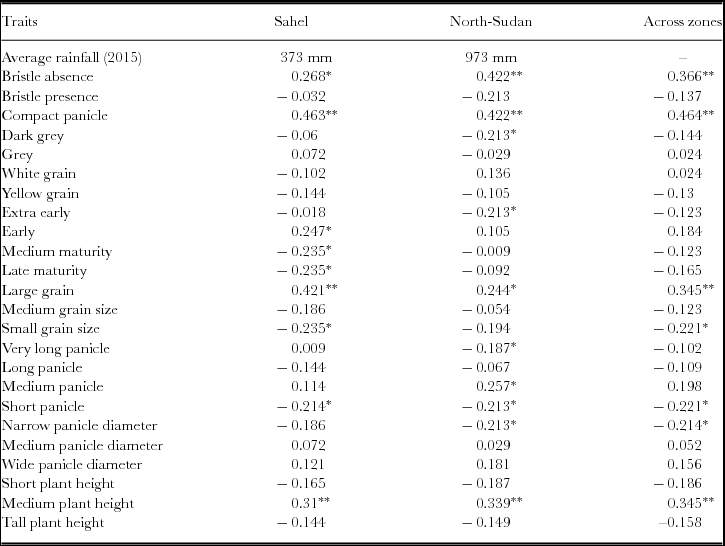
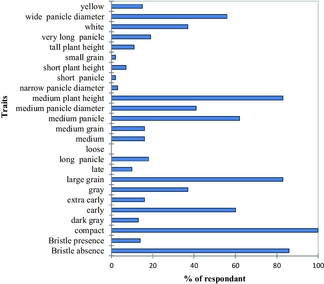
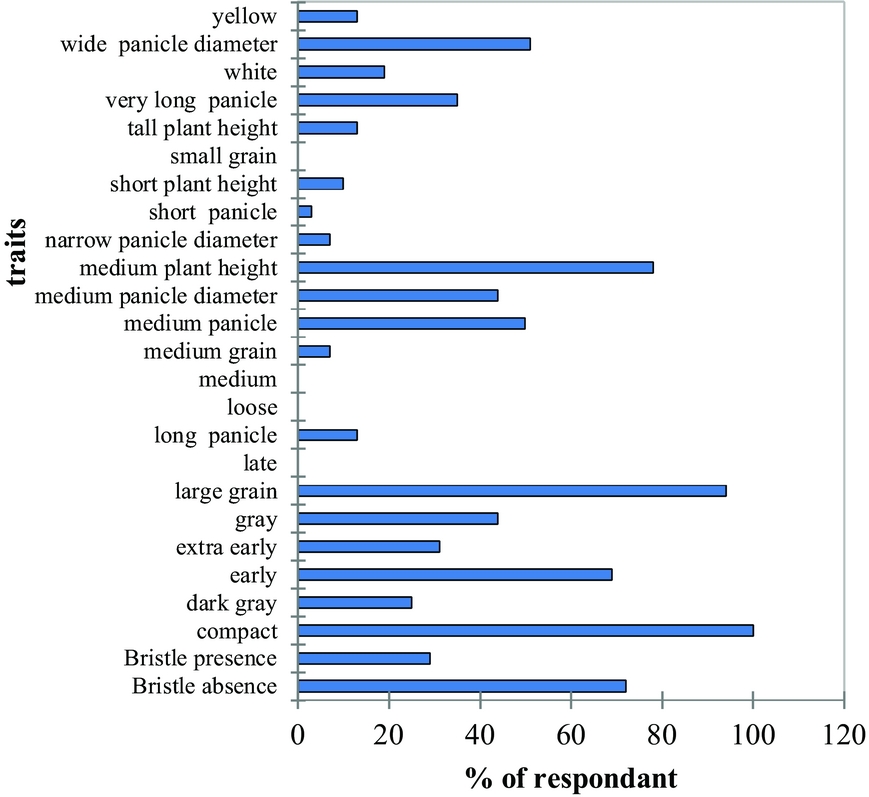
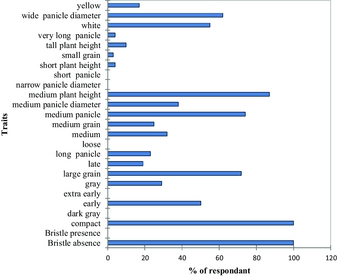
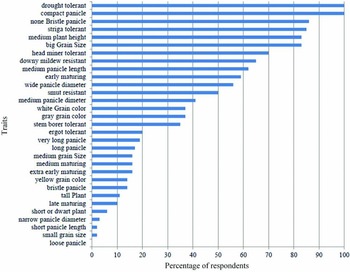
Farmers identified 25 morphological traits that they use to appreciate pearl millet varieties (Table 1, Figures 1–3). These traits are related to yield components and quality traits. Answer correlations within and across zones showed positive and negative concordance between farmers’ appreciations of these traits (Table 1). In the Sahel zone, there were negative and significant correlations between farmers’ appreciation of medium and late maturity crop cycle, while there was significant and positive concordance between their appreciations of early maturity crop cycle (Table 1). For the other traits, the trend of appreciation was almost the same in the two agro-ecological zones. Farmers’ most preferred traits in pearl millet across sites were compact and non-bristled panicle, large grain size and medium plant height (Figure 1). Those traits were positively appreciated by more than 80% of the respondents. Other traits such as early maturing, medium panicle length and wide panicle diameter were positively appreciated by more than 50% of the respondents (Figure 1). Traits such as small grain size, loose, narrow and short panicle were poorly appreciated (Figure 1). In the Sahel zone, in addition to the compact and non-bristle panicle, large grain size and medium plant height, early maturing crop cycle and very long panicle were also more appreciated by farmers (Figure 2). Traits such as medium and late maturing crop cycle were very poorly appreciated by farmers in the Sahel zone. In the Sudan zone, compact and non-bristle panicle type, large grain size and medium plant height got also very good appreciation (Figure 3). In contrast to the Sahel zone, medium panicle length was well appreciated in the Sudan zone. Extra-early maturing crop cycle, bristle and loose panicle, dark grain colour, narrow and short panicle, short plant height, very long panicle and small grain size got very weak appreciation in the Sudan zone (Figure 3). As far as grain colour is concern, white and grey grain were generally well appreciated than yellowed and dark grain colour.
Answers correlation coefficient within an across agro-ecological zones.

*Significant at P value < 0.05, ** significant at P value <0.01.
Farmers’ preferences for individual traits in pearl millet across agro-ecological zones in Burkina Faso.

Famers’ preferences for individual traits in pearl millet in the Sahel zone in Burkina Faso.
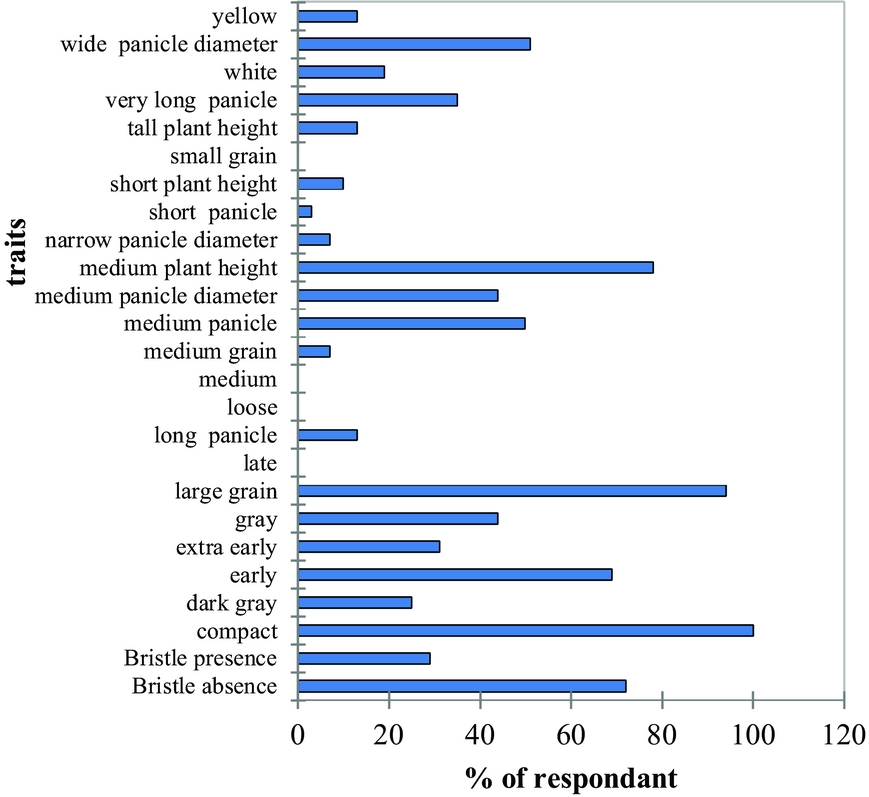
Farmers’ preferences for individual traits in pearl millet in the North-Sudan zone in Burkina Faso.

Constraints to pearl millet production in Burkina Faso
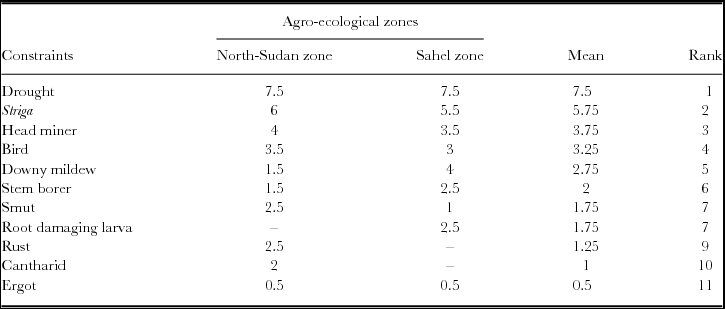
Up to 11 production constraints were listed by farmers across the Sahel and the North-Sudan zones (Table 2). Shapiro–Wilk test for Normality was not significant for all the constraints indicating a normal distribution of the population. Overall result from the four group discussions indicated that drought is the most important constraint followed by the parasitic weed Striga hermontica, head miner and birds’ damage (Table 2). Four diseases were listed; downy mildew, ergot, rust and smut among which, downy mildew was ranked as the disease causing important yield losses in pearl millet (Table 2). Other constraints such as cantharid attack, rust and ergot were considered as minor constraints. Drought and Striga were identified as the serious production constraint in each agro-ecological zone (Table 2). In the Sahel zone, downy mildew and head miner were also considered as major production constraints, whereas in the Sudan zone head miner and bird damage were seen more important than downy mildew disease.
Frequencies provided by the four sites and rank of pearl millet production constraints identified by farmers across the Sahel and Sudan zones of Burkina Faso.

Frequencies were obtained from pair-wise ranking and are equivalent to the constraints in column and row. Low Frequency = high ranking indicating that the constraint is less important and vice versa.
Farmers’ selection criteria for pearl millet varieties
Generally, farmers use a large range of traits to distinguish between pearl millet cultivars and to select for the variety that they prefer (Figure 4). These traits can be classified into two principal groups. The first group relates to traits of adaptation to major constraints prevailing in the production environment and the second group includes morphological traits that farmers use to describe the productivity potential of the variety, grain and fodder quality. The major traits that guided selection of preferred pearl millet variety by farmers across sites were tolerance to drought and Striga, panicle compactness and absence of bristle, medium plant height and large grain size. Each of these traits was chosen by more than 80% of the participants (Figure 4).
Selection criteria used by farmers for an ideal pearl millet variety.

DISCUSSION
Constraints to pearl millet production
Water deficit is the important factor that affect crop production worldwide (Kholová et al., Reference Kholová, Hash, Kumar, Yadav, Kovcová and Vadez2010). It was reported as the major constraint to maize production in Burkina Faso (Dao et al., Reference Dao, Sanou, Gracen and Danquah2015). It also appears as the major constraint to pearl millet production in the Sahel and the North-Sudan zones in Burkina Faso. S. hermonthica appeared in this study as an important biotic constraint affecting pearl millet production. Very few control methods of this parasite are accessible to smallholder farmers because of the limitation in resources. Chemical control and use of adequate dose of fertilizer are expensive. The only solution that seems to be cheaper to smallholder farmers is hand pulling of emerged Striga plants (Ramaiah, Reference Ramaiah1985). However, before the Striga emerges, it has already caused serious damage to the pearl millet plants. Therefore, there is little solution for subsistence farmers to control this weed. Head miner of pearl millet (Heliocheilus albipunctella), appeared in this study as a constraint to pearl millet production in some areas in Burkina Faso. On-farm biological control method proposed by Payne et al. (Reference Payne, Tapsoba, Baoua, Malick, N'Diaye and Dabire-Binso2011) is an efficient control method that has been tested in Burkina Faso. However, the cost and the technical aspect of this method make it inaccessible to smallholder farmers. No resistant variety is yet released against this insect. Thus, it remains as a constraint where susceptible landraces are grown. Birds’ also appeared as a threat to pearl millet production in Burkina Faso. This is constraining some farmers to abandon pearl millet production, especially in areas along river sides. Downy mildew caused by Sclerospora graminicola (Sacc.) Schroët is reported as the most important and widespread disease of pearl millet (Singh et al., Reference Singh, King and Werder1993; Singh, Reference Singh1995; Thakur et al., Reference Thakur, Sharma and Rao2011). It was ranked fourth overall production constraint across sites and the most important disease in this study. However, many farmers do not recognize downy mildew as a serious threat to pearl millet production. In general, most of the pearl millet varieties grown in Burkina Faso are landraces, and landraces are heterogeneous with different level of resistance. Thus, though downy mildew occurred in farmers’ field, they still harvest grain. In this case, field survey data are valuable to estimate the relative prevalence and distribution of pathotypes (Sudisha et al., Reference Sudisha, Amruthesh, Deepak, Shetty, Sarosh and Shetty2005). In sum, pearl millet production constraints remained the same for the Sahelian and North-Sudanian zones with the only difference that the rainy season is shorter in the Sahelian zone and the rainfall is low compared to the Sudanian zone. In 2015, the total rainfall was 373 mm (22 days of rain) in the Sahel zone compare to 973 mm (54 days of rain) in the Sudan zone. This clearly explains why farmer in the Sahel zone prefer early maturing varieties and they systematically reject late maturing pearl millet varieties.
Farmers preferred traits of pearl millet varieties
Compact panicle was the overall most preferred trait in pearl millet in this study. Farmers relate compactness to grain productivity. In fact, compactness is associated with seed set. Panicle with good seed set will be more compact than panicle with poor seed set. This trait is also used to appreciate the resistance of the panicle against head miner. Though all the farmers agree that bristle panicle repel birds, they do not prefer this trait. They preferred non-bristle panicle for the simple reason that bristle panicle is difficult to harvest and process as the harvest and post-harvest activities are done manually. The most important difference in farmers’ preferences between the Sahel zone and the Sudan zone were the panicle length and crop cycle. The Sahel zone is a driest area with a short raining season. Therefore, only early and extra-early maturing varieties can reach maturity in this zone. However, in the North Sudan zone, medium maturing varieties fit to the rainy season. Extra-early varieties will mature very early and it will be subject to bird attack and grain mold. Also, farmers in this zone grow cash crops such cotton and sesame. They start by harvesting the cash crops by delaying the harvest of the cereal crops, including pearl millet sorghum and maize. Medium panicle length is the preferred panicle type in this zone because for them medium panicle take less space in store room and they are generally more compact than the very long panicle.
Farmers use various criteria to select the best variety (Sthapit et al., Reference Sthapit, Joshi and Witcombe1996). These include productivity (grain and fodder), adaptation to constraints prevailing in the cropping environment and needs (Weltzien et al., Reference Weltzien, Whitaker and Anders1996). In this study, farmers most preferred pearl millet ideotype was drought and Striga tolerant variety, with compact and non-bristle panicle and having a large grain size. Drought tolerance was the first selection criterion for pearl millet varieties because pearl millet growing areas are characterized by highly variable beginnings and endings of the rainy season and unpredictable water stress at any time during the growing season (Haussmann et al., Reference Haussmann, Boureima, Kassari, Moumouni and Boubacar2007). It is obvious that drought susceptible genotypes will not yield in this environment. A previous study reported early maturity and grain yield as the most important selection criterion for pearl millet varieties in the Sahel and Sudan zones in four countries in West Africa, including Burkina Faso (Omanya et al., Reference Omanya, Weltzien-Rattunde, Sogodogo, Sanogo, Hanssens, Guero and Zangre2007). In fact, early maturity is associated with low water requirement and provides relative drought escape especially at the end of the cropping season. Since water requirement of pearl millet depend on the duration of crop cycle (Dancette, Reference Dancette1983), short maturity varieties required less water and are thus useful in the Sahel and North-Sudan zones of Burkina Faso, where the raining season is short. Resistance to Striga was also important in varietal selection. Pearl millet is mostly grown on poor soil by subsistence farmers who have limited resources to apply Striga control methods. Compact panicle and large grain size were highly considered in selecting for pearl millet variety. In fact, large grain size and compact panicle are both contributing to grain yield. Large grain size is also a good market traits. Compact panicle is associated with good seed set (Weltzien et al., Reference Weltzien, Whitaker and Anders1996). Thus, through compactness farmers also assess the ability of a variety to yield. Since panicle compactness is influenced by environment, especially post-flowering drought that affect seed set, compact panicle is an indication that the plant could complete its cycle. Non-bristle panicle-type was a non-negligible criterion that farmers take into account in pearl millet variety adoption because of the easy to harvest and the easy to thresh.
CONCLUSIONS
Pearl millet production is subject to many constraints. The major production constraints were by order of importance drought, Striga, head miner, bird and downy mildew. Compact panicle, large grain size and non-bristle panicle were the most preferred traits across agro-ecological zones. Very long panicle and extra early maturity cycle were more preferred in the Sahel zone, whereas medium panicle length and medium maturity cycle were preferred in the Sudan zone. The major selection criteria were drought tolerance, panicle compactness, panicle bristling, Striga tolerance, plant height and grain size. Any pearl millet variety with these traits would have the chance of being largely adopted by farmers. Thus, breeding program must give high weight to these traits while setting breeding objectives. The non-preferred traits in pearl millet variety were loose and bristle panicle types, small grain size, short and narrow panicle, dwarf and late maturing plants. Pearl millet variety with these characteristics would not have a chance of being largely adopted. Therefore, in the selection process, lines with these traits must be discarded. This study provides useful information that could serve in pearl millet variety profiling in Burkina Faso.
Acknowledgements
This research was done with the financial support of the Alliance for a Green Revolution in Africa (AGRA). The authors also thank colleagues from INERA and farmers’ organization AMSP and UGCPA for their help in organizing farmers’ meetings and data collection. Thanks to farmers who graciously offered their time to discuss with us.
AUTHORS’ CONTRIBUTIONS
Inoussa Drabo and Roger G. Zangre selected the study sites. Inoussa Drabo collected and analysed the data and drafted the manuscript. Eric Y. Danquah, Kwadwo Ofori, John R. Witcombe and C. Tom Hash were involved in the conception and design of the study. All authors read and approved the final manuscript.