Introduction
When compared to a control diet, increasing the energy content of the lactation diet increases the energy intake of sows even if their feed intake is decreased (Schoenherr et al., Reference Schoenherr, Stahly and Cromwell1989; Renaudeau et al., Reference Renaudeau, Quiniou and Noblet2001). As energy provided through lipids is mainly transferred to mammary glands, sows fed diets fortified with lipids during lactation produce milk with a higher fat content (Schoenherr et al., Reference Schoenherr, Stahly and Cromwell1989; van den Brand et al., Reference van den Brand, Heetkamp, Soede, Schrama and Kemp2000; Renaudeau and Noblet, Reference Renaudeau and Noblet2001). This may explain why in most cases body weight (BW) and backfat losses are not reduced, and reproductive performance is not improved in sows fed diets supplemented with fat. Piglets are not always heavier at weaning; increased weaning weight is most often observed when creep feed is offered to the litter (Renaudeau and Noblet, Reference Renaudeau and Noblet2001). Supplying dietary fat to sows before farrowing improves the vitality of newborn piglets, especially when the survival rate is usually low in the herd (Pettigrew, Reference Pettigrew1981). Such an effect would result from an increased lipid content in colostrum. It implies that the duration of fat feeding before farrowing is long enough to enable the adaptation of digestive and metabolic processes for utilisation and transfer of a large amount of lipids to the mammary glands.
Over the past years, quantitative genetic selection for increased carcass leanness has resulted in a reduction of lipid deposition both in adipose tissues and in muscles (Tribout and Bidanel, 1999; Labroue et al., Reference Labroue, Marsac, Luquet, Gruand, Mourot, Neelz, Legulat and Ollivier2001). Lipid content in muscle is very low, but it is closely linked with flavour of the meat, i.e. with meat quality. Mourot (Reference Mourot2001) reported that the addition of fat in the gestation and lactation diets increases the number of adipose cells in the dorsal subcutaneous adipose tissue and in Longissimus dorsi muscle of the progeny at birth, and then the potential of lipid accumulation in these tissues. Gerfault et al. (Reference Gerfault, Louveau, Mourot and Le Dividich2000) indicated that such an effect on the potential of lipid deposition was not associated with fatter carcasses at slaughter, but these results were obtained on few litters and need to be evaluated on a larger number of pigs.
The aim of the present experiment was to quantify the effects of the energy provided through fat or starch in the diet during either gestation and lactation, or only after farrowing, on the performance of sows and their litters during lactation, subsequent performance of pigs during nursery and growing–fattening periods, and on their carcass composition at the commercial slaughter weight.
Material and methods
Experimental design
Two trials were carried out at the IFIP’s Research Unit in order to study the effect of feeding a diet supplemented with fat or starch to sows on their performance and those of their progeny. Terminal crossbred Large White × Landrace sows of mixed parity (around 20% of primiparous sows) were inseminated with semen from terminal line crossbred Large White × Pietrain boars. The sows weighed 202 ± 36 kg (mean ± s.e.) on average at 7 days after insemination. In the first trial, three batches with 28 inseminated sows each were studied and fed during gestation either with the fat-enriched diets or with the starch-enriched diets. Based on parity number and body condition on the 7th day of gestation, the sows were allocated to one of the two treatments. At the end of gestation, 12 sows per treatment were moved to the farrowing unit. The sows fed the fat-enriched gestation diet received the fat-enriched lactation diet after farrowing (treatment GL5), whereas those fed the starch-enriched gestation diet during gestation received the starch-enriched lactation diet after farrowing (treatment GL0). In the second trial, five batches of mixed-parity sows (around 24% of primiparous sows) weighing 200 ± 38 kg at 9 days after insemination were used. When transferred to the farrowing rooms on the 108th day of gestation, 24 sows per batch were allocated to their respective treatments based on parity and the assessed body condition. They were fed either the fat-enriched lactation diet (treatment L5) or the starch-enriched lactation diet (treatment L0) from the 1st day after farrowing to weaning at 28 days after farrowing. Within each trial, the pigs farrowed in one of the batches were studied during the nursery and growing–fattening periods. All the pigs from that batch remained in the experiment during the nursery period. During the growing–fattening period, 184 and 144 pigs from both sexes were studied in trials 1 and 2, respectively. Care and use of animals were performed according to the Authorization to Experiment on Living Animals issued by the Ministry of Agriculture (certificate numbers 35-07 for NQ).
Experimental diets and feeding conditions
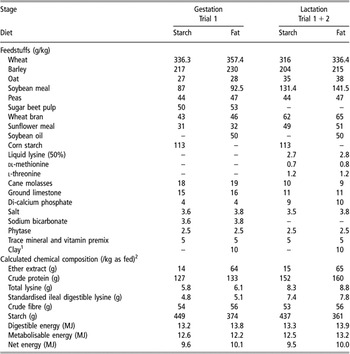
Two basal diets were formulated for gestation and lactation. The same amount of net energy (NE) was then added to these diets through the addition of either 5% soybean oil, i.e. 53 g of soybean oil (‘Fat’ diets), or 11.3% cornstarch, i.e. 123 g cornstarch (‘Starch’ diets), to 1 kg of basal diet (Table 1). In the ‘Fat’ diets, 11 g of clay was also added to 1 kg of basal diet for technological reasons, i.e. 1.0% in the final diet. These diets were pelleted. The standard diet usually fed in our experimental station (9.4 MJ NE, 38 g crude fat and 5.0 digestible lysine per kg) was given until 35 days of gestation in trial 1, and during the whole pregnancy in trial 2. The sows were fed the experimental gestation or lactation diets from 35 days of gestation until weaning in trial 1, and the experimental lactation diets were fed after farrowing only in trial 2.
Composition of experimental diets

1Used to improve quality of pellets.
2From INRA-AFZ (2004) on a 87% dry matter basis.
The total amount of net energy required during gestation to restore body condition after the previous weaning was calculated for each sow according to the factorial model developed by Dourmad et al. (Reference Dourmad, Etienne, Valancogne, Dubois, van Milgen and Noblet2008). The expected BW gain during the first gestation was 60 kg so that primiparous weighed 200 kg after farrowing. The corresponding BWs were 225, 260 and 270 kg after the 2nd, 3rd or 4th and the following parities, respectively. The expected backfat thickness was 20 mm at farrowing.
In trial 1, feed allowance was adjusted to parity and body condition assessed at weaning and on the 7th day of gestation to replete and homogenise the body reserves of sows within each batch before the beginning of the experimental period. The experimental diets were supplied from the 35th day after insemination, when gestation was confirmed. This stage was early enough to influence the adipose cell development of the foetuses (Gerfault et al., Reference Gerfault, Mourot, Etienne and Mounier1999). The GL5 sows were fed 2.8 kg/day of the ‘Fat’ gestation diet and the GL0 sows fed 3.0 kg/day of the ‘Starch’ gestation diet until farrowing so that daily allowances of net energy and essential amino acids were similar for both treatments. Corresponding feed allowances for the GL5 and GL0 gilts were 2.6 and 2.8 kg/day, respectively.
In trial 2, gilts were fed 2.6 kg/day of the standard gestation diet until 107 days of gestation, whereas sows were individually fed according to their body condition at the beginning of gestation from 10th day until 107th day of gestation. From the 108th day of gestation until farrowing, gilts and sows received 2.7 and 3.0 kg/day of the standard diet, respectively.
Gilts and sows were fed 1 kg of their allocated gestation diet on the expected day of farrowing (115th day of gestation, D0), and 1.8 kg on the 1st day after farrowing (D1). Thereafter, they were provided their respective experimental lactation diets according to a scale increasing from 2.6 kg/day on D2 to ad libitum on D5. The day before weaning, they were fed half of the amount of feed consumed the day before and refusals were removed from the troughs at 1600 h.
Farrowing usually occurred on Wednesday and Thursday. From the first following Monday, litters were given some peat for 1 week. Thereafter, a commercial creep feed was available. After weaning, the piglets were transferred to nursery pens and 7 kg of creep feed was allocated per pig per pen. When this amount was consumed, pigs were fed ad libitum a commercial nursery diet until the end of the nursery period at 61 days of age. During the growing–fattening phase, pigs were fed ad libitum a grower diet (9.71 MJ NE and 8.5 g digestible lysine per kg) up to 60 kg and a finisher diet (9.71 MJ NE and 7.7 g digestible lysine per kg) between 60 kg and slaughter at around 110 kg.
Management of sows and piglets at birth
Farrowing was induced by intra-muscular injection of 175 μg synthetic prostaglandin (Cloprostenol, Planate, Schering Plough, 92, rue Baudin, 92307 Levallois-Perret Cedex, France) at 114 days of gestation. This induction was performed on Wednesday in sows whose farrowing was expected on Thursday, and on Thursday for farrowings expected on Friday and Saturday. Litters were homogenised within the first 24 h of life after iron injections. Cross-fostering was performed in trial 1 between sows in the same treatment group. As far as possible, cross-fostering was performed 24 h after farrowing of the dam, and within the 48 h after farrowing of the nursing sow. Males were castrated at 5–6 days of age. No floatation test was performed to discriminate stillborn pigs and those who died shortly after birth. The pigs that did not move at all at birth when farrowings were attended and those found dead at the back of the dam when the stockman persons arrived on the morning were considered as stillborn. No care was provided to newborn piglets as long as farrowing was not completed. Assistance to newborn piglets was forbidden, except for piglets being crushed when technicians were present in the rooms.
Housing conditions
From artificial insemination until 108 days of gestation, the sows were individually housed in trial 1, and were either individually housed or group-housed (six or 13 sows per pen) in trial 2. The group-housing system allowed the animals to be fed individually through individual refectories in which sows were kept during the meals or through single-space electronic feed dispensers. The feed dispensers were equipped with an electronic identification system (antenna) that was activated by an ear responder when the sow entered the station.
From 108 days of gestation until weaning, the sows were kept individually in two farrowing rooms with 12 farrowing pens each. During the cold season, heating systems provided a minimal ambient temperature of 23°C to 24°C during the 4-week lactation period. During summer, ambient temperature was regulated through the ventilation system, but no cooling system was available to limit exposure to warm temperature. On the farrowing day, each pen was equipped with two infrared lamps located behind and on the right side of the sow. The lamp placed behind was removed on the next day, whereas the other lamp was removed 3 days later.
At weaning, the piglets were moved into two rooms with 16 pens each. Eight piglets, four castrated males and four females from the same litter when possible, were put in each pen. Expected ambient temperature was fixed at 27°C during the 1st week, 26°C during the 2nd week and 25°C afterwards. Each pen was equipped with a collective trough equipped with a hopper. Water was available ad libitum from a bowl.
At the end of the nursery period, 144 pigs (72 barrows and 72 females) were moved into two rooms with six pens each. Each pen was equipped with an electronic feed dispenser. Barrows and females were housed separately. When possible, within each pen, pigs came from three or four different litters only. Water was available ad libitum. In trial 1, 40 additional pigs were moved to a room with four pens equipped with a single trough but without an electronic feed dispenser. They were used to increase the number of adipose or muscle tissues sampled at the slaughterhouse for chemical analyses.
Measurements
In trial 1, sows were weighed at 7, 35 and 108 days of gestation, within 24 h after farrowing and at weaning. Backfat thickness was ultrasonically measured at the last rib level (P2) at the same times, except after farrowing. Piglets were weighed at birth and at weaning at 28 days of age. In trial 2, the same measurements were performed except on 35 days of gestation.
The faeces aspect was evaluated for all the batches after the transfer to the farrowing unit and 10 days after farrowing. Their consistency was visually evaluated 2 h after the morning meal using a scale from 1 for small balls indicating constipation to 5 (dung). Notations were made within each batch by the same person.
During lactation, daily feed intake was determined for each sow from the difference between feed allowance and refusals collected the day after. The dry matter content of the diets was measured weekly. Fresh refusals were weighed and dried for 48 h at 105°C to determine the dry matter intake. The litter’s creep feed intake was recorded during the 4th week of lactation. Sows were weaned on Thursday and checked for oestrus twice daily with a teaser boar from the 4th to the 21st days after weaning.
Piglets studied during the nursery and growing–fattening periods were weighed 5 weeks after weaning when they were transferred to the fattening unit, and thereafter every 2 weeks or each week as soon as they reached 100 kg. Feed intake was measured between each weighing on a pen basis. After slaughter, the carcasses were weighed warm. Carcass lean meat content was estimated from the fat depths between the 3rd/4th lumbar vertebra and between the 3rd/4th ribs and the Longissimus dorsi muscle depth between the 3rd/4th ribs obtained with the an CGM invasive probe (Sydel, Lorient, France) (Daumas, 2000).
The effect of energy source in sows’ diets on adipose cell development in dorsal subcutaneous adipose and muscular tissues was assessed from pigs from one batch in trial 1 slaughtered at weaning and at the end of the growing–fattening period. At weaning, six piglets per treatment were slaughtered. They were chosen from six different litters and their BW at weaning was close to the average BW of their littermates. Samples of dorsal subcutaneous adipose tissue, Longissimus dorsi and liver were collected. The remaining fully eviscerated carcass with the head was ground and sampled. The number of adipose cells and pre-adipose cells in collagenase-treated samples of subcutaneous fat and intramuscular fat was counted by means of a Bürker chamber. The lipid content in the carcass and in samples of dorsal subcutaneous fat, Longissimus dorsi and liver was determined according to Folch et al. (Reference Folch, Lees and Sloanes Stanley1957). The dry matter content of the carcass was calculated after freeze-drying followed by heat-drying at 105°C for 24 h. At the end of the growing–fattening period, pigs were slaughtered in a commercial slaughterhouse. Samples of dorsal subcutaneous fat and Longissimus dorsi were collected for lipid content determination on the highest number of pigs that were possible to sample with regard to the slaughtering management.
Calculations and statistical analyses
During lactation, some sows emptied the hopper in the trough completely. Enough feed was available to meet the ad libitum feeding conditions but an unknown amount sometimes fell under the slatted-floor. The daily feed intake was then calculated only from sows that did not waste any feed. Mummified piglets were not taken into account in calculations. In trial 2, litter size at birth was higher in L5 sows than in L0 ones (+0.8 piglet, P > 0.01). This was not related to experimental treatments as they were applied only after farrowing. Litter size at birth was then introduced as a covariate in the statistical analysis of mean birth weight.
Data from both trials were analysed separately. Adjusted means are presented in Tables 2 and 4–7. During lactation, the sow was considered as the experimental unit. Sows were gathered in four parity classes: first, second, third and fourth, fifth and more. Data were submitted to a variance analysis (proc GLM, SAS 1998) with diet (lipid v. starch), parity class (n = 4) and batch (n = 3 in trial 1 or 5 in trial 2) as main effects. Interaction between diet and parity was also introduced in the model and removed when not significant. The average litter size during lactation was introduced as a covariate in the model in order to analyse the performance of sows and litters before weaning. The average litter size from farrowing to weaning was calculated from the number of weaned piglets and from the number of days of life of the piglets that died before weaning.
In trial 1, mortality at birth was calculated as the proportion of piglets that was stillborn. Early mortality was calculated from piglets that died within the first 24 h after farrowing for those suckled by their dam. Postnatal mortality corresponded to losses after 24 h of life for piglets suckled by their dam or after cross-fostering for those who were moved under another sow within the first 24 h of life. Indeed, it was not possible to avoid cross-fostering before 24 h of life for some piglets, and some of them died under the nursing sow before 24 h of life. Only postnatal mortality was calculated in trial 2 as treatments were applied from the 1st day after farrowing. The χ 2 test was used (proc FREQ, SAS 1998) to study the effect of the diet on these mortality rates and on the proportion of sows in oestrus within 21 days after weaning.
Individual data obtained during the nursery and growing–fattening periods were submitted to a multifactorial variance analysis with diet, sex and interaction between diet and sex as main effects and the pen as the experimental unit. Data obtained on a pen basis were submitted to a variance analysis with diet and experimental room (n = 2) as main effects during the nursery period, and with diet, sex, experimental room (n = 2 or 3) and diet × sex interaction during the growing–fattening period.
Results
Performance of sows and litters during lactation
Litter characteristics at birth and survival rates
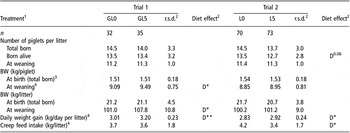
In trial 1, there were 14.5 and 14.0 total born piglets per litter in treatments GL0 and GL5, respectively (P > 0.1, Table 2). At weaning, corresponding values were 11.2 and 11.3 piglets. The diet did not affect individual birth weight (1.51 kg/piglet on average for both treatments). In trial 2, litter size at birth was not significantly different between diets, but the number of piglets born alive tended to be higher in the L0 litters (+0.8, P = 0.06). This was not related to the diet characteristics as treatments were applied only after farrowing. Individual birth weight averaged 1.54 kg/piglet for both treatments (Table 2).
Performance of piglets from birth to weaning (trials 1 and 2)

1Different energy sources (starch: GL0, or oil: GL5) during gestation and lactation (trial 1) or during lactation only (trial 2: L0, L5).
2Variance analysis with diet (D), parity, and batch as main effects. Statistical significance: r.s.d. = residual standard deviation; **P < 0.01; *P < 0.05. When P < 0.10, its value is indicated.
3Litter size at birth was introduced in the model as a covariate.
4Average litter size during lactation was introduced in the model as a covariate.
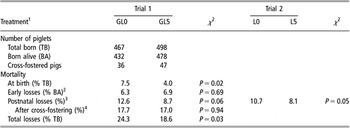
As indicated in Table 3, the proportion of stillborn piglets was lower in the GL5 group (4.0 v. 7.5% for the GL0 group, P < 0.05). Early losses were not affected by treatments but postnatal losses tended to be lower in the GL5 group (8.7 v. 12.6%, P = 0.06). Cross-fostering occurred in 53% of the litters nursed by the GL0 sows and in 32% of the litters nursed by the GL5 sows (P = 0.58). Mortality rate of cross-fostered piglets averaged 17% in both treatments. Lower stillbirth rate and postnatal mortality in the GL5 group resulted in an improved survival rate at weaning (P < 0.05). In trial 2, postnatal mortality tended to be lower in the L5 than in the L0 sows (8.1 v. 10.7%, P = 0.05).
Piglet losses at birth, within the first hours of life, and during the postnatal period (trials 1 and 2)

1See Table 2.
2From piglets that died within the fist 24 h post-farrowing when suckled by their dam.
3From losses after 24 h of life for piglets suckled by their dam or from losses after cross-fostering for those that were moved under another nursing sow. Expressed as a percentage of piglets alive after 24 h of life and cross-fostered piglets.
4Expressed as a percentage of cross-fostered piglets.
Litter performance during lactation
In trial 1, the GL5 piglets were heavier at weaning than the GL0 piglets (Table 2), and the average litter average daily gain (ADG) was higher (+190 g/day, P < 0.01). In trial 2, piglet mean weight at weaning did not differ significantly between groups, but the L5 litters grew faster (+90 g/day; P < 0.05).
Body condition and reproductive performance of sows
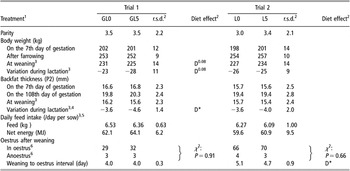
When sows were transferred to the farrowing unit, mean backfat thickness was 20.1 ± 2.4 and 19.4 ± 2.8 mm in trials 1 and 2, respectively (Table 4), without any difference between treatments within trial. After farrowing, mean BW ranged between 252 ± 32 (trial 1) and 256 ± 32 kg (trial 2). Whatever the trial considered, BW loss during lactation was not affected by treatments. Similarly, backfat thickness loss did not differ between treatments in trial 2, whereas it was significantly higher in the GL5 sows in trial 1 (−4.6 v. −3.6 mm in the GL0 sows, P < 0.01). The proportion of sows coming into oestrus after weaning was not affected by treatments and averaged 91% in trial 1 and 95% in trial 2 (Table 4). The weaning-to-oestrus interval was 0.4 days shorter in the L5 than in the L0 sows (P < 0.05).
Sow’s body characteristics and reproductive performance after weaning (trials 1 and 2)

1See Table 2.
2See Table 3.
3Average litter size during lactation was introduced as a covariate in the statistical model.
4Calculated as the difference between values obtained at weaning and at 108 days of gestation.
5From sows that did not waste feed (GL0: n = 20, GL5: n = 29; L0: n = 51, L5: n = 54).
6Within 21 days after weaning.
Lactation feed intake and faeces consistency
Irrespective of the trial, the average daily feed intake during lactation was not significantly influenced by treatments. The numerically lower intake of the GL5 or L5 sows was counterbalanced by the higher net energy content of the diets, and no significant difference in daily net energy intake was observed (Table 4). In trial 1, faeces of the GL5 sows were tougher before farrowing, as indicated by the average score (1.8 v. 2.3 for the GL0 sows; P < 0.05). After farrowing, this difference was no longer observed. In trial 2, the faecal score was 2.7 on average for both treatments.
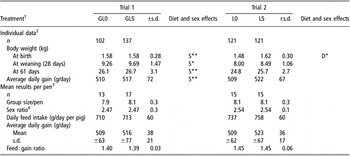
Performance during the nursery and growing periods
Nursery period
The GL5 pigs remaining in the experiment were 400 g heavier at weaning than the GL0 pigs, which is close to the average difference observed for all batches (+450 g). Over the nursery period, ADG was not affected by the diet fed to the dams (513 g/day, Table 5). This resulted in a final BW of 26.1 and 26.7 kg for the GL0 and GL5 pigs, respectively. The feed : gain ratio was 1.4 on average for both treatments. In trial 2, the pigs of the batch kept to characterise growth performance after weaning were lighter than those of the other batches because of high ambient temperatures that occurred in farrowing rooms during late summer. The L5 pigs were 490 g heavier at weaning than the L0 pigs (P > 0.10; Table 5). Treatments did not affect either ADG (515 g/day) or feed conversion ratio (1.45 for both treatments).
Performance of pigs during the nursery period (trials 1 and 2)

r.s.d. = residual standard deviation.
1See Table 2.
2Variance analysis with diet (D), sex (S), interaction D × S and pen within treatment as main effects.
3Variance analysis with diet (D) and experimental room as main effects.
4Gilts were codified ‘2’ and castrated males ‘3’. A sex ratio equal to 2.5 indicate that the number of gilts and castrated males was the same in the pen.
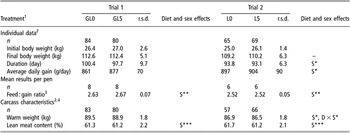
Growing–fattening period
In trial 1, the pigs were slaughtered at 112.5 kg on average (Table 6). The ADG did not differ significantly between treatments over the whole period (869 g/day). The feed : gain ratio was 2.66 on average for both treatments. The lean meat content averaged 61.3% in the two groups. In trial 2, the pigs weighed 109.7 kg on average at slaughter. The ADG was 901 g/day for treatments L0 and L5. The feed : gain ratio and carcass lean meat content were not influenced by the diet (2.52% and 61.4% on average, respectively; Table 6).
Performance of pigs during the growing-fattening period and carcass characteristics (trials 1 and 2)

r.s.d. = residual standard deviation.
1See Table 2.
2Multifactorial variance analysis with diet (D), sex (S) and D × S interaction as main effects, and pen within treatment as the experimental unit.
3Variance analysis with diet (D), sex (S), experimental room and D × S interaction as main effects.
4Slaughter weight was introduced as a covariate in the model; data were not available for one gilt that died before arriving at the slaughterhouse.
Tissue characteristics
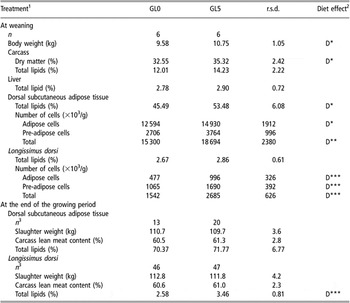
At weaning, lipid content tended to be higher in the carcass of the GL5 piglets (Table 7). No significant difference was observed in subcutaneous adipose tissue, liver or longissimus dorsi. In both sampled adipose and muscle tissues, the number of adipose cells was significantly higher in the GL5 piglets. At the end of the growing period, higher lipid contents were found in dorsal adipose tissue and in Longissimus dorsi in the GL5 pigs, but the difference was only significant in muscle (3.5% v. 2.6% in GL0 pigs, P < 0.01).
Tissular and chemical characteristics of the piglets analysed at weaning and of the pigs at slaughter (trial 1)

Discussion
Usually, the amount of feed supplied during gestation depends on the feed energy content and on the required nutrients to achieve expected growth for gilts and for repletion of body reserves for sows. The factorial model proposed by Dourmad et al. (Reference Dourmad, Etienne, Valancogne, Dubois, van Milgen and Noblet2008) takes into account the expected BW and backfat thickness gains, conceptus development and housing conditions that influence the physical activity level. Such an approach was used to adjust the daily allowance of the experimental diets in trial 1, and of the standard diet in trial 2. The net energy system developed by Noblet et al. (Reference Noblet, Fortune, Dupire and Dubois1993) was used to assess the energy value of each diet. In both trials and irrespective of the diet used, similar BW and backfat thickness were reached at the end of gestation, which validates both the nutrient model and the energy system used.
Increasing the proportion of energy supplied by fat in the lactation diet was associated in the present study with a higher dietary net energy content. It induced a reduction in the daily ad libitum feed intake, in agreement with Schoenherr et al. (Reference Schoenherr, Stahly and Cromwell1989) and Renaudeau et al. (Reference Renaudeau, Quiniou and Noblet2001). It was associated with a non-significant increase of energy intake. In addition, the backfat thickness loss during lactation was significantly higher in the fat-supplemented sows in trial 1, which corresponds to a deteriorated energy balance as already reported by Schoenherr et al. (Reference Schoenherr, Stahly and Cromwell1989) and van den Brand et al. (Reference van den Brand, Heetkamp, Soede, Schrama and Kemp2000). Such results indicate that the extra energy intake supplied by lipids is of little interest for the sow itself as most fatty acids are transferred to the mammary glands and incorporated in milk lipids (Boyd et al., Reference Boyd, Moser, Peo and Cunningham1978; Jones et al., Reference Jones, Edwards, Sinclair, Gebbie, Rooke, Jagger and Hoste2002).
According to the results obtained in trial 1, piglet survival rate before weaning was improved by adding fat to the sow’s gestation diet. Seerley et al. (Reference Seerley, Pace, Foley and Scarth1974), Gerfault et al. (Reference Gerfault, Mourot, Etienne and Mounier1999) and Rooke et al. (Reference Rooke, Shanks and Edwards2000) reported a significant relationship between fatty acid composition of the diet fed to the sow during gestation and fatty acid composition of the newborn piglets. These data suggest that fatty acids cross to some extent the placental barrier, in agreement with Père (Reference Père2003). According to Seerley et al. (Reference Seerley, Pace, Foley and Scarth1974) and Gerfault et al. (Reference Gerfault, Mourot, Etienne and Mounier1999), higher lipid contents of the newborn piglets were observed when the lipid content of the diet provided to the dam was increased. In such conditions, Seerley et al. (Reference Seerley, Pace, Foley and Scarth1974) also observed an increase in the hepatic glycogen content in these piglets. According to Boyd et al. (Reference Boyd, Moser, Peo and Cunningham1978), the glycogen content remained longer at this high level when sows were fed a lipid-based diet than when fed a starch-based diet. Then, the alteration of the newborn piglet’s body composition through characteristics of the diet offered to the pregnant sow could be considered as a possible way for improving the survival rate at birth according to Moser and Lewis (Reference Moser and Lewis1981), Pettigrew (Reference Pettigrew1981) and Shurson et al. (Reference Shurson, Hogberg, Defever, Radecki and Miller1986). Indeed, neonatal losses are closely linked with the low level of stored energy in the body and the insufficient energy intake during the 1st day of life, both resulting in difficulties to maintain body temperature (Edwards, Reference Edwards2002). Then, increased body reserves of lipid and glycogen at birth may help the newborn piglet to limit the effects of postnatal hypothermia through a better thermoregulatory ability (Herpin et al., Reference Herpin, Damon and Le Dividich2002). Indeed, Seerley et al. (Reference Seerley, Pace, Foley and Scarth1974) observed that in piglets farrowed by sows that received 7 g of corn oil per kg BW, rectal temperature decreased less under cold stress than in piglets farrowed by sows that received the same amount of energy through cornstarch. Feeding gestating sows with fat increases the colostral lipid content and thereafter contributes to improving the nutritional status of piglets at birth (Le Dividich et al., Reference Le Dividich, Esnault, Lynch, Hoo-Paris, Castex and Peiniau1991). Such effects of energy supply to the dam through lipids would be consistent with the improved survival rate observed in the present study.
No effect of fat supply during gestation was reported on the stillbirth rate in the studies mentioned above. In the present experiment, the farrowings were not attended, and some piglets classified as stillborn probably died soon after birth. It is then possible that the difference in losses at birth was related to an improved survival ability of the piglets during the first hours of life in the GL5 treatment rather than to a lower occurrence of stillbirths.
As reviewed by Pettigrew (Reference Pettigrew1981), the effects of fat content in the gestation diet on the piglet survival rate are rather variable between studies. Yet, differences can be related to the level of fat supply, duration of feeding the fat-rich diet and the survival rate of the control piglets. According to Moser and Lewis (Reference Moser and Lewis1981), a minimum level of 7.5% of added fat would be required in order to significantly increase litter size at weaning. With 5% of fat in the diet, no significant effect on litter size was observed in our study. The level of fat should not be considered independently but in relation to the feed allowance during gestation. Our study was performed with sows that weighed around 150 kg on average at their first mating and 270 kg on average after their 5th farrowing. Such body size is associated with an important requirement of energy for maintenance (Noblet et al., Reference Noblet, Dourmad and Etienne1990) and explains the relatively high levels of feed allowance during gestation (2.8 or 3.0 kg/day in treatments GL5 and GL0, respectively). Then, the effects of the energy source observed in the present study are obtained through the exchange of 0.6 g soybean oil or 1.5 g cornstarch per kg BW, which is lower than the 3 g corn oil or 7 g cornstarch per kg BW supplies studied by Seerley et al. (Reference Seerley, Pace, Foley and Scarth1974). Moser and Lewis (Reference Moser and Lewis1981) mentioned that adding fat during the end of gestation and during lactation was the most interesting strategy for improving survival rate.
The source of fat used may influence the difference observed between the fat-rich diet and the starch-rich diet, especially with regard to their essential fatty acid profile. The long-chain essential fatty acids play a key role in the development of the brain and more generally of the nervous system (Edwards, Reference Edwards2002). Soybean oil was used in the present study. It contains some polyunsaturated C18:3, i.e. around 7.4% of total fatty acid, but no polyunsaturated long-chain fatty acids in contrast with fish oils (INRA-AFZ, 2004). Rooke et al. (Reference Rooke, Bland and Edwards1998) showed that piglets had a higher viability score when they were born to sows fed a diet supplemented with soybean oil than with tuna oil during gestation. The authors ascribed this effect to an increased gestation length due to the n-3 fatty acid intake from tuna oil, as shown by Edwards and Pike (1997), and because the sows were induced to farrow on days 113 and 114 of gestation, i.e. earlier than their normal term. Our sows were induced to farrow on day 114 only, which would have probably minimised an eventual difference of survival rate between both sources of oil. Farnworth and Kramer (Reference Farnworth and Kramer1989) reported that plasma n-3 fatty acid concentration remained low in sows fed a gestation diet containing 4.7% soybean oil in comparison with sows fed a diet without added fat. Effects on piglet maturity in the present experiment could then hardly be ascribed to the n-3 fatty acid content of soybean oil. To our knowledge, comparison between soybean oil and animal fat is not available in the literature. Some studies focused on the comparison of other vegetable oils, for which fatty acid profiles are not much different from the profile of soybean oil (Berschauer, Reference Berschauer1986), to animal fat. With corn oil or sunflower oil, respectively, neither Seerley et al. (Reference Seerley, Snyder and McCampbell1981) (10% during late gestation and lactation) nor Babinszky et al. (Reference Babinszky, Langhout, Verstegen, den Hartog, Zandstra, Bakker and Verstegen1992) (5% throughout pregnancy and lactation) reported any difference with animal fat on survival rate and litter BW gain during lactation. On the basis of these results, it could be expected that effects reported in the present study with soybean oil would have been similar with animal fat.
In agreement with Henry and Etienne (Reference Henry and Etienne1978) and Rooke et al. (Reference Rooke, Shanks and Edwards2000), no effect of energy source was found on piglet birth weight. In trial 1, it averaged 1.5 ± 0.3 kg, which theoretically corresponds to a rather good situation in terms of survival rate (Quiniou et al., Reference Quiniou, Dagorn and Gaudré2002). However, variability within a litter may result in a survival rate of the control (GL0) piglets that was lower (76.4% of the total born piglets) than the 80% threshold level proposed by Pettigrew (Reference Pettigrew1981), below which an improvement of survival rate could be expected. Indeed, according to the present results, feeding sows with a fat-enriched diet decreased the losses at birth significantly and tended to improve postnatal survival. Reduction of losses observed over the different periods considered resulted in an overall improved survival rate in trial 1. However, energy supplied through 5% oil was not sufficient to modify litter size at weaning significantly, in agreement with Moser and Lewis (Reference Moser and Lewis1981). In trial 2, a reduction of losses after cross-fostering was also observed with the L5 treatment only after farrowing.
According to Pettigrew (Reference Pettigrew1981), energy supply as fat should begin at least 5 days before farrowing in order to increase colostrum and milk lipid content. This delay would be necessary for physiological adjustments required at both digestive and metabolic levels so that fatty acids can be transferred to the mammary glands and exported in colostrum and milk. This condition was met in trial 1 and resulted in a higher increase of ADG of litters than in trial 2 in which no extra fat was provided to sows before farrowing. According to Jones et al. (Reference Jones, Edwards, Sinclair, Gebbie, Rooke, Jagger and Hoste2002) and Ramaekers (2003), litter growth performance is not influenced by fat content in the lactation diet when no creep feed is provided, and piglets are fatter at weaning. In our trials, creep feed was supplied during the last 3 weeks of lactation and a higher intake was observed in the L0 litters than in the L5 ones. Besides the effect of the stage at which exchange between starch and fat supply began, differences in creep feed intake between treatments might contribute to reduce the effect of treatment on the litters’ ADG in trial 2 in comparison with trial 1. Indeed, there would be a synergy between proteins supplied by creep feed and lipids supplied by milk (Renaudeau and Noblet, Reference Renaudeau and Noblet2001), even if milk lipid content was lower in sows fed the low-fat diet as already reported by Schoenherr et al. (Reference Schoenherr, Stahly and Cromwell1989), Tilton et al. (Reference Tilton, Miller, Lewis, Reese and Ermer1999) and van den Brand et al. (Reference van den Brand, Heetkamp, Soede, Schrama and Kemp2000).
At weaning, data obtained in trial 1 indicated that starch replacement by fat in gestation and lactation diets enhanced the proliferation of adipose cells and confirmed previous results obtained by Gerfault et al. (Reference Gerfault, Mourot, Etienne and Mounier1999) and Mourot (Reference Mourot2001). According to Amri et al. (Reference Amri, Ailhaud and Grimaldi1994), fatty acids would act as a pseudo-hormone on adipose cell proliferation. At 110 kg, an increase in body fatness was a subsequent fear. Results obtained on the pigs studied up to slaughter in trials 1 and 2 showed no effect of energy source provided to the sow either on growth performance or on carcass composition at slaughter. Indeed, no difference was observed on ADG or on the feed : gain ratio irrespective of the energy source added to gestation and/or lactation diets of the sows. The genotype of the pigs in these trials might explain why carcasses were not fatter at slaughter. These pigs seemed to have a low potential for lipid deposition. The continuous genetic selection for low body fatness pigs led concomitantly to select for a limited appetite without alteration of the potential for muscle growth. A marked increase of body fatness is observed only when energy supply exceeds the amount required to maximise muscle growth (Campbell and Taverner, Reference Campbell and Taverner1988). This was usually the case in earlier kinds of pigs having a much higher spontaneous feed intake level than that required for maximum lean gain. The risk for excessive body fatness would then have been higher than nowadays in such pigs when farrowed and nursed by sows fed fat-enriched diets. Thus, during the nursery period, Bishop et al. (Reference Bishop, Stahly and Cromwell1985) observed a small but insignificant decrease in growth performance (feed : gain ratio: +0.3) in pigs with a lower growth potential than in our trials (738 g/day during the growing period) when they were born from sows fed a diet supplemented with soybean oil from the 105th day of gestation.
Improving survival rate mainly in low birth weight piglets (less than 1 kg: Seerley et al., Reference Seerley, Pace, Foley and Scarth1974; Bishop et al., Reference Bishop, Stahly and Cromwell1985) through energy supplied as fat in the sows’ diets would result in a higher proportion of underweight piglets during the nursery and growing periods. According to Quiniou et al. (Reference Quiniou, Dagorn and Gaudré2002) and Gondret et al. (Reference Gondret, Lefaucheur, Louveau, Lebret, Pichodo and Le Cozler2005), growth performance of piglets with a low birth weight is worse than that of their heavier littermates. In these studies, the piglets lighter at birth were slaughtered not more than 2 weeks later than the other pigs with a carcass weight within the payment scale grid. Their carcass composition and feed : gain ratio were not significantly different but they were lighter at slaughter. At a similar BW at slaughter, Gondret et al. (Reference Gondret, Lefaucheur, Juin, Louveau and Lebret2006) reported an increase in body fatness for these animals. Consequently, the small differences of growth performance observed by Bishop et al. (Reference Bishop, Stahly and Cromwell1985) might be explained to some extent by an increased proportion of low birth weight piglets still alive at weaning. At a similar weaning weight, no difference in performance was observed between treatments in the present study.
Conclusion
Energy supply through lipids from the 35th day of gestation until weaning improved the survival rate after parturition. According to the literature, feeding the sows with a fat-enriched diet from the 35th day of gestation potentially reduces piglet losses by increasing piglet energy reserves at birth and colostrum and milk qualities. However, our results indicate that such a strategy should be considered only as an aid to the pig breeder who does not want to supervise the sows 24/24 h during parturition. Indeed, supplying energy as fat instead of starch was not sufficient to significantly increase litter size at weaning in our experimental conditions, i.e. when no specific care was provided to the newborn piglets within the first 24 h of life.
The increased proportion of energy supplied as fat in the sows’ diet resulted in a higher growth rate of the nursed litters than when the same amount of energy was provided through starch. This effect was more important when fat supply began during pregnancy than just after farrowing. According to Pettigrew (Reference Pettigrew1981), it would be observed when dietary fat supply started at least 5 days before farrowing. However, these results were obtained on conventional sows and need to be evaluated on high-producing sows, i.e. with at least 14 total born or 12 weaned piglets.
The exchange of an isoenergetic amount of energy supplied by fat or starch to the diet fed to sows before and/or after farrowing resulted in similar performance of their progeny after weaning. Feed efficiency and carcass quality were similar for both treatments. Nevertheless, the number and type of adipose cells of muscle were affected by the energy source in gestation and lactation diets, indicating a potential improvement of meat quality with fat addition.
Acknowledgements
The authors gratefully acknowledge JP Commereuc, L Coudray, MH Lohat, D Loiseau, JC Giclais, F Guyomard, S Watine, S Lechaux, D Pilorget, K Rocher, P Rocher, L Chenard (IFIP), M Alix, Y Jaguelin-Peyraud, J Liger, G Mézière, G Robin, JF Rouault and R Vilboux (INRA) for their technical assistance. The ‘Programme National de Développement Agricole et Rural’ is gratefully acknowledged.