From May 1850 to January 1851, the Lady's Newspaper and Pictorial Times of London featured a series of articles entitled “A Few Words about Music” by “M. H.” The author was the governess, composer, and Catholic convert Mary Holmes (1815–1878). Over the course of several months, Holmes extolled the value of music in women's education, offered practical advice on practicing the piano, recommended suitable repertoire for students, and provided useful guidelines for teaching music to children. In 1851, the articles were expanded into a small book and published by J. Alfred Novello as A Few Words about Music: Containing Hints to Amateur Pianists; to Which Is Added a Slight Historical Sketch of the Rise and Progress of the Art of Music, by M. H.
Although her name does not appear in nineteenth-century music dictionaries or memoires, Mary Holmes is a familiar figure in literary history, thanks to her voluminous correspondence with a number of notable figures, including William Makepeace Thackeray, Anthony Trollope, and, in particular, John Henry Newman, later Cardinal Newman. Their surviving letters, addressed to “My dear Miss Holmes,” have long been studied, cited, and reprinted. Newman thought enough of their correspondence that in 1863, he copied a selection of their letters, hoping to publish it as “A History of a Conversion to the Catholic Faith, in the Years 1840–1844, Exhibited in a Series of Letters.”Footnote 1 And, as Trollope biographer N. John Hall points out, Mary Holmes “was one of the few people with whom he [Trollope] would discuss in writing the relative merits of his books” (447).
Despite her significance, Holmes has been an elusive figure. R. C. Terry, in the Oxford Reader's Companion to Trollope describes her simply as the governess to Thackeray's daughters, adding, “She found consolation in Roman Catholic faith, music, literature, and cultivating friendships with eminent figures like Newman” (“Holmes, Mary”). Joyce Sugg, in her work on Newman and his female circle, has given the most comprehensive picture of Holmes's life based on a careful reading of her correspondence with Newman, Thackeray, and Trollope. She recounts her peripatetic life as a governess, and accurately portrays Holmes as “sincere and very intelligent, but somewhat lacking in common sense and with a certain nuisance value” (46). Even so, Sugg's account is fragmentary, especially in regard to Holmes's musical career, and until now, no one has correctly identified her date and place of birth, her family background, or her other publications, most of which appeared anonymously (see Appendices A and B).
Much of the mystery surrounding Holmes seems to have been due to an error by the bibliographer Ralph Thomas in his Handbook of Fictitious Names (1868). Writing under the unwieldy anagram of his own name, “Olphar Hamst,” Thomas identified M. H., the author of A Few Words about Music, as “Mrs. Hullah” (89); Thomas was possibly confused by a quotation on the title page of the book referring to music educator John Pyke Hullah (1812 – 1884)Footnote 2 and assumed M. H. was his wife. The error was repeated in 1883 by Samuel Halkett and John Laing (917), as well as American bibliographers John Edward Haynes (63), William Cushing (124), and John Foster Kirk (2: 870). Halkett and Laing, Cushing, and Kirk all specifically attributed A Few Words about Music to “Mrs. M. Hullah,” while Kirk included the first Mrs. Hullah's maiden name, Foster, without noting that the lady's first name was Caroline. Although Thomas's misattribution does not appear to have been publicly challenged by either Miss Holmes or the Hullahs, the 1872 Catalogue of the Library of the Sacred Harmonic Society (380), James Duff Brown (329) and Stephen Samuel Stratton (Brown and Stratton 204), and Otto Ebel (70) correctly identified Mary Holmes as the author of the book, as did Anya Laurence (44) and Patricia Joan Williams Boyd (271) in the 1970s.
Nonetheless, Thomas's mistake, like a bad penny, returned to bedevil more recent researchers, and most library catalogers have accepted Thomas's identification of M. H. as “Mrs. Hullah.” The Cambridge Bibliography of English Literature: 1800–1900 attributes A Few Words about Music to Mary E. Hullah (Shattock 2396), John Hullah's second daughter and an author of children's books; Mary Hullah, however, was born in 1848 and was a baby when the material first appeared in the Lady's Newspaper. Equally implausible is the suggestion of the Cambridge University Press that “Mrs. Hullah” was John Hullah's second wife, Frances Rosser Hullah (b. 1838), described on their website as “a professional sculptor and writer on music for women's periodicals” (“Life of John Hullah”). This Mrs. Hullah was also too young to have written “A Few Words about Music” for the Lady's Newspaper, she was not a musician, and did not marry John Hullah until 1865. Beyond the series appearing in the periodical, no other articles on music were ever attributed to “Mrs. Hullah.” Additionally, Frances Hullah signed her rare publications as “F. R. H.”
As a result of this error, researchers did not recognize A Few Words about Music as the book mentioned in letters to Holmes from Newman, Thackeray, and Charlotte Brontë. The editors of Newman's Letters and Diaries refer to it simply “a little book on music” (Newman 14: 330n3). In 1945, when one of Thackeray's letters to Holmes was placed on sale in Boston, Goodspeed's Book Shop called out for more information on the mysterious Miss Holmes, “the long-vanished fair one” (“Enigmas”). Robert F. Metzdorf, curator of the R. B. Adam Collection at the University of Rochester, responded with several details of Holmes's biography but Metzdorf assumed the book mentioned in the letter was on religious topics (“Thackeray's Miss Holmes”). In 2004, Margaret Smith, editor of Charlotte Brontë’s letters, admitted herself unable to trace Holmes's book (Brontë 42) nor was it identified when Brontë’s letter to Holmes was sold to the Bronte Parsonage Museum in 2012.
In June 2014, I examined the copy of A Few Words about Music held by the British Library. On the back page is a list of musical compositions for pianoforte, “By the same Authoress,” which had been previously published under the name of Mary W. Holmes. On the title page, an addendum in an unknown hand identifies M. H. as Mary Holmes, “a Roman Catholic lady introduced to me by Sir George Hodson, Bart.”Footnote 3 Moreover, the volume in the British Library had clearly belonged to Holmes herself, who over the years made numerous corrections in both pen and pencil, crossing out some material and adding ideas, and occasionally including her initials and the date, i.e., “MH 1863” (Few Words, British Library 27). Of particular interest is an inscription on a back page in the hand of William Makepeace Thackeray.
My identification of Holmes's authorship of A Few Words about Music and subsequent research has permitted a thorough reconstruction of her biography. The outline of her early years is predictable enough: the unmarried daughter of educated but impoverished parents, she was obliged to earn her living as a governess with all the drudgery and degradation the job entailed. It is easy to see Holmes as an object of pity as did the editor of Thackeray's letters, who described her as “struggling to the best of her feeble strength in a society where the odds were heavy against a solitary woman” (Ray 1: cxxxix-cxl). However, a closer examination of her life reveals a creative and enterprising woman, brilliant but eccentric, whose achievements are all the more noteworthy in view of the many disadvantages she faced.
Mary Hester Holmes was born on 9 September 1815 in Bristol to George Holmes (ca. 1770–1851) and his wife Mary Ann.Footnote 4 Her father, a Protestant Irishman from Dublin, was a respected illustrator, landscape draughtsman, and drawing master.Footnote 5 According to family tradition, the Holmeses were direct descendants of the seventeenth-century admiral Sir Robert Holmes (1622-1692), noted for his service in the Restoration Navy and his attack on the Dutch Republic. The family also claimed connections to the Barons Holmes of Kilmallock in Ireland, an extinct peerage, and to estates on the Isle of Wight (Tweddell “Memoir” xi-xiii). George Holmes was educated at Samuel Whyte's celebrated English Grammar School in Dublin, which counted Thomas Moore and Richard Brinsley Sheridan amongst its alumni. Holmes continued his art studies at the Dublin Society Drawing Schools, where he studied landscape and architectural drawing, winning medals in 1788 and 1789; he then contributed illustrations to various books and periodicals (Strickland 498–99). Because of political unrest, Holmes left Ireland for England with his first wife, Anna, in about 1799. After arriving in England, he published his Sketches of Some of the Southern Counties of Ireland, a descriptive account of his home country, in 1801. Holmes dedicated his book to the fashionable Duchess of Devonshire, Georgiana Cavendish; the book includes a drawing of Lismore Castle in Waterford, the Irish seat of the Duke of Devonshire.
George Holmes eventually settled in Bristol, where his first son Marcus Henry was born in 1803. The child was named after Marcus Beresford, a member of the Irish aristocratic Beresford family; the Lady Araminta Monck, Beresford's daughter, was his godmother (Tweddell, “Biographical Sketch” 4). Having been left a widower shortly after his son's birth, George Holmes married Mary Ann Anstie (1781–1858), a native of Devizes, Wiltshire, in 1807. Mary Ann was the only child of John Anstie (1743–1830), a prominent wool manufacturer, industrial pioneer, and liberal philanthropist (Haycock 83). At one point the value of Anstie's property exceeded £20,000, but it all disappeared in the financial crisis of 1793 and he eventually moved his family to Bristol. George and Mary Ann Holmes had three children: George (b. 1808), Mary Hester, and Annie Catherine (b. 1818).
During his Bristol years, George Holmes worked primarily as a drawing master, and was eventually assisted by his son Marcus (Nicholls and Taylor 283). The family was living in Brunswick Square, where Mary Ann established a boarding school (Haycock 93), very likely a girls’ school or ladies’ seminary. Such private academies, with a dozen or so pupils taken into the home of the proprietress, were common enough in the late eighteenth and early nineteenth centuries, although, as one Bristol historian noted in 1816, no attempts were made to document their existence (Evans 260). This was surely the setting for the education of Mary Holmes, who became proficient in literature and languages (French, German, and Latin), as well as music. Her mother had been a pupil of the renowned concert pianist and pedagogue Johann Cramer, and she gave Mary a solid grounding in piano technique and music theory (Few Words 42). Mary is likely to have assisted her parents as a teacher in the school, in the manner of Cornelia Blimber in Dickens's Dombey and Son. In about 1833, the family relocated to Plymouth, giving up the school, and Mary presumably took her first teaching position at about that time.
In 1837, at the age of twenty-two, Mary Holmes became caught up in the fever of the Tractarian Movement. Seeking guidance, she wrote to John Henry Newman in 1840 and he soon became her spiritual director, although the two did not meet face to face until 1842. They had a common interest in music — Newman was an avid amateur violinist and had composed a number of hymns — but most of their correspondence centered on religious questions. Holmes asked Newman for his help in publishing her first book, Aunt Elinor's Lectures on Architecture, Dedicated to the Ladies of England (1843). The work reflects the Tractarian fascination with ecclesiastical Gothic architecture, which was thought to correctly embody the original spirit of the Christian faith, as opposed to the neoclassic style popular in England at the time. Holmes may have taken her pseudonym from the Young Lady's Book: A Manual of Elegant Recreations, Exercises, and Pursuits (1832), a best-selling compilation of educational guidelines for girls and their governesses. One of the fictional introductory characters is an “Aunt Elinor,” described as “the very pearl of the ancient sisterhood of spinsters” (3).Footnote 6
Aunt Elinor's Lectures begins with an “Introductory Letter” from the daughter of a country parson to her brother, announcing the imminent publication of Aunt Elinor's lectures, supposedly drawn up for “the children's evening amusements” (1). In a cloying, gossipy tone, the Letter recounts various activities of Aunt Elinor and her female pupils: visiting local churches and sketching their architectural details, restoring stained glass windows, and eliminating the box pews in their own church that effectively segregated the rich from the poor during worship services, all concerns of the Tractarians.
In the body of the book, Holmes acquaints her readers with basic information on Classical architecture, and then proceeds to describe the various styles of early English churches in authoritative and pedantic detail, following the system of classification propounded by Thomas Rickman in his classic work, An Attempt to Discriminate the Styles of Architecture in England (1817). While this may seem a remarkable accomplishment for a young governess, Holmes had almost certainly acquired some understanding of architecture from her father. Furthermore, she appropriated most of the technical information word for word, without attributions, from standard texts by Rickman, James Barr, and Augustus Welby Northmore Pugin, among others. The “List of Works for Study” at the back of the book include nearly thirty textbooks, pamphlets, and periodicals from which she had taken the bulk of her material, although a few sources are not mentioned at all. While today this would be considered plagiarism, many nineteenth-century authors and critics made a distinction between “literary” and “non-literary” sources, claiming that factual material was not a product of the imagination and therefore open to appropriation (Macfarlane 130–32).Footnote 7 Evidently, Mary Holmes was not alone in her borrowing, as authoritative texts on architecture and other technical subjects were frequently reprinted in part or in whole in periodicals and encyclopedias without acknowledgement. Moreover, Victorian architects employed a limited vocabulary, and similarities of expression abound in the literature. Not everything in Aunt Elinor's Lectures was unoriginal; Holmes's descriptions of churches in Sussex, where she had been living before publishing the book, indicate an obvious familiarity with the buildings.
Near the end of her book, Holmes reveals her true intentions and speaks personally to her feminine readers, exhorting them devote their time and energy to religion. She encourages them to decorate their churches with elaborately worked altar cloths and stained glass, rather than making gifts for their clergymen. She discloses her own convictions, with the Tractarian emphasis on inner self-reflection, and advises her readers, “And if we really love the Lord Jesus, if our hearts bleed when we look upon the cross, or read the gospel narrative of His sufferings, if we long to behold Him with our eyes, if we envy those blessed women who were permitted to minister to Him, surely it will be our greatest earthly delight to be able to adorn His altar. . . .” (116). Further, she continues:
We must all have something to fix our energies and minds upon. Men have public life, professions, business: women till they marry (excepting in particular cases), nothing. Why it is I do not undertake to say; but it is an admitted fact, that there are more single ladies in the world now than there used to be, and yet nobody seems to believe that they are so from their own choice.
. . . Far be it from me to say, that equal holiness is not attainable in the married state; I merely mean, that the single woman has the easier task. . . . And though, no doubt, most women are fitted by nature for wedded life, I am sure that there are more than the despisers of religious celibacy would believe, who are intended to remain single. (118–20)
Holmes's strong case for female celibacy in the cause of religion was perhaps a reasonable solution to the Victorian problem of female redundancy but, as the Athenaeum pointed out, it was an odd addition to a book on architecture (“Reviews” 792).
Newman, who had only a superficial knowledge of architecture, was impressed by Holmes's project and persuaded his publisher Francis Rivington to bring out Aunt Elinor's Lectures. The firm was cautious; Rivington had doubts about the title, which he found too imprecise, and was reluctant to publish it anonymously (Newman 9: 138n2). Holmes insisted on keeping her name hidden, however, and even Rivington was ignorant of her identity (Newman 10: 223). While the publishers did not pay Holmes an honorarium, they widely promoted the book, which received prominent reviews in the Athenaeum and the Art-Union, with smaller notices elsewhere (“Reviews,” “Literature”). The verdict was mixed. The Gentleman's Magazine praised the work, declaring, “The rarity of the gift, and the celebrity of the giver, alike demand a public and peculiar acknowledgment, in a work of this kind, when the instructor in art and our teacher in poetry is a female” (“Miscellaneous”). A few critics remarked on the pedantic style and at least one suspected the author was a man (“Symbolism” 28). The Churchman's Magazine noticed the plagiarism of Rickman and wrote disapprovingly, “If it had been Uncle Edward instead of Aunt Elinor, we should have spoken very plainly and unmistakeably [sic] on such a method of proceeding” (“Church Architecture” 70). Despite the criticisms, the book achieved considerable popularity among Tractarians (Turnor 65; Hill 356) and in 1848 the Churchman's Companion, an Anglican periodical, republished the section on celibacy in an article entitled “Honour onto the Weaker Vessel.”
Holmes had in mind a variety of other literary projects for which she asked Newman's advice, including a life of St. Theresa, a catechism of ecclesiastical history, a book of designs for altar cloths, and a collection of moralistic short stories. However, the looming issue facing Tractarians was that of conversion. In the early years of their correspondence, both Holmes and Newman were members of the Anglican Church but moving inexorably closer to Roman Catholicism, Holmes with emotional abandon, Newman with great doubt and hesitation. As Frank M. Turner notes, in their “long, often moving exchanges . . . , a correspondence that constituted a spiritual direction for himself as much as for her, Newman repeatedly advised against action based on feeling or impulse” (594). Holmes wished to convert whilst keeping Newman as her spiritual director; Newman, who was struggling to remain an Anglican, would have none of it. Her letters at the time show her to have been impetuous and prone to embarrassingly passionate outbursts (Newman 10: xxi–xxii). Holmes finally entered the Catholic Church in November 1844, against Newman's advice. Exasperated, he broke off their correspondence although they eventually reconciled sometime after Newman's own conversion in 1845.
Conversion to Roman Catholicism was a momentous decision, usually with immense consequences. Holmes's family seems to have accepted it, and her mother, who had been raised a Nonconformist, encouraged her friendship with Newman. Additionally, Mary's niece, Annie Emra Holmes (b. 1834), converted to Catholicism and took Holy Orders in the Catholic Church, eventually entering the English Convent of St. Augustine in Bruges.Footnote 8 But, as an outspoken Tractarian, Holmes had already faced problems with employers (Newman 9: 48–49; 49n1), and conversion further limited her career prospects. Despite legal reforms restoring some of their civil rights, notably the Roman Catholic Relief Act of 1829, Catholics were still shunned in England, and most Protestants would not consider bringing a “popish” governess into their families, let alone a convert as zealous as Holmes.
While many doors were now closed, others opened. During the early years of her correspondence with Newman, Holmes had been working as governess to the family of William Leigh (1802–1873), a wealthy merchant whose conversion to Catholicism had also taken place in 1844. Her next employer, from 1846 to 1848, was the noted architect Augustus Welby Northmore Pugin (1812–1852), another convert. Pugin, a leader of the Victorian Gothic Revival, was best known for his designs of the interior of the Palace of Westminster and the Big Ben clock tower. The two may have met through Leigh, who had consulted Pugin on the building projects at his new estate, Woodchester Hall. Both Pugin and his assistant John Hardman Powell were in awe of Miss Holmes's intellect, although with time Pugin found her irritating (Hill 356).
After leaving Pugin in the spring of 1848, Holmes may have gone to stay with her parents in Plymouth. In April 1849, Newman wrote to her about unspecified future plans involving a possible relocation to London which might benefit her mother materially, implying that the Holmes family was experiencing financial difficulties. He added, “At present you seem to be very much out of the way of excitement, and to have much time to yourself, which is a great thing” (Newman 13: 122). Even so, Holmes soon took a position as governess to the family of George Thornton, a civil engineer and inventor living in the village of Gargrave in the Craven district of North Yorkshire. Although there were four girls to teach, it was a period of intense creativity for Holmes. She had made the acquaintance of the music publisher and Catholic J. Alfred Novello (1810–1896), and in 1849 and 1850, Novello published several of her compositions — piano solos, duets, and songs — as did another leading music publisher, Robert Cocks. Holmes's compositions were apparently pleasant, if unexceptional. The Spectator called her Return of Spring a “pretty little piece,” noting its elegant style and placid, cheerful character, “well fitted for drawingroom performance” (“Publications”). The Literary Gazette took a similar view in a mention of the Songs without Words: “These are not likely to drive the celebrated ‘lieder ohne vorte’ [sic] out of favour, and the less so, because they are only a rifacciamento of well-known Scotch airs; they are, however, pretty enough, and will be acceptable for pupils” (“Music”). Holmes was critical of her own work, and in her copy of A Few Words about Music, she crossed out in pencil the listing of The Shamrock, adding “Very bad indeed” (Few Words, British Library 103).
In addition to composing, Holmes began contributing to the Lady's Newspaper and Pictorial Times, an illustrated weekly broadsheet which had commenced publication in 1847. The Lady's Newspaper was aimed at middle class women, but “went for a higher intellectual capacity in its readers” (Braithwaite 12), featuring an eclectic mix of articles on fashion and needlework, reports on the Royal family and court, sensational news stories, and reviews of concerts and new publications. Throughout 1850, items by Holmes appeared twice a month on average, including poems and articles on medieval embroidery and tapestries — she was evidently a skilled needlewoman. While Holmes was writing “A Few Words about Music” for the newspaper, Novello may have seen an opportunity to promote her compositions by reprinting the series as a small book. The firm announced the upcoming publication in December 1850, well before the series had finished running in the Lady's Newspaper.
In the opening chapter of her book, Holmes takes as point of departure a review of Charlotte Brontë’s 1849 novel Shirley by an anonymous critic, later identified as G. H. Lewes. Lewes had claimed that the intellectual inferiority of women was demonstrated by their inability to compose great music, stating that the art “is cultivated by all women who have the least aptitude for it” (154). Holmes agrees that most women are indeed incompetent in music, not because of any defect inherent in their sex, but because they have not been properly instructed. She identifies her intended readership as women isolated in the country, family members — mothers, sisters, aunts — who find themselves having to teach the children in their care, and “above all . . . to governesses, whom a tyrannical custom obliges to undertake the teaching of an art they have never learnt themselves” (16).
Holmes was addressing a very real problem. During the 1840s and 1850s, considerable criticism was levelled at ignorant governesses who overstated their capacities in order to get a position (Hughes 42). This was particularly true for musical competence, usually the first on the list of prerequisites for governesses. In 1837, Chambers's Edinburgh Journal discussed the plight of women who were limited to teaching and a few other trades, such as sewing, without regard for their talents and abilities:
I have known girls drilled for years on the piano-forte, in order that they might be able to teach music — the accomplishment at present regarded as the highest that a governess can possess — when it was evident that the young creatures had no ear for music, and only with the greatest difficulty learned the movements mechanically, so that it was as impossible that they should ever teach music with the requisite taste and feeling, as that a dumb man should teach elocution. (“Employment” 305)
The result, Chambers's cautioned, was misery for all concerned.
However, ill-equipped teachers were only part of the larger crisis in British music in the nineteenth century. As Holmes expounds in her book: “At the risk of appearing extreme I do not hesitate to say that a large portion of the musical publications and performances of the present day are injurious not only to public taste but also to public morality” (10). She charges modern music with fostering “vanity, conceit, affectation, and insincerity” (12), common complaints of Victorian social and musical reformers. Holmes echoes the sentiments of her fellow instructor, Olivia Dussek Buckley, who in 1843 counseled that “all inharmonious or vulgar trash ought to be placed out of hearing or reach, as carefully as a worthless book; for nothing can be more unprofitable to the mind than bad music or bad books, both being out of the pale of common sense, consequently injurious to the student” (13). After making a strong case for the importance of “classical” music (17–18), Holmes offers a number of practical suggestions: the playing of organ music on the piano, participation in the popular Hullah singing classes, and the study of well-known didactic works and periodical publications such as Novello's Part-Song Book.
Holmes disputes the prevailing opinion of many educators and parents that minimally skilled governesses could provide satisfactory elementary music instruction, and maintains that the first years of training are crucial, another of Buckley's admonitions. She devotes several chapters to the teaching of music to young children through a series of games and exercises. Avoiding the elaborate musical card games and toys on the market at that time, Holmes recommends simple materials found in the schoolroom, familiar analogies, and physical movements to introduce the basics of music theory. She encourages teachers to let children find answers for themselves, rather than relying on rote memorization. With a manifest affection and concern for pupils, Holmes stresses the necessity of going slowly with children, who were often being pushed to succeed by overly ambitious parents.
The original journal article was enhanced by a brief history of Western music and the development of the pianoforte. As in her earlier book, Holmes presents a synthesis of several textbooks evidently at her disposal. This time, however, she scrupulously documented her sources, having learned her lesson from the critical reactions to Aunt Elinor's Lectures. She devotes considerable space to the music of the early Christian church, based on an anonymous 1845 compendium entitled The Progress of Music on the Continent of Europe. Much of her subsequent information was taken from François-Joseph Fétis's popular text, Music Explained to the World.Footnote 9 Holmes was never a scholar and her history is piecemeal, as she admits, “. . . I do not profess to be writing a complete treatise, but merely suggesting ideas, which can be followed out by those among my fair readers, who have a taste for research, and the means of indulging it” (64).
Holmes appears to have kept up with musical trends despite living in relative isolation as did many governesses. For the benefit of piano teachers, she recommends specific classic works and notes the new school of pianists, including Liszt and Chopin, discussing in detail compositions by modern composers popular in England. (Judging from the addenda in her copy of the book, she changed her mind about several composers over the years.) She encourages her lady readers to support popular music education, explicitly the classes of Hullah and others who were teaching thousands of working-class men and women to sing. Although Holmes was well-acquainted with the state of church and cathedral music in England, she had apparently not spent any significant time in London or other large cities. One revealing annotation in her copy is found in the section on music history: in the margin next to a discussion of the oratorio, she jotted, “When the author wrote this book, she had never heard an oratorio” (Few Words, British Library 83).
A Few Words about Music was in no sense a method, nor was it one of the many juvenile instruction books in the form of “conversations” penned by women (Rainbow 143). Rather, it was a personal statement of the author's approach to music teaching. From a literary standpoint, the book suffered somewhat from its origins as “a series of ephemeral communications, commenced without any idea of its ever taking the shape of a book,” as Holmes wrote in her preface ([iv]). Although it was liberally sprinkled with verses from Holmes's favorite poets — Keble, Wordsworth, Tennyson, Milton, and others — it was free from the coyness and pedantry of Aunt Elinor's Lectures. It was also free of overt Catholic propaganda which might have limited its appeal, although the discerning reader would have noticed the presence of Catholic and Tractarian poets among the quotations. Holmes's sincerity and earnestness is evident throughout, as are her qualifications as a knowledgeable music teacher. In addressing herself to governesses, Holmes was reaching into the experiences of her own life, and the consolations she found in music:
In order to make the pianoforte an agreeable companion to a lady who leads a retired life, and is thrown on her own resources for amusement, it is necessary that she should be mistress of her instrument.
. . . To a good pianiste the pianoforte is a loving friend. It gives you the most precious of all things — sympathy. . . . What the face of Nature is to one who loves Wordsworth's poetry, such is her piano to one who loves Beethoven's music. (23–24)
Despite its merits, A Few Words about Music did not have the success that Holmes had anticipated. Novello had agreed to publish the book, but on the condition that she assume the production costs. Without a financial interest in the book Novello did little in the way of marketing, in manifest contrast to Rivington's handling of Aunt Elinor's Lectures. By the end of 1851 Holmes was discouraged and began considering a new position as governess, possibly abroad, or attempting independent music teaching in London. Newman sensed her restlessness and wrote, “I do not like to see real good mental stuff, which might be made useful, wasted” (Newman 15: 33). He urged her to enter a convent, not for the first time. Although Holmes had toyed with the idea before, she was evidently aware that she was not suited to community life. Another addition to her unhappiness was the departure of her parents, who left England in 1850.Footnote 10 They were following their son George, a physician, and daughter Annie, married to an Irish clergyman,Footnote 11 both of whom had already immigrated to Canada. The elderly couple must have been in dire financial straits to undertake such a voyage. George, Sr. died the next year, in 1851.
But Mary Holmes never stayed down for long, and with entrepreneurial spirit reached out to prominent literary personalities in hopes they would promote her book. She corresponded with Sir Edward Bulwer-Lytton and additionally attempted to convert him to Catholicism; none of their letters survive, although she discussed the exchange with both Newman and Thackeray (Newman 15: 16; Thackeray 3: 12, 3: 20–22). In early 1852, she also sent a copy of her book to Charlotte Brontë and received a cordial reply:
Now that I have read [your book] — I cannot help smiling at the notion of my ‘criticising’ it — or the apprehension of my thinking it ‘frivolous’. It seems to [me] very clever and very learned. The writer of that small treatise knows more than I do — and has read a score of books I have never handled. You erred in telling me to skip the first chapters; I am glad I disobeyed the injunction. The latter part of the book evinces the author's knowledge; the former contains more of the author's self. I own I prefer the study of the human being — to that of the human being's acquirements.
Though I understand nothing of your art, I cannot but feel interested in your sincere love for it: I feel too that there is both good sense and good feeling in the views you take of — and the principles you lay down for — Music Teaching. (41)
Holmes also wrote to Thackeray to ask his assistance in establishing herself in London. She had passed a part of her youth at Sand, in Talaton, Devonshire, the home of the Rev. Francis Huyshe,Footnote 12 a close friend of the Carmichael-Smyths, Thackeray's mother and stepfather (see Figure 1); Huyshe was the model for the character of Dr. Portman in Thackeray's Pendennis (1848–50). Thackeray not only answered Holmes at some length, but mentioned her in letters to his family as well; his frank correspondence gives us the most precise descriptions we have of Miss Holmes. At first, Thackeray was intrigued by her epistles, and wrote with some enthusiasm to his mother:
Do you remember a Miss Holmes a little girl at Tallaton [sic] with Mrs Huyshe? This young lady has turned Catholic, and wants a place as Governess, and is a great musical talent it appears, and interests me very much. . . . I shall give her a turn for music for the girls: & get her to play to them, for she writes well about it in a little book written like an artist & Poet, and Mr Novello says she is uncommonly strong as a musician. (3: 16–17)
George Holmes. “Sand, in the Parish of Sidbury, Devon.” Francis Huyshe. “Manor-House of Sand, in Sidbury, Devonshire.” Gentleman's Magazine 155 (1834): (facing) 265. Google Book Search. Web. 25 July 2016.

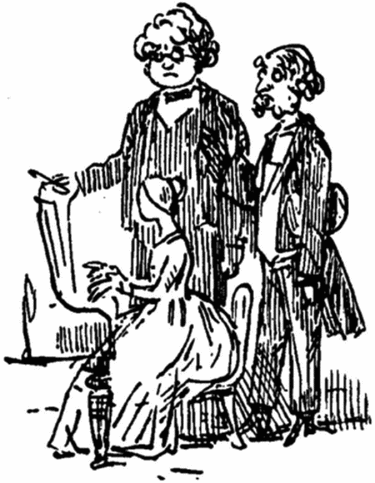
Thackeray promised to get a review of A Few Words about Music in a prominent weekly paper, although none ever appeared. He sent Holmes money to help defray the printer's bill, and proposed a “select T party” (Thackeray 3: 21), to which he would invite Bulwer-Lytton (see Figure 2). In March 1852 Holmes moved to London, where she became the music governess for Thackeray's daughters.
William Makepeace Thackeray. [“T-party” with Thackeray, Sir Edward Bulwer-Lytton (standing), and Mary Holmes (seated).] 5 Mar 1852. Pen and ink on paper. “To Mary Holmes.” By W. M. Thackeray. Letters and Private Papers of William Makepeace Thackeray. Ed. Gordon N. Ray. Cambridge: Harvard UP, 1946. 3: 21.

Once they had met in person, Gordon N. Ray explains, “the charm that he [Thackeray] found in her letters proved to be absent from her person” (Thackeray 1: cxl). Disappointed, he wrote again to his mother:
. . . Miss Holmes has arrived and been here 3 days. . . – She seems to me to play very soberly and finely;. . . Poor Miss Holmes is not a lovely object to look upon with red hair and nose, the lady of Babylon is scarcely more scarlet. I have told her that she must come & give her lesson and be off without much talking else she will be theologizing but I shall be glad if the gals can be taught music by an artist who has the brains and heart as well as the fingers of her art. (3: 25)
After Holmes had played for Thackeray, he praised her performance as “very good indeed,” but he cautioned her not to get her hopes up: “. . . I think there are a thousand brilliant-fingered gentry on the look out [sic] for pupils; and I begin to be frightened about you and your quiet performance” (3: 26).
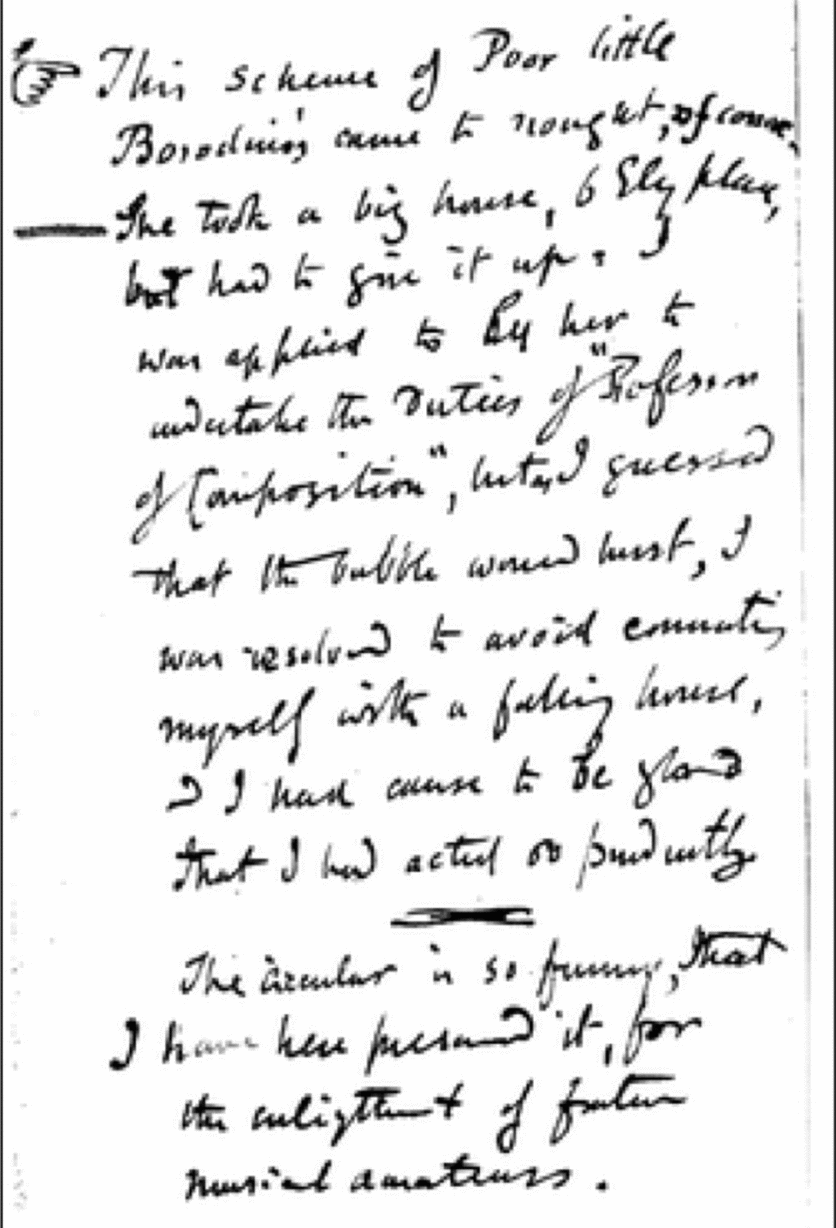
Holmes found lodgings in Chelsea and attempted to set herself up as an independent music teacher or daily music governess. Her friendship with Thackeray continued for several months after her arrival in London as she gave music lessons to Annie and Minnie Thackeray. Evidence of their relationship may be seen in the inscription Thackeray wrote, or rather scribbled, into the back of Holmes's copy of A Few Words about Music (see Figure 3):
 This scheme of Poor little Borodino's came to nought of course,
— She took a big house, 6 Ely Place, but had to give it up. I was applied to by her to undertake the duties of “Professor of Composition,” but as I guessed that the bubble would burst, I was resolved to avoid connecting myself with a fading house & I had cause to be glad that I acted so prudently.
——————
The circular is so funny, that I have here presented it, for the enlightenment of future musical amateurs. (Few Words, British Library [104])Footnote 13
William Makepeace Thackeray. [Inscription to Miss Mary Holmes.] Mar-Apr? 1852. Pen and ink on paper. A Few Words about Music, . . .. By M. H. [Mary Holmes]. London: Novello, 1851. General Reference Collection 7895.a.190, British Library, London. Unnumbered back page.

The meaning of the inscription is opaque, although “Borodino” is the name Thackeray gave to several minor characters — disreputable French aristocrats — who appeared in his fiction, namely in Lords and Liveries (1847), Vanity Fair (1847–1848), and Pendennis (1848–1850). The “circular” in question, from which the pointing finger may have been directed, was possibly a document placed in the book, now missing.
Unsure of her prospects as an independent teacher in London, Holmes had already inserted the following notice in the Musical Times of March 1852: “Musical Governess. — The Writer of ‘A Few Words about Music’, wishes to obtain an appointment as Governess. Terms, 100 Guineas per annum. Address M.H., care of Mr. Novello, 69, Dean-street, Soho” (“Front Matter”). Holmes would have been fortunate to be hired on her own terms as she was asking the maximum conceivable salary (Butler 5–6). Despite her exceptional qualifications, she was thirty-seven and quickly surpassing the optimal age for governesses (Hughes 31). She reinserted the ad in July and, finally giving up her teaching in London, left England in September 1852 for France, to Boulogne-sur-Mer. Before leaving, Holmes told Thackeray that she had accepted a position for £20 a year, an implausibly low figure, perhaps in an attempt to elicit his sympathy (Thackeray 3: 68). He was finding her increasingly tiresome as she attempted to convert him and his family (Thackeray 3: 71), and their correspondence petered out by the end of 1852.
In fact, Holmes had found employment in the household of Thomas Preston, Commissioner of Higher Education in Ireland. Preston was the son of Lord Gormanston, one of the most powerful men in Ireland. The family was making a tour of France and Italy, including a visit to Rome, although Newman warned Holmes not to expect much in the way of comfort, adding that the Italians were “a degenerate people” (Newman 16: 228). She continued to submit the occasional article to the Lady's Newspaper through October 1853, including a couple of reports from Boulogne, but her literary career seems to have come to a halt. In January 1854, her half-brother, Marcus Holmes, died. At the age of thirty-eight, with her mother and remaining siblings in Canada, Mary Holmes was now thrown completely onto her own resources.
Regardless of the advantages of a position with employers like the Prestons, Holmes remained unsettled, and for the next two decades she led a nomadic existence, moving from one prominent Catholic family to the next, alternating with attempts at independent music teaching. After leaving the Prestons, she taught piano in Boulogne. When that failed, she took a position in Sheffield with the family of R. J. Gainsford, a solicitor and educational reformer. After a year, she left for Ireland, employed by Patrick John Kearney, magistrate and deputy lieutenant for County Meath. Next, she was in Oxfordshire with the family of Michael Henry Blount of Maple-Durham. Another unsuccessful attempt at teaching in London was followed by more “governessing,” and for a short time she took a post at a school for ladies in Northwich, Cheshire. Other illustrious employers, for various lengths of time, were the families of Francis Wegg-Prosser and Lord Howard of Glossop. More than once, Holmes found herself in financial straits and Newman ended up writing friends and former employers to beg their assistance (Newman 18: 138; 25: 99). Complicating matters were increasingly debilitating attacks of bronchitis, an illness which would eventually prove fatal.
Despite ill health and financial insecurity, Holmes continued to correspond regularly with Newman and later with Anthony Trollope. Her relationship with the latter had begun in 1863, after the death of Thackeray, and she wrote him frequently about his novels, expressing her reactions to his characters and plots. She made several efforts to publish some verses and spent considerable time on a novel, enlisting Trollope as her agent. Trollope submitted her poems to Cornhill and Macmillan's magazines, but they never appeared. He prudently refused to read her novel, but forwarded it to his publishers Chapman and Hall, in 1874. Their reader, George Meredith, turned it down, much to Holmes's distress. Trollope attempted to soothe her injured feelings:
Your letter has made me unhappy; because I feel that you feel that you have been ill-used. I feared that it would be so. It generally is so when some little assistance is wanted by literary aspirants. . . .
You think that Chapman and his reader have illused you, — but I believe you to be wrong in so thinking. I know them both well and would not have put your Mss into their hands had they been unworthy. The firm is existing (you suspect that there is no such firm). It is doing a very lucrative business (you imagine the contrary). Mr. Chapman is not deterred by the need of publishing the works of either his friends or his relatives from publishing yours. He has in truth done with your Mss as he does with others, — but has done this somewhat quicker than he usually does under my instance. He sent your Mss to his reader, and acted on his opinion. (Trollope 635–36)
Trollope urged her to take the reader's comments to heart and revise her manuscript, but Holmes gave it up.
During the 1870s, the Musical Times published several letters from Holmes, signed M. H. (see Appendix A). In her spirited missives, she stresses the concept of music as a language and, surprisingly, shows herself to be a strong supporter of string instruments, even lauding their advantages in comparison to the pianoforte:
Now, there is no doubt that fiddlers do get attached to their fiddles, and nothing is more natural. First of all the instrument is the most perfect of instruments. It can be put into perfect tune which is more than we can say for the pianoforte; and he or she who plays it, tunes it, and is never obliged to torture his or her nerves by playing on an ill-tuned instrument, as so many organists and pianoforte players are often obliged to do. Secondly, it is a small portable instrument that can be carried about by the player, and is on that account a companion, — almost like the dog, that lives with you year by year, with the additional advantage of giving no trouble, and of never dying. If it has not the power of loving you like a dog, it enables you to do something better than play the passive part of being loved, it enables you to conjugate the verb “amo” actively, and that is a good deal for a thing made of wood and catgut to do for one!” ([Holmes], “A Reply” 522)
Holmes was at her best when writing about music — clever and provocative — and in other circumstances, she might well have succeeded as a music critic.
Holmes retired from teaching at some point after 1870, but continued to move about, visiting friends and former employers for lengthy periods of time. As her health worsened, she moved to Bournemouth, a seaside resort described by Alfred Sharwood's Penny Guide of 1875 as beneficial for those “subject to weak throats and bronchitis” (11). There she found her final home with a niece, Elizabeth Emra Brackenbury,Footnote 14 whose husband was headmaster of Saugeen, a preparatory school for boys. While many unfortunate governesses ended their days alone and in abject poverty, a fate that Newman had long feared for her, Holmes was evidently comfortable and in congenial surroundings; Elizabeth's husband, Rev. E. B. Brackenbury, was a musician and also taught music at the school.Footnote 15 Newman commended Holmes on the move, writing, “I am glad you have got a piano — which must be a great solace to you. I have given up music altogether, except the hearing of it — for my fingers won't move and I can't keep time” (Newman 28: 361).
Despite the advantages of Bournemouth, Holmes's health continued to decline and she died on October 1, 1878 at the age of sixty-three. Newman was shocked at the news, not having realized the magnitude of her illness. He considered her death a welcome release, and wrote to Elizabeth Brackenbury, “Dear Miss Holmes has had a very hard life; . . . She has had several good friends; you have done more for her than any; but she had no reason for wishing to live longer, and she had had a long time of illness, which was a long preparation for death” (Newman 28: 402).
Mary Holmes had indeed led a difficult life. She had been a gifted and talented girl who grew up at a time when formal higher education was denied to females. As an adult, she had to make her way without a supportive father, husband, or brother behind her. Her attempts at a literary career were hampered by the lack of self-discipline and focus necessary to build on her early accomplishments. Like many aspiring authors, Holmes was naive about the publishing business and overly ambitious in her choice of subject matter. Newman conveyed the assessment of James Anthony Froude, editor of Fraser's Magazine, to whom Holmes had submitted a story: “I agree with [Froude] that you write capitally, when you describe what you know; but fail when you attempt what you do not know” (Newman 21: 406–07).
Comparable problems plagued Holmes in her independent music teaching. She was an outsider to the profession, without the performing experience, reputation, or connections that would attract pupils. She made matters worse by capriciously abandoning her teaching on several occasions, as evidenced by notices she placed in the Musical Times, i.e., “Miss Mary Holmes begs to inform her Friends and her Pupils that a Country Engagement will prevent her returning to Town before Easter” (“Professional Notices”). Newman chided her for her lack of perseverance in this regard but, as was often the case, his advice went unheeded.
Holmes's eccentricity and emotional instability were in evidence throughout her adult life. Headstrong and opinionated, her moods alternated between enthusiasm and despair, energy and lethargy. In an extract from one of her few surviving letters to Newman, written in June 1852 as her London teaching stalled, Holmes lamented, “I don't care for any thing now, and feel so lonely, and so indifferent about every thing. I am very much perplexed and harrassed [sic] with care” (Newman 15: 113n2). While Newman certainly had an affectionate regard for Holmes, and indeed worried about her, he disapproved of her lifestyle and could not comprehend her inability to stay in one place for any length of time (Sugg 75).
But in other respects, that very lifestyle was remarkable for an impoverished spinster. Holmes was a published composer and author, and a respected correspondent of literary celebrities. She lived and traveled throughout England, Ireland, and the Continent, surrounded by people of ideas and influence. Unlike many women in her situation, she had the courage to leave positions where she was dissatisfied. She did not evince any sense of inferiority or shame in respect to her status as a poor governess. On the contrary, she was quite forthright in getting friends and acquaintances to help her find new employers, deal with prospective publishers, and pay her debts. She was a sociable woman, and charmed acquaintances with her wit and intellect.Footnote 16 Although some, like Thackeray, were put off by her religious proselytizing, she had friends and supporters on both sides of the confessional divide. In a letter of condolence to Elizabeth Brackenbury, Trollope expressed his admiration for her aunt:
I found her letters to be full of piety, good sense, and of most excellent literary criticism. She never spared me when, — as was very often the case, — she thought I had strayed either from truth to nature or from good sense in my writing. But when she was pleased by what I did, she spoke her praise very openly. I may truly say that I attended more to her censure than her eulogy —
She was an honest, religious, and high-minded lady, and I feel her death has robbed me of a friend. (Trollope 794)
Nor was Holmes a nonentity during her lifetime. Like many “anonymous” authors, her identity appears to have been common knowledge, in both Catholic and literary circles. Charles Locke Eastlake's 1872 history of the English Gothic Revival of the 1830s and 1840s mentions Aunt Elinor's Lectures on Architecture and its authoress, “now known to be Miss M. Holmes” (219). Her name also appears in a pamphlet entitled “Rome's Recruits”: A List of Protestants Who Have Become Catholics. . . ., published in 1878, the year of her death. As the editor explains, “all we essayed was the publication of the names of the élite;. . .” (4). Holmes is described therein as the “author of ‘Hints on Music’ [sic], etc.” (18).Footnote 17
Holmes was undoubtedly a more complex and multifaceted personality than previously recognized. The details of her expanded biography allow us to go beyond the stereotypical portrait of “the governess Miss Holmes,” with all its intimations of deprivation, humiliation, and frustrated spinsterhood. They may permit us to reevaluate her career as an author and musician, and to reexamine her relationships with Newman and her other literary correspondents. And, at the very least, we now have the opportunity to correct misconceptions and errors in the secondary literature, and to update library catalogues and websites, recognizing once and for all the author of Aunt Elinor's Lectures on Architecture and A Few Words about Music as Mary Holmes.
APPENDIX A Published Literary Works by Mary Holmes, in Chronological Order
Aunt Elinor's Lectures on Architecture, Dedicated to the Ladies of England. London: Rivington, 1843. Google Book Search. Web. 30 July 2016.
“Mediæval Embroidery.” Lady's Newspaper and Pictorial Times [henceforth LN] 158 (5 Jan.1850):12; LN 159 (12 Jan.1850): 26; LN 161 (26 Jan.1850): 54; LN 163 (9 Feb. 1850): 82; LN 165 (2 March 1850): 116; LN 169 (23 March 1850): 159; LN 170 (30 March 1850): 172. Gale Cengage. Web. 30 July 2016.
M. H. “A Few Words about Music.” LN 177 (18 May 1850): 278; LN 181 (15 June 1850): 333; LN 188 (3 Aug. 1850); 63; LN 189 (10 Aug. 1850): 76; LN 190 (17 Aug. 1850): 84; LN 196 (28 Sept. 1850): 175; LN 197 (5 Oct. 1850): 191; LN 198 (12 Oct. 1850): 205; LN 206 (7 Dec. 1850): 317; LN 207 (14 Dec. 1850): 322; LN 210 (4 Jan.1851): 11. Gale Cengage. Web.
M. H. “Wordsworth.” LN 191 (24 Aug. 1850): 108. [Poem]. Gale Cengage. Web.
M. H. “Nature's Teaching.” LN 196 (28 Sept. 1850): 169. [Poem]. Gale Cengage. Web.
M. H. “Letters from the Country.—No. I.” LN 196 (28 Sept. 1850): 175; No. II, LN 200 (26 Oct. 1850): 228; No. III. LN 205 (30 Nov. 1850): 298–99. [Series on needlework]. Gale Cengage. Web.
M. H. “Poetry: Sunday Evening in May.” LN 204 (23 Nov. 1850): 287. [Poem]. Gale Cengage. Web.
M. H. A Few Words about Music. London: Novello, 1851.
M. H. “Fine Arts.” LN 292 (31 July 1852): 59. [Report on exhibit of the Royal Academy of Art]. Gale Cengage. Web.
M. H. “Sketches from Abroad.” LN 305 (30 Oct. 1852): 264. [Report from Boulogne]. Gale Cengage. Web.
“Musical and Theatrical On Dits.” LN 353 (1 Oct. 1853): 194. [Report on music from Boulogne]. Gale Cengage. Web.
M. H. “Original Correspondence.” Musical Times 14.324 (1 Feb. 1870): 374–75. [Letter to the Editor]. JSTOR. Web. 30 July 2016.
M. H. “A Reply to Mr. Hinton.” Musical Times 16.376 (1 June 1874): 22–23. [Letter to the Editor]. JSTOR. Web.
M. H. “Secular Music in Churches,” Musical Times 16.379 (1 Sept. 1874): 617. [Letter to the Editor]. JSTOR. Web.
M. H. “Professor Blackie and Professor Oakeley.” Musical Times 17.399 (1 May 1876): 470–71. [Letter to the Editor]. JSTOR. Web.
Holmes, Mary. [“To John Henry Newman, ca Feb 1878.”] Ever Yours Affly: John Henry Newman and his Female Circle. By Joyce Sugg. Leominster: Gracewing, 1996. 285–86. [Unpublished poem, mentioned by Newman in a letter to Holmes (Newman 28: 316)].
APPENDIX B Musical Compositions Published under the name Mary W. HolmesFootnote 18
Fac ut portem: Introduction and Air, from Rossini's “Stabat Mater.” London: Novello, ca. 1850.
Return of Spring: Andante Scherzo Pastorale for the pianoforte. London: Novello, 1849.
The Shamrock: Three Irish Airs, arranged as Sestetts, for two pianofortes. London: Novello, ca. 1850.
Songs without Words, Scotch Melodies, No. 1 and No. 2. Dedicated to Miss Middleton, Stockeld Park. London: Robert Cocks, 1850.
Souvenir religieux sur des Motifs de Mozart, Novello, et Webbe. London: Novello, ca. 1850.
Sweet Summer Time: Sonata Pastorale. Dedicated to Miss Kate Loder. London: Novello, 1850.
“There Dwelt among th'Untrodden Ways,” Song, with poetry by Wordsworth. London: Novello, ca. 1850.