INTRODUCTION
Natural disasters induced by severe storms and tornadoes have been implicated in adverse maternal and infant health outcomes.Reference Antipova and Curtis 1 - Reference Simeonova 3 Adverse pregnancy outcomes associated with in utero exposure to severe storms include low birth weight, preterm birth, and small for gestational age.Reference Antipova and Curtis 1 - Reference Simeonova 3 Research evidence shows that the magnitude of the effects of various natural disasters tends to vary by the disaster type and exposure experience.Reference Simeonova 3
Little is known about birth outcomes related to prenatal exposure to tornadoes. To our knowledge, only one study assessed the effect of maternal prenatal exposure to tornadoes in aggregate with other storms, such as hurricanes and thunderstorms, on the health outcomes of the unborn child.Reference Simeonova 3 The findings of this study show that prenatal exposure may increase the likelihood of shorter gestations and delivery of a low-birth-weight baby. Preterm and low-birth-weight infants are known to have an increased risk of morbidity and long-term, health-related complications.Reference Boulet, Schieve and Boyle 4 - Reference Saigal and Doyle 8 These adverse outcomes demand significant research consideration and attention because they represent a substantial financial and emotional cost to affected families and an economic burden on communities due to increasing health care costs and long-term treatment requirements.Reference Johnson, Patel and Jegier 9 - Reference Zhang, Cardarelli and Shim 13 As the frequency and intensity of tornado disasters increase in the United States, pregnancy may place women at higher risk-levels for maternal and infant health complications from these disasters.Reference Simeonova 3 , Reference Dunkel Schetter and Glynn 14 - Reference King and Laplante 16
In 2011, the United States experienced an astounding record of over 1,625 tornadoes, making it the second most active year of tornadic activity since 1950. 17 The most catastrophic tornado outbreaks occurred during the period of April 25-28, 2011, in Alabama, and on May 22, 2011, in Missouri. 17 , 18 Using the 2010-2012 linked infant births and deaths data set from the National Center for Health Statistics, we examined birth weight, preterm delivery; infant mortality; and mode of delivery in a large population-based sample of pregnancies that were exposed to the tornado incidents in April and May 2011. We sought to bridge the knowledge gap related to the effect of prenatal exposure to tornadoes on birth outcomes by investigating specific birth outcomes associated with the spring 2011 tornado outbreak in Alabama and Missouri.
METHODS
Sample
The sample for this study was drawn from the Alabama- and Missouri-linked infant births and deaths record files for 2010-2012, provided by the National Center for Health Statistics, with county-level identifiers for women residing in and giving birth in these states. Pregnant women were sampled according to county-level identifiers, to include county of residence and home location, based on the Federal Information Processing Standards (FIPS) Code, 19 suggesting plausible individual exposure to the natural disaster.
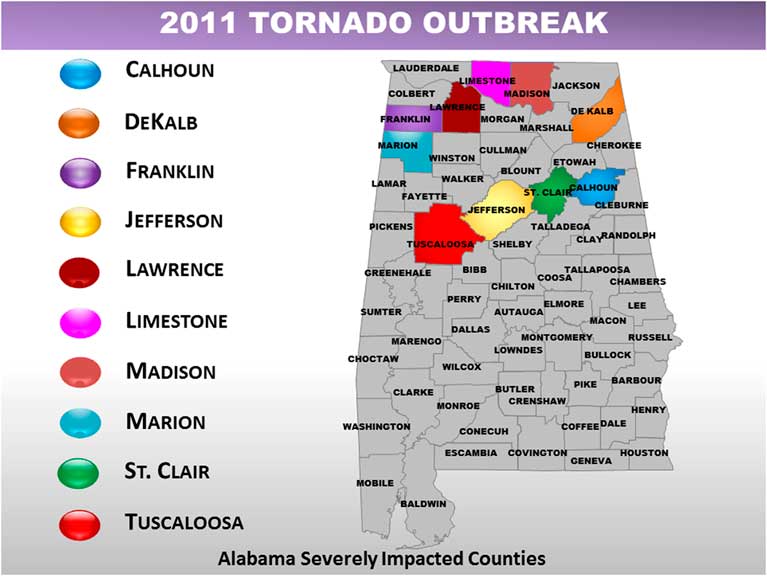
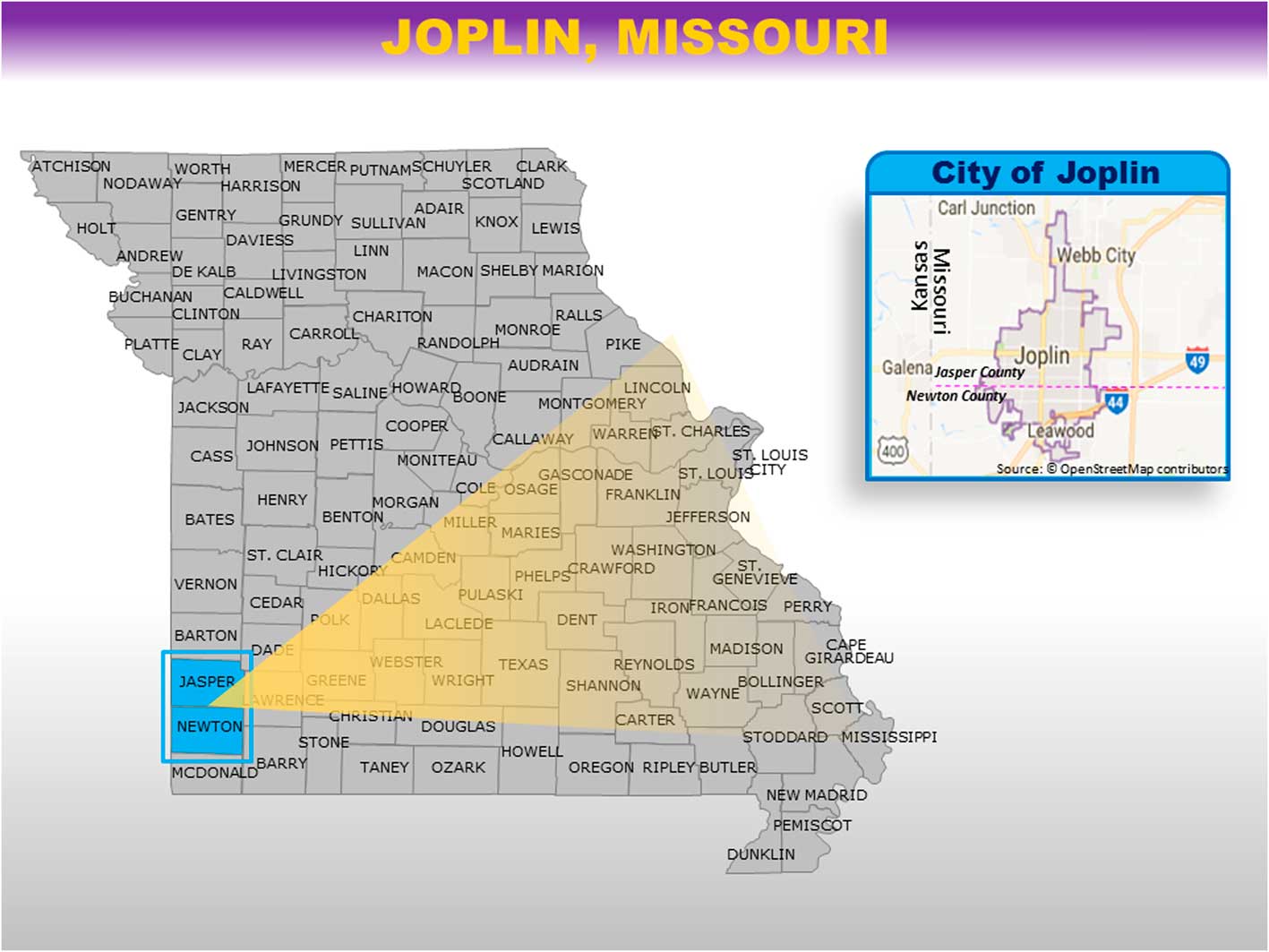
The study sample for Alabama (n=126,453) comprised all linked singleton infant births and deaths from tornado-affected counties in the state between March 1, 2010, and April 30, 2012; this period includes the pre-disaster, disaster/post-disaster periods. The Alabama tornado-affected counties included in this study were Calhoun, DeKalb, Franklin, Jefferson, Lawrence, Limestone, Madison, Marion, St. Clair, and Tuscaloosa. For Joplin, Missouri, all singleton linked births and infant deaths from April 1, 2010, to May 31, 2012, were included in the sample (n=6,897) from the tornado-affected counties of Jasper and Newton, Missouri.
Tornado Exposure and Time Framework
On April 27, 2011, Alabama experienced an outbreak of tornadoes, which occurred in 3 consecutive waves and produced catastrophic tornado damage in several counties across the state. 18 , 20 , Reference Knupp, Murphy and Coleman 21 The tornadoes triggered nearly 248 fatalities, caused more than 2,219 injuries, and cost over $4.2 billion of property loss over a 10-county region 17 , 18 , 20 (Figure 1).
Alabama Counties Harshly Damaged by the April 2011 Tornado Outbreak

The City of Joplin, Missouri, located within the limits of both Jasper and Newton Counties in the southwest corner of the state (Figure 2), was struck by a powerful Enhanced Fujita 5 (EF5) tornado on May 22, 2011. 22 , 23 The Joplin tornado packed winds estimated in excess of 200 mph and owned a total path of about 22.1 miles long and up to 1 mile in width. 22 The tornado’s swath of destruction ranged from 6 to 13 miles long, and up to 3/4 of a mile wide. 22 , 23 The twister resulted in over $3 billion in property damages and caused 162 fatalities and over 1,371 injuries, making it the single deadliest U.S. tornado since 1950. 17 , 22 , 23
Counties Impacted by the May 22, 2011 Joplin, Missouri Tornado

The main independent variable was maternal prenatal exposure to a tornado disaster measured as a dichotomous variable (yes/no). Our data were drawn from the Spatial Hazard Events and Losses Database for the United States (SHELDUS), Version 15.2. 24 Prenatal exposure was derived from SHELDUS data on tornado incidence and geography, and maternal county residence. The independent variables of interest were county-level indicators for the occurrence reflecting the severity of the effects (fatalities>10 and property loss>$10 million) of 10 counties in Alabama and the City of Joplin, Missouri, consequential to the 2011 tornado outbreak. County-level storm characteristics reported in SHELDUS and used in this study included tornado intensity classified using the EF scale, estimated property damage, and cases of morbidity and mortality caused by the hazard.
A 12-month framework parameter, before and after the disaster incident, was applied in this study to facilitate delimitation of the study population. The aim of the 12-month framework was to generate enough data on women who gave birth at the time of the incident, and those who were pregnant or got pregnant and gave birth sometime within the 12-month framework after the disaster incident occurred. Previous researchers have applied similar approaches to investigate natural disasters and pregnancy outcomes.Reference Antipova and Curtis 1 , Reference Simeonova 3 , Reference Zahran, Breunig and Link 25 In this study, a pre-disaster period (non-exposure to the disaster) and a disaster/post-disaster period characterized as the date of the disaster impact and a 12-month period after the disaster (exposure to the event) was established. The pre-disaster period was defined as March 1, 2010, to March 31, 2011 (Alabama), and April 1, 2010, to April 30, 2011 (Joplin, Missouri). The disaster/post-disaster period was established as April 1, 2011, to April 31, 2012 (Alabama), and May 1, 2011, to May 31, 2012 (Joplin, Missouri). The length of the pre- and post-disaster time periods was based upon previous similar research studies.Reference Antipova and Curtis 1 , Reference Zahran, Breunig and Link 25 This research was approved by the Institutional Review Board of Walden University (#12-10-15-0408759).
Measures
Pregnancy outcome variables in this study included birth weight, gestational age at birth, infant mortality, and mode of delivery. All of these variables were recorded on the birth certificate by the women’s health care providers. Birth weight was categorized as low (<2500 grams) and normal (≥2500 grams). Gestational age at birth was classified as preterm (<37 weeks) and term (≥37 weeks). Infant mortality was defined as any death that occurred during the first 364 days after birth. The mode of delivery was classified as vaginal or cesarean section; data for this outcome variable were available for the Missouri sample only.
Relevant sociodemographic and maternal medical comorbidities for poor pregnancy outcomes were included in the analyses. Sociodemographic variables included maternal race/ethnicity (Hispanic, non-Hispanic black, non-Hispanic white, and other), maternal age (<18, 18-26, 27-34,>34 years), and marital status (married, not married). Medical complications experienced during pregnancy included chronic and gestational hypertension.
Statistical Analysis
Descriptive statistics were used to describe the sample, and chi-square analyses were conducted to examine bivariate associations between exposure and the outcome variables. Logistic regression models were built to compute odds ratios (OR) and 95% confidence intervals (CI) for all outcome variables separately for each state, in examining the magnitude and direction of the associations between maternal prenatal exposure to tornadoes and the perinatal outcomes considered in this study. All analyses were performed using SPSS, version 21 (SPSS Inc., Chicago, IL).
RESULTS
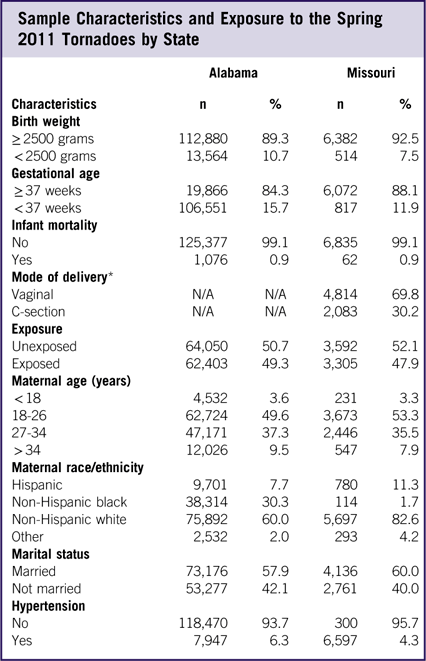
Sample characteristics for the tornado-affected counties in both states are shown in Table 1. Nearly 49% of the Alabama sample were exposed to tornadoes. About 60% of the mothers were white non-Hispanic, and 30.3% were black non-Hispanic. Women from this sample had high rates of low birth-weight infants (10.7%) and preterm deliveries (15.7%). Infant mortality was 0.9%. A majority of the mothers (50%) were between the ages of 18 and 26 years, and about 58% of them were married. The prevalence of hypertension was 6.3%. Approximately 48% of the Missouri sample were exposed to tornadoes. More than 80% of mothers were non-Hispanic white. A low birth weight accounted for 7.5% of the births, and 11.9% were preterm births, whereas infant mortality was 0.9%. About 53% of the mothers were 18 to 26 years old, and 60% were married. The prevalence of hypertension was 4.3%.
Sample Characteristics and Exposure to the Spring 2011 Tornadoes by State

* N/A: Data for mode of delivery were not available for the Alabama sample.
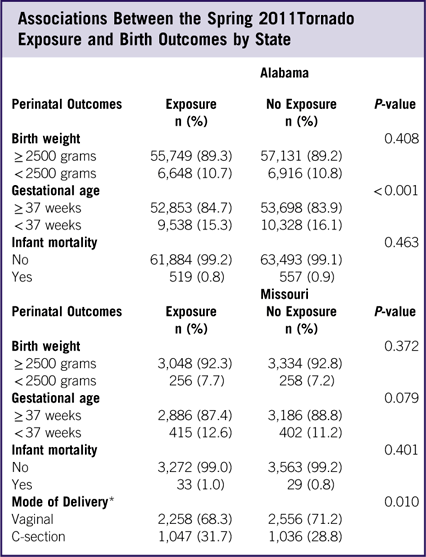
Table 2 presents bivariate associations between tornado exposure and perinatal outcomes separately for each state. For the Alabama sample, the percent of preterm deliveries among women exposed to tornadoes was lower (15.3%) than those who were not exposed (16.1%). Although preterm births were slightly higher (12.6%) among women who were exposed to Missouri tornadoes than their non-exposed counterparts (11.2%), this was not statistically significant. The distribution of low birth-weight infants and infant mortality was approximately the same between the exposed and non-exposed groups. An association was found between exposure to tornadoes and mode of delivery for the state of Missouri. Specifically, a higher number of women exposed to tornadoes experienced a cesarean section.
Associations Between the Spring 2011Tornado Exposure and Birth Outcomes by State

* Data for mode of delivery were not available for the Alabama sample.
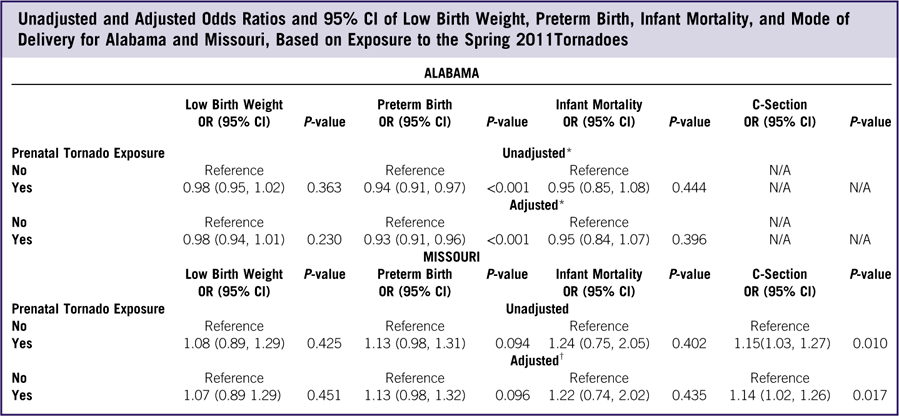
Table 3 presents results related to the effects of tornado exposure on birth weight, gestational age, infant mortality, and mode of delivery, separately for each state. Adjusted analyses showed that women exposed to the Alabama tornadoes were less likely to have a preterm birth (OR: 0.93, 95%; CI: 0.91, 0.96). For the Missouri sample, mothers exposed to the Missouri tornadoes were 1.14 (95% CI: 1.02, 1.26) times more likely to have a cesarean section compared with those who were not exposed to tornadoes. We did not observe any significant associations between exposure to tornadoes for either state and other perinatal outcomes considered in this study.
Unadjusted and Adjusted Odds Ratios and 95% CI of Low Birth Weight, Preterm Birth, Infant Mortality, and Mode of Delivery for Alabama and Missouri, Based on Exposure to the Spring 2011Tornadoes

* N/A=Estimates cannot be computed as no data were available, and therefore odds ratios, CI, and P-values are not calculated.
† Analyses were adjusted for maternal race/ethnicity, age, marital status, and hypertension.
DISCUSSION
This paper examined potential associations between maternal prenatal exposure to tornado disaster incidents and adverse birth outcomes. Because tornadoes are one of the most intense, severe weather phenomena on earth and can occur rapidly with little or no advanced notification,Reference Bluestein 26 , Reference Wallace 27 we hypothesized that exposure could be associated with adverse maternal and birth outcomes among exposed pregnant women. Using data from the linked infant births and deaths registers and data on tornadoes from SHELDUS for Alabama and Missouri, we found evidence of a reduced risk for preterm births among pregnant women exposed to the Alabama tornadoes compared with their unexposed counterparts. This finding adds to the body of inconclusive evidence in the current literature pertaining to the associations between natural disasters and birth outcomes. Although a number of studies found positive associations between similar natural disasters and a high risk of preterm birth,Reference Antipova and Curtis 1 , Reference Simeonova 3 , Reference Harville, Xiong and Pridjian 28 , Reference Xiong, Harville and Mattison 29 others reported no association between exposure to natural disasters, such as hurricanes, and reproductive health (eg, birth weight, prematurity, fetal death).Reference Grabich, Robinson, Konrad and Horney 30 These conflicting findings have been attributed to potential confounding that has not been accounted for in the analyses, variations in how exposure to natural disasters were defined, and study populations that may differ.Reference Grabich, Robinson, Konrad and Horney 30 , Reference Grabich, Robinson and Engel 31
Our findings show there was no statistical association between tornado exposure and birth weight outcomes, and infant mortality rates. These findings are consistent with other studies, which did not find a significant effect of exposure to natural disasters on preterm birth and low birth weight.Reference Antipova and Curtis 1 , Reference Grabich, Robinson and Engel 2 , Reference Harville, Xiong and Pridjian 28 , Reference Xiong, Harville and Mattison 29 , Reference Currie and Rossin-Slater 32 - Reference Harville, Tran, Xiong and Buekens 34 Our findings differ from prior research evidence published by Simeonova, and highlight disparities in the literature regarding the influence of tornadoes on preterm birth and low birth weight. Simeonova detected marginal statistically significant evidence correlating exposure to thunderstorms, hurricanes, and tornadoes with preterm birth and low birth weight.Reference Simeonova 3 However, Simeonova examined these austere weather systems in the aggregate, combining tornadoes with other storms (termed severe storms).Reference Simeonova 3 Differences in the definition and measurement (ie, combining tornadoes with other storms versus examining tornadoes only) of these storms may influence study findings.
Further, our findings show that the likelihood of infant mortality was slightly higher among exposed mothers compared with their non-exposed counterparts. Although this finding was not statistically significant, it could lend credence to the premise that tornado exposure may not be the primary factor in a potential association. More specifically, it may be that other factors connected with the disaster incident, such as individual experiences and environmental conditions, could indirectly influence findings of a possible association with perinatal mortality. Other research evidence shows a strong association between maternal prenatal exposure to hurricanes and abnormal conditions of the neonate, to include meconium aspiration syndrome and respiratory complications requiring assisted ventilation.Reference Currie and Rossin-Slater 32 Moreover, natural disasters like hurricanes are known to contribute to an increased incidence of morbidity, as measured by incidental medical consequences such as acute respiratory infections, fevers, and diarrhea.Reference Callaghan, Rasmussen and Jamieson 35 , Reference Zotti, Williams and Robertson 36
Consistent with prior studies, which demonstrate an association between prenatal exposure to hurricanes and an increased incidence of cesarean section deliveries,Reference Currie and Rossin-Slater 32 - Reference Harville, Tran, Xiong and Buekens 34 , Reference Zahran, Peek and Snodgrass 37 we found evidence that prenatal exposure to tornadoes was associated with an increased risk of cesarean section deliveries in Joplin. This may be due to maternal stress (eg, exposure to a disaster), which can increase the duration and difficulty of labor and the exploitation of medicines for the management of labor, consequently influencing the mode of delivery.Reference Hamilton, Sutton and Mathews 33 , Reference Harville, Tran, Xiong and Buekens 34 , Reference Zahran, Peek and Snodgrass 37 - Reference Saunders, Lobel, Veloso and Meyer 40 It is also likely that rapid delivery due to the impending impact on resources, including access to a health care facility and availability of staff, as well as changing providers who may have limited knowledge of women’s health history and thus choosing a more conservative management of labor, may influence this finding.
There are several limitations in this study. We were unable to precisely assign prenatal exposure at the county level or to ascertain the specific pathways linking exposure to observed birth outcomes. Exposure was assumed based upon residence data obtained from the birth certificate, and is consistent with prior research approaches, which assessed spatial methods of a storm’s trajectory to calculate exposure.Reference Antipova and Curtis 1 , Reference Simeonova 3 , Reference Currie and Rossin-Slater 32 , Reference Zahran, Snodgrass, Peek and Weiler 41 Although the classification of exposed and non-exposed women to these tornadoes was based on previous research,Reference Antipova and Curtis 1 , Reference Zahran, Breunig and Link 25 classification bias may exist because some women may have been misclassified. Other limitations include the cross-sectional nature of the data, which does not allow for causal inferences. The study population was restricted to pregnant women and singleton infant births and deaths occurring in 10 counties in Alabama, and two counties in Missouri. As a result, the findings of this study cannot be generalized outside of the study population.
Despite these limitations, this study used a large birth certificate data set that is a stable source of cohort information, and provides a source for identifying potential associations between maternal exposures and infant health outcomes.Reference Andrade, Scott and Davis 42 - Reference Vinikoor, Messer, Laraia and Kaufman 44 The utilization of linked birth and infant death registration files affords a comprehensive and fundamentally complete data set with records on about 99% of all U.S. live births and infant deaths, and the linked data files are instrumental in facilitating time-based contrasts and evaluations of multiple disparate communities.Reference Mathews and MacDorman 45 , Reference Schoendorf and Branum 46
CONCLUSIONS
The findings of this study showed that prenatal exposure to tornadoes does not consistently influence birth outcomes. Although we found no association between exposure to tornadoes and low birth weight and infant mortality, our findings suggest that prenatal exposure to tornadoes could increase the odds for a cesarean section. The limited data provided in this study, coupled with the findings of previous research offering evidence to the contrary, strongly suggest that this inquiry requires further examination.
Overall, this study adds to the existing body of research on birth outcomes related to tornado exposure and has implications for areas that are prone to, or have recently experienced, a tornado disaster. Given the susceptibility of entire populations to disasters like tornadoes, the investment in community-level programs, which integrate whole-community resources, including social, economic, and political structures, are crucial to preparedness planning and advancing community and individual and family resilience to public health emergencies. Pregnant and postpartum women and their newborns are among the group of vulnerable populations who will benefit considerably from preparedness initiatives, which meet their social and public health preparedness needs, prior to, during, and in the wake of natural disasters.
As communities prepare for the natural disaster threats to which they are most vulnerable, the role of health care coalitions, which comprise hospitals, public health departments, emergency medical services, and emergency management agencies, should be emphasized as a community asset that can help convene obstetrics and gynecology, family practice, and public health practitioners within the broader disaster planning community. 47 Such collaboration should ensure that these practitioners will be better prepared to manage public health emergencies that affect pregnant, postpartum women, and newborns. The unique needs and specific vulnerabilities of this population suggest that their access to health care and social services should remain a top priority for public health emergency and disaster preparedness programs.
Acknowledgments
The authors gratefully acknowledge the support of Dr Derek Pate and Mr Glenn Copeland from the National Association for Public Health Statistics and Information Systems (NAPHSIS) for their help in gaining access to the data. We also appreciate Dr Amy Branum and her colleagues at the National Center for Health Statistics (NCHS), U.S. Centers for Disease Control and Prevention, for providing the data. The authors also thank the Hazards and Vulnerability Research Institute (HVRI) of the University of South Carolina for sharing data on tornadoes in the USA via the SHELDUS. NCHS and HVRI are responsible for the original data only and not the content of the present study.
Conflict of Interest Statement
The authors report no conflict of interests.