INTRODUCTION
Sociologists have documented that, in the post-1965 civil rights era, public sector work has served as an important “occupational niche” for African Americans (Model Reference Model and Katz1985; Waldinger Reference Waldinger1996). Footnote 1 By niche, we are referring to the fact that public sector is the location in a differentiated labor market that has offered relative racial equity in socioeconomic rewards and routes for advancement (Brown and Erie, Reference Brown and Erie1981; Model Reference Model and Katz1985; Waldinger 1995). Indeed, in the case of African Americans, this is precisely what research has found: relative parity in income (Farley Reference Farley2005; Jaynes and Williams, Reference Jaynes and Williams1989), promotion prospects (Farley and Allen, Reference Farley and Allen1987; Glass Ceiling Commission 1995), and ability to retain jobs (Jaynes and Williams, Reference Jaynes and Williams1989; Wilson et al., Reference Wilson, Roscigno and Huffman2013). Bart Landry and Kris Marsh (2011) capture this historical pattern quite nicely in noting that “government employment has compensated for the legacy of private sector discrimination, serving to build a Black middle class that is stable, prosperous and extends to life-chance opportunities on an inter-generational basis” (p. 117).
As important as the public sector has been in addressing historical racial exclusions and inequalities over the past few decades, we should remain cognizant of the fact that occupational niches of racial minorities are historically contingent, fluid, and require constant re-examination (Model Reference Model and Katz1985; Waldinger Reference Waldinger1996). Indeed, we suspect the historically favorable public sector status of African Americans is now in jeopardy. We base this on observations surrounding the emergence of “new governance” reforms of civil service work, marking “the end of government work as we know it” (Kamarck Reference Kamarck2007, p. 131). Steadily gaining momentum in the last two decades, new governance alters the nature of employment from a public service to a business model. In doing so, it may very well be replicating stratification-pertinent aspects of the workplace protections, labor process, and gatekeeper decision-making that have historically been the bases of significant private sector minority disadvantages (Kamarck Reference Kamarck2007; Wilson Reference Wilson2006). Of particular interest are the prods to generate “efficiency” and “flexibility” by reducing size, enhancing managerial discretion, eradicating traditional worker employment rights, and debureaucratizing employment-based rules and regulations (Kamarck Reference Kamarck2007; Morgan and Cook, Reference Morgan and Cook2014).
Analyses of the implications of public sector reforms, noted above, have been relatively sparse. Two specific studies, by George Wilson and colleagues (Reference Wilson, Roscigno and Huffman2013, Reference Wilson, Roscigno and Huffman2015), utilize data from the Panel Study of Income Dynamics and find that African American men have been progressively losing parity with their White male peers when it comes to downward mobility and gross income. In this article, we expand on this prior work in several important regards including but not limited to: (1) a focus on workers at privileged authority levels of the occupational structure, who may be either vulnerable given their higher statuses or protected by those very statuses; (2) incorporation of specific and unique indicators of new governance within our modeling of income and our assessment of racial income gaps over time; (3) the explicit inclusion and consideration of women in our analyses; and (4) sensitivity to public sector changes over three discrete periods (i.e., pre-reform, early reform, and late reform).
The role of job authority in protecting against, generating or sustaining inequality, beyond its obvious implications for African American workplace vulnerability and changes to public sector employment noted above, represents one of the most important advances in stratification research in recent decades (Kalleberg and Griffin, Reference Kalleberg and Griffin1980; Tilly Reference Tilly2005; Western Reference Western1994; Wright Reference Wright1985). Sociologists, for instance, have documented that one of the most tangible benefits derived from authority attainment is earnings. In fact, studies have shown that variation in authority position generates wage differentials among identical workers and, moreover, explains earnings better than a variety of traditional measures of workplace inequality (e.g., socioeconomic status and occupational prestige) (Halaby Reference Halaby1979; Kalleberg Reference Kalleberg2010; Roos Reference Roos1981; Wilson Reference Wilson1997). Charles Halaby and David Weakliem (Reference Halaby and Weakliem1993) conclude that consideration of job authority constitutes the principal contribution to the analysis of earnings:
The main idea is that crucial reward-relevant properties of jobs derives from their location in the hierarchical structure of the workplace as defined by the unequal distribution of authority rights…. (p. 6).
Building on insights regarding both the trends toward new governance in the public sector and what we know regarding the inequality relevance of authority, we draw on the General Social Survey (GSS) in this study and analyze racial differences in earnings “returns” to job authority across public and private sectors and three time periods, pre-reform (1992–1994), early reform (2000–2002), and late reform (2010–2012). Such temporal data allows for assessment of racial and sector-specific inequalities over time for men and women occupying varying status positions, and also allows us to highlight the extent to which new governance reforms are implicated.
THE EVOLVING PUBLIC SECTOR
Pre-New Governance
Across the first three decades of the post-1965 civil rights era, government employment was seen as a “public service” and was premised on a “career system” (Bowman and West, 2006; Light Reference Light1999). At its peak in 1990, this system covered a majority of the 18.2 million full-time public sector employees at the federal and state levels (Kamarck Reference Kamarck2007) and included a favorable employment package and meaningful employment protections in exchange for public service. Those designated as “classified,” for instance, were afforded “property rights” in jobs, i.e., worker termination restricted to “just cause” reasons, relatively elaborate equal employment opportunity laws, and a guarantee of formal bureaucratic procedures (Bernhardt and Dresser, Reference Bernhardt and Dresser2002; Cornwell and Kellough, Reference Cornwell and Kellough1994).
The Rise and Spread of New Governance
The “new governance” model of workplace reforms, emerging and spreading since the early 1990s, is a reflection of neoliberal economic sentiment in national political discourse—sentiment that prioritizes open markets, profit, and competition in economic activity (Bowman and West, Reference Bowman and West2007; Kamarck Reference Kamarck2007). Its application to the public sector has been viewed as redressing “the perceived ills associated with a bloated and inefficient government that has outlived its usefulness in effectively delivering public services and protection of basic public rights” (Kamarck Reference Kamarck2007, p. 134).
Predicated on the logic of “bottom line” financial principles, the “new governance movement” places a premium on increasing performance, efficiency, and results: it calls for a more incentive-laden public sector. Such incentives, in turn, are believed to enhance productivity and increase the flexibility of managers to make efficiency mandated personnel adjustments at a time when a more fluid public sector is perceived a response to the rapid pace of social change (Bowman and West, Reference Bowman and West2007; Wilson Reference Wilson2006). Significantly, new governance calls for shared responsibility between the public and private sectors. Phenomena such as the outsourcing of long-historic public functions, and the rise of competitive bidding for government contracts between public and private entities are manifestations of the new intersector partnership, fundamentally altering conditions of work among incumbents and new hires in the public sector. This includes, most dominantly, the ever-increasing designation of employees as “declassified.” It has also entailed the supplanting of a highly bureaucratized work environment by one that is more clearly decentralized such that onsite discretion of managers, including the potential biases therein, increasingly determines stratification aspects of work (Bowman and West, Reference Bowman and West2007, Lawthler Reference Lawthler, Hays and Kearney2003).
Beyond declassification and decentralization, it is essential to recognize the implications of such changes for the very conditions of work (e.g., task/unit assignments) pertinent to inequality. This is especially true when segregation exists or persists (Wilson Reference Wilson2006). Footnote 2 Under “new governance” reforms, declassified workers lose property rights in their jobs, becoming employees “at will” (Malamud Reference Malamud1995) who, absent narrowly carved judicial and legislative exceptions, can be terminated for “any or not reason at all” (Villemez and Bridges, Reference Villemez and Bridges1994). No less important, broader opportunities to invoke equal opportunity laws to contest employers’ decisions are constricted (Dobbin Reference Dobbin2009; Wilson Reference Wilson2006).
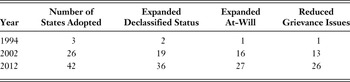
Table 1 reports the progressive adoption of new governance at the state level across time. In 1994, only three states had adopted aspects of it; by 2002 that number had increased to twenty-six states; by 2012, forty-two states had adopted aspects of it. Noteworthy as well, by 2008 five of the six largest federal agencies had implemented aspects of it. Indeed, new governance reforms had become so dominant that President George Bush gained congressional approval to use new governance as a template for all future federal government hires. By 2012, over 65% of full-time state and federal government workers were subject to new governance reforms (Morgan and Cook, Reference Morgan and Cook2014). The expansion of declassified employment status was the most often adopted aspect of new governance across the three time periods (over two-thirds of states adopted across each of the three time periods) while reductions in grievance procedures were the least adopted (at least 50% of states across each of the time periods).
Adoption of New Governance

Sources: Hays and Sowa (Reference Hays, Sowa, Bowman and West2007), Morgan and Cook (Reference Morgan and Cook2014)
IMPLICATIONS FOR RACIAL INEQUALITY
The increasing adoption of new governance has likely had important consequences for racial inequalities in earnings returns to job authority. This expectation is in line with sociological research that captures the dynamics of African American socioeconomic disadvantage at privileged occupational levels in the private sector, particularly in White-owned and -managed firms (Bielby Reference Bielby2012; Collins Reference Collins1997; Dobbin Reference Dobbin2009; Elliot and Smith, Reference Elliot and Smith2001; Feagin and McKinney, Reference Feagin and McKinney2003; Fernandez Reference Fernandez1981; Haveman et al., Reference Haveman, Broschak and Cohen2009; Landry and Marsh, Reference Landry and Marsh2011; Roscigno Reference Roscigno2007; Smith Reference Smith1997, Reference Smith2005; Tomaskovic-Devey and Stainback, Reference Tomaskovic-Devey and Stainback2007, Wilson Reference Wilson1997; Wilson et al., Reference Wilson, West and Sakura-Lemessy1999; Wingfield Reference Wingfield2010).
Rooted in the pioneering work of sociologists such as Gordon Allport (Reference Allport1954), Thomas Pettigrew (Reference Pettigrew1971) and Herbert Blumer (Reference Blumer and Hunter1966), this empirical work characterizes contemporary discrimination as situational, institutional, and ostensibly nonracial in nature. As such, workplace-based inequities are embedded in the daily operation of social institutions rather than being associated with individual psychological functioning (e.g., frustration-aggression-induced “scapegoating,” “authoritarian personality,” etc.) that was more characteristic of traditional “Jim Crow” racism (Bobo et al., Reference Bobo, Kluegel, Smith, Tuch and Martin1997). Accordingly, dynamics such as the perceived need to achieve “bottom line” financial results and maintain a productive workplace as well as the generalized susceptibility to forms of cognitive bias encompassing “self-serving attribution bias” (Pettigrew Reference Pettigrew1985) and “statistical discrimination” (Tomaskovic-Devey and Skaggs, Reference Tomaskovic-Devey and Skaggs1999) result in race-specific outcomes within finite gradations in the stratification system (Bielby Reference Bielby2012; Stainback and Tomaskovic-Devey, 2005).
The work cited above identifies an underlying firm-level mechanism that generates racial inequities at a nuanced stratification level: employers have difficulty deciphering evaluation-relevant criteria of their African American employees. Indeed, two substantive criteria emerge as difficult to decipher: (1) “signals of productivity” (Pettigrew Reference Pettigrew1985), referring to workplace performance as evidenced by, for example, demonstrated effort, commitment, initiative, and problem solving ability (Stainback and Tomaskovic-Devey, Reference Stainback and Tomaskovic-Devey2012), and; (2) “signals of personality” (Kluegel Reference Kluegel1978; Wilson et al., Reference Wilson, West and Sakura-Lemessy1999), which encompass a range of informal traits such as perceived loyalty, trustworthiness, and sound judgment. Such attributes are usually evaluated by proximate gatekeepers (i.e., supervisors and managers) within the process of hiring, promotion, demotion, and firing.
Managerial practices that limit minority opportunities to communicate evaluation-relevant criteria can take a variety of forms. Thomas Pettigrew and Joanne Martin (Reference Pettigrew and Martin1987) as well as Steven Elliott and Ryan Smith (Reference Elliot and Smith2001) maintain, for example, that restricting African American managers to segregated domains (i.e., over coracial group members) leaves them prone to “information bias”—a form of statistical discrimination in which demonstrated performance and formal credentialing are viewed as less credible than those of Whites. Further, Jomills Braddock and James McPartland (Reference Braddock and McPartland1987) and George Wilson (Reference Wilson1997) argue that allocating minority managers and professionals to racially delineated work/task groups as well as the segregated operation of traineeship and internship program produces susceptibility to attribution bias (i.e., being evaluated on selective bases the reaffirm negative stereotypes about their suitability for, and productivity at, work). Finally, several authors—including Thomas Cox and Stella Nkomo (Reference Cox and Nkomo1990), Elliot and Smith (Reference Elliot and Smith2001), and, John Fernandez (Reference Fernandez1981)—maintain that when not segregated, the tendency to subordinate African American managers/executives to Whites in authority hierarchies limits opportunities to demonstrate the range of performance-relevant and informal characteristics that may emerge, for example, when “taking the lead” and initiating solutions to workplace-based issues.
In sum, findings from this line of sociological research in conjunction with our knowledge regarding the structure of new governance provides a solid basis for maintaining that, in the context of earnings returns to job authority, the public sector should be progressively declining as the occupational niche for African Americans. Specifically, increasing managerial discretion—in terms of “bottom line” decision-making that emerges in association with changes wrought by new governance in the social organization of work, and the changing status/rights of workers—should result in progressively larger racial gaps that increasingly mirror those in the historically less minority-friendly private sector.
Along with racial inequalities, we also consider the possibility of gender variations by race given that the structural basis of inequality may vary (Browne and Misra, Reference Browne and Misra2003). Irrespective of race, for instance, we know that women suffer from a shared “penalty,” tied to both segregation (Stainback and Tomaskovic-Devey, Reference Stainback and Tomaskovic-Devey2012; Wingfield Reference Wingfield2010) and the persistence of gender-based stereotypes (e.g., commitment to work and fitness for lengthy tasks) (Browne and Kennelly, Reference Browne, Kennelly and Browne1999; Browne and Misra, Reference Browne and Misra2003). Accordingly, we posit that the wage penalties for African American women are distinct. While suffering a race penalty, for instance African American women share a gender cost with their White female peers. As such, and while we expect a generally similar pattern of racial disadvantage for men and women, the overall trend and level of racial inequality will plausibly be less pronounced for women.
DATA AND MEASUREMENT
A sample of individuals from the files of the General Social Survey across three periods, the pre reform (1992–1994), early reform (2000–2002), and late reform (2010–2012) are utilized to examine trends in the racial gap in earnings returns to the attainment of three distinct hierarchical levels of job authority for both men and women. During each period, African American and White men and women between the ages of eighteen and sixty were included in the sample if they worked full-time in a non-self-employed capacity in either the private sector or public sector. Public sector employment is derived from industrial occupational codes, namely, those who work in “the government and social services” and do not work in “the private sector.” Further, all sample members responded to two authority questions. They were asked:
-
1. In your job, do you supervise anyone who is directly responsible to you? If Yes, do any of those persons supervise anyone else?
-
2. Do you have a supervisor on your job to whom you are directly responsible? If yes, does that person have a supervisor on the job to whom he/she is directly responsible?
From these questions, researchers (e.g., Smith Reference Smith1997) have operationalized a three- category authority measure that consists of those in Upper Command, Middle Command, and Lower Command. Members of the Upper Command (coded as 2) supervise at least two levels of subordinates, but are not themselves supervised; members of the Middle Command (coded 1) have one supervisor above them and two levels of subordinates below them. Finally, those in positions of Lower Command (coded 0) have one or more supervisors above them and they supervise one level of subordinates below them. Footnote 3
The criteria above resulted in a sample size of 4636 men and 2575 women across the pre-reform period (men=380 African American, 1165 White; women=214 African American, 626 White); early reform period (men=372 African American, 1156 White; women=220 African American, 620 White); later reform period (men=387 African American, 1176 White; women=243 African American, 652 White).
Dependent Variable: Our dependent variable is yearly wages. The effect of inflation on wages was removed by multiplying the measure by the Consumer Price Index. This results in a wage variable expressed in constant 2013 dollars. Finally, to facilitate ease of interpretation, we present wages in raw dollars.
Race and Sector: Race is coded as 1 for African American and 0 for White. The public sector is coded 1 and private sector is 0.
Control Variables:
Human Capital Credentials: We control for several influential human capital attributes. The first is level of educational attainment, represented by two dummy variables: “college degree,” and “post-college degree.” Respondents with a high school degree or less serve as the reference category. Footnote 4 Second, because a worker’s physical capacity is treated as a human capital characteristic, respondents who said they had “health problems that limited their capacity to work” were coded 1 and all others were coded 0. Third, time in labor force is measured by number of years since age 18 respondent has worked full time.
Job/Labor Market Characteristics: Several job/labor market characteristics are included as controls. First, union status of job is measured by 1=yes, 0=no. Second, we separate federal (coded as 1) from the state level (coded as 0) in analyses.
Family/Household: We also control for marital status (1=married, 0=unmarried) as marriage has a documented positive impact on earnings (Ahituv and Lerman, Reference Ahituv and Lerman2007). Second, we account for number of children in a household, as their presence tends to be positively related to earnings (Caucutt et al., Reference Caucutt, Gurner and Knowles2002).
Sociodemographic: Based on its unique—and relatively negative—historic track record regarding intergroup relations (Farley and Allen, Reference Farley and Allen1987; Jaynes and Williams, Reference Jaynes and Williams1989) and the distribution of socioeconomic resources across racial groups (Farley Reference Farley2005; Jaynes and Williams, 1987), we include the South as a dummy variable relative to other regions in the United States. In addition, age (years) is included as a control. Finally, time is used to partial out the effects of variation in period effects within each of the three periods examined.
ANALYTIC STRATEGY AND RESULTS
Our analyses report OLS regressions on a pooled sample of African Americans and Whites working in the public and private sectors by gender. Footnote 5 The sample is stratified across each of the three hierarchical levels of job authority within the pre-reform, early reform and late reform periods. In these analyses, sample weights are used for the production of point estimates of population parameters. These weights serve to ensure representativeness across cohorts as well as across sectors, thereby precluding the possibility that findings were driven by compositional differences in the GSS sample.
Aggregate Inequalities Across Sectors, Time and by Gender
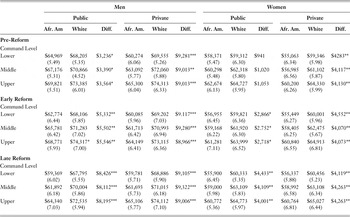
Table 2 reports means and standard deviations for the racial gap in earnings returns to job authority among African American and White men and women in both the public and private sectors during the pre-reform, middle reform, and late reform periods with earnings being presented in raw dollars (the Appendix reports descriptive statistics for variables in the statistical model). Footnote 6
Means and Standard Deviations of Men for Hourly Wages

*** P<.001, **P.01, *P<.05; Standard Deviations in Parentheses.
Results indicate that among both men and women, the relative parity in earnings returns at all three levels of job authority achieved by African Americans in the public sector relative to the private sector during the early reform period progressively eroded because of widening racial gaps in the public sector. Footnote 7 Specifically, and for men during the pre-reform period, the public sector racial gap in earnings returns favoring Whites over African Americans at the lower command level is $3236, at the middle command level the gap is $3390 and at the upper command level the racial gap in earnings returns is $3564. During the middle reform period, the racial gap expands to $5332 at the lower command level, $5502 at the middle command level and $5546 at the upper command level. During the late reform period, the racial gap in earnings returns further expands to $8426 at the lower command level, $8112 at the middle command level and $8195 at the upper command level. Conversely, in the private sector, the racial gap favoring White men in earnings returns at all levels of job authority are relatively stable and robust across the three time periods.
Among women, a similar pattern emerges, although racial differences are less pronounced as we predicted earlier. Specifically, public sector racial inequality at the lower command level is $941, at the middle command level the gap is $1020, and at the upper command level the racial gap in earnings returns is $1053 during the pre-reform period. These racial inequalities among women are magnified to $2866, $2752, and $2718, respectively, at the lower, middle, and upper command levels during the early reform period and then, further, to $4443, $4109, and $4001 at the three command levels during the later reform period. Notably, and as was the case with men, the racial gap favoring White women in earnings returns at all levels of job authority are relatively stable and robust across the three time periods in the private sector.
Wage Models of Racial Inequality Over Time
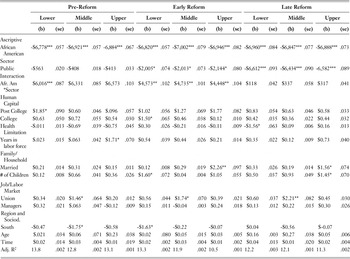
Table 3 reports the results for OLS wage models at the three hierarchical levels of job authority and across the three reform periods for men. The coefficient for race reflects the estimate of the racial wage gap in the private sector. Thus, the main effect of race should be interpreted as the penalty for being African American in the private sector. In the public sector, the racial wage gap is equal to the sum of the race coefficient and the coefficient of the interaction term. This interaction constitutes the “boost” that African Americans receive for working in the public sector relative to their private sector peers. Footnote 8
OLS Regressions for Hourly Wages Among Men: African Americans Relative to Whites in Authority Positions

*** P<.001, **P.01, *P<.05; Standard Errors in Parentheses.
Findings from Table 3 indicate—consistent with our predictions and the descriptives previously reported—the relative parity in earnings returns achieved by African American men in the public sector during the pre-reform period progressively eroded in the early reform and late reform periods primarily because of widening racial gaps in the public sector. Specifically, in the pre-reform reform period, African Americans were highly disadvantaged (P< .001) in the private sector in earnings returns to the attainment of all command levels (lower command b=$-6778, middle command b=$-6921, upper command b=$-6884), while receiving a robust (P< .001) public sector wage “boost” within the context of public sector employment (lower command b=$6106, middle command b=$6331, upper command b=$6573). This results in a non-significant racial disadvantage for African Americans in earnings in the public sector (lower command b=$-563, middle command b=$-408, upper command b=$-413) during the early period.
In the early reform period, African American men were similarly highly disadvantaged within the private sector in earnings returns (lower command b=$-6820, middle command b=$-7002, upper command b=$-6946), while receiving a moderate (P< .01) wage boost in public sector employment (lower command b=$4573, middle command b=$4735, upper command b=$4448). This results, overall, in a modest (P< .05) level of racial disadvantage in the public sector (lower command b=$-2005, middle command b=$2013, upper command b=$-2144). Finally, during the late reform period, African American men were similarly highly disadvantaged within the private sector in earnings returns (lower command b=$-6960, middle command b=$-6847, upper command b=$-6888), while receiving a non-significant boost for employment in the public sector (lower command b=$118, middle command b=$337, upper command b=$317). This results, overall, in a robust level of racial disadvantage in the public sector that increasingly resembles that observed in the private sector (lower command b=$-6612, middle command b=$-6434, upper command b=$-6582).
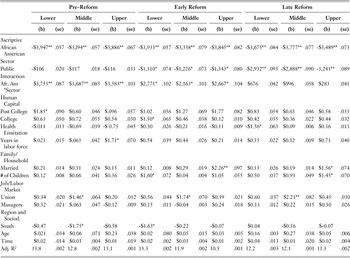
Table 4 reports similar multivariate analyses among women. Consistent with our predictions, findings indicate that: (1) the relative parity in earnings returns achieved by African American women in the public sector, relative to the private sector, during the pre-reform period progressively eroded in the early reform and late reform periods primarily because of widening racial gaps in the public sector; and, (2) levels of racial disadvantage are less overall among women. Specifically, during the pre-reform period, the moderate public sector wage “boost” African American women experienced in public sector employment (lower command b=$3753, middle command b=$3687, upper command b=$3583) translated into a non-significant racial disadvantage for African Americans in earnings in the public sector (lower command b=$106, middle command b=$117; upper command b=$116). During the early reform period, the modest public sector wage “boost” African American women experienced in public sector employment (lower command b=$2771, middle command b=$2163, upper command b=$2667) translated into a modest racial disadvantage for African Americans in earnings in the public sector (lower command b=$-1,310, middle command b=$-1,226, upper command b=$-1,343). Finally, during the late reform period, the non-significant public sector wage “boost” African American women experienced in public sector employment (lower command b=$676, middle command b=$996, upper command b=$283) translated into a moderate racial disadvantage for African Americans in earnings in the public sector (lower command b=$-2,932, middle command b=$-2,888, upper command b=$-3,241). Footnote 9
OLS Regressions for Hourly Wages Among Women: African Americans Relative to Whites in Authority Positions

***P<.001, **P.01, *P<.05; Standard Errors in parentheses
Modeling The Impact of New Governance Specifically
Additional multivariate analyses help assess and more directly pinpoint the specific role of new governance reforms in the patterns of racial inequality reported above. To capture this, we disaggregate the public sector sample and assess whether, and to what degree, respondents are working in a state or federal agency that had adopted aspects (i.e., expansion of at-will status, expansion of declassified status, and reduced grievance procedures) of new governance. We coded this in nominal fashion (more than 1 aspect adopted; one aspect adopted; referent = no aspects adopted) and because of sample size limitations regarding African American men and women, we collapsed the three authority levels during each of the three time periods.
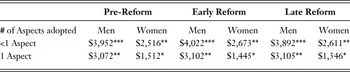
Findings reported in Table 5 indicate that when all factors in the statistical model are controlled, among both men and women, across the three time periods examined, working in a state or federal agency served to: (1) increase the racial wage gap; (2) increase the gap in a more pronounced fashion when at least two aspects of new governance were adopted; and (3) magnify the wage gap more so among men than women.
Racial Wage Gap in Earnings from Aspects of New Governance Adopted

*** P<.001, **P.01, *P<.05
Among men specifically, when at least two aspects of new governance are adopted, the racial wage gap is robust with Whites earning an additional $5952 during the pre-reform period, $6022 during the early reform period, and $5892 during the later reform period. Further, among men, when one aspect of new governance is adopted the racial wage gap is moderately significant with Whites earning an additional $3072 during the pre-reform period, $3102 during the early reform period, and $3105 during the late reform period.
A similar pattern emerges for women in the public sector analyses though the racial wage gaps are more modest than for men. Specifically, among women, when at least two aspects of new governance are adopted the racial wage gap is moderately significant with Whites earning an additional $2516 during the pre-reform period, $2673 during the early reform period, and $2611 during the later reform period. When one aspect of new governance is adopted, the racial wage gap is modestly significant with Whites earning an additional $1512 during the pre-reform period, $1445 during the early reform period, and $1346 during the late reform period.
Decomposing the Wage Gap
Finally, our analyses considered the extent to which racial gaps reported in Tables 3 and 4 are the product of differences in the characteristics people bring to the labor market relative to potential differences in the evaluation of these characteristics. For African Americans, we assess the relative contribution of evaluations (intercepts and slopes) and characteristics (means) to the group difference in wages through a regression decomposition. We specifically use the regression slopes from Tables 3 and 4 and the means from the Appendix to decompose the observed gaps based on the following formula (Jones and Kelley, Reference Jones and Kelley1984, p. 330):
 $${Y_W} - {Y_{aa}} = \left( {{a_w} - {a_{mg}}} \right) + \sum {\left( {{b_w} - {b_{mg}}} \right)} {X_w} + \sum {\left( {{b_w} - {b_{mg}}} \right)\left( {{X_w} - {X_{mg}}} \right) + \sum {\left( {{X_w} - {X_{mg}}} \right)} {B_{mg}}}$$
Where the subscripts w and mg refer to White and African Americans, respectively, Y is the mean of logged earnings, a is the y-intercept, b is the slope, and X is the mean of a predictor. The first term on the right side of the equation is the portion of the wage gap due to “group membership.” The second term on the right side of the equation is the portion of the wage gap due to differences in rates of return. The third term on the right side of the equation represents the interaction term between worker characteristics and their evaluation. The fourth term on the right side of the equation is the portion of the wage gap due to “nondiscriminatory” differences in worker characteristics brought to the labor market. Overall, combined are the group membership term and the returns term into a “potential discrimination” component, which assumes that the portion of the wage gap due to group membership reflects possible discriminatory factors. The size of the fourth or “means” component designates the expected gap between African Americans and White wages if African Americans entered the labor market with characteristics similar to those of Whites. Footnote 10
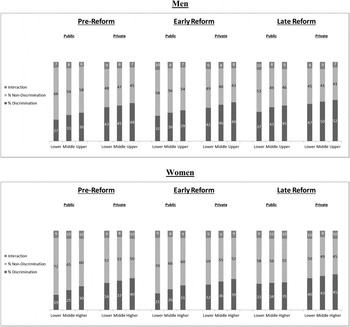
Figure 1 reports the results of the earnings decomposition for all hierarchical levels of job authority across periods in both economic sectors among both men and women. For purposes of simplicity of presentation, the nondiscriminatory and discriminatory components are presented as percentages of the total earnings gap in hourly earnings.
Decomposition of Race Differences in Hourly Wages (African American vs. White)

The findings are consistent with those reached in previous multivariate analyses: discrimination levels captured in our modeling strategy remain relatively constant in the private sector at all levels of job authority and across the three periods. In contrast, we find progressively increasing discrimination as a component of the racial gap in earnings returns at all authority level across the three periods among both men and women.
Among African American men during the pre-reform period, the proportion of the public sector wage gap due to discrimination rises from 27% (lower command) to 33% (middle command) to 36% (upper command). During the early reform period, the proportion of the wage gap due to discrimination is higher overall, ranging from 32% (lower command) to 36% (middle command) to 39% (upper command). Finally, we see that, during the late reform period, the racial wage gap attributable to discrimination is highest, ranging from 37% (lower command) to 43% (middle command) to 45% (upper command). Conversely, in the private sector and among men, the proportion of the wage gap due to discrimination is pronounced yet relatively consistent over time.
A similar pattern is found among women. Specifically, and during the pre-reform period, the proportion of the wage gap due to discrimination ranges from 19% (lower command) to 25% (middle command) to 30% (upper command). This increases during the early reform to 21% (lower command), 26% (middle command) and 31% (upper command). Finally, during the late reform period, we find the greatest inequality attributable to discrimination, ranging from 33% (lower command) to 34% (middle command) to 35% (upper command). Conversely, in the private sector, the proportion of the wage gap due to discrimination is pronounced but again more or less consistent across time.
DISCUSSION
Our analyses of GSS data indicates that rapidly advancing new governance reforms in public sector employment are having significant if not profound consequences for both levels of racial wage inequality and the long-standing economic niche status of the public sector as a context of greater racial equity. Indeed, the relative parity in earnings returns achieved by African Americans relative to their White and gender peers in the public sector relative to the private sector during the pre-reform period (1992–1994) progressively eroded during the early reform period (2000–2002) and even more so by late reform period (2010–2012).
Causally determinative in these patterns, we believe, are the ways in which new governance reforms—including the transition to both declassified and at-will employment status as well as the reduction of grievance rights—ultimately, remove bureaucratic formality and allow for enhanced managerial discretion. Such discretion results in: (1) the allocation of minorities into segregated work tasks/roles and; (2) the subordination of African Americans to Whites in authority hierarchies. Such disparate allocation and position specific subordination also translates into difficulty communicating evaluation relevant criteria to managers. This holds for men and women, though the disadvantage being created is less pronounced for African American women relative to their White female counterparts than it is for African American compared to White men. The “double disadvantage” experienced by African American women is partially countered by the gender penalty experienced by White women. African American men, however, are unique in their gender group in suffering a penalty—a more strictly racial one—which serves to widen inequities.
Significantly, the new governance movement does not appear to be transitory: calls to reform government have received support across both major political parties in the last decade with Democratic policy makers emerging as prime movers in the movement to make government more efficient through downsizing, decentralizing authority, and focusing more on results and less on rules (Kamarck Reference Kamarck2007). Accordingly, if new governance continues unabated, African Americans will likely suffer long-term consequences as they have relatively few alternative locations in the American labor market to achieve more favorable earnings returns, and their relatively negligible accumulation of wealth makes it uniquely difficult to compensate for wage-based hardship (Byron Reference Byron2010; Oliver and Shapiro, Reference Oliver and Shapiro1995). Moreover, declining access to resources wrought by the implementation of new governance likewise threatens the decades-old ability of African Americans in the public sector to accumulate the financial means to blunt discrimination and provide for the orderly transmission of privileged economic status on an inter-generational basis—a stratification phenomenon that has become a hallmark of the public sector for minorities during the civil rights era (Hout Reference Hout1984; Landry and Marsh, Reference Landry and Marsh2011).
CONCLUSION
It is vital to implement protections that counteract the effects of new governance on African Americans. Enacting policy that balances the thrust of its “business model” orientation with the need to achieve racial equity in socioeconomic outcomes such as wages is crucial. Accordingly, we believe that providing minorities with opportunities to contest managerial discretion in employment practices likely represents a suitable compromise. Indeed, sociological research documents that the negative impact of discretionary practices are most effectively blunted if minority workers can resort to a formal grievance procedure—with formal counsel—as part of due process in contesting managerial practices (Dobbin Reference Dobbin2009; Kalev Reference Kalev2014; Kalev and Dobbin, Reference Kalev and Dobbin2006). In addition, establishing more permeable and flexible work-group boundaries and establishing minority leaders in integrated work settings increases the exposure of African Americans—and their work product—to a greater range of decision-makers. Achieving this will only facilitate integrated formal and informal social networks that render authority attainment a source, rather than barrier of, relative racial equality (Kalev Reference Kalev2009; Kalev and Dobbin, 2009).
The findings from this study should reorient social scientists toward the status of the public sector as a locus of racial stratification. Indeed, similar to the private sector, racial/ethnic stratification in government work emerges as fluid and volatile rather than static and monolithic. Additional analyses of racial stratification in the public sector are certainly warranted, and would benefit from the arsenal of theoretical/conceptual tools, such as “social closure” and “queuing” theory (Lieberson Reference Lieberson1980) that have shed light on the mechanisms that drive racial stratification in the private sector. Indeed, it is significant in our view that Max Weber (Reference Weber1968) himself identified a factual situation of “social closure” similar to that experienced by African Americans in the “new public sector,” namely the devaluation of well-rewarded positions when few legitimate alternatives exist.
Considerably more research is needed to draw more definitive conclusions about the niche status of the public sector for African Americans, and for racial inequality in the United States more generally. Such research, to be sure, should proceed mindful of limitations in the research design of our study. Specifically, unmeasured factors not associated with new governance reform could certainly be contributing to some of the inequalities that we have outlined. Future work, for instance, might more directly link discretionary decision-making and race-based stratification outcomes such as earnings returns to authority attainment. Mixed methods approaches that encompass case studies of particular workplaces would be quite useful in this regard, particularly if purported causal factors can by observed first-hand. Such avenues can only enhance our understanding of the critical if not neglected issue of the public sector in racial stratification research and the stability and location of labor market niches for African Americans in the United States.
APPENDIX
Descriptive Statistics for GSS Sample