





Background
Heart failure affects 64 million people worldwide and is a major public health threat (GBD, 2018 Collaborators, 2018; Shahim et al., Reference Shahim, Kapelios, Savarese and Lund2023). In Europe and the United States, heart failure incidence ranges from 1 to 9 per 1000 people. Prevalence varies across countries (2.5% in the USA, 1.3% in China, 1% in India, and 3.9% in Germany) and averages 4.2% in developed countries (Shahim et al., Reference Shahim, Kapelios, Savarese and Lund2023). In Türkiye, the prevalence of heart failure was reported as 2.93%, while the incidence in 2022 was 5.03 per 1,000 person-years (Şahin et al., Reference Şahin, Çöllüoğlu, Çelik, Ata, Yılmaz, Ural, Kanık, Ayvalı, Ülgü and Birinci2024).
Clinical indicators guide diagnosis, treatment decisions, monitoring, and self-care evaluation in heart failure. Ejection fraction reflects left ventricular systolic function and is used to classify heart failure phenotypes. Lower ejection fraction is associated with increased hospitalization and mortality risk (McDonagh et al., Reference McDonagh, Metra, Adamo, Gardner, Baumbach, Böhm, Burri, Butler, Čelutkienė, Chioncel, Cleland, Coats, Crespo-Leiro, Farmakis, Gilard, Heymans, Hoes, Jaarsma, Jankowska, Lainscak, Lam, Lyon, McMurray, Mebazaa, Mindham, Muneretto, Piepoli, Price, Rosano, Ruschitzka and Skibelund2021; Pfeffer et al., Reference Pfeffer, Shah and Borlaug2019). Fluid retention is common, presenting as peripheral or pulmonary oedema, and symptom worsening is closely related to medication management, sodium restriction, and fluid intake (Ayvaz and Enç, Reference Ayvaz and Enç2018; McDonagh et al., Reference McDonagh, Metra, Adamo, Gardner, Baumbach, Böhm, Burri, Butler, Čelutkienė, Chioncel, Cleland, Coats, Crespo-Leiro, Farmakis, Gilard, Heymans, Hoes, Jaarsma, Jankowska, Lainscak, Lam, Lyon, McMurray, Mebazaa, Mindham, Muneretto, Piepoli, Price, Rosano, Ruschitzka and Skibelund2021). Functional capacity is frequently assessed using the 6-minute walk test, which informs treatment strategies and is associated with exercise confidence and quality of life (Cavero-Redondo et al., Reference Cavero-Redondo, Saz-Lara, Bizzozero-Peroni, Núñez-Martínez, Díaz-Goñi, Calero-Paniagua, Matínez-García and Pascual-Morena2024; Toukhsati et al., Reference Toukhsati, Mathews, Sheed, Freijah, Moncur, Cropper, Ha and Hare2020). These indicators are also relevant for primary health care because they reflect patients’ need for ongoing symptom monitoring, self-management support, and timely referral when clinical deterioration occurs.
Heart failure impairs daily functioning and psychosocial wellbeing (CETAD, 2024; Demirci and Metin Akten, Reference Demirci and Metin Akten2023). Symptoms and treatment demands can reduce self-care and quality of life, highlighting the importance of lifestyle modification, non-pharmacological strategies, and structured follow-up (McDonagh et al., Reference McDonagh, Metra, Adamo, Gardner, Baumbach, Böhm, Burri, Butler, Čelutkienė, Chioncel, Cleland, Coats, Crespo-Leiro, Farmakis, Gilard, Heymans, Hoes, Jaarsma, Jankowska, Lainscak, Lam, Lyon, McMurray, Mebazaa, Mindham, Muneretto, Piepoli, Price, Rosano, Ruschitzka and Skibelund2021; Yancy et al., Reference Yancy, Jessup, Bozkurt, Butler, Casey, Colvin, Drazner, Filippatos, Fonarow, Givertz, Hollenberg, Lindenfeld, Masoudi, McBride, Peterson, Stevenson and Westlake2017). Although self-care supports symptom control, functional capacity, and quality of life, adherence remains suboptimal, with 27–40% of patients not complying with treatment (Aghajanloo et al., Reference Aghajanloo, Negarandeh, Janani, Tanha and Hoseini-Esfidarjani2021; Lee et al., Reference Lee, Poon, Yip, Bo, Zhu, Yu, Ngai, Wong and Wong2022). Structured education is therefore recommended to strengthen symptom management and behaviours such as medication adherence, physical activity, diet, weight and fluid monitoring, and recognition of worsening symptoms (Hayhoe et al., Reference Hayhoe, Kim, Aylin, Majeed, Cowie and Bottle2019; Heidenreich et al., Reference Heidenreich, Bozkurt, Aguilar, Allen, Byun, Colvin, Deswal, Drazner, Dunlay, Evers, Fang, Fedson, Fonarow, Hayek, Hernandez, Khazanie, Kittleson, Lee, Link, Milano, Nnacheta, Sandhu, Stevenson, Vardeny, Vest and Yancy2022). Self-efficacy is essential for initiating and sustaining these behaviours, and nurses play a central role in providing education and counselling (Bandura, Reference Bandura1997; Zuhur and Özpancar, Reference Zuhur and Özpancar2017).
Cardiac rehabilitation is recommended in heart failure management (Class 1A) and supports physical and psychological recovery (Heidenreich et al., Reference Heidenreich, Bozkurt, Aguilar, Allen, Byun, Colvin, Deswal, Drazner, Dunlay, Evers, Fang, Fedson, Fonarow, Hayek, Hernandez, Khazanie, Kittleson, Lee, Link, Milano, Nnacheta, Sandhu, Stevenson, Vardeny, Vest and Yancy2022). Participation in centre-based cardiac rehabilitation, however, remains limited. Home-based cardiac rehabilitation can improve access and provide clinical and health-related quality-of-life outcomes comparable to centre-based programmes in appropriately selected patients, with similar healthcare costs. It may be particularly useful for patients who face barriers to centre-based participation, including travel distance, transportation difficulties, limited programme availability, or reduced mobility (Buckingham et al., Reference Buckingham, Taylor, Jolly, Zawada, Dean, Cowie, Norton and Dalal2016; McDonagh et al., Reference McDonagh, Dalal, Moore, Clark, Dean, Jolly, Cowie, Afzal and Taylor2023; Thomas et al., Reference Thomas, Beatty, Beckie, Brewer, Brown, Forman, Franklin, Keteyian, Kitzman, Regensteiner, Sanderson and Whooley2019). Although cardiac rehabilitation is traditionally organized as a specialist secondary or tertiary care service, many patients require long-term self-management support after hospital discharge. In this context, nurse-led home-based education and follow-up may help bridge the gap between specialist cardiology care and community-based long-term management. Such models may be particularly relevant in health systems or regions where structured centre-based rehabilitation is unavailable or underused (McDonagh et al., Reference McDonagh, Dalal, Moore, Clark, Dean, Jolly, Cowie, Afzal and Taylor2023; Thomas et al., Reference Thomas, Beatty, Beckie, Brewer, Brown, Forman, Franklin, Keteyian, Kitzman, Regensteiner, Sanderson and Whooley2019; Uddin et al., Reference Uddin, Faruque, Mashreky, Siddiqueea, Ahmed, Khaled, Karim, Deighan, Taylor, Dalal and Taylor2026). Major professional bodies emphasize smoking cessation, medication adherence, stress management, physical activity, and healthy nutrition as core cardiac rehabilitation components, and highlight nurses’ roles in education and rehabilitation support (Sazak et al., Reference Sazak, Kanadlı and Olgun2021; Thomas et al., Reference Thomas, Beatty, Beckie, Brewer, Brown, Forman, Franklin, Keteyian, Kitzman, Regensteiner, Sanderson and Whooley2019).
Model-based approaches can strengthen systematic and tailored interventions. The Transtheoretical Model, developed by Prochaska and DiClemente, conceptualizes voluntary behaviour change through stages and supports matching intervention content to readiness to change (Prochaska and Velicer, Reference Prochaska and Velicer1997). The model conceptualizes intentional behaviour change as progression through stages such as precontemplation, contemplation, preparation, action, and maintenance, and proposes that educational and counselling strategies should be matched to the individual’s readiness for change. Because the model explicitly incorporates decisional balance, processes of change, and self-efficacy, it is particularly relevant to heart failure self-management, where patients are expected to initiate and maintain multiple behaviours, including symptom monitoring, medication adherence, physical activity, dietary regulation, and fluid control (Prochaska and Velicer, Reference Prochaska and Velicer1997). The Transtheoretical Model has been applied across diverse populations and health contexts, with studies showing its relevance to physical activity, self-efficacy, treatment adherence, self-management, and broader lifestyle change (Abdoli et al., Reference Abdoli, Tapak, Amini, Geravandi, Moeini, Hamidi and Afshari2025; Díaz Fonte and Cruzado, Reference Díaz Fonte and Cruzado2021; Fallahipour et al., Reference Fallahipour, Nazari, Karimi, Zare and Badicu2022; Mansuroğlu and Kutlu, Reference Mansuroğlu and Kutlu2022; Yang et al., Reference Yang, Chen, Wu, Li, Li, Chen and Chen2021). Although nurse-led home-based education and self-management interventions have been evaluated in people with heart failure (Jiang et al., Reference Jiang, Koh, Ramachandran, Nguyen, Lim, Tay, Shorey and Wang2021; Siabani et al., Reference Siabani, Driscoll, Davidson and Leeder2016), evidence remains limited regarding structured programmes that explicitly tailor behavioural support to patients’ stages of change while integrating repeated nurse-led home visits and telephone follow-up. In particular, the potential contribution of a Transtheoretical Model-based approach to supporting self-care and related outcomes has been less clearly established in settings where structured centre-based cardiac rehabilitation is unavailable.
Against this background, the present study addresses this gap by integrating Transtheoretical Model-based stage-tailored education, behavioural counselling, repeated nurse-led home visits, and telephone follow-up within a structured 12-week home-based programme. Rather than replacing specialist centre-based cardiac rehabilitation, the programme was designed to extend self-management support and continuity of care into the home after specialist cardiology assessment, particularly in a setting where structured centre-based rehabilitation was unavailable. This study therefore aimed to evaluate the effect of the programme on self-care behaviour in people with heart failure. Secondary aims were to examine changes in quality of life, self-efficacy, and functional capacity, while selected clinical parameters were assessed as exploratory outcomes.
Methods
Study design
This study used a parallel-group, randomized controlled trial design with baseline and post-intervention assessments and was prepared in accordance with the CONSORT reporting guideline. The trial evaluated a nurse-led home-based self-management education and follow-up model designed to support continuity of care after specialist cardiology assessment.
Settings
This study was conducted in the Cardiology Department of a city hospital. The department provides diagnosis, treatment, and follow-up services for patients with cardiovascular diseases, including heart failure. It includes a heart failure outpatient clinic, a 12-bed intensive care unit, and an 18-bed inpatient ward. The heart failure outpatient clinic examines approximately 80 patients per day. The hospital did not provide a structured centre-based or home-based cardiac rehabilitation service during the study period. Usual care consisted of outpatient cardiology follow-up, physician-led medical management, and verbal recommendations during routine clinical encounters. Both groups continued to receive usual outpatient cardiology care, and all medication changes were made only by the treating physicians. This service gap provided the context for evaluating a nurse-led home-based self-management and follow-up model for patients who could not access structured rehabilitation services. Although participants were recruited after specialist cardiology assessment, the intervention was delivered in the home setting and focused on education, symptom monitoring, self-management, and continuity of care. Therefore, the study was conceptualized as a primary health care-relevant home-based model rather than as a trial conducted entirely within a primary care clinic. Data were collected between February and December 2024.
Participants, sample size, and eligibility
The study population consisted of patients with heart failure who were treated and followed in the cardiology department of the study hospital, and the sample size was determined with the G*Power programme. According to Chen et al. (Reference Chen, Zhao, Hao, Xie, Ouyang and Zhao2018), the self-care effect size was calculated as 0.837, and a minimum sample of 62 participants (31 intervention, 31 control) was required with α = 0.05, 1-β = 0.90. Thirty-seven intervention and 37 control patients were included, considering the 15% loss rate. During the follow-up process, five patients in the intervention group and six patients in the control group were excluded from the study, resulting in a final sample of 32 intervention and 31 control patients. The reasons for participant loss during follow-up were specified by group in the CONSORT flow chart. The sample size calculation was based on the primary outcome, self-care behaviour. Therefore, the study was powered to detect differences in self-care behaviour, whereas secondary and exploratory clinical outcomes should be interpreted with caution.
Inclusion criteria included being between 40 and 75 years of age, being at least a primary school graduate, having an ejection fraction >30%, and having a diagnosis of New York Heart Association class I–III heart failure. NYHA functional class was used to describe the degree of physical activity limitation related to symptoms. Class I indicates no limitation of physical activity, Class II slight limitation, Class III marked limitation, and Class IV an inability to perform physical activity without discomfort, with symptoms potentially present at rest (Heidenreich et al., Reference Heidenreich, Bozkurt, Aguilar, Allen, Byun, Colvin, Deswal, Drazner, Dunlay, Evers, Fang, Fedson, Fonarow, Hayek, Hernandez, Khazanie, Kittleson, Lee, Link, Milano, Nnacheta, Sandhu, Stevenson, Vardeny, Vest and Yancy2022). Only patients in NYHA Classes I–III were eligible for the study. Exclusion criteria included having cognitive dysfunction, receiving an active cardiac rehabilitation programme, and having contraindications for cardiac rehabilitation including hypertrophic heart failure, advanced aortic stenosis, angina pectoris, oncological diagnosis, advanced chronic obstructive pulmonary disease, dialysis treatment, pregnancy, and morbid obesity. In addition, patients who could not continue the study due to their health status including dialysis, pregnancy, or death, did not attend cardiac rehabilitation follow-up regularly, or did not complete the follow-up process were excluded from the study. Comorbidities were recorded based on physician-diagnosed chronic diseases documented in patient files and patient reports. The main comorbidities assessed included hypertension, diabetes mellitus, chronic respiratory disease, coronary artery disease, and chronic kidney disease. Participants were informed about the process, and their written informed consent was obtained.
Randomization and blinding
Participants were assigned to the intervention or control group using computer-assisted block randomization. Baseline measurements were completed before group allocation was implemented. Block randomization was used to maintain balance between groups. Because of the nature of the home-based education and follow-up intervention, participants and the intervention provider could not be blinded. Outcome assessors were not blinded to group allocation. To reduce analytical bias, the dataset was coded before statistical analysis, and the statistician analyzed the data without access to group labels. The lack of participant, provider, and outcome assessor blinding was considered a methodological limitation.
Outcome measures
The primary outcome measure of this study was self-care behaviour, assessed using the European Heart Failure Self-Care Behavior Scale, in patients with heart failure receiving the Transtheoretical Model-based home-based cardiac rehabilitation programme. Secondary outcome measures included quality of life, assessed using the Minnesota Living with Heart Failure Questionnaire, self-efficacy, assessed using the General Self-Efficacy Questionnaire, and physical capacity, assessed using the 6-minute walk test. Exploratory clinical outcomes included body composition, assessed using the Tanita RD 545 device, ejection fraction, assessed by echocardiography, and HbA1c level, assessed by blood test. The primary endpoint analysis was based on baseline (week 0) and post-intervention (week 12) measurements. Interim follow-up assessments conducted during the intervention period were used to monitor behavioural stage progression, adherence to the programme, symptoms, physical activity, and general clinical status rather than as separate primary endpoint analyses. Behavioural stages were specifically re-evaluated at weeks 4 and 8 to tailor the intervention content according to participants’ readiness to change.
Intervention
The intervention was a nurse-led, Transtheoretical Model-based home education and follow-up programme designed to support self-management in people with heart failure. A Home Cardiac Rehabilitation Training Booklet was developed to guide education, counselling, and follow-up. The booklet was reviewed by five experts, including cardiology specialists, cardiopulmonary rehabilitation nurses, and nursing faculty members, revised according to their feedback, and pre-tested with five patients with heart failure.
The intervention was not intended to replace specialist centre-based cardiac rehabilitation. Instead, it transferred selected rehabilitation-related education, symptom monitoring, behavioural counselling, and follow-up components into a structured home-based model relevant to primary health care and community-based chronic disease management.
The booklet was structured according to the stages of the Transtheoretical Model.
The stages of change were defined according to the Transtheoretical Model. Participants in the precontemplation stage were not yet considering behaviour change, while those in the contemplation stage were thinking about making a change. The preparation stage reflected an intention to take action, whereas the action stage indicated that the recommended behaviour had been adopted. The maintenance stage referred to continuing the behaviour over time (Prochaska and Velicer, Reference Prochaska and Velicer1997). Participants’ stages of change were assessed at baseline and reassessed during follow-up. Assessments at weeks 4 and 8 were used to tailor subsequent education and counselling to the participant’s current stage.
Its content included heart failure symptoms, recognition of worsening symptoms, daily weight monitoring, salt and fluid management, medication adherence, safe physical activity, tobacco control, healthy nutrition, stress management, relapse prevention, and individualized behaviour-change planning. Motivational interviewing and psychosocial support were used to identify barriers, strengthen motivation, and support behaviour change.
The physical activity component included low-to moderate-intensity home-based activities for clinically stable patients, mainly walking, cycling, light daily activities, and simple warm-up and cool-down exercises, adapted to symptoms and functional capacity. Participants were instructed to stop activity and seek medical advice if warning symptoms occurred, including chest pain, severe dyspnoea, dizziness, palpitations, or excessive fatigue. The programme did not include supervised physiotherapist-led exercise sessions.
Baseline assessments were conducted at the hospital. One week later, stage-tailored education began during the first home visit. Home visits were conducted in weeks 1, 3, 4, 6, 8, and 10, and telephone follow-up was provided in weeks 2, 5, 7, 9, and 11. Each home visit lasted 45–60 minutes, and each telephone follow-up lasted 10–15 minutes.
During follow-up, symptoms, medication adherence, weight monitoring, fluid and salt management, physical activity, tobacco use, motivation, barriers to behaviour change, and general clinical status were reviewed using follow-up forms. In week 12, participants were invited to the hospital for post-intervention measurements. This mixed-contact model was designed to link hospital-based cardiology follow-up with home-based self-management support and continuity of care.
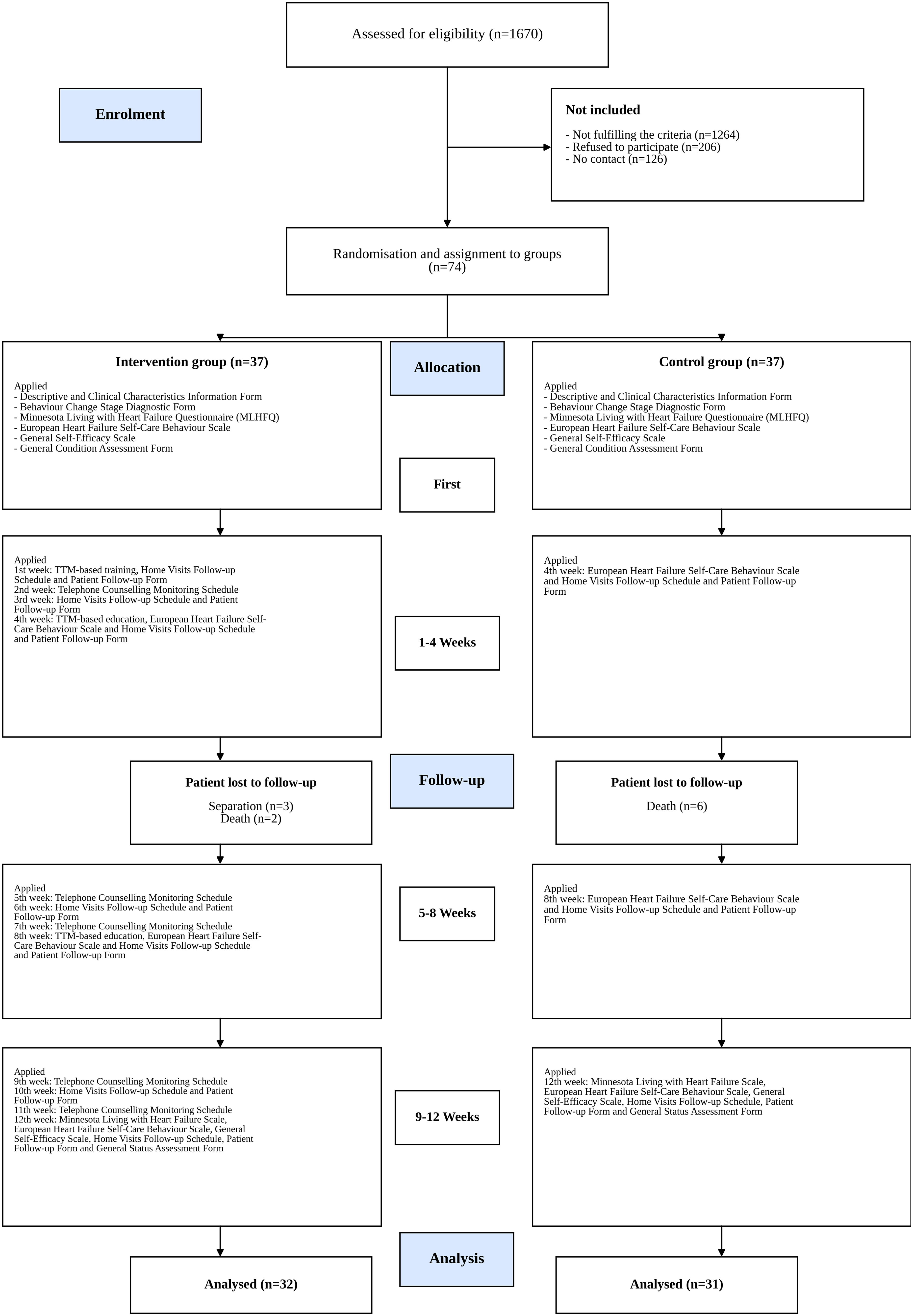
Control group participants continued routine outpatient cardiology follow-up. Usual care included medical examination, routine clinical monitoring, physician-led medication management when required, and standard verbal recommendations during clinical encounters. They did not receive the Transtheoretical Model-based home education and follow-up intervention during the study period. Any medication changes were made only by the treating physicians and recorded by the researcher. Post-intervention measurements were conducted at the hospital in week 12. After study completion, the control group received the educational booklet. The study flow is presented in Figure 1 in accordance with the CONSORT 2025 Statement (Hopewell et al., Reference Hopewell, Chan, Collins, Hróbjartsson, Moher, Schulz, Tunn, Aggarwal, Berkwits, Berlin, Bhandari, Butcher, Campbell, Chidebe, Elbourne, Farmer, Fergusson, Golub, Goodman, Hoffmann, Ioannidis, Kahan, Knowles, Lamb, Lewis, Loder, Offringa, Ravaud, Richards, Rockhold, Schriger, Siegfried, Staniszewska, Taylor, Thabane, Torgerson, Vohra, White and Boutron2025).
CONSORT flow diagram.

Figure 1. Long description
The flowchart begins with 1670 patients assessed for eligibility. 1264 did not meet criteria, 206 refused to participate, and 126 could not be contacted, leaving 74 patients randomized into two groups: intervention and control, each with 37 patients. Both groups had applied forms including Descriptive and Clinical Characteristics Information Form, Minnesota Living with Heart Failure Questionnaire, European Heart Failure Self-Care Behaviour Scale, and General Condition Assessment Form. The intervention group received TTM-based training and follow-up schedules, while the control group received standard education. Follow-up occurred at 1-4 weeks, 5-8 weeks, and 9-12 weeks, with patient loss due to separation or death noted. Final analysis included 32 patients in the intervention group and 31 in the control group.
Data collection tools
Data were collected using a Descriptive and Clinical Characteristics Information Form, the Minnesota Living with Heart Failure Questionnaire, the European Heart Failure Self-Care Behavior Scale, the General Self-Efficacy Scale, the 6-minute walk test, the Tanita RD 545 Smart Digital Scale, and researcher-developed follow-up forms.
The Descriptive and Clinical Characteristics Information Form included sociodemographic characteristics, heart failure diagnosis, New York Heart Association class, comorbidities, body mass index, smoking and alcohol use, living arrangement, caregiver support, and recent hospitalization.
The Minnesota Living with Heart Failure Questionnaire was used to assess quality of life. It includes 21 items, and lower scores indicate better quality of life (Aşık-Özdemir, Reference Aşık-Özdemir2009). The European Heart Failure Self-Care Behavior Scale was used to assess self-care behaviour. It includes 12 items, and lower scores indicate better self-care (Baydemir et al., Reference Baydemir, Ozdamar and Unalir2013). The General Self-Efficacy Scale was used to assess self-efficacy. It includes 10 items, and higher scores indicate higher self-efficacy (Aypay, Reference Aypay2010).
The 6-minute walk test was used to assess physical capacity (Holland et al., Reference Holland, Spruit, Troosters, Puhan, Pepin, Saey, McCormack, Carlin, Sciurba, Pitta, Wanger, MacIntyre, Kaminsky, Culver, Revill, Hernandes, Andrianopoulos, Camillo, Mitchell, Lee, Hill and Singh2014; Yap et al., Reference Yap, Lim, Gao, Teo, Lam and Yeo2015). The Tanita RD 545 Smart Digital Scale was used to assess body composition, including body mass index, intracellular fluid, and extracellular fluid.
Statistical analysis
Data were analyzed using IBM SPSS 22. Descriptive statistics were used to summarize participant characteristics and outcome variables. Scale reliability was assessed using Cronbach’s alpha. Normality was evaluated using skewness and kurtosis coefficients, descriptive indicators, and Q-Q plots. Between-group comparisons were conducted using independent-samples t-tests, Mann–Whitney U tests, Pearson Chi-square tests, Fisher’s exact tests, or Fisher–Freeman–Halton exact tests as appropriate. Within-group pre-test and post-test comparisons were conducted using paired-samples t-tests or Wilcoxon signed-rank tests according to distributional assumptions. Statistical significance was set at P < 0.05. Effect sizes were interpreted according to Cohen’s d (Pallant, Reference Pallant2020). The primary analysis focused on the between-group difference in self-care behaviour at 12 weeks. Secondary outcomes were interpreted as supportive findings, and exploratory clinical outcomes were interpreted cautiously because the study was not powered to confirm physiological effects.
Ethics
Before the study, ethics approval was obtained from the Cukurova University Faculty of Medicine Non-Interventional Clinical Research Ethics Committee (meeting no. 128, decision no. 61; 2 December 2022). Institutional permission was obtained before data collection. This study was conducted in accordance with the Declaration of Helsinki. Written informed consent was obtained from all participants prior to enrolment. The trial was prospectively registered at ClinicalTrials.gov (NCT06074887; 10 October 2023) before the first data collection. Permissions to use the study instruments were obtained from the relevant copyright holders.
Results
Baseline characteristics
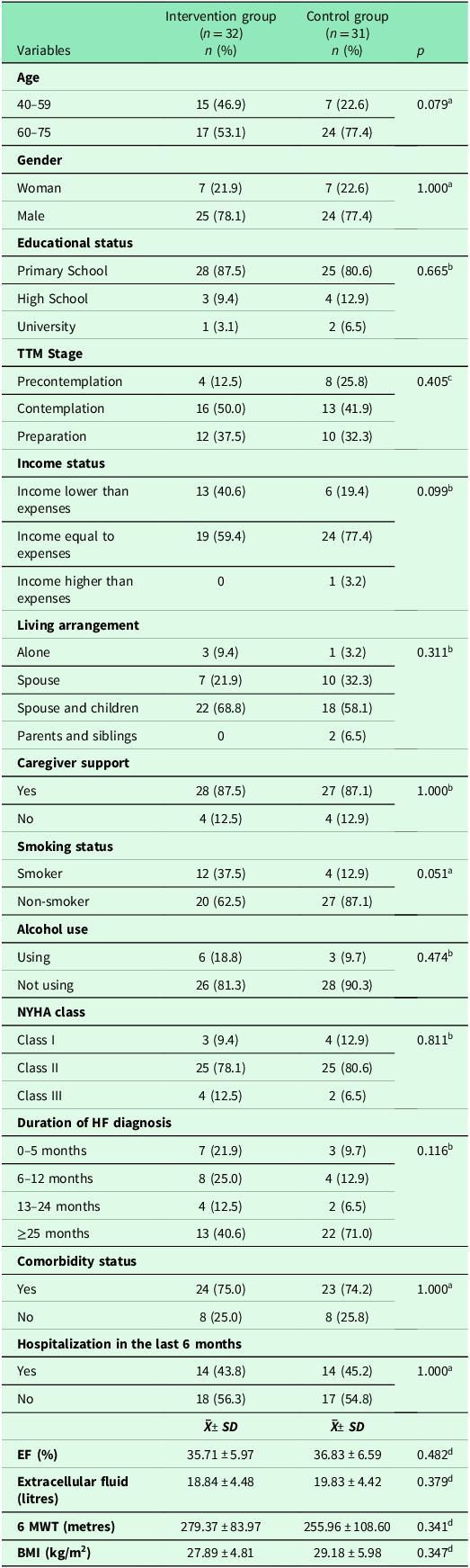
There were no statistically significant differences between the intervention and control groups in sociodemographic or baseline clinical characteristics (P > 0.05). The groups were comparable with respect to key clinical measures, including NYHA class, TTM stage, ejection fraction, 6-minute walk distance, and body mass index. Detailed baseline characteristics are presented in Table 1.
Baseline descriptive and clinical characteristics of the participants by group

Table 1. Long description
A table comparing baseline characteristics of participants in intervention and control groups. The table has 16 rows and 5 columns. Column headers are Variables, Intervention group (n = 32), Control group (n = 31), and p. Row labels include Age, Gender, Educational status, TTM Stage, Income status, Living arrangement, Caregiver support, Smoking status, Alcohol use, NYHA class, Duration of HF diagnosis, Comorbidity status, Hospitalization in the last 6 months, EF (%), Extracellular fluid (litres), 6 MWT (metres), and BMI (kg/m^2). Each row provides percentages and counts for the intervention and control groups, along with p-values indicating statistical significance. Notable trends include similar distributions in gender, educational status, and NYHA class between the two groups.
NYHA: New York Heart Association, TTM: Transtheoretical Model, HF: Heart failure, EF: Ejection fraction, 6MWT: 6 Minute Walking Test, BMI: Body mass index, X̄: Mean, SD: Standard Deviation.
a Continuity Correction.
b Fisher’s Exact Test.
c Pearson Chi-Square.
d Independent sample t-test.
Primary and secondary outcomes
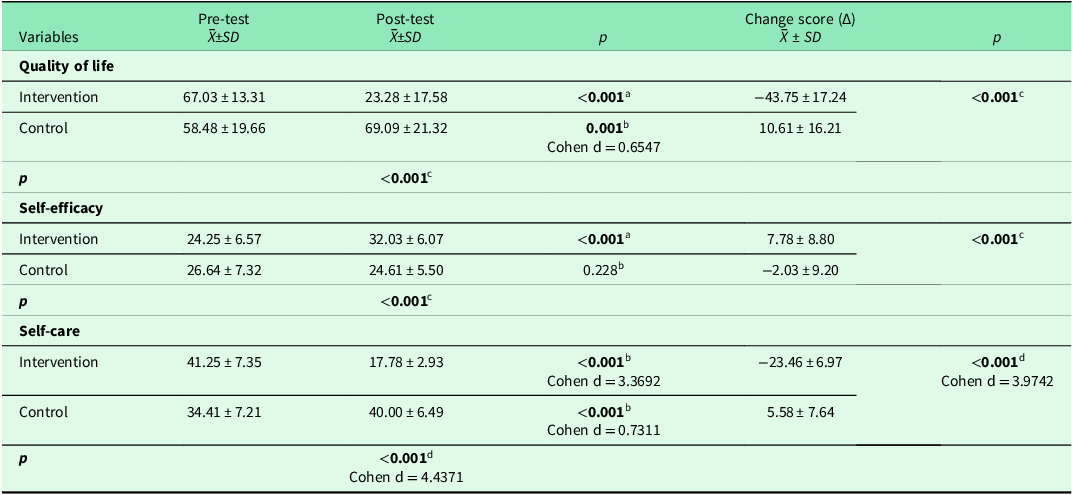
Self-care behaviour was the primary outcome. At 12 weeks, self-care improved significantly in the intervention group, accompanied by improvements in quality of life and self-efficacy (P < 0.01). In contrast, self-care and quality of life worsened in the control group, while self-efficacy remained unchanged. Between-group post-test and change-score comparisons favoured the intervention group across all three outcomes (P < 0.01). The between-group effect size for self-care was very large (d = 4.44). Detailed results are presented in Table 2.
Within-and between-group comparisons of quality of life, self-care behaviour, and self-efficacy scores

Table 2. Long description
The table presents a comparison of quality of life, self-efficacy, and self-care scores between intervention and control groups. It includes pre-test and post-test scores, change scores, and p-values for each variable. The table has 12 rows and 7 columns. Column headers are Variables, Pre-test, Post-test, p, Change score (Δ), X̄ ± SD, and p. Row labels include Quality of life, Self-efficacy, and Self-care. For Quality of life, the intervention group shows a significant decrease in scores from 67.03 ± 13.31 to 23.28 ± 17.58 with a change score of -43.75 ± 17.24. The control group shows an increase from 58.48 ± 19.66 to 69.09 ± 21.32 with a change score of 10.61 ± 16.21. For Self-efficacy, the intervention group shows an increase from 24.25 ± 6.57 to 32.03 ± 6.07 with a change score of 7.78 ± 8.80. The control group shows a slight decrease from 26.64 ± 7.32 to 24.61 ± 5.50 with a change score of -2.03 ± 9.20. For Self-care, the intervention group shows a significant decrease from 41.25 ± 7.35 to 17.78 ± 2.93 with a change score of -23.46 ± 6.97. The control group shows an increase from 34.41 ± 7.21 to 40.00 ± 6.49 with a change score of 5.58 ± 7.64. Notable trends include significant improvements in the intervention group across all variables and worsening scores in the control group for quality of life and self-care.
X̄: Mean, SD: Standard Deviation.
a Wilcoxon Signed Ranks test.
b Paired-sample t-test.
c Mann–Whitney U test.
d Independent sample t-test.
New York Heart Association class
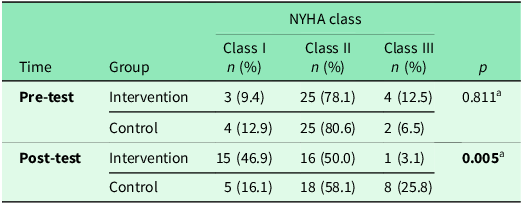
NYHA class was comparable between the groups at baseline. At 12 weeks, a significant between-group difference was observed in NYHA class distribution, with a higher proportion of participants in the intervention group classified as NYHA Class I (P < 0.01) (Table 3).
Changes in New York Heart Association functional class by group

Table 3. Long description
The table has four rows and three columns, comparing NYHA class changes by group over time. The columns are labeled Class I, Class II, and Class III, with values in percent. The rows are labeled Pre-test Intervention, Pre-test Control, Post-test Intervention, and Post-test Control. Pre-test Intervention: Class I 3 (9.4 percent), Class II 25 (78.1 percent), Class III 4 (12.5 percent). Pre-test Control: Class I 4 (12.9 percent), Class II 25 (80.6 percent), Class III 2 (6.5 percent). Post-test Intervention: Class I 15 (46.9 percent), Class II 16 (50.0 percent), Class III 1 (3.1 percent). Post-test Control: Class I 5 (16.1 percent), Class II 18 (58.1 percent), Class III 8 (25.8 percent). The p-value for the pre-test is 0.811, and for the post-test, it is 0.005.
NYHA: New York Heart Association.
a Fisher Freeman Halton Exact Test.
Transtheoretical model stages
TTM stages were similar between the groups at baseline. By the end of the 12-week intervention, most participants in the intervention group had progressed to the action stage, while this stage was rarely reached in the control group. This between-group difference was statistically significant (P < 0.01) (Table 4).
Changes in transtheoretical model stages by group

Table 4. Long description
The table has four rows and six columns. The columns are labeled Time, Group, Precontemplation n(%), Contemplation n(%), Preparation n(%), Action n(%), and p. The rows are labeled Pre-test Intervention, Pre-test Control, Post-test Intervention, and Post-test Control. Row 1: Pre-test Intervention, Precontemplation 4 (12.5 percent), Contemplation 16 (50.0 percent), Preparation 12 (37.5 percent), Action 0 (0 percent), p 0.405. Row 2: Pre-test Control, Precontemplation 8 (25.8 percent), Contemplation 13 (41.9 percent), Preparation 10 (32.3 percent), Action 0 (0 percent), p 0.405. Row 3: Post-test Intervention, Precontemplation 0, Contemplation 1 (3.1 percent), Preparation 0, Action 31 (96.9 percent), p <0.001. Row 4: Post-test Control, Precontemplation 2 (6.5 percent), Contemplation 12 (38.7 percent), Preparation 16 (51.6 percent), Action 1 (3.2 percent), p <0.001.
TTM: Transtheoretical Model.
a Pearson Chi-Square Test.
b Fisher Freeman Halton Exact Test.
Functional capacity and exploratory clinical outcomes
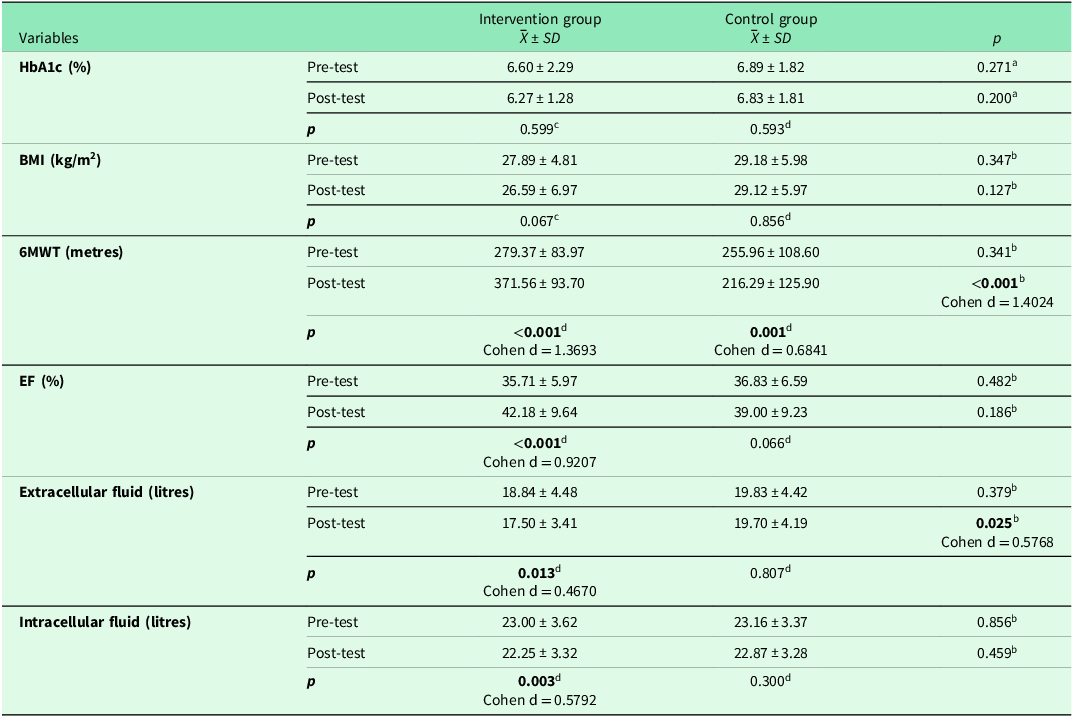
At 12 weeks, the intervention group showed a clear improvement in functional capacity, reflected by a longer 6-minute walk distance than the control group. Improvements were also observed in ejection fraction and body-fluid measures within the intervention group. In contrast, BMI and HbA1c remained unchanged in both groups. Detailed findings, including the corresponding effect sizes, are presented in Table 5.
Changes in functional capacity and exploratory clinical outcomes by group

Table 5. Long description
A table comparing clinical outcomes between intervention and control groups. The table has six rows and five columns. The columns are labeled Variables, Intervention group X ± SD, Control group X ± SD, and p. The rows are labeled HbA1c (%), BMI (kg/m2), 6MWT (metres), EF (%), Extracellular fluid (litres), and Intracellular fluid (litres). Each row contains pre-test and post-test values for both groups, along with p-values indicating statistical significance. Notable trends include significant improvements in the 6-minute walk distance (6MWT) and ejection fraction (EF) for the intervention group, while BMI and HbA1c remained unchanged in both groups.
HF: Heart failure, EF: Ejection fraction, 6MWT: 6 Minute Walking Test, BMI: Body mass index, X̄: Mean, SD: Standard Deviation.
a Mann–Whitney U test.
b Independent sample t-test.
c Wilcoxon signed-rank test.
d Paired-samples t-test.
Discussion
The main finding of this study was that the nurse-led, Transtheoretical Model-based home education and follow-up programme improved self-care behaviour in patients with heart failure over 12 weeks. Quality of life, self-efficacy, and functional capacity also improved as secondary outcomes, while selected clinical parameters were assessed as exploratory findings. Previous nurse-led and motivational interviewing-based programmes have also shown benefits in heart failure care (Jiang et al., Reference Jiang, Koh, Ramachandran, Nguyen, Lim, Tay, Shorey and Wang2021; Vellone et al., Reference Vellone, Rebora, Ausili, Zeffiro, Pucciarelli, Caggianelli, Masci, Alvaro and Riegel2020). Home-based education and technology-supported approaches have similarly been used to strengthen self-care (Siabani et al., Reference Siabani, Driscoll, Davidson and Leeder2016; Yokota et al., Reference Yokota, Fukushima, Tsuchihashi-Makaya, Abe, Takada, Furihata, Ishimori, Fujino, Kinugawa, Ohta, Kakinoki, Yokota, Endoh, Yoshino and Tsutsui2023). However, the effects of these interventions have not been consistent across studies (Boyde et al., Reference Boyde, Peters, New, Hwang, Ha and Korczyk2018; Østergaard et al., Reference Østergaard, Mahrer-Imhof, Wagner, Barington, Videbæk and Lauridsen2018). Differences in intervention intensity, follow-up duration, and the degree of individualization may help explain this variation and provide context for the marked improvement in self-care observed in the present study.
The very large effect size for self-care may be related to the intensity of the intervention and the way it was tailored to each participant. Participants received regular home visits and telephone follow-up during the 12-week programme. The educational content was also adjusted according to their stage of change. This repeated support may have helped participants address self-care difficulties and maintain recommended behaviours over time. The larger between-group difference may also reflect the improvement seen in the intervention group together with the poorer self-care scores in the control group at follow-up. Previous nurse-led and home-based interventions have also improved self-care in people with heart failure, although the size of the effect has varied across studies (Boyde et al., Reference Boyde, Peters, New, Hwang, Ha and Korczyk2018; Siabani et al., Reference Siabani, Driscoll, Davidson and Leeder2016; Østergaard et al., Reference Østergaard, Mahrer-Imhof, Wagner, Barington, Videbæk and Lauridsen2018; Jiang et al., Reference Jiang, Koh, Ramachandran, Nguyen, Lim, Tay, Shorey and Wang2021). From a primary health care perspective, this model may help extend education and self-management support into the home for patients who have difficulty accessing centre-based services.
Quality of life improved in the intervention group. Better symptom awareness and greater confidence in daily disease management may have contributed to this improvement. The increase in functional capacity may also have made daily activities easier, while regular follow-up provided opportunities to discuss difficulties and receive practical support at home. Previous findings on quality of life have been mixed. Family nursing and walking-based interventions have not consistently produced significant improvements (Du et al., Reference Du, Newton, Budhathoki, Everett, Salamonson, Macdonald and Davidson2018; Østergaard et al., Reference Østergaard, Mahrer-Imhof, Wagner, Barington, Videbæk and Lauridsen2018), whereas mobile-phone, telemonitoring, and physical activity interventions have reported more favourable outcomes (Dang et al., Reference Dang, Karanam and Gomez-Marin2017; Hong and Esquivel, Reference Hong and Esquivel2022; Mizukawa et al., Reference Mizukawa, Moriyama, Yamamoto, Rahman, Naka, Kitagawa, Kobayashi, Oda, Yasunobu, Tomiyama, Morishima, Matsuda and Kihara2019; Taylor-Piliae and Finley, Reference Taylor-Piliae and Finley2020). The present findings suggest that continued education and practical support may be important alongside the specific content of the intervention.
Self-efficacy also improved in the intervention group, while no positive change was observed in the control group. This finding is important because effective heart failure self-management depends on patients feeling confident in managing symptoms and treatment recommendations in daily life. The stage-tailored structure of the programme may have strengthened this confidence by focusing on behaviours that participants were ready to address. Regular home visits and telephone follow-up also allowed difficulties to be reviewed and progress to be reinforced over time. Improvements in self-efficacy have also been reported in nurse-led, technology-supported, and physical activity interventions for people with heart failure (Boyne et al., Reference Boyne, Vrijhoef, Spreeuwenberg, De Weerd, Kragten and Gorgels2014; Dang et al., Reference Dang, Karanam and Gomez-Marin2017; Jiang et al., Reference Jiang, Koh, Ramachandran, Nguyen, Lim, Tay, Shorey and Wang2021; Nordgren and Söderlund, Reference Nordgren and Söderlund2020; Oka et al., Reference Oka, DeMarco and Haskell2005).
Improvements were also observed in NYHA class and TTM stage. Most participants in the intervention group progressed to the action stage by the end of the programme. This finding is consistent with the Transtheoretical Model, which links support to a person’s readiness to change (Prochaska and Velicer, Reference Prochaska and Velicer1997). Similar stage-based approaches have also supported healthier behaviours in different populations (Aksoy and Özentürk, Reference Aksoy and Özentürk2021; Mansuroğlu and Kutlu, Reference Mansuroğlu and Kutlu2022; Tosun and Zincir, Reference Tosun and Zincir2016). In this study, repeated counselling and follow-up may have helped participants overcome barriers and turn intention into daily self-care. The improvement in NYHA class may also reflect better symptom management and functional capacity during the programme. This clinical finding should be interpreted with caution because the follow-up period was relatively short.
Functional capacity, assessed using the 6-minute walk test, improved in the intervention group. The programme did not include supervised exercise sessions, but participants received guidance on safe physical activity according to symptoms and functional capacity. Regular symptom monitoring and repeated encouragement may have helped participants incorporate activity into daily life with greater confidence. Previous studies have reported improvements in exercise capacity with structured exercise interventions, including home-based programmes (Bean et al., Reference Bean, Mou, Pflugeisen, Olsen, Hoag, Silva, Ball and Lee2021; Ma et al., Reference Ma, Zhou, Jia and Tang2022), whereas technology-supported and lifestyle interventions have more consistently increased physical activity than functional capacity (Jaarsma et al., Reference Jaarsma, Klompstra, Ben Gal, Ben Avraham, Boyne, Bäck, Chialà, Dickstein, Evangelista, Hagenow, Hoes, Hägglund, Piepoli, Vellone, Zuithoff, Mårtensson and Strömberg2021; Saleh et al., Reference Saleh, Elshatarat, Elhefnawy, Helmi Elneblawi, Abu Raddaha, Al-Za’areer, Mofdy Almarwani, Alzahrani, Aqel, Shawashi and Tayeh2023; Vetrovsky et al., Reference Vetrovsky, Siranec, Frybova, Gant, Svobodova, Linhart, Parenica, Miklikova, Sujakova, Pospisil, Pelouch, Odrazkova, Parizek, Precek, Hutyra, Taborsky, Vesely, Griva, Semerad, Bunc, Hrabcova, Vojkuvkova, Svoboda and Belohlavek2024). These findings suggest that structured guidance and continued support may contribute to functional improvement even when supervised centre-based exercise is not available.
Changes in ejection fraction were exploratory and should be interpreted cautiously. Although ejection fraction increased within the intervention group, the between-group difference at 12 weeks was not statistically significant. These findings do not support a clear treatment effect on cardiac function. Previous studies suggest that education and exercise may influence ejection fraction and functional outcomes, although the effects vary according to the type and intensity of the intervention (Wisløff et al., Reference Wisløff, Støylen, Loennechen, Bruvold, Rognmo, Haram, Tjønna, Helgerud, Slørdahl, Lee, Videm, Bye, Smith, Najjar, Ellingsen and Skjærpe2007; Tian et al., Reference Tian, Li, Zhang, Qiao, Li and Zhang2024; Tucker et al., Reference Tucker, Beaudry, Liang, Clark, Tomczak, Nelson, Ellingsen and Haykowsky2019). Evidence from cardiac rehabilitation studies also supports potential benefits for physical activity levels in people with heart failure (Dibben et al., Reference Dibben, Dalal, Taylor, Doherty, Tang and Hillsdon2018).
Changes in body-fluid parameters were also exploratory. Better adherence to fluid and dietary recommendations may have contributed to these findings. Nutritional and self-management interventions have previously been associated with changes in clinical status and fluid-related outcomes in heart failure (Colín Ramírez et al., Reference Colín Ramírez, Castillo Martínez, Orea Tejeda, Rebollar González, Narváez David and Asensio Lafuente2004; Philipson et al., Reference Philipson, Ekman, Forslund, Swedberg and Schaufelberger2013; Shao et al., Reference Shao, Chang, Edwards, Shyu and Chen2013; Welsh et al., Reference Welsh, Lennie, Marcinek, Biddle, Abshire, Bentley and Moser2013). However, evidence regarding sodium restriction remains mixed, and a systematic review found no clear benefit for several major clinical outcomes (Zhu et al., Reference Zhu, Cheng, Su, Ma, Lei and Hou2022). The changes observed in the present study should therefore be considered preliminary.
The findings also have implications for primary health care practice. The programme was not intended to replace specialist cardiac rehabilitation. Instead, it extended structured education and follow-up into the home after cardiology assessment. This approach may allow primary health care teams to reinforce self-management and follow patients who have limited access to centre-based services. It may also provide an opportunity to identify difficulties early and refer patients for further clinical assessment when needed.
Strengths and limitations
A key strength of this study is that it evaluated an individualized, systematic, Transtheoretical Model-based home education and follow-up programme for patients with heart failure. The programme was developed with expert input, pre-tested with patients, and tailored to participants’ stages of change. The use of patient-reported outcomes together with objective clinical measures strengthened the assessment of the intervention. The randomized controlled design, baseline comparability of the groups, and regular follow-up also supported the methodological rigour of the study.
Another strength is that the intervention was tested under real-world service conditions where structured centre-based cardiac rehabilitation was not available. This increases the relevance of the findings for health systems that need practical home-based approaches to support self-management and continuity of care after specialist cardiology assessment.
Several limitations should be considered. The study was conducted in a single centre and included patients aged 40 to 75 years, which may limit generalisability. Standard cardiac rehabilitation was not available in the study setting, so the intervention could not be compared with an established centre-based programme. Long-term outcomes were not assessed, and full blinding was not possible because of the nature of the intervention. Participants were recruited from a cardiology department rather than directly from a primary care clinic. Therefore, the findings should be interpreted as evidence for a primary health care-relevant home-based model delivered after specialist cardiology assessment, rather than as a trial conducted entirely within primary care. Future studies should test this model in larger and more diverse patient groups and compare it with centre-based, hybrid, digitally supported, and primary care-integrated rehabilitation services.
Conclusion
This single-centre randomized controlled trial showed that a stage-tailored, nurse-led home education and follow-up programme improved self-care behaviour in patients with heart failure over 12 weeks. Improvements in quality of life, self-efficacy, and functional capacity were observed as secondary findings, while selected clinical parameters were exploratory. When centre-based cardiac rehabilitation is unavailable, this model may help extend education, self-management support, and follow-up into the home setting after specialist cardiology assessment. Larger multicentre studies with longer follow-up and stronger blinding procedures are needed to confirm these findings and examine implementation, cost-effectiveness, and long-term sustainability.
Data availability statement
The datasets generated and/or analyzed during the current study are not publicly available due to project-related restrictions, but are available from the corresponding author (HC) upon reasonable request.
Acknowledgements
This article was derived from the doctoral dissertation of Hakan Çelik, completed at Erciyes University under the supervision of Betül Özen. The authors thank the Office of the Dean of Research at Erciyes University for proofreading and language editing support. The authors are also grateful to all patients who participated in this study.
Author contributions
Both authors contributed to the concept and design of the study. HC and BO conducted the literature review. HC performed the data collection and analysis, while BO made significant contributions to the writing and editing. Both authors critically reviewed the article, supervised the study process, and read and approved the final version.
Funding statement
This work was supported by the Erciyes University Scientific Research Projects Unit, grant number TDK-2023–12974, and the TÜBİTAK 1002-B Emergency Support Program, grant number 323S090.
Competing interests
The authors declare none.
Ethical standards
Ethics approval was obtained from the Cukurova University Faculty of Medicine Non-Interventional Clinical Research Ethics Committee, meeting number 128 and decision number 61, dated 02.12.2022. The study was conducted in accordance with the Declaration of Helsinki. Written informed consent was obtained from all participants before enrolment. The trial was registered at ClinicalTrials.gov with the registration number NCT06074887 on 10 October 2023 before the first data collection.
Consent for publication
All participants provided written informed consent for publication of anonymised data.
Trial registration
ClinicalTrials.gov: NCT06074887. Registered on 10 October 2023.
Declaration of AI use
The authors used ChatGPT by OpenAI for language editing and grammar improvement during the preparation of this manuscript. The authors reviewed and approved all AI-assisted outputs and take full responsibility for the content of the manuscript.


 Open access

