The discordance of this essay's subtitle is difficult to grasp for those unfamiliar with the connotations of the term cinci hoca or, alternatively, üfürükçü. As practitioners of a popular form of religious healing that treat individuals being afflicted by cin (jinn) with a combination of curative amulets (muska), Qur

anic verses (ayet), and ritual prescriptions, figures such as the cinci hoca, and the complex of marginal religious practices they index, are commonly regarded as antithetical to the ideals of a modern society. For many observers, in fact, the former obstructs the proper development of the latter; they are not in, or better yet of, Turkish modernity, but a lingering disruptive reminder of what came before.
1Defining “modernity” is an inherently problematic endeavor that runs the risk of essentializing and reifying a complex and dynamic set of processes. However, my argument hinges not on what modernity is, but on what is clearly regarded as not belonging to the sphere of the modern. By examining figures and practices that are excluded or marginalized from modernity, we begin to gain an understanding of both its shifting boundaries and the ways in which they, in their exclusion, play a constituting role in the staging of the modern. My use of the term modernity is informed by Timothy Mitchell's argument that modernity is defined by both its universalism as a project (its claims to uniqueness and unity) and its singularity as an always incomplete realization of the project: Timothy Mitchell, ed., Questions of Modernity (Minneapolis: University of Minnesota Press, 2000).
Taking the pervasive and recurrently scandalous appearance of religious healers within Turkish print and television news media as its focus, the aim of this article is twofold. First, it considers how media attacks on marginal religious and social practices (variously labeled superstition, heterodoxy, heresy, or simply ignorance) serve to assert a set of prohibitions constituting an ideal image of a modern, national community and to enact the state's legitimacy as guardian and protector of its citizenry. Second, countering the apparent desire to eliminate superstition, I argue that such attacks have become a vital site for not only the staging of state authority but also the expression of a series of widespread social, political, and economic anxieties. In this second instance, the attempt to eliminate the cinci hoca in the name of the modern has transformed into a reliance upon their presence so that they can then be disavowed. Within their attempted delegitimization, marginal religious and social practices are thereby included as a menacing presence around which a series of public fears converge and become manifest. In this regard, the figure of the cinci hoca represents what Victor Turner might refer to, in a different context, as a “condensed symbol” through which “many ideas, relations between things, actions, interactions, and transactions are represented simultaneously.”2
Victor Turner, The Forest of Symbols: Aspects of Ndembu Ritual (Ithaca, N.Y.: Cornell University Press, 1967).
Initially I found media apparitions of the cinci hoca as something peripheral to my study of the utilization and practice of religious healing within two gecekondu (squatter) communities of Ankara, Turkey. As time passed, however, and I talked with more healers and spent more time in their homes, in front of their televisions, it became clear that the media was far from peripheral to the lives and practices of such healers as the cinci hoca. Moreover, in daily conversations within and outside the communities, much more than simply the cinci hoca was talked about in discussions (and frequently arguments) inspired by these scandals. Initially, as well, the media's concern with portraying the immoral conduct of those regarded as religiously pious was simply a means of ridiculing pro-Islamist political parties and their supporters who were becoming increasingly influential over the course of my fieldwork. As such, it appeared as but an extension of Bobby Sayyid's argument concerning Kemalism's use of Islam as the antagonistic and necessary other for the consolidation of its legitimacy.3
Bobby Sayyid, The Fundamental Fear: Eurocentrism and the Emergence of Islamism (London: Zed Books, 1997).
As I got further into my field and archival research, the cinci hoca scandal took on a deeper, historically larger significance. From 17th-century scandals involving Sultan “Deli” Ibrahim's (Ibrahim the Mad's) close relationship with cinci hoca,4
See, for instance, Ahmet Refik Altinay, Samur Devri (Istanbul: Kütüphane-i Hilmi, 1927), and M. Turhan Tan's historical novel Osmanlı Rasputini Cinci Hoca (Istanbul: SLE Sühulet Kitabevi, 1938).
F. Gökay, “Türkiye'nin Hijien Mental ve Psişiyatri Sahasindaki Hizmetleri,” Tib Dünyası 12 (1939): 4185–86; idem, “Hastaneler Mes'elesi,” Tib Dünyası 12 (1939): 4287–89.
While other marginal figures and groups find themselves caught in media scandals,6
While one can identify numerous popular targets of media scandal—“corrupt” politicians, “militant” leftists, “militant” Islamists, Kurdish “separatists,” misguided youth (especially “satanists” accused of sacrificing neighborhood cats), “quack” doctors, prostitutes, and so forth—the cinci hoca's unique position within a constellation of religious, political, and economic discourses (all transected by themes of authority and exploitation) makes it a particularly useful figure for thinking through Turkey's staging of the modern.
For a discussion of the relationship between religious healing and the history of medicine in Turkey, see Christopher Dole, “In the Shadows of Medicine and Modernity: Medical Integration and Secular Histories of Religious Healing in Turkey,” Culture, Medicine, and Psychiatry 28 (2004): 255–80.
I will treat the terms cinci hoca and üfürükçü as synonymous in the following discussion, frequently referring to both simply as “hoca.” Although such healers commonly reject these labels for reasons that will become apparent (referring to themselves as everything from shaykh to simply hoca), they nonetheless recognize that their practices are those of what is popularly known as the cinci hoca or üfürükçü.8
Many more terms are used to describe the cinci hoca, such as muskacı (writer of muska), büyücü (‘sorcerer’), and, at times, the more general şifacı (‘healer’).
MEDIA AND THE IMAGINATION
From relentless newspaper reportings to lurid television news broadcasts, from vulgar cartoons to pornographic websites (entitled “A Cinci Hoca's Webpage” promising access to “A Cinci Hoca's Beauties” for those who click on the “Hoca's Instrument”—an image of a penis), the media in its multiple modalities seems obsessively fascinated with the various improprieties of the cinci hoca. Although figures such as the cinci hoca have long been surrounded by scandal, this article's point of departure in considering the media's fascination with the cinci hoca is the emergence of a privatized media industry in the 1980s. It is this privatization and expansion of the media industry that both broadened the means of attacking cultural practices perceived as antimodern and, in the process, revealed a deeper logic whereby the public disavowal of “superstition” serves to sustain the Turkish modernization project.
Throughout most of the Turkish republic's history (1923–), the state has maintained a hold on the production and dissemination of ideological discourses aiming to mold a new citizenry. In at least the past fifteen years, however, especially since the 1990 breaking of the state broadcasting monopoly, Turkish Radio and Television Authority, and the introduction of the first private television channel, the roles of the state and the media have undergone a remarkable reversal. As compared to the early relationship between the state and the media, it is now the newly privatized media, although still accountable to state censors, that has moved to the foreground as the principal provider of news and entertainment. Meanwhile, with the proliferation of inexpensive television sets in the past decade, television has become a ubiquitous presence in homes throughout Turkey. Taken together, these interrelated shifts mark at once the expansion and privatization of the historical link between the media and the nation-building project of the Turkish state.
This shift in the media industry also reflects a major transformation in the types of neighborhoods where this project was located—established squatter communities of Ankara made up of densely clustered, self-made homes that house staggering numbers of the unemployed and working poor. Where residents had previously been principally producers for the national and global economy, they are now also its major consumers. Images of stylish consumer goods and slender models, of both foreign and domestic provenance, that previously only cluttered the newsstands of upscale neighborhoods are now equally at home in these newly emerging consumer markets. In the now commonplace sights of young, thin women in tightly fitted clothing and neatly styled hair (the staple of fashion magazines) walking alongside their thick-set mothers wearing loose combinations of homemade sweaters, skirts, and headscarves (the staple of tourist brochures), it is not difficult to discern the rapidly burgeoning role of the private media, and the accompanying advertising industry, in influencing daily lives within such neighborhoods. Nonetheless, the scope of this article is considerably broader than a particular neighborhood and signals one of the specific characteristics of the Turkish media: its dominant national, rather than local, generative framework. That is, the media industry in Turkey is closely monitored by a state authoritarianism that is deeply distrustful of local autonomy, which is prominently reflected in campaigns against Kurdish-language media.9
Particularly in light of the Kurdish separatist movement, local media is seen as but another means of establishing regional autonomy and thus threatening the unifying goals of Turkish nationalism. The struggle between MED-TV (a leading Kurdish-language broadcasting agency) and the Turkish state does well to highlight this resistance to local media: see “RTÜK Yerel Basina Ceza Yağdirdi,” Hürriyet, 16 January 2003. Of late, however, there does appear to be an increase in the availability of local news sources and programming.
At this intersection of Turkish nationalist thought and mass mediation, the work of the imagination stands as a privileged site of struggle that spans and constitutes relationships between the personal, local, and national. In what Arjun Appadurai describes as the “imagination as social practice,” mass mediation (in its realistic and fictional modes) profoundly shapes and creates “ideas of neighborhood and nationhood, of moral economies and unjust rule, of higher wages and foreign labor prospects.”10
Arjun Appadurai, Modernity at Large (Minneapolis: University of Minnesota Press, 1996), 7.
The now classic analysis of the importance of the imagination in nationalism is Benedict Anderson, Imagined Communities: Reflections on the Origin and Spread of Nationalism (London: Verso, 1983).
Appadurai, Modernity at Large, 31.
Although Appadurai overstates the case, presuming that the imagination was not already a field of social practice and site of negotiation, he nevertheless correctly draws attention to the contemporary significance of the interconnectedness of the media, the imagination, and everyday lives. As a productive site of emergent possibilities, it is at this intersection where new futures are fashioned and the place of one's life within them plotted. Crudely put, as the slender young woman and her heavy-set mother walked along the gecekondu road that cut between newly constructed apartment complexes, they imagined very different futures for themselves.
Appadurai's framing of the constructive or generative intersection of the media and imagination is significant in that it opens our consideration of media representations of the cinci hoca to a deeper reading than simply as instances of repression or desired elimination of unwanted remnants of a political and cultural past. At this intersection, rather, new worlds are being imagined as old ones are being rendered unimaginable, or at least obsolete. In the case of the cinci hoca scandal, for example, it is not that the hoca is experiencing a form of censorship in which something is edited out before being published or broadcast (an absence without lack). Instead, as a scene of denunciation that is at once a productive site for re- or unimagining, the cinci hoca is first presented and then publicly disavowed. A brief introductory example will illustrate this point.
“THE VILLAGE WHERE THE DRUM ISN'T PLAYED”
Babacan, a television program classified alternatively as a “news program” and a “reality show” but nonetheless cast in the “realistic mode,” was a weekly, one-hour program hosted by the Turkish cinema star Cüneyt Arkin. Whether it was the misery of abject poverty or the horrors of false belief, Babacan devoted itself to traversing the country in search of the unbelievable, miraculous, or simply bizarre. For this discussion, the episode, titled, “The Village Where the Drum Isn't Played,” which aired in October 1999, is particularly illustrative. Although not specifically about religious healing, it nonetheless has one of its characteristic features—the yatir, a place where a holy person is buried—and treads on similar conceptual grounds. The particular destination of this episode was a village renowned for prohibiting the playing of the drum, an instrument of central importance for celebrations throughout the country (e.g., weddings, circumcisions, soccer-match victories, and the departure of young men for military service). According to villagers interviewed, the dead holy person disliked the sound of drums, and their playing was thus forbidden for fear of retribution.
Into this visibly impoverished village rides Cüneyt Arkin in his new, unmistakably expensive sport utility vehicle. Over ghostly music and shifting camera angles noticeably seeking to create an aura of mysteriousness, Babacan confronts villager after villager with what he regards as their “irrational belief.” With little restraint, he forcefully interrogates them on why they believed in this prohibition. He then becomes more threatening, questioning them on what would happen if he played a drum. “How will this hurt that dead person laying over there?” he asks. Villagers repeated the prohibition. If they played the drum, a great calamity would befall them, perhaps even death. If he played it, however, nothing would happen. He is, after all, an outsider.13
Interestingly, as well, it is acceptable to have a drum playing on television within the confines of the village.
The vehicle is then shown returning from a nearby town where they had hired a drum and zurna (a reed instrument) player. Turning to follow the road sign pointing toward the village, one of the musicians insists on getting out of the truck. He too is struck by fear. (One questions the sincerity of this response, particularly considering the camera is somehow already outside of the vehicle, at some distance, when the musician insists on getting out.) Picking up the drum, Cüneyt Arkin, the intrepid warrior against irrationality, nevertheless forges forward.14
Cüneyt Arkin's role in Babacan should be understood in relation to his long cinematic career, where he is easily one of the most recognizable figures in the history of Turkish film. Especially during the 1970s, his role as a great Turkish warrior capable of killing throngs of attackers with a single swing of a sword captured the imagination of a generation of Turkish youth and was critical in popularizing the nationalist image of the Central Asian ethnic Turk endowed with superhuman strength and the natural disposition of a warrior.
What is left unclear, however, is the impact of this event on the village he has long since moved beyond. Nevertheless, in this spectacularized confrontation of realities, a now public drama that would reach millions of viewers, the subtext was difficult to ignore: “rationality” had encountered and vanquished the “ignorance” and “superstition” of “tradition.” Cüneyt Arkin, with a theatrical flourish, pulls into daylight and questions what is taken for granted—“no drum is to be played in the village”—and, mockingly, attempts to refute other worldly injunctions through the earthly, yet ethereal, technology of television. In depicting the place of superstition at the intersection of a national media and local imaginaries, this episode also reveals the staged characteristics of its disavowal (e.g., the “spontaneous” reaction of the hired musician) and the alternative community it seeks to articulate. Within the village, the injunction against drum playing is one of the community's constitutive prohibitions, the breaking of which is accompanied by sanction. In turn, Arkin, representing an important segment of the Turkish elite, callously rejects inappropriate superstitious behavior in order to replace a local, communal prohibition with a set of prohibitions (against superstition) that designate a distinctly national community.
READING AND VIEWING THE CINCI HOCA
Particular types of viewers are presumed and readings encoded within the Babacan program. As opposed to the “mainstream secularist” press,15
I use the term “mainstream secularist” to refer to a number of television stations (ATV, StarTV, ShowTV, etc.) and newspapers (Hürriyet, Milliyet, etc.) that may not be explicitly prosecularist/laicist (although they frequently are) but that claim an objectivity that clearly works through the state's normative secularist code.
Jenny White, Islamist Mobilization in Turkey (Seattle: University of Washington Press, 2002); Yael Navaro-Yashin, Faces of the State: Secularism and Public Life in Turkey (Princeton, N.J.: Princeton University Press, 2002).
Stuart Hall, “Encoding/Decoding,” in Culture, Media, Language, ed. Stuart Hall, Dorothy Hobson, Andrew Lowe, and Paul Willis (London: Hutchinson, 1980), 128–38.
Despite differences, these scandals appear on channels and in newspapers maintaining a range of ideological positions. And since the privatization of the media industry, this range has become significantly fragmented along political and religious lines, with each media outlet frequently linked to larger media conglomerates owned by identifiable families and catering to specific audiences. Although some attract very specific and loyal audiences, those characterized as “mainstream secularist” are the most watched and frequently draw a mixed audience. Especially when it comes to television news programming, where these scandals most frequently appear, the “mainstream secularist” stations are extremely popular and attract a wide viewership. In both the pro-Islamist and ardently secularist/Kemalist neighborhoods where I conducted research, residents most commonly turned to these stations when it came time for the evening news.18
I refer to “secularist” and “Islamist” not as exclusive oppositions. To say one neighborhood is pro-Islamist is not to imply that it is opposed to secularism. Nor is this intended to suggest that “secularist” and “Islamist” capture the full range of ideological, religious, and political positions available—within and without the neighborhoods. Despite their analytic imprecision, these terms stood as cogent social categories used by residents to characterize themselves and their neighborhoods. The distinction I draw between the two neighborhoods is most clearly reflected in their political alliances: where one overwhelmingly supported the Kemalist Cumhuriyet Halk Partisi (Republican People's Party), the other supported the Islamist Fazilet Partisi (Virtue Party). Both neighborhoods were in the Mamak municipality of Ankara and reflected little, if any, class difference.
Although audiences are roundly cognizant of each media outlet's ideological position, and approach the outlets accordingly, one cannot presume that messages are decoded as anticipated. Although a full consideration of “audience” or “reception studies” within media theory is beyond the scope of this discussion, one must bear in mind that audiences receive messages in particular ways and make use of them in divergent contexts. As such, this essay addresses calls to take television seriously in making sense of the sorts of ethnographic realities within which social scientists work19
See Lila Abu-Lughod, “Modern Subjects: Egyptian Melodrama and Postcolonial Difference,” in Mitchell, Questions of Modernity, 87–114; Purnima Mankekar, Screening Culture, Viewing Politics: An Ethnography of Television, Womanhood, and Nation in Postcolonial India (Durham, N.C.: Duke University Press, 1999); Faye Ginsburg, Lila Abu-Lughod, and Brian Larkin, ed., Media Worlds: Anthropology on New Terrain (Berkeley: University of California Press, 2002). For a consideration of the sociality of television use, see Ron Lembo, Thinking through Television (Cambridge: Cambridge University Press, 2000).
See Fatma Göçek, ed., Political Cartoons in the Middle East (Princeton, N.J.: Markus Wiener, 1998); Allen Douglas and Fedwa Malti-Douglas, Arab Comic Strips: Politics of an Emerging Mass Culture (Bloomington: Indiana University Press, 1994).
Building on recent work in the anthropology of the media that stresses a contextual analysis of media representations21
Ginsburg et al., Media Worlds; Abu-Lughod, Questions of Modernity; Mankekar, Screening Culture, Viewing Politics.
Mankekar, Screening Culture, Viewing Politics.
Ibid., Abu-Lughod, Questions of Modernity.
Locally, nonetheless, it is important to recognize how television, for instance, is watched. Broadly speaking, television watching is a lively, collaborative event in which items are noted, commented upon, and argued over. The audience in this case is not frequently a passive or quiescent one. Media representations that capture the various improprieties of healers, for example, are not merely absorbed but rather become subjects of debate, used to ridicule characters on television or relatives in the same room. In both neighborhoods where I worked, viewers reacted with disdain and frequently ire—at times spitting at the television—when these programs aired. That the viewers I worked with came from poor, working-class neighborhoods is significant in that it counters relentlessly drawn associations between poverty and the cinci hoca. As opposed to common portrayals of elite segments of society acting as enforcers of an appropriately modern national image, one that frequently takes as its target the “ignorant” (cahil) social practices that are presumed to be endemic among the poor and less educated, my neighbors' reactions to the hoca scandal attests to the fact that such an ideal is very much a national ideal in which they, too, are deeply invested.
ANATOMY OF A SCANDAL: SEX AND MONEY
Media scandals pervade the entirety of the cinci hoca's world, profoundly shaping how, where, and when they do their work. Well-established fears of secret agents, MIT (National Intelligence Organization), and informers are now met with suspicion over hidden cameras, concealed microphones, and undercover reporters. For instance, one day while visiting Ahmet, a local cinci hoca who had spent some time in prison, he talked at length about a recent visitor whom he instinctively suspected of being an agent, possibly from MIT. He then showed me a microcassette recorder he had recently purchased and proceeded to play back the taped meeting with the suspected agent. “If he were to take me to court for doing the work of those fake hocas,” Ahmet explained, “I'd have something for my defense. I could just play this tape… Prison taught me a few things.” Trepidation of being caught on television, and then by the police, has pushed the hoca largely underground. In the course of fieldwork, there was no more prominent yet elusive figure than the cinci hoca.
Repeatedly, and with striking consistency, however, cinci hoca after cinci hoca were caught in compromising positions on the national news. No less frequently than once a month, news broadcasts featured a story involving a hoca, with trailers repeated throughout the show until the final revelation of yet another cinci hoca's improprieties. The distinct pattern and recurrent themes of news reports featuring the cinci hoca are illustrated in the following two accounts:
ShowTV, 20 October 1999: As the central teaser of the evening news program, commercial breaks and transitions between segments are filled with video and audio clips proclaiming “once again a cinci hoca, once again a sexual harassing.” When the segment finally begins, a common scenario unfolds: a female complainant carrying a concealed camera (supplied by the ShowTV crew) reveals an older man, a cinci hoca living in an impoverished neighborhood, as a fraud. After entering the building, the hidden camera shows the complainant entering a small room where the hoca receives visitors. Once seated, the hoca places his hands across the upper part of her chest and on her back as he begins to pray. Periodically he blows over her. He then begins to pray over sugar, again putting his hands across her upper chest and back. At this point, she begins to express discomfort over the way she is being touched. When the treatment is complete and he tells her that we wants 50 million lira [U.S. $105] in total, she holds forth a 5 million lira note. Repeatedly, she extends the note, he takes it, and she snatches it back. Intermittently, she pushes the muska he prepared for her into the camera. [In all of this, it is clear that she is working the camera.] She then allows him to keep the 5 million lira, telling him that she already gave him 20 million and will give him the rest if she gets better. Transitioning to footage recorded on an unconcealed camera, ShowTV interviews the complainant and follows her into the hoca's house as she confronts him. The segment concludes with a visit to an “expert” who can read the muska's Arabic script.
StarTV, 4 February 2000: Tellingly placed between stories about the discovery of a corpse in Adana (one of many murders linked to Hezbollah) and the Fazilet Partisi (Virtue Party),24
The Fazilet Partisi, or Virtue Party, is regarded as the pro-Islamist party that replaced the Welfare Party that came to power in 1996 when Necemettin Erbakan became prime minister. This party is often criticized by secularists as, at best, religiously conservative and, at worst, seeking to replace Turkey's democratic state structures with Islamic law. In 2001, the Virtue Party was closed by the Constitutional Court.
Gizli İlimler is a popular and readily available book of ritual prescriptions that serves as a manual of sorts for many cinci hoca.
Not to be left behind in the Internet era, ShowTV's website, ShowTVnet, has dedicated an entire portion of its news section to “hidden camera” segments in which three of its four subcategories (health, magic, and harassment) focus almost exclusively on the work of religious healers such as the cinci hoca. The fourth targets prostitution. See http://www.showtvnet.com/haber/gizli_kamera/.
Turkish Demographic and Health Survey 1998 (Ankara: Hacettepe University Institute of Population Studies, 1999), 28.
Orhan Öztürk, “Cinciler, Dinciler ve Medya,” Cumhuriyet, 18 January 1997, 2.
As opposed to the Cüneyt Arkin episode, however, rarely does such reporting simply conclude with a reporter leaving. Rather, they commonly—if not inevitably, for this is part of their script—come to a resolution with state intervention and the appearance of the police or a gendarmerie. In unraveling the multiple themes that converge around the cinci hoca, the following discussion will be framed by the dominant motifs of cinci hoca scandals, two themes already evident in the earlier excerpts and themselves the universal trappings of news scandal: sex and money. Although historically these are not unfamiliar themes to be associated with the cinci hoca, their content and details reveal a shifting set of contemporary social, political, and economic conditions.
SEX: SEXUAL HARASSMENT AND THE HOCA
The association of hocas with sexual impropriety runs through an array of settings—from newspaper reporting to television news broadcasts, from arguing and joking on street corners to pornographic websites.29
It should be noted that female cinci hoca are rare and that I have never heard of a female hoca being criticized for inappropriate sexual behavior. They are not, however, as we shall soon see, immune to attacks based upon economic exploitation.
Nuri Kurtcebe, “Gaddar Davut,” Cumhuriyet, 21 January 1997.

GADDAR DAVUT NURI KURTCEBE
In this regard, the specific context of the cartoon is significant. Published in 1997, it appeared alongside the arrest and trial of Ali Kalkanci, an infamous figure labeled a cinci hoca who was accused of illicit sexual behavior with a young female follower, Fadime Şahin. Although Kalkanci worked on a much grander scale than the local hocas of the neighborhoods where I conducted research and unlike the local cinci hoca in that he assumed the position of leader of a religious order, or tarikat, and was also referred to as a shaykh, he was notwithstanding depicted as a cinci hoca and thereby instrumental in reinforcing popular, daily images of the cinci hoca as lustful, indecent, and licentious.
At the end of 1996, based on statements from a young female follower named Fadime Şahin, Ali Kalkanci was arrested. As the mainstream secularist newspaper Milliyet recalls, “The fearless words of Fadime Şahin about tarikats and fake shaykhs created the effect of a bomb.”31
Tunca Bengin, “Sahte Tarikatlarin İçyüzü,” Milliyet, 24 August 1997.
Atilla Dişbudak, “Kalkanci Ağir Cezalik,” Milliyet, 28 January 1997.
Throughout the trial, Fadime Şahin's tearful face filled television screens as she explained that she had been lied to, that he had taken advantage of her sexually, and that she was now a ruined woman. The explicit details of their relationship only came out later, with the publication of her memoir in August 1997, not a year after Kalkanci's arrest.33
Fadime Şahin, Fadime Şahin'in Anıları: Sahte Tarikatların Perde Arkası (Fadime Şahin's Memoirs: Behind the Scenes [Curtain] of Fake Religious Orders) (Istanbul: AD Yayincilik, 1997).
İmam nikâhı refers to a wedding ceremony conducted by an imam. In secular Turkey it carries no legal weight. It is frequently used to bypass legal prohibitions such as taking more than one wife or engaging in premarital sexual relations.
In the outpouring of editorials and reporting that accompanied the trial, a broad set of themes, associations, and anxieties were drawn into debates over the cinci hoca. Duygu Asena, for instance, took the opportunity to promote “imaginary sex” on the Internet for Turkey's youth in order to release their stifled sexual desires. She went on to lament hearing time and again “how many times a day, with whom, and how the young girl from wherever makes love with the frauds that are taken to be religious men and with whom they marry (imam nikâhı) in order to more freely love.”35
Duygu Asena, “Sanal Seks ve Fadime,” Milliyet, 18 January 1997.
Şahin Alpay, “Zina Çarpmasi,” Milliyet, 16 January 1997.
Metin Toker, “Haydi Hocam, Bastir!” Milliyet, 28 January 1997.
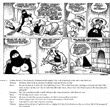
Ali Kalkanci fulfilled all the contemptible expectations one had of the cinci hoca and, in this regard, the implications of his trial extend well beyond him. Although Kalkanci and Şahin represent a prominent case, the images of the cinci hoca's sexually libidinous behavior that fueled it are not exceptional. If anything, the Kalkanci–Şahin case amplified preexisting sentiments. Television and print media, in scandal after scandal, reproduce the image of the lustful and indecent cinci hoca. Recall, for instance, both the news program described earlier (its emphasis on the hoca's touching of the patient's chest) and the cartoon in which the young (covered) woman receives “treatment” from an impotent hoca (Figure 1). The association between the cinci hoca and sexual licentiousness has become so commonplace that the phrase the cartoon used to describe the ritual practice of the hoca—the exorcising of cin (cin çıkartma, lit. “extracting cin”)—has entered popular language as an idiom for sexual intercourse. A series of satirical diary entries of a “young female member of a tarikat” published in the popular, leftist satirical magazine Dinozor illustrates this well38
Fikret Bekler, “Tarikatçi Bir Genç Kizin Hatira Defteri'nden,” Dinozor, 15 January 1997.
April 12, 1996: My toothache has gotten much worse. My mother said, “Going to the public hospital in the morning, then taking a number, then getting in line, that is too hard. Come, I'm taking you to the Shaykh.” We went. The Shaykh looked at me and said, “I am exactly what you need. What you have is not for doctors.” Then he mixed two colorless liquids together. From that a juice that was white like milk appeared.39
This is a reference to the Turkish alcohol rakı, which, when mixed with water, turns white. It is referred to by some as “lion's milk.”
May 21, 1996: I began to go continuously to the Shaykh's tekke. When my toothache continued, the Shaykh had said, “You have cin, they need to be exorcized.” Today, everyone except me was sent to the Egyptian bazaar to get supplies for muskas. The two of us remained alone. He had me take my clothes off. And he undressed himself. We were spotlessly clean, immaculate. He read prayers. Then we got into bed and extracted cin. Oh, it was beautiful.
June 15, 1996: So I could more easily exorcize cin with the Shaykh, we got married [imam nikâhı]. In the ceremony, the Shaykh's witness was a cin named Abuzer, and mine was Peter Pan. At the reception after the ceremony, Azrael [Angel of Death] gave us a little concert. The gold embroidered bath towel set that Medium Memiş40
Medium Memiş is a popular medium who often appeared on television.
A great deal can be said about the case of Ali Kalkanci, as well as the outpouring of representations of cinci hocas in the media coverage that followed. On the one hand, humorous cartoons and satirical diaries found in leftist media organizations are clearly lampooning the surging presence and political influence of pro-Islamists within state politics. Portraying the religiously conservative (who are presumed to be supporters of Islamist political parties) as immoral, duplicitous, and lacking in self-control serves both as a source of humor and, in its indignation, as a form of critique. To return to the interactional dynamic captured in Figure 1, the cartoon's humor relies on an inversion of status and authority: instead of the dominating elder male and submissive young woman, one encounters the weak and impotent religious man confronting a strong and independent woman. In contrast, especially in the less humorous instances of real life sexual harassment, the cartoon's inversion becomes unsettling.
In media scandals that portray actual young women falling prey to the uncontrollable sexual power of the hoca, the intent is not humor. Moreover, they speak toward something more than the need to protect helpless young women. If Ali Kalkanci inspired dread not only in terms of moral fear (as someone who could seduce young women) but also in regard to political power (with his associations to radical Islamists and their perceived threat to the viability of contemporary state structures of authority), a perhaps not obvious question should be posed: exactly whose authority is threatening or being threatened in accusations of sexual misconduct? In other words, is it only a question of the cinci hoca's authority and persuasiveness animating media attacks?
In an analysis of satirical magazines in Istanbul (the magazine Dinozor being one), Ayşe Öncü notes a similar set of concerns in relation to the cartoon figure of the maganda—“a ribald and bawdy…figure of derision who is totally oblivious to his own uncouth and offensive masculinity.”41
Ayşe Öncü, “Global Consumerism, Sexuality as Public Spectacle, and the Cultural Remapping of Istanbul in the 1990s,” in Fragments of Culture: The Everyday of Modern Turkey, ed. Deniz Kandiyoti and Ayşe Saktanber (New Brunswick, N.J.: Rutgers University Press, 2002), 174.
Öncü, “Global Consumerism,” 173.
It is within the same set of historical and economic conditions that we must locate the contemporary cinci hoca scandal. In this case, however, it taps not only into concerns over public sexuality and consumerism, but also into transformations in structures of gender authority. Note, for instance, that the woman in both the cartoon and the satirical diary were not merely passive objects of the hoca's persuasion. In each, it is ultimately the principal character—the young woman—leaving one hoca to go to another. With the final cell of the cartoon in particular, the story of an elder man's exploitation of a powerless young woman becomes radically subverted when the woman reveals her complicity in the affair—that she is not simply being deceived—as she leaves in search of another hoca who will satisfy her (and wear a condom). In this respect, what is threatening is neither merely the hoca's sexual appetite nor necessarily the woman's desire, but rather her willingness to abandon one man for another.
A similar dynamic appeared in the earlier mentioned connection between the cinci hoca, religious marriage (imam nikâhi), and Turkey's “sexual revolution.”43
Alpay, “Zina Çarpmasi.”
Representations of lascivious hocas and their desirous clients should not be read simply as critiques of invading Western notions of sexuality, pleasure, and desire. Beyond problems of identifying what constitutes Western desire, this was not how they were received within the neighborhoods where I worked. Although linked, sexual pleasure is not viewed as being problematic—as long as it is within marriage. In addition, it is in marriage and associated expectations of women's submission where the first dimension of our discussion becomes entangled with the cinci hoca. For instance, a news segment airing on ShowTV that described a cinci hoca being hacked to pieces for luring away a man's wife concerns not only the dangerous influence of a hoca's power, but also the woman's willful decision (however constrained) to leave her husband for another man. Hence, on the one hand, the public dismemberment of the cinci hoca stands clearly as an example and warning to other cinci hoca. On the other hand, and although we can only speculate about the fate of the man's wife, it captures a sense of threat to men's authority emerging from ongoing societal transformations. Although on the surface cartoons and satirical diaries appearing in secularist and leftist publications are utilizing accusations of widespread immorality to deride those regarded as religiously conservative (who are linked, however inaccurately, to the cinci hoca), a deeper anxiety courses through the humor. The cinci hoca, as represented in the news media, is a figure that threatens patriarchal structures of authority—submission both to one's father and one's husband—and, in his sexual relations with young women, signifies the rapidly transforming position of women within homes, the labor force, and the global economy.
MONEY: ECONOMIES OF HEALING
Inextricable from the sexual implications of the cinci hoca scandal, recurrent images of the cinci hoca as a swindling profiteer out to make a quick profit at the expense of vulnerable patients highlight a further set of anxieties arising from the economic transformations of the 1980s and, in particular, the uneven and frequently destructive repercussions of the opening of Turkey's economy to the vagaries of global capital. While charges of defrauding helpless patients have a long history, they take on a particular dynamic in contemporary Turkey that marks their divergence from older scandals. In addition, because these accusations are not unfounded, the media's focus on the cinci hocas' financial exploitation serves to confirm frustrations over making sense of the newly emerging economic order.
Broadly speaking, the practice of the cinci hoca has undergone a process of deprofessionalization and reprofessionalization since roughly the mid-19th century. Under the Ottoman Empire, many persons practicing the forms of healing represented by the cinci hoca emerged from or claimed association with such state-authorized institutions as the medrese (theological school or medresseh). Although such practices as the exorcising of jinn was certainly not part of formal medrese education (being long regarded as against orthodoxy by the ulema), oral historical data show that many medrese trained clerics—as they traveled into villages—regularly engaged in such practices. It is in such official training in or claimed association with the medrese that we see resonances of professionalism. As tarikats were banned (but certainly not eliminated) and medreses closed under the secularization reforms of the early Republic, however, the claiming of authority based on association with religious institutions took on radically different implications. In the past several decades, however, the cinci hoca has become reprofessionalized under alternative models of professionalism—what some refer to as the ticaret, or commercial, hoca. Furthermore, with the political and economic transformations of the 1980s—most notably, a military coup and the radical liberalization of the economy—this reprofessionalizing process has greatly accelerated and resulted in the proliferation of self-taught cinci hoca (although they may have received sanctioning from a noted religious figure).
Despite increasing commercialization, the cinci hoca's historical association with the religious establishment remains relevant for how the cinci hoca is positioned in relation to contemporary Islamist political mobilization. For committed Kemalists who regard themselves as defenders of Turkey's secularist future, these healers (and their patients) epitomize the increasing influence of an Islamist politics that is viewed as oppositional to the ideals of secular democracy. While the association between figures such as the cinci hoca and either Islamist politics or religious conservatism is far from self-evident, it nevertheless persists as a popular trope for denigrating Islamist politics. That the media fervor created by the Kalkanci scandal emerged soon after the leader of the pro-Islamist Welfare Party, Necemettin Erbakan, became Turkey's prime minister is highly suggestive in this respect. When one recognizes that many forms of religious healing have historical roots within the same religiopolitical structures that were suppressed with the establishment of Turkey and that are currently being mobilized within pro-Islamist circles, it is not surprising that religious forms of healing have emerged as targets of widespread antagonism.
The cinci hoca's new professionalism must also be understood in relation to the history of biomedicine in Turkey. Alongside commercialism as an emblem of authority, hocas also commonly employ medical symbols, rhetoric, and paraphernalia in their cultivation of therapeutic legitimacy. It is not surprising that physicians roundly condemn such practices as ignorant and potentially harmful to patients. This is not, however, simply an instance of concern for or competition over patients; the medical establishment's critique of the hoca, in other words, is not merely a medical critique. When one recognizes that the modernization of Turkey's medical system was a prominent site for the articulation of the state's broader modernization project (encoding many of its central themes, such as individual autonomy, rationality, faith in scientific progress, and the health of the national body), medicine's critique of religious healing folds into the larger project of marginalizing particular religious and social practices so that they can be supplanted in the name of a national image befitting a properly modern nation.44
Dole, “In the Shadows of Medicine and Modernity.”
Countering portrayals of the cinci hoca as antimodern, many contemporary hoca have thus turned toward commercialized and professionalized models of self-legitimation. In other words, and in sharp contrast to past cinci hocas' reliance on medrese authorization (or claims to medrese association), there are now healers associating legitimacy (as a healer) with the legitimacy of the financial transaction. On one occasion, while visiting Ahmet, a cinci hoca, one of these scandals serendipitously appeared on television. Clearly incensed, he explained:
If you have a certificate [of taxation]…this, this is fake. Being that they didn't pay [taxes]. If you submit an application and get a free certificate [serbest kağit]… How is this like this. Where in the world are these fakes? When you open a shop, you pay taxes, right? And I am paying. You are bound to taxes, and I am bound. If you are doing commerce are you bound? I am. Where is this swindler? Where is this?
In the case of Ali Kalkanci, the troubling scope of his financial exploitation (in the form of a massive accumulation of wealth) slowly emerged to reveal, at the opening of his trial in 1997, that he was part owner of six companies, ranging “from medicine to food, from construction to textiles and leathers.”45
Cem Eser, “Benzinciye Baskin,” Sabah, 22 January 1997.
In the context of daily discussions and arguments, then, it is the ways by which money is received and the substantial amounts of capital the hoca is able to amass that causes consternation. It is not surprising that similar indictments can be found throughout media accounts of fraudulent cinci hoca. In the ShowTV news segment discussed earlier, for example, considerable attention was drawn to the amounts of money being paid and the haggling that followed. In addition to gaining media attention, the financial dimension of the cinci hocas' practices—and the charges of fraud and swindling (dolandiricilik) that frequently ensue—is what most commonly serve as the justification for their arrest. A 5 December 2000 article in Milliyet Newspaper captures the images of the undeservedly affluent cinci hoca and his resulting arrest well:
The Channel-D news crew that moved into action based on a tip made an appointment with Hocaoğlu to have him write a muska. According to the official announcement of the crime, The Special News team went to the cinci hoca's luxury home in Karaduvar neighborhood that had a pool and resembled a villa set within a grove of citrus trees. Earlier, a female reporter who had given the cinci hoca 200 million lira…had wanted a muska written under the pretext of having a disagreement with her husband. Hocaoğlu, after getting the money, began to perform a pseudo cin-summoning session. The police in the area that had come as a precaution caught the fake hoca red-handed.46
Ali Ekber Şendha, “'Cin'i Hocayi Satti,” Milliyet, 5 December 2000.
M. Ali Birand, “Bu Kargaşayi Ancak Refah Temizleyebilir,” Sabah, 20 January 1997; Nurettin Kurt, “Sosyete Üfürükçüsü Milyarlari Üfürmüş,” Hürriyet, 26 January 2002.
“Üfürükçüler İşbaşinda,” Radikal, 23 March 1999.
“Hacilari da Dolandirmiş,” Radikal, 12 January 2000.
Kurt, “Sosyete Üfürükçüsü Milyarlari Üfürmüş.”
When it comes to the cinci hoca's insatiable lust for money, however, there is a specificity to the accusations that distinguish them from earlier scandals and locate them within particular political–economic conditions. In media accounts, as well as in repeated conversations in the course of fieldwork, critiques were grounded in two interrelated dimensions of the hoca's finances: the modes of exchange that framed healer–patient relationships and the hoca's ability to accumulate capital. In other words, although they draw on longstanding idioms of fraudulence and quackery, contemporary criticisms focus on the commercial nature of the cinci hoca's interactions, where money is exchanged for services, coupled with distrust about his or her ability to prosper financially (in trying economic times). “If the cinci hoca was a real healer,” as countless people explained, “he wouldn't take money.”51
Although most healers receive remuneration of some sort, the “real” healers do not ask for them. In these cases, money is not typically exchanged as in a commercial interaction, in exchange for services. It is rather understood as a gift that is discretely left for or passed on to the healer.
Although the interpenetration of capital economies and religious forms of healing, such as the cinci hoca, is far from surprising as an outgrowth of Turkey's capitalist development, it has nonetheless given rise to novel reconfigurations of the play between corruption and legitimacy, scandal and authenticity. As the case of Ahmet instantiates—where being a cinci hoca is a legitimate business, and hence taxable—the same forces that opened a space within the Turkish economy for a commercialized economy of healing have also created the potential for additional forms of exploitation, and legitimacy. For many, this form of legitimization is deeply unsettling and, through scandal after scandal, it becomes publicly expressed through accusations of corrupt claims to religious authority and authenticity. Around images of cinci hoca as exploitative profiteers thus converge a wider set of anxieties linked to the impact of Turkish capitalist development and, in particular, the dramatic restructuring of the Turkish economy in the 1980s. Through scandals that portray the ruthless and shameless greed of the cinci hoca—“Real healers wouldn't take money” (at least, not in the ways and to the degree that they now do)—one encounters themes of the corrupting nature of money, the degradation of an “authentic” Turkish culture (a mourned for village life), and a palpable fear of an imminent disenchantment of the world.
Paralleling the anxieties over the rationalization of the economy and its feared effects on cultural life, reactions to the cinci hoca scandal also reflect a bewilderment over and frustration with the seeming irrationality of the new economy. In attempting to gain access to the promised economic fruit of transformed economic policy, people, especially in the types of poor neighborhoods where research was conducted, were continually thwarted in their efforts to obtain secure employment, establish new businesses, and trade successfully in the stock market. More often than not, they persisted in the same economic condition as they had, but now with the burden of an unfulfilled dream. Yet, according to the news, the cinci hoca has been able to make it big. In this light, a question posed earlier can be reworded: if an ignorant man such as Ali Kalkanci can accumulate such wealth, why can't I? Thus, linked with melancholic sentiments of cultural loss and religious corruption, the cinci hoca scandal expresses frustration over something that should not be: not only were cinci hocas not meant to survive Turkish national development, they certainly were not supposed to represent a “legitimate” means of succeeding in the new economic order.
CONCLUSION: TELEVISION VIOLENCE AND THE TENACITY OF ADVERTISING
Despite their popularity as objects of media derision, it is important to bear in mind that figures such as the cinci hoca are central dimensions of local health care systems and people (from all backgrounds) seek their assistance for a variety of reasons: for the treatment of problems not defined as treatable within biomedical settings; in instances where one has no access to or cannot afford biomedical treatment; or, most commonly, alongside biomedical treatments that are seen as overly impersonal and fraught with divisions of class and authority (divisions similarly encountered, for instance, in the Babacan episode). From this perspective, going to a cinci hoca for treatment is neither necessarily an act of devotion nor a consciously strategic act of resistance against the state, but a decision driven by the desire to receive appropriate and effective care. Such forms of healing are deeply embedded in social life and, against the ostensible hopes of many, show no signs of disappearing.
Yet, the tension between what is hoped for (i.e., how the hoca is imagined and represented in the media) and the actual practices of cinci hoca has run throughout this discussion. While the broader study from which this article emerges considers specifically how healers of various sorts reformulate religious authority in relation to overarching discourses aiming at their deligitimization, recognizing the interconnection between the real and the represented hoca is crucial for understanding how the media can function as a means of social surveillance. In its influence on how hocas are regarded and how hocas practice, the media stands as a productive and imaginative site for the policing of the disreputable and undesirable.
Many healers and patients, for instance, discussed repeated instances of spousal violence or fears thereof for either continuing to practice such modes of healing or seeking the cinci hocas' assistance, each time making explicit reference to media reporting that involved such figures as the cinci hoca. With the media attention drawn to hocas, individuals seeking their care not only run the risk of being the target of local suspicion and gossip but also gamble with being caught within a nationally broadcast exposé. In addition, especially in urban contexts, as people seeking the assistance of cinci hoca move more and more frequently through neighborhoods they do not know and whose residents do not know them, local systems of social surveillance have become less effective and decreasingly significant. In this sense, the cinci hoca scandal marks the nationalization of localized systems of surveillance, with the emerging community of the nation taking up its determined role as guardian within a reconfigured national village culture.
For this reason, the attack on the cinci hoca bears a historical genealogy within Turkey's project of modernization and aligns itself with a host of other discourses aimed at eradicating marginal social and religious practices regarded as contrary to the image of a modern nation. In this capacity, the critics that see these scandals as but a form of advertising are in some ways correct, albeit for the wrong reasons. As one columnist wrote, “One note to Babacan…his program has become a broadcast that advertises the veritable hoodwinker hoca and waters, caves, and homes that are said to be extraordinary.”52
Hürol Dağdelen, “O Günler,” Yeni Asir, 21 January 2000.
Öztürk, “Cinciler, Dinciler ve Medya,” 2.
By framing the hoca as an anachronism, critics misread the relationship between the set of marginal religious practices represented by the cinci hoca and Turkish modernity. Writing about witchcraft in postcolonial Cameroon, Peter Geschiere, for instance, argues that witchcraft should not be conceptualized as a “traditional” obstacle to development; rather, in the close conceptual link between witchcraft and power, it represents a political and economic discourse located squarely within Cameroonian modernity.54
Peter Geshiere, The Modernity of Witchcraft: Politics and the Occult in Postcolonial Africa (Charlottesville: University of Virginia Press, 1997).
Jean Comaroff and John Comaroff, “Introduction,” in Modernity and Its Malcontents, ed. Jean Comaroff and John Comaroff (Chicago: University of Chicago Press), xxx. For further writing on this topic, see Jean Comaroff and John Comaroff, “Occult Economies and the Violence of Abstraction: Notes from the South African Postcolony,” American Ethnologist 26 (1999): 279–303; idem, “Alien-Nation: Zombies, Immigrants, and Millenial Capitalism,” South Atlantic Quarterly 101 (2002): 779–805. For a collection of essays indebted to the approaches of Geschiere, Comaroff, and Comaroff, see Birgit Meyer and Peter Pels, ed., Magic and Modernity: Interfaces of Revelation and Concealment (Stanford, Calif.: Stanford University Press, 2003). To this could also be added Michael Taussig's description of the power of magic and sorcery in colonial imaginations of Indian wildness in southwest Colombia in Shamanism, Colonialism, and the Wild Man (Chicago: University of Chicago Press, 1987).
That is, the critics ignore the simultaneously alluring and repulsive qualities of the cinci hoca both as the transgressor of prohibitions and as a particular knot within Turkish modernity that condenses a series of unsettling social anxieties. The figure of the cinci hoca thus points beyond the ostensible desire to eradicate “backward” and “ignorant” social practices. On the one hand, through the condemnation of cinci hocas (and their potential clientele), a set of prohibitions is asserted that constitute an ideal image of a modern, national community. On the other hand, such scandals hold the ability to condense a series of contentious debates concerning reconfiguring notions of sexual propriety, transforming economic conditions, a perceived threat to the institution of the family, the degradation of a social harmony issuing from an idealized village life, a resurgent Islamist political mobilization, and the implications of each of these for the persistence of inherited systems of authority. As an object of fascination and animosity, the cinci hoca becomes in many regards a necessary figure of Turkish modernity through which its boundaries are marked, its margins are enforced, and the unity of a national political imagination is rearticulated.
Rather than reading the image of the cinci hoca in relation to Turkish modernity as a symptom of its failure (the persistence of an underlying “traditional” core, as loathsome as it may be), I have taken it as a figure of modernity that serves to stage state authority and enact its position as sovereign protector. As such, the attempt to eliminate cinci hocas in the name of the modern transforms into a reliance on their presence so that they can then be disavowed. Not only is the cinci hoca not a threat to Turkish modernity and state authoritarianism, but the repeated performance of disavowal in many respects serves to sustain them. The actual elimination of figures such as the cinci hoca can thus be regarded as more of a threat to the imagined unity of Turkish modernity than their persistence.
Author's note: The research for this article was made possible through generous support from the National Institute of Mental Health, the American Research Institute in Turkey, and the Institute of Turkish Studies. I thank Steve Caton, Aykan Erdemir, Tuğba Tanyeri-Erdemir, and other participants in the Harvard Middle East Anthropology Workshop for their comments on an early draft of this article. I am particularly grateful to Nuri Kurtcebe for his willingness to revisit and expound upon his earlier graphic commentaries, as well as Michael Meeker for offering insightful comments concerning aspects of my argument. I also thank Thomas Csordas, Mary-Jo DelVecchio Good, Byron Good, Sarah Pinto, Mark Soileau, Jonathan Sadowsky, Atwood Gaines, Charlotte Ikels, Neslihan Tok, Nurdan Atalay, Micah Parzen, and Joy Howard for their input at various stages of this project. My deepest gratitude goes to all those who cannot be named here but who generously offered their kind hospitality and patiently endured my consummate naivete.