Carbapenemase-producing carbapenem-resistant Enterobacterales (CP-CRE) are a major public health threat.Reference Bonomo, Burd and Conly1,Reference Martin, Fahrbach, Zhao and Lodise2 Their rapid and accurate identification is critical because newly available antimicrobial agents are associated with improved outcomes for CP-CRE infections, but their activity depends on the type of carbapenemase present.Reference Tamma, Goodman and Harris3 These novel agents are frequently not on automated antimicrobial susceptibility testing (AST) panels; thus, their susceptibility information is typically delayed. Rapid detection of carbapenemase genes may be useful in guiding early administration of appropriate antimicrobial therapy and for infection control interventions.Reference Traczewski, Carretto, Canton and Moore4 However, to our knowledge, there are no reports characterizing the real-world implementation of tests for rapid detection of carbapenemases in clinical isolates in the United States. Herein, we describe the implementation of a rapid genotypic carbapenemase detection test, Xpert Carba-R assay (Cepheid, Inc., Sunnyvale, CA), the molecular epidemiology of CP-CRE in our institution, and how use of the assay informed antimicrobial therapies and infection prevention investigations.
Methods
At our institution, an academic medical center in New York City where Klebsiella pneumoniae carbapenemase (KPC)-producing CRE are endemic,Reference Satlin, Chen and Patel5 we began evaluating all meropenem-nonsusceptible Enterobacterales clinical isolates in real time using the Carba-R assay in July 2018. This assay detects bla IMP, bla KPC, bla NDM, bla OXA-48, and bla VIM. Leadership from the clinical microbiology laboratory, infectious diseases (ID), infection prevention and control (IPC), and antimicrobial stewardship program (ASP) planned the implementation. Clinical Enterobacterales isolates recovered in culture that tested meropenem nonsusceptible using automated broth microdilution (MicroScan WalkAway, Beckman Coulter, Brea, CA) gradient diffusion, or disk diffusion, underwent testing using the Carba-R assay.6,7 Results from the Carba-R test were available within 2 hours. Positive results were communicated to the on-call ID fellow or stewardship pharmacist between 8 a.m. and 10 p.m. The fellow or pharmacist provided antimicrobial therapy recommendations using guidelines developed by the multidisciplinary team (Supplementary Table 1 online). The IPC team also received the Carba-R results. For patients positive for metallo-β-lactamase–producing Enterobacterales, rectal surveillance screening was recommended for potentially exposed patients who shared a room prior to initiation of contact precautions. The clinical microbiology laboratory utilized the FilmArray Blood Culture Identification (BCID) panel (BioFire Diagnostics, LLC, Salt Lake City, UT) for patients with positive blood cultures. Isolates with bla KPC detected on the BCID did not receive Carba-R testing.
We reviewed all inpatients and outpatients with meropenem-nonsusceptible Enterobacterales clinical isolates from July 1, 2018, to December 31, 2019. Only the patient’s first meropenem-nonsusceptible Enterobacterales isolate for a given species was included. Excluded specimens were rectal swabs for surveillance purposes, bla KPC positive on the BCID, or unavailable outpatient records. Non-Enterobacterales gram-negative rods were also excluded because the Carba-R assay does not detect the most common mechanisms of carbapenem resistance in these organisms.Reference Walters, Grass and Bulens8
We extracted the following patient data: demographics, comorbidities, travel history, AST results, antimicrobial therapy, hospital length of stay, and mortality. The cost per Carba-R test was estimated based on the manufacturer’s cost (M. Moy, PhD, Cepheid, Inc., written personal communication, August 2020) and technologist time (10 minutes) for a total cost of $60.9 Outcome measures included frequency of changes in antimicrobial therapy in accordance with prespecified guidelines and/or initiation of epidemiologic investigations to detect in-hospital transmission. We estimated total microbiology laboratory costs, the cost to detect 1 KPC CP-CRE and 1 non-KPC CP-CRE (calculated as the total microbiology laboratory costs to perform the test divided by the number of KPC CP-CRE or number of non-KPC CP-CRE, respectively).
Results
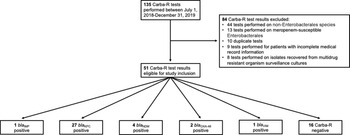
From 135 Carba-R tests performed during the study period, 51 isolates (50 unique patients) were included in the analysis (Fig. 1). Overall, 35 of 51 isolates (69%) were positive for a carbapenemase gene on the Carba-R assay; whereas 16 of 51 isolates (31%) did not have 1 of the 5 carbapenemase genes detected. The following genes were detected: bla KPC (n = 27), bla NDM (n = 4), bla OXA-48 (n = 2), bla VIM (n = 1) and bla IMP (n = 1).
Study flow chart and epidemiology of CP-CRE isolates detected by the Xpert Carba-R test.

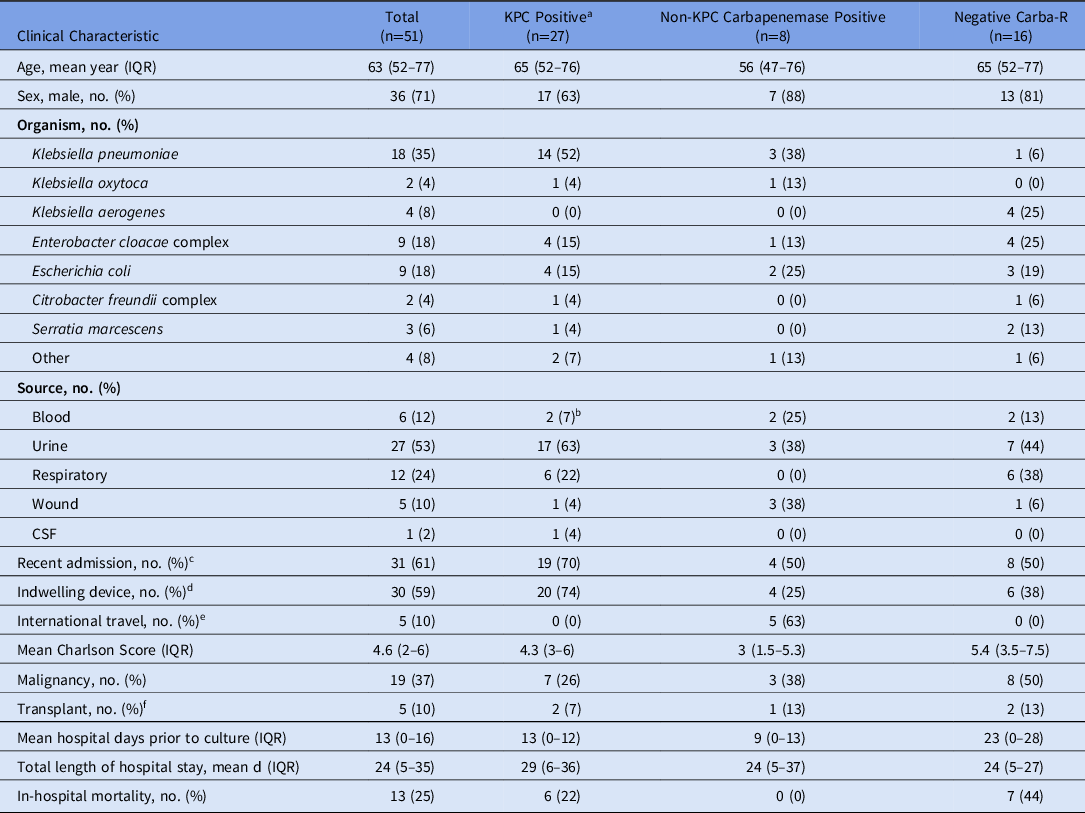
The clinical characteristics of our patient population are displayed in Table 1. Among the 35 CP-CRE isolates, K. pneumoniae was the most frequent species (18 of 35, 51%). For the overall cohort, high Charlson comorbidity indices, recent hospitalization, indwelling hardware, presence of malignancy, and prolonged hospital lengths of stay were common. Of 8 non-KPC CP-CRE isolates, a recent history of international travel was noted in 5 cases (63%). International travel was not documented for any of the bla KPC or Carba-R negative patients. The in-hospital mortality rate in the overall cohort was 13 of 51 patients (25%), including 6 of 35 CP-CRE patients (17%) and 7 of 16 patients (44%) who had Carba-R–negative isolates. There were no in-hospital deaths among the non–KPC CP-CRE patients.
Clinical Characteristics of Study Population

Note. IQR, interquartile range; CSF, cerebrospinal fluid.
a Includes KPC-positive isolates from Carba-R assay only. An additional 11 patients had KPC-positive Enterobacterales identified in positive blood culture broths using the FilmArray Blood Culture Identification (BCID) panel.
b 2 positive blood cultures where KPC was detected on the Carba-R, and not the BCID panel, included Pantoea species and Providencia rettgeri.
c Hospitalization within 90 d.
d Implantable medical device or central venous catheter.
e Recent international travel as documented in admission note or infectious diseases consultation note. All international travel was documented to occur within 1 month prior to admission. International travel cases included Montenegro (NDM), India (NDM), Bangladesh (NDM), Egypt (VIM), France (OXA-48).
f Includes solid-organ and stem-cell transplantation.
The Xpert Carba-R assay led to antimicrobial management changes in accordance with institutional guidelines in 10 of 51 patients (20%): 8 due to the detection of bla KPC and 2 due to the detection of bla NDM. None of these 10 patients received active therapy prior to the Carba-R result and the median time on ineffective therapy was 48 hours. The median time to initiation of active therapy after the Carba-R test was 3 hours. For bla KPC management changes in 8 cases, molecular results allowed appropriate initiation of ceftazidime-avibactam from culture sources that included respiratory (n = 4), blood (n = 1), urine (n = 1), cerebrospinal fluid (n = 1), and wound (n = 1). Identification of bla NDM resulted in initiation of aztreonam and ceftazidime-avibactam in 2 cases of bacteremia leading to clinical cure. Among 25 patients with positive Carba-R results who did not have an antibiotic management change, the following reasons were given: colonization (72%), already receiving effective therapy (24%) and deceased prior to Carba-R result (4%).
No epidemiologically related clusters of infection with non-KPC carbapenemases were identified. Among the 4 patients with bla NDM-positive isolates, 3 roommates were identified with potential exposure prior to recognition of bla NDM. All 3 of these patients were screened and were negative for CRE. No exposed roommates were identified for patients with other metallo-β-lactamases. The estimated cost for Carba-R testing of CRE during the study period was $3,060. The laboratory costs to detect 1 KPC CP-CRE and 1 non-KPC CP-CRE were $113 and $383, respectively.
Discussion
We have demonstrated the implementation and impact of a rapid molecular assay to detect CP-CRE at an academic medical center in a CRE-endemic region of the United States. The Carba-R assay led to antimicrobial management changes in 10 of 51 cases (20%) and epidemiological investigations in 2 of 51 cases (4%). Our experience exemplifies the importance of integrating laboratory diagnostic tests with ID, IPC, and ASP. Direct communication between the clinical microbiology laboratory and ID providers allowed for results to be rapidly interpreted and acted upon. Results were particularly useful in cases where bla NDM was detected allowing for targeted therapy against metallo-β-lactamases and epidemiological investigation.
Although interventions were made in a minority of cases, the cost to detect 1 non–KPC CP-CRE was ˜$400. Given the clinical and epidemiological implications of missed identification of a non-KPC CRE this may be a reasonable investment for some hospitals. Furthermore, with potentially less expensive detection technologies, such as lateral flow immunoassays, or targeted testing of clinical isolates based on travel history, cost-effectiveness may be improved.Reference Jenkins, Ledeboer and Westblade10
This study has several limitations. As a single-center retrospective study in New York City, generalizability to other settings may be limited. The overall number of patients with CRE was modest and thus conclusions could not be drawn about outcome differences. Despite these limitations, our work provides a valuable model for the real-world, multidisciplinary implementation of a molecular diagnostic tool to recognize and respond to the complex molecular epidemiology of CP-CRE.
Acknowledgements
We acknowledge the technical excellence of the medical technologists in the NewYork-Presbyterian Hospital/Weill Cornell Medical Center clinical microbiology laboratory.
Financial support
No financial support was provided relevant to this article.
Conflicts of interest
L.F.W. reports consulting fees from Roche Molecular Systems, Inc. and Shionogi, Inc., and grants from Accelerate Diagnostics Inc., BioFire Diagnostics LLC, and Hardy Diagnostics. M.S.S. has received consulting fees from Roche Diagnostics. M.J.S. reports consulting fees from Shionogi Inc. and Achaogen Inc. and grants from BioFire Diagnostics LLC, Merck&Co, Inc., and Allergan Inc., and compensation for data and safety monitoring board participation from Spero Therapeutics Inc. All other authors report no conflicts of interest relevant to this article.
Supplementary material
To view supplementary material for this article, please visit https://doi.org/10.1017/ice.2021.6