Elections are the main mechanism through which citizens make their preferences heard in a democracy. However, not everyone who can vote chooses to do so. This is a problem, inasmuch as a “core assumption of liberal democratic theory is that … those who participate in the political process will have better representation of their interests than those who do not participate” (Avery Reference Avery2015, 956). According to Lijphart (Reference Lijphart1997), such inequalities in participation constitute a democratic “dilemma.” If large groups exclude themselves persistently enough, they may skew public policy against them. Thus, what matters is not so much the level of overall participation but rather the bias in turnout between different population groups.
Along these lines, class bias is a central concern: if the rich vote more, they may get more than their due in the policy process. The underlying mechanism for this intuition is captured in Meltzer and Richard’s Reference Meltzer and Richard1981 model, in which the level of redistribution is determined by the median voter. If the poor vote less than the rich, the median voter will be richer than the median income earner, and therefore demand less redistribution. A similar logic can be applied to other forms of participation bias. For instance, if the median voter is older than the median adult, then policy outcomes may be skewed in favor of the interests of older voters.
Though many initiatives to increase electoral participation exist, the most radical of all is compulsory voting. In theory, if everyone votes, then no turnout bias can exist, and everyone will be equally well represented. Conversely, a move from compulsory to voluntary voting should increase turnout bias, unless all social groups have an equal propensity to vote. Compulsory voting is thus thought to be equality-enhancing, inasmuch as it forces groups who would otherwise vote less—such as the young or the poor—to go to the polls, and thereby increase their political influence.
We will here argue, however, that this reasoning is flawed in many real world circumstances, where compulsory voting is coupled with only intermediate levels of effective turnout. Indeed, this is the case in many Latin American countries, where voting is compulsory and yet turnout ranges between 55 percent and 80 percent of the electorate.Footnote 1 In such cases, turnout biases are already likely to exist despite the presence of compulsory voting; moreover, the removal of compulsory voting may affect these biases in unexpected ways, either increasing or decreasing them.
To substantiate our argument, we contribute evidence from Chile, a country that enforced a compulsory voting system until 2012, the year it switched to a voluntary voting system. Chile’s previous system had a distinctive feature: though voting was compulsory and generally well enforced, registration in the electoral rolls was voluntary and yet irreversible: once enrolled, there was no opting out. Though the rule was adopted for purely strategic reasons at the end of the 1980s, over time it created unforeseen imbalances in the composition of the electorate, which became substantially older than the population average, since younger generations who came of age chose not to register.
Though Chile’s institutional setup may have been unique, the problem of nonuniversal participation under compulsory voting is not. Thus, it is important to study actual transitions from compulsory to voluntary voting to see how they affect turnout bias. The case of Chile is also of interest because, as we will show, the fall in participation after the introduction of voluntary voting was significant. In such a context, most theorists would expect such a large drop in turnout to lead to a significant increase in turnout bias among different social groups.
The goal of this study is to give an overall assessment of how the change in the voting rule affected the structure of turnout, with a focus on the potential class, age, and territorial biases introduced or attenuated by the reform. In other words, did Chile’s abandonment of compulsory voting lead to an intensification of class and other biases, such that its electorate became less representative of its overall population?
While some research has already analyzed the effects of this reform on turnout in Chile (e.g., Barnes and Rangel Reference Barnes and Rangel2018; Contreras et al. Reference Contreras, Joignant and Morales2016), we believe this study improves on them in several ways. First, it explicitly considers the effect of the reform on the age gradient, something that previous studies have so far either ignored or have examined in isolation from other determinants of turnout (e.g., Cox and González Reference Cox and González2016). Given the critical situation of the prereform youth vote in Chile (see below), this is especially important for an overall evaluation of the reform’s effects.
Second, in addition to local elections, the analysis incorporates evidence from national ones. This is important because the link between biased turnout and unequal influence is of special concern in national elections, when most significant policy decisions are made. Relatedly, we differentiate effects by election type instead of assuming that effects are homogeneous across all elections, something that reviews of the extant turnout literature have explicitly called for (Cancela and Geys Reference Cancela and Geys2016). We also broaden the temporal scope of the analysis by including the last four municipal elections and the last four presidential elections. In each of these cases, the first two elections were conducted under the old compulsory voting rule and the last two under the new voluntary voting rule. By considering turnout patterns over eight (local and national) elections, we seek to provide a more balanced understanding of the reform’s long-term effects and to avoid drawing conclusions from single elections that may have been idiosyncratic in some respect.
Third, we include a more diversified set of control variables and, critically, use more robust estimation methods. This allows us to separate the question of bias levels for any given variable (e.g., class, age, territorial factors) from the question of the direction of change of those biases after the introduction of voluntary voting.
This article argues that the reform, despite causing a large decrease in turnout, significantly and consistently moderated the age bias in both local and national elections, thus making the effective electorate more age-representative of the overall population. It also argues that in both local and national elections, the reform disproportionately depressed participation among the urban poor, but not among the rural poor. And it further argues that the reform intensified a preexisting “rural bias” (where small localities vote more than large ones) in local elections, but moderated that same bias in national elections.
Overall, therefore, we find that instead of a dramatic widening of political inequalities, the reform had mixed effects, relatively empowering the youth but disempowering the urban poor while equalizing the influence of urban and rural voters in national elections. This suggests that the overall effect of the reform may not be as detrimental to the quality of democracy as the sharp drop in turnout could seem to indicate. In other words, we argue that large decreases in turnout are not straight-forwardly related to a poorer fit between the actual electorate and the overall population. From a theoretical viewpoint, this highlights the point that the effects of changes to compulsory voting laws may be conditional on their interaction with other institutional factors and the structure of preexisting biases.
Theoretical Discussion
Whether turnout biases actually have policy consequences has been much debated, particularly concerning class bias. Many scholars have argued—particularly in the United States—that for a variety of reasons, higher turnout among the poor has little effect on policy (e.g., Ellis et al. Reference Ellis, Ura and Ashley-Robinson2006; Bartels Reference Bartels2008; Gilens and Page Reference Gilens and Page2014).Footnote 2 Nevertheless, a series of recent and geographically diverse studies offer persuasive evidence that biases in turnout do, in fact, translate into biases in policy. In Australia and Switzerland, separate studies found that the introduction of compulsory voting increased turnout among the poor and thereby increased support for leftist policies (Fowler Reference Fowler2013; Bechtel et al. Reference Bechtel, Hangartner and Schmid2016). In the United States, two studies found that states with greater class bias in turnout produce higher income inequality over time (Avery Reference Avery2015; Franko et al. Reference Franko, Kelly and Witko2016)—an argument that parallels the one made by Carey and Horiuchi (Reference Carey and Horiuchi2017) for Venezuela regarding the effect of the abandonment of compulsory voting in 1993. In addition, Fujiwara (Reference Fujiwara2015) uses a regression discontinuity design across Brazilian states to show that the introduction of electronic voting machines—which reduced voting error and produced a large de facto enfranchisement of the lower classes—translated into greater public health care spending, higher utilization of health services, and improved infant health rates.
If politicians are as responsive to voters as the literature suggests, studying the effects of compulsory voting is crucial, as it is the most radical of institutional mechanisms available to increase participation. In this regard, the effect of compulsory voting on overall turnout is fairly clear. One of the most consistent findings is that compulsory voting increases turnout, usually raising participation at least ten percentage points relative to voluntary voting (Stockemer Reference Stockemer2017, 704; see also Cancela and Geys Reference Cancela and Geys2016; Fornos et al. Reference Fornos, Power and Garand2004). The more interesting—but difficult—question, however, regards the effect of compulsory voting on the relative participation of different groups; that is, on class and other forms of bias.
The standard assumption is that inasmuch as compulsory voting raises participation rates and helps a country to approach near-universal turnout, it automatically flattens preexisting voting inequalities. At the extreme of this argument, if everyone votes, no turnout bias is possible. This is the logic of Gallego’s findings (Reference Gallego2010) regarding the attenuation of class bias under compulsory voting, in her study covering 28 advanced democracies. Since the literature shows that higher education, income, and age are all, on average, predictors of higher participation (Haime Reference Haime2017; Smets and van Ham Reference Smets and Van Ham2013), it is precisely among the least educated, poorer, and younger that the effect of compulsory voting might be most relevant—which is consistent with the aforementioned studies of Fowler (Reference Fowler2013) and Bechtel et al. (Reference Bechtel, Hangartner and Schmid2016) on the Australian and Swiss experiences with compulsory voting. It seems to follow that lower turnout levels imply higher inequalities, so that drops in participation due to the abandonment of compulsory voting lead to larger turnout biases.
We suggest, however, that even though this connection between compulsory voting and absence of significant turnout biases may be true when participation is, in fact, close to being universal, it does not necessarily hold when it is not. The problem with this hypothesis is twofold. First, it assumes a monotonic relationship between higher turnout and lower participation bias: as more people vote, the less room there seems to be for turnout bias between groups. Yet this is not always the case. As Berinsky (Reference Berinsky2005) shows for the United States, some measures to increase electoral participation, such as absentee or early voting—conducted under the impression that they would help equalize turnout between groups—did manage to raise participation, but only by making better-off voters vote more steadily, rather than by increasing the participation of the poor. Thus, higher participation was coupled with higher turnout inequality between rich and poor.
Second, the argument assumes that specifically compulsory voting disproportionately increases the participation of the poor (and less vote-enthusiastic groups more generally). However, that may not always be the case. For instance, it has been shown that in Brazil, the specific way nonvoters are sanctioned for failing to vote (e.g., refusal of state services, such as obtaining a passport, rather than having to pay an expensive fine) induces higher compliance among the rich than among the poor, thus increasing turnout bias as compared to voluntary voting (Cepaluni and Hidalgo Reference Cepaluni and Daniel Hidalgo2016; see also Power Reference Power2009). We would therefore expect that if Brazil abandoned compulsory voting, turnout bias between rich and poor would decrease.
In fact, this case suggests that where compulsory voting laws interact with other institutional features, the assumption that compulsory voting equates to either near-universal participation or absence of turnout biases may be misplaced. In such cases, a switch to voluntary voting may shift class, age, and other biases in unexpected ways. In sum, it is not obvious that either higher participation or compulsory voting laws will reduce turnout bias. This will depend on both the “natural” propensity to vote of different social groups and the electoral rules in place (such as allowing early voting, registration procedures, kinds of penalties for not voting, and enforcement thereof) that may impact the costs of (not) voting differentially across such groups.
The Chilean Reform
Between 1990 and 2012, Chile had compulsory voting coupled with voluntary voter registration. This meant that voting was compulsory only for those who voluntarily registered on the electoral roll. Once registered, however, there was no exit. The origins of this system can be found in the organization of the 1988 plebiscite that ousted the military dictatorship. The electoral designer at the time thought that voluntary registration would discourage citizens from registering and would thereby work in the government’s favor (Huneeus Reference Huneeus2006, 15). However, that bet failed: thanks to the democratic opposition’s mobilization and the extraordinary salience of the vote, near-universal registration was achieved. This meant that almost anyone in Chile who was 18 or older in 1988 was both registered and “locked in.” Thus, during the early years of democracy, compulsory voting indeed led to near-universal participation.
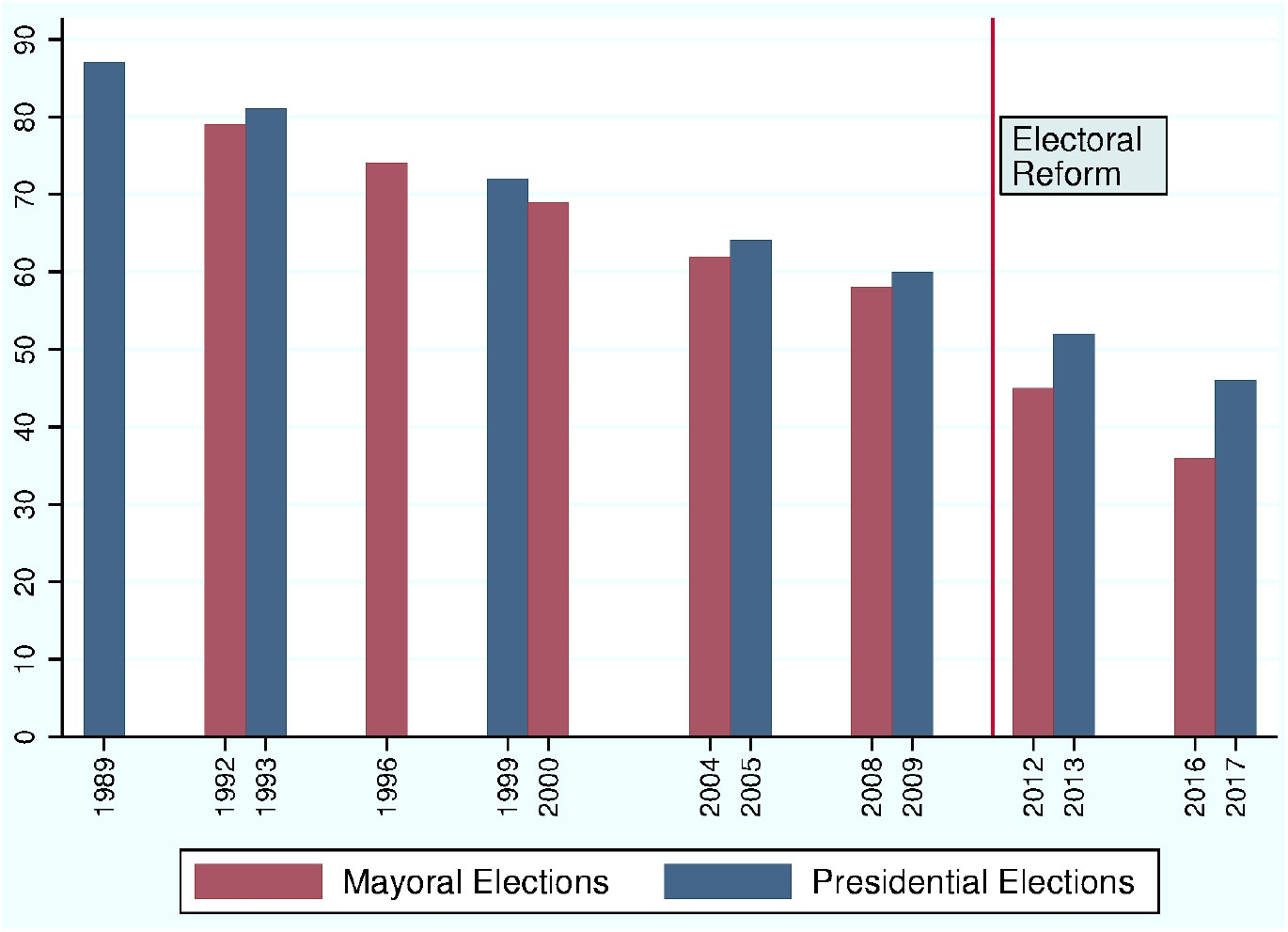
As the years passed, however, new generations who came of age mostly did not register and thereby excluded themselves from the system. While the registering procedure itself was not particularly tedious, the register closed 120 days before election day, which meant that by the time people started paying attention to the election, the possibility of registering was already closed (Navia Reference Navia2004). As figure 1 shows, voting as a proportion of the adult population decreased steadily between 1989 and 2009, but that decrease was almost entirely explained by the gradual increase in the nonregistered population, since registered voters mostly complied with compulsory voting. (Turnout was stable around 90 percent among registered voters throughout the period.)
Participation in National and Local Elections as a Percentage of the Voting-age Population, Chile, 1989–2017

Inasmuch as some young people did register to vote, the composition of those younger cohorts was heavily class-biased. Corvalán and Cox (Reference Corvalán and Cox2013) note that in 2005, in the municipalities of the capital city (Santiago), the rate of registration of 18- and 19-year-olds ranged from about 5 percent in poor La Pintana to over 50 percent in wealthy Vitacura. Using survey data, they estimated that turnout among those who came of age after 1988 was less than 40 percent in the 2006–2010 period, as opposed to sustained high participation among the older cohorts. Thus, though age bias is a regular feature of democracies under voluntary voting, Chile, despite its mandatory voting law, had one of the most “lopsided” electorates in Latin America by the late 2000s (Corvalán and Cox Reference Corvalán and Cox2013, 61; see also Toro Reference Toro2008). This has led some authors to analyze Chile in terms of two electorates divided by the 1988 plebiscite as a political and generational watershed (Contreras and Navia Reference Contreras and Navia2013; Huneeus et al. Reference Huneeus, Lagos and Díaz2015). Because these two electorates did not, and do not, share the same political views, this bias in participation was not neutral in terms of political representation (Carlin Reference Carlin2006; Huneeus et al. Reference Huneeus, Lagos and Díaz2015; Toro Reference Toro2008).
In 2012, the Chilean Congress approved a voluntary voting system with automatic registration. This meant that the registered population increased overnight from about 8.1 million to about 13.4 million, dramatically enlarging the electorate. Given that most unregistered voters were under the age of 35 at the time, it was expected that this would help correct the electorate’s increasing age bias. Moreover, many politicians thought that the increase from automatic registration would more than offset any potential drop in voters caused by the shift from mandatory to voluntary voting. Indeed, “President Piñera touted [the prediction] that the 2012 municipal elections would have the highest turnout in Chile’s history” (Barnes and Rangel Reference Barnes and Rangel2014, 570). Things turned out otherwise: as figure 1 shows, voluntary voting participation dropped substantially in local elections, with a cumulative drop of 23 percentage points in turnout between 2008 and 2016. National elections fared somewhat better: the cumulative net loss of votes was about half a million (as opposed to about 2 million in local elections).
It should be noted, however, that the overall effect on turnout varied widely among different types of electoral districts. As Brieba (Reference Brieba2015) shows for the 2012 municipal elections, in districts with fewer than 50,000 voters, the average drop in participation from the previous local election was a mere 1 percent. In larger, urban districts, the fall was 19 percent, while in the Greater Santiago electoral districts, the average fall reached 26 percent (see also Barnes and Rangel Reference Barnes and Rangel2018). This suggests that a territorial focus that pays attention to subnational variation in voting patterns is warranted.
Though the net effect of the reform was negative for turnout, the two parts of the reform worked in opposing directions. As Cox and González (Reference Cox and González2016) note, each was relevant to a different part of the population: automatic registration was only relevant to the unregistered, while voluntary voting was mainly relevant to the registered. Using official, individual-level data, the authors estimate that for the 2013 presidential elections, about one million new voters were causally attributable to automatic registration, while approximately 1.6 million people ceased to vote because of voluntary voting. This implies a negative net effect but also high rotation levels within the electorate, thus raising questions about its new composition. Significantly, the authors found that almost all the new voters were below 45 years of age, while 80 percent of “leavers” were older than 40. This resulted in a substantial moderation of the voter age gradient in that election.
Nevertheless, most of the debate surrounding the reform has centered on the possible apparition or intensification of class bias due to voluntary voting. In this regard, an initial wave of studies after the 2012 municipal election reached opposing conclusions. While some studies confirmed the existence of class bias (Contreras and Morales Reference Contreras and Morales2015; Mackenna Reference Mackenna2015), others suggested that there was no consistent relationship (Ramírez Reference Ramírez2015), that it was negative (Bargsted et al. Reference Bargsted, Valenzuela, De la Cerda and Mackenna2015), or that it was conditional on district size (Brieba Reference Brieba2015). All these studies used district-level data, except for Mackenna Reference Mackenna2015, which used individual-level survey data, and Contreras and Morales Reference Contreras and Morales2015, which used both. It is probably not a coincidence that precisely these last two studies found positive class bias while most others did not.
If class bias appeared in large urban districts but not in rural ones, then one would expect survey-based data to show class bias if the electorate is heavily urban (as in Chile), so that the mere weight of urban numbers would overshadow any neutral or opposing tendency among the small rural population surveyed. Conversely, since most electoral districts are rural, weighing all districts equally would swamp the minority urban data points in the majority rural ones. It is therefore important to allow for class effects to vary among district types.
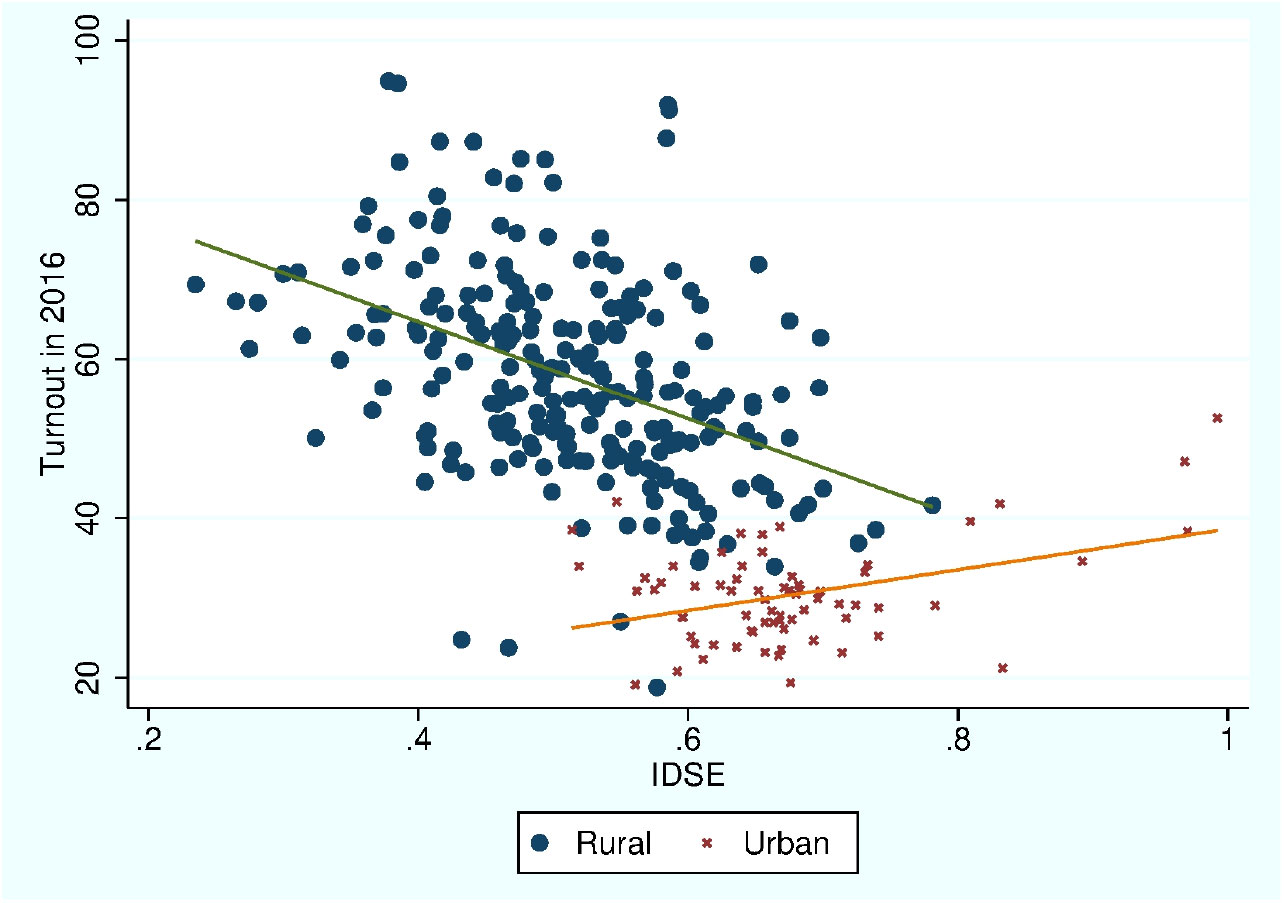
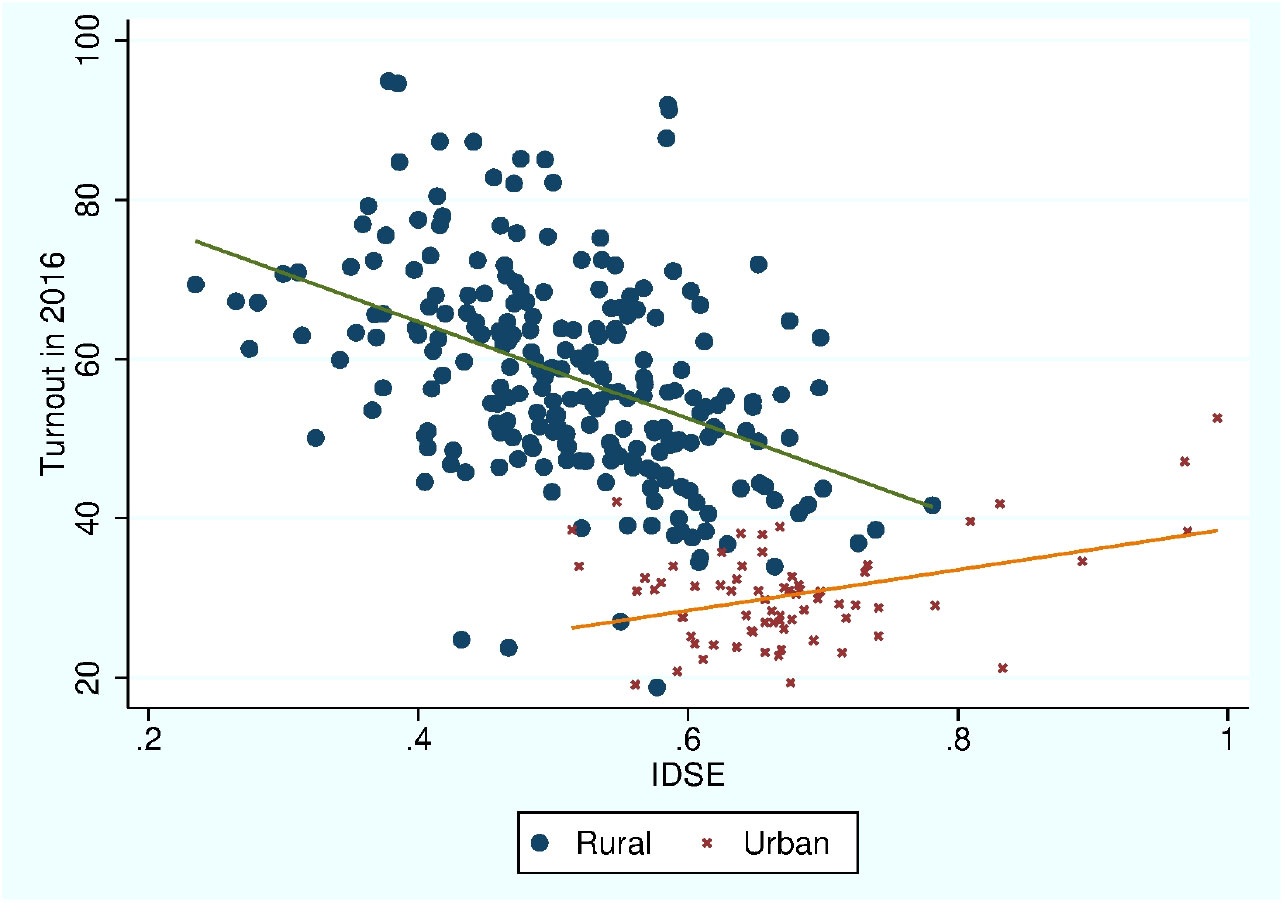
Indeed, visual inspection of the data suggests that this may be useful. Figure 2 shows a scatterplot between turnout in the 2016 mayoral elections and a district-level class indicator. The data show an opposing trend between urban and rural districts, whereby rich urban districts vote more than poor urban ones but poor rural districts vote more than their richer counterparts.
Turnout Trends in the 2016 Mayoral Elections, Controlling by Class
In a more recent study of the Chilean reform, Contreras et al. (Reference Contreras, Joignant and Morales2016) also found class bias, but only in larger, mostly urban districts (defined as those with at least 70,000 voters). The authors found that in these larger districts, income and education positively predict turnout levels. Moreover, they argue that this relationship was mediated by electoral competition levels, so that when competition between the two frontrunning candidates was high, the rich and poor voted at similar levels, but when it was low, the rich voted more. While suggestive, their results are based on ordinary least squares (OLS) estimations using data from the 2012 and 2008 elections only.
Similarly, Barnes and Rangel (Reference Barnes and Rangel2018) show that with the introduction of voluntary voting, turnout in local elections became much more sensitive to electoral competition levels, though they did not interact competition with socioeconomic variables. They also found that district size gained substantial importance as a predictor of turnout with the introduction of voluntary voting. This makes sense from a rational choice perspective, wherein a smaller district size increases the voting power of individual voters. Here, too, however, their only source of post–voluntary voting data was the 2012 municipal elections. It is thus unclear that their results also hold for the 2016 elections or even for national elections, where this rational choice dynamic does not theoretically apply (since all votes weigh the same when there is only one district).
More generally, it is important not only to determine whether there is class or other sorts of bias in a single election, but also to compare biases between elections to determine the direction of change. For this, a longer timeframe—and different election types—allow us to gain greater confidence in the stability and robustness of any findings.
Data
For our analysis, we consider two types of elections, local and national. For the former we look at mayoral races and for the latter at presidential ones. While mayors are elected through simple majority (the candidate with the most votes wins), presidents are elected through absolute majority (a runoff takes place if no candidate gets more than half the votes in the first round). For presidential elections, we use first-round turnout data. For both local and national elections, we include the last two elections held under a compulsory voting system (CVS) and the first two held under a voluntary voting system (VVS). Since the electoral reform took place at the start of 2012, we use 2004, 2008, 2012, and 2016 for local elections and 2005, 2009, 2013, and 2017 for national ones. The most basic electoral district in Chile is the comuna, the total number of which is 345. We use 305 of these electoral districts as the unit of analysis.Footnote 3
Table 1 shows the list of variables used to test our hypotheses, their definitions, and their measurements. The dependent variable is turnout, which is the number of voters divided by the estimated voting-age population (VAP). The eligible voting population varies across electoral systems: under CVS it is given by the total number of people registered to vote; under VVS it is given by the total number of people at least 18 years of age (i.e., the VAP). Thus, to avoid introducing bias in the estimator, we use the VAP for all elections alike and use it as the common denominator.
List of Variables

The independent variables are subdivided into four groups. The first group considers territorial variables. The primary objective of this group is to control for changes in the size and distribution of the eligible electorate. Previous literature has consistently found that as the size of the electorate grows, turnout rates will decrease, and that this effect is accentuated in subnational elections (Cancela and Geys Reference Cancela and Geys2016). The main independent variable of interest is the VAP; we use its natural logarithm to detect any latent nonlinear relationships. As a control, we include the number of registered voters (register), to correct for the fact that people do not always vote where they live; also, under CVS, the register determined who could vote. Thus, we expect this variable to be positive in all cases, but more so under CVS. We also control for the density of each district, as rural voters may find it harder to vote.
The second group of independent variables considers sociodemographic factors. The main independent variables are age and class. Age is simply the average age of the district. Class is a socioeconomic index constructed at the district level by indicators of economic (monthly per capita income and poverty rates), educational (average years of schooling), and housing and sanitation conditions.Footnote 4 We believe that this is a more robust indicator of class than either education or income on their own and is therefore preferable to either.
Moreover, as this index is built by averaging each district’s information over three waves (2006, 2009, and 2011) of CASEN, Chile’s national household survey, each district’s score is more precisely calculated, as many districts are small and sample error in them is large in any single survey. Thus, our socioeconomic index does not vary over time. As relative socioeconomic conditions between districts change slowly over time, this fixed measure avoids misattributing changes in this variable to what is mostly measurement noise between surveys. The overall hypothesis is that as age rises and socioeconomic conditions improve, turnout will increase.
The third group considers electoral variables. The hypotheses are that when an incumbent is present and when there is a high level of competition between the top two vote getters, turnout will increase.Footnote 5 We use this group of variables only for local elections, since presidential elections imply a single race across all districts.
We also control for geographical factors. Specifically, we introduce two dummy variables to allow for the possibility that large urban districts may have been affected differently by the reform than rural districts, over and above the effect captured by the territorial variables discussed above. We interact these dummies with class to test whether class bias is conditioned by location, as previous authors have argued (Brieba Reference Brieba2015; Contreras et al. Reference Contreras, Joignant and Morales2016). The hypothesis is that class bias is greater among urban than among rural voters. Thus, we introduce a capital city dummy for Santiago’s 34 districts and a large cities dummy for the 34 non-Santiago districts with at least 60,000 eligible voters, plus the respective class interaction terms. These 68 “urban” districts represent roughly 20 percent of all districts but about 70 percent of the total population.Footnote 6
Methods and Estimation Techniques
Our primary objective is to assess the impact the 2012 reform had on the structure of turnout. To do this, we proceed in two steps. First, we apply OLS regressions with robust standard errors to look separately at each of the last four local and national elections. Our aim is to compare how the variable coefficients in our model changed within and across these elections and before and after the introduction of voluntary voting. This allows us to gain an overall impression of how class, age, and territorial biases evolved over time and across election types.
In our second step, we formally estimate the effect of the introduction of voluntary voting on turnout biases. To do so, we go beyond previous studies of the Chilean reform (Barnes and Rangel Reference Barnes and Rangel2018; Contreras et al. Reference Contreras, Joignant and Morales2016) and estimate two-way panel fixed effects models. Since this technique only uses within-unit variation in estimating the effect of the independent variables on the outcome, it is a particularly exacting test, as most of the variation in our dataset comes from differences across districts. Nevertheless, it has the major advantage of controlling for all omitted variables that do not vary over time. Since reviews of the turnout literature have highlighted the diversity of variables used by different authors and have concluded that no “core model” of turnout has yet been established (Smets and Van Ham Reference Smets and Van Ham2013), fixed effects provide much greater protection against omitted-variable bias. As a final check, we then split the sample to detect any heterogeneous effects between rural and urban districts.
Results
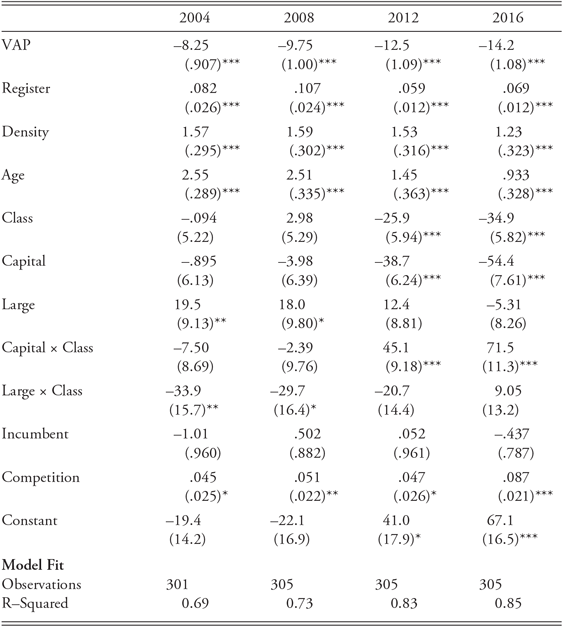
We first estimate an identical model for each election of the same type (local or national), using the variables specified above. Table 2 shows the OLS estimates of determinants of turnout for each of the four local elections. Starting with the territorial variables, we see that population size is negatively correlated to turnout. However, the magnitude of the VAP coefficient increases substantially after voluntary voting is introduced. In fact, this variable alone is mostly responsible for the marked increase in the R-squared coefficient after the introduction of voluntary voting. In other words, the preexisting “small-district bias” seems to have intensified after the reform.
Determinants of Turnout in Local Elections (OLS)

* p < 0.1, **p < 0.05, ***p < 0.01.
Method: Ordinary Least Squares. Dependent variable: turnout. Display: coefficients; robust standard errors in parentheses.
Turning to the sociodemographic variables, age is, as expected, a consistent predictor of turnout. Through all the observed period, older voters are significantly more likely to cast a vote than younger voters. However, there is a large decline in the coefficient’s magnitude after voluntary voting is introduced. By 2016, an increase in one year in average district age impacts turnout points less than half as much as it did in 2008.
Equally notable are the trends in class bias. Contrary to usual expectations, a negative class bias appears outside large cities, as shown by the Class coefficient, which becomes negative and significant in 2012 and 2016. Given that the class variable is also interacted with Santiago (Capital x Class) and with other cities (Large x Class), Class on its own shows the value for the omitted category—the rural districts. Thus, after the reform but not before it, people in lower-class rural districts were more likely to cast a vote than people in higher-class rural districts.
However, the reverse holds true for urban voters. Before the reform, there was no significant difference in turnout between rich and poor districts in the capital city. But after the reform, turnout decreased less for richer districts than for poorer ones. By the same token, the negative class bias visible in regional cities (Large × Class) before 2012 disappears after the reform. In this sense, the direction of change in those cities was like Santiago’s. In sum, in urban settings, the reform seems to have decreased the vote of the poor the most.
Furthermore, the electoral variables show only a weak relationship to turnout. Incumbency is always zero, while competition is always significant, but its magnitude is very small: a race that becomes 10 points closer implies an increase in turnout of between only 0.5 and 0.9 percentage points, depending on the year.
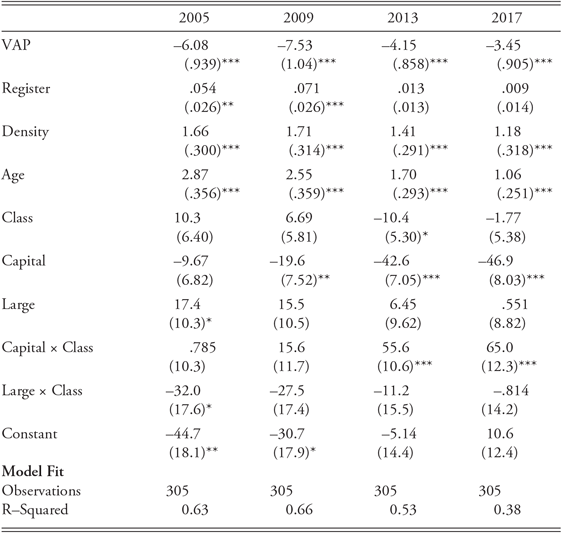
Table 3 shows the OLS determinants of turnout for national elections. The main difference from the local election models is that the national models exclude the electoral variables, since a presidential election is a single, nationwide competition.
Determinants of Turnout in National Elections (OLS)

Method: Ordinary Least Squares. Dependent variable: turnout. Display: coefficients; robust standard errors in parentheses.
In general, both models exhibit similar trends. For instance, they show that the gap between younger and older voters closes considerably after the 2012 electoral reform. A positive class bias again appears in Santiago after the reform, even as the negative class bias in regional cities disappears. While this largely mirrors the local-level findings, there is now no evidence of a negative rural class bias forming after the reform.
There is, however, one major difference between local and national results. In presidential elections, the magnitude and significance of the VAP coefficient becomes smaller after the reform. In fact, its 2017 value is about half what it was in 2009. In other words, the reform seems to have caused less inequality in turnout between small and large districts, while in local elections the opposite trend was evident.
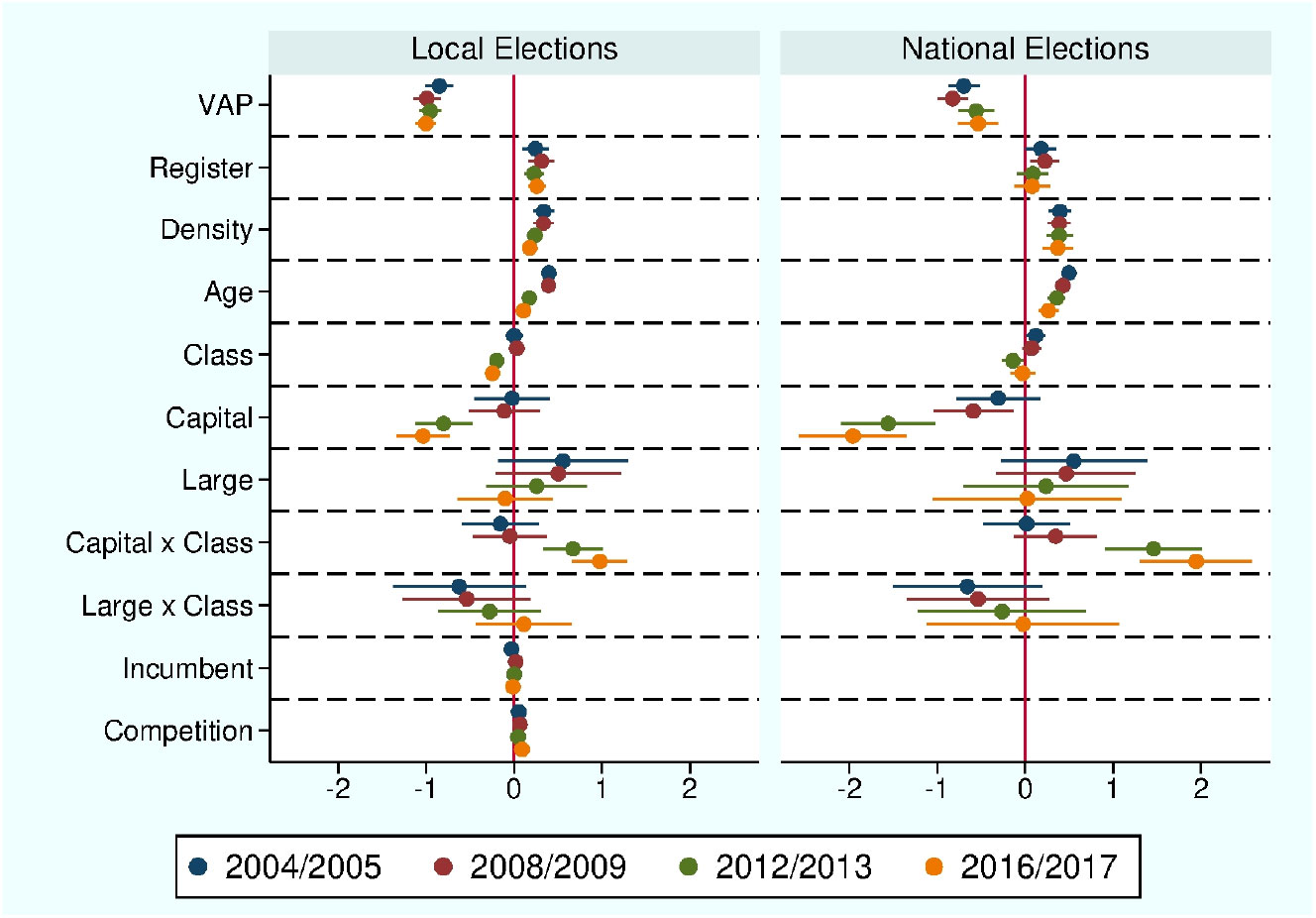
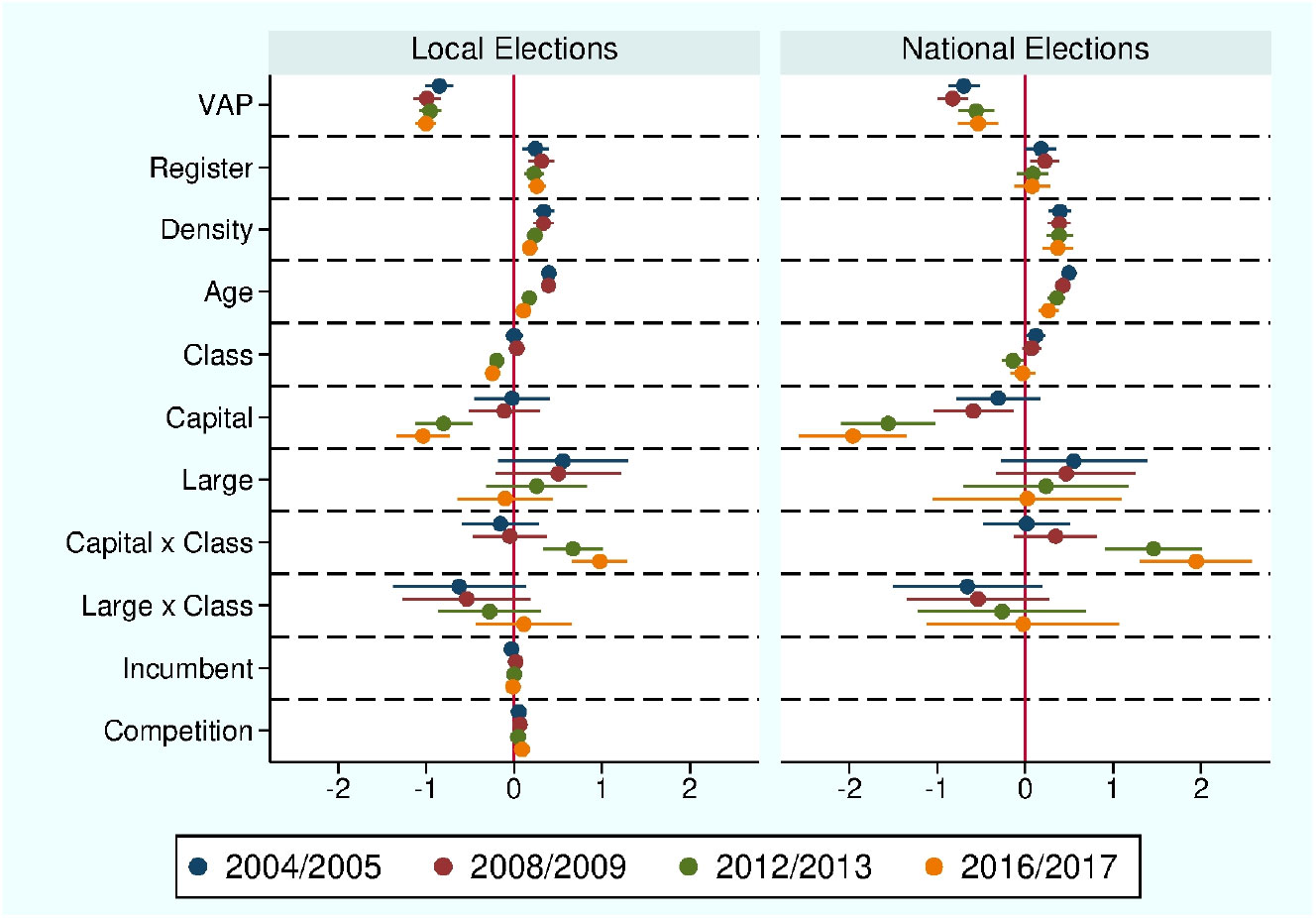
To complement these results and give an idea of the relative importance of each of these variables in affecting turnout, figure 3 presents the standardized or beta coefficients for all regressions. Among continuous variables, we can see that in both kinds of elections, district size and age are comparatively important predictors of turnout—the former more so in local elections and the latter especially under compulsory voting. On the other hand, competition has a very minor impact on turnout. Among dummy variables (whose distribution is very different from continuous variables and hence less comparable to them), the interaction of class and Santiago acquires importance from 2012 on in both kinds of elections.
Determinants of Turnout in Chile
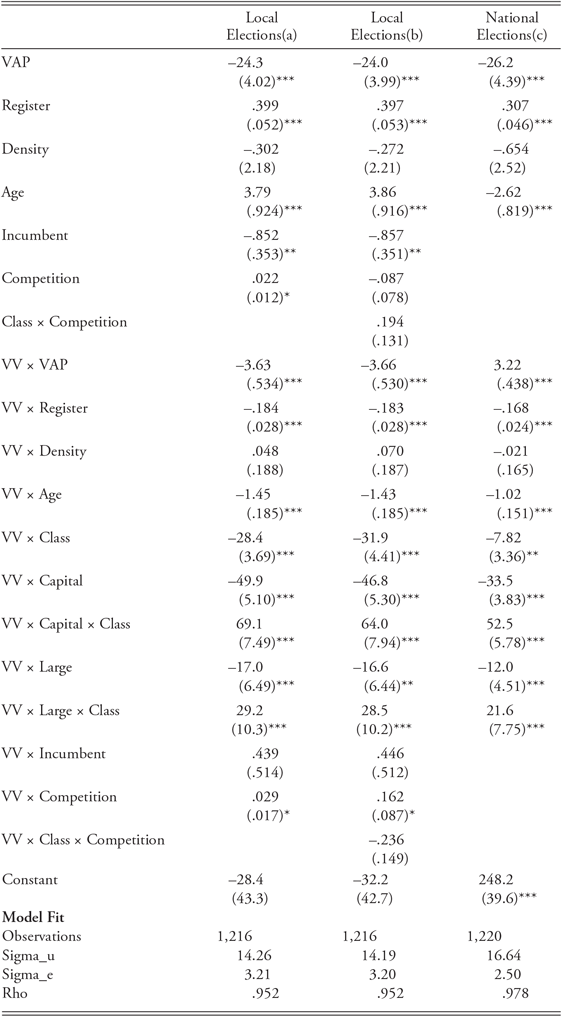
While the OLS estimates are useful as an overview of bias levels over time, we need to determine whether the changes observed after the reform are statistically significant. For this, we now turn to a fixed effects estimation that uses within-district variation over time to estimate the impact of voluntary voting. This is a two-way fixed effects design, since we also control for time effects, as there is a clear downward time trend in the turnout data. Specifically, and along the lines of Barnes and Rangel Reference Barnes and Rangel2018, we introduce an interaction term between a “voluntary voting” dummy and each of our predictors. These interactions estimate whether any statistically significant change occurred in that variable’s relationship to the outcome after voluntary voting was introduced, as compared to the situation under compulsory voting. In this way, the two prereform elections are systematically compared to the two postreform elections.Footnote 7
The first two models in table 4 show the results for local elections. The first model (a) uses the same variables as in table 2, while model b adds an interaction between class and competition. This is to test whether the poor are more sensitive to competition levels than the rich. The third model (c) shows results for national elections.
Determinants of Turnout in Chile (Fixed Effects)

Method: Fixed effects with clustered robust standard errors. Dependent variable: turnout. Display:coefficients; standard errors in parentheses. Election year dummies included.
Note: Variables that do not change over time are dropped from the model, as they cannot be estimated separately under fixed effects. These include class, the dummies for the capital and for other large cities, and their respective interactions.
In line with the preliminary results above, we find that after the introduction of voluntary voting (VV × Age), the gap between old and young voters significantly closes. This result is highly consistent across all models and elections. Evidence also confirms that in rural districts, a negative class bias in local elections appears after voluntary voting (VV × Class). Interestingly, the direction of the change is now negative and significant in presidential elections as well, suggesting that in these elections, voluntary voting also had some pro-poor bias in rural districts. In Santiago (VV × Capital × Class) and other large cities (VV × Large × Class), on the other hand, results are consistent in showing that turnout moved toward a positive class bias after the reform. This confirms that it was specifically the urban poor whose turnout was most affected.
Table 4 also confirms that after voluntary voting, the small-district bias intensified in local elections but moderated in national elections, as the change in the sign of the coefficient (VV × VAP) between the two types of elections shows. In both kinds of elections, there was also a move—as hypothesized—toward lower importance of the electoral register (VV × Register) as a predictor of turnout. This makes sense, considering the new automatic registration regime.
Both models a and b show some support for the increased importance of competition (VV x Competition) as a predictor of turnout under voluntary voting, though its magnitude is relatively small. On the other hand, model b does not support the contention that with voluntary voting the poor became more sensitive than the rich to competition levels. The key term (VV × Class × Competition) is not significant.
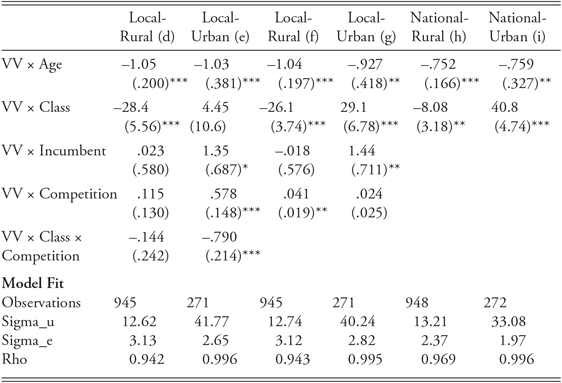
Nevertheless, Contreras et al. (Reference Contreras, Joignant and Morales2016) detect this class-competition dynamic only in larger districts, not in the full sample. Therefore we test models a to c again, but splitting our sample between rural and urban districts. In this way we can test whether in this or any other respect the effects of voluntary voting are heterogeneous between urban and rural voters. We show the results in table 5. Models d and e correspond to model b in table 4, while models f and g correspond to model a.
Changes in Turnout by Urban and Rural Subsamples (Fixed Effects)

Method: Fixed effects with clustered robust standard errors. Dependent variable: turnout. Display:key interaction coefficients; standard errors in parentheses.
Note: Only the variables of interest are shown, but all models are identical to the corresponding ones in table 4, except that the capital and large variables and their class interactions are omitted.
As model e shows, the competition-class interaction term is now highly significant in the urban sample. In fact, the inclusion of the interaction makes the class coefficient insignificant, thereby suggesting that in urban districts the level of competition in local elections mediates to some degree the class bias, as Contreras et al. (Reference Contreras, Joignant and Morales2016) suggest. The coefficients suggest that relative to compulsory voting, a race that becomes 10 points closer raises turnout by roughly 3 percent in a poor urban district, such as La Pintana, relative to a rich one, such as Las Condes.
This is still a fairly small effect compared with the magnitude of the direct class effect suggested by the other models. For instance, the VV × Class coefficient in model g suggests that relative to the situation under mandatory voting, turnout in Las Condes is about 12 points higher than in La Pintana, while model a estimates that it is instead 28 points higher (VV × Class × Capital). In sum, the results in tables 4 and 5 suggest that voluntary voting made competition a slightly more relevant variable and may have made the urban poor’s turnout more sensitive to competition levels, but overall, these effects are minor in comparison to those of class, age, and district size.Footnote 8
The remaining models, f to i, show consistency with the previous results. The urban and rural subsamples behave similarly to each other regarding the shrinking age bias, in both types of elections. In terms of class, the direction of change in turnout is (as expected) pro-poor in the rural districts and pro-rich in the urban districts. Fur-thermore, incumbency is now significant in urban districts, but trivially so: relative to mandatory voting, turnout increases one point when an incumbent is present.
Discussion
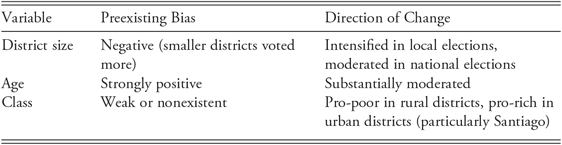
The results are consistent in showing that the 2012 electoral reform in Chile had important effects on the composition of the electorate.Footnote 9 Table 6 summarizes the main findings about the nature of preexisting size, age, and class biases and their change after the introduction of voluntary voting.
Summary of Voter Biases Before and After Voluntary Voting

To interpret these changes, it is crucial to remember that Chile’s well-enforced mandatory voting system had been nonetheless far from achieving universal turnout by the time it was abandoned. This is because mandatory voting was coupled with voluntary registration, which, over time, had produced a heavily age-skewed electorate as post-Pinochet generations mostly chose not to register. Just before the reform, the Chilean electorate had a significant age bias and a negative district size bias (smaller districts voted more), but little class bias. This held true for both kinds of elections.
After the reform, however, the negative district size bias intensified in local elections but diminished in national elections; a negative class bias appeared in rural districts, even as a positive class bias appeared in Santiago; and the age bias in the electorate was cut to about half its previous size, in both local and national elections. This was achieved even as total votes and participation rates fell in both kinds of elections. We understand this last equalization of likelihoods to be a democratization of sorts. By replacing the old electoral roll that disproportionally favored older voters, the reform reduced inequality among electoral cohorts.
More generally, these results show that even though abandoning mandatory voting will probably reduce turnout, greater inequalities will not necessarily ensue. Because mandatory voting may interact with other electoral institutions to produce an uneven turnout, abandoning it may either increase or reduce turnout bias, depending on the nature of that interaction. In the case of Chile, the combination of two reforms—voluntary voting and automatic registration—clearly helped reduce age bias. But strictly speaking, the latter was not needed for this effect: even if the reform had only introduced voluntary voting (without touching registration rules), the age bias would have still decreased, since older, disenchanted voters would have ceased to vote anyway.
Considering that young people’s political preferences are less aligned with Chile’s two major postdictatorship coalitions and are more inclined to support new political leaders and parties (Bunker Reference Bunker2018; Huneeus et al. Reference Huneeus, Lagos and Díaz2015), the results of this relative age-equalization of influence may have important consequences. In fact, in the 2017 presidential election, the new far left coalition secured 13 percent of the lower house in Congress even as its presidential candidate, Beatriz Sánchez, was less than two percentage points away from displacing the traditional center-left coalition candidate from the runoff round. Since, according to surveys, Sánchez and her coalition were overwhelmingly supported by younger people, shifts in the relative influence of different age cohorts are already affecting Chile’s party system and soon may do so even more. This suggests, contrary to some previous research (e.g., Lutz and Marsh Reference Lutz and Marsh2007), that the partisan effects of switching from mandatory to voluntary voting may well not be trivial.
In terms of class bias, the finding that after the reform, positive bias appears in Santiago and to some degree in other cities but that this coexists with negative class bias in rural districts is perhaps the most interesting puzzle of all. Following Remmer (Reference Remmer2010), who also finds negative class bias in Costa Rica in local elections, we suggest that this may be due to the existence of clientelistic networks that mayors and other local politicians can develop to a greater degree in smaller districts. As Remmer notes, clientelism induces higher participation in small localities (where such networks are easier to form) and particularly in poorer individuals (who are more sensitive to material rewards for voting). This logic is consistent with two of our findings: first, that voluntary voting intensified negative district size bias in local elections but reduced it in national ones; and second, that a much stronger negative class bias appeared in local elections. Clientelistic dynamics in Chilean rural districts have been documented by Durston (Reference Durston2005), while the growing importance of localized, personalized networks of intermediation in Chilean politics has been high-lighted in recent work (Luna and Mardones Reference Luna and Mardones2017).
In large but poor urban districts, on the other hand, Bartle et al.’s evidence (Reference Bartle, Birch and Skirmuntt2017) that socioeconomic segregation (or “ghettoization”) lowers turnout may be especially applicable. Particularly in highly segregated Santiago, where municipalities tend to be internally homogeneous by class even as large differences in wealth and education exist between them, the dynamics of poverty ghettos may depress turnout in ways that are altogether different from social dynamics in poor but rural districts.
Conclusions
While the introduction of voluntary voting in Chile reduced turnout, the reform changed the composition of the electorate in ways that both increased and reduced participation biases. Considering that most people in Chile live in cities, the apparition of urban class bias suggests that the overall electoral weight of the relatively better off has increased relative to that of the worst off. This is especially problematic in the context of national elections, where different classes—which tend to live in different districts—most directly confront each other’s interests. On the other hand, the major reduction in age bias means that in this respect, the electorate has become more representative of the population. This may well have larger consequences for Chile’s political system than the growth of urban class bias, though the tradeoffs between the two are not easy to assess.
Nevertheless, we have shown that moving from compulsory to voluntary voting does not necessarily lead to an unambiguous increase in turnout bias, even in the context of large decreases in turnout. This suggests that the relationship between mandatory voting and turnout bias is more complex than what an analysis solely focused on turnout levels might lead us to believe. The structure of that turnout is crucial in determining whether drops in electoral participation have the potential to lead to changes in the quality of representation of different social groups. In Chile’s case, we suggest that the shift to voluntary voting has been far from an obvious step back in terms of democratic quality, particularly as compared with the previous status quo (which is a more relevant benchmark than an ideal world of universal participation).
From a theoretical perspective, this article also lends support to Remmer’s Reference Remmer2010 call for greater attention to scale as a variable that mediates political dynamics, such as the difference between the turnout behavior of the urban and rural poor here detected. It also emphasizes that analyzing the effects of mandatory voting requires more attention to how this rule may interact with other institutions—such as the electoral registration procedure or enforcement levels—that condition the level and structure of turnout.
Thus, though Chile’s institutional setup was unique, this analysis has broader implications, inasmuch as other institutional arrangements under mandatory voting may also generate intermediate levels of participation and biased turnout. In this sense, our findings support both Berinsky’s Reference Berinsky2005 claim that higher participation may be coupled with larger turnout biases and Cepaluni and Hidalgo’s Reference Cepaluni and Daniel Hidalgo2016 point that compulsory voting may also increase bias under certain configurations of electoral institutions. Thus the adoption of voluntary voting, contrary to theoretical expectations, can lead to a more balanced electorate and to less unequal representation.