Population ageing and retirement practices
Population ageing has posed major challenges to policy makers as they struggle to keep pension systems sustainable (European Commission, 2015; Bloom and Luca, Reference Bloom, Luca, Piggott and Woodland2017).Footnote 1 Pensions are an important social programme. Pensions account for a large and increasing part of Gross Domestic Product (GDP) and are the main source of income for a substantial and growing proportion of the population.Footnote 2 Pensions are also a political hot spot often called the ‘third rail’, in reference to their potentially electrocuting impact during elections (Safire, Reference Safire2007; Lynch and Myrskyl, Reference Lynch and Myrskyl2009).
Pension systems have to maintain a delicate balance between the adequacy of benefits and financial sustainability. The political significance is most obvious in the pay-as-you-go (PAYG) pension systems present in almost all advanced economies, in which the contributions of younger generations are used to pay the pension benefits of the older generation (Börsch-Supan et al., Reference Börsch-Supan, Härtl, Leite, Piggott and Woodland2016). Generous pension benefits are appreciated by the older generation but curtail the purchasing power of the young. If population ageing reduces the number of younger workers relative to the increasing number of older pension recipients, more older people have to be financed by fewer younger people and PAYG systems may therefore become financially unsustainable. For instance, the dependency ratio is projected to increase furthest in Japan (from 46.2 to 77.8 from 2015 to 2050), Italy (from 37.8 to 72.4) and Germany (from 34.8 to 59.2). Increases are expected to be much more moderate in the United Kingdom (UK), France and the Netherlands (from 31.0, 33.3 and 30.2 in 2015 to 48.0, 52.3 and 53.0 in 2050, respectively) and even smaller in the USA (from 24.6 to 40.3; see Organisation for Economic Co-operation and Development (OECD), 2017).
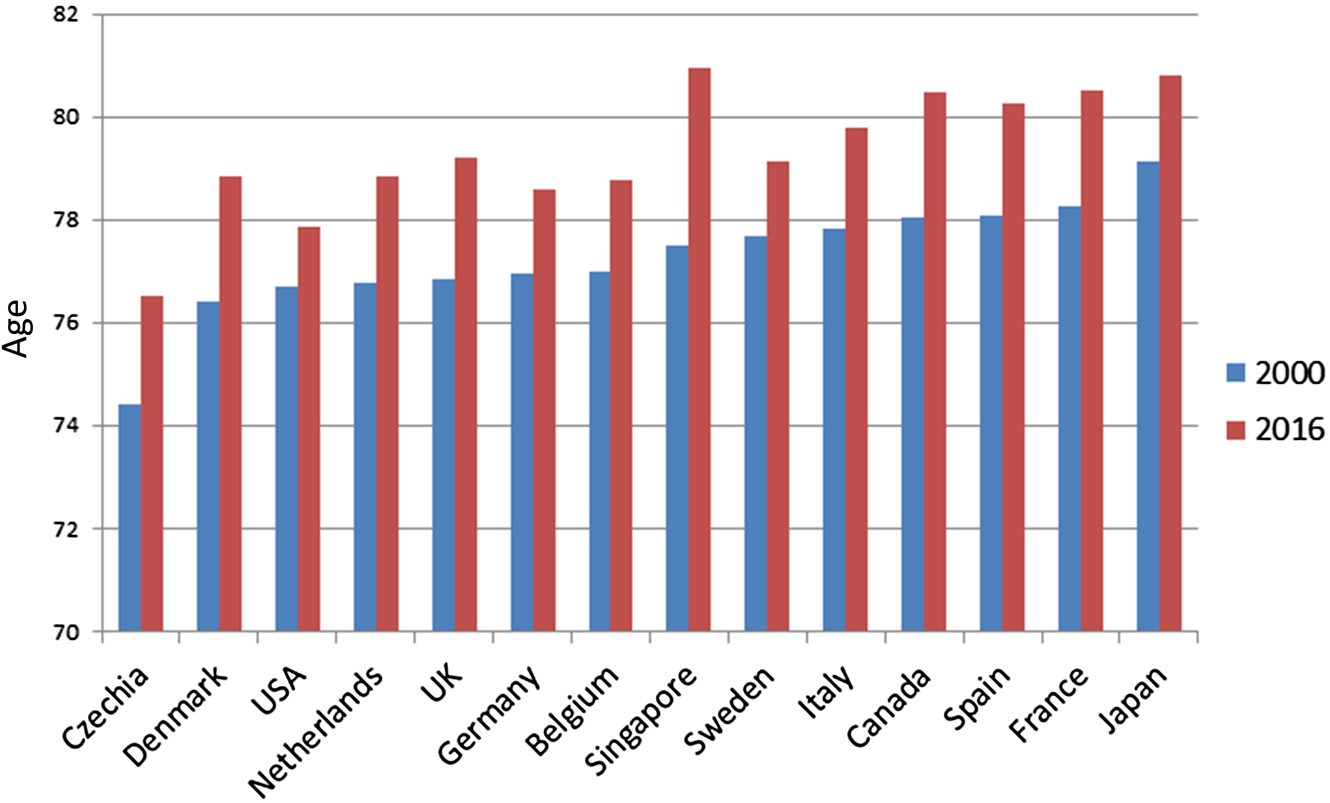
At the same time, people have longer and healthier lives (Joint Academy Initiative on Aging, 2010; Staudinger, Reference Staudinger2015). The World Health Organization (WHO, 2016) provides data on ‘healthy life expectancy’, which measures the age at which disabilities first occur. Figure 1 shows that healthy life expectancy in the industrialised world was already high in the year 2000 and has increased by about another two years between 2000 and 2016.
Healthy life expectancy.
Source: WHO (2016). Notes: USA: United States of America. UK: United Kingdom.

Figure 1 also shows the large variation across countries, both in levels and change. Singapore features an especially large improvement (3.4 years), while healthy life expectancy has improved only a little in the United States of America (USA) (1.1 years). Increasing longevity and improving health raises the possibility that some people will work longer and that longer working lives may be a central element of a solution to the pension systems’ fiscal challenges. Hence, much attention has been given to increase labour supply at older ages (e.g. Staudinger et al., Reference Staudinger, Finkelstein, Calvo and Sivaramakrishnan2016). Simply increasing the statutory age at which one is eligible to receive a full pension (‘statutory eligibility age’ (SEA)), however, is extremely unpopular among voters. Alternative approaches differentiate between incentives that discourage leaving the labour force before the SEA and those that encourage working at least partially after that age. Such ‘flexibility reforms’ have become a promising policy tool for politicians (Börsch-Supan et al., Reference Börsch-Supan, Bucher-Koenen, Kutlu Koc and Goll2018). They centre on combinations of part-time work and partial pension benefit receipt and relaxing constraints such as earnings tests that force workers to exit the labour market when claiming a pension.
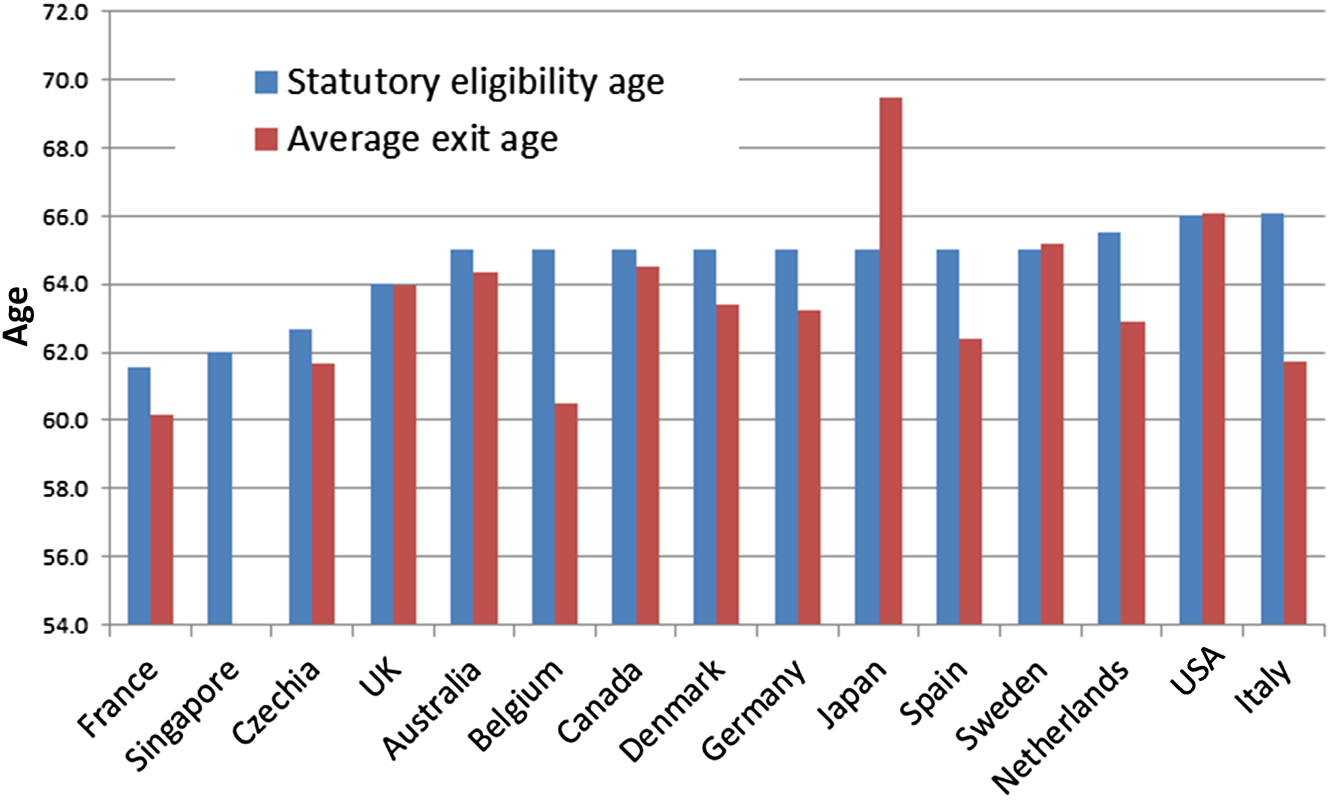
However, such policy proposals face a large variation in labour force participation rates above age 60 across different countries, which appears to be unrelated to the health status of the population. Figure 2 compares the SEA with the actual age at which individuals exit the labour force. While most countries have a SEA of 65 years for both men and women (some of them gradually increasing), the variation of the actual exit age is much larger. In most countries, the average labour force exit age is substantially earlier than the SEA, especially in Belgium and Italy. A notable exception is Japan.
Statutory eligibility age and average exit age.
Source: OECD (2017). Notes: USA: United States of America. UK: United Kingdom.
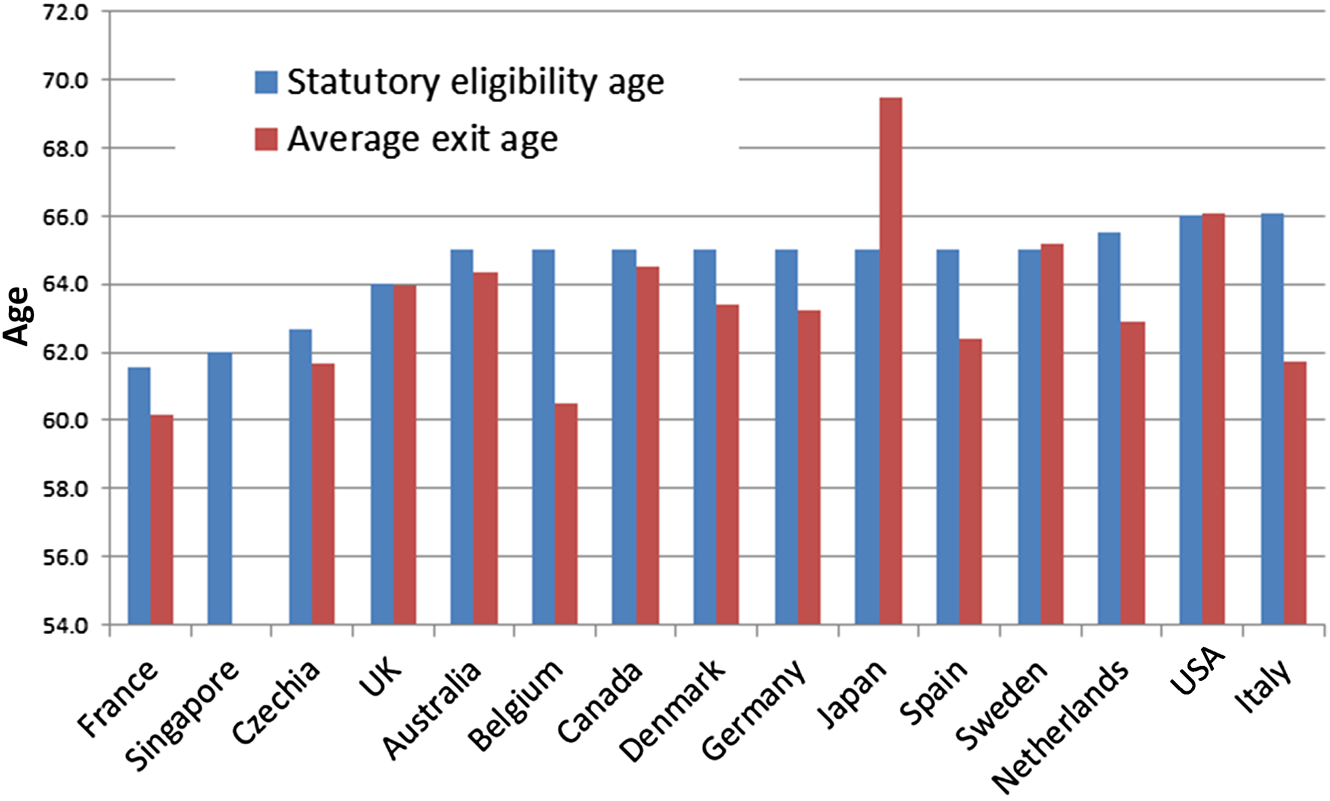
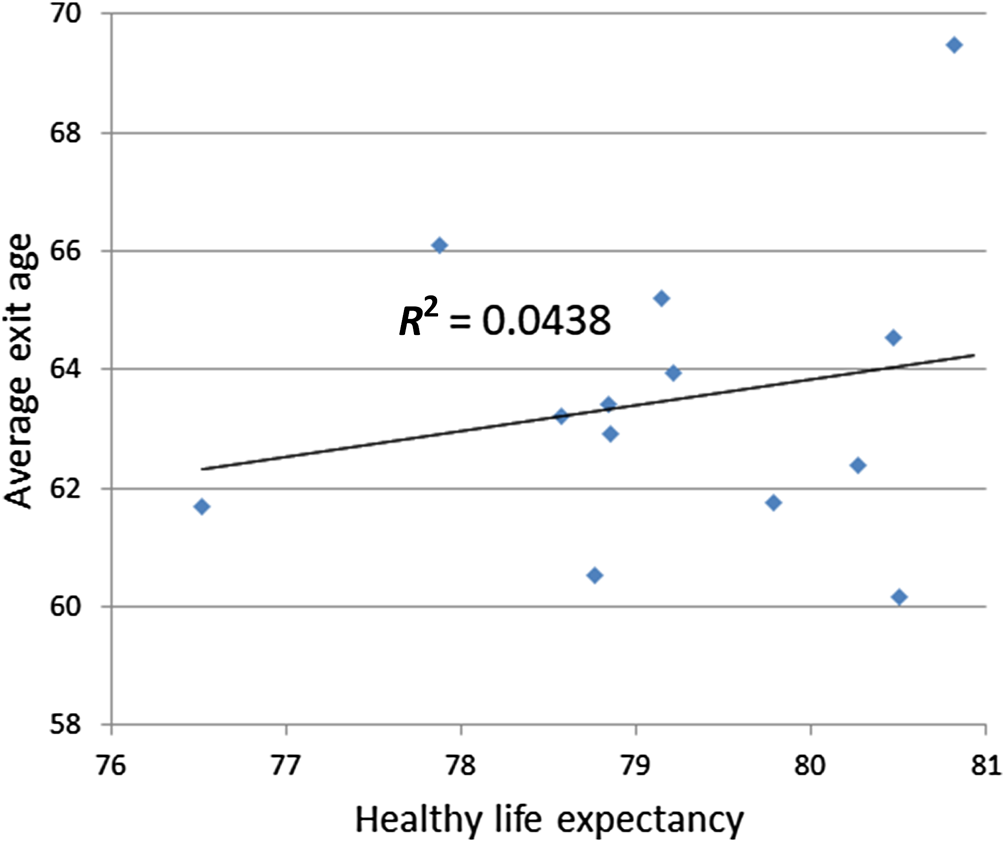
Figure 3 shows that the association between healthy life expectancy and average labour force exit age is very weak and not stable. After removing Japan from the set of countries included, the correlation even turns negative. Quite clearly, health is not the predominant factor to explain cross-national differences in old-age labour force participation.

An important question is therefore what governs labour force participation in later life and why is it so different across countries? The lack of a sizeable correlation between health and labour force participation in older ages and the large variation across countries points to the role of country-specific regulations governing pension receipt and old-age labour force participation. In addition to the SEA, such country-specific regulations can broadly be divided into two categories that make: (a) retirement before the SEA attractive in different countries and (b) working after the SEA attractive in different countries. The former include, for instance, the often very small amount of benefit deductions for early retirement, the availability of part-time pensions before normal retirement and special regulations that permit early retirement for certain population groups. The latter set of regulations include benefit increases for late retirement which vary greatly from country to country. In some countries, employers may even receive subsidies if they keep older employees in their labour force while in other countries working beyond the normal retirement age may incur costs for the employers. Moreover, many countries still have earnings tests in place that limit the amount of earnings when pension benefits are received. This paper therefore specifically asks two questions:
(1) Can we link a relatively low labour force participation at ages 60–64 to country-specific regulations that make early retirement attractive?
(2) Can we link a relatively high labour force participation at ages 65–74 to country-specific regulations that make late retirement attractive?
To answer these questions, we compared the experiences in a set of developed countries around the world in order to understand better the impact of country-specific rules and laws on work and retirement behaviour at older ages and, by consequence, on the financial sustainability of pension systems.
Evaluating extant retirement policies: incentives for early and late retirement
Background to our work is the well-established literature on the effects of retirement policy on labour market behaviour at older ages (Börsch-Supan et al., Reference Börsch-Supan, Härtl, Leite, Piggott and Woodland2016). This past research shows a highly significant effect of the financial incentives inherent in retirement policy provisions on people's decisions about when to claim social security benefits and at which pace to retire partially and/or fully from the labour force. Gruber and Wise (Reference Gruber and Wise1999) established that the financial incentives for retirement that resulted from pension provisions are strongly related to labour force participation. More specifically, they estimated the ‘tax force’ of a pension system for a typical worker, defined as the loss of cumulative pension benefits resulting from continuing work without claiming pension benefits. The correlation between tax force and labour force participation is very strong (about 90%). This finding, and the OECD's variant by Blondal and Scarpetta (Reference Blondal and Scarpetta1999), were very influential in convincing politicians to start abolishing early retirement incentives in the parametric pension reforms of the early 2000s.
Economists have set up dynamic programming models based on the assumptions of perfect foresight and rational behaviour that generate the optimal labour force exit and benefit-claiming ages. Examples for this approach are Gustman (Reference Gustman1986), Rust (Reference Rust and Wise1990), Berkovec and Stern (Reference Berkovec and Stern1991), and Rust and Phelan (Reference Rust and Phelan1997). These models produce very specific results (e.g. Gustman and Steinmeier (Reference Gustman and Steinmeier2005) on the joint determination of retirement and wealth; Gustman and Steinmeier (Reference Gustman and Steinmeier2009) on the synchronisation of retirement decisions between spouses; and Gustman et al. (Reference Gustman, Steinmeier and Tabatabai2010) on partial un-retirement). However, these economic optimisation models are highly sensitive to their actual specification. A more robust approach is the so-called ‘option value model’ which captures all the impacts of the various pension rules on retirement behaviour in a single incentive variable such as the already-mentioned tax force (Stock and Wise, Reference Stock and Wise1990). The option value model has been successfully applied in a series of papers on US pension plans (Stock and Wise, Reference Stock and Wise1990; Lumsdaine et al., Reference Lumsdaine, Stock, Wise and Wise1992), public PAYG pension systems around the world (Gruber and Wise, Reference Gruber and Wise2004, Reference Gruber and Wise2007, Reference Gruber and Wise2010; Wise, Reference Wise2012, Reference Wise2016), and the sequence of German pension reforms between 1992 and 2007 (Börsch-Supan, Reference Börsch-Supan2000; Berkel and Börsch-Supan, Reference Berkel and Börsch-Supan2004). The model has also been extended to the joint retirement decision of couples (Coile, Reference Coile2004) and the choice among multiple retirement pathways, including disability pensions (Börsch-Supan, Reference Börsch-Supan and Wise2001; Butler et al., Reference Butler, Gumus and Burkhauser2003).
Country comparisons as a useful tool of policy studies
As with any internationally comparative research project, there is a rich opportunity to learn from the broader scope of policies adopted in multiple countries, compared with any one country alone (National Research Council, 2001). Over recent years, the diversity of pension reforms adopted in countries around the world is substantial (OECD, 2017). Our goal is to draw from this diverse international experience to help inform reform discussions, particularly as they relate to the effect of policies on work and benefit claiming at older ages.
Our selection of countries was guided by two main criteria. On the one hand, they should represent different pension systems that have emerged from diverse cultural-historical backgrounds. On the other hand, however, the countries should be comparable with regard to stages of the demographic transition and of economic development with its associated job composition and quality of work.
As we were interested in in-depth local knowledge about the country-specific pension systems, we took advantage of the International Longevity Centre Global Alliance (ILC Global Alliance) which is an association of Longevity Centres founded by Robert N. Butler (ILC-USA) and Shigeo Morioka (ILC-Japan) in 1990 to help societies to address population ageing. In line with the two criteria presented above, we selected seven countries from the ILC Global Alliance.
France, Germany, the Netherlands and the UK represent the diversity of pension systems and realities in Europe. France is a country with very early retirement. Germany represents the prototypical earnings-related PAYG system. This is contrasted with the Dutch and UK public systems which provide flat benefits, i.e. benefits of the same amount independent of contributions. In the Netherlands, these flat public benefits are complemented by mandatory occupational pensions with ex ante defined benefits, while in the UK any additional pensions are voluntary and are generally of the defined contribution type, i.e. without the promise of a defined benefit. Asia is represented by Japan and Singapore. Japan features a PAYG system, while the pension system in Singapore is mostly fully funded through a state-managed provident fund. Finally, we included the USA, whose social security system is characterised by the co-existence of a large earnings-related PAYG system for the lower and the middle class and funded private and occupational systems for the more well-to-do.
The pension systems in the seven countries cover most of the characteristics of the pension systems established across the developed world, ranging from strictly earnings-related systems to systems with flat benefits; very generous and rather frugal systems; systems with large incentives to retire early; and systems rewarding later retirement. While we do not claim that our results are generaliseable to developing countries, we are confident that they represent the pension systems in the OECD and similar countries.
The present study
This study uses a more comprehensive but less-technical approach than the dynamic programming and option value models cited earlier. We employed a relatively large set of indicators that each measure along four dimensions (a) what makes retirement earlier than the SEA attractive and (b) what makes working after the SEA attractive in the countries under study. Rather than reducing these eight dimensions to a single index and/or embedding them into a structural model, team members from each country ranked their respective country in terms of these indicators.
Methods
We collected qualitative data on the public pension systems of seven countries from three continents. As the major aim of this study was to understand better the effect of retirement policies by comparing across countries with roughly comparable degrees of population ageing and economic development, but with a wide range of retirement policies in place, we needed to define a set of characteristics that in principle apply across countries. We also had to find a way to quantify these characteristics in order to make it possible to assess the effect of such characteristics across countries.
In a first step, we developed a rating system categorised according to the two overarching dimensions, that is, incentivising early and late retirement (in relation to SEA), respectively. In a second step, countries were rated with regard to these characteristics. Finally, in a third step, the ratings were used to analyse the relationship between the retirement policies’ design and the labour market participation of older persons across countries, separately for the age bands 60–64 and 65–74 years.
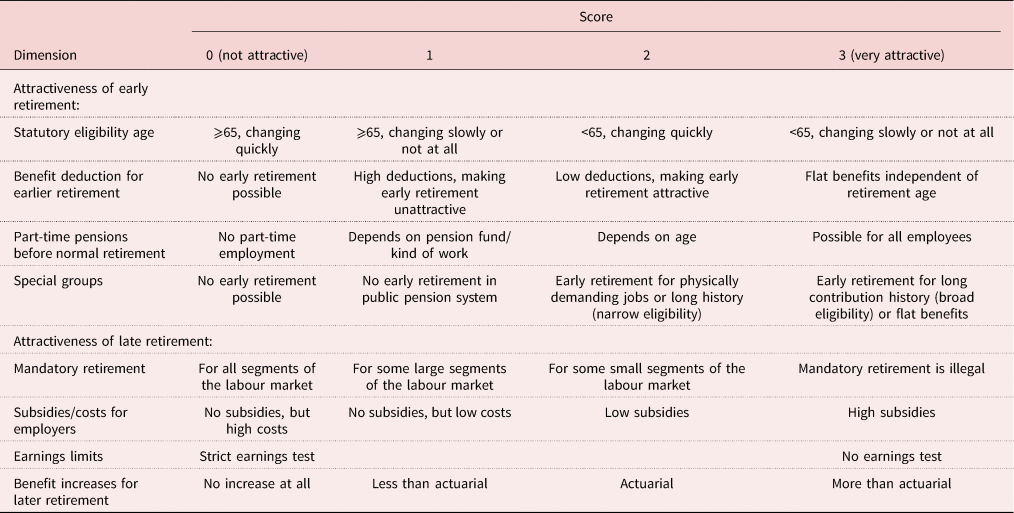
The rating system for the attractiveness of both early (i.e. before SEA) and late (i.e. after SEA) retirement consists of four different categories, each reflecting different policy dimensions. The categories to rate the attractiveness of early retirement contained (a) the assessment of the age when typical workers are eligible for the full public pension; (b) the amount of benefit deductions for early retirement; (c) the availability of part-time pensions before SEA; and (d) special regulations for certain population groups, including rare retirement pathways for workers with unhealthy and arduous jobs, sometimes using disability insurance. The categories to rate the attractiveness of late retirement contained (a) the legal options for late retirement; (b) the amount of subsidies or costs for employers; (c) the degree of earnings limits; and (d) the amount of benefit increases for later retirement. Each category is evaluated on a qualitative basis and subsequently given a score between 0 (reflecting not attractive) and three (reflecting very attractive). This quantification allows a numerical comparison among countries in terms of financial incentives offered by the public pension systems. The specifics of the scoring system using these categories is presented in Table 1.
Rating system

Assigning country ratings
In the second step, each country was rated with regard to each of these categories. This rating process was conducted by the two economists and retirement experts on the team while consulting with the respective country expert on the team. A preliminary score was assigned once consensus was reached among the three raters. Finally, these ratings were discussed in the entire team to ascertain comparability and resolve disagreements. Detailed information on the ranking of the different dimensions can be obtained from the first author upon request.
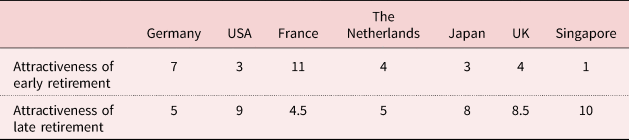
Table 2 shows the final country scores regarding the attractiveness of early and late retirement based on the rating system described in Table 1.
Summary ratings of the attractiveness of early and late retirement across countries

Notes: USA: United States of America. UK: United Kingdom.
The assignment of these scores is explained together with the following descriptions of the retirement policy profiles of the countries under study, first with regard to incentives for early retirement and second for late retirement. The sequence follows the ranking of countries in terms of their ratings, starting with the highest score.
Attractiveness of early retirement (see Table S1 in the online supplementary material)
France
The public pension system in France is attractive for early retirement for several reasons. First, since the Woerth reform in 2010, the age at which pension benefits become available has been gradually increasing from 60 to 62 years for those born after 1955; compared to other countries, however, the age to claim public pension benefits in France is still very young, hence a score of 3. Second, the penalty for claiming benefits before the SEA of 67 years is low. There is a decrease of up to 25 per cent of the full rate for basic and complementary pensions depending on the age they are claimed and the years of contributions, resulting in a score of 3. Third, starting from the age of 60, it is possible to receive a partial pension and, at the same time, to work part-time with the accrual of further pension rights, to be scored at 2. Fourth, there are large groups within the labour market for whom softer regulations for early retirement access apply. Those with harmful jobs are able to access a full pension starting at age 60. Additionally, employees of some government-owned corporations (e.g. military, police, energy companies, public transport, opera workers and members of parliament) enjoy a special retirement plan which includes lower eligibility ages and requires fewer working years to obtain full benefits, leading to a score of 3. The total score for France is therefore 11 out of 12.
Germany
Legislated in March 2007, the SEA for public pensions in Germany has been gradually increasing from 65 to 67 years until 2029. It is currently 65.3 years. This change is due to many reforms introduced between 1992 and 2007 aiming to create a sustainable pension system and to increase labour force participation in later life. The public discussion over these measures has changed the general attitude about early retirement, hence a score of 1. Nevertheless, the German public pension system still offers some incentives for early retirement. With the pension reform in 1992, pension adjustments were introduced for early retirement in the amount of a benefit reduction of 3.6 per cent for each year of claiming benefits before the SEA. However, the current adjustments are below actuarial neutrality; hence some incentive to claim pension benefits early remains. This results in a score of 2. Further, Germany introduced a partial pension system in 1992, which allows a reduction in working hours at the same time as drawing a partial pension while still accumulating pension entitlements, leading to a score of 2. Finally, the last grand coalition of the Christian Democrats and the Social Democrats decided on a pension reform in 2014 that reintroduced some incentives for early retirement such as allowing early retirement at age 63 for those persons who have a contribution history of at least 45 years, including periods of unemployment, further education and care-giving, hence a score of 2. Summing up leads to a total score of 7 in Table 2.
UK
The SEA (called the State Pension Age in the UK) was equalised for women and men in November 2018 to 65 (in 2017 the State Pension Age for women was still lower than that for men). After that, a further stepwise increase of the State Pension Age is planned: to 66 by October 2020, to 67 by April 2028 and to 68 between 2044 and 2046. Consequently, the UK has one of the highest claiming ages from the perspective of further increases in line with anticipated increases in life expectancy; a recent independent review commissioned by the government has also recommended that the increase to 68 be brought forward to the late 2030s. This yields a score of 0 for the indicator on normal retirement age. Apart from that, the State Pension Age is a strict age limit without any exceptions. Therefore, early retirement in the sense of receiving public pension benefits before the State Pension Age is not possible in the UK, which results in a score of 0 on the part-time pensions dimension. There are civil service jobs and private pension schemes where it is possible to draw pensions at an earlier age, but this does not impact the eligibility for state pension. Since benefits from the state pension are flat, lower earners have little financial incentive to choose work over retirement if they decide to stop working before State Pension Age. This is a rare case, however, so we have given a score of 1 for the indicator related to benefit deduction and a score of 3 for the indicator relating to special groups. The total score for the UK comes to 4, placing it in the middle of our scale.
The Netherlands
The eligibility age for a public pension has been gradually increasing to 67 years and 3 months until 2022. Afterwards, the eligibility age will be linked to life expectancy. In 2019 the retirement age is 66 years and 4 months. In general, there is no possibility for early retirement in the public pension system, leading to a score of 1. Private pension plans in general offer early retirement options depending on the type of contract and on the amount of savings. It is also possible to retire early or to receive a part-time pension in the occupational pension scheme. However, this is not possibile in the public system, therefore resulting in a score of 1. Most often, a part-time pension in the occupational pension scheme is unattractive from a financial point of view since the deduction for each year of early retirement amounts to 8 per cent on average, resulting in a score of 1. Fourth, there is no possibility for specific groups in the public retirement scheme to retire earlier (score of 1). Summing up this leads to a total score of 4 in Table 2, equal to the UK.
Japan
The SEA in Japan is set at the age of 65, hence a score of 2. There are different types of public pension and every person having an address in Japan is required to join the system. The type of pension is determined by the work status (e.g. occupation, type of employment). The National Pension System (NPS) is mandatory for all persons from the age of 20 to 59 years. All employees, not only of private companies but also public workers and teachers, are covered by the Employees’ Pension Insurance (EPI). In both systems, it is possible to retire early after the age of 60 with a deduction of 6 per cent per year of early withdrawal. These rather high deductions make early retirement financially unattractive, hence a score of 1. NPS and EPI do not have a part-time pension scheme and specific groups’ pension scheme for early retirement, hence both scores of 0. Furthermore, working plays a major role in Japanese culture, including in old age (Williamson and Higo, Reference Williamson and Higo2009). With a sum score of 3, this mentality leaves little room for early retirement.
USA
A gradual increase of the eligibility age in the USA from 66 to 67 years was legislated in 1983; it is currently 66.2 years. This resulted in a score of 0. Only very special groups (e.g. military veterans, government employees, railroad workers) have lower eligibility ages which is linked with a rating of 1. Part-time employment before reaching the SEA is only available for civil servants. This highly constrained practice received a score of 1. In general, it is possible to retire earlier but one has to face very high deductions that are linked to specific ages rather than year-based deductions. If benefits are taken at the age of 62, only 70 per cent of the full benefits are granted, which equals a deduction of 6 per cent per year. Taken at the age of 65, the benefits amount to 86.7 per cent of the full benefits, annualised to 6.65 per cent. On top of these high deductions, a fixed ceiling on additional earnings for pension recipients make early retirement unattractive in the USA. In 2016, benefits for persons under the age of 65 were reduced by US $1 for each $2 of annual earnings in excess of $15,720 and benefits for persons between 65 and 67 were reduced by $1 for each $3 of earnings above $41,880. These harsh conditions were rated with a score of 1. In sum, this amounts to a total score of 3 for the USA, making early retirement rather unattractive.
Singapore
Singapore does not have a basic universal pension for older persons. Rather, it has a pension system comprised of two components, that is, employees’ savings and public assistance. Primarily people rely, however, on an employee savings scheme administered by a national agency called the Central Provident Fund (CPF). Participation in the CPF is compulsory for all employed Singapore citizens, so that over 90 per cent of the resident workforce is covered by the CPF system. Monthly payments from the CPF can only be received after the age of 62, consequently, no early retirement before this age is possible. The eligibility age is gradually increasing from 62 to 67. This yields a score of 1 for the dimension of normal retirement age and 0 in all others. The second component of the pension system is a very limited and stringent means-tested public assistance scheme. It is a monthly grant given by the government to citizens who are unable to work due to old age, illness or disability, have no means of subsistence and lack family support. As of 2008, only 0.5 per cent of older Singaporeans aged 60 and above were covered. Hence, the second component does not change the overall score of 1.
Attractiveness of late retirement (see Table S2 in the online supplementary material)
Singapore
Being the least attractive country to retire early, Singapore offers many incentives for working beyond the SEA. The retirement and re-employment act of 2012 requires employers to offer re-employment to eligible employees who turn 62 up to the age of 65, increasing to the age of 67 starting in 2015. The eligibility criteria for re-employment are met if: (a) you are a Singapore citizen or Singapore permanent resident; (b) you have served your current employer for at least three years before turning 62; (c) you have satisfactory work performance as assessed by the employer; and (d) you are medically fit to continue working. There is no income limit for working after the SEA, making Singapore the most attractive country for late retirement and resulting in a score of 10. The only reason for not giving the highest possible score of 12 is the fact that contribution rates to the CPF remain very high after the SEA, yielding a score of 1 in the last dimension of Table 1 while all other categories receive a score of 3. This yields a very high overall score of 11.
USA
There is no legal retirement age. This practice received the highest attractiveness rating of 3. Working beyond the SEA in the USA is attractive for employees because they receive a financial bonus of an additional 8 per cent benefit for each year of delayed retirement. This incentive structure makes working longer highly attractive and was therefore rated as 3. This collection of additional benefits is limited to the age of 70 and there is a maximum pension benefit of US $3,501 at the age of 70. Thus, it deserves a rating of 2 rather than 3. There is no extra financial incentive for employers to hire older workers; in contrast, employers have to pay full social security contributions for workers beyond the SEA which resulted in a low score of 1. In sum, this amounts to a total score of 9 for the USA.
UK
In 2011, the mandatory retirement age of 65 was abolished, which gives the UK a score of 3 on this indicator. Additionally, the public pension system in the UK offers several incentives to work beyond the SEA (State Pension Age). First, it is possible to continue working while receiving pension benefits with no fixed ceilings on earnings. This earns a score of 3. Second, National Insurance payments are no longer required when working after reaching the State Pension Age; this is a moderate incentive for employers, so we have scored it 1.5. Third, for people taking their state pension from 6 April 2016, pension benefits are increased by 1 per cent per 9 weeks of working, deferring the state pension, accumulating to approximately 5.8 per cent per year. In contrast, the workplace pensions, which represent an important source of retirement income for some people, do not offer financial incentives for a delayed claiming. Taken together, we have given this indicator a score of 1, bringing the summary score for the UK to 8.5.
Japan
The Act on Stabilization of Employment of Elderly Persons in 1971 was designed to facilitate the secure employment of older workers in Japan. More specifically, under the act, employers are supposed to raise or even abolish the mandatory retirement age or to introduce employment policies aiming to retain employees until at least SEA (Higo et al., Reference Higo, Schöder, Yamada, Hofacker, Hess and König2016). The Labor Contract Law prohibits limited-term employees from being treated in unreasonable working conditions compared to regular employees, and this rule also applies to older prolonged employees beyond mandatory retirement age, yielding a score of 2. Further, a system that requires the employment of older workers beyond their retirement age should be introduced by the employer, hence a score of 2. The employer receives various subsidies and provision of relevant assistance if any measures for the employment security of older workers are taken, hence a score of 2. Employees can increase their benefits by 8 per cent per year between the ages of 65 and 70; this translates into a maximum of up to 42 per cent increase for five years, hence a score of 2. Thus, the sum score for Japan is 8.
Germany
In principle, working beyond the SEA in Germany is possible without age limit and without limits on earnings, hence a score of 3. There are, however, very large segments of the labour market (e.g. all public employees; almost all sectors with collective agreements) which are facing mandatory retirement (Börsch-Supan et al., Reference Börsch-Supan, Bucher-Koenen, Kutlu Koc and Goll2018), hence a score of 0 in this dimension. Late retirement leads to an increase in pension benefits by 6 per cent for each year of claiming benefits late, slightly lower than actuarial, hence a score of 2. Until 2017, employers had to pay the employer's contribution to the pension insurance and the unemployment insurance for employees beyond the SEA. Moreover, the employees’ pension contributions payed on the labour income received after the SEA did not increase their pension entitlements, hence a score of 0. Summing up leads to a total score of 5 for Germany.
The Netherlands
In general, retirement at the SEA is mandatory in the Netherlands, resulting in a score of 0. However, there are two exeptions. First, manadatory retirement has been abolished for those who are employed by the government in 2008 in the Netherlands, they can continue their work until the age of 70. Only a few people make use of this exception. Second, the retirement ages for occupational pensions depend on rules set in the agreements between employers and unions. An employee can continue to work after SEA, but only with a new employment contract with a different set of rules and regulations. The employer is not obliged to provide a new contract. There are no earning limits in the occupational pension scheme, hence a score of 3, but at the same time also there are no financial benefits of deferring retirement in the public pension system. Depending on the collective agreement funds, there might be additional benefits for working beyond the SEA with respect to the occupational pension. Employers benefit from engaging older workers because the contribution payments are abolished and the sick pay is reduced, resulting in a score of 2. Benefits for late retirement are only valid for occupational pensions schemes, not for public pension schemes, therefore giving a score of 0. The total score for the Netherlands is 5.
France
Except for certain groups (e.g. civil service or age limits imposed by employers, score 0), working beyond the SEA in France is allowed without fixed ceilings on earnings, hence a score of 3. While larger companies have to develop ‘senior action plans’ for hiring seniors, there is no specific benefit for the employers to do so (score 0.5). Unlimited deferment of pension receipt is possible with an increase in the benefit claims of 1.25 per cent per quarter which equals 5 per cent per year, leading to a score of 1. The total score for France is thus 4.5.
Results
The results in Table 2 show that it is most attractive to retire early in France, followed by Germany and the UK. The Netherlands, USA and Japan are below the average, and it is least attractive or rather impossible to retire early in Singapore. In contrast, working beyond the normal retirement age is most attractive in Singapore, closely followed by the USA, UK and Japan. Germany, the Netherlands and France offer fewer incentives to work beyond the normal retirement age and therefore they score below the country average.
In a third step, we associated these results with the labour force participation rates of the respective countries as reported by the OECD Employment Database (OECD, 2016). Unfortunately, these data are available only in five-year age bands. While finer age categories would be more desirable and could be obtained from some of the countries included in our study, we decided to use the OECD data due to their international comparability which is key for this study. We associated the summed attractiveness scores for early retirement in each country with the 2016 labour force participation rate of the related age band 60–64 and the summed attractiveness scores for late retirement in each country with the 2016 labour force participation rate of the related age band 65–74.
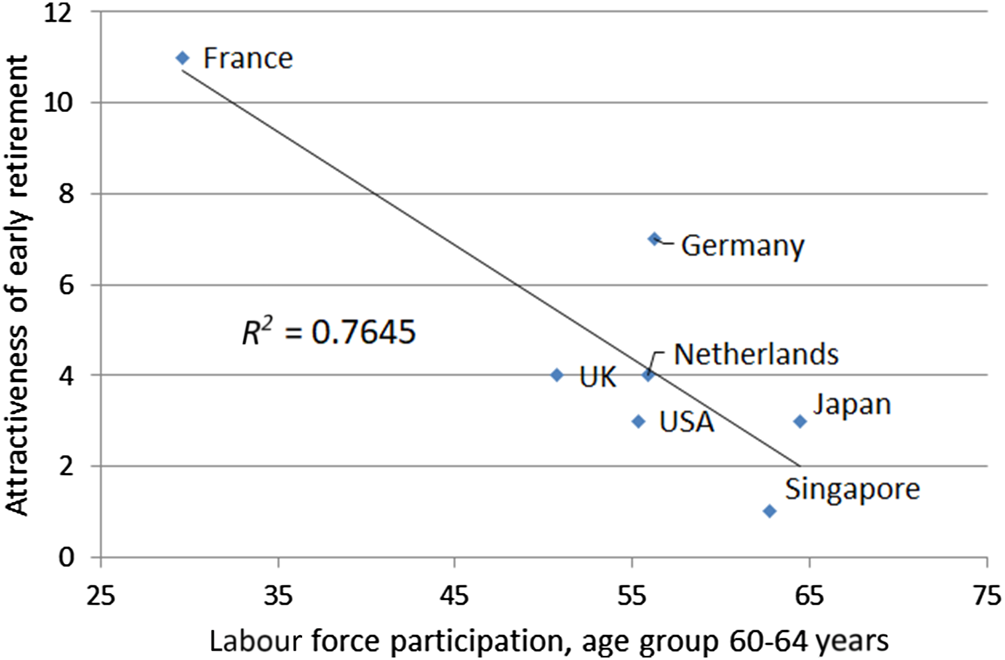
Results for the early age band are displayed in Figure 4. The figure shows that the attractiveness of early retirement is negatively correlated with labour force participation. It covers about 76.5 per cent of the variance in labour force participation. The higher the attractiveness of early retirement, the lower the labour force participation in a country.
Attractiveness of early retirement and labour force participation.
Notes: USA: United States of America. UK: United Kingdom.

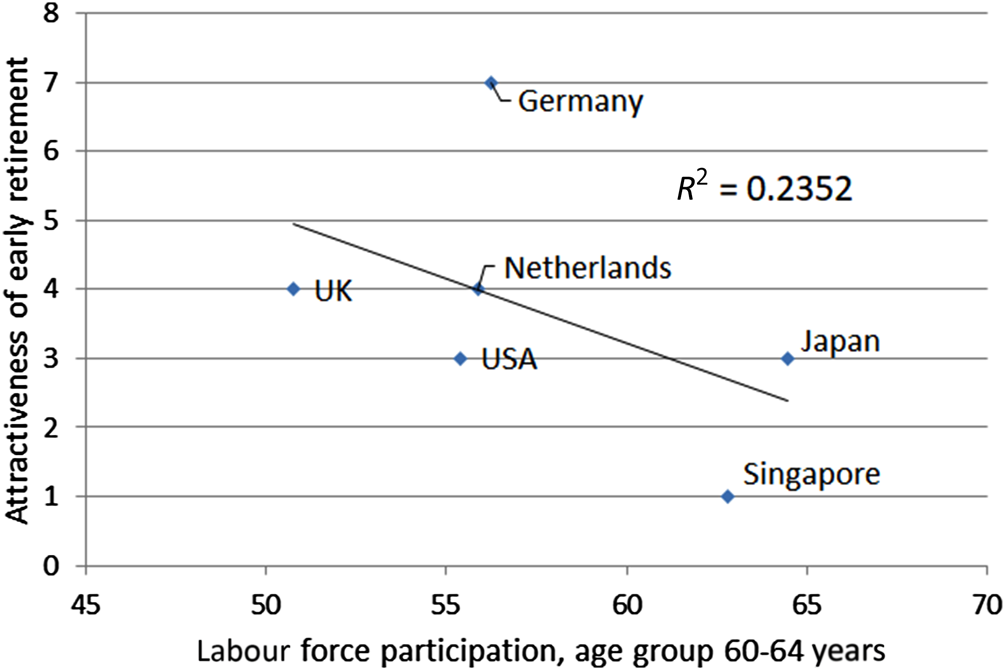
France is an outlier both in terms of attractiveness of early retirement and in terms of labour force participation. This may lead to an over-assessment of the relationship between the attractiveness of early retirement and labour force participation rates. This is not the case. Figure 5 shows that slope and intercept of the negative relationship remain virtually unchanged after dropping France from the data. The amount of variance covered, however, drops to 23.5 per cent.
Attractiveness of early retirement and labour force participation – without France.
Notes: USA: United States of America. UK: United Kingdom.

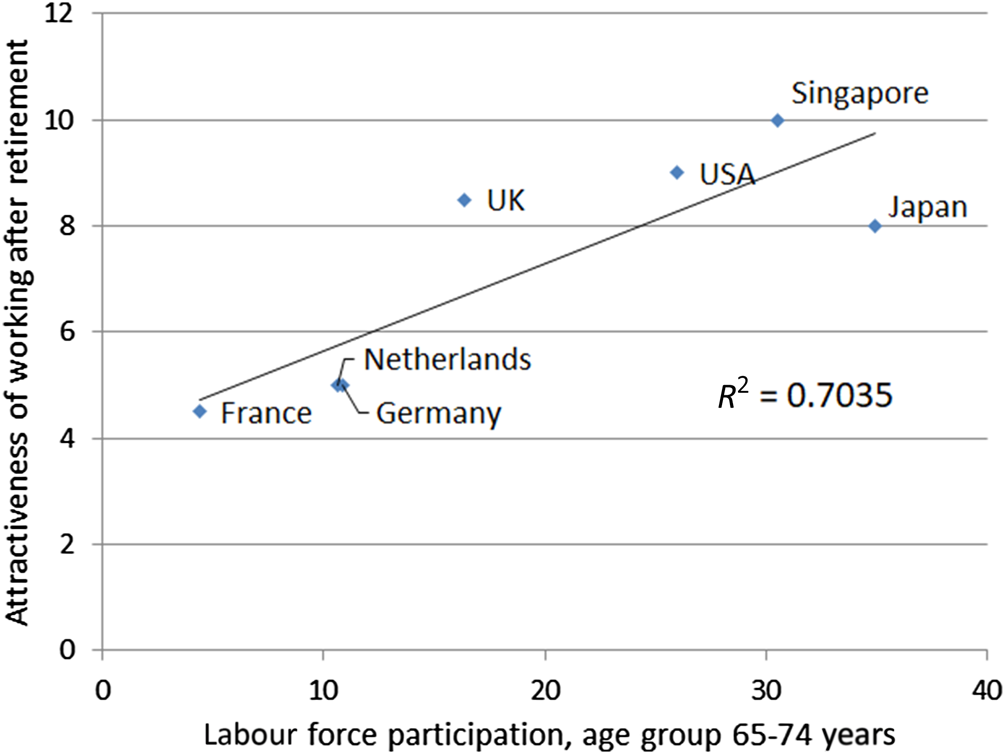
Figure 6 displays the relationship for the attractiveness of working after the SEA and the labour force participation rate of the respective age group 65–74. This labour force participation is composed by the labour force participation rate of the age group 65–69 weighted with the factor 0.55 and the labour force participation rate for the age group 70–74 weighted with the factor 0.45. Thereby, the labour force participation rate closest to the normal retirement ages gains importance. We find a positive relationship between the attractiveness of working after retirement and the labour force participation rate in this age group. This indicates that the policy incentives set by the public pension schemes explain a large part of the variation in the labour force participation rates (R 2 = 0.704).
Attractiveness of late retirement and labour force participation.
Notes: USA: United States of America. UK: United Kingdom.

Discussion and conclusions
Our measures of the attractiveness of early retirement and the attractiveness of working after the SEA are highly correlated with labour force participation in the respective age bands. While we do not claim that our results are generalisable to developing countries, we are confident that they represent the pension systems in the OECD and similar countries because the pension systems in the seven countries in this paper span most pension systems established in the developed world.
Whether these correlations are causal cannot be determined from our analyses. A causal analysis would require cross-nationally comparable micro-data such as in Gruber and Wise (Reference Gruber and Wise2004). Nevertheless, the results of this country-comparative study are in line with the hypothesis that retirement policy and social welfare legislation impact individuals’ early or late transitions into retirement. It is impressive to see that policy incentives and disincentives cover more than 50 per cent of the variance in labour force participation.
Even though we managed to create harmonised dimensions of comparison across countries, we need to keep in mind that these policies are deeply rooted in cultural and mentality differences between countries, which also impact their effect. This has two implications. First, culture and mentality may be a common cause for both sides of the observed correlations. A country's preference for early retirement shapes public policies through the voting process. In turn, events like population ageing force policy makers to change policies which then have impacts on retirement decisions. Separating the causal pathways in this dialectic process requires long-term series of policy changes (Börsch-Supan and Coile, Reference Börsch-Supan and Coilein press). Second, a policy that works in one country does not necessarily have similar effects in another country if these countries differ in culture and mentality. Nevertheless, our analysis identified the relevant policy areas – the eight rating categories – which are common across countries and are, in principle, necessary to design policies that incentivise working longer and disincentivise retiring earlier. They need to be in place in order to optimise labour market outcomes.
When considering the impact of labour force participation in later life for the older adult, more and more evidence has accrued that the timing of retirement is associated with physical and functional health in old age (e.g. Bonsang et al., Reference Bonsang, Adam and Perelman2012; van der Heide et al., Reference van der Heide, van Rijn, Robroek, Burdorf and Proper2013; Fisher et al., Reference Fisher, Chaffee and Sonnega2016; Staudinger et al., Reference Staudinger, Finkelstein, Calvo and Sivaramakrishnan2016). However, we would also like to stress that it has been reported that delaying retirement for too long may provide no health benefits or even have a counter-productive impact on health (Calvo et al., Reference Calvo, Sarkisian and Tamborini2013) and that the intensity of jobs in terms of the number of hours worked might offset the health benefits of continuing to work (Luoh and Regula Herzog, Reference Luoh and Regula Herzog2003). Despite such qualifying evidence, it seems fair to say that working longer during longer lives constitutes a win–win situation for individuals and societies alike (cf. Staudinger et al., Reference Staudinger, Finkelstein, Calvo and Sivaramakrishnan2016).
In the present study, we focused on the relationship between retirement policies and individuals’ labour market participation. Of course, there are additional factors impacting individuals’ labour market behaviour, such as the demand for older adults in the labour market. Research suggests that employers’ decisions for or against older workers may be influenced by the interplay between projected labour shortage, educational levels and life-long learning, experience, costs of older workers (seniority pay scheme) and age discrimination (Vodopivec and Dolenc, Reference Vodopivec and Dolenc2008). Today, age discrimination persists even though older workers are often not less healthy, educated, skilful or productive than their younger counterparts (MacArthur Foundation Research Network on an Aging Society, 2009; Burtless, Reference Burtless2013).
In sum, we have shown that disincentives for early retirement and incentives for working longer after retirement are highly correlated with labour force participation at older ages. They are important predictors of individuals’ retirement behaviour even though there are, of course, also other factors influencing older adults’ labour force participation. The eight evaluation categories applied in this study may contribute major elements of a blueprint for policy makers to buffer the effects of population ageing.
Supplementary material
The supplementary material for this article can be found at https://doi.org/10.1017/S0144686X19001454
Acknowledgements
We thank the editor and two reviewers for constructive comments. We are grateful for the support by the Berlin Demographic Forum (BDF) which sponsored meetings of the entire group of authors. We also thank the attendants of the BDF for helpful discussions and Elisabeth Gruber for assistance. We thank the Alliance of International Longevity Centres for providing the forum within which this project was conceived. The usual disclaimer applies.
Author contributions
AB-S and UMS conceived the study. FH compiled the country-specific information, led the consensus discussions and conducted the analyses. The remaining authors provided country-specific information and participated in the respective consensus discussion. AB-S, FH and UMS drafted the manuscript and the other authors edited the manuscript.
Financial support
This work was supported by the Berlin Demographic Forum.
Conflict of interest
The authors declare no conflicts of interest.