Introduction: Volunteering and social policy
In one of his first public utterances on assuming the role of UK Prime Minister, Gordon Brown praised volunteers as among the country's unsung heroes. Political and academic discourses throughout the UK, as in other developed economies, emphasise the contribution volunteering can make to the wellbeing of individuals and communities (Milligan and Conradson, Reference Milligan and Conradson2006). A £3m cross government programme Volunteering For All was announced in March 2006 to identify and remove barriers to volunteering in England. Similarly, the Scottish Executive has adopted a ‘Volunteering Strategy’ to improve opportunities for volunteering and ensure that volunteers are supported and encouraged. The UK Government is determined to make new investments to provide the platform for further growth in volunteering (Cabinet Office, 2007). Unpaid, voluntary activity is of course not new. It has traditionally been an important aspect of individual and community life, especially for women (Prochaska, Reference Prochaska1988). What is unprecedented is the heightened expectation for what volunteering can achieve across policy domains.
Voluntary organisations (and volunteers) now have a significant role in the delivery of public service (HM Treasury, 2002; Blackmore, Reference Blackmore2005; RNID, 2004; House of Commons, 2006). At the same time the UK government looks to the voluntary and community sector to reinvigorate participation in political processes and community life (Home Office, 2004; Jochum et al., Reference Jochum, Pratten and Wilding2005). Volunteering is increasingly parcelled into initiatives to combat worklessness by helping to connect (or reconnect) individuals to the labour market through opportunities to develop skills, contacts and credentials (Doyle and Smith, Reference Doyle and Smith1999; Bruegel, Reference Bruegel2000; Wardell et al., Reference Wardell, Lishman and Whalley2000; Russell, Reference Russell2005). In this way volunteering becomes aligned with welfare to work policies. Yet one of the criticisms of the welfare to work agenda is that it tends to devalue non-marketised activity (Lister, Reference Lister2002). In this article we confront that paradox, setting it against a background of perspectives on volunteering that predate present day policy initiatives. Then we explore it through the lens of volunteer activity within organisations present in one place where people have borne the brunt of economic decline. We draw upon qualitative empirical data to reflect on the complex and contested interplay between volunteering and work in places beset by worklessness. The case for promoting volunteering to enhance individuals’ readiness for employment can be convincing. However, the evidence we report below suggests that it would be a serious loss for such places if volunteering became re-branded in ways that privilege its association with employment, and marginalise notions of altruism and caring.
Volunteering and the boundaries of work
The roots of voluntary action in the UK can be traced to two central impulses: philanthropy and mutual aid (Davis Smith et al., Reference Davis Smith, Rochester and Hedley1995). Mutual aid is characterised by a common concern and a shared decision to do something about it (Wann, Reference Wann1995). It contrasts with forms of voluntary action based on philanthropy and enshrined in charitable law (Hyatt and England, Reference Hyatt and England1995). Within both traditions there is a longstanding association of volunteering with women's unpaid roles in social reproduction and reciprocal exchange. Evidence suggests that volunteering by women can in some contexts be a reflection of the hegemonic power of paid work over unpaid (Little, Reference Little1997). For most of the twentieth century the concept of work was treated as synonymous with paid employment (Beechey, Reference Beechey1987; Pahl, Reference Pahl1988; Glucksmann, Reference Glucksmann2000). Second wave feminist thought pioneered the idea that waged work is not the only kind of purposeful activity with social significance. Some now classic texts (Oakley, Reference Oakley1974; Waring, Reference Waring1988) argued powerfully for understanding domestic tasks and caring as ‘work’. This issue became widely seen as symbolising society's undervaluation of women and their contribution to social wellbeing (Beneria, Reference Beneria1999). The theoretical advance of expanding concepts of work was questioned, on the other hand, by (Himmelweit, Reference Himmelweit1995), who argued that it left personal and relational aspects of unpaid activity in the domestic domain even more invisible and undervalued.
Volunteering has been characterised as ‘serious leisure’ (Stebbins, Reference Stebbins1996). Since Putnam's (Reference Putnam2000) influential interpretation of social capital, however, it has most typically been theorised in terms of participation in public life (Locke et al., Reference Locke, Sampson and Shepherd2001; Evers, Reference Evers2003; Devine and Roberts, Reference Devine and Roberts2003). Devine applied Putnam's (Reference Putnam2000) theory to ask the empirical question, do voluntary activities generate social capital? She concluded that there is a significant research gap in the area of voluntary careers and how they might lead to formal employment opportunities (Devine, Reference Devine2003). Thinking about work and volunteering in this way is in harmony with the current emphasis on volunteering as an aspect of labour market policy. Until recently little attempt has been made to conceptualise volunteering in a broader understanding of what constitutes ‘work’ in ways that draw upon the insights of feminist thinking on unpaid labour in the home (Parry et al., Reference Parry, Pettinger, Glucksmann, Pettinger, Parry, Taylor and Glucksmann2005). Glucksmann's conceptual framework ‘the total social organisation of labour’ (TSOL) encompasses activities that cut across boundaries between paid and unpaid work, market and non-market, formal and informal sectors (Glucksmann, Reference Glucksmann2000). TSOL proposes a sophisticated model of work that highlights its fuzzy edges, with the existence of activities that can be work or non work according to context (Taylor, Reference Taylor2004). Taylor builds upon TSOL to situate volunteering within a continuum of work that can take place in public, institutional or familial settings and can be either paid or unpaid in any of them. In recognising the neglected dimension of unpaid activity in the public sphere, TSOL can encompass the work identities and the practical realities of people whose lives include volunteering, and who may or may not also perform work within market-like exchange relations. Extending work's conceptual boundaries as proposed by Taylor (Reference Taylor2004) is persuasive as a theoretical basis for research into volunteering. However, keeping in mind Himmelweit's (Reference Himmelweit1995) caveat on the unwanted consequences of the expansion of ‘work’, it is important to ensure that analysis of volunteering continues to capture its relational aspects undertaken as an expression of care and support for others.
The empirical research reported below was originally influenced by policy agenda about the significance of volunteering in reconnecting excluded individuals to the labour market. Conceptually it was animated by feminist thinking about work and non-work, and which sought to include volunteering in debates about the changing nature of work whilst questioning and stretching understanding of what work consists of in the light of social policies that equate citizenship with having a paid job (Hardill and Baines, Reference Hardill and Baines2003, Reference Hardill and Baines2006). The research was situated within an interpretive paradigm long established in the social sciences, which seeks to understand the actor's definition of situations and the meaning attributed to experience. The evidence from the narratives of people engaged in volunteering in a community beset by many disadvantages alerted us to a concern that persisting with work as the overarching theme risked lapsing into a deficit model of volunteers who were beyond the labour market because of age, disability (mental and physical), or caring responsibilities within the family.
Living voluntary action: evidence from a community beset by worklessness
In this section we turn to an empirical study of voluntary action in one community, which we call Brightville. Brightville, in the English East Midlands, developed in the nineteenth century, and had a diverse industrial base spanning coal mining and textiles. It coalesced with a nearby industrial town, Irontown but to this day Brightville's residents retain a strong sense of a separate identity from Irontown. Brightville is characteristic of communities where social and family ties once flourished as a result of the place stability provided by industry (Sprigings and Allen, Reference Sprigings and Allen2005). In common with many smaller industrial towns, the economic foundations upon which it was built have ceased to exist. Levels of unemployment are higher than elsewhere in the region but there is also widespread ‘hidden’ unemployment, mainly accounted for by adults of working age claiming sickness-related benefits (CRESR, 2002). The ‘hidden’ unemployed are mostly older workers, the less healthy, the less skilled and women with young children at home (ibid.). Brightville is composed of two types of ‘poor’ area: one consists of largely working class nineteenth century terraced housing, and the other is a peripheral post-war social housing estate. Both were a poverty cluster since their inception (Lupton, Reference Lupton2003). Brightville is the kind of place that typically tends to have relatively low levels of volunteering (Williams, Reference Williams2005).
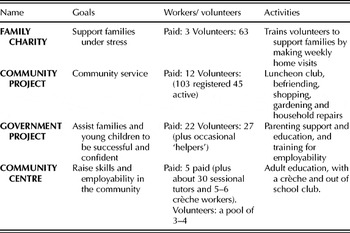
We undertook research with four volunteer using organisations with a presence in Brightville. They were chosen to capture some of the diversity of volunteer activity. All four, however, are engaged in welfare activities to support young families and older adults in the community. All employ paid workers and are heavily reliant upon volunteers for service delivery. They are: a local community centre (COMMUNITY CENTRE), a national project funded by central government and administered by the local authority (GOVERNMENT PROJECT), a family support charity (FAMILY CHARITY); and a community project (COMMUNITY PROJECT). All four attract volunteers from within the boundaries of Brightville as well as from neighbouring Ironntown. (The government project has a remit to work within defined geographical boundaries and directs enquiries from beyond them to other organisations). Table 1 summarises key characteristics of each organisation.
Summary of the study organisations

We used a combination of techniques as data gathering tools: repeated, systematic observation; collection of documentary evidence; interviews with key informants (officers in local economic development and social inclusion, managers and workers in organisations using volunteers); focus groups; and ‘life history’ interviews with a selection of volunteers. In this article we draw mainly but not exclusively upon the interviews with volunteers. We refer more briefly to one of the focus groups and to key informant interviews. In this article we use simple counting to help the reader to get a sense of the material as a whole but there is no claim that numbers are generalisable in a statistical sense to a wider population. We were concerned with explanations, dynamics and processes rather than counting phenomena.
The interviewees from these organisations were 19 volunteers (15 women, 4 men) and eight paid workers (5 women, 3 men). Five of the paid workers were also volunteers at the time of the interview, making a total of 24 volunteer interviewees. (Three paid workers we interviewed were no longer volunteers but had originally come to the site in that role.) The volunteers participated in management and trustee roles as well as delivering services to the public. The interviews followed a ‘life history’ design which we adopted because of its capacity to capture the overlap between the individual and social and institutional structures (Dex, Reference Dex1991). This approach was intended to explore the meanings and explanations that individuals attribute to their experiences. Interviews were recorded and transcribed in full and analysed by theme, paying careful attention to language used and emphasis given.
Selection of volunteers and former volunteers for interviews was guided by key informants (who were in some cases the gatekeepers who facilitated access). Our intention was to include a range of characteristics present in the sites (age, gender, employment status, volunteer role, caring responsibility, disability, and time commitment to volunteering). The length of volunteering experience varied from one who was just completing the compulsory training for the FAMILY CHARITY, to others who had been volunteering for over a decade. Three-quarters of the volunteer interviewees were women. All were white, reflecting the lack of ethnic diversity in the community. Ages ranged from early 20s to late 60s. Individuals’ weekly time commitment to volunteering ranged from two hours to around 15 hours.
Just seven of the 19 volunteers were in waged work. Of the other 12, only two expected to engage in the labour market in the future (one of whom was in training and the other on Job Seekers Allowance). Others were retired (4), in receipt of incapacity benefit (3), one a full-time carer for a severely disabled son, and two were partnered mothers who expressed no interest in paid work. Pseudonyms are used to protect the identity of individuals, voluntary organisations and the community. In the following sections we draw upon the interview data to discuss volunteers’ reflections and reasoning about volunteering, care and employment in their lives. We consider the meanings people attached to volunteering, explore how they create and maintain space (emotional, social and temporal) for voluntary work, and comment upon tensions between the paid/unpaid work binary. As a framework for organising the interview material we drew upon Omoto and Snyder (Reference Omoto and Snyder2002) who propose three stages of volunteering: antecedents, experience and consequences – each of which operates at individual, organisation and community levels.
Antecedents to volunteering: personal histories and explanations
The subject of motivation for volunteering has attracted considerable interest and been addressed in a number of studies (Knapp et al., Reference Knapp, Vasiliki and Davis Smith1995; Merrell, Reference Merrell2000; Wardell et al., Reference Wardell, Lishman and Whalley2000; Yeung, Reference Yeung2004; Narushima, Reference Narushima2005; Dolnica and Randle, Reference Dolnica and Randle2007). These categorise motivation in various ways but tend to report that people volunteer for a mix of altruistic and self-interested reasons. Other accounts of entry into (or rejection of) volunteering look beyond individual preferences to wider contextual factors. Volunteering needs to be situated within networks of informal support, especially family, neighbours, and friends (Roberts and Devine, Reference Roberts and Devine2004). Images of volunteering can also be significant. For example, perception that volunteering is middle aged and middle class can deter older people from less privileged backgrounds (Volunteer Development Scotland, 2003). In this section we briefly discuss the pathways into volunteering narrated by Brightville volunteers. Our intention is to draw upon the experiences in Brightville to offer a way of conceptualising how people construct and negotiate various constraints and opportunities in their daily lives that lead to volunteering.
As noted above, historical accounts of volunteering in the UK identify two main impulses i.e. philanthropy and mutual aid. Mutual aid is characterised by individuals with a shared experience or situation working together to bring about change. Philanthropy is associated with altruism towards people less closely identified with the giver. These historical stances towards volunteering resonate strongly with the Brightville volunteers’ accounts of their attitudes and personal histories. Eleven volunteers (nine women and two men) talked about their volunteering mainly as a response to a problem or experience shared with their ‘clients’, reflecting the notion of ‘mutual aid’. One volunteer who exemplifies this group was Claire, who explained that she volunteered for the FAMILY CHARITY to ‘put something back’ because she had been supported by a FAMILY CHARITY volunteer herself when she had suffered from severe post-natal depression. In trying to generalise her own experience to the contribution made by the FAMILY CHARITY she commented ‘I think it's really to help the community help themselves’. In contrast, six volunteers (all women) talked about their approach to volunteering in ways that evoke ‘philanthropy’, although the word itself was not used. These volunteers (who lived outside Brightville), externalise the needs of the recipient and tend to stress their own relative good fortune. For example, Stella sees herself as helping people less fortunate than herself:
I see it as they are trying to help people in this community which I suppose could be described as a bit of a deprived community and I try to help them through [the COMMUNITY PROJECT].
There was a smaller group of volunteers (two men and two women) who recounted how they entered volunteering in response to a personal need associated with a life event. This is referred to in discussions of volunteer motivation as ‘social adjustment’ (Knapp et al., Reference Knapp, Vasiliki and Davis Smith1995). Sarah, for example, entered volunteering for the FAMILY CHARITY following divorce and her daughter's growing independence:
The fact that there's another family that needs you is perhaps filling an emotional gap for me. I think sometimes I am actually just filling an emotional gap [with the volunteering]. Cynical me!
Only three interviewees (two women and one man) described their volunteering as a way of developing skills and experience of practical use in the labour market. Sally, for example, thought that volunteering for the FAMILY CHARITY was likely to strengthen her CV. She had taken a degree in social care and was seeking employment in that field but had so far failed to find a job that fitted her family commitments as a lone parent with three young children. Each of these three also talked about how their volunteering mattered because it contributed to the wellbeing of other individuals and the community.
In this short summary we use a typology developed in more detail elsewhere (Hardill et al., Reference Hardill, Baines and 62007) to denote the factors in individual histories and social contexts that were used to explain volunteering within the Brightville organisations. This highlights the prominence of identification with the needs of others, and illustrates that altruism can take different forms.
The ‘work’ of the volunteers
In this section we talk about the experience of volunteering and, in particular, how it intersects with paid work and care. It was typical of volunteers to refer to their voluntary activity casually as ‘work’. Some volunteers made the point strongly that their volunteering is like work in terms of the commitment they give to it and of its value to others. FAMILY CHARITY volunteers in a focus group, for example, claimed that they were doing some of the same tasks as social care professionals (although they also made the point that the families they support trust them because they are not paid). When Sally (as noted in the last sub-section) explained that her initial hopes of gaining advantage in the labour market were not fulfilled she went on to speak of volunteering as an alternative to having a job. It supports her sense of self-worth while she is not in employment, ‘because otherwise I'd just be a single mum, living off the Social’. This theme of volunteering as a source of personal identity was particularly strong for Brightville volunteers for whom paid work was impossible (or perceived as such) due to age, disability, or ill health. Laura, for example, said she was ‘cut off’ from paid work due to her disability (failing eyesight). She told us, ‘with me being classed as disabled, it gives me a bit of a boost to say that at least I can do something’.
Volunteering represents a substantial time commitment for Laura. She spends four days per week undertaking formal voluntary work for three organisations. Her weekday routine is structured around volunteering to a degree that is quite extreme and she says that sometimes her family takes second place to it. Other respondents described juggling caring and voluntary work on a day to day basis in ways that recall themes from work–life balance debates. If they have young children or other dependents they have to organise childcare to create ‘space’ in their lives to volunteer. Sue, who works part-time, volunteers mid week. Her mother looks after her toddler daughter while Sue visits her FAMILY CHARITY family. Demands on the part of family, on the other hand, can put severe pressure on time available to volunteer. COMMUNITY PROJECT volunteer Sandra explained that her daughter, her daughter's partner and their baby are about to come to live with her because he has lost his job and they can no longer afford to be an independent household. Her daughter is looking for a job and expects Sandra to care for the baby while she is at work. ‘If it comes to it I would have to do it [give up volunteering] to help my family but I don't want to.’ In the study sites we observed tension between paid and unpaid workers that centred on some volunteers being perceived as ‘unreliable’. Jean, the Team Support Worker at the COMMUNITY PROJECT, spoke about being let down by lunch club volunteers who failed to turn up when expected. All this highlights one of the work-like characteristics of volunteering that is relatively little acknowledged; it requires time that needs to be managed alongside other activities including caring and domestic roles. The capacity to volunteer – like the capacity to engage in the labour market – needs to be managed alongside work and caring within the household and across the generations.
A few individuals who came to the organisations as volunteers were later recruited as paid workers. Pippa is a former GOVERNMENT PROJECT volunteer who, when we interviewed her, was employed by the project as a full-time administrator. It was through her volunteering experience that she had gained the confidence to apply for this employment. ‘I wouldn't have applied for the job if I hadn't done the volunteering first, I wouldn't have thought I was worth it’. Her transition from volunteer to paid worker, however, was not an easy one. Paid jobs in the GOVERNMENT PROJECT are considered highly desirable and some volunteers resented her success in being selected. Moreover, some of the GOVERNMENT PROJECT staff found it difficult to accept her as a fellow staff member after knowing her in the role of volunteer. Pippa's experience dramatises how difficult and contested the boundaries between paid work and volunteering can be. Her progress from volunteering into paid employment was not unique but nor was it typical in this study. Much more characteristic were temporary shifts and overlaps between paid and unpaid activity for volunteers and for paid workers. Jean, for example, as part of her paid role runs a lunch club for older people in the community. Each year at Christmas cooking and organising a meal in the same place becomes a volunteer task for her. When Jean is on holiday or off sick volunteer Sandra takes over her roles of cooking and planning meals and receives remuneration on a short term basis.
The experience of volunteering for participants in the Brightville organisations is ‘work-like’ in a number of contrasting and overlapping ways. Volunteering is described as ‘work’ and directly compared to other forms of work. Volunteering can take the place of a job in terms of meaning and identity. Organisations need reliable unpaid inputs, and in order to be reliable volunteers need to ‘juggle’ the time they give alongside other demands on their time.
Change and consequences
Relationships between waged work, care within the family, and voluntary action in the case study volunteer sites were many faceted. Volunteering was only occasionally described by volunteers as an actual or potential route out of unemployment or into a new career. On the other hand, people described personal rewards that they had not sought or anticipated. Accreditation for training and experience can be a significant benefit from volunteer activity for some. Donna, for example, did not identify her career as a reason for becoming a FAMILY CHARITY volunteer but she did report that she had gained both skills and credentials that were valued in her workplace (she is a youth worker). She expressed delight in having a ‘portfolio’ of certificates including those for volunteer activity. ‘I often look through and see my FAMILY CHARITY Certificate – when I'm applying for a job it reminds me what I've done.’
Many interviewees (paid workers, key informants and volunteers themselves) asserted that increased confidence was an important gain from volunteering. Their claims on this topic were illustrated by detailed description of their own and others’ experience. For example, Jean proudly related how Lily (whom she had recruited as a volunteer) had gained confidence through helping at the lunch club after her retirement from a job she had held for 45 years. Jean's narrative of Lily's newly acquired confidence focussed upon how she used to be too shy to call the bingo numbers at the lunch club but now loves this task. This is how Sandra, another volunteer at the COMMUNITY PROJECT lunch club, emphasised her own growth in confidence:
I was sort of ‘I hope they don't ask me questions’ – you know? But now it doesn't bother me and I feel I can sit there and if we have any discussion I will say something. Whereas before I wouldn't say anything but now I'll say, ‘I've had this experience’ and ‘I've done this’.
Personal consequences of volunteering were positive and almost invariably explained in terms of small gains in confidence, often to take on public tasks and speak out in front of others. Examples which may seem trivial on one level (e.g. calling out bingo numbers at a lunch club for older people), were important to individuals and to the groups they supported within the community.
Discussion and conclusions
There are diverse and sometimes contradictory dimensions to UK policy promoting volunteering for individuals, organisations, and communities. Volunteering is often presented as a panacea for a wide range social and political problems including worklessness and lack of participation in political processes (Milligan and Fyfe, Reference Milligan and Fyfe2004). In terms of building personal confidence that enables people to feel at ease in public arenas the Brightville study concurs with some of the most positive expectations invested in volunteering. Volunteers recounted how they gained a role, a sense of purpose and personal well-being through their volunteering. People outside paid work described their participation in volunteering as a form of engagement in public space that contrasted with an alternative they dismissed as ‘just sitting at home’. It is possible that new confidence gained from volunteering could support more active engagement in other forms of community participation although data from the Brightville study cannot demonstrate this directly. We can show however that in the study sites volunteering constitutes an important aspect of individual and community life especially for women.
The Brightville study uncovered numerous examples of the continued strength and importance of family networks within the community, similar to the findings in other relatively deprived place-based communities (Mumford and Power, Reference Mumford and Power2003). Individual narratives of volunteer engagement revealed that the capacity to give time to volunteering often depends upon active support from within the household and wider family. Conversely, demands of family could be prioritised in ways that constrained (or were likely to) volunteer activity. Volunteering – in common with labour market participation – is negotiated within the household and family and mediated through beliefs about family responsibilities and appropriate behaviours for men and women and for young and old (Daly, Reference Daly2002; Wheelock and Jones, Reference Wheelock and Jones2002; Wheelock et al., Reference Wheelock, Oughton and Baines2003,).
There was limited evidence in the volunteer sites discussed above of raised aspirations towards the labour market or of enskilling for employment, despite the fact that volunteers of working age outside the labour market indicated that they had gained confidence and, in some cases, certificates. Mutual aid and philanthropy are terms used in analyses of the history of volunteering and they helped us to make sense of volunteers’ own accounts, although volunteers themselves do not use these words. For some people in Brightville who were excluded from the labour market volunteering afforded an identity that was articulated in terms of work. They typically described their volunteering as ‘work’ and compared it to the tasks performed for wages by others. One reading of the data from Brightville is that that volunteering can be seen as an individualised adaptation to labour market failure in a community damaged by economic decline. A more upbeat version is that these findings are consistent with the idea that sites of volunteering can be construed as ‘spaces of hope’ that embrace logics of work outside market-orientated exchange (Williams, Reference Williams2002). Overall, the empirical evidence demonstrates that the relationship between volunteering and waged work is uncertain, and subject to new pressures from policy interventions in the domains of welfare to work, community building, and service delivery. In all this it is important to ensure that volunteer involving organisations and policy makers continue to recognise and nurture the relational and intrinsic rewards of volunteering, as well as its potential to support pathways into paid work.