Introduction
Attention deficit hyperactivity disorder (ADHD) is a complex pervasive developmental disorder affecting approximately 3–5% of children (APA, 1994). The DSM specifies three types of ADHD: predominantly inattentive type (inattention, trouble with organization, easily distracted), predominantly hyperactive-impulsive type (fidgetiness, difficulty remaining seated, talking excessively, frequent interruptions, impulsivity), and combined type (symptoms of both inattention and hyperactive-impulsivity) (APA, 1994).
These characteristics or benchmark symptoms of ADHD significantly interfere with cognitive and social functions in the child's developmental process. Numerous studies correlate ADHD with poor academic performance and achievement, depression, anxiety, aggression, conduct problems, poor peer and family relations, as well as potential drug abuse (Barkley, Reference Barkley1990, Reference Barkley1997a; Biederman et al. Reference Biederman, Faraone, Lapey and Weiss1992; Weiss & Nechtman, Reference Weiss and Hechtman1993; Nadeau, Reference Nadeau1995).
The large body of literature on ADHD focuses mainly on the effects the disorder has for children and adolescents. Recently, researchers have broadened ADHD research to adults. What happens to the symptoms of ADHD children after they become adults remains very much under debate. Some researchers have claimed that behavioral and cognitive difficulties associated with the disorder abate as ADHD individuals reach adulthood (Shaffer, Reference Shaffer1994; Hill & Schoener, Reference Hill and Schoener1996). Hill & Schoener (Reference Hill and Schoener1996), for instance, estimate the prevalence rate among 20-year-olds as 0.8%, about a third of the prevalence rate in children, decreasing even more dramatically to 0.05% among 40 year olds. Other researchers have claimed that although the severity of the disorder may decline, symptoms continue to remain prevalent in adulthood (Murphy & Barkley, Reference Murphy and Barkley1996; Barkley, Reference Barkley1998; Faraone et al. Reference Faraone, Sergeant, Gillberg and Biederman2003, 2005 a). Barkley (Reference Barkley1998) estimates that 50–70% of children with ADHD will continue to exhibit the cardinal signs of the disorder well into adulthood. Faraone et al. (Reference Faraone, Biederman and Mick2005a) suggest that the prevalence rates depend on the definition used to assess impairment. They estimate that by the age of 25 years, only 15% of children previously diagnosed with ADHD meet full criteria for ADHD as an adult; a further 40–60% would meet criteria for partial remission.
Even with the large variance in estimated prevalence rates among adults, the overall decline in these rates suggests that as an ADHD child develops, either some of the symptoms go in remission or the child learns to manage and cope with the symptoms, so that the disorder does not interfere with executive function at the same level as it did in childhood (Barkley, Reference Barkley1997b; Faraone et al. Reference Faraone, Biederman, Spencer, Wilens, Seidman, Mick and Doyle2000, Reference Faraone, Biederman and Mick2005a). Most researchers agree that the hyperactive component lessens to a greater degree as the child develops as compared with the inattentive component (Shaffer, Reference Shaffer1994; Faraone et al. Reference Faraone, Biederman, Spencer, Wilens, Seidman, Mick and Doyle2000).
Research on the developmental course of inattention or disinhibition, however, remains inconclusive. One consequence of this purported lack of inhibition has on persons with ADHD is that irrelevant information might be processed and maintained, which effectively reduces working memory capacity and may contribute to problems with controlling affect and inappropriate behaviors (Barkley, Reference Barkley and Routh1994, Reference Barkley1997b, Reference Barkley1998; Gaultney et al. Reference Gaultney, Kipp, Weinstein and McNeill1999; Nigg, Reference Nigg2001; Slaats-Willemse et al. Reference Slaats-Willemse, Swaab-Barneveld, de Sonneville, van der Meulen and Buitelaar2003). Persons with ADHD have difficulty inhibiting prepotent responses, or response inhibition (Barkley, Reference Barkley1997b; Miyake et al. Reference Miyake, Friedman, Emerson, Witzki, Howerter and Wager2000). We conducted the present meta-analysis to investigate whether the presumed response inhibition problem associated with ADHD decreases over the course of development, an issue hitherto not examined in meta-analyses on inhibition and ADHD (Boonstra et al. Reference Boonstra, Oosterlaan, Sergeant and Buitelaar2005).
The test often used to measure response inhibition is the Stroop color-word test (Stroop, Reference Stroop1935). There are multiple variants of this test. The one most often used in ADHD research is the version designed by Golden (Reference Golden1978). To minimize noise in the data, our meta-analysis only collected studies that used this version.
The test consists of three conditions, each presented on a separate sheet of paper. The first sheet contains 100 instances of three color words (‘red’, ‘blue’, ‘green’) printed in black ink. The subject is instructed to read each item out loud as quickly as possible. In the second condition, the color condition, the subject is presented with five rows of four Xs printed in colored ink (red, blue, green) and instructed to rapidly name the ink color. The third condition, the color-word condition, consists of 100 color words (‘red’, ‘blue’, ‘green’) printed in incongruent colored ink (e.g. the word ‘blue’ printed in red). The subject is requested to name the ink color, thereby inhibiting the prepotent response of reading the word. The dependent variable is the number of correct responses emitted during a 45 s period (Golden, Reference Golden1978).
The Stroop measures the individual's ability to inhibit a dominant response (reading) in favor of completing a required task (color naming). Cohen et al. (Reference Cohen, Dunbar and McClelland1990) state that two processes are involved in this task: an automatic response, which requires little to no attention for execution, and a controlled response, which requires attention and is under voluntary control. Overall, people tend to be consistently faster at reading words than at naming colors. The reading of a word is considered an automatic process and therefore faster than the controlled process of color naming. In the incongruent or third trial of the Stroop test, people tend to read the word written (an automatic response) rather than name the color of ink (a controlled process) which results in word reading competing against color naming, thus resulting in poorer performance on this task (Cohen et al. Reference Cohen, Dunbar and McClelland1990). The hypothesis is that persons with ADHD have more difficultly attending to the controlled process than age-matched controls.
When comparing individuals with ADHD with age-matched controls, researchers have traditionally investigated only performance in the color-word condition (Doyle et al. Reference Doyle, Biederman, Seidman, Weber and Faraone2000). The finding that ADHD individuals are slower in this condition is taken as evidence that they have more problems with response inhibition than age-matched controls (Barkley, Reference Barkley1997b; van Mourik et al. Reference van Mourik, Oosterlaan and Sergeant2005). The problem with investigating only the color-word condition is that differences in baseline speed are not taken into account. Persons with ADHD have been found to have lower scores in both reading ability (word condition) and naming speed (color condition) (Dykman et al. Reference Dykman and Ackerman1991; Semrud-Clikeman et al. Reference Semrud-Clikeman, Biederman, Sprich-Buckminister, Lehman, Faraone and Norman1992; Doyle et al. Reference Doyle, Biederman, Seidman, Weber and Faraone2000; Tannock et al. Reference Tannock, Martinussen and Frijters2000; van Mourik et al. Reference van Mourik, Oosterlaan and Sergeant2005). It is possible that persons with ADHD respond slower on color-word trials not because of poorer response inhibition, but simply because of slower naming speed. Therefore, an interference score should be calculated from the color-word score only with adequate control for baseline speed differences in the color score.
What form should that control take? Often, researchers calculate an interference score as a difference score (a procedure advocated by Stroop, Reference Stroop1935), that is, time needed for the color-word condition minus the time needed for the color condition. This approach was taken in a meta-analysis on adult ADHD individuals by Boonstra et al. (Reference Boonstra, Oosterlaan, Sergeant and Buitelaar2005); this control made the effect size of the incongruent trial disappear.
It is, however, far from certain that this is the optimal procedure. In a meta-analysis on aging and the Stroop task, Verhaeghen & Cerella (Reference Verhaeghen and Cerella2002), using data from Verhaeghen & De Meersman (Reference Verhaeghen and De Meersman1998), first examined the relationship between response time (RT) in the color-word condition and RT in the color condition. If Stroop's (Reference Stroop1935) difference score would be the best way to characterize the Stroop effect, one would expect a constant difference between the two conditions within each of the age groups. This was not what was found. Instead, a multiplicative relationship emerged for both younger and older adults (Verhaeghen & Cerella, Reference Verhaeghen and Cerella2002), showing that the requirement for response inhibition slows performance down by a constant factor (in the Verhaeghen & Cerella meta-analysis, this factor was 1.9, i.e. color-word RT equaled 1.9 times color RT). Therefore, a ratio score [i.e. RT (color-word):RT (color)] appears to be the best measure of the response inhibition. It is worth noting that Verhaeghen & Cerella found that the average ratio of color-word RT over color score RT for all studies was identical for younger and for older adults, showing that older adults have no particular deficit in response inhibition, once slowing in color naming (older adults are about 1.8 times slower in this condition; Verhaeghen & De Meersman, Reference Verhaeghen and De Meersman1998) is taken into account. One lesson from this analysis is that the multiplicative cost imposed upon the color-word condition leads to much larger difference scores in slower individuals or slower groups.
If the findings by Verhaeghen & Cerella (Reference Verhaeghen and Cerella2002) generalize across populations, then ratio scores should be used for the investigation of differences in Stroop interference scores for ADHD versus control subjects as well. Therefore, in a preliminary analysis, we investigated the functional relationship between color-word RT and color RT in our sample, and tested for differences in linear coefficients for this relationship. If no such differences are found, we may conclude that the Stroop effect is identical across the two groups.
In sum, we investigated whether response inhibition, as measured by the Stroop color-word test, is indeed sensitive to ADHD status, and, if so, what influence maturation has on this attentional symptom of ADHD. If the literature on the decrease of ADHD-related hyperactivity symptoms over the course of development generalizes to the realm of attention, one might expect: (a) a larger color-word RT:color RT ratio in ADHD individuals than in age-matched controls, and (b) faster maturation rates in these ratios for ADHD individuals than for controls.
Method
We conducted a search on PsycINFO and Medline, with the following keywords: Stroop color word, ADHD, maturation rates, inattention, and response inhibition. Reference lists from articles retrieved were searched for further studies. To be included in the analysis, published reports had to meet the following criteria: (a) studies included a control group; (b) the ADHD group clearly met established ADHD diagnostic criteria, with no co-morbid disorders (i.e. depression or oppositional defiant disorder); (c) no stimulant medication was administered at the time of evaluation; (d) participants were assessed with the Golden (Reference Golden1978) version of the Stroop color-word test; (e) reports provided either raw scores or T-scores for the separate conditions on the Stroop color-word test. In total, 25 studies met these criteria for inclusion, yielding a total of 55 data points (i.e. 29 groups of ADHD individuals and 26 groups of age-matched controls).
A majority of the studies used in this analysis did not specify whether the ADHD subjects were classified as predominantly inattentive type or predominantly hyperactive-impulsive type. Rather, authors simply specify whether subjects met overall criteria for ADHD. Therefore, we are unable to determine if differences or lack of differences exist due to subject variability with diagnosis. Additionally, we do not include studies that included subjects with co-morbid disorders and/or learning disabilities (i.e. reading deficits) in order to avoid potential confounds of these disabilities. Golden & Golden (Reference Golden and Golden2002) indicate that the presence of learning disabilities may complicate interpretations and for this reason we do not include this sample in our analysis.
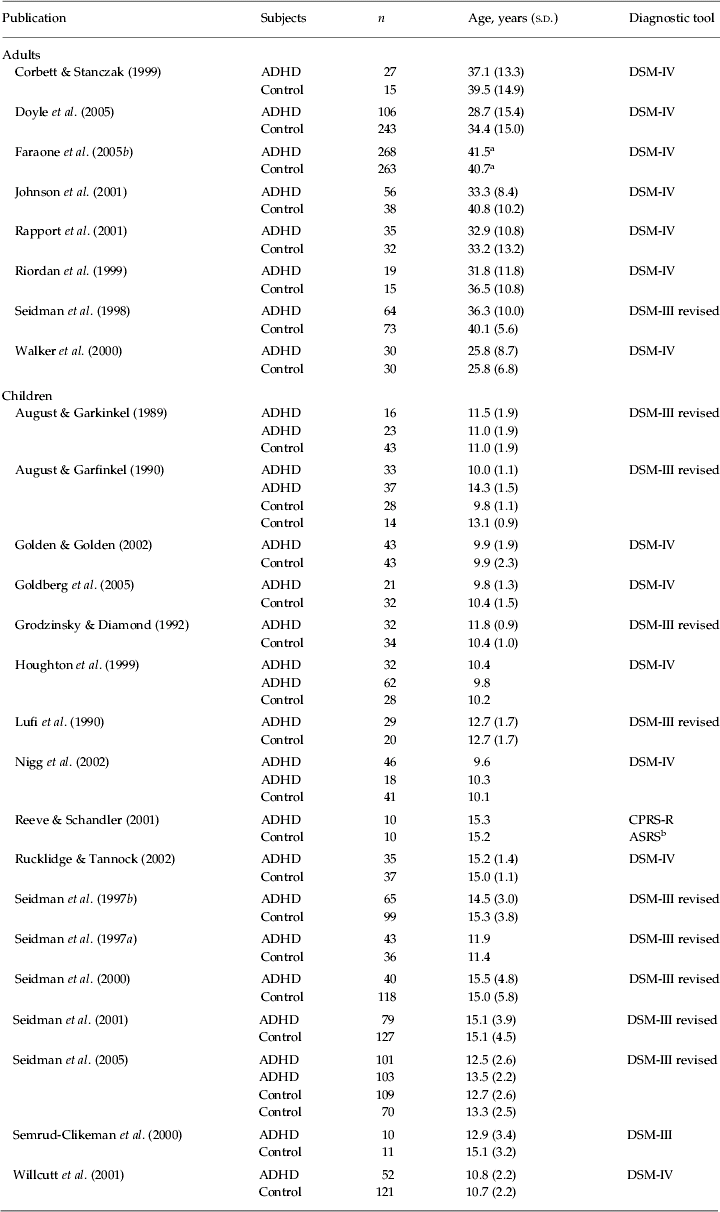
Table 1 provides information on each study, including the number of subjects, the mean age and the diagnostic system used for ADHD diagnosis. In addition to demographic information, we extracted scores on the Stroop color-word test. Usable data included raw scores or T-scores. If reports provided T-scores, we calculated raw scores using the Golden manual (Reference Golden1978) . If reports only provided the interference score and not mean scores on each of the three conditions, we calculated raw scores using the Golden manual. Like Verhaeghen & De Meersman (Reference Verhaeghen and De Meersman1998), we converted the scores to RT for a single item, expressed in ms. Since each condition of the Golden version of the Stroop color-word test is timed at 45 s, our conversion formula was: (45/mean raw score)×1000.
Demographic information for the 25 studies used in this meta-analysis

s.d., Standard deviation; ADHD, attention deficit hyperactivity disorder; DSM, Diagnostic and Statistical Manual of Mental Disorders; CPRS-R, Conners Parent Rating Scale-Revised.
a Information reported in Michelson et al. (Reference Michelson, Adler, Spencer, Reimherr, West, Allen, Kelsey, Wenicke, Dietrich and Milton2001).
b ADD-H Adolescent Self-Report Scale.
Results
Color-word condition RT as a function of the color condition RT: no effect of age and ADHD status
In a first analysis, we tested whether Stroop effects are indeed, as sometimes asserted, larger for ADHD individuals than for control subjects and whether these effects vary as a function of age. A hierarchical approach was used – first we regressed color-word scores onto color words to determine the shape of the relationship, and then we added ADHD status (ADHD or control), age, and the interaction between age and ADHD (to test for intercept differences as a function of age and ADHD status and their interaction), as well as the interaction between ADHD status and color RT, between age and color RT, and the triple interaction (to test for slope differences as a function of age and ADHD status and their interaction) to the equation. If the second step proves significant, the relationship between color-word and color scores differs across individuals with different ADHD status, different ages, or the combination of the two. The data are presented in Fig. 1, separated by ADHD status.
Response times (RT, expressed in ms/item) in the color-word condition as a function of response times in the color condition, split by attention deficit hyperactivity disorder (ADHD) status, along with the best-fitting model for these curves: a single line through the origin (- - - -), indicating that the Stroop interference cost is best expressed as a ratio score, and that the interference cost is identical for ADHD individuals (●) and age-matched controls (○).

The first step yielded the following equation:

This relationship is multiplicative: The 95% confidence interval around the 92 ms intercept contains zero. Constraining the intercept to be zero led to the equation:

The addition of the variables described above did not result in a significant increase in fit from equation (1) [F(3, 50)=0.78].
Clearly, then, the relationship between color-word and color RT is multiplicative, and the slope of this function, or the ratio of color-word RT over color RT, is identical across age groups and ADHD status. In other words, the Stroop interference effect is identical for ADHD participants and control subjects, and does not covary with age, once baseline differences in color RT are taken into account.
No differences in maturation rates in color and color-word conditions as a function of ADHD status
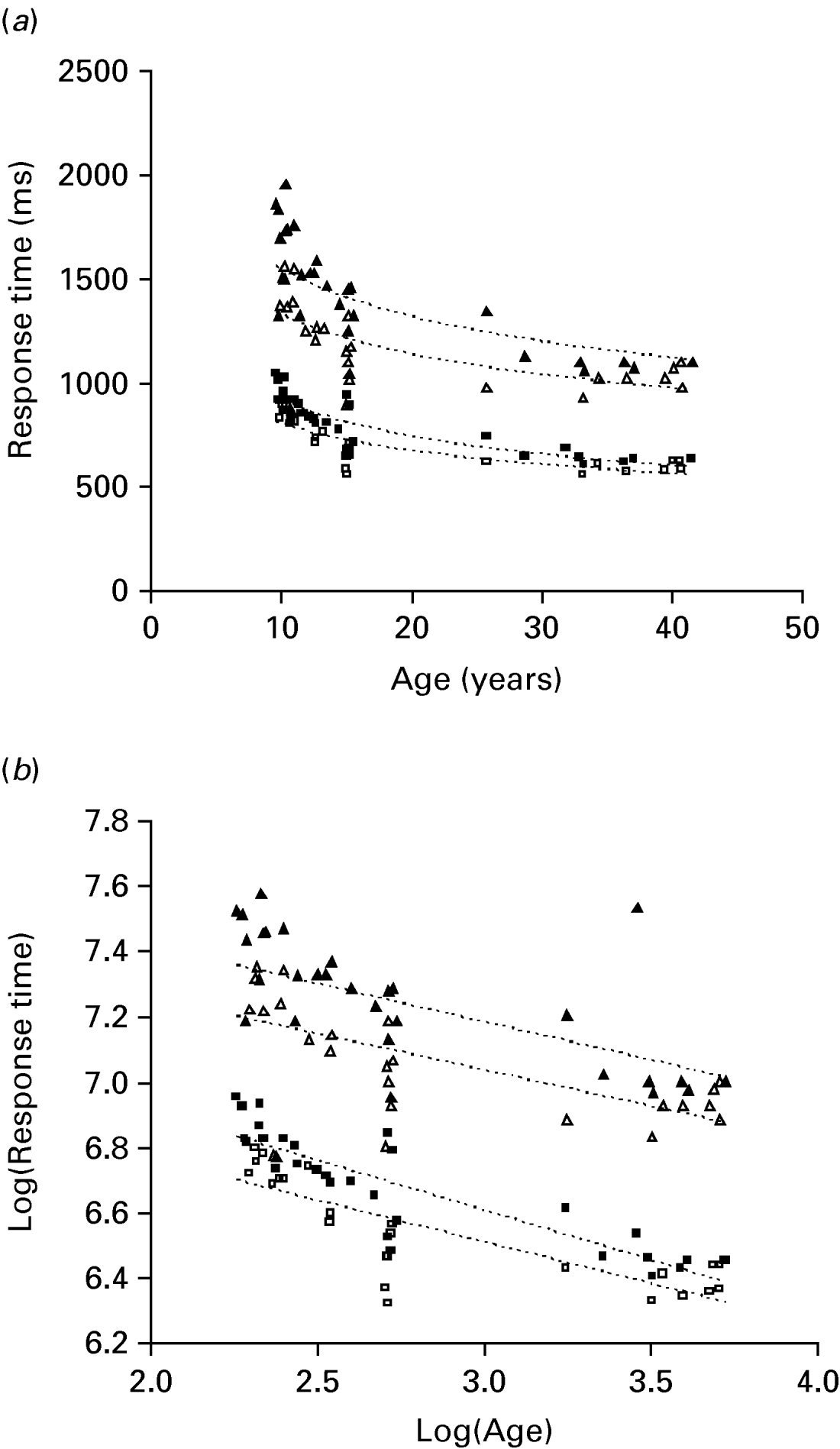
In a second analysis, we investigated the maturation rate for the color and color-word conditions in ADHD and control subjects. Fig. 2 a shows RT for the two conditions plotted as a function of age and ADHD status. The plots suggest a non-linear, negatively accelerating relationship; we fitted power functions to the data, in accordance with standard developmental models for response times (e.g. Kail, Reference Kail1988; Cerella & Hale, Reference Cerella and Hale1994). To test for significant differences between the four curves, we first linearized the data by performing a logarithmic transformation on both age and RT (Fig. 2 b), and then conducted a hierarchical linear regression analysis. We note that this analysis, in effect, contains a test for interference effects as ratio scores as advocated in the Introduction and the previous section. That is, given that log[RT (color-word)]−log[RT (color)]=log[RT (color-word)/RT (color)], a lack of ADHD status×condition interaction in log-transformed scores signifies that the ratio of the color-word over color condition is identical in ADHD participants and control subjects.
Response times for the color and color-word conditions for attention deficit hyperactivity disorder (ADHD) individuals and age-matched controls as a function of age, in raw (a) and log-log transformed units (b), along with the best-fitting model for these curves. The data indicate identical rates across all four curves (i.e. equal maturation rates for ADHD individuals and controls, and equal maturation rates for the color-word and color conditions), as well as identical interference effects for the ADHD individuals and the age-matched controls. □, Control color condition; △, control color-word condition; ■, ADHD color condition; ▲, ADHD color-word condition.

In a first step, we predicted log(RT) from log(Age). Log(Age) predicted log(RT) significantly [R 2=0.16, F(1, 108)=19.91, p<0.001].
In a second step, we entered ADHD status (to test for slower responses depending on ADHD status), a dummy variable to denote condition (to test for slower responses depending on condition, i.e. interference effects), and the interaction between this dummy and ADHD status (to test whether interference effects depended on ADHD status), thus testing for intercept differences between the four curves. This second step added considerable predictive power [ΔR 2=0.69, F(3, 105)=161.10, p<0.001]. Only the coefficients associated with age, ADHD status, and the dummy condition reached significance; the condition×ADHD status interaction was not significant [t(1)=0.73, p=0.467]. RTs were faster for older individuals, for control subjects and for the color condition. The lack of significant condition×ADHD status interaction then further corroborates our finding in the previous section that the interference effect is statistically identical in ADHD individuals and control individuals.
In a third and final step, we entered the interaction terms between the three variables entered in step 2 and log(Age), thus testing for slope (i.e. age-related) differences between the four curves. This final step clearly did not lead to an increase in fit [ΔR 2=0.00, F(3, 103)=0.49], indicating that the slopes for the four curves are statistically identical.
The following set of four equations describes the four curves, R 2=0.85:


We repeated these regression analyses using reading speed rather than color naming as the independent variable. The reason for doing so lies in a relatively recent model for Stroop interference, Cohen's computational task-demand model (Cohen et al. Reference Cohen, Dunbar and McClelland1990; Cohen & Servan-Schreiber, Reference Cohen and Servan-Schreiber1992; Cohen & Huston, Reference Cohen, Huston, Urnilta and Moscovitch1994). This model takes three types of input – a word's meaning, the ink color it is written in, and input to specific task-demand units, which determine whether the system will perform color naming or word reading. If the task-demand units are damaged, control over the task diminishes. Reading is an overlearned response, but color naming is not, and therefore one might argue that the correct comparison is not between the color-word condition and color naming (both of which might suffer when the task-demand system fails) but between the color-word condition and word reading. Using word reading rather than color naming as the independent variables did not change the tenor of the results: (a) the condition×ADHD status interaction was not significant [t(1)=0.96, p=0.342]; (b) there was no indication of a slope difference between the four curves [ΔR 2=0.00, F(3, 102)=0.46].
Although the data are fit well by a single power function, we also fitted the data to two separate sets of linear functions, one for groups with an average age under 20 years, the other for the groups with an average age over 20 years. The set of younger groups showed a large slope of RT by age (−52, t=−6.10, p<0.001), the set of older groups no age effect at all (slope of −5, t=−0.86, p=0.40), indicating that the speed-up of RTs happens before age 20 years and that after age 20 years RTs remain stable up until (at least) age 40 years. Importantly, in neither of the two sets did we observe a significant condition×ADHD status interaction (t=1.55, p=0.13, and t=1.47, p=0.15, respectively), nor did we observe slope differences between the four curves [ΔR 2=0.01, F(3, 70)=0.60, and ΔR 2=0.02, F(3, 102)=1.01, respectively].
All previous analyses were conducted on RTs, the common metric across all studies. It can be argued, however, that these analyses might be problematic because they do not take age-related changes in between-subject variability into account. A traditional effect size-based meta-analysis (we used the system advocated by Hedges & Olkin, Reference Hedges and Olkin1985) in which the mean standardized difference between the time needed for color-word stimuli and the time needed for naming colors is calculated might be better suited for these purposes. We were able to extract 31 such effect sizes from the data, 14 for control groups and 17 for ADHD groups. The average effect size did not differ between these two groupings: Cohen's d (corrected for small-sample bias)=1.62 for control subjects and 1.57 for ADHD subjects [Q B (2 df)=0.37, n.s.]. Of more interest is the relationship between effect size and age. Linear regression yielded an R 2 of 0.39. Age was a significant predictor [β=0.62, t(30)=3.33, p<0.01], but neither the regression coefficient associated with a dummy variable denoting group membership [β=−0.04, t(30)=−0.14, p=0.89], nor the regression coefficient denoting the interaction between group membership and age [β=0.01, t(30)=0.00, p=1.00], became significant. This result then, like the previous set of analyses, indicates equal interference effects in control and ADHD participants, as well as equivalent evolution of this effect size over the age span considered in the meta-analysis. We note that effect sizes increase rather than decrease with age, likely because an age-related decrease in variability inflates the mean standardized differences with advancing age.
Discussion
Our meta-analysis was guided by two questions: (a) is there a deficit in response inhibition in ADHD individuals? and (b) what happens to this presumed deficit over development from childhood to adulthood? Put succinctly, the answers to these questions are, respectively (a) no, and (b) nothing.
First, we found no evidence for an ADHD-related deficit in response inhibition, as measured by the Stroop task. Two lines of evidence point to this conclusion. First, when color-word RTs were plotted as a function of color RTs, we found that a single line, going through the origin explained the data sufficiently. This indicates, first, that a ratio score rather than a difference score is the best indicator of the type of interference caused by the color-word condition and second, that this ratio score is identical across the two groups. Regardless of ADHD status, it takes participants 1.7 times longer to respond to stimuli in the color-word condition than the color condition. Note that Verhaeghen & Cerella (Reference Verhaeghen and Cerella2002), using a non-overlapping sample of studies, obtained a comparable slowing factor of 1.9. If there were a response inhibition deficit as a result of ADHD, we would have found two lines, with the line for the ADHD groups situated above the line for control groups. This was not the case.
The second piece of evidence comes from the maturation rates as derived from the age×RT functions. After logarithmic transformation of the RTs, the interaction between condition and ADHD status was not significant, again showing that interference scores expressed as ratios do not differ as a function of ADHD status. This result also held true when bilinear functions rather than power functions were fit; a third replication of the constant-interference effect was found in an effect-size analysis. As explained in the Introduction, this constancy of ratio scores implies that when interference scores are calculated as simple difference scores of raw RT (as was Stroop's (Reference Stroop1935), original intent), slower individuals (ADHD) will be considered more challenged by the response inhibition requirement generated by the color-word condition than faster individuals. With the presented data in this study, this conclusion would be erroneous. Rather, the perceived deficit is merely due to slowing in the basic processes of color naming (and word reading) for persons with ADHD, combined with the wrong type of measurement to calculate interference scores – a difference score or performance in the color-word condition alone.
The rather surprising conclusion from our analysis is that ADHD children and adults are equally proficient at dealing with the response inhibition requirement of the Stroop test as age-matched control subjects. This has consequences not just for the use for the Stroop as a clinical assessment tool (it might only be useful in picking up baseline slowing in color naming, not in picking up non-existing differences in response inhibition), but also for inhibitory control theories about ADHD supported by Barkley (Reference Barkley1997a) and Pennington & Ozonoff (Reference Pennington and Ozonoff1996). The attentional deficit component commonly associated with ADHD does not seem to be related to response inhibition at all. It is obviously possible that tasks other than the Stroop color-word task might show an ADHD-related breakdown of response inhibition. Also, our results do not preclude that ADHD individuals may have deficits in other aspects of selective attention, or in aspects of divided or sustained attention.
The second main conclusion from our meta-analysis is that there is no evidence for differential maturation rates in either of the Stroop conditions of interest between ADHD individuals and control subjects, as suggested by Gualtieri & Johnson (Reference Gualtieri and Johnson2006). For both subject groups and both conditions, RT decreased as a function of age, but the rates for all four curves (i.e. the two conditions crossed with the two ADHD status groups) were identical. We did, however, obtain an intercept difference as a function of ADHD status – ADHD individuals were on average 1.14 times slower than age-matched controls in both the color and the color-word condition. This slowing factor remains constant over the span of life measured in the present meta-analysis – age 9 to age 41 years – and perhaps beyond.
An additional result that springs from these analyses is that the Stroop interference effect itself appears to be immune to age. In log-log coordinates, the decrease in RT in the color-word condition is identical to that in the color condition, indicating that the ratio of color-word over color RT remains constant over age for both ADHD individuals and age-matched controls. This result echoes the results obtained by Verhaeghen & De Meersman (Reference Verhaeghen and De Meersman1998), who found no age sensitivity of the Stroop effect over the course of the adult life span, from age 20 to age 70 years.
We are not the first to report a lack of meta-analytic evidence of a response inhibition deficit for persons with ADHD as measured by the Stroop test (Boonstra et al. Reference Boonstra, Oosterlaan, Sergeant and Buitelaar2005; van Mourik et al. Reference van Mourik, Oosterlaan and Sergeant2005). However, one other meta-analysis has claimed that the Stroop test is in fact sensitive to response inhibition in children with ADHD (Homack & Riccio, Reference Homack and Riccio2004). The authors do caution that their finding was not consistent across studies. The variation in conclusions is likely due to inconsistencies in measuring response inhibition (raw color-word scores, interference scores expressed as differences, or mean standardized differences). In our meta-analysis, we have preceded our analyses proper with an investigation of what the most appropriate measure of interference in Stroop might be. We argue that the proportional difference in scores is the best measure; this proportional score is insensitive to both age (over the developmental span of childhood into adulthood) and ADHD status. We conclude that the development rate among persons with ADHD is identical to control, with the caveat that persons with ADHD remain persistently slower on all three conditions of the Stroop. We therefore humbly propose that the Stroop color word test is a suboptimal measure to demonstrate an interference deficit in persons with ADHD.
Acknowledgements
This research was supported in part by NIH grant AG16201. We thank John Cerella for comments.
Declaration of Interest
None.