Introduction
Mumps virus is one of several viruses responsible for common childhood illnesses. Mumps infection is most often characterised by swelling of the parotid glands, although as many as half of the patients do not have parotitis, and 7 to 30 per cent of infections may be totally asymptomatic but still infectious.Reference Jubelt1
Prior to the introduction of an effective vaccine, mumps infection was a major cause of viral meningitis, encephalitis and unilateral sensorineural hearing loss (SNHL), and caused a significant number of deaths each year, with as many as 50 cases in the USA.Reference Jubelt1, Reference Stokes2 Since 1967, when the first vaccine became available, the annual incidence of mumps virus infections and consequent complications has declined in countries with routine vaccination programmes.Reference Nussinovitch, Volovitz and Varsano3 However, the frequency of infections remains high in countries where vaccination is not available or is voluntary. Moreover, outbreaks continue to occur in countries where routine vaccination has been in place for years.Reference Gabutti, Rota, Salmaso, Bruzzone, Bella and Crovari4, Reference Nardone, Pebody, van den Hof, Levy-Bruhl, Plesner and Rota5 These outbreaks have been attributed to reduced vaccine uptake or vaccine failure, most evident when only one dose of the measles, mumps and rubella vaccine had been administered.Reference Reaney, Tohani, Devine, Smithson and Smyth6, Reference Pugh, Akinosi, Pooransingh, Kumar, Grant and Livesly7 Cases of mumps re-infections in the presence of neutralising antibodies have also been documented and may account for some of these reported infections.Reference Crowley and Afzal8
Sensorineural hearing loss, mostly unilateral, profound and permanent, is a well-known complication of mumps infection. It manifests during or shortly after acute infection, but occasionally appears months later.Reference Kanzaki and Nomura9–Reference Hydén11 It has been estimated that SNHL occurs in 0.005–0.3 per cent of all mumps patients.Reference Morrison and Booth12 A much higher incidence of post-mumps SNHL (as high as 4 per cent of adult mumps patients) has also been reported.Reference Vuori, Lahikainen and Peltonen13 Therefore, it has been recommended that routine audiological evaluation be conducted on all patients after mumps infections.Reference Kanra, Kara, Cengiz, Isik, Ceyhan and Atas14 Damage to the inner ear following mumps infection is likely to be a direct result of the infection: the virus reaches and infects the inner ear through the blood during viraemia, or through the cerebrospinal fluid that reaches the perilymphatic space via the internal auditory meatus or the cochlear aqueduct.Reference Wright, Newton and Valley15
Dizziness and vertigo have been reported in about half of the cases of post-mumps SNHL.Reference Hydén, Ödkvist and Kylén16–Reference Yamamoto, Watanabe and Mizukoshi18 It is reasonable to consider that the vestibular system will be affected along with the cochlea following mumps infection. However, the vestibular system has received less attention than the cochlea, probably because the general malaise in the acute stage of mumps infection often overwhelms the vertigo symptom, especially in children.
Studies on the effects on the vestibular system following mumps infection are quite rare and are mainly in the form of case reports.Reference Hydén, Ödkvist and Kylén16, Reference Yamamoto, Watanabe and Mizukoshi18, Reference Tsubota, Shojaku, Ishimaru, Fujisaka and Watanabe19 Accordingly, this study was conducted to explore the extent of possible vestibular damage in patients with post-mumps SNHL.
Materials and methods
Nineteen patients with recent post-mumps unilateral SNHL participated in the current study. Patient age ranged from 10 to 30 years, with a mean age (± standard deviation (SD)) of 17.1 ± 5.4 years. There were 13 males and 6 females.
Mumps infection was confirmed by clinical examination, and by cardinal symptoms and signs. Patients were examined in a period that ranged from 7 to 90 days following mumps infection, with a mean (±SD) of 44.4 ± 23 days. Eight patients had right parotid swelling, eight patients had left parotid swelling and three patients had bilateral parotid swelling that was more significant on one side (two had greater right parotid swelling and one had greater left parotid swelling). Three patients had a history of right testicular swelling and one had a history of left testicular swelling.
There was no history of otological or vestibular problems prior to mumps infection. All patients complained of hearing loss in one ear. Patients were referred to the Audiology Unit at Minia University Hospital, Egypt for hearing assessment following mumps infection.
All patients in the current study had been informed about the study aims and the detailed procedures to be used, prior to taking part. All patients gave written consent for their participation in the study and all procedures were approved by the ethical research committee at Minia University. The authors assert that all procedures contributing to this work complied with the ethical standards of the relevant national and institutional guidelines on human experimentation (audiological and vestibular tests), and with the Helsinki Declaration.
All patients were subjected to a full assessment of otological history. This included a full description of the dizziness, its onset relative to the onset of parotid swelling, its course and its duration. A thorough history of auditory symptoms (hearing loss and tinnitus) was taken, including their onset relative to parotid swelling onset. All patients were subjected to basic audiological and vestibular evaluations. Audiological evaluation involved pure tone audiometry, speech audiometry, tympanometry and acoustic reflex recording. Vestibular evaluation included video-nystagmography and vestibular-evoked myogenic potential testing.
A complete video-nystagmography test battery was performed using the ICS® Chartr binocular four-channel system. Video-nystagmography examination included the search for spontaneous, gaze-evoked and post-headshake nystagmus. It also included the recording of smooth pursuit, saccadic and optokinetic eye movements. The search for positioning and positional nystagmus was also performed during the right and left Dix–Hallpike tests, and when patients were in the supine position with their head centred, with their head to the right and with their head to the left. Finally, a monothermal caloric test was conducted using cool water irrigation at 30°C.Reference Becker20
Vestibular-evoked myogenic potential testing was performed using Intelligent Hearing System two-channel evoked potential recording apparatus with Smart EP software, version 4.5 (IHS, Miami, Florida, USA). The patients were tested in the sitting position. Electromyographic (EMG) activity was recorded ipsilaterally from the middle of the sternocleidomastoid muscle using a surface (active) electrode, with a reference electrode on the upper edge of the sternum and a ground electrode on the forehead. Care was taken to place the bilateral electrodes symmetrically. During each recording session, patients were instructed to rotate their heads towards the contralateral side from the tested ear, to keep the sternocleidomastoid muscle under tension. The patients were instructed to tense the sternocleidomastoid muscle during acoustic stimulation and relax it between recording sessions. Tone bursts of 500 Hz with a two-cycle rise and fall time and plateau were used. They were presented at a rate of three cycles per second (through a Telephonics® TDH-39 headphone) at 95 dB nHL. The EMG signal was amplified (10 000 times), bandpass filtered (30–1500 Hz) and averaged after 100–200 sweeps. The analysis window started 30 ms before stimulus onset and ended 70 ms after stimulus onset (i.e. from −30 ms to 70 ms). Each ear was stimulated separately and the first ear to be tested was selected randomly.
To decrease the effect of tonic activity of the sternocleidomastoid muscle on the recorded vestibular-evoked myogenic potentials and ensure equal muscle contraction on both sides, the recording device and the Smart EP software only accepted data acquisition when the root mean square EMG activity was between 50 and 100 µV. Data acquisition was rejected when root mean square EMG activity was below 50 µV or above 100 µV. The level of root mean square EMG activity was monitored and appeared on the computer screen, allowing the examiner to give feedback responses to the patient to increase or decrease muscle contraction and maintain constant muscle tension.
The measurement obtained for vestibular-evoked myogenic potentials was the peak amplitude difference between the first positive peak (P1) and the first negative peak (N1). The corrected amplitude was computed with the software by dividing the P1–N1 amplitude by the root mean square of EMG for the first 30 ms before stimulus onset. The P1–N1 amplitude asymmetry ratio was evaluated using the following equation: (larger corrected amplitude – smaller corrected amplitude)/ (larger corrected amplitude + smaller corrected amplitude) × 100.Reference Rosengren, Welgampola and Colebatch21
Results
All 19 patients participating in the current study had recent post-mumps infections complicated by unilateral SNHL. All patients had a profound degree of SNHL in one ear with complete loss of speech discrimination in that ear. Hearing loss was on the same side as parotid swelling in patients with a history of unilateral parotid swelling, or on the more swollen side in patients with a history of bilateral parotid swelling. Ten patients had unilateral SNHL in the right ear and nine patients had unilateral SNHL in the left ear. In all cases, the other ear had normal hearing sensitivity. All patients, except two, had persistent tinnitus in the same ear as hearing loss. Hearing loss was noticed by the patients in a period ranging from the same day as parotid swelling to 7 days after parotid swelling, with a mean (±SD) of 4.2 ± 2.7 days. In all patients, hearing loss was constant in severity.
Fifteen patients (78.9 per cent) had vestibular symptoms, usually a sense of rotation of the surroundings. Onset of vestibular symptoms relative to parotid swelling ranged from the same day to 8 days after parotid swelling, with a mean onset (±SD) of 3.5 ± 2.5 days. Among the patients, vestibular symptoms lasted between 1 and 14 days, with a mean (±SD) of 4.5 ± 3.1 days.
All 19 patients showed normal oculomotor test results in video-nystagmography recordings. There was no gaze-evoked nystagmus, and accuracy, velocity and latency of saccadic eye movements were normal. The patients also had normal and symmetric smooth pursuit and optokinetic eye movements. The other video-nystagmography test results were normal in eight patients (42.1 per cent), with intact vestibular-evoked myogenic potential responses in both ears. The remaining 11 patients (57.9 per cent) had signs of vestibular lesions, which were in the form of a weak caloric response and absent vestibular-evoked myogenic potential responses in the same ear as hearing loss in all 11 patients.
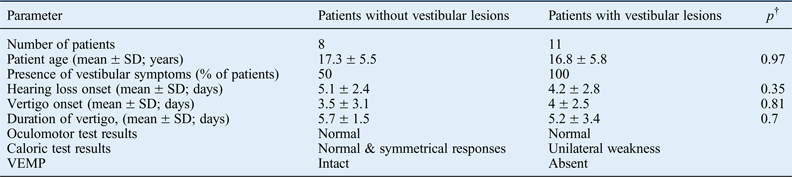
The 19 patients in the current study were allocated to 1 of 2 groups according to the video-nystagmography and vestibular-evoked myogenic potential results. The first group comprised the eight patients with normal video-nystagmography results and intact vestibular-evoked myogenic potential responses. The second group comprised the 11 patients with a weak caloric response and absent vestibular-evoked myogenic potential responses in the same ear as hearing loss. Table I summarises the results for the two groups.
Patient data summary*

* For patients with post-mumps sensorineural hearing loss. †Independent samples Mann–Whitney U test comparing the two groups. SD = standard deviation; VEMP = vestibular-evoked myogenic potentials
While all patients in the second group had a history of vestibular symptoms, only four patients in the first group (50 per cent) had such a history. The independent samples Mann–Whitney U tests showed that there were no statistically significant differences between the two groups as regards to: patient age (p = 0.97), hearing loss onset (p = 0.35), vestibular symptom onset (p = 0.81) or vestibular symptom duration (p = 0.7).
In the first group, which had intact vestibular-evoked myogenic potential responses, the vestibular-evoked myogenic potential asymmetry ratio ranged from 0.1 to 25.5 per cent, with a mean of 15.1 per cent and SD of 8.5 per cent. Although we did not compare these values with values recorded from control subjects, the values are consistent with normative values reported in the literature.Reference Rosengren, Welgampola and Colebatch21
In the second group, with vestibular lesions, canal weakness ranged from 51 per cent to total loss of caloric response. Mean canal weakness was 67.5 per cent and SD was 13.6 per cent. Only one patient, who was seen one week after mumps swelling, had signs of vestibular compensation failure in the video-nystagmography recording; this was in the form of nystagmus beating towards the healthy side in the spontaneous and post-headshake recording, and positioning and positional testing. All other patients in this group showed signs of vestibular compensation in the video-nystagmography recording.
Discussion
This study was conducted to explore the possible vestibular insult in patients with post-mumps SNHL. The mean age of patients in the present study was 17.1 years. This is in accordance with Mizushima and Murakami,Reference Mizushima and Murakami22 who reported that hearing and vestibular impairments following mumps infection occur more often in patients over 10 years of age.
Hydén et al.,Reference Hydén, Ödkvist and Kylén16 and Yanagita and Murahashi,Reference Yanagita and Murahashi17 showed that the incidence of vestibular symptoms in patients with mumps-related SNHL ranges from 45 to 60 per cent. In the current study, a higher incidence of vestibular symptoms (78.9 per cent) was found among patients with mumps-related SNHL. This difference is most likely attributed to the older age of patients participating in the current study. For example, the mean age of patients in the study by Hydén et al.Reference Hydén, Ödkvist and Kylén16 was 12 years, compared with 17.1 years in the current study. Symptoms of vertigo are often overlooked in children with mumps-related SNHL. Consistent with this, Yanagita and MurahashiReference Yanagita and Murahashi17 found that the incidence of vestibular symptoms following mumps deafness was higher in adults than in children.
In the current study, 8 patients (42.1 per cent) showed no signs of vestibular impairment according to the video-nystagmography and vestibular-evoked myogenic potential test results, whereas the majority of patients (11 patients; 57.9 per cent) had marked signs of vestibular lesions in the same ear as hearing loss in the form of a marked weak caloric response and absent vestibular-evoked myogenic potential responses. In patients with vestibular lesions, video-nystagmography results pointed to peripheral unilateral vestibular dysfunction rather than central dysfunction. The vestibular-evoked myogenic potential responses were always absent when the patient had an abnormally weak caloric response. As regards to the site of lesions, our findings implicate a labyrinthine and/or VIIIth cranial nerve lesion following mumps infection; however, human and experimental animal studies suggest a labyrinthine lesion with possible VIIIth cranial nerve involvement.
The significance of the labyrinth as a site of lesions following mumps infection is supported by the findings of Westmore et al.Reference Westmore, Pickard and Stern23 who isolated the mumps virus from the perilymph of a patient with sudden deafness following mumps infection. Two available post-mortem histopathological studies support the labyrinthine site of lesions in patients with mumps-related SNHL. The first study, by Lindsay et al.,Reference Lindsay, Davey and Ward24 showed severe lesions in the inner-ear structures including the stria vascularis, tectorial membrane and organ of Corti. The second study, by Smith and Gussen,Reference Smith and Gussen25 revealed degeneration of the organ of Corti, utricle and saccule. The latter study supports the involvement of the vestibular system in patients with mumps-related SNHL and explains the absence of vestibular-evoked myogenic potential responses in the majority of patients in the current study. The findings of an experimental animal study also support saccular involvement following mumps infection; in that study, the antigen of mumps virus was observed in the macula of the saccule and in the endolymphatic membranes.Reference Davis, Shurin and Johnson26
Two studies support the possibility of VIIIth cranial nerve involvement, with labyrinth involvement, in patients with mumps-related SNHL.Reference Tsubota, Shojaku, Ishimaru, Fujisaka and Watanabe19, Reference Comacchio, D'Eredità and Marchiori27 Magnetic resonance imaging indicated a pathological labyrinth and signs of VIIIth cranial nerve inflammation in one patient following mumps infection.Reference Comacchio, D'Eredità and Marchiori27 In a case study, Tsubota et al.Reference Tsubota, Shojaku, Ishimaru, Fujisaka and Watanabe19 reported left profound SNHL, left canal weakness and left absent vestibular-evoked myogenic potential responses in a six-year-old girl following mumps infection. These findings are similar to our findings for the group with vestibular involvement. In addition, the child had absent responses to a left galvanic body sway test, which is a test for the vestibular nerve and not the vestibular sensory cells.Reference Goldberg, Smith and Fernández28 Six months later, the left canal weakness was still present, but galvanic body sway test results were normal on both sides suggesting temporary involvement of the vestibular nerve following mumps infection.
In the current study, all 11 patients with vestibular lesions had a history of vertigo. This differs from the findings of Hydén et al.Reference Hydén, Ödkvist and Kylén16 who reported five patients with caloric impairment following mumps deafness and with no history of vertigo. The difference is most likely attributed to the younger age of patients in the study by Hydén et al.Reference Hydén, Ödkvist and Kylén16 The symptoms of vertigo are often missed in children who are suffering with the general malaise associated with acute mumps infection; in addition, there is rapid vestibular compensation following peripheral vestibular insults in children relative to adults. However, our results agree with those of Hydén et al.Reference Hydén, Ödkvist and Kylén16 in that some patients with normal vestibular test results have dizziness symptoms. In the current study, four out of eight patients with normal vestibular test results had a history of vertigo. This might be explained by the possibility of subtle, temporary labyrinthine or retrolabyrinthine lesionsReference Tsubota, Shojaku, Ishimaru, Fujisaka and Watanabe19 that could not be detected by the tests used; the limitations of these tests are well known. Other possible explanations include nervous system involvement or mumps encephalitis, the latter of which often accompanies mumps infection and may manifest with dizziness or ataxia.Reference Jubelt1, Reference Ito, Go, Okuno and Mikawa29
• Most patients with post-mumps sensorineural hearing loss had reduced caloric response and absent vestibular-evoked myogenic potential responses in affected ear
• Findings suggest a peripheral site for the lesion, most likely the labyrinth, with possible vestibular nerve involvement
It is unclear why the vestibular system is affected in some patients with mumps-related SNHL and spared in others. In the current study, there were no significant differences between the group with vestibular lesions and the group without vestibular lesions as regards to patient age, hearing loss onset, vestibular symptom onset or vestibular symptom duration. Further research should be conducted to address this point. More importantly, further research should be directed to preserving the inner ear following mumps infection. In the current study, it was apparent that the occurrence of hearing loss and vertigo were delayed by up to 8 days following parotid swelling. This time interval might give hope for possible rescue of the inner ear following mumps infection.