Introduction
Suicide is one of the leading causes of death among world's youth. In most countries youth suicide rates are much higher in males than females; rates among young males have increased substantially in recent years (Lynskey et al. Reference Lynskey, Degenhardt and Hall2000; Hawton & James, Reference Hawton and James2005). Despite the higher rates in males, suicide deaths in persons aged 15–29 years account for 24.4% of all male suicides worldwide but 30.5% of all females suicides (Krug et al. Reference Krug, Dahlberg, Mercy, Zwi and Lozano2002). Mental disorders (especially mood disorders, conduct disorders, substance abuse and disruptive disorders), previous suicide attempts, family history of suicidal behaviour, and stressful life events are risk factors for both genders (Gould et al. Reference Gould, Fisher, Parides, Flory and Shaffer1996; Shaffer et al. Reference Shaffer, Gould, Fisher, Trautman, Moreau, Kleinman and Flory1996; Groholt et al. Reference Groholt, Ekeberg, Wichstrom and Haldorsen1997, Reference Groholt, Ekeberg, Wichstrom and Haldorsen1998; Brent et al. Reference Brent, Baugher, Bridge, Chen and Chiappetta1999; Beautrais, Reference Beautrais2000).
In China suicide is the leading cause of death among persons aged 15–24 years (Li & Phillips, Reference Li and Phillips2001; Phillips et al. Reference Phillips, Li and Zhang2002a) and the estimated 49 000 annual suicides in this age group account for 17% of all suicides in the country (Phillips et al. Reference Phillips, Li and Zhang2002a). The pattern of youth suicides in China is very different from that in the West: female rates are 60% higher than male rates and rural rates are threefold urban rates. This study uses data from the national psychological autopsy study to assess the characteristics and risk factors for suicide in this important age group.
Method
Subjects and sampling
Most community-based case-control studies of suicide use living controls (Vijaykumar & Rajkumar, Reference Vijaykumar and Rajkumar1999; Mortensen et al. Reference Mortensen, Agerbo, Qin and Westergaard-Nielsen2000; Beautrais, Reference Beautrais2001), but dead controls have methodological advantages (Brent, Reference Brent1989; Hawton et al. Reference Hawton, Appleby, Platt, Foster, Cooper, Malmberg and Simkin1998) because the source of information used to assess risk factors – proxy informants who have recently experienced the death of a family member or close associate – is then much more comparable. In China, coroners' reports and medical records are not available so the only information available is that provided by proxy informants, thus it is particularly important to ensure the psychological equivalence of the informants for cases and controls. We chose persons who died of injuries as controls because these deaths, like suicides, are usually sudden and unexpected. Another advantage of injury death controls is that it makes it possible to estimate the proportion of suicide misclassified as injury deaths.
Twenty rural and three urban sites were selected from among the 145 sites in the National Disease Surveillance Points (NDSP) network administered by the Chinese Center for Disease Control and Prevention. DSPs with above-average suicide rates identified in each of China's six geographic regions were intentionally selected to be representative of the different economic strata in each region. More rural sites were included because rural population accounts for 65–70% of the total population in China. In three sites all death certificates coded as suicide, other specific injury, undetermined injury or mental illness for death that occurred from 1 August 1995 to 31 August 2000 were reported to the research group at 3-month intervals. The same procedure was followed in the other 20 sites from 1 January 1998 to 31 August 2000. If more than five suicides or five specific injury deaths were reported in any 3-month period, five cases of each type of death were randomly selected for detailed investigation to ensure that similar numbers of cases and control were identified at each site. If less than five decedents of either type were reported, all reported deaths were selected and additional suicides or other injury deaths occurring over the same time period were sequentially selected from adjoining locations if they had a formal death-reporting system (many did not). All reported deaths due to mental illness or undetermined injury death were investigated. This continued until 60 deaths were investigated at a site or until the end of recruitment (September 2000).
We defined suicide as a deliberate self-injury resulting in death. Death certificates are typically completed by low-level medical workers (particularly in rural areas) so the accuracy of death certificates was uncertain. Therefore, the final determination of the cause of each death was the consensus opinion of the interviewers and independent researchers after reviewing all available information about the specific events surrounding the death. Misclassified ‘injury deaths’ and deaths originally attributed to ‘mental illness’ that were reclassified as suicides by the research team were included in the case group. Thus, the final sample of cases is more representative of all suicides.
Overall, 1932 decedents were selected for psychological autopsy: in 67 cases appropriate informants were not found, in 65 identified informants refused to be interviewed and one was a death from physical illness. Among the 1799 decedents chosen for whom a psychological autopsy was completed, seven died of medical causes, 30 did not have a formal death certificates, 87 were aged <10 years, and in 22 the interview data were lost. Among the remaining 1653 decedents, 207 were aged 15–24 years: 110 had a death certificate coded as suicide, 87 as other specific injury, six as undetermined injury, and four as mental illness. After detailed evaluation, 114 decedents were classified as suicide, 91 as injury death, one as non-suicidal self-starvation (in a person with schizophrenia), and one as death due to physical illness (epilepsy) – the latter two deaths were not included in the subsequent analyses. The 91 injury death controls included 30 traffic accidents, 16 drownings, 13 murders, 10 electrocutions, six accidental falls, five crushing injuries, four accidental poisonings, two deaths from explosions, two deaths by fire, one death by burial, and two unspecified unintentional injuries.
The gender by region (urban or rural) distribution of these 114 suicides is very similar to that estimated for all youth suicides in China for 1995–1999 (Phillips et al. Reference Phillips, Li and Zhang2002a). Among the suicides identified in this study, urban males, rural males, urban females and rural females accounted for 2.6%, 36.8%, 6.1% and 54.4% of the total sample, respectively. The corresponding proportions in all suicides aged 15–24 years in the country were 3.5%, 34.1%, 3.9% and 58.5%, respectively (χ2=0.43, df=1, p=0.512). This indicates that the sample is broadly representative of all youth suicides in China.
Trained researchers, including public-health physicians and psychiatrists, visited each site every 3–6 months and independently administered a comprehensive survey to family members and, separately, to close associates of identified decedents. The survey instrument – which underwent extensive field testing and multiple revisions over a 2-year period – had three main components: (1) an audiotaped open-ended interview about the causes and circumstances of death; (2) a structured questionnaire that included information about the circumstances of the death, detailed demographic and socio-economic status of the deceased, a 60-item life-event scale developed for the study, a quality-of-life scale, and a medical and psychiatric history; and (3) a semi-structured psychiatric examination based on a slightly revised Chinese version of SCID-P (First et al. Reference First, Spitzer, Gibbon and Williams1996) that included all Axis I disorders of the DSM-IV, metal retardation, dementia, and borderline personality; this scale has been used and validated in other studies in China (Li et al. Reference Li, Yang, Zhang, Bian, Ji, Wang, Zheng, He and Phillips2001; Phillips et al. Reference Phillips, Yang, Zhang, Wang, Ji and Zhou2002b; Zhang et al. Reference Zhang, Li, Wang, Zhao, Meng, Zhang, Peng, Shen, Liu, Jiao, Yang and Phillips2004; Shi et al. Reference Shi, Zhang, Xu, Phillips, Xu, Fu, Gu, Zhou, Wang, Zhang and Yu2005; Yang et al. Reference Yang, Phillips, Zhou, Wang, Zhang and Xu2005).
We obtained informed consent from all proxy informants. The study was approved by the institutional review boards of the Beijing Hui Long Guan Hospital and the Chinese Centres for Disease Control and Prevention. Further details of the methodology are described in previous papers (Phillips et al. Reference Phillips, Yang, Zhang, Wang, Ji and Zhou2002b; Phillips & Yang, Reference Phillips and Yang2004; Zhang et al. Reference Zhang, Li, Wang, Zhao, Meng, Zhang, Peng, Shen, Liu, Jiao, Yang and Phillips2004; Yang et al. Reference Yang, Phillips, Zhou, Wang, Zhang and Xu2005).
Measures
The ‘chronic stress score in year prior to death’ was the product of the duration (in months) and severity of the psychological effect summed for all negative life events. To quantify the psychological triggering effect of negative life events, an ‘acute stress score at time of death’ was computed as the product of the severity of the psychological effect and the inverse of the time from the life event to death, summed for all negative life events that continued has a psychological effect on the deceased up until the time of death. In prior research with attempted suicides we found that the chronic and acute stress scores assessed based on reports of life events by suicide attempters are highly concordant with those based on independent reports by attempter's family members [intra-class correlation coefficient (ICC) 0.72 and 0.81, respectively] (Li et al. Reference Li, Phillips, Ji, Xu, Bian and He2005).
A depression symptom score reflecting the number, severity, and persistence of depressive symptoms in the 2 weeks prior to death was derived from the structured psychiatric examination (Phillips et al. Reference Phillips, Shen, Liu, Pritzker, Streiner, Conner and Yang2007). In this analysis this continuous variable was converted to a dichotomous variable: those with and without any symptoms of depression (other than suicidal thoughts) for any duration in the 2 weeks prior to death.
The quality of life of the deceased in the month prior to death was assessed by having respondents rate six characteristics of the deceased (physical health, psychological health, economic circumstances, work, family relationships, and relationships with non-family associates) on a scale of 1 (very poor) to 5 (excellent) and then converting the average sum of the six scores for the two independent respondents to a scale of 0–100. The internal consistency of the six items in the 402 separate assessments conducted in this study was excellent (α=0.84) and the reliability of the average measure of quality of life of the two informants was also excellent (ICC=0.79).
Statistical analysis
Risk factors for youth suicide were identified using unconditional logistic regression where case-control status was regressed on the risk factors. Crude and adjusted odds ratios and their corresponding 95% confidence intervals were estimated. Given that gender and location of residence are strong determinants of suicides in China, we adjusted the crude odds ratios for these two factors. Risk factors that remained significant after controlling for gender and location of residence were then entered into an overall unconditional logistic regression model. Forward and backward selection procedures were used to identify the final model. The interactions between all significant risk factors with age and sex were tested and the gender×diagnosis interaction was found to be significant, so this interaction term was also included in the final model. Statistical significance in the logistic regression models was assessed using the Wald test statistic. To simplify interpretation of the odds ratios, we categorized several continuous variables into dichotomous variables or tertiles. For each variable coded into tertiles, we assessed its linearity using an orthogonal polynomial contrast. Model performance was assessed by the C statistic [which is equal to the area under the receiver-operating characteristic (ROC) curve] (Hanley & McNeil, Reference Hanley and McNeil1982) and the Nagelkerke R 2 statistic (a measure of the proportion of explained variation in the logistic model) (Nagelkerke, Reference Nagelkerke1991). SPSS-PC software version 11.5 (SPSS Inc., Chicago, IL, USA) was used for statistical analyses.
There were no reported prior suicide attempts in the control group, so 0.5 was added to all four cells in the 2×2 table to estimate an unadjusted odds ratio (Haldane, Reference Haldane1956), but it was not possible to compute an adjusted odds ratio or to include this variable in the multivariate analysis. Previous studies (Brent et al. Reference Brent, Baugher, Bridge, Chen and Chiappetta1999) have used a hybrid logistic model to deal with this problem (Chen et al. Reference Chen, Hoppe, Iyengar and Brent2003) but in our sample prior suicide attempts in the suicide case group was significantly associated with three other predictors (gender, presence of a mental illness, and severe negative life event in the 2 days before death) so it was not appropriate to employ this method. Given that prior attempt is strongly associated with suicide in the univariate analysis, non-inclusion of this variable in the multivariate model probably resulted in an inflation in the odds ratios of these three variables.
Results
There were no significant differences between the 114 suicides and 91 deaths from other injuries by average age [21.3 (s.d.=2.6) v. 20.9 (2.6) years], time from death to interview [11.0 (5.1) v. 11.0 (4.6) months], and total interview time [213 (57) v. 205 (64) min] (all p>0.05). There was, however, a significant difference in the average years of education [6.0 (3.4) v. 7.0 (2.7) years, p=0.03]. In the suicide and control groups 4.4% and 9.9%, respectively, were students.
Of the 114 suicides, 81.6% died by ingestion of poisons or medications, 12.3% by hanging, 3.5% by drowning, 0.9% by jumping, 0.9% by traffic accident, and 0.9% by gunshot. Among the 91 ingestion suicides for whom the agent was known, 63.7% took agricultural chemicals, 24.2% rat poisons, 4.4% medications, and 7.7% other poisons. In 61.8% (55/89) of the suicides by ingestion the poison or medication was stored, unlocked in the house or yard.
Among the suicides, 10.6% (12/113) drank alcohol just prior to the suicide; in 16.7% someone was present observing the suicidal act and in an additional 11.4% the victim immediately sought assistance after the act; 10.6% (12/113) wrote a will before the suicide and 19.3% left a suicide note; 27.4% (31/113) had discussed death with family members or other associates prior to the suicide; and 57.0% received medical resuscitation that failed.
The frequency of negative life events among the deceased in the year prior to death was much higher in cases than controls. The most frequent negative life events in the suicide group were loss of face or social embarrassment (43.0%), economic difficulties (33.3%), and conflict with parents (32.5%); while among the 90 control cases with detailed information about life events, the most frequent negative life events were love or engagement problems (27.8%), economic difficulties (23.3%) and long-term separation from family (15.6%). There were non-significant differences between cases and controls in the rates of being beaten by spouse, beaten by parents, and beaten or raped by others (females: 13.0% v. 0.0%, 10.1% v. 13.3%, and 7.2% v. 0.0%; males: 0.0% v. 0.0%, 8.9% v. 2.7%, and 4.4% v. 2.7%; Fisher's exact test, all p>0.05).
Suicide decedents were much more likely to have experienced severe negative life events – typically intense interpersonal conflicts – in the 2 days before death: marital disputes (9.6%), disputes with parents (8.8%), disputes with other relatives (5.3%), being beaten by parents (4.4%), intense loss of face or social embarrassment (4.4%), being beaten by spouse (2.6%), and being beaten or raped by others (1.8%). In the control group, acute severe life events in the 2 days before death included being frightened (n=1), dissatisfaction with work or study status (n=1), being involved in a physical fight (n=1), conflict with mother-in-law (n=1), and engagement problems (n=1).
Mental disorders were more common among suicides than among those who died of injuries (44.7% v. 11.1%). In the suicide group, the rates of the different psychiatric disorders were as follows: major depressive disorder (28.9%), schizophrenia (6.1%), borderline personality disorder (2.6%), mental retardation (1.8%), alcohol dependence (0.9%), substance abuse (0.9%), substance dependence (0.9%), brief psychotic disorder (0.9%), adjustment disorder (0.9%), mood disorder due to epilepsy (0.9%), psychotic disorder due to epilepsy (0.9%), and unspecified affective disorder (0.9%). Two of the 114 suicides met criteria for two mental disorders. Depressive symptoms of varying intensity and duration were present in 57.0% of the suicide decedents, but in many cases these symptoms were not severe enough or did not persist long enough to meet the criteria of a depressive disorder. Only 9.6% of all suicides and 21.6% of suicides with a diagnosable mental illness had ever seen a mental-health professional and only 7.9% and 17.6% had taken psychotropic medications in the month before death. In the 90 control decedents for whom proxy informants completed the psychiatric examination, the rates of mental disorder were as follows: mental retardation (5.6%), schizophrenia (2.2%), alcohol dependence (1.1%), substance abuse (1.1%), and substance dependence (1.1%).
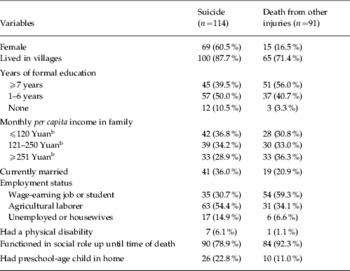
As shown in Table 1, compared with youth who died of other injuries, youth who died by suicide were more likely to be female and to live in rural villages. After adjusting for gender and location of residence there were no significant differences in the years of formal education, marital status, family financial status, having a preschool-age child or physical health status. The only demographic factors that remained significantly different between cases and controls were employment status (persons engaged in wage-earning jobs and students had lower risk of suicide than agricultural labourers, housewives and the unemployed) and whether or not the individual was functioning in his or her social role up until the time of death.
Comparison of demographic characteristics of suicides and deaths from other injuries in persons aged 15–24 years in China

OR, Odds ratio; CI, confidence interval.
Because of rounding, not all percentages total 100.
a Adjusted for sex and location of residence (villages versus cities/suburbs/towns).
b At the time of the study 8.26 Yuan=US $1.
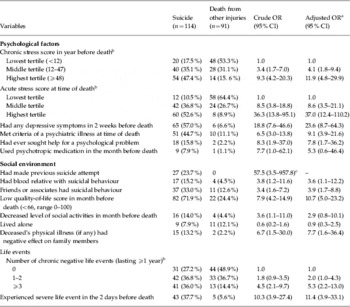
The suicide and control groups differed significantly on a range of social and psychological factors. Most of these factors remained significantly different after adjustment for gender and location of residence (Table 2). Several risk factors for suicide had a clear dose–response effect: chronic stress score in the past year, increased acute stress at the time of death, and number of chronic negative life events (that lasted longer than 1 year). Living alone was not a risk factor for suicide. Having a prior suicide attempt was a strong risk factor for suicide but its adjusted OR could not be calculated because there were no prior suicide attempts in the control group. Although significantly more common in cases than in controls, only 44.7% (51/114) of suicide decedents had a diagnosable mental illness at the time of death; the prevalence of mental illness in female suicide decedents [37.7% (26/69)] was lower than in male suicide decedents [55.6% (25/45)] (χ2=3.53, df=1, p=0.061). Among the 63 suicide decedents without a diagnosable illness, 22 (34.9%) had sub-syndromal depressive symptoms and another 38 had moderate or severe levels of acute stress at the time of death.
Comparison of psychological, social environment, and life event characteristics of suicides and deaths from other injuries in persons aged 15–24 years in China

OR, Odds ratio; CI, confidence interval.
Because of rounding, not all percentages total 100.
a Adjusted for sex and location of residence (villages v. cities/suburbs/towns).
b The linear trend is statistically significant.
c In absence of prior attempts among controls, the OR was estimated by adding 0.5 to all four cells in the 2×2 table.
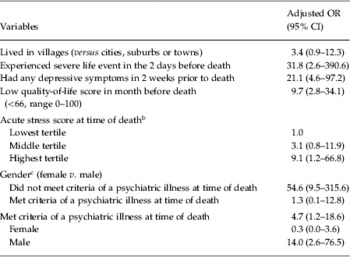
Multivariate models identified six independent risk factors for youth suicide: experiencing severe negative life events in the 2 days before death, the presence of any depressive symptoms in the 2 weeks before death, low quality of life in the month before death, higher acute stress at the time of death, female gender, and having a mental illness at the time of death (Table 3).
Multivariate model of risk factors for 15- to 24-year-old youth suicide in China comparing 114 suicides and 90 deaths from other injuriesFootnote a

OR, Odds ratio; CI, confidence interval.
a Prior suicide attempt was not considered in the multivariate model because none of the control decedents had prior attempts. Nagelkerke R 2 for the model is 0.806 and the C statistic is 0.966.
b The linear trend is statistically significant.
c There is a significant interaction between gender and diagnosis (Wald z=5.80, p=0.016), so the table presents stratified results. For the gender variable, among those without a diagnosis the risk of suicide is 54.6 times higher in women than men (p<0.001), but among those with a diagnosis the risk of suicide is not significantly related to gender (OR 1.3, p=0.837). Similarly, for the ‘met criteria of a psychiatric illness at time of death’ variable, among females the risk of suicide is, surprisingly, not significantly associated with diagnostic status (OR 0.3, p=0.361), but among males the risk of suicide is 14 times higher in those with a diagnosis (p=0.002).
There is a significant interaction between gender and diagnosis (Wald z=5.80, p=0.016); Table 3 presents stratified results for these variables. For the gender variable, among those without a diagnosis the risk of suicide is 54.6 times higher in women than men (p<0.001), but among those with a diagnosis the risk of suicide is not significantly related to gender (OR 1.3, p=0.837). Similarly, for the ‘met criteria of a psychiatric illness at time of death’ variable, among females the risk of suicide is, surprisingly, not significantly associated with diagnostic status (OR 0.3, p=0.361), but among males the risk of suicide is 14 times higher in those with a diagnosis (p=0.002). This indicates that females without a mental disorder and males with a mental disorder were at higher risk of suicide, so when counting the number of risk factors to which an individual is exposed gender and diagnostic status are combined into a single risk factor.
Among the 205 suicides and controls, the risk of suicide increases with exposure to an increasing number of risk factors: only 3.0% (2/67) of those unexposed to any risk factor or only exposed to one risk factor died of suicide, while 75.3% (73/97) exposed to two or three risk factors died of suicide, and 97.6% (40/41) exposed to four or five risk factors died of suicide. The suicide cases were exposed to an average (s.d.) of 3.16 (0.94) risk factors versus 0.95 (0.94) for controls (t=16.8, p<0.001); the average for females was 2.81 (1.00) versus 1.74 (1.52) for males (t=5.6, p<0.001).
Discussion
With the exception of a lower rate of diagnosable mental illness (45% v. 66%), the characteristics of youth suicides found in this study are similar to those of suicide victims in other age groups in China (Phillips et al. Reference Phillips, Yang, Zhang, Wang, Ji and Zhou2002b). Characteristics of Chinese youth suicides are, however, different from those reported in Western countries where pesticide ingestion is uncommon, most suicides are male, over 90% have a mental illness, and many have multiple mental illnesses (Gould et al. Reference Gould, Fisher, Parides, Flory and Shaffer1996; Shaffer et al. Reference Shaffer, Gould, Fisher, Trautman, Moreau, Kleinman and Flory1996; Dudley et al. Reference Dudley, Kelk, Florio, Howard and Waters1998; Brent et al. Reference Brent, Baugher, Bridge, Chen and Chiappetta1999; Beautrais, Reference Beautrais2000; Maris et al. Reference Maris, Berman, Silverman, Nisbet, Maris, Berman and Silverman2000; Agerbo et al. Reference Agerbo, Nordentoft and Mortensen2002; Gould et al. Reference Gould, Greenberg, Velting and Shaffer2003).
In Western studies a history of physical or sexual abuse is strongly associated with suicidal behaviour (Edgardh & Ormstad, Reference Edgardh and Ormstad2000; Coll et al. Reference Coll, Law, Tobias, Hawton and Tomas2001; Molnar et al. Reference Molnar, Berkman and Buka2001; Martin et al. Reference Martin, Bergen, Richardson, Roeger and Allison2004; Evans et al. Reference Evans, Hawton and Rodham2005). Consistent with Western studies, in the current study informant reports of prior physical or sexual abuse among female decedents was more common in those that died of suicide rather than of injuries, but the difference was not statistically significant.
The low social status of women in rural China contributes to their relatively high rates of completed suicide, but we believe that the ready availability of toxic pesticides is a more important factor (Phillips et al. Reference Phillips, Yang, Zhang, Wang, Ji and Zhou2002b). In rural China most households own a small plot of farmland and try to increase crop yields by using cheap but highly lethal pesticides, which are usually stored in the house or yard. The frequent use of pesticide ingestion among those who engage in suicidal behaviour, the higher rate of suicidal behaviour in young females compared to young males (about 2.5/1), and the lack of the technical competence and equipment required to effectively manage pesticide ingestion in rural areas may lead to an increased fatality among persons who engage in low-intent suicidal acts and, thus, a relative increase in the numbers of young females who die by suicide (Phillips et al. Reference Phillips, Yang, Zhang, Wang, Ji and Zhou2002b; Conner et al. Reference Conner, Phillips, Meldrum, Knox, Zhang and Yang2005, Reference Conner, Phillips and Meldrum2007).
Despite different characteristics, the pattern of risk factors in youth suicides is quite similar in China and the West. In Western countries prior suicide attempt, mental illness, family history of suicidal behaviour and mental disorders, experiencing stressful life events, and the ready availability of firearms are key risk factors (Gould et al. Reference Gould, Fisher, Parides, Flory and Shaffer1996; Beautrais, Reference Beautrais2000; Maris et al. Reference Maris, Berman, Silverman, Nisbet, Maris, Berman and Silverman2000; Agerbo et al. Reference Agerbo, Nordentoft and Mortensen2002; Gould et al. Reference Gould, Greenberg, Velting and Shaffer2003). In China, these are also key risk factors (with the role of firearms replaced by pesticides); but the importance of recent severe negative life events, depressive symptoms, and low quality of life in the month before death appear to be greater than in the West.
The much lower prevalence and low co-morbidity of mental disorders compared to that reported for youth suicides in Western countries (Brent et al. Reference Brent, Baugher, Bridge, Chen and Chiappetta1999; Beautrais, Reference Beautrais2000) suggests that mental disorders play a less central – although still important – role in youth suicide in China. This lower prevalence and co-morbidity is partially explained by the much lower rates of substance abuse in China: only three of the 114 (2.6%) suicide decedents in our study met diagnostic criteria for substance abuse or dependence. These low rates of mental disorders are not unprecedented: several studies of youth suicide in the West find that for younger adolescents (age <16 years) the rates of psychiatric disorder can be in the 40–60% range (Shaffer et al. Reference Shaffer, Gould, Fisher, Trautman, Moreau, Kleinman and Flory1996; Groholt et al. Reference Groholt, Ekeberg, Wichstrom and Haldorsen1997; Brent et al. Reference Brent, Baugher, Bridge, Chen and Chiappetta1999). One possibility is that the absence of substance abuse problems extends the early adolescent pattern of suicide into later ages in China.
In our study mental illness was an important predictor of suicide in males but not in females. This surprising finding is at odds with published studies from the West but is supported by other studies of fatal and non-fatal suicidal behaviour in China (Li et al. Reference Li, Phillips, Wang, Zhang, Ji, Bian, Ma and He2003, Reference Li, Phillips, Ji, Xu, Bian and He2005; Conner et al. Reference Conner, Phillips, Meldrum, Knox, Zhang and Yang2005, Reference Conner, Phillips and Meldrum2007; Yang et al. Reference Yang, Phillips, Zhou, Wang, Zhang and Xu2005) which find that impulsive, low-intent suicidal behaviour involving the ingestion of lethal pesticides is common among young Chinese females.
The absence of a diagnosable mental illness in 62% of the female suicide decedents and 44% of the male suicide decedents does not, however, mean that they are not distressed. Ninety-five percent (60/63) of the suicide decedents without a mental illness either had sub-syndromal depressive symptoms or acute stress (typically related to a precipitating interpersonal conflict) at the time of death. Among all decedents, we found that experiencing a severe life event in the 2 days before death and having any depressive symptoms for any duration in the 2 weeks prior to death were more important predictors for youth suicide such as depression. Therefore, the focus of preventing youth suicide in China should be on increasing resilience to acute psychosocial stressors and the timely recognition and management of depressive symptoms – even sub-syndromal depressive symptoms (Phillips et al. Reference Phillips, Shen, Liu, Pritzker, Streiner, Conner and Yang2007).
The low rate of care-seeking in suicide decedents with a mental illness (21.6%) highlights the need for innovative programmes aimed at changing attitudes about care-seeking for psychological problems among youth. Improving the recognition and management of sub-syndromal depressive symptoms will also require increased public educational efforts among youth and those who interact with youth (parents, teachers, general physicians, etc.) about the characteristics and treatment of depressive symptoms.
Strategies aimed at enhancing the resilience of youth – especially those who have had prior suicide attempts, who are experiencing acute stress, or who have a poor quality of life – are also important components of a comprehensive suicide prevention effort for youth. Such strategies might include public health education about suicide, enhancing the social support system for rural women, peer-support programmes for students, and problem-solving skill training (Speckens & Hawton, Reference Speckens and Hawton2005; McAuliffe et al. Reference McAuliffe, Corcoran, Keeley, Arensman, Bille-Brahe, De Leo, Fekete, Hawton, Hjelmeland, Kelleher, Kerkhof, Lonnqvist, Michel, Salander-Renberg, Schmidtke, van Heeringen and Wasserman2005). Given that 70% of youth suicides in China involved ingestion of pesticides or rat poisons, suicide prevention efforts also need to promote safe and secure home storage of poisons.
Limitations
In addition to the limitations of the psychological autopsy method (Hawton et al. Reference Hawton, Appleby, Platt, Foster, Cooper, Malmberg and Simkin1998), this study had other limitations that should be considered when interpreting the results.
A control group of deceased individuals has the advantage of ensuring similarity among the informants, but the disadvantage that young persons who die of injuries tend to be male ‘risk-takers’. We tried to minimize this problem by adjusting all risk factor estimates for gender, but the controls may differ from the general population in other ways (e.g. higher rates of substance abuse). In this situation one can be reasonably certain about the identified risk factors but there may be additional risk factors that would have emerged if a living control group were employed.
Despite being one of the largest studies on adolescent suicide reported, the sample was still somewhat small for developing a stable multivariate model of risk factors. Some significant but uncommon risk factors may have dropped out from the final model and the precision of some of the estimated odds ratios is poor. The extreme example of this was the absence of any prior suicide attempts in the control group which made it impossible to include this important risk factor in the multivariate analysis. The relatively long interval between the death and the interviews of informants (median time of 11.0 months), a practical necessity given the size of the study and the death reporting practices of the participating sites, could have resulted in under-reporting of mental illnesses and other recall bias-related problems. But the interval between cases and controls was not statistically different so the estimates of odds ratios are unlikely to be biased. Moreover, a previous report found no differences over time in the number and type of symptoms reported by proxy informants, so recall bias does not appear to change over time following a death by suicide or injury (Phillips et al. Reference Phillips, Yang, Zhang, Wang, Ji and Zhou2002b). Supporting evidence for the reported low rate of diagnosable mental illness in fatal suicides also comes from studies of serious suicide attempters in China who are interviewed immediately after the attempt and in whom rates of diagnosable mental illness are about 40% (Li et al. Reference Li, Phillips, Ji, Xu, Bian and He2005). The 5-year duration of the data collection period could have affected the results, but the gender×age×region (urban versus rural) pattern of suicides nationally did not change over the time period of the study (Phillips et al. Reference Phillips, Li and Zhang2002a) so it is unlikely that there were substantial changes in the risk factors for youth suicide over the period.
These issues aside, the key findings of this paper identify for the first time risk factors and characteristics for youth suicide in China and show that there are many similarities but also important differences with those found for Western youth: (1) most youth die by ingestion of pesticides; (2) fatal suicidal behaviour is more prevalent in women than men, possibly due to the frequent use of lethal pesticides in low-intent suicidal acts by young women in rural areas; (3) acute negative life events and sub-syndromal depressive symptoms are more important risk factors than diagnosable mental illness, particularly among women; and (4) substance abuse or dependence is uncommon. These findings imply that youth suicide prevention efforts in China should focus on restricting access to pesticides, on enhancing psychological resilience, and on identifying and treating symptoms of depression.
Acknowledgements
This study is part of the ‘Causes and Prevention of Accidental Deaths in China’ project, which was supported by grants from the Ford Foundation, the Save the Children Fund, and Befrienders International. Participating institutions include 23 Disease Surveillance Points and four psychiatric centres (Department of Neuropsychiatry, Xijing Hospital, Xian, Shaanxi Province; Jingzhou City Psychiatric Hospital, Hubei Province; Shenyang Mental Health Centre, Liaoning Province; and Suzhou Guangji Hospital, Jiangsu Province). The authors thank all the institutions, investigators and respondents for their contribution to the research. We also thank Annette Beautrais and Mark Davies for their comments on the manuscript and Alex Cohen's contribution on the revision. While preparing this manuscript the first author was partly supported by the NIH Fogarty International Center grants 5 D43 TW007273 to E.C. and 5 D43 TW05809 to B.J.G.
Declaration of Interest
None.