Introduction
The problem of cancer pain
Pain is experienced by 30%–75% of people with cancer (van den Beuken-van Everdingen et al., Reference van den Beuken-van Everdingen, de Rijke and Kessels2007, Reference van den Beuken-van Everdingen, Hochstenbach and Joosten2016) and is undertreated worldwide (Deandrea et al., Reference Deandrea, Montanari and Moja2008; Foley, Reference Foley2011). Successful management of cancer pain is a complex undertaking dependent on a range of patient, provider, and systems factors and the interactions among these (Jacobsen et al., Reference Jacobsen, Liubarskiene and Moldrup2009; Oldenmenger et al., Reference Oldenmenger, Sillevis Smitt and van Dooren2009). Patient-level barriers have been documented in the form of reluctance to report pain and disproportionate fears of opioid addictiveness and tolerance. Provider-level barriers include a lack of priority accorded to pain management and poor communication with patients. Health system barriers include insufficient routine pain screening and poor coordination of care across providers. Clinical guidelines can improve quality of care and outcomes for cancer pain, but need targeted strategies to support implementation (Brink-Huis et al., Reference Brink-Huis, van Achterberg and Schoonhoven2008; Davies et al., Reference Davies, Walker and Grimshaw2010).
Continuing developments in cancer treatment means that people can live with advanced cancer for many years, often alongside other comorbidities (Phillips & Currow, Reference Phillips and Currow2010; Wong et al., Reference Wong, Charman and Round2018). Cancer symptoms such as pain therefore require management within a chronic disease framework focused on enabling patients to self-manage their condition, its impacts on their everyday life, and their emotional response to it (Bodenheimer et al., Reference Bodenheimer, Lorig and Holman2002; Lorig & Holman, Reference Lorig and Holman2003; McCorkle et al., Reference McCorkle, Ercolano and Lazenby2011; World Health Organization, 2002). Healthcare aimed at supporting patient self-management needs to be aimed at increasing patients’ control over their condition within the context of their overall priorities and preferences; include information and training to enable patients to administer pharmacological and nonpharmacological treatments; leverage strategies to support and monitor patient behavior change and coping; and enable ongoing partnerships between patients and providers and coordination of care to ensure appropriate advice and support is available as needed. This means that, to successfully improve patient self-management, interventions should ideally effect change not only at the patient level but also at the levels of the provider and the health system.
The current authors set out to design a cancer pain self-management resource with potential for addressing barriers across all three levels as part of a suite of strategies for implementing clinical guidelines for cancer pain adapted for Australia from international precedents (Lovell et al., Reference Lovell, Luckett and Boyle2015). Guideline implementation constitutes a ‘complex intervention’ as defined by the UK's Medical Research Council (2006) (Craig et al., Reference Craig, Dieppe and Macintyre2008). The Medical Research Council's Framework for Complex Interventions was therefore used as a guide, using the four phases of development, feasibility and piloting, evaluation, and implementation. This paper reports development and feasibility and piloting phases for the patient self-management resource. The feasibility and piloting phase for two other implementation strategies (pain screening and audit) has been reported elsewhere (Lovell et al., Reference Lovell, Birch and Luckett2018). A cluster randomized controlled trial (RCT) is under way to evaluate these strategies in combination with provider education on cancer pain care.
Method
A mixed methods approach was undertaken using a concurrent triangulation design (Cresswell, Reference Cresswell2003). Our overarching research questions were: what are the barriers and facilitators to assessment and management of cancer pain, and how can we leverage these in a theoretically informed self-management resource? Our starting assumption that a patient self-management resource could also address patient-, provider-, and system-level barriers meant we needed to review evidence and canvass perspectives in relation to providers as well as patients.
The research was carried out over a three-year period from mid-2011 to mid-2014. Although many of the same methods also informed development of the clinical guidelines and the implementation suite as a whole, the current paper reports previously unpublished results focused on the development of the pain self-management resource.
The patient self-management resource was intended to have broad applicability across tumor types/stages and care settings and to complement a widely used, evidence-based Australian patient education booklet and DVD called Overcoming cancer pain. This education resource is published by the Cancer Council New South Wales (NSW) and has been found to reduce mean average pain and worst pain scores versus usual care in a RCT (Cancer Council Australia, 2013; Lovell et al., Reference Lovell, Forder and Stockler2010). “Overcoming cancer pain” includes information on cancer pain itself (causes, types, potentially exacerbating and alleviating factors), general advice on non-pharmacological and pharmacological management (including side-effects and misconceptions about opioids), the need for multi-disciplinary team input, and a question prompt list to support communication with providers.
Data sources included the following.
1. A review of existing evidence-based guidelines, including sections on patient and caregiver resources (see our online guidelines for more details) (Improving Palliative Care through Clinical Trials, 2013).
2. A systematic review and synthesis of qualitative studies investigating barriers and facilitators to patient care (Luckett et al., Reference Luckett, Davidson and Green2013b).
3. A national online survey of current practice (Lovell et al., Reference Lovell, Agar and Luckett2013a; Luckett et al., Reference Lovell, Agar and Luckett2013a; Phillips et al., Reference Phillips, Lovell and Luckett2015), which included questions on providers’ perceptions of barriers and facilitators to cancer pain assessment and management as well as the priority accorded to the following patient/caregiver level strategies to improving care: patient and caregiver education and resources; guidance on assessing patient-identified priorities; and inclusion of patient ‘action plans’ to aid self-management.
4. A systematic review and theory-driven meta-analysis of the evidence for different approaches to patient education (Marie et al., Reference Marie, Luckett and Davidson2013). The theory in question was Michie et al.’s (Reference Michie, van Stralen and West2011) framework of behavior change interventions developed via a comprehensive systematic review. The authors classified interventions according to their behavior change ‘functions’ as these impact capability, opportunity and/or motivation - the ‘COM-B model’. Educational interventions were independently coded for COM functions, and sub-group analyses were used to test whether these functions explained the heterogeneity in effects on pain intensity reported by previous reviews.
5. A desktop review of online, free-to-use pain diaries and other pain-related patient resources conducted in March 2013. Google searches were undertaken using search terms relating to pain diaries and pain self-management. Resources needed to be free-for-use in English language and go beyond information to provide tools to fulfil an ‘enablement’ function for assessment and management of pain as defined by Michie et al. (Reference Michie, van Stralen and West2011) after the American Psychological Association as ‘encouraging or enabling people to meet their own needs and ends.”. Enablement became the focus of interest after our systematic review highlighted this as a potentially useful behavior change function (see Results).
6. Consultation with stakeholders at local, national, and international conferences and other fora (Agar et al., Reference Agar and Davidson2012; Clayton et al., Reference Clayton and Phillips2012; Liauw et al., Reference Liauw and Davidson2012; Lovell et al., Reference Lovell and Davidson2012a, Reference Lovell and Davidson2012b, Reference Lovell, Agar and Luckett2013b, Reference Lovell and Phillips2013c, Reference Lovell and Agar2013d; Lovell, Reference Lovell2013a, Reference Lovell2013b; Luckett et al., Reference Luckett and Agar2014; Phillips et al., Reference Phillips and Keall2012a, Reference Phillips and Davidson2012b). Fora were attended by pain specialists, cancer nurses, palliative care providers from different disciplines, pharmacists and consumers. Topics discussed included perceptions of patient-level barriers and the need for education and support for self-management.
An Advisory Committee met at regular intervals throughout the project to discuss emergent findings and develop iterative drafts of the self-management resource. The Committee consisted of two palliative care specialists (ML and MA) and a senior nurse (PMD), with coordination and support from social science researchers TL and AG. Input was sought at intervals from the other authors listed on this article, some of whom (FB, JS, JP) also served on the Working Party convened to develop the clinical practice guidelines.
The findings from the above methods were used to inform development of a draft self-management resource that was assessed for acceptability and perceived usefulness in semi-structured interviews with patients with cancer pain at two sites in Sydney: a public palliative care inpatient and outpatient unit and a private oncology outpatient service. Patients were purposively sampled to include a range of cancer diagnoses and experiences of pain assessment and management. Interview questions focused on participants’ experience of pain management and education preferences in general, as well as specific experience of using the draft self-management resource, Overcoming cancer pain booklet and any other resources they may have accessed. Patients were given brief training in using the materials by the study nurse (MRB). Analysis was undertaken deductively by MRB to identify perceived benefits and problems associated with each resource feature, with emerging themes reviewed by two other members from the team (TL and ML).
Results
These methods discussed provided the following results informative to development of the self-management resource.
1. A review of guidelines identified support for patient education and involvement of patients in self-management in those published by the Scottish Intercollegiate Network (2008), National Health Service (NHS Quality Improvement Scotland, 2004), National Comprehensive Cancer Network (2011), European Society of Medical Oncology, and National Institute for Health and Care Excellence (2012) (Ripamonti et al., Reference Ripamonti, Bandieri and Roila2011). Information topics recommended for inclusion in patient education concerned the causes and nature of cancer pain, pharmacological and nonpharmacological management, medication side effects and safety, common misconceptions presenting a barrier to use of opioids (e.g., addictiveness, tolerance), and the importance of reporting pain in a way optimally informative to management, sometimes with resources to support this (e.g., pain diary). NICE, in particular, was found to provide online information for patients and families about opioids together with a question prompt list for discussing concerns and garnering information from the medical team (National Institute for Health and Care Excellence, 2012).
2. Results from our qualitative synthesis (reported in detail elsewhere; Luckett et al., Reference Luckett, Davidson and Green2013b) highlighted the need to integrate patient/family education within person-centered communication more generally and improve capacity to self-manage pain. The most pervasive finding was the need to individualize assessment and management and engage the patient as expert on his or her own pain. Lack of care coordination was identified as the most important health system barrier, often influencing the quality and timeliness of pain management and access to medications.
3. The survey of current practice was completed by 527 providers from different disciplines and settings across Australia. Results suggested further support for the need for patient/caregiver education. Of 425 providers who answered questions relevant to the self-management resource, 62% reported that they routinely provided education to patients with cancer pain and 51% considered more education important to improving care. Ninety-one percent of 416 respondents said they would welcome guidance on identifying patient priorities, 93% wanted patient “action plans” to aid self-management, and 83% supported provision of a patient version of a clinician clinical pathway.
4. Results from our systematic review and meta-analysis indicated that educational interventions combining strategies for improving capability, opportunity, and motivation tended to be effective in reducing pain intensity, whereas those that did not contain all three functions were less so (Marie et al., Reference Marie, Luckett and Davidson2013). In practice, COM versus less comprehensive interventions were distinguished by strategies for boosting patients’ sense of control such as communication aids (e.g., question prompt lists) and guidance on tailoring management to individual needs. No evidence was found that greater resource-intensivity per se resulted in higher efficacy.
5. Our desktop review found free-to-use pain-related patient resources on 24 websites worldwide, including 23 pain diaries, three question prompt lists, one pain management plan, and one motivational “toolkit.” See Lovell et al. (Reference Lovell, Luckett and Boyle2014) for a selection of these resources.
6. Consultation with providers confirmed the need for patient strategies aimed at encouraging reporting of pain and addressing opioid-related misconceptions. Potential solutions highlighted included self-management record (hard copy or electronic), use of pain diaries, use of a question prompt list and advocacy from patients and consumer groups to tackle provider and systems-related barriers, as well as materials readily available on the website and media strategies aimed at educating the general public. Providers reported patient feedback to be a potent trigger for change. Involvement of the caregiver as well as patient was seen as important. Translation of resources into a range of languages was considered essential to benefit patients most at risk for low health literacy due to language barriers.
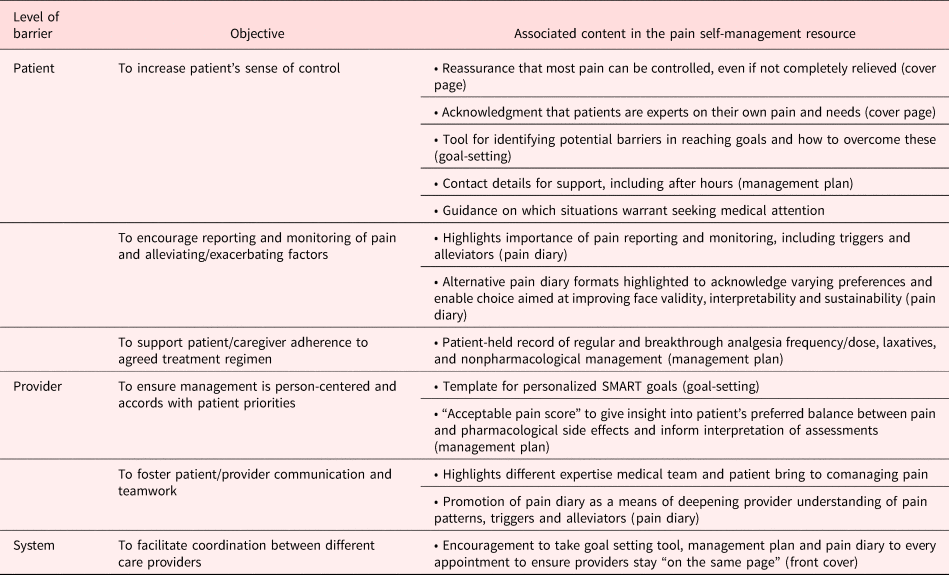
Based on the results here, the Advisory Committee concluded that Overcoming cancer pain contained necessary and sufficient information for patient education, and that sufficient pain diaries were available online to suit a range of preferences. However, therapeutic potential was identified for an innovative self-management resource aimed at ‘enabling’ proactive patient involvement in assessment and self-management of pain by: boosting patients’ sense of control and self-efficacy; helping them to communicate with providers and advocate for evidence-based, person-centered care; and supporting their role in coordinating care between different care providers in response to their individual needs. To this end, the team drafted a self-management resource that included: 1) a template for setting specific, measureable, achievable, relevant and time-bound (SMART) care goals for pain management, as well as identifying potential obstacles and ways to overcome them; 2) a pain management plan detailing exacerbating and alleviating factors, current strategies for management and contacts for support in the event of new or poorly controlled pain; and 3) a tool for self-evaluating capacity to self-manage pain and adequacy of support against the COM-B model (Michie et al., Reference Michie, van Stralen and West2011). The rationale for each of the resource's design features is summarized in Table 1.
Pain self-management resource: Objectives and associated content aimed at addressing barriers to care at the levels of the patient, provider, and health system

SMART = specific, measureable, achievable, relevant, achievable, and time-framed.
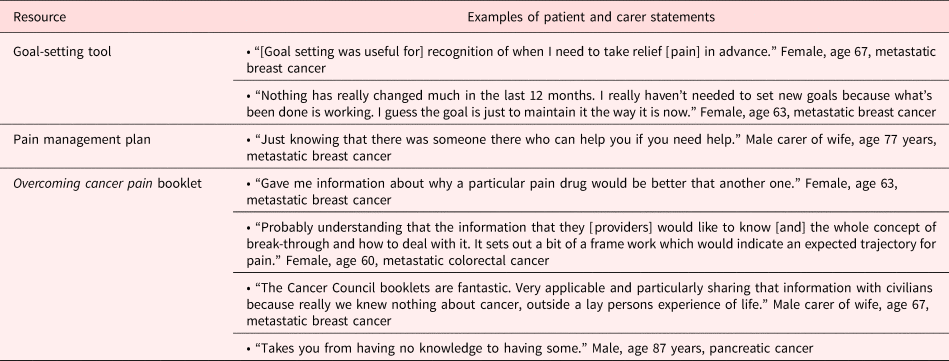
Eighteen patients agreed to be interviewed for acceptability testing of the draft resource. Illustrative participant quotes on the goal setting tool, management plan and Overcoming cancer pain booklet are presented in Table 2.
Examples of patient quotes on the use of a draft self-management resource and Overcoming cancer pain booklet (Cancer Council Australia, 2013)

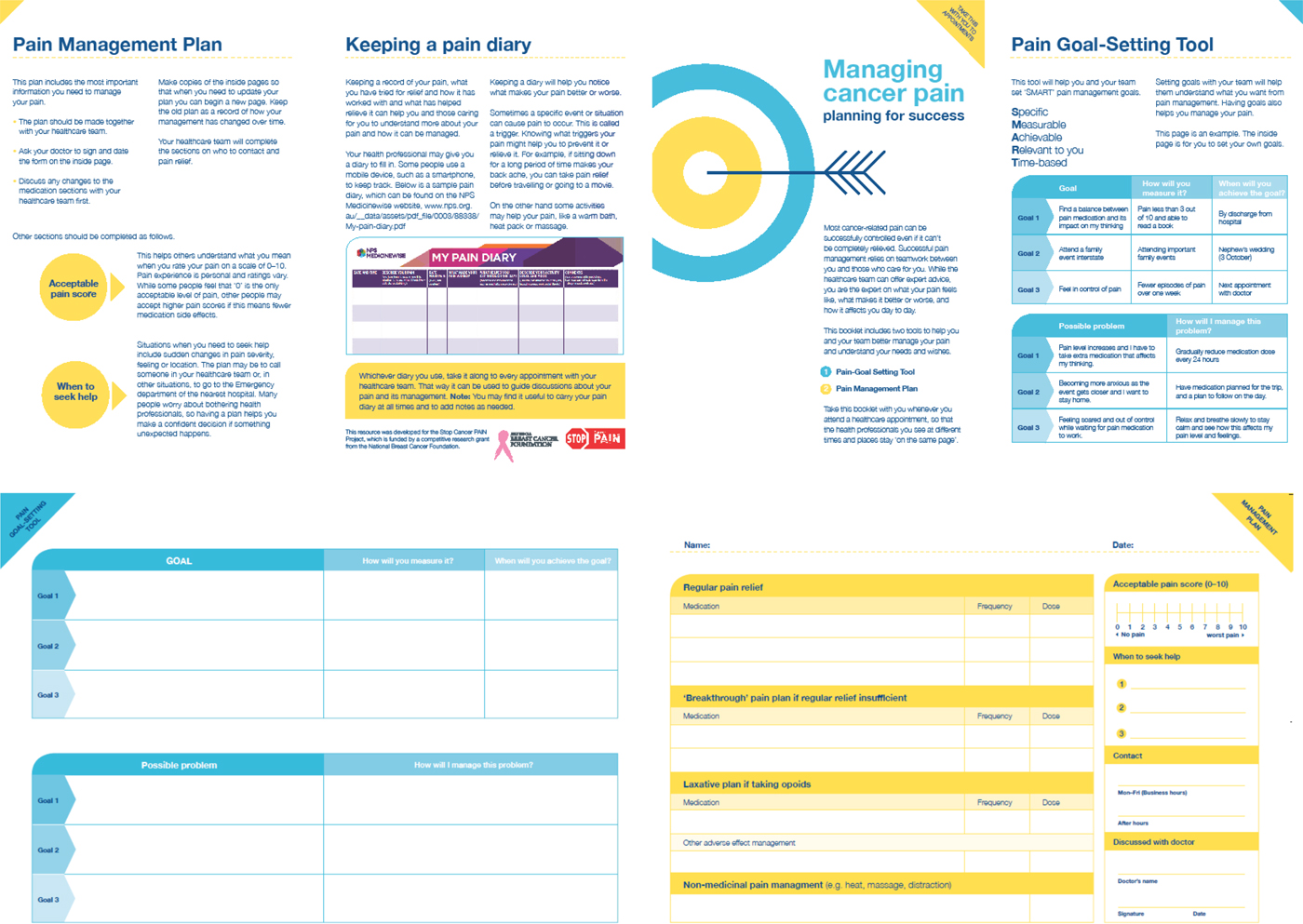
Participants reported that the materials increased their confidence in communicating about their pain with providers and helped them to better understand management goals and options. However, several patients struggled with using a numerical rating scale to rate their pain severity, which they felt did not sufficiently capture the quality of their experience. The goal setting tool was perceived to be useful for informing anticipatory analgesia ahead of planned events as well as for prompting patients to reflect more generally on their current status and prioritize for the future. One negative case was a woman with breast cancer who felt her goals had not changed for at least a year. Participants found the pain management plan helped them to better understand breakthrough pain and drew comfort from information on where to get help, especially outside normal business hours. They also commented on the potential for the resource to facilitate communication and coordination between different healthcare professionals involved in their care across settings (e.g. GP, oncologist, pain specialist). However, they were less supportive of the tool for self-evaluating their capacity to self-manage pain, which they found difficult to understand and use. This tool was therefore removed from the next iteration of the resource, which is presented in Figure 1. This resource folds into an A5 size for portability.
Pain self-management resource developed through a mixed method project.

Discussion
The project described in this paper developed a self-management resource for cancer pain with theoretical potential not only to support patients’ administration of pharmacological and non-pharmacological therapies but also to address provider and health system barriers to care by improving patient-provider communication and facilitating coordination between different providers.
A RCT is underway to test whether this resource, alongside other strategies for overcoming barriers to cancer pain care, can improve patient pain and quality of life (Luckett et al., Reference Luckett, Phillips and Agar2018). This research will test the hypothesis that patients’ sense of control may be an important mediator in enabling self-management interventions to influence pain-related outcomes. People with cancer pain often report loss of control to be an important dimension of their experiences in relation to both pain and cancer itself (Flemming, Reference Flemming2010; Luckett et al., Reference Luckett, Davidson and Green2013b). Interventions targeting sense of control and the related construct of self-efficacy have been found to lead to improvements in the ability to self-manage pain, functional status and, less frequently, pain itself in people with chronic non-cancer pain (Marks et al., Reference Marks, Allegrante and Lorig2005). Studies focusing on cancer pain to date have been largely descriptive, but have found consistent associations between self-efficacy for pain management and pain intensity/interference (Baker et al., Reference Baker, O'Connor and Krok2014; Edmond et al., Reference Edmond, Shelby and Kimmick2013; Jerant et al., Reference Jerant, Franks and Kravitz2011; Kowal et al., Reference Kowal, Wilson and McWilliams2012; Kravitz et al., Reference Kravitz, Tancredi and Grennan2011; Porter et al., Reference Porter, Keefe and Garst2008). Evidence for a relationship between self-efficacy in communication and cancer pain experience has been more mixed, with the single intervention study to date finding coaching aimed at improving communication self-efficacy to lead to only temporary improvements in pain interference and no change in pain severity (Jerant et al., Reference Jerant, Franks and Kravitz2011; Kravitz et al., Reference Kravitz, Tancredi and Grennan2011). More evaluative research of the kind underway by the current researchers is needed to understand whether self-efficacy can play a therapeutic role in improving pain in and of its own right, or whether correlations to date merely reflect that self-efficacy is a surrogate for ability to self-manage, in turn responsible for better pain control.
Unfortunately, acceptability testing of the new resource found that patients found it difficult to appraise their capability, opportunity and motivation (COM) to self-manage pain. A systematic review by Michie et al. (Reference Michie, van Stralen and West2011) suggests that COM may be prerequisites for behavior change across health conditions, and further research is needed to understand how best these components can be assessed in a clinical context. In the meantime, the patient self-management resource designed in the current project may offer some utility for less formal assessment of COM during provider-patient discussion of goals and the pain plan.
Results from acceptability testing also indicated that a range of pain rating scales and diaries should be made available to cater for varying preferences. This is consistent with findings from our meta-synthesis that many patients find it difficult to rate pain using numerical or visual analog scales (Luckett et al., Reference Luckett, Davidson and Green2013b). Fortunately, there is now a variety of scales and diaries available to suit many patient needs. Training patients to use pain scales effectively is associated with improved uptake and adherence (Morren et al., Reference Morren, van Dulmen and Ouwerkerk2009). Although recording pain patterns over time is informative to management, providers also need to consider the possibility that rating pain could increase the perception of morbidity, potentially increasing fatalistic perceptions and negatively affecting a patient emotionally (Luckett et al., Reference Luckett, Davidson and Green2013b).
Limitations
Although use of discrete and diverse methods yielded rich data for triangulation, we lacked a formal approach for integrating results. Also, some of the functions we designed the resource's content and features to fulfill remain largely hypothetical. For example, although patient-held records have theoretical potential to improve care coordination, evidence for effectiveness is limited, and implementation faces its own set of barriers (Aubin et al., Reference Aubin, Giguere and Martin2012; Ko et al., Reference Ko, Turner and Jones2010; Price et al., Reference Price, Bellwood and Kitson2015). One study found patient-held records to improve patients’ self-monitoring and sense of control but failed to generate substantial engagement by providers (Williams et al., Reference Williams, Cheung and Chetwynd2001).
Conclusion
Self-management resources have potential for addressing barriers not only at the patient level, but also the levels of the provider and health system. A cluster randomized controlled trial is underway to test effectiveness of the resource designed in this project in combination with pain screening, audit and feedback, and provider education. More research of this kind is needed to understand how interventions at different levels can be optimally combined to overcome barriers and improve care.