1. Introduction
There is now broad recognition that avoiding dangerous climate change requires large-scale effective action on reducing emissions from deforestation and forest degradation (REDD). Including a REDD mechanism in a global climate agreement presents an opportunity to achieve stronger global emission-reduction targets more quickly and cheaply, while providing countries that preserve their forests with a valuable economic development opportunity (Stern, Reference Stern2007). REDD was included as an important element in the Copenhagen Accord, and it also has broad support within the UNFCCC negotiations as expressed by the outcome of the 16th Convention of the Parties in Cancun in December 2010. Hence, the debate has shifted from whether to pursue REDD to how to implement it, and the challenges involved.
National governments will clearly have a critical role to play in the design and implementation of REDD, especially in addressing the indirect drivers of land use change. However, other actors such as subnational governments, indigenous peoples, farmers, and logging activities will also play a crucial role. In practical terms, much of the implementation of REDD activities is likely to occur at the subnational level, bridging multiple scales from individual stakeholders up to the national government. In this respect, Skutsch and van Laake (Reference Skutsch and van Laake2008) have already characterized REDD programs as an emerging framework of multi-level governance.
This paper focuses on an important aspect of the design of a national REDD mechanism that has not been addressed in a formally consistent framework: how REDD incentives are to be distributed across scales, and the inconsistencies that may arise due to the uncertainty of the counterfactual at these different scales. In particular, we focus on the role of crediting reference levels – benchmarks against which actual emissions from deforestation would be monitored and verified for the purpose of compensation – in affecting risk. Although Angelsen et al. (Reference Angelsen, Streck, Peskett, Brown, Luttrell and Angelsen2008) began addressing issues of scale in REDD, it was mainly in the context of the appropriate accounting scale for an international REDD incentive mechanism, and not how to link REDD activities across scales. To our knowledge this paper, which builds on the ‘nested’ approach proposed by Streck et al. (Reference Streck, Pedroni, Porrua, Dutschke, Streck, O'Sullivan, Janson-Smith and Tarasofsky2008), is the first to address this problem using a formally consistent framework in which accounting, crediting, and implementation are taken into consideration.Footnote 1 The paper begins by laying out the multiple scales at which REDD will need to be implemented, and how these scales are linked. It then continues by analyzing how uncertainty entails risks for participants, and it highlights how the design of a REDD mechanism affects which stakeholders bear this risk. Finally, we provide an example based on REDD design options in Brazil at the state level to illustrate, in practice, the points made in the preceding sections.
2. Reducing deforestation: a multiscale challenge
The importance of the spatial scale at which human activities and physical processes are analyzed has been recognized for over 50 years. It is well known, in landscape ecology, geography, and remote sensing, that conclusions that may hold at one scale need not be valid at another scale (Clark and Avery, Reference Clark and Avery1976; Turner et al., Reference Turner, O'Neill, Gardner and Milne1989; Goodchild and Quattrochi, Reference Goodchild, Quattrochi, Quattrochi and Goodchild1997). Recent economics literature using agent-based modeling is increasingly emphasizing the importance of scale (Evans and Kelley, Reference Evans and Kelley2004). Verburg et al. (Reference Verburg, Schot, Dijst and Veldkamp2004) provide a good overview of land use change modeling and the role scale plays. For a REDD policy to reduce deforestation substantially at the national level will require understanding how entities and processes are linked across scales. An approach that may be effective at the local level may not transfer to a more aggregate scale, and vice versa. REDD architectures will need to integrate these different approaches into a coherent strategy.
Empirical studies reveal that thresholds can be detected within the scale continuum that corresponds to specific levels of organization within a hierarchical system (Marceau, Reference Marceau1999). Gibson et al. (Reference Gibson, Ostrom and Ahn2000) go further and argue that scale is important to social sciences in four basic areas: (1) how resolution affects identification of patterns; (2) in the explanation of observed patterns; (3) for the generalization of a proposition made at one level and applied at another level; and (4) for optimizing a process at particular locations. This is an interesting breakdown for addressing deforestation in the context of a national REDD program because a REDD architecture will have to facilitate the identification and explanation of patterns of deforestation, integrating both direct and indirect drivers of deforestation, and optimize the use of scarce financial resources to address drivers at different scales.
The issue of resolution mentioned in the previous paragraph and determining the appropriate scale for the study of a particular phenomenon is known in geography as the modifiable areal unit problem (MAUP), as introduced by Openshaw and Taylor (Reference Openshaw, Taylor, Wrigley and Bennett1981). MAUP expresses that results of studies could be different using different areal units and is thought of as the combined output of a scale problem (dependency on pixel resolution) and an aggregation problem (dependency on how pixels are aggregated; Wu and Li, Reference Wu and Li2009). For what concerns deforestation, the resolution of remote sensing has improved over time, making the scale problem more tractable. However, the aggregation problem is one of understanding how entities and processes are linked across scales and will likely remain a challenging area, and one that is crucial in designing REDD architectures at the national levels so as to address both direct and indirect drivers of deforestation.
One of the challenges at all scales of implementation of REDD is to determine the distribution of incentives among stakeholders. This challenge has emerged at the international level, as governments debate how to establish crediting reference emissions levels and how to structure REDD incentives. Following Angelsen (Reference Angelsen and Angelsen2008), these benchmarks may or may not be entirely distinct from historical emissions, and may be entirely distinct from the unobservable business-as-usual (BAU) baseline that would occur without REDD. Proposed methods for establishing such reference levels have different implications for the amounts of credits generated through REDD activities and the resulting distribution of incentives for countries to participate in a REDD program (Busch et al., Reference Busch, Strassburg, Cattaneo, Lubowski, Bruner, Rice, Creed, Ashton and Boltz2009a; Cattaneo et al., Reference Cattaneo, Lubowski, Busch, Creed, Strassburg, Boltz and Ashton2010b).
These challenges are not unique to the international aspect of REDD. At more disaggregated scales these issues may become even more relevant and challenging. For individual stakeholders, the notion of predicting who would deforest in a given year can be difficult, making the definition of BAU baselines and crediting reference levels more difficult than at more aggregate scales. Nonetheless, if REDD is to be successful, incentives on the ground must change, and therefore some way of crediting changes of behavior must be put in place. Such a system will also have to reconcile the different activities intended to reduce emissions with the reported and verified aggregate emissions reductions.
Below the international level, it is possible to distinguish between four different levels: national, subnational, project levels, and individual stakeholders. There are various REDD activities that could be undertaken at any of these different levels:
(i) Monitoring Frameworks: monitoring deforestation and emissions could be performed at any level, but we assume it will be done as part of a consistent national framework.
(ii) Crediting Framework: necessary to go from simply monitoring emissions to computing emissions reductions and allocating such reductions across implementing entities for compensation purposes. It may be challenging to set crediting reference levels in a consistent manner across scales so that they add-up.Footnote 2
(iii) Implementation: Implementing activities that reduce deforestation could be undertaken by national governments (through large-scale policy reform), by subnational governments (through district or provincial spatial planning and policies), or by project developers or individual stakeholders (through specific actions to reduce deforestation in a designated area), or at many levels (through a combination of policy enactment and local action).
(iv) Ownership of Credits: Each country will consider how ownership and benefits of credits are to be shared among REDD stakeholders to deliver cost-effective environmental and socio-economic benefits. Countries will need to define a clear structure of property rights to the carbon asset across scales and stakeholders. The national government may own and transact all carbon rights (provided a benefit-sharing framework is put in place), or it may decide to devolve ownership of credits to subnational and local actors.
(v) Approval and Verification of Credits: the verification of credits can be done by private third-party entities at the project level (accounting for leakage), at the regional or national level by government, or by an international third party entity.
Following the above classification, it emerges quite naturally that policy options are not limited to approaches where all activities are either performed at the project-level or taken on by the government in a national-level approach. There are ways of designing a mechanism that allow for hybrid approaches, matching different scales to specific design options. For example, the national government could carry out the monitoring and accounting and then allocate incentives to successful REDD activities around the country. National-level accounting does not presuppose national-level implementation. A hybrid approach could also allow multiple scales to participate in a specific activity. So, for example, either governments or private investors could be considered implementing entities and receive credit for emissions reductions.
In this paper, we use the classification above as a guide to the different challenges that need to be addressed for reducing emissions from deforestation at the national scale. However, we focus mainly on the link between the crediting framework and the implementation of REDD activities. We therefore assume that monitoring and verification are guaranteed, and that the incentive level to stakeholders is given.Footnote 3
One example of the hybrid approaches that starts addressing issues of crediting reference levels and implementing entities is the ‘nested approach’, proposed by Streck et al. (Reference Streck, Pedroni, Porrua, Dutschke, Streck, O'Sullivan, Janson-Smith and Tarasofsky2008) and Pedroni et al. (Reference Pedroni, Dutschke, Streck and Porrúa2009), which would grant tradable emission reduction credits to participants in REDD activities while promoting action on both the national and subnational level. The principle of the ‘nested’ mechanism consists of the following elements: (i) a country-wide scheme based on an internationally negotiated target level of deforestation and the creation of fungible carbon credits; (ii) a project-based mechanism for REDD based on the authorization by host governments of private or public entities to implement REDD activities at the project level, with fungible carbon credits issued directly to the project entities through an international and independent mechanism, regardless of national emissions from deforestation.
Although in principle this approach is quite straightforward, in practice it can be challenging. In Streck et al. (and Pedroni et al.), credited emissions reductions from projects are assumed fungible regardless of national emissions from deforestation. This assumption skews the link between projects and the overall emissions reductions of the country in favor of one type of implementing entity, which is rewarded first and only subsequently are other actors credited for their actions if ‘residual’ emissions reductions remain to be allocated. This may not create sufficient incentives for more broad-based policies which would be rewarded only residually.
Uneven incentives have the potential to increase leakage if stakeholders tend to engage in REDD in areas where reference levels are defined so that it is a particularly profitable activity, while other areas will have no coordinated action to slow deforestation. Therefore removing a risk element for private project activities, and effectively transferring it to the public sector, may not be the most economically efficient approach. In fact, it may lead to a suboptimal outcome in the aggregate and a loss in environmental integrity, which in turn would affect the longer-term viability of REDD. Insulating project activities from external risks is one among several ways in which risk can be distributed across implementing entities, but how this may be done and whether it is the best approach in terms of the overall outcome requires a more in-depth analysis of the balance between different implementing entities and how risk is distributed among them.
3. Designing a robust REDD program under uncertainty
The success of any voluntary environmental program will depend crucially on stakeholder participation. Participation in a voluntary REDD program will depend, among other things, on how easy it is for different stakeholders, or implementation entities, to understand the rules by which emissions reductions are credited inside a country and how the risks involved are distributed throughout the system.Footnote 4
Reducing emissions from deforestation involves uncertainty both on the demand side (e.g., buyers of carbon credits) and the supply-side (implementing entities). In public debate, REDD risk is mostly perceived as the risk faced by demanders of emissions reductions credits. Demand-side risk can originate from a number of causes, such as country political risk, counterparty risk, or uncertainty in measuring emissions reductions. These risks will affect demand, affecting the price that buyers are willing to pay for REDD credits. However, it must be recognized that supply-side risk may affect participation too. Risk on the supply-side may stem from entering a REDD contract under uncertainty about future prices (for agricultural commodities and carbon), from unexpected fire events, or from country nonperformance relative to the national reference level.
The greater the uncertainty in REDD, be it on the demand-side or the supply-side, the lower the participation level is likely to be. In this respect, a REDD program can be considered robust if it minimizes these risks so as to not discourage participation. One aspect that will be important for a robust REDD design is the reliability of measurement, reporting, and verification procedures adopted. However, in this paper the focus is on the supply-side and how REDD program design affects the risk faced by implementing entities. More specifically, we analyze the role of reference levels in how risk may be distributed across implementing entities at different scales. The perspective taken is that reference levels may contain an error relative to the unknown counterfactual. Such an error may affect the risk of nonperformance, both at the level of individual implementing entities (direct risk) and at the national level for a country as a whole (an indirect risk that implementing entities may have to bear). The greater these risks, the lower the participation level. Therefore an important element for a REDD program to be robust under uncertainty is if it minimizes these reference level risks.
Even if knowledge of direct and indirect drivers of deforestation is available, it is unlikely that a REDD program can be designed to eliminate reference level risk at the individual level. It will therefore be important that the risk faced by one implementing entity have as little impact possible on other implementing entities. For the purpose of this paper we therefore introduce the notion of ‘scale-neutrality’ of a REDD architecture. An architecture is scale-neutral if the crediting relative to the reference level at a given scale is not affected by errors in reference levels at scales below it. Scale-neutrality compartmentalizes risk, limiting its distribution through the REDD architecture since it implies that any inconsistencies in crediting have to be resolved at the same level at which they occur, and cannot have repercussions at more aggregate scales.Footnote 5 The principle behind the notion of scale-neutrality is that confining risk so that it does not spread across scales may broaden participation in REDD as it lowers the risk that implementing entities will face due to the actions of others.
One of the elements introduced in the hybrid approach is that implementation entities at different scales may be credited for emissions reductions, from national governments down to individuals. Clearly, many configurations are possible for a country to set up a hybrid REDD architecture. How would a subnational distribution of incentives have to be structured so that implementation entities at different scales can co-exist and be most effective in reducing deforestation? Is scale-neutrality possible to obtain?
The main elements necessary to see how the multiple implementing entities would interact in a hybrid system are:
(1) The coordination structure for defining reference levels at different scales and linking registries. For example, assuming that stakeholders will try to maximize income from REDD participation, an uncoordinated process might lead stakeholders in areas with high deforestation rates to adopt a historical approach to setting reference levels whereas those in areas with low deforestation rates would adopt a projected deforestation approach.
(2) Specifying who takes on the risk associated with inconsistent reference levels, nonperformance, and leakage outside of project areas.Footnote 6 How crediting reference levels are allocated to implementing entities at different scales will affect how risk is distributed across stakeholders both in terms of inconsistencies with the national reference level and nonperformance by implementing entities. A REDD architecture is said to have internally consistent reference levels if crediting reference levels at more disaggregated scales add up to be less than or equal to those assigned at more aggregated scales;
(3) The financial incentives for avoided emissions from different REDD activities, which will be linked to the incentive level and the risks mentioned above;
(4) The level of transaction costs, such as setting up a system for monitoring and enforcement, and covering administrative costs, and how much these would be shouldered by the national program as opposed to other implementing entities.
As mentioned earlier, this paper focuses mainly on the link between the crediting framework and the implementation of REDD activities. We therefore assume that the incentive level to stakeholders is given, that all credits being considered are ex post monitored and verified credits, and do not take into consideration the transaction cost aspects of a hybrid system.Footnote 7
In the following section we present possible ways of representing the links across institutions and stakeholders at different scales. The rationale of the next section is that for REDD to be successful in the long term, all stakeholders who can impact forest resources need to be involved, such as farmers, logging activities, and indigenous people, but also government at the national, regional, and local levels. Therefore, given the number of stakeholders involved, the arrangements put in place to effectively coordinate across scales and implementing entities will play an important role in the overall environmental outcome of a REDD program.
3.1 Nesting as a way to build a coordinated network of institutions
One of the challenges of substantially reducing deforestation on a broad geographic scale is that an institutional arrangement needs to be found between different implementation entities and a clear mechanism for coordination needs to be introduced. In practice a network needs to be put in place so that information flows appropriately across scales, and actions can be taken accordingly, accounting for the different elements of risk. Although there are many institutional aspects that need to be considered, here we focus exclusively on the assignment of reference levels to different implementation entities and how different scales interact in the crediting of emissions reductions.
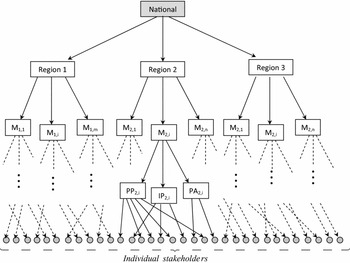
In figure 1 we present a top-down nesting, where reference levels originate causally from the more aggregate national scale and are gradually disaggregated at the regional level, the municipality level (Mi,j), and then across different implementation entities such as the project level (PPi,j), indigenous peoples (IPi,j), and protected area units (PAi,j). This is just one possible top-down specification. For example, a country may decide not to include the municipality as an additional layer in specifying reference levels, and go directly from a regional level to the implementation entities, which may extend beyond the boundaries of single municipalities. Furthermore, the characterization of implementation entities in different categories will depend on institutional arrangements. All activities, outside of policy measures, can in principle be viewed as project activities; however the institutional and legal arrangements will depend on who is implementing the REDD activities, so that implementing a REDD activity in indigenous lands will not have the same institutional framework as implementing a REDD project with individual landowners. Similarly, REDD activities in protected areas will involve governmental institutions rather than the private sector. It is for the above reasons that we introduce the distinction between private projects, indigenous lands, and protected areas, but this distinction is not essential to the approach developed.
The causal relationship between reference levels in a top-down hybrid approach. From national to regional to municipality level (Mi,j), and then across different implementation entities such as the project level (PPi,j), indigenous peoples (IPi,j), and protected area units (PAi,j), and then down to individual stakeholders.

In a top-down nesting, the coordination effort – expressed here as the negotiation of reference levels at different scales – begins with the national reference level which is either linked to international agreements or to domestic legislation. The emissions below the national reference level are then allocated to regions, which then, in turn, allocate them to more regionally disaggregated implementation entities. The more intermediate entities there are before reaching people on the ground, the more complicated it will be to negotiate a system of reference levels. In a top-down nesting, the causal relationship between reference levels is hierarchical in the sense that the flow of decisions concerning reference levels goes from the more aggregated scales to the more disaggregated.
The top-down nesting structure is an intuitively appealing option if a national reference level is adopted by a country. However, there are three disadvantages to this approach. Firstly, the coordination problem can be challenging given the number of decision makers involved in determining reference levels at different scales (as can be seen from the schematic diagram in figure 1). Secondly, the approach is dependent on the initial institutional structure, and might need to be renegotiated if a new implementing entity were to enter the scene, such as for example a new REDD project, as the tree-structure would change and reference levels would have to be reallocated (unless some part of total reference levels had not yet been allocated).Footnote 8 Thirdly, the top-down approach may create a disincentive for implementing entities such as private project developers who would have the reference level for the project imposed from above, as opposed to having it determined internally and then certified by a third party. Although an implementing entity would no longer have to incur the cost of establishing the crediting reference level, it would also lose control over an important element of project planning. This problem may be resolved by having very clear and unambiguous guidelines on how reference levels are determined, so that implementing entities can plan accordingly when developing a REDD activity.
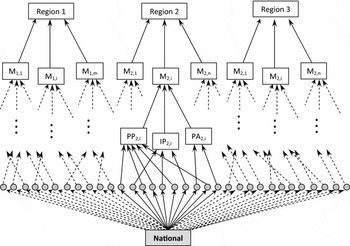
Figure 2 presents the bottom-up nesting as one possible alternative form of nesting. In this approach reference levels are allocated directly to the most disaggregated units, consistent with the national reference level, and then are aggregated up step-by-step to the regional level. The challenge here would be to find a relatively simple rule for allocating reference levels at the individual stakeholder level in a way that encourages participation. For example, one could envisage allocating the reference levels based on a combination of the amount of forest carbon managed by a stakeholder, the historical deforestation rate in a region, and the legal status of the land involved. Whatever combination is used, the resulting individual reference levels need to add up to less than or equal to the national reference level.Footnote 9 Once an agreement is reached on the criteria to set the most disaggregated reference levels possible, then the more aggregate reference levels are obtained by simply summing the reference levels at the more disaggregated levels. The advantage of the this approach, relative to the top-down approach, is that it is institutionally flexible to the extent that implementing entities at more aggregated levels may come into being without disrupting the system. On the downside, finding a general rule of thumb to allocate reference levels directly from the national to the individual stakeholder level may make it difficult to take into consideration local conditions.
The causal relationship between reference levels in a bottom-up hybrid approach. From national level directly to individual stakeholders and then aggregating up across different implementation entities such as the project level (PPi,j), indigenous peoples (IPi,j), and protected area units (PAi,j), up to municipality level (Mi,j), and then up to the regional level.

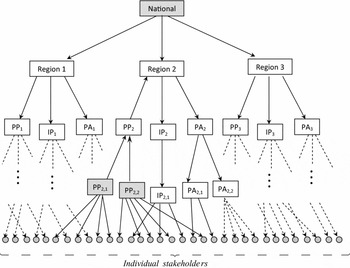
The diagrams represented in figures 1 and 2 provide an intuitive representation of two possible ways of structuring the causal relationship between reference levels. However, there are many possible ways of designing a hybrid nested structure. In figure 3 we present a top-down structure with the difference that reference levels at the project level are set independently (not causally dependent) from the national reference level, as in the ‘nested’ proposal of Streck et al. (Reference Streck, Pedroni, Porrua, Dutschke, Streck, O'Sullivan, Janson-Smith and Tarasofsky2008) and Pedroni et al. (Reference Pedroni, Dutschke, Streck and Porrúa2009). By following the arrows in the diagram, we see that any potential inconsistencies between the project-level and the national-level in terms of crediting will have to be resolved at the regional level and will have repercussions on the reference levels in nonproject activities, such as protected areas or indigenous lands. This complication indicates that some hybrid architectures may create more coordination problems than others. In turn these coordination challenges will affect the risk associated with inconsistent reference levels and nonperformance, which is the focus of the next section.Footnote 10
The causal relationship between reference levels when project reference levels are set independently of the national reference levels in what is otherwise a top-down hybrid approach

3.2 Allocating REDD risk subnationally
As mentioned in the previous section, reducing emissions from deforestation involves uncertainty both on the demand side and the supply side. Risk on the supply side may stem, among other things, from imperfect knowledge about future prices (agricultural and carbon), or about potential country nonperformance relative to the national reference level. This lack in information means that expectations of REDD outcomes contain an element of error. In the presence of uncertainty, understanding the sources of error can lead to better decisions. For example, in structuring a REDD program the BAU emissions are not known with certainty, and neither is the impact of REDD actions. Therefore the level of risk will depend on these two sources of error.
Let CNAT be the avoided emissions credited at the national accounting level to be distributed as credits to all implementing entities, from individual stakeholders (CSTKHLD) and projects (CPROJ), to those associated with indirect regional actions (CREG) and national government action (CNGOV). If strict internal consistency is satisfied, then credits allocated subnationally will have to add up to the observed reductions in emissions relative to the national reference level. Then the following identity would hold:

However, there is no a priori guarantee that equation (1) will hold in general without coordination of reference levels across scales. At a given scale, i, the credits can be computed as:

where REFi is the crediting reference emission level at scale i, BAUi is the BAU at scale i, and CO2_reduci is the reduction in emissions relative to the BAU associated with actions at scale i. However, there will be uncertainty both concerning the BAU path of emissions and the change in emissions associated with a specific action at any given scale. There will therefore be an expectation (E[·]) of the credits generated by activities at each scale based on predictions of a BAU and the impact of the actions undertaken. However, at each scale, i, there will be a difference between the expectation and the realized reductions.


where e ref,i is the error associated with setting of the crediting reference level. It is the amount of credits received as a result of the reference level, even if no action to reduce emissions occurs. The error in reference level will be positive when a conservative reference level is adopted for that component. A negative reference level error indicates that there will be fewer credits generated than expected based on actions undertaken (assuming that the actions do realize the expected reductions in emissions). This component is equal to zero if the reference level is set at the value of the BAU; however, this may not necessarily be the case. There are two reasons for this: (i) the BAU is not observable once REDD is in place, and (ii) even if the BAU were known with certainty, the reference level could be set to a different value by policymakers as a tool to redistribute financial incentives. Therefore this error is not a purely random error tied to uncertainty because policymakers may be biasing the reference level intentionally. However, we consider it an error component to the extent that it generates credits or debits without any actual change relative to the BAU. Based on the definition in equations (2) and (3), the credits at scale i can be expressed as:

where E[CO2_reduci] is a component representing the expected credits stemming from actions at scale i, and there is also an implementation error component, e IMPL,i, reflecting that the actions taken may not lead to exactly the expected reduction.
In practice attributing the errors to one or the other of the actions will be challenging. For example, aside from the fact that it will be difficult to distinguish ex post between errors in reference levels and in implementation, one also has to take into account the interaction between the different scales or implementation entities. One such example is leakage where an action by implementation entity i, affects the BAU of implementation entity j, thereby affecting the reference level error of the latter. It is for this reason that having a formal framework to analyze errors and risk of noncompliance can be useful in how to design a REDD program.
In economic terms countries would like to define the national crediting reference level based on knowledge about the exact value of the BAU emissions. This would help to create across-scale consistency in terms of the credited emissions reductions (eREF,NAT = 0 if reference level is set equal to BAU). However, the BAU is unobservable, and even the best projection model will have an error component. The design of a REDD program architecture will therefore determine how this discrepancy between aggregate reductions monitored at the national level and the sum of the subnational reductions is resolved.
Observation # 1 – Setting a national emissions reference level will involve a degree of error relative to the unobservable BAU emissions, which may lead to discrepancies in the distribution of credited emissions reductions at the subnational level relative to expectations.
The above observation is meant to highlight that how the national reference level is set will have implications for the risk faced by implementing entities. However, errors do not arise only from the setting of the national reference level. Errors at one scale i can be driven by errors at another scale j. Errors can arise from inconsistent expectations across scales when reference levels are not coordinated, such as when implementing entities at one scale have reference levels set independently of other scales. For example, if reference levels of project activities are set independently and the regional crediting reference level is defined as a residual relative to the national, then how crediting reference levels are set for projects will affect the crediting reference level for the nonproject regional activities.
In practice, once the national emissions reductions are computed relative to the reference levels, it will be difficult to distinguish the source of errors, either in reference levels or in implementation, and allocate them precisely to implementing entities. But then how will a REDD architecture function in a way that is consistent across scales?
Observation # 2 – For reference levels to be internally consistent, a hybrid REDD architecture will need to specify an operational rule to reconcile crediting across scales. The rule is meant to allocate any windfall or shortfall in crediting emission reductions relative to the expectations among implementing entities at different scales. The closer the allocation rule is to the proportion in actual reference levels, the more uniformly the risk is distributed. Some of the possible options are listed below.
Option 1 – Shared liability: In this option if there is a shortfall or windfall of credited reductions relative to what would be expected from subnational accounting, then the difference is distributed according to each implementer's reference level.
Option 2 – Regional scale buffering: The reference level for crediting from regional policy actions could be taken as the difference between the national crediting reference level and the sum of all the individual stakeholder and project-based reference levels. In this case the risk associated with biases in reference levels would be attributed by default to the regional action.
Option 3 – Scale prioritisation: When one scale, or category of implementation entities, is insulated from risk outside of its domain. For example, a nested system where projects are credited for emissions reductions regardless of reductions in national emissions.
Option 4 – Individual liability: In this option all implementing entities and stakeholders are liable for their own nonperformance relative to their crediting reference level compensating for any additional emissions.
The options presented above to reconcile across scales are all viable, but they have different implications for the risk that implementing entities across scales will face. It appears intuitive that scale prioritization will likely not be scale neutral and therefore not allow for a systematic compartmentalization of risk across scales, although it will isolate one scale from crediting risk. Similarly, regional scale buffering will transfer all risk from scales below regional to the regional level, and therefore, this option too will not be scale neutral. For shared liability or individual liability, it is not immediately clear whether scale-neutrality would hold. A general result can be derived by assuming internally consistent crediting reference levels.
Proposition 1 – A hybrid architecture where the crediting reference levels are allocated in an internally consistent manner is scale neutral subject to the level of participation being fixed.
Proposition 2 – A cap-and-trade architecture where allowances are allocated to individual stakeholders and then these can be agglomerated into projects or other regional activities is scale neutral.
The results presented above provide sufficient conditions for a REDD architecture to be scale neutral (see the Annex, available online at http://journals.cambridge.org/EDE, for the proof). They are also consistent with the qualitative argumentation of Skutsch and van Laake (Reference Skutsch and van Laake2008) that countries may have to allocate ownership of emissions reductions to a wide range of forest stakeholders with direct compensation. A scale-neutral REDD architecture, by ensuring that risk is clearly allocated across REDD implementing entities, can encourage broader participation thereby making a REDD-architecture more robust. We believe this is an important insight; however, these results do not exclude the possibility that other REDD architectures could be effective in distributing risk across implementing entities. An empirical example with existing proposed methodologies to set reference levels can provide additional insight.
4. An empirical example: subnational reference levels and uncertainty in the context of the Brazilian Amazon
The previous section emphasized the importance of how reference levels are set. It is therefore useful to see how REDD design options differ in the manner in which the reference levels of implementation entities are established, which in turn leads to differing incentives for such entities to participate in a REDD program. After a brief description of reference level design options, we investigate for Brazil how they might perform in the face of uncertainty concerning the BAU deforestation rate in the crediting period. Other analyses exist which examine the potential reduction in deforestation in the Brazilian Amazon based on opportunity costs of not deforesting (Cattaneo, Reference Cattaneo2001; Börner and Wunder, Reference Börner and Wunder2008). In the example presented here, the analysis is based on opportunity cost data from Soares-Filho et al. (Reference Soares-Filho, Nepstad, Curran, Cerqueira, Garcia, Ramos, Voll, Macdonald, Lefebvre and Schlesinger2006); however, we focus more on the uncertainty in reference levels relative to BAU and the impact this has in designing a REDD architecture.
In the simplest crediting reference level design option, an entity's reference level is equal to its average rate of emissions from deforestation over a recent historical period, as in one variant of the original compensated reduction design proposal (Santilli et al., Reference Santilli, Moutinho, Schwartzman, Nepstad, Curran and Nobre2005). When positive incentives are extended only to entities covering areas with historically high rates of deforestation, there is a threat of shifting, or ‘leakage’, of deforestation activities to areas with historically low deforestation rates (da Fonseca et al., Reference da Fonseca, Rodriguez, Midgley, Busch, Hannah and Mittermeier2007). Some design proposals address leakage based on historical emissions with an adjustment factor affecting the reference level (Santilli et al., Reference Santilli, Moutinho, Schwartzman, Nepstad, Curran and Nobre2005; Mollicone et al., Reference Mollicone, Achard, Federici, Eva, Grassi, Belward, Raes, Seufert, Stibig, Matteucci and Schulze2007; Strassburg et al., Reference Strassburg, Turner, Fisher, Schaeffer and Lovett2009). Alternatively, it also possible to rely on historical emissions but set up a fund, financed by a withholding on revenues from compensated emissions reductions, for forest stock stabilization (Cattaneo, Reference Cattaneo, Bosetti and Lubowski2010a). The previous proposals rely on historical emissions with the adjustments implicitly accounting for the likely future convergence in deforestation rates between areas with high and low deforestation rates. However, one could explicitly model future deforestation and set reference levels accordingly (Ashton et al., Reference Ashton2008).
The above reference level approaches were proposed in the context of international negotiations but can in principle function just as well for a national program. Here we will use a subset of these options to highlight the design issues that arise from uncertainty concerning the BAU scenario, and provide an empirical example of the theoretical results presented in the previous section. To do so we will use the Brazilian Amazon Negotiation Toolbox for the Economics of REDD (BANTER), which is a partial equilibrium model intended to inform users about the environmental and financial impact of different policy design options at the level of the Brazilian Amazon states (Cattaneo et al., Reference Cattaneo, Soares-Filho, Alencar, Merry, Bowman, Nepstad, Busch, Moutinho, Stickler, Hissa, Stella and Lima2010c). A brief overview of BANTER is provided in Annex 3 (available online at http://journals.cambridge.org/EDE). The first step towards making REDD an Amazon-wide program is for states to agree on a system of reference levels. The BANTER model can examine whether a system of reference levels is environmentally effective, economically efficient, and fair according to different measures of equity. In the context of this paper the model is used to examine how uncertainty about the BAU may affect the environmental effectiveness and efficiency of a REDD program depending on the architecture adopted.
The analytical framework for BANTER follows that of the Open Source Impacts of REDD Incentives platform (OSIRIS) (Busch et al., Reference Busch, Strassburg, Cattaneo, Lubowski, Bruner, Rice, Creed, Ashton and Boltz2009b). It is a stylized one-period partial equilibrium market for a single composite commodity. Following Busch et al. (Reference Busch, Strassburg, Cattaneo, Lubowski, Bruner, Rice, Creed, Ashton and Boltz2009a), expansion of the agricultural frontier is assumed to be responsible for deforestation, which is a plausible assumption in the Brazilian case. The impact of REDD incentives on deforestation is modeled by shifting state-level supply curves for frontier agricultural land. A state's quantity of deforestation, reference level and estimated average forest carbon density are used to calculate the state's reductions in emissions from deforestation and REDD revenue.
The basic premise here is to use deforestation data from 1990 to 2000 to construct possible reference levels for a hypothetical REDD crediting period in 2000–2005. Since the deforestation in the crediting period is known, we can also use data from the 2000 to 2005 period to construct what would be a perfect-foresight reference level to use as a benchmark, representing a state-of-the-world without uncertainty.
From the simple comparison presented in table 1, we observe that historical annual emissions rates may not be a good predictor of future deforestation. In this particular case, adopting historical emissions from 1990 to 2000 as a reference level for a crediting period in 2000–2005 would underestimate the actual BAU during the crediting period. The implication of underestimating the actual BAU is that it may affect participation because a substantial amount of actual emissions reductions would not be compensated. For example, the state of Pará, with a historical reference level, would have to reduce annual emissions by approximately 100 million tonnes of CO2e relative to the BAU before being credited for any reductions. The risk arising from such a situation is that several states may have limited financial incentives to participate in REDD. If participation of all states is not guaranteed, even though the reference levels may be defined to be internally consistent, scale neutrality may not hold (from Proposition 1). Increased leakage from nonparticipating states will increase the risk for stakeholders in participating states.
Historical state-level annual emissions from deforestation in the Brazilian Amazon for two time periods, 1990–2000 and 2000–2005 (million tonnes CO2e yr−1)

Source: BANTER v2.0. (Cattaneo et al., Reference Cattaneo, Soares-Filho, Alencar, Merry, Bowman, Nepstad, Busch, Moutinho, Stickler, Hissa, Stella and Lima2010c)
Different reference level designs will deviate from historical emissions and from the BAU in different ways (see Annex 4, available online at http://journals.cambridge.org/EDE). The comparison we are interested in making here focuses on a REDD design with a reference level that is set with perfect foresight and compared with the outcome – both environmental and financial – of when the reference level is linked in some way to historical emissions rates. Different reference level design options are considered so as to show how they make an adjustment relative to the historical BAU. The objective of this empirical example is to provide insight on the implications of different design options when faced with uncertainty in BAU.
As an example, we follow Busch et al. (Reference Busch, Strassburg, Cattaneo, Lubowski, Bruner, Rice, Creed, Ashton and Boltz2009a) to quantitatively model and compare the impact of REDD financial transfers for emissions reduction for four Amazon-scale REDD incentive-design options under one set of illustrative conditions, among these a ‘perfect foresight’ scenario used here as a benchmark:
• ‘Perfect Foresight’ – the reference level for each state is set to the level of the actual BAU during the crediting period (in this case the period 2000–2005), and acts as a benchmark.
• ‘Historical’ – Reference levels equal to a state's historical rate (Santilli et al., Reference Santilli, Moutinho, Schwartzman, Nepstad, Curran and Nobre2005).
• ‘Weighted average of state-level and national’ – Following the approach of Strassburg et al. (Reference Strassburg, Turner, Fisher, Schaeffer and Lovett2009), reference levels are a weighted average of state and Brazilian Amazon historical rates. The results presented are based on reference levels by state obtained weighing at 85 per cent a state's historical emissions rate and at 15 per cent the Brazilian Amazon average emission rate.
• ‘Flow withholding and stock payment’ – A percentage of payment for emissions reductions relative to historical is withheld to fund payments proportional to states’ forest stock (Cattaneo, Reference Cattaneo, Bosetti and Lubowski2010a). The withholding level is assumed to be 15 per cent of the price for emissions reductions.
• ‘Cap-and-trade – Historical allocation’ – States are required to purchase credits for emissions above their reference level set equal to historical emissions.
The main theoretical conclusion in the previous section was that a cap-and-trade architecture with reference levels allocated to individual stakeholders would be scale-neutral. Although we cannot simulate that result empirically with the available model, we can investigate how introducing a cap-and-trade model with allocation of reference levels to the states would perform. For the sake of simplicity, we assume here that allowances under the cap-and-trade system are allocated according to historical emissions, so the error in the reference level is the same as for a historical reference level. However, there will be a difference in the performance of the cap-and-trade relative to all the other reference levels to the extent that participation is not voluntary in a cap-and-trade architecture, and therefore the reference level values will not determine participation level under a cap-and-trade system, assuming there is appropriate enforcement.
The performance of these five designs is analyzed, assuming a price for credited emissions reductions of $10/t CO2e.Footnote 11 The formulae for calculating reference levels under each design option are presented in Busch et al. (Reference Busch, Strassburg, Cattaneo, Lubowski, Bruner, Rice, Creed, Ashton and Boltz2009a).
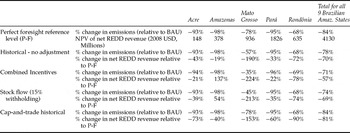
In table 2 the potential environmental effectiveness and cost efficiency for the different REDD designs is presented in terms of emissions reductions and net REDD revenue for a select number of states in the Brazilian Amazon, and for the Brazilian Amazon as a whole. In the benchmark, perfect foresight design, emissions are reduced by 84 per cent Amazon-wide at an annual cost of approximately $4 billion a year. This is assuming, however, that all reductions in emissions relative to the actual BAU are credited. In practice this may not be the case even if the BAU is exactly predicted, and states may have to take on the burden of some reductions without compensation. Because annual emissions increase going from the 1990–2000 reference period to the 2000–2005 crediting period, the other designs implicitly shift some of the burden for emissions reduction onto the states by underestimating the actual BAU. This results in a REDD revenue that is considerably lower, decreasing by 57 per cent for the combined incentives, 69 per cent with a flow withholding and stock payment, and up to 81 per cent for the cap-and-trade design.
Simulating performance of REDD reference level approaches under uncertaintya

aFour approaches for setting reference levels are compared to a perfect-foresight situation where the reference level is set exactly at the value of the BAU during the crediting period. The comparison, using the BANTER model, is in terms of the change in emissions and the revenue generated by implementing entities (i.e., the budgetary cost of a Brazilian REDD program).
Source: BANTER v2.0. (Cattaneo et al., Reference Cattaneo, Soares-Filho, Alencar, Merry, Bowman, Nepstad, Busch, Moutinho, Stickler, Hissa, Stella and Lima2010c).
Underestimating the actual BAU can lower participation, which is indeed what is observed in the simulation results. In all reference designs except the cap-and-trade, emissions reductions are less pronounced than in a perfect foresight reference level. This occurs mainly because emissions in Mato Grosso are substantially underestimated, leading to a borderline participation of the state, and fewer emissions reductions. On the other hand, one can observe with the cap-and-trade design where participation is mandatory that the emissions reductions are equivalent to the perfect foresight case, but with much lower budgetary requirements as can be inferred by the same level of reductions but the much lower net REDD revenue received by stakeholders (table 2). Clearly how allowances are allocated will matter to income distribution and how much enforcement may be required, however, the simulation results provide an example of how a cap-and-trade approach with allowances allocated at the subnational level can give rise to the same environmental outcome as a reference level design based on perfect foresight of the BAU.
5. Conclusions
This paper outlined some of the coordination issues and challenges of reducing greenhouse gas emissions from deforestation when there are multiple implementing entities at different geographic scales. It attempts to provide an intuitive framework to study different forms of nesting and how risk is distributed through a REDD architecture. The premise of the paper is that the objective of REDD is to reduce emissions relative to a BAU scenario that is unobservable once REDD is in place. Ideally, if the BAU were known, then compensation could be provided based on such a BAU without any error in reference levels arising in the process. Unfortunately the BAU is not known and can only be estimated. This implies that unintended errors will arise both in the national crediting reference level and at more disaggregated scales, and that the magnitude of the error will depend on the approaches taken in assigning credits at the national and subnational levels.
To categorize REDD architectures, the concept of scale-neutrality of a REDD architecture is introduced, indicating that the crediting relative to the reference level at a given scale is not affected by errors in reference levels at scales below it. Scale-neutrality compartmentalizes risk, limiting its distribution through the REDD architecture. A clear allocation of risk and liabilities reduces the uncertainty for potential participants in REDD transactions, both on the demand-side and the supply-side, thereby making a REDD program more robust and increasing potential participation.
The findings of this paper indicate that (i) a cap-and-trade architecture for REDD where allowances are allocated at the level of individual stakeholders (and these can be agglomerated) is scale-neutral, and (ii) a cap-and-trade for REDD can be effective and efficient (as already discussed in an international context by Busch et al. (Reference Busch, Strassburg, Cattaneo, Lubowski, Bruner, Rice, Creed, Ashton and Boltz2009a) and Cattaneo et al. (Reference Cattaneo, Lubowski, Busch, Creed, Strassburg, Boltz and Ashton2010b)), but also that it can obtain the same environmental outcome under uncertainty as if the reference levels were set with perfect foresight. These results arise because a cap-and-trade approach provides a clear allocation of responsibilities, and therefore risk is clearly allocated, but also because participation is required. It may be that other approaches that provide a clear allocation of risk and lead to full participation may perform as well as a cap-and-trade, but this is an open research question.
The results presented here are just a starting point in terms of designing REDD architectures and much remains to be done. Here we focused on the role of crediting reference levels and the uncertainty surrounding BAU emissions. However, other areas are equally important, such as the setting up of registries, the harmonization of MRV methods, and the institutional and legal arrangements defining a REDD architecture.