INTRODUCTION
The horseshoe crab, Tachypleus tridentatus (Leach, 1819), has undergone little morphologic evolution in the last 200 million years (Walls et al., Reference Walls, Berkson and Smith2002). Although it has escaped many catastrophes that led to mass extinctions (Raup & Sepkoski, Reference Raup and Sepkoski1982), it is now facing extinction (Liao & Li, Reference Liao and Li2001; Chen et al., Reference Chen, Yeh and Lin2004; Berkson et al., Reference Berkson, Chen, Mishra, Shin, Spear, Zaldívar-Rae, Tanacredi, Botton and Smith2009; Tanacredi et al., Reference Tanacredi, Botton and Smith2009). Before the 1980s, fishermen caught 1.5 million T. tridentatus every year; however, today, they catch less than 50,000 individuals from the Beibu Gulf of the South China Sea. Thus, in 2004, T. tridentatus was classified as an endangered species by the ‘Red Book of China’ (Wang & Xie, Reference Wang and Xie2004). To manage and protect the rare horseshoe crab resources, a detailed study of its life cycle (Cierpich et al., Reference Cierpich, Grady and Valiela2004) and its ability to adapt to environmental changes is necessary.
Horseshoe crabs spawn on sandy beaches (Ehlinger & Tankersley, Reference Ehlinger and Tankersley2003; Brousseau et al., Reference Brousseau, Sclafani, Smith and Carter2004), and the fertilized eggs hatch into planktonic trilobite larva (Botton & Loveland, Reference Botton and Loveland2003), which then settle as benthic larvae in the intertidal zones near the beach (Botton et al., Reference Botton, Loveland and Tiwari2003). The early juveniles of the horseshoe crab T. tridentatus wander the intertidal mud flats. Their exoskeleton are black, hence, the local fishermen call them black-skin horseshoe crabs. As they moult more and grow gradually, they move into the subtidal shallow water. Between the 11th and the 16th moults, their skins become yellowish, and they are referred to as sallow-skin horseshoe crabs (Liao et al., Reference Liao, Li and Hong2002). The late juveniles live in deeper water (20–40 m) sea areas (Liao et al., Reference Liao, Li and Hong2002). Juveniles moult 17–18 times within 13–14 years to reach sexual maturity (Sekiguchi, Reference Sekiguchi1988). Adults live in the region from the beach and the shallow sea to deeper waters (20–40 m) (Sekiguchi, Reference Sekiguchi1988). Their life history involves the hatching of embryos, the growth of early larvae and late juveniles, and adult life in different sea areas. The habitat changes during the different stages of the horseshoe crab life cycle mean that there are likely corresponding adaptations to different sea environments.
Evidently, a horseshoe crab encounters a number of salinity changes during its life cycle. At present, the effects of salinity change on Limulus polyphemus have been revealed clearly on its embryo (Ehlinger & Tankersley, Reference Ehlinger and Tankersley2004) and larval growth (Jegla & Costlow, Reference Jegla, Costlow, Bonaventura, Bonaventura and Tesh1982; Laughlin, Reference Laughlin1983; Ehlinger & Tankersley, Reference Ehlinger and Tankersley2004), and its osmotic regulation (McManus, Reference McManus1969; Robertson, Reference Robertson1970; Towle et al., Reference Towle, Mangum, Johnson, Mauro, Bonaventura, Bonaventura and Tesh1982; Towle & Henry, Reference Towle, Henry, Shuster, Barlow and Brockmann2003). However, few reports on the effects of salinity change on other horseshoe crabs are available, except for the effects of salinity on larval growth and the moulting of the horseshoe crab Tachypleus gigas (Chatterji et al., Reference Chatterji, Kotnala and Mathew2004), on the insemination and hatching of T. tridentatus (Li et al., Reference Li, Liao and Dong1999), and on embryo development of T. tridentatus (Wang et al., Reference Wang, Su, Wang and Liang2001).
Moreover, most of the scanty available research on T. tridentatus is restricted to embryos or larvae within one year after hatching. The late juveniles (sallow-skin) are abundantly distributed off Zhanjiang, China (Liao et al., Reference Liao, Hong and Li2001), where the shallow sea area is influenced by rainwater (1588.8 mm/year) and the salinity is lower and more variable (20‰ to 30‰) than in the more stable and comparatively higher salinity of deeper sea areas (32‰ to 36‰). Therefore, experiments on the salinity tolerance and adaptations of sallow-skin T. tridentatus were conducted to determine whether they are osmoregulars or osmoconformers (Barrington, Reference Barrington1979).
MATERIALS AND METHODS
Sallow-skin Tachypleus tridentatus horseshoe crabs, with average carapace width of 14.5 cm, a body length of 30.0 cm, and a body mass of about 280 g, were collected from the Dongnan Sea area (20′40″ to 20′21″N and 110′9″ to 110′38″E) of Leizhou Bay, China. The salinity of seawater in Dongnan ranges from 22‰ to 32‰. The depth of the seawater is 20–40 m, at which the horseshoe crabs were collected.
To prepare seawater with varying salinities, natural seawater was taken from the Zhanjiang Sea area, which has a salinity of 28.3‰–30‰ and a pH value of 7.55–8.65. The seawater was filtered through 400-mesh bolting silk after sand filtration, and then adjusted to 30‰ salinity using ‘Yuxiabao’™ instant seawater crystals (97-b type), which were ready for use. Based on the experimental results of the food category and feeding amount (Gao et al., Reference Gao, Liao and Ye2003), 0.5–1 cm2 meat pieces of freshly eviscerated cuttlefish (Sepia) were prepared as food. The cuttlefish were bought from the Dongfeng Market of Zhanjiang. During the experiment, the room temperature was 23.5–29.5°C and the water temperature was 22.5–27.5°C. The water in the containers was continuously aerated.
Fifteen salinity levels, from 0‰ to 70‰, at 5‰ intervals were prepared using natural seawater with tap water (pH 7.85) aerated for 24 hours or with seawater crystals, based on the method by Liao & Li (Reference Liao and Li2002), and placed into 55 l plastic buckets (45 l water in each bucket). After being reared at 30‰ salinity for 2 days, the horseshoe crabs were placed into the containers with water with different salinity levels, with 6 horseshoe crabs for each salinity group. The horseshoe crabs were fed 20 g daily at 21:00 every day. At 09:00 the next day, the leftover food was taken out and weighed, and water in each bucket was replaced with freshly prepared water at the same salinity.
After 7 days of the salinity-challenged experiment, the water for all salinity groups was replaced with 30‰ seawater. The other conditions and methods remained the same. The salinity recovery experiment lasted 3 days. The survival rate of the horseshoe crabs at a particular salinity level was calculated with the formula below:

where S is the survival rate, Ns is the total number of the surviving horseshoe crabs at that salinity level after the 7-day experiment, and Ni is the number of horseshoe crabs initially introduced.
The mean relative daily food intake of the horseshoe crabs was calculated using the formula below (Gao et al., Reference Gao, Liao and Ye2003):

where I is the mean relative daily food intake of the horseshoe crab, F is the total daily food intake, and M is the body mass before the experiment, same as below.
The food intake experiments were all accompanied by the corresponding food solubility tests to correct the amount of food intake.
After the water was emptied with a basket, the T. tridentatus were weighed with a Shimadzu electronic scale (Japan), and the precision of the scale was 0.01 g. The body mass experiments were all accompanied by corresponding no-food-intake tests to correct the amount of body mass that resulted from the food intake.
The relative body mass change of the horseshoe crabs on the nth day was calculated by the formula as below:

where Mc is the relative body mass change of horseshoe crabs on the nth day and Ms is the mean body mass on the nth day.
Significance tests for difference in survival rates were directly carried out based on the expansion of the binomial (p + q)n. SPSS 12.0 statistical software was applied in a two-way analysis of variance to test the significance of the differences in relative food intake and relative body mass. The least significant difference method was used for intergroup comparisons. The differences were considered significant at P < 0.05.
RESULTS
Survival
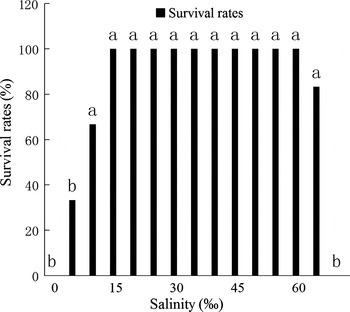
The salinity challenge had a remarkable influence on the survival of the sallow-skin horseshoe crabs (Figure 1). The survival rate was 100% at 15‰–60‰ salinity, which dropped to 83.3% in the 65‰ salinity group, 66.7% in the 10‰ salinity group, and 33.3% in 5‰ salinity. All individuals in the 0‰ and 70‰ salinity groups died. During the salinity recovery period, all horseshoe crabs that did not die during the salinity challenge survived after 3 days.
Effect of salinity challenged on the survivorship of sallow-skin horseshoe crab.

These results indicate that the sallow-skin horseshoe crabs have a high tolerance for salinity changes. They can live not only in the river estuaries and inshore areas with low salinities, but also in abyssal seas with high salinities.
Food intake
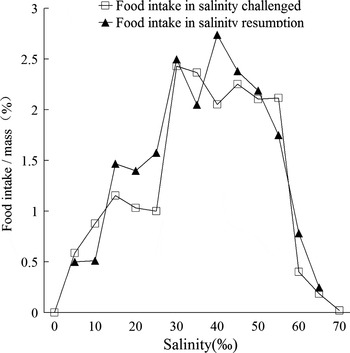
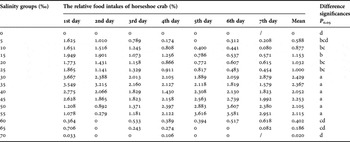
Food intake was higher (with the mean relative food intake being above 2.052%) at salinity 30‰–55‰, and dropped significantly at salinities below 25‰ and above 60‰ (P < 0.05: Table 1; Figure 2). During the salinity recovery period, the mean relative daily food intake of the sallow-skin horseshoe crabs were similar to that of the salinity-challenged ones (Figure 2), and were over 1.75% at 30‰–55‰ salinity (Table 2).
Effect of salinity challenged on food intake of sallow-skin horseshoe crab.

Effect of salinity challenge on the mean relative daily food intake of sallow-skin horseshoe crabs with 6 individuals in each salinity group.

The ‘/’ denotes the death of the horseshoe crab or no measure; the lower case letters denote the significant difference. There are no significant differences among groups having the same letters, and there are significant differences among groups not having the same letters (similarly in Tables 2, 3 & 4).
Effect of salinity recovery after challenge on the mean relative food intake of sallow-skin horseshoe crabs with 6 individuals in each salinity group.

The optimum feeding salinity for the sallow-skin horseshoe crabs ranges from 30‰ to 50‰. The relatively suitable salinities ranged from 15‰ to 25‰ and 55‰. The most unsuitable salinities are at 0‰ and above 70‰.
The body mass of sallow-skin horseshoe crabs
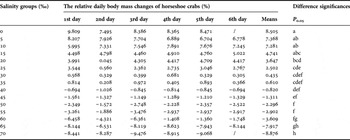
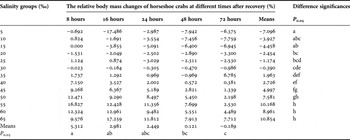
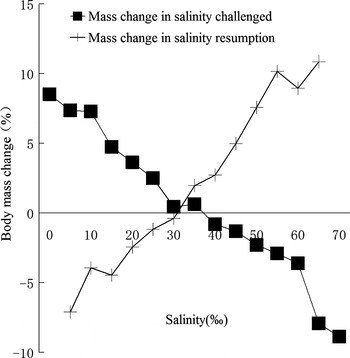
The changes in body mass of the sallow-skin horseshoe crabs during the salinity challenge revealed a linear relationship between gained mass at low salinity and lost mass at high salinity at salinity levels from 10‰ to 60‰ (Table 3; Figure 2). An inverse linear relationship was observed during the recovery period (Table 3; Figure 2). The water-retaining horseshoe crabs in the low-salinity groups had rapid water loss during the late period of recovery, whereas the dehydrated horseshoe crabs in the high salinity groups had a rapid increase in mass during the early period of salinity recovery (Table 4). These results reveal that the sallow-skin horseshoe crabs are osmoconformers.
Effect of salinity challenge on the mean relative body mass of the sallow-skin horseshoe crabs with 6 individuals in each salinity group.

The ‘-’ denotes the body mass decrease.
Effect of salinity recovery after challenge on the mean relative body mass of sallow-skin horseshoe crabs with 6 individuals in each salinity group.

DISCUSSION
The sallow-skin horseshoe crabs survived well at 15‰–60‰ (Figure 1), fed well at 30‰–55‰ (Table 1), gained mass at 0‰–25‰, lost mass at 45‰–70‰ and maintained mass at 30‰–40‰ during the salinity challenge (Table 3). These results indicate that sallow-skin Tachypleus tridentatus can tolerate a wide range of salinity changes, adapting gradually from inshore low salinity to offshore high salinity. The gametes of T. tridentatus can be inseminated in a broad salinity range (3‰–48‰), but fertilized eggs can hatch only in a narrow salinity range (16‰–40‰); within this range, the lower the salinity, the higher the hatching rate (Li et al., Reference Li, Liao and Dong1999). Moreover, the hatching rates were 8.67% and 14.50%, respectively, at 10‰ and 15‰ salinity, and the larvae (between the 1st–2nd moults) grew fastest at 20‰ salinity (Wang et al., Reference Wang, Su, Wang and Liang2001). Summarizing these data reveals that fertilized T. tridentatus eggs can hatch normally from 10‰ to 40‰, and the highest hatching rate and fastest development is at 16‰–26‰ (Wang et al., Reference Wang, Su, Wang and Liang2001). Therefore, the embryonic and larval development of T. tridentatus is restricted to a narrow range at low salinities, of which 16‰–26‰ was optimal.
The effects of the salinity challenge and recovery on the food intake of the sallow-skin horseshoe crabs coincide with the aforementioned findings. The relative food intake was high at 30‰–55‰ salinity (Figure 2), whereas the relative change in mass of the sallow-skin horseshoe crabs was slight at 30‰–40‰ salinity (Figure 3). These indicate that, compared with the embryos and larvae, the sallow-skin T. tridentatus can live at higher salinities. From 16‰–26‰ in the embryo and larval stage, the optimum salinity range of T. tridentatus expands to 30‰–55‰ in the sallow-skin stage.
Effect of salinity challenged on body mass change of sallow-skin horseshoe crab.

The experimental results, as well as the analysis above, indicate that the sallow-skin horseshoe crabs can live at 15‰–60‰ salinity, feed well at 15‰–55‰, and feed optimally at 30‰–55‰. In hypoosmotic 0‰–25‰ salinity, the horseshoe crab absorbs water and its body mass increases. The lower the salinity, the more the mass increases. In hyperosmotic 45‰–70‰ salinity, the horseshoe crab loses water and its body mass decreases. The higher the salinity, the more the mass decreases. At 25‰–40‰ salinity, the body mass remained almost stable. At 50‰–55‰ salinity, the food intake of the horseshoe crab was initially low, but it later increased gradually. These prove that the sallow-skin horseshoe crab can tolerate a wide range of salinities (15‰–60‰); however, the comparatively high salinity of 30‰–55‰ is most favourable, with the optimal range at 25‰–40‰.
In the shallow sea of Zhanjiang, the salinity is influenced to a great extent by rainwater. Thus, salinity is comparatively lower. In deeper sea areas, salinity is stable and comparatively higher, ranging from 30‰ to 40‰, which exactly coincides with the narrowest range in which salinity influences body mass changes in our experiment. Therefore, the physiological adaptation to salinity of horseshoe crabs corresponds to its life history and migration route, from its embryonic and larval stage at low inshore salinities to its adult stage at higher salinities in deep sea areas. This reflects the long-term evolutionary adaptation of the living fossil, and indicates that humans should pay more respect and focus on protecting the species (Chen et al., Reference Chen, Hsieh, Chen, Yeh, Lin, Wang, In Tanacredi, Botton and Smith2009).