

1. Introduction
The increasing global energy demand coming mainly from heating, electricity and transport fuels is primarily met by fossil energy sources with a corresponding share of 87 per cent of primary energy consumption for the year 2013 (BP, 2015). According to the International Energy Agency (IEA) (2006), fossil fuel will account for 77 per cent of the increase in world primary energy demand between 2007 and 2030, with the major contribution coming from countries in a transitional stage of economic development (emerging economies). Current CO2 emissions caused by global energy use account for about 80 per cent of total emissions, making energy use a major source of pollution. At the same time, access to energy is considered a vital infrastructural input in socio-economic development (Kaygusuz, Reference Kaygusuz2012). Hence, energy consumption in the context of sustainable development has become a research and policy topic of the highest importance. In this respect, the relationship between energy use and economic growth deserves closer attention: if, as it is widely believed, a stricter energy supply hampers a country's income growth, restrictive energy policies may have adverse effects on economic development. Although extensive empirical work has been conducted on the energy–growth nexus, only a few studies provide results based on larger cross-sectional samples which allow us to derive policy recommendations that can be applied across countries. Considering the increasing importance of lower income countries for global energy consumption, the current paper contributes to the existing literature by empirically examining the structural relation between energy use and economic growth, using a large sample of macro-level panel data with a specific focus on different stages of economic development.
The empirical link between energy use and income has undergone extensive investigation in the applied economic literature, especially after the two oil crises of the 1970s. Results vary with regard to different countries, research periods and econometric methods. The causal relationship is generally categorized into four testable hypothesesFootnote 1 : First, the neutrality hypothesis suggests the absence of a causal relationship between energy use and economic growth, implying that neither conservative nor expansive policies in relation to energy consumption have any effect on economic growth. Secondly, the conservation hypothesis postulates unidirectional causality from economic growth to energy use. It implies that conservation policies may be implemented with little or no adverse effect on economic growth. Thirdly, the growth hypothesis asserts unidirectional causality running from energy use to economic growth, which implies that restrictions on the use of energy may have detrimental effects on economic growth. Fourthly, the feedback hypothesis suggests bidirectional causality, with energy use and economic growth being jointly determined.
The vast majority of existing studies rely on time series econometrics examining the bi-directional relation between energy use and income, focusing on the longitudinal variation. Ozturk (Reference Ozturk2010) and Payne (Reference Payne2010) synthesize the existing results by providing a systematic literature review on energy (and electricity) use and economic growth. The evidence supports the four hypotheses almost equally: among the studies examined by Ozturk (Reference Ozturk2010), 25 per cent of the findings support the neutrality hypothesis, 30 per cent the growth hypothesis, 23 per cent the conservation hypothesis, and 22 per cent the feedback hypothesis.Footnote 2 The majority of countries under examination belong to the high-income group according to the World Bank classification (roughly 40 percent). The different results derived by country-specific studies reveal conflicting results that crucially depend on different country characteristics, which makes it difficult to reach a synthesized conclusion with regard to the energy–growth nexus.Footnote 3 More general conclusions are provided by several multi-country studies: Chontanawat et al. (Reference Chontanawat, Hunt and Pierse2008) and Ferguson et al. (Reference Ferguson, Wilkinson and Hill2000) show that the relationship between gross domestic product (GDP) and energy is more prevalent in wealthier countries, which indicates higher possible impacts of energy policies in high-income countries. Wolde-Rufael (Reference Wolde-Rufael2009) analyzes a sample of 17 African countries and shows that the neutrality hypothesis is generally rejected and that energy plays only a minor role in output growth next to capital and labor. Using a multivariate time series model for Chinese data, Shahbaz et al. (Reference Shahbaz, Khan and Tahir2013) find that energy use drives economic growth. Insufficient observations in annual time series data for many of these studies have been a major concern relating to the reduced power and size properties of conventional bivariate causality tests applied. With recent advances in time series econometrics, particularly the panel cointegration test, this methodological limitation has been addressed by providing additional power combining cross-sectional and time series data.Footnote 4 Al-Iriani (Reference Al-Iriani2006) tests the causal relationship in a panel of six Gulf Cooperation Council countries, finding support for the conservation hypothesis. Using a panel-based error correction model, Lee (Reference Lee2005) investigates the co-movement between energy consumption and GDP using data for 18 developing countries, showing that causality runs from energy consumption to GDP, indicating that conservation policies may harm economic growth in low-income countries. Lee and Chang (Reference Lee and Chang2007) use a panel VAR model for 40 countries, providing evidence for the conservation hypothesis for developing countries.
Using similar methodologies for a heterogeneous sample of 82 countries and classifying the data into four income groups, Huang et al. (Reference Huang, Hwang and Yang2008) conclude that results vary with regard to the countries’ stage of development: whereas there is no relation between energy use and growth for low-income countries, a causal relationship runs from economic growth to energy use for middle- and high-income countries, providing support for the conservation hypothesis. Ozturk et al. (Reference Ozturk, Aslan and Kalyoncu2010) examine a sample of 51 middle- and low-income countries and conclude that GDP drives energy use for lower income countries and that the effect is bidirectional for the middle-income group. Ozcan (Reference Ozcan2013) examines the energy–growth nexus for 12 Middle Eastern countries, finding evidence for the conservation hypothesis in the short run. It can be concluded that, even if cross-country variation is included into the analysis, the reported results on the energy–growth nexus remain conflicting. Conclusions depend on the sample properties (especially the selection of countries) and methodologies used, calling for a more systematic analysis based on larger cross-country samples.
A second strand of literature which is related to the present approach is based on structural interactions between energy use and economic growth which are closer to economic theory. Zachariadis (Reference Zachariadis2007) shows that results based on the bivariate energy–growth causality tests are contradictory and sometimes economically implausible, highlighting the importance of using multivariate models based on economic theory which allow for several mechanisms and causality channels for a better empirical representation. In fact, most studies rely on the direct interaction between GDP and energy consumption, using a limited number of control variables and with no distinction between level and growth effects of energy. Building on modern growth theory and endogenous capital accumulation, Bretschger (Reference Bretschger2015) suggests that energy impacts economic growth through capital accumulation. He examines the interrelation between energy use and economic growth by applying an augmentation of the cross-country growth regression to a sample of high-income countries. Contrary to prevalent views, he finds that a reduction in energy use can enhance economic growth indirectly by fostering the capital accumulation process. Lee et al. (Reference Lee, Chang and Chen2008) empirically investigate the role of the capital stock for the energy–income causality for a sample of high-income countries and conclude that neglecting the impact of capital on income tends to overestimate the effect of energy use on economic growth. Ayres and Voudouris (Reference Ayres and Voudouris2014) examine the interaction of economic growth, capital and labor for three high-income countries and show that growth has been driven by declining energy costs. In summary, the recent trend of analyzing the energy–growth nexus based on more structural empirical models provides crucial additional insights. However, the corresponding conclusions are drawn based on samples of higher income countries.
The current study contributes to the existing literature in at least three points. (i) Using a large sample of 117 countries over the period 1973–2007, we analyze the structural relation between energy use and economic growth, considering different channels of causality based on Bretschger's (Reference Bretschger2015) theoretical and empirical framework. This allows us to account explicitly for the role of economic development. (ii) We examine the role of economic development by applying sample segmentation based on income classification. We thereby address the issue of parameter heterogeneity, which typically arises in the context of the cross-country growth regression (see, for example, Temple, Reference Temple2000; Durlauf and Johnson, Reference Durlauf and Johnson2006). The sensitivity of the popular cross-country growth regression with regard to parameter heterogeneity has been treated in various applications but not in combination with energy use.Footnote 5 (iii) We apply a set of different dynamic panel estimation strategies in order to address typical estimation problems related to the energy–growth nexus such as endogeneity, persistent variables, measurement errors and omitted variables.
Results suggest that growth rates in high-income countries are negatively related to energy consumption, whereas we find clear evidence that income growth in middle-income countries relies positively on energy use as a production factor. In low-income countries, the rate of economic growth does not seem to be affected by changes in energy use. These results clearly indicate that the relationship between energy consumption and economic growth differs with regard to the living standards of a country, with higher income countries being less dependent on energy use than middle-income countries, including the major emerging markets. As energy conservation policies are expected to be harmful for middle-income countries, appropriate policy designs and possible compensation mechanisms are required in order to ensure a sustainable development during economic transition, especially with regard to multilateral environmental agreements such as climate policies.
The remainder of the paper is organized as follows. Section 2 gives a basic conceptual framework for the interrelation between energy use and economic growth and provides stylized facts. Section 3 describes the empirical strategy and section 4 presents the empirical results. Section 5 summarizes and concludes.
2. Theoretical considerations and principal hypotheses
2.1. Theoretical basis
The linkages between energy and the economy have been addressed in several ways and remain open to different interpretations within diverse theoretical frameworks: in the neoclassical theory of economic growth, for example, the focus is on substitutability and complementarity between energy and other production factors, whereas ecological economic models consider economies that create goods by extracting energy from a closed ecosystem (Zachariadis, Reference Zachariadis2007). In this section, we discuss theoretical contributions from the modern growth literature which relate to energy use and endogenous investments. Using a narrative approach, we illustrate and discuss possible direct and indirect effects of energy use on economic growth based on a theoretical framework developed by Bretschger (Reference Bretschger2015). The main insights will be used to derive empirically testable hypotheses.
In economic theory, energy (E) is regarded as an input factor for the production of output Y such as the capital stock (K) or labor (L):
 $$Y = F(E, K, L).$$
In a simplified setting, F(·) is assumed to be a static linear homogeneous production function with α, β, γ > 0,
 $$Y = K^{\alpha} L^{\beta} E^{\gamma}.$$
Since
 ${\partial Y \over \partial E} \gt 0$
, an increase of energy will lead, ceteris paribus, to an increase in Y, which we refer to as the level effect. Hence, the more energy is fed into the production activity, the higher will be the corresponding output. It is therefore obvious that for an economy with energy as a production factor, income levels and energy inputs should be positively linked. In order to illustrate the corresponding growth rates, we consider equation (2) as a dynamic production function. Taking the derivatives with respect to time and calculating growth rates leads to the well-known growth-accounting relation where the hats denote the growth rates:
 $$\hat{Y} = \alpha \hat{K} + \beta \hat{L} + \gamma \hat{E}.$$
We can see that output growth is driven by the growth rates in inputs. A higher energy input in terms of a higher growth rate favors economic growth which is a direct consequence of the level effect described above. However, this simplified framework does not suffice for an appropriate identification of causal effects. Of course, growth accounting is only concerned with the immediate determinants of growth, treating inputs as exogenous variables while ignoring essential structural elements, such as possible interrelations between the inputs as well as bidirectional effects between output and inputs. Furthermore, this basic example illustrates the need to separate the level and growth effects of energy: although it is reasonable to assume a direct impact of energy use on output levels, the more interesting topic for analyzing the long-run development relates to the question of whether an economy experiences growth effects through more energy input which offset the level effect.
From well-established economic theory, we know that the accumulation of physical and knowledge capital stocks are the main engines of economic growth. New growth theory suggests that capital stocks are endogenously produced by market participants that respond to incentives (Romer, Reference Romer1990). Different contributions to the economic literature integrate a natural resource component into endogenous growth theory (see, for example, Bovenberg and Smulders, Reference Bovenberg and Smulders1995; Xepapadeas, Reference Xepapadeas, Mäler and Vincent2005; Acemoglu et al., Reference Acemoglu, Aghion, Bursztyn and Hemous2012; Bretschger and Smulders, Reference Bretschger and Smulders2012). An important mechanism for capital accumulation is the notion of induced innovations which states that relative prices of alternative factors are an important determinant of innovation directing technical change to become more biased towards saving the more expensive factors (Hicks, Reference Hicks1932; Kennedy, Reference Kennedy1964; Binswanger, Reference Binswanger1974). In the context of natural resources, with rising prices of fossil fuels and declining energy use, there will be incentives to innovate with respect to less energy intensive production. This concept has been examined intensively by the empirical literature (see, for example, Jaffe and Palmer, Reference Jaffe and Palmer1997; Popp, Reference Popp2002; Johnston et al., Reference Johnston, Hascic and Popp2010) and it has served as a basic mechanism for modelling economic growth with environmental components in various numerical models (Popp, Reference Popp2004; Bosetti et al., Reference Bosetti, Carraro, Massetti, Sgobbi and Tavoni2009; Bretschger et al., Reference Bretschger, Ramer and Schwark2011). Along these lines, Bretschger (Reference Bretschger2015) develops a multi-sectoral growth model which captures the interaction between energy inputs, endogenous capital formation and economic growth. Energy can be either used to produce capital (i.e., the transformation of raw materials into machines), intermediate inputs or the final output. Based on the concept of induced investment, changes in relative energy prices will lead to a reallocation of production factors. In that sense, energy does not only affect the final economic output directly but also has an indirect impact on economic growth through the substitution of inputs within the economy. The ultimate effect of energy use on economic growth is ambiguous and depends on the economic properties of the corresponding sectors. In fact, with the capital-producing sector exhibiting a relatively low energy intensity, a reduction of total energy supply may have beneficial effects on capital accumulation and economic growth, as the capital sector will attract productive resources from the rest of the economy. For an economy where capital production is more dependent on energy, we would expect that lower energy use has detrimental effects on capital formation leading to negative growth effects. In fact, with lower energy efficiency levels for lower income countries (see, for example, Sadorsky, Reference Sadorsky2013), there are strong reasons to believe that reductions in energy use are harmful for growth at earlier stages of development. We therefore expect that the structural impact of energy use on a country's long-run economic growth rate transmitted through the capital channel varies with regard to different income levels: whereas high-income countries benefit from lower energy use through the reallocation of resources towards capital formation, lower income countries with lower levels of energy efficiency may depend critically on the energy input.
The question of whether these predictions apply requires empirical evaluation of how energy use is related to the capital accumulation and the long-run growth process. To this end, we propose an empirical specification where energy is allowed to influence income growth indirectly by capital accumulation through input substitution. The link between energy use, capital accumulation and economic growth is formalized by considering the conditional convergence property discussed in Mankiw et al. (Reference Mankiw, Romer and Weil1992), with the growth rate of income depending positively on the predicted steady-state value of capital and negatively on the current income level. In fact, investment in physical capital is found to be one of the few robust variables in cross-country growth regressions (Levine and Renelt, Reference Levine and Renelt1992; Hauk and Wacziarg, Reference Hauk and Wacziarg2009). With the presumption that the capital stock depends on energy use, we extend the growth regression by adding an additional equation, which describes the capital accumulation process as a function of the energy input. Following the description above, capital accumulation is expected to depend positively on energy use for higher income countries and negatively for lower income countries. An appropriate econometric analysis is required in order to identify the structural relation of energy use on the economic performance throughout different groups of income. The corresponding estimation equations and strategies are described in the next section.
2.2. Stylized facts
Probably the most prominent energy–income relations in the recent past were the two oil crises in the 1970s. Both events were followed by a worldwide recession, indicating a positive relation between energy and economic output. However, this impression changes if we consider a cross-country perspective for the last years. As is visualized in figures A1 and A2, available in the online appendix at http://dx.doi.org/10.1017/S1355770X16000243, the linear association between energy use per capita and economic growth for a sample of 134 countries averaged over the years from 2003 to 2010 is negative. That is, without controlling for further characteristics, countries with higher growth rates tend to have a lower energy consumption per capita. This, of course, is not surprising, considering fast-growing emerging countries such as China and India which have a relatively low energy consumption per capita. Stratifying for income groups in figure A2, we see that among low- and middle-income countries a high energy use per capita is associated with high economic growth rates, whereas the converse applies to high-income countries, suggesting that income-growth in lower income countries relies more heavily on energy use.Footnote 6 In line with the theoretical considerations, we propose that the relation between energy use and economic activity varies along different stages of development. More specifically, in accordance with the environmental Kuznets curve hypothesis indicating an inverted U-shape relationship between environmental degradation and income per capita, we suggest that the relationship between energy consumption and economic growth differs with regard to the living standard of the countries. For countries at a low income level, energy use affects economic growth positively, whereas it turns negative for higher stages of development.
3. Empirical methodology
This paper uses a dynamic model for panel data in order to identify the long-run impact of energy consumption on economic growth. The analysis is conducted with a broad sample of countries, thereby accounting for different stages of economic development. As described in the previous section, we consider possible indirect effects transmitted through the capital accumulation channel. The data will be averaged over five years in order to exclude short-run business cycle effects. Following Mankiw et al.'s (Reference Mankiw, Romer and Weil1992) seminal contribution to growth empirics, the growth equations are derived from a linearization of the system around the steady state. Appropriate econometric techniques are applied in order to adequately address typical estimation problems related to growth regression models.
3.1. Growth regressions
The methodological debate on the statistical identification of the determinants of economic growth has a long-lasting tradition. The major drawbacks include ‘an often excessive distance between measured variables and the theoretical concepts they are meant to capture; poor grounding of estimated functional forms in economic theory (...) and a small number of available observations’ (Hauk and Wacziarg, Reference Hauk and Wacziarg2009: 104), giving rise to several estimation difficulties such as endogeneity, persistent variables, measurement errors, omitted variables and parameter heterogeneity. Previous empirical studies on energy consumption and economic growth show that the presence of endogeneity due to a possible feedback relationship (simultaneity) is indeed a major concern. In the following, we present the econometric strategy used to identify the effect of energy use on economic growth.
Following the usual notation in the econometric literature, the growth regression model for panel data can be written as:
 $$\Delta y_{it} = (\gamma -1) y_{i,t - 1} + x_{it}^{\prime} \beta + \alpha e_{it} + \eta_{t} + \mu_{i} + \epsilon_{it}.$$
y it is log per capita income at period t in country i and Δ y it is the corresponding first difference representing the growth rate of income per capita during period t. (γ−1) represents the convergence parameter indicating that, for given characteristics, countries will converge to a similar income level (conditional convergence). x it is a vector of control variables varying over countries and over time including (log) investment rates (ci), population growth rates (popg), a measurement for human capital (approximated by the gross primary school enrollment rate) (enroll) and trade openness (openc). Investment shares and human capital are key components of the growth regression based on its well-known derivation (see Mankiw et al., Reference Mankiw, Romer and Weil1992). They reflect the prediction that growth is determined by different types of capital accumulation. We include population growth to control for possible drags on per capita income growth. Trade openness captures the impact of increasing globalization on a country's growth performance, which is expected to be positive (see, for example, Dufrénot et al., Reference Dufrénot, Mignon and Tsangarides2010). η t and μ i are period-specific and country-specific variables, respectively. In order to control for possible direct effects of energy use on economic growth, we include log energy consumption per capita (e it ) as a regressor in the estimation equation (4).
Compared to ordinary least squares (OLS), in the absence of possible sources of endogeneity, one can achieve more efficient estimates by applying a conventional panel-technique such as the fixed effects (FE) or the random effects (RE) methods to equation (4), which are commonly used for static model specifications. Assuming the unobserved individual-specific time-invariant variables μ i , such as the initial level of technology, to be correlated with included right-hand side variables, the FE-estimator will dominate the RE-estimator because it prevents bias caused by omitting this unobserved heterogeneity. We perform Hausman specification tests based on Hausman (Reference Hausman1978) in order to detect failures in the assumptions for the RE model.
However, the methods mentioned above usually assume strict exogeneity for all right-hand side variables, that is
 $E(\epsilon_{i,t} \vert X_{i}) = 0$
, for t=1, …, T, where X
i
is a vector including all regressors. Obviously, this assumption cannot be maintained in the presence of a lagged dependent regressor y
i, t−1. Furthermore, we need to address the issue of reversed causality between energy use and economic growth. As has been shown by a large number of previous studies, the endogenous nature of energy use is theoretically and empirically plausible. In fact, the literature review of Ozturk (Reference Ozturk2010) reveals that 28 per cent of the empirical studies find evidence for the conservation hypothesis, indicating that causality runs from income to energy use and about 22 per cent find evidence for the feedback hypothesis stating that energy use and economic growth are jointly determined. Intuitively, with energy being a production factor, it is expected to lead economic production and income growth. On the other hand, a positive shock to growth might encourage higher energy use through the acceleration of private energy consumption. Alternatively, causality may also flow negatively from income to energy use, which can be explained by growing economies being constrained by infrastructural, political or managerial obstacles, which may put downward pressure on energy consumption (Squalli, Reference Squalli2007). We address these endogeneity issues by the appropriate estimation techniques described in the following paragraph.
Arellano and Bond (Reference Arellano and Bond1991) propose a generalized methods of moments (GMM) estimator in first differences using sequential exogeneity only for consistent parameter estimation. According to Bond et al. (Reference Bond, Hoeffler and Temple2001), equation (4) can be rearranged as follows
 $$y_{it} = \gamma y_{i,t - 1} + x_{it}^{\prime} \beta + \alpha e_{it} + \eta_{t} + \mu_{i} + \epsilon_{it}.$$
Taking first differences:
 $$\Delta y_{it} = \eta_{t} - \eta_{t - 1} + \gamma \Delta y_{i,t - 1} + \Delta x_{it}^{\prime} \beta + \alpha \Delta e_{it} + \Delta \epsilon_{it}.$$
Under suitable assumptions, valid instruments can be found for all regressors included in equation (6).Footnote
7
The corresponding orthogonality condition in the case of energy consumption is
 $E(e_{i,t - \tau} \Delta \epsilon_{it}) = 0$
for
 $t = 3, \ldots, T; \tau \geq 2$
.
Blundell and Bond (Reference Blundell and Bond1998) show that, in the presence of persistent data due to weak instruments, the GMM estimator for the model in first differences is poorly behaved in finite samples. They propose supplementary moment conditions based on additional model equations in levels leading to the so-called System-GMM (SYS-GMM) estimator.
In correspondence with the argumentation above, Bond et al. (Reference Bond, Hoeffler and Temple2001) suggest that, theoretically, the GMM and the SYS-GMM methods should be preferred to more conventional estimators when dealing with growth regressions due to consistency reasons. However, considering a finite sample, the estimation properties strongly depend on the data-generating processes. Based on Monte Carlo simulations, Hauk and Wacziarg (Reference Hauk and Wacziarg2009) evaluate bias properties of different econometric methods which are frequently used in the growth regression context. Basically, they show that no method can be applied to overcome all possible sources of bias simultaneously. For example, by addressing the reverse causality bias with the GMM technique, the bias coming from measurement error increases relative to the other methods. In order to check if the results are robust, we therefore apply different estimation methods such as pooled OLS, RE, FE, GMM and SYS-GMM. Furthermore, the performance of the GMM estimators strongly depends on the validity of the instruments. Accordingly, we use Hanson's test of overidentifying restrictions based on Hanson (1982) in order to test whether the restrictions of the GMM-models are satisfied. A rejection of the test indicates a possible failure of the moment conditions. We additionally test the subset of orthogonality conditions included for the SYS-GMM estimation by the so-called Difference-in-Hansen test developed by Eichenbaum et al. (Reference Eichenbaum, Hansen and Singleton1988). The rejection of the null indicates possible invalidity of the additional instruments and thus a failure of the SYS-GMM assumptions. Furthermore, we examine the GMM and SYS-GMM model with regard to instrument proliferation which can lead to an over-fit of endogenous variables and weakens the Hansen test of instruments’ joint validity (see, for example, Bowsher, Reference Bowsher2002). Following Roodman (Reference Roodman2009), all GMM and SYS-GMM regressions are re-estimated by reducing the number of instruments into smaller sets. Results from reduced regressions are reported in the online appendix.
3.2. Capital regressions
Based on the theoretical considerations above, additional regressions are performed examining the effect of energy consumption on capital accumulation, representing a possible channel through which economic growth can indirectly be influenced. Similar estimation techniques are applied for the growth regressions, expecting capital accumulation and energy use to be simultaneously determined. As in the case of economic growth, additional investments may accelerate energy consumption in general. Furthermore, public investment in energy-related infrastructure is a possible determinant for higher energy use causing reversed causality. Apart from energy use, we control for additional determinants which reflect the demographic and economic structure of the corresponding country. We consider the following specification, where ci is the average investment share of real GDP, approximating the accumulation of physical capital,
 $$ci_{it} = z_{it}^{\prime} \gamma + \delta e_{it} + \eta_{t} + \mu_{i} + \epsilon_{it}.$$
Again, e it is log energy use per capita, capturing a possible indirect effect of energy use on economic growth through input substitution. η t and μ i are period-specific and country-specific variables, respectively. z it is a vector of control including the size of population (pop), population growth (popg), the government share of real GDP (cg), trade openness (openc), the ratio of the dependent population (younger than 15 or older than 65) to the working age population (agedep), the share of urban population (shurb) and life expectancy at birth (exp). The size of population is used to control for possible scale effects on investment activities and population growth captures possible drags on per capita income growth in demographically dynamic countries. As has been shown by an earlier study (Wacziarg and Welch, Reference Wacziarg and Welch2008), trade liberalization fosters growth in part through its effect on physical capital accumulation. We therefore expect the coefficient for trade openness to be positive. Age dependency of a society and life expectancy at birth have important distributional implications between the active and inactive population with possible links to a country's growth performance (Bloom et al., Reference Bloom, Canning and Fink2010). More specifically, population ageing tends to lower labor market participation and savings rates with negative effects on economic growth. This should be reflected in a negative sign for the age dependency and life expectancy variables in the capital regression. In the case of lower income countries, life expectancy may additionally serve as an indicator for a country's institutional quality, which is typically related to higher investment rates (Gwartney et al., Reference Gwartney, Holcombe and Lawson2006). The effect of urbanization on investment and economic growth is not a priori clear: higher urbanization rates are usually associated with more concentrated human capital and advanced economic structures with possible positive effects on building investments (Bertinelli and Black, Reference Bertinelli and Black2004). On the other hand, as is shown by Brueckner (Reference Brueckner2012), urbanization can also be harmful for economic growth in African economies, especially in large countries with high levels of ethnic polarization.
Similar specification tests are performed for the growth regression estimations. Throughout all estimations, robust standard errors are applied, controlling for heteroscedasticity and autocorrelation in the error term.
3.3. Data
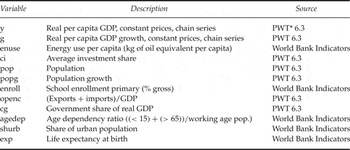
The empirical analysis includes 117 countries, which are subdivided into three income groups using gross national income (GNI) for the year 2008 as proposed by the World Bank. The high-income group includes 36 countries, the middle-income group includes 47 countries, and the low-income group includes 34 countries.Footnote 8 A detailed description of the variables and data sources is given in table 1. Data are taken from the World Bank Indicators (World Bank, 2013) and from the Penn World Table (PWT) Version 6.3. The time period ranges from 1973 to 2007. Taking five-year averages, we obtain seven observations over time.
Variables included in the analysis

Notes: *Penn World Table.
4. Empirical evidence
4.1. Estimation setting
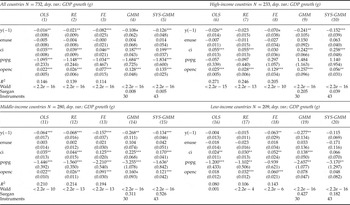
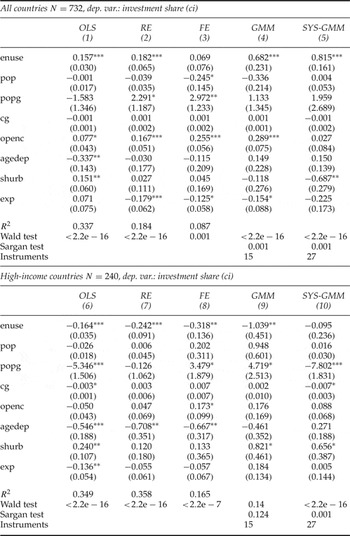
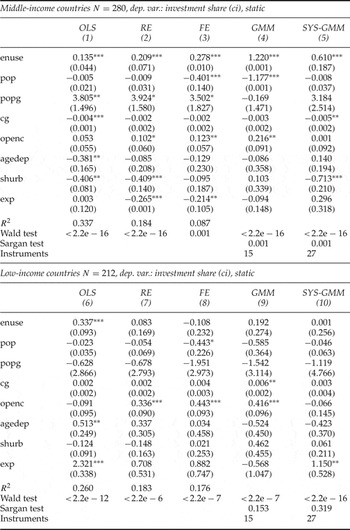
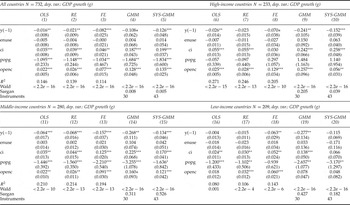
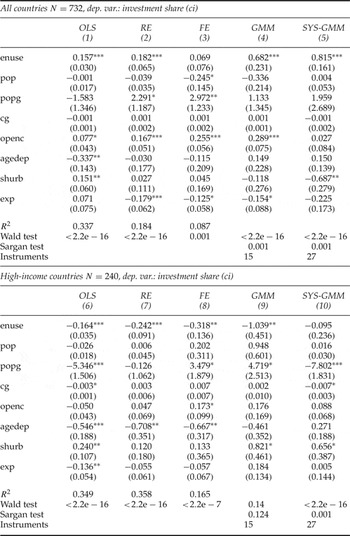
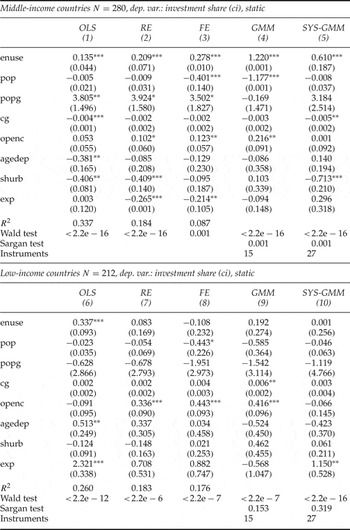
The results presented in this section cover the estimations for the growth and capital regressions. Each regression is applied to the aggregate sample of countries as well as to the three different income groups of countries in order to control for parameter differences with regard to different stages of development. Along with the GMM and SYS-GMM approach, we apply pooled OLS as well as the RE and FE estimators. The estimated coefficients and the different test results are listed in the following tables, which can be found in the appendix: table 2 shows the growth regressions for the aggregated sample as well as for each income group.Footnote 9 Tables 3 and 4 show the estimated coefficients for the capital regressions. Additional specification tests are listed in the online appendix. Table 5 presents a clearly arranged overview over all estimation results.
Growth regressions: all samples
Notes: Robust standard errors in parenthesis. ***p-value ≤ 0.01, **p-value ≤ 0.05, *p-value ≤ 0.1.
Capital regressions: all countries and high-income countries
Notes: Robust standard errors in parenthesis. ***p-value≤0.01, **p-value≤0.05, *p-value ≤ 0.1.
Capital regressions: Middle- and low-income countries
Notes: Robust standard errors in parenthesis ***p-value ≤ 0.01, **p-value ≤ 0.05, *p-value ≤ 0.1.
Summarized results

4.2. Growth regression results
Table 2 shows that, for the major part of the estimations, energy use does not affect economic growth directly, neither in the aggregated case nor for the single groups. A significant direct effect is only found using SYS-GMM for high-income countries (column (20) in table A4 of the online appendix). Thus, by applying growth regressions on different income groups of countries considering only a direct effect of energy use, we find support for the neutrality hypothesis.
For the aggregated sample, we can see in table 2 that the estimated coefficients generally correspond to their expected values from the theoretical and empirical growth literature.Footnote 10 The coefficient for lagged income levels has a negative and significant effect on GDP growth in every regression specification, indicating that, given the control variables, countries converge with respect to income. The corresponding parameters range between −0.02 and −0.13. The growth-enhancing effect of capital accumulation is reflected in the significant and positive effect of investment share for physical capital throughout most regressions. The parameters range between 0.04 and 0.2. Population growth has a significant negative effect and trade openness a significant positive effect, indicating growth advantages for more open economies. When including school enrollment rate, the results for GMM and SYS-GMM do not appear to be robust with respect to the convergence rate. The expected significant positive effect for school enrollment rate can only be found in column (15). In accordance with Hauk and Wacziarg, (Reference Hauk and Wacziarg2009), the GMM estimator tends to detect higher convergence rates than the other estimators.Footnote 11
The estimations for high-income countries also show their expected signs and magnitudes. Compared to the aggregated sample, population growth does not seem to play a relevant role at a higher stage of development. The inclusion of school enrollment rates leads to less significant coefficients, especially for the FE estimations. In contrast to the other country groups, energy use exhibits a positive and significant effect for the SYS-GMM estimator in column (20) in table A4. Convergence appears to be faster than in the aggregate case with parameters ranging between −0.02 and −0.24. Also, the positive and significant parameters for the investment share, ranging between 0.03 and 0.26, implies a higher capital share for high-income countries than for the aggregate country group which is in line with general expectations and stylized macroeconomic facts.
The results for the middle-income countries resemble the results for the aggregated country groups with population growth exhibiting a negative effect on economic growth, reflecting the burden of higher population growth in lower income countries (Heady and Hodge, Reference Heady and Hodge2009). Compared to the other samples, the results are more robust to the inclusion of the enrollment variable. The convergence parameter is smaller than for the aggregate and the high-income sample, implying faster convergence with estimated values between −0.06 and −0.27. This is related to intensive growth dynamics among middle-income countries, which include the fast-growing emerging economies. The implied capital share is in a similar range to the high-income countries.
The estimations for low-income countries tend to exhibit less significant results. However, where significance is obtained, the signs and magnitude of the coefficients reflect the expected value, especially with respect to capital accumulation and population growth. More specifically, investments in physical capital reveal a positive and significant effect for all but one model specification, with the range being smaller than for high- and middle-income countries. Similarly to the case of middle-income countries, population growth is negatively linked with economic growth. This reflects the counteracting effect of high population growth on per capita income.
In general, with the inclusion of school enrollment rate as a proxy for human capital, the explanatory power of all model results changes for the worse. As described in the data section above, the sample size has to be reduced in order to account for human capital, which might be a reason for this finding. In fact, we can see from the usual test results such as the R 2, the Wald and the Sargan statistic that the goodness and reliability of the models is notably reduced, revealing a preference for the estimation equations without school enrollment rate. Nonetheless, throughout all regressions, energy neutrality as well as the positive effect of capital accumulation is robust. The Hausman test in table A5 (online appendix) indicates an endogeneity problem for the RE estimator favoring the FE technique. Validity of the instruments for the GMM estimators cannot be rejected according to the Sargan test and the Sargan difference test in table 4. Parameter estimates do not change considerably when collapsing the number of instruments.Footnote 12
4.3. Capital regression results
With respect to energy use, the results are more revealing when interpreting the capital regressions shown in tables 3 and 4. Estimates suggest that energy use has a significant effect on capital accumulation which varies with regard to a country's stage of development.
Considering the aggregated country sample in table 3, we find that, except for the FE estimator, energy use exhibits a positive and significant effect on physical capital accumulation which implies a positive effect transmitted to the country's income growth. That is, for the aggregate sample, the present evidence supports the growth hypothesis indicating that lower energy withdraws essential inputs from capital accumulation. Trade openness is also found to significantly drive capital accumulation, which confirms the existing finding that beneficial effects of trade liberalization are partly transmitted through higher investments (Wacziarg and Welch, Reference Wacziarg and Welch2008). Further results are less robust throughout the different estimation techniques for the aggregate sample: population growth has a positive and significant effect on capital accumulation, indicating that economies that are demographically more dynamic tend to accumulate more capital. On the other hand, for the OLS specification, life expectancy exhibits a negative and significant effect on economic growth which is in line with the expected results that higher intergenerational distribution harms investment activities. The same argument also applies to the age dependency ratio, which is found to be negative and significant only for the OLS estimation.
The estimations for high-income countries in table 3 show that energy use has a negative and significant effect on capital accumulation, indicating that capital accumulation is crowded out by abundant energy use. Age dependency and life expectancy tend to have a negative effect on capital accumulation, which is more robust than in the case of the aggregate country sample. This indicates that, specifically for high-income countries with advanced social and intergenerational redistribution systems, population ageing affects investment activities negatively. GMM estimates suggest that urbanization is positively linked to investment share, whereas trade openness does not seem to play a major role for high-income countries (it is only positive and significant for the FE specification).
Energy use has a positive and significant effect for capital accumulation for middle-income countries. Other than for high-income countries, energy use seems to be an essential input for capital accumulation which, in turn, drives economic growth. This confirms the hypothesis developed in the theoretical section. Similarly to high-income countries, age dependency and especially life expectancy tend to have negative effects on capital accumulation, reflecting intergenerational redistribution which conflicts with investment activities. For middle-income countries, trade openness fosters capital accumulation, significantly highlighting the essential role of trade liberalization and globalization, not only through its direct effect on economic growth, but also for fostering investment activities.
As for growth regressions, the low-income group exhibits the least robust results. Trade openness seems to be an important driver of capital accumulation, highlighting the essential role of trade liberalization for enhancing economic growth. There is a positive and significant effect of energy use, but only for the OLS specification. Thus, we infer that energy is neutral with regard to economic growth. We find weak evidence that age dependency and life expectancy are positively and significantly related to investment for the OLS and SYS-GMM specification. In the case of low-income countries, life expectancy at birth (as an indicator of the public health system's performance) may serve as an approximation of the country's institutional quality, which explains the positive effect on investment activities. According to this, Gwartney et al. (Reference Gwartney, Holcombe and Lawson2006) highlight the importance of controlling for institutional quality and its effect on a country's investment when analyzing economic growth.
The Hansen tests generally support the validity of the instrument and, except for the middle-income countries, the Hausman test rejects the consistency of the RE model. Collapsing the number of instruments has no major effects on the estimates.Footnote 13
Together with the estimated effects of investment rates on economic growth from the former section, we can use the parameters to indicate the magnitude of these indirect effects of energy use on economic growth numerically. For high-income countries, assuming an average income growth rate of 3 per cent, a 10 per cent decrease in energy use would increase economic growth by 0.12 percentage points on average. For middle-income countries, assuming an average income growth rate of 5 per cent, a 10 per cent decrease in energy input would lead to a decrease in the growth rate of 0.96 percentage points on average.Footnote 14 , Footnote 15
4.4. Summarized results and policy implications
In this empirical analysis, we allow energy to have two possible effects on economic growth. The direct effect is represented in the growth regression. The indirect effect is identified by regressing capital accumulation on energy use, with the former also being an explanatory variable in the growth regression. Throughout all country groups, capital accumulation exhibits a positive effect on economic growth which is in line with the general finding that investment share is one of the few robust variables in cross-country growth regressions. Energy does not show any significant direct effect for most regression specifications. On the other hand, we find robust evidence that energy use influences economic growth through the capital channel. This effect is negative for high-income countries. In line with the empirical findings in Bretschger (Reference Bretschger2015), these results suggest that for the group of developed countries, a reduced energy input does not harm economic growth. Energy restrictions can even be favorable for economic growth which is driven by the reallocation of inputs towards growth-enhancing capital accumulation. In other words, a high energy use can be harmful since capital accumulation is crowded out by abundant energy use which in turn reduces economic growth. Evidence further suggests that, for middle-income countries, energy use has a positive impact on economic growth transmitted through the capital accumulation channel. In line with the stated hypotheses, with energy efficiency being typically lower in middle- and low-income countries, capital production will depend critically on energy as an input, which is reflected in a consistent positive relation between energy use and investment shares. Contrary to high-income countries, lower energy use is detrimental to economic growth in middle-income countries including the major emerging economies (Brazil, Russia, India, China and South Africa). These findings stand in contrast to earlier conclusions drawn from cross country panel time series analysis. Analyzing the direct effect of energy, Lee and Chang (Reference Lee and Chang2007), Huang et al. (Reference Huang, Hwang and Yang2008) and Ozcan (Reference Ozcan2013) find evidence for the conservation hypothesis for low- or middle-income countries, which implies that energy-reducing policies may be feasible without creating harm for economic growth. Accordingly, Ozturk et al. (Reference Ozturk, Aslan and Kalyoncu2010) do not find any evidence that energy use leads to economic growth when analyzing different income groups separately. In that sense, the present study provides crucial additional insights featuring opposing conclusions and underlining the importance of applying structural models which allow for different channels of causality when analyzing the energy–growth nexus. A possible reason for this difference is the focus of the present study on long-run economic growth. A recent study by Shahbaz et al. (Reference Shahbaz, Khan and Tahir2013) confirms the positive relationship for a single emerging country looking at Chinese data only.
No effects, direct or indirect, can be found for low-income countries, which can be interpreted as evidence for the neutrality hypothesis. However, as is generally shown by Henderson et al. (Reference Henderson, Storeygard and Weil2012), a possible reason for the missing evidence in this group might be the weak data quality and restricted data availability for lower income countries which typically dispose weak statistical capacities. In line with Zachariadis (Reference Zachariadis2007), the empirical relationships may be interpreted carefully for developing countries, which are often characterized by energy supply shortages and the use of fossil fuels (such as biomass) that are not sufficiently accounted for in official statistics. The results of the different energy–growth effects are summarized in table 5. In accordance with the theoretical considerations and stylized facts, countries at a transitional stage of development seem to rely on energy use as a necessary determinant for economic growth. Given the fact that the major part of global primary energy consumption is based on fossil fuel, this finding relates to an inverted U-shape relationship between environmental degradation and income per capita (the environmental Kuznets curve), a concept which is often found in empirical research (Smulders et al., Reference Smulders, Bretschger and Egli2011).
The empirical findings of the present study provide important insights for the design of effective environmental and energy policies. Since we do not find evidence that energy consumption harms economic growth for high-income countries and considering the externality costs of energy use, the corresponding economies will benefit from energy conservation policies. The possible positive effect of lower energy use on capital accumulation may even accelerate economic growth for this income group. Conversely, for countries in a transitional stage of development (middle-income countries), the beneficial effect of energy indicates that conservation-oriented policies may have detrimental effects on economic growth. In the light of international conservation agreements such as climate policies, compensation mechanisms from higher to lower income countries are required in order to preserve sustainable development during economic transition and to ensure an equitable burden sharing.
5. Conclusions
In this paper we empirically investigate the effect of energy use on economic growth. Unlike most previous empirical studies in this field, we focus on the long-run relationship considering a broad range of countries and applying the growth regression approach. Capital accumulation is additionally considered as a possible channel through which economic performance can indirectly be influenced by energy use. We perform the analysis for different income groups separately as we expect that the linkage among energy use and economic growth varies with regard to the stage of development. Different estimation strategies such as RE, FE and GMM approaches have been applied in order to consistently identify the effects of interest.
The estimated regressions suggest that energy does not affect economic growth directly. However, with regard to capital regressions, countries seem to vary critically in terms of indirect energy effects. For middle-income countries, an increase in energy use seems to drive capital accumulation, which is beneficial for economic growth. On the other hand, in high-income countries, energy restrictions can be favorable for economic growth because of indirect effects transmitted through capital substitution. For low-income countries, a higher energy input does not harm economic growth directly or indirectly. We show that middle-income countries which typically are in a transitional stage of economic development rely more heavily on the use of energy in production. Energy reduction is not found to be harmful either for high- or for low-income countries. Possible causes for these differences may be related to typical economic features of emerging markets such as the production structure or lower energy efficiency. Further theoretical and empirical research is required to investigate the drivers of differential energy–growth effects. Based on this analysis, we conclude that a country's stage of economic development has to be accounted for when considering the long-run consequences for economic growth caused by energy-reducing policy measures. Especially for middle-income countries, including the quintet of large emerging economies – Brazil, Russia, India, China and South Africa – conservation policies are expected to be harmful for long-run economic growth. In that sense, in order to ensure sustainable development during economic transition, appropriate mechanisms are required when implementing international-orientated energy policies.
Supplementary material and methods
To view supplementary material for this article, please visit https://doi.org/10.1017/S1355770X16000243.