The quotative system is a widely acknowledged locus of repeated linguistic innovation (Buchstaller, Reference Buchstaller2004:294, Reference Buchstaller2011:59). A case in point concerns the recent emergence of the innovative be like variant in English, characterized as one of the most dramatic grammatical changes of the last three decades (Labov, personal communication, 2000, cited in Cukor-Avila, Reference Cukor-Avila2002:21–22). A series of studies charting the spread of this variant has yielded important insights into the linguistic conditions governing its use, its ongoing grammaticalization, and the interaction between global trends and localized outcomes associated with its transnational diffusion (see, e.g., Buchstaller, Reference Buchstaller2006; Buchstaller & D'Arcy, Reference Buchstaller and D'Arcy2009; Ferrara & Bell, Reference Ferrara and Bell1995; Tagliamonte & D'Arcy, Reference Tagliamonte and D'Arcy2004, Reference Tagliamonte and D'Arcy2007; Tagliamonte & Hudson, Reference Tagliamonte and Hudson1999). Complementing the burgeoning literature on quotative variation in English is an increasing number of studies that address patterns of variation and change in the quotative systems of other languages, opening up avenues for comparative research on the emergence, grammaticalization, and diffusion of new quotative markers (see, e.g., Buchstaller & van Alphen, Reference Buchstaller and van Alphen2012; Cameron, Reference Cameron1998, Reference Cameron2000; Eriksson, Reference Eriksson1995; Foolen, Reference Foolen, Ahrenholz, Bredel, Klein, Rost-Roth and Skiba2008; Golato, Reference Golato2000; Maschler, Reference Maschler2002).
Our goal in the present study is to contribute to the cross-linguistic literature on variation and change in quotative usage by focusing on Canadian French, specifically as it is used in the bilingual city of Ottawa. Cursory inspection of the French spoken in this location reveals alternation among competing variants in spontaneous discourse:
(1) Pis tu dis, “Qu'est-ce que les gars faisaient?” (001/M/2/OTT)Footnote 1
Then you say, “What were the guys doing?”
(2) Ø “C'est une Anglaise d'Angleterre qui vit là” (002/F/2/OTT)Footnote 2
Ø “It's an English woman from England who lives there”
(3) J'étais comme, “Yeah! On s'en va pêcher! On s'en va pêcher!” (003/F/1/OTT)
I was like, “Yeah! We're going fishing! We're going fishing!”
(4) Fait que là, j'ai fait, “Ah, ça me dérange pas” (004/M/1/OTT)
So then, I went (lit. ‘did’), “Ah, that doesn't bother me”
(5) Il y avait les soldats israéliens qui étaient, “On nous a demandé de venir mais on fait rien” (005/M/1/OTT)
There were Israeli soldiers who were, “We were told to come, but we're doing nothing”
(6) Pis il était juste, “Ben je parle pas anglais- je parle pas français, achale-moi pas” (006/F/2/OTT)
Then he was just, “Well I don't speak English—I don't speak French, don't hassle me”
In addition to the generic speech verb dire, examples (1)–(6) show that reported speech or thought can be introduced by various means, including verbs of equation (être), action (faire), similarity (être comme), or indeed no overt lexical form at all (see Deutscher, Reference Deutscher, Narrog and Heine2011:650; Güldemann, Reference Güldemann2008:295). The use of a variety of markers derived from distinct lexical sources is a product of layering (Hopper, Reference Hopper, Traugott and Heine1991:23) in this grammatical subsystem, whereby older variants compete with more recently evolved ones. A seemingly new addition to the Canadian French quotative system concerns the variant être comme, exemplified in (3). The recent emergence of être comme can easily be construed as a prima facie case of contact-induced change by virtue of its superficial similarity to the English be like quotative. The presence of être comme in the French spoken in Canada's National Capital Region makes language contact a logical inference on a number of counts. First, large-scale bilingualism in this area, as well as the intensity and duration of contact between French and English, are social factors that are widely regarded to favor structural convergence in contact settings (Poplack & Levey, Reference Poplack, Levey, Auer and Schmidt2010). Second, all the quotative markers illustrated here, with the possible exception of faire ‘do’ in (4), have attested equivalents in vernacular varieties of English. Typological congruence (Thomason, Reference Thomason2001:71, Reference Thomason and Hickey2010:44–45), or interlingual equivalence sites (Backus, Reference Backus2005:326), are commonly believed to facilitate the “enhancement of inherent structural similarities found between two linguistic systems” (Bullock & Toribio, Reference Bullock and Toribio2004:91). Finally, a rapidly innovating form such as be like qualifies as an ideal candidate for what Heine and Kuteva (Reference Heine, Kuteva, Narrog and Heine2010:86) referred to as grammatical replication, acting as a possible trigger for the emergence of the French analogue être comme. Grammatical replication does not involve the direct transfer of other language material, but it engenders the creation of a new grammatical construction in one language based on a model construction in another language. Among the factors bolstering the possibility that be like is a viable model for contact-induced change is its documented 450% increase in Canadian English over a seven-year period (Tagliamonte & D'Arcy, Reference Tagliamonte and D'Arcy2004), culminating in its present status as the default quotative variant used by younger speakers.
In this study, we pursue the inference of contact-induced change by undertaking detailed quantitative analyses of quotative variation in two datasets based on recordings of native French and English speakers made in Ottawa between 2008 and 2010. We supplement the contemporary Ottawa French data with an additional corpus based on recordings made in 2011 in Hawkesbury, Ontario, to probe quotative variation in a location where French is the dominant language. Each of the contemporary French and English corpora contains an apparent-time component that can be exploited to identify and track the directionality of any changes in progress. Complying with Labov's (Reference Labov, Lehmann and Malkiel1982:218) recommendation that the best method for the study of change should be based on the description of a series of cross sections in real time, we also mine a number of diachronic datasets representing earlier varieties of Canadian French and English, respectively. Drawing on these complementary data sources, and making use of the comparative variationist framework (Poplack & Tagliamonte, Reference Poplack and Tagliamonte2001), we propose to: (i) characterize the nature of the contemporary quotative system in Canadian French; (ii) determine how this system has evolved over time in relation to the English quotative system; and (iii) ascertain whether être comme behaves in identical ways to its superficially similar counterpart be like.
In the ensuing sections, we briefly review the literature addressing quotative variation in Canadian French and the emergence of être comme. We then outline the methodological issues that need to be considered in order to make a solid case for contact-induced change. We subsequently furnish details about the data and our analytical method before presenting the results of the investigation. After examining the contribution of the results to elucidating the aims of the study, we offer our conclusions.
QUOTATIVE VARIATION IN CANADIAN FRENCH AND THE RISE OF ÊTRE COMME
There are few published quantitative studies that specifically address variation in the quotative system of Canadian French. Notable exceptions include Vincent and Dubois's (Reference Vincent, Dubois, Arnold, Blake, Davidson, Schwenter and Solomon1996) examination of two corpora of Montreal French from 1971 and 1984, and their subsequent monograph on reported speech (Vincent & Dubois, Reference Vincent and Dubois1997).
In their large-scale analysis of quotative markers used in direct speech, Vincent and Dubois (Reference Vincent and Dubois1997:87) reported that the pragmatically neutral variant dire ‘say’ accounts for 70% of the variable context; the zero or null variant makes up 20%; and the remaining 10% comprises markers that have a specific illocutionary force, such as crier ‘cry (out)’, déclarer ‘declare’. Vincent and Dubois (Reference Vincent and Dubois1997) made no mention of être comme as a quotative marker in the 1971 and 1984 Montreal corpora. The only explicit comparison they draw with English be like relates to the use of the particle style ‘style’ in a quotative function.Footnote 3 Drawing on a later corpus of Montreal French from 1995, Vincent (Reference Vincent2005) added genre ‘type, kind’ and être comme to the repertoire of markers that can be used to introduce reported speech. From what Vincent (Reference Vincent2005:205) said, être comme is circumscribed to teenage speech in the 1995 corpus, suggesting that it is a relatively recent addition to the quotative paradigm. Indeed, Vincent (Reference Vincent2005:206) wrote in connection with être comme, “we may be witnessing the first traces of a change in progress,” but she reserved judgment (owing to insufficient data) on whether it is a calque of English be like. The idea that être comme is modeled directly on English be like is pursued by Sankoff, Thibault, Nagy, Blondeau, Fonollosa, and Gagnon (Reference Sankoff, Thibault, Nagy, Blondeau, Fonollosa and Gagnon1997). Using a subset of sociolinguistic interviews recorded in Montreal between 1993 and 1994 with young native anglophones proficient in French, Sankoff et al. (Reference Sankoff, Thibault, Nagy, Blondeau, Fonollosa and Gagnon1997) demonstrated that être comme is well attested as a quotative marker in L2 speech. Sankoff et al. (Reference Sankoff, Thibault, Nagy, Blondeau, Fonollosa and Gagnon1997:205) noted the absence of être comme from L1 speech, although they pointed out that comme had been attested in native Quebec French as a discourse marker (akin to English like) since the 1930s. The apparent restriction of quotative être comme to anglophone-dominant bilinguals led Sankoff et al. (Reference Sankoff, Thibault, Nagy, Blondeau, Fonollosa and Gagnon1997:208) to hypothesize that it is the product of transfer effects rather than a reflection of the acquisition of a native construction. According to other researchers, être comme can be found in the speech of native francophones by the mid-1990s. Chevalier (Reference Chevalier2001:21, 34) discussed its occurrence in the speech of adolescents recorded in the south-east of New Brunswick and added that there are no instances of its use by speakers over 40 years old.
Summarizing, the handful of studies that make any reference to quotative être comme cite no evidence indicating that it was in use in Canadian French before the early 1990s. We should additionally mention at this juncture that a firm temporal baseline for the introduction of be like into Canadian English is also lacking, although it is generally assumed that this innovation originated in American English in the early 1980s (Butters, Reference Butters1982), and subsequently began to diffuse outward from an American epicenter by the early 1990s (Buchstaller & D'Arcy, Reference Buchstaller and D'Arcy2009:292). We return to the time depth of these innovations in Canada in the results section.
At the time of writing, the only detailed variationist analysis of être comme in a contemporary variety of Canadian French is reported in Dion and Poplack's (Reference Dion and Poplack2005) study of language contact in Quebec. Particularly innovative in this study is the comparison of the linguistic conditioning of be like and être comme, affording a detailed perspective on underlying structural differences between the variable grammars that host these innovations. As a first observation, Dion and Poplack (Reference Dion and Poplack2005) remarked that être comme is used less often by young francophones in comparison with their English counterparts, leading them to surmise that the incursion of être comme into the French quotative system postdates the rise of be like in Canadian English. Inspection of the underlying grammars of both languages reveals a number of structural parallels in the linguistic conditioning of être comme and be like (e.g., grammatical person and content of the quote) but also uncovers different patterning in relation to the tense/aspect distinctions typically encoded by these variants. Whereas Dion and Poplack (Reference Dion and Poplack2005) found be like to be favored with the present tense, they report that être comme preferentially occurs with the imperfect. The existence of this “conflict site” (Poplack & Meechan, Reference Poplack and Meechan1998) is construed by Dion and Poplack (Reference Dion and Poplack2005) as evidence militating against the idea that être comme is a wholesale replication of its English counterpart. An important caveat to emerge from this study is that surface similarity of form does not necessarily equate with similarity of (underlying) structure. In the following section, we explore the ramifications of this caveat with regard to the elaboration of an empirically accountable method capable of detecting contact-induced change.
ESTABLISHING CONTACT-INDUCED CHANGE
A recurrent assumption in much of the literature on bilingualism is that language contact almost always precipitates language change (Appel & Muysken, Reference Appel and Muysken1987:154; Bynon, Reference Bynon1977:240; Harris & Campbell, Reference Harris and Campbell1995:149; Hickey, Reference Hickey and Hickey2010:7; Siemund, Reference Siemund, Siemund and Kintana2008:3). Although this viewpoint enjoys widespread acceptance by many researchers, others have pointed to the dangers of hastily inferring contact-induced change without considering the alternative possibility of internal motivations for the emergence of a putatively novel feature in a contact variety (Mougeon, Nadasdi, & Rehner, Reference Mougeon, Nadasdi and Rehner2005; Poplack & Levey, Reference Poplack, Levey, Auer and Schmidt2010).
A key issue in the establishment of contact-induced change concerns the conditions that need to be met in order to reliably ascertain whether structural similarities between languages are bona fide products of convergence. According to Hickey (Reference Hickey and Hickey2010:153), if a structure in one language is believed to have arisen through contact with another, then a solid case for contact can be made if there is a good structural correspondence between both languages. But this kind of pattern-matching exercise raises the crucial question of which criteria (e.g., form, underlying structural constraints on usage, or some combination thereof) should be invoked to bolster the case for a good structural match. As we have noted, reliance on formal correspondences alone can be misleading in the absence of detailed information about the structure of the underlying variable grammars in which variants are embedded.
Observing that linguistically watertight criteria for ratifying contact-induced change are elusive, Thomason (Reference Thomason and Hickey2010:32) claimed, “contact is a source of linguistic change if it is less likely that a particular change would have happened outside a specific contact situation.” If we examine être comme in the light of this claim, then we find that the case for contact as the primary source of this variant is weakened by the propensity of markers similar to être comme (and be like) to be recruited cross-linguistically as quotatives (Buchstaller & van Alphen, Reference Buchstaller and van Alphen2012; Foolen, Reference Foolen, Ahrenholz, Bredel, Klein, Rost-Roth and Skiba2008; Güldemann, Reference Güldemann2008; Heine & Kuteva, Reference Heine and Kuteva2002:274–275), as illustrated in (7) to (10).
(7) Finnish niinku ‘like’: Ja sit mä olin niinku, “Että herrajjumala et voi olla totta”
And then I was like, “Oh my God, I can't believe it.” (Fleischmann, Reference Fleischman1999)
(8) Hebrew kaze ‘like (this)’: hu pit'om ‘omer li kaze, “Eh . . . titxatní ‘itì?”
He suddenly says to me like, “Uh, will you marry me?” (Maschler, Reference Maschler2001:315)
(9) Norwegian liksom ‘like’: og han er liksom “Å vi må bastille togbillett” og er helt hyper.
And he is like, “Oh we must order our train tickets” and is totally hyper. (Hasund, Opsahl, & Svennevig, Reference Hasund, Opsahl, Svennevig, Buchstaller and van Alphen2012:51)
(10) (Brazilian) Portuguese tipo assim ‘type like this’: Então tipo assim, “Ok, sim senhor, vou assinar aqui agora”
Then like, “Ok, yes sir, I'm going to sign here now” (Levey, Groulx, & Cuervo, unpublished manuscript)
Cross-linguistic evidence suggests that a range of typologically related and unrelated languages have innovated quotative markers drawing on lexical items that denote similarity, comparison, and approximation (Buchstaller & van Alphen, Reference Buchstaller and van Alphen2012:xiv; Meyerhoff & Niedzielski, Reference Meyerhoff, Niedzielski and Pearson1998). Thus, in the light of examples (7)–(10), and others like them, we cannot rule out the possibility that the emergence of être comme in Canadian French is an independent system-internal development.
In attempting to differentiate externally motivated developments from internally motivated ones, researchers have formulated a number of stringent criteria that need to be satisfied in order to determine what has changed in the grammar of a contact variety and to corroborate the presumed source of change. Poplack, Zentz, and Dion (Reference Poplack, Zentz and Dion2012:204) adumbrated a number of prerequisites that need to be met in order to ratify contact-induced change. These preconditions require that:
1. a candidate feature is in fact a change;
2. the feature was not present in a precontact variety;
3. the feature is not present in a contemporaneous noncontact variety;
4. the feature behaves in the same way as its counterpart in the source variety; and
5. the feature differs in nontrivial ways from superficially similar constructions in the host variety
In combination with the framework of variationist sociolinguistics, we use these criteria as our methodological foundation for comparing the quotative systems of Canadian French and English and for ascertaining whether être comme is the product of contact with English be like.
DATA AND METHOD
Corpora
The primary evidence that we examine in this study comes from two synchronic corpora of Canadian French and English. Both corpora are based on digital recordings of native speakers made between 2008 and 2010. The sample constitution of each corpus is shown in Tables 1 and 2.
Sample constitution: Ottawa French Corpus (2008–2010)

Sample constitution: Ottawa English Corpus (2008–2010)

All speakers belonging to these corpora were recorded in Ottawa, where English is the majority language and French the minority language. An additional dataset of contemporary Canadian French is represented by a small corpus of vernacular speech collected in 2011 in the small town of Hawkesbury (population 10,510), situated some 55 miles to the east of Ottawa. The sample constitution of this corpus is shown in Table 3. Hawkesbury is predominantly francophone, with 76% mother-tongue claimants (Statistics Canada, 2006).Footnote 4 We use this corpus to compare quotative variation in French as a majority language in Hawkesbury with its minority status in Ottawa. If minority language status is a key predictor of contact-induced change (as is widely assumed in the literature), then our assumption is that any manifestations of contact in the quotative system should be particularly salient in the case of Ottawa French.
Sample constitution: Hawkesbury Corpus (2011)

As a diachronic control supplementing the apparent-time components of each contemporary corpus, we make use of a number of historical corpora offering real-time cross sections of the quotative systems of Canadian French and English, respectively. For French, this includes a subsample from the Ottawa-Hull Corpus of 23 speakers (Table 4) born between 1893 and 1965 (Poplack, Reference Poplack, Fasold and Schiffrin1989). Based on sociolinguistic interviews conducted with speakers in the early 1980s, this subsample enables us to identify and track major developments in the evolution of the French quotative system in the 20th century.
Sample constitution: Ottawa-Hull Subcorpus

We additionally analyze 20 speakers (Table 5) born between 1846 and 1895 belonging to the Récits du français québécois d'autrefois (Poplack & St. Amand, Reference Poplack and St-Amand2007). This corpus, based on the speech of insular rural inhabitants recorded in French Canada by folklorists in the 1940s and 1950s, contains a wealth of folktales, local legends, and interview data. Crucially, for the purposes of our analysis, these speakers knew little or no English (see Poplack & St. Amand, Reference Poplack and St-Amand2007, for further details). Therefore, this subsample represents a precontact variety of Quebec French and extends the time depth of the investigation to the late 19th century.
Sample constitution: Récits du français québécois d'autrefois Subcorpus

The real-time benchmarks for Canadian English are derived from two sources. The first source (Table 6)Footnote 5 comes from a series of sociolinguistic interviews conducted with 23 university students in Ottawa 1995 (Tagliamonte & Hudson, Reference Tagliamonte and Hudson1999), providing a window on the quotative system used by Canadian youth at the close of the 20th century. This is supplemented by a small corpus (Table 7) based on 14 speakers recorded in Ottawa in 1982 and born between the end of the 19th century and the 1970s. In conjunction with the synchronic datasets, these diachronic corpora furnish a longitudinal time frame, allowing the ascent of be like to be tracked in the same location (Ottawa) over the past three decades.
Sample constitution: Ottawa English Corpus 1995

Sample constitution: Ottawa-Hull Spoken Language Archives 1982

Coding the data
We adopt a broad, functional definition of the variable context, encompassing “all strategies used to introduce reported speech, sounds, gesture and thought by self or other” (Buchstaller, Reference Buchstaller2006:5).Footnote 6 Following standard variationist procedures, we exclude a number of ineligible contexts. These include incomplete or anomalous utterances (11), quotatives introducing indirect speech (12), multiple quotatives (13), quotatives introducing excerpts of written language (14), and ambiguous contexts involving the use of a zero quotative before a code-switch, where it is not clear whether the zero quotative should be classified as belonging to either the French or English quotative system (15).Footnote 7
(11) Pis j'ai dit, “Ah j'ai…” (012/M/2/OTT)
Then I said, “Ah I've . . .”
(12) I remember trying to tell him that this was not the appropriate time (001/F/1/OEC)Footnote 8
(13) I told him I'm like, “You know what Greg, listen up . . . ” (013/F/1/OEC)
(14) On est allé placer des pancartes pour dire, “Terrain privé” (008/M/2/OTT)
We went to place notices saying, “Private land”
(15) Elle se fait mordre par un chien Ø “I don't wanna be a dog groomer” (009/F/1/OTT)
She gets bitten by a dog Ø “I don't wanna be a dog groomer”
Following these exclusions, we retained 4115 tokens for analysis. Each token was coded for a variety of factors hypothesized to affect variant selection.Footnote 9 Each of these factors has previously been invoked in the literature with regard to the choice of one or another quotative marker. We briefly review these, focusing in particular on their pertinence to be like and être comme.
Each occurrence of a quotative marker was initially coded with respect to variant type, as well as the age and sex of the speaker who produced it. Previous studies of quotative be like have found it to be largely circumscribed to speakers younger than 40 years (Tagliamonte & D'Arcy, Reference Tagliamonte and D'Arcy2007:205). We take this finding as our basis for categorizing speakers as young (<40 years) and old (>40 years), and we hypothesize that, as a recent change, être comme should exhibit an age-related distribution similar to be like. Sex-differentiated patterns of quotative variation are less consistent across varieties: Tagliamonte and D'Arcy (Reference Tagliamonte and D'Arcy2004, Reference Tagliamonte and D'Arcy2007, Reference Tagliamonte and D'Arcy2009) reported a female lead for be like in Canadian English, whereas researchers investigating other varieties have observed that this variant is preferred by males (Blyth, Recktenwald, & Wang, Reference Blyth, Recktenwald and Wang1990; Dailey-O'Cain, Reference Dailey-O'Cain2000). Drawing on empirical generalizations about the role of speaker sex in language change, we predict that if être comme is an authentic change in progress, and one that is below the level of conscious awareness, then women will be in the vanguard of change (Labov, Reference Labov2001:292).
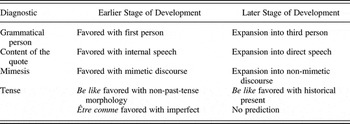
A number of linguistic factors are widely considered to affect the choice of quotative variant, as well as being implicated in grammaticalization. Along with other sociolinguists (e.g., Ferrara & Bell, Reference Ferrara and Bell1995; Tagliamonte & D'Arcy, Reference Tagliamonte and D'Arcy2004), we argue that a major manifestation of grammaticalization is the extended or generalized use of a construction in new contexts. To track the trajectory of a grammaticalizing construction, a number of structural diagnostics can be operationalized. Grammatical person is a case in point: be like is typically favored with first-person subjects and dispreferred with third-person subjects (Buchstaller & D'Arcy, Reference Buchstaller and D'Arcy2009; Durham, Haddican, Zweig, Johnson, Baker, Cockeram, Danks, & Tyler, Reference Durham, Haddican Bill, Eytan, Daniel, Baker, Cockeram, Danks and Tyler2012; Tagliamonte & D'Arcy, Reference Tagliamonte and D'Arcy2004, Reference Tagliamonte and D'Arcy2007; Tagliamonte & Hudson, Reference Tagliamonte and Hudson1999). Any significant association of be like/être comme with third-person subjects can be used as a measure of advancement along the cline of grammaticalization (Ferrara & Bell, Reference Ferrara and Bell1995). We accordingly distinguish quotatives that occur with first-person subjects (16) from those that occur with third-person subjects (17).
(16) Pis moi j'étais comme, “Oh shit, tu sais, j'ai de l'école” (005/M/1/OTT)
Then I was like, “Oh shit, you know, I've got school”
(17) Pis il est comme, “Ben . . . on sautait sur Nathan” (008/M/2/OTT)
Then he's like, “Well . . . we were jumping on Nathan”
This diagnostic, along with others described here, provisionally allows us to address the issue of whether être comme is a case of “replica grammaticalization” (Heine & Kuteva, Reference Heine and Kuteva2005), according to which a grammaticalizing feature in a contact variety follows the same grammaticalization path as a counterpart feature in the putatively influencing language. If grammaticalizing forms deriving from the same source material follow a similar pathway of change (Brinton & Traugott, Reference Brinton and Traugott2005), then evidence of parallel trajectories should be manifest in their linguistic conditioning.
Content of the quote is another major factor determining the choice of quotative marker and is also associated with ongoing grammaticalization. A defining feature of quotative be like is its use to represent internal monologue (Buchstaller & D'Arcy, Reference Buchstaller and D'Arcy2009; Tagliamonte & D'Arcy, Reference Tagliamonte and D'Arcy2004, Reference Tagliamonte and D'Arcy2007; Tagliamonte & Hudson, Reference Tagliamonte and Hudson1999). In spite of its reported strength across varieties, some weakening of this constraint has been detected. Durham et al. (Reference Durham, Haddican Bill, Eytan, Daniel, Baker, Cockeram, Danks and Tyler2012) observed an association between internal monologue and the use of be like in British English, but they added that this association is not statistically significant in their data. Tagliamonte and D'Arcy (Reference Tagliamonte and D'Arcy2004:504) noted a reversal of the expected effect in the speech of 17- to 19-year-old Canadian teenagers, with these speakers favoring be like with reported speech rather than internal monologue. The expansion of be like/être comme into contexts associated with reported speech is a potential measure of grammaticalization. To capture the relevant distinctions in this factor group, we coded each token according to whether it introduces reported speech (18) or internal monologue (19).Footnote 10
(18) a. I was like, “Mom I can't do it” (019/F/1/OEC)
b. and she's like “Ok sweetie, it's ok, I'll go, I'll go talk to him” (019/F/1/OEC)
(19) Moi je suis comme, “Ben moi je suis malade là” (014/F/1/OTT)
I'm like, “Well, I'm ill”
Mimesis is also heavily implicated in variant choice (Buchstaller & D'Arcy, Reference Buchstaller and D'Arcy2009), although to the best of our knowledge, its effects remain undocumented in the quotative systems of Canadian French and English. By mimesis, we refer to a speaker's use of suprasegmental phonology, sound symbolism, and representational gestures to dramatize quotations (Güldemann, Reference Güldemann2008:276). Empirical confirmation of the relationship between mimesis and be like can be found in Buchstaller and D'Arcy's (Reference Buchstaller and D'Arcy2009) analysis of three national varieties in which this association exhibits consistent and statistically significant effects. To operationalize the notion of mimesis, we distinguish quotes that contain mimetic effects (i.e., dramatic re-enactments characterized by modulations in voice, accent, and sound effects), as in (20), from those which do not, as in (21).Footnote 11
(20) we were going to do it on the Holocaust but then we were like “HOLY FUCK, that's way too, you know, intense to get into” (019/F/1/OEC)Footnote 12
(21) il est comme, “Ah ben, comment ça, elle a vu des photos ou quelque chose?” (014/F/1/OTT)
he's like, “Ah well, how's that, did she see some photos or something?”
We hypothesize that over time a quotative that typically encodes mimetic effects may come to be increasingly used to introduce nonmimetic discourse (see Güldemann, Reference Güldemann2008:373). This hypothesis furnishes an additional testable measure that can be used to compare be like and être comme.
The final factor group that we consider concerns the temporal reference of the quotative. Temporal reference has been found to be one of the most powerful predictors of variant choice, although it does not exhibit uniform effects across varieties (Buchstaller & D'Arcy, Reference Buchstaller and D'Arcy2009:308) and, as such, offers weaker predictions in relation to grammaticalization. In Canadian English, Tagliamonte and D'Arcy (Reference Tagliamonte and D'Arcy2007:209) claimed that the effect of temporal reference on the selection of be like is such that it is initially associated with the use of non-past-tense morphology by speakers above the age of 30 years, but it shows a marked preference for the historical present in the case of younger speakers. To detect the presence of similar effects in our own data, we distinguish between quotatives encoded with non-past-tense morphology used with past temporal reference (i.e., the historical present), as in (22); quotatives encoded with non-past-tense morphology used with present temporal reference (23); and quotatives encoded with past-tense morphology that have past temporal reference (24). We also distinguish other tense/aspect forms such as the present perfect, as in (25), as well as the imperfect, as in (26). Extrapolating from the results of earlier research examining the influence of temporal reference on the selection of be like and être comme (Dion & Poplack, Reference Dion and Poplack2005), we expect that these variants will pattern differently in terms of their co-occurrence with preferred tense-aspect forms.
(22) I confronted her about it but then she's like, “Yeah it's true and I'm sorry” so we ended up working stuff out pretty well (002/F/1/OEC)
(23) because when I do react, people are like “Oohh I can do my neck” (010/F/1/OEC)
(24) I was like, “I've never been drunk. I've had you know beers with you guys and everything and I just haven't been drunk” (012/M/1/OEC)
(25) J'ai dit, “Je viens juste de finir” (002/M/2/OTT)Footnote 13
I said, “I've just finished”
(26) Pis là elle était comme, “T'es tu sérieuse?” (017/F/1/OTT)
Then she was like, “Are you serious?”
A summary of the linguistic hypotheses that we are testing, and their relationship to grammaticalization, is provided in Table 8.
Summary of linguistic hypotheses and their relationship to the grammaticalization of be like/être comme

Source: Adapted from Tagliamonte and D'Arcy (Reference Tagliamonte and D'Arcy2004:503, Reference Tagliamonte and D'Arcy2007:209).
RESULTS
Distributional analysis of the synchronic data
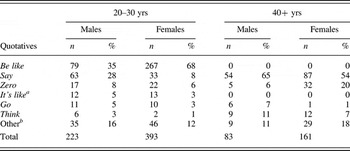
Before we compare the social and linguistic constraints on be like and être comme, we first present an overview of the distribution of variants in the synchronic datasets. Table 9 presents a breakdown by speaker age and sex of the major quotative variants in the Ottawa English Corpus.
Distribution of quotative variants in the Ottawa English Corpus (2008–2010) by age and sex

aWe classify quotative be like/être comme with nonreferential “it”/“ce” (i.e., it's like/c'est comme) separately from other occurrences of be like/être comme on the grounds that this variant is almost categorically used in English and French with internal thought (see also Buchstaller & D'Arcy, Reference Buchstaller and D'Arcy2009:302; Tagliamonte & D'Arcy, Reference Tagliamonte and D'Arcy2004:504) and appears to be specializing as a collocation indexing an internal response to an event, action, or utterance (Fox & Robles, Reference Fox and Robles2010:716). This variant is excluded from the multivariate and dummy interaction analyses of be like/être comme reported in Tables 12 and 13.
bIncludes tell, realize, yell, and decide.
Table 9 shows clearly that be like accounts for the bulk of the quotatives used by speakers between 20 and 30 years of age. In the quotative system of younger females, be like is the predominant variant, unrivalled by any other. By contrast, the generic speech verb say maintains a secure foothold in the quotative system of younger males. These speakers also make use of a more extensive range of variants such as ask, announce, tell, subsumed under the category of “other.” For both younger males and females, go and think are minor contenders in the quotative system.
The status of be like as an under-40s phenomenon is confirmed by its absence from the vernacular of older speakers. In comparison with the younger speakers, the quotative system used by speakers over 40 years old is relatively uniform, although we note some sex asymmetry in rates of variant occurrence (e.g., the zero variant).
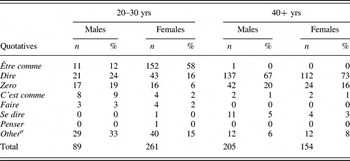
We next consider quotative variation in the synchronic French data. Table 10 shows the breakdown by age and sex of major quotative variants in the Ottawa French Corpus. A first important finding is that in the aggregated data for the 20- to 30-year-olds, être comme is the lead variant, although its overall rate (47%) is somewhat lower than be like (56%) in the Ottawa English Corpus.
Distribution of quotative variants in the Ottawa French Corpus (2008–2010) by age and sex

aIncludes raconter ‘tell’, être de même ‘be like’, demander ‘ask’, venir ‘come’, and réaliser comme ‘realize like’.
As with be like, women are in the vanguard in relation to the use of être comme, with men lagging much further behind. Comparison of the two age cohorts also confirms that être comme is almost categorically restricted to speakers younger than age 40. We interpret these findings as a preliminary indication that être comme and be like exhibit compelling parallels in terms of their social embedding. When we compare the older French speakers with their age-matched English counterparts, we find a similar (if not greater) degree of uniformity in quotative usage, with dire ‘say’ and zero accounting for the lion's share of the variable context.
Further inspection of the French quotative system reveals the presence of variants such as faire ‘do/make’ that have no direct equivalents in the English quotative system. Likewise, the use of quotative go, a minority variant in the Ottawa English data, is not replicated to any appreciable extent in the French corpus. There is only one such occurrence in the entire Ottawa French Corpus.Footnote 14 We also observe that other variants with direct counterparts in both quotative systems occur at very different rates. For example, penser ‘think’ is almost nonexistent in the French corpus, whereas think, though not frequent, is comparatively more robust in the English dataset.
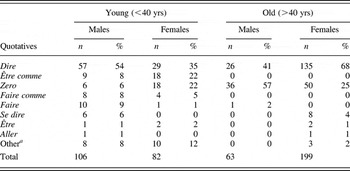
We next extend the analysis by considering data from the Hawkesbury Corpus, enabling us to explore patterns of variation and change in a locale where French is the majority language. As shown in Table 11, we see that être comme is absent from the older generation and is restricted to speakers under 40 years of age. The older speakers rely overwhelmingly on dire ‘say’ and zero, just like their francophone counterparts in Ottawa. In the aggregated data, for younger speakers, dire ‘say’ is the lead variant (46%), with être comme ranked second (14%), marginally ahead of zero (13%).
Distribution of quotative variants in the Hawkesbury Corpus (2011) by age and sex

aIncludes décider ‘decide’, crier (comme) ‘shout out (like)’, genre ‘kind, like’, and demander ‘ask’.
The overall rate of use of être comme is markedly lower than in the Ottawa data, but in terms of its social distribution, there is still a familiar sex-differentiated pattern, with females' rate of use clearly exceeding that of males. The fact that young Hawkesbury speakers lag behind their contemporaries in Ottawa in their use of être comme would seem, at first sight, to be compatible with a contact-induced explanation given that exposure to English (and, by extension, be like) is liable to be greater in Ottawa, where English is the majority and French the minority language. Alternatively, if être comme is an internally motivated development, then its proportionally lower rate of occurrence in Hawkesbury may be a product of the spatially discontinuous propagation of linguistic change, which typically affects larger urban centers before diffusing to smaller settlements (Trudgill, Reference Trudgill1974). Thus, the rate differential between Ottawa and Hawkesbury may simply be the result of the later spread of être comme to Hawkesbury owing to its smaller population size.
Summarizing, the findings of this initial comparison reveal that in spite of a number of superficial parallels between the quotative systems of French and English, these systems are by no means identical to one another in terms of both their inventory and frequency of forms.
Distributional analysis of the diachronic data
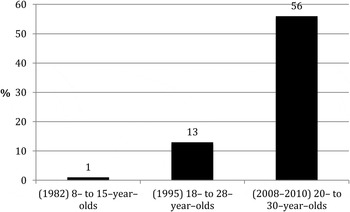
As a next step, we can refine the analysis by supplementing the apparent-time perspective with a real-time one. Because be like and être comme are reported to be recent changes, it is important to compare their diachronic trajectories in order to ascertain whether these changes are temporally coterminous with one other (Sankoff, Reference Sankoff1994:312). We first consider the diachronic evolution of be like in Ottawa English. Figure 1 graphically depicts the proportion of quotatives represented by be like in three corpora of Ottawa English spanning a 28-year period. In the 1982 data from preadolescents and teenagers, there are only two instances of quotative be like, both produced by the same 11-year-old female speaker. These are reproduced in (27) and (28).
(27) Yeah. Because sometimes when I talk to my mom, I talk in French to her sometimes, and then my mom's like, “What did you say?” (laughter) (011/F/1/OHSLA)
(28) I woke up and I was like, “Whoa, whoa, what happened?” (011/F/1/OHSLA)
The scarcity of be like in this corpus suggests that its incursion into Ottawa English was incipient in the early 1980s, at least in the age range represented by this dataset. By 1995, it had secured a foothold in the quotative system of Ottawa youth, and between 1995 and 2008–2010, it experienced a precipitous increase (see also Tagliamonte & D'Arcy, Reference Tagliamonte and D'Arcy2004).
Proportion of be like in three corpora of Ottawa English (1982–2010).

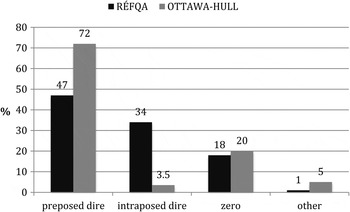
Turning to the quotative system in earlier varieties of French, we compare the distribution of quotative variants in the subsamples of the Récits du français québécois d'autrefois and the Ottawa-Hull Corpus. Figure 2 depicts the results of this comparison.
Distribution of quotative markers in the Récits du français québécois d'autrefois (RÉFQA) and the Ottawa-Hull Corpus.

In Figure 2, we distinguish preposed dire, which introduces a quote, as in (29), from multiple iterations of dire within the same reported extract. We refer to the latter strategy, illustrated in (30), as intraposed dire.
(29) Elle dit, “C'est de ta faute ça”. L'autre dit, “Non, c'est toi qui as commencé.” (RFQ/021:88)
She says, “That's your fault.” The other person says, “No, you started [it].”
(30) vingt-six en—vingt-six enfants. “Ah! bien, elle dit, le vingt-sixième enfant, elle dit, je vas le donner à monsieur le curé, elle dit, quand, elle dit, on a vingt- vingt-six minous, elle dit, faut bien lui en donner, bien, elle dit, le vingt-sixième enfant, ça va être lui qui va appartenir.” (RFQ/022:5)
twenty-six ch—twenty-six children. “Ah!, well, she says, the twenty-sixth child, she says, I'll give to the parish priest, she says, when, she says, you've got twenty- twenty-six little darlings, she says, you really have to give some of them to him, well, she says, the twenty-sixth child will belong to him”
At first glance, intraposed dire appears to be an instantiation of an “intraquote,” a distinct quotation strategy found in a number of languages (Güldemann, Reference Güldemann2008:197–198). But closer inspection of (30) suggests that the first instance of dire may encode a quotative function, but its successive, redundant iterations hint at semantic bleaching, suggesting that such uses could have a discourse marking function associated with reported evidentiality (see Li, Reference Li and Coulmas1986:35; Vincent & Dubois, Reference Vincent and Dubois1997:102). This possibility is strengthened by the fact that verba dicendi are a frequent source of evidentiality markers cross-linguistically (Aikhenvald, Reference Aikhenvald, Narrog and Heine2011:607).
Three basic quotation types—preposed dire, intraposed dire, and zero—account for the bulk of the variable context in the Récits du français québécois d'autrefois. A similar state of affairs obtains in the subsample of the Ottawa-Hull Corpus, although the frequency of intraposed dire is severely reduced in comparison with its prevalence in the Récits du français québécois d'autrefois. The proportion of quotatives represented by the zero variant remains consistent across the two corpora. The quantitative preponderance of dire and zero in the Ottawa-Hull Corpus is highly reminiscent of variant usage by older speakers in the synchronic (2008–2010) Ottawa French dataset examined here (see Table 10), suggesting that these speakers have essentially preserved a quotative system that was characteristic of Ottawa French some three decades earlier. There are no occurrences of être comme in the Ottawa-Hull subsample, but low-level variants such as dire comme ‘say like’ and être de même ‘be like’ are harbingers of future developments in the system.
What can we infer from this brief diachronic survey? The moment at which be like/être comme were innovated in Ottawa English and French remains unobservable, but the available evidence suggests that be like began to emerge in Ottawa some time during the early 1980s, with être comme surfacing later in French. Indeed, as we observed in our earlier synthesis of the literature on quotative variation in Canadian French, there are no published studies of which we are aware that document the presence of être comme in this variety before the last decade of the 20th century.
We conclude this section by emphasizing that rates of variant occurrence cannot be used to ascertain whether a linguistic change is the product of contact. This issue can only be adequately addressed by contextualizing forms in the larger systems to which they belong and by effecting a detailed comparison of the variable grammar of the host language with that of the presumed source language. In the ensuing section, we undertake such a comparison.
Comparison of underlying constraints governing the selection of be like and être comme
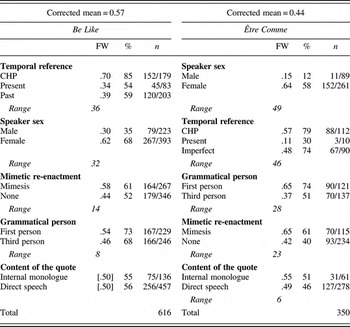
Table 12 shows the results of two independent multivariate analyses of the factors contributing to the selection of be like and être comme in Ottawa English and French for speakers under the age of 40. As a first observation, we can see that all of the factor groups selected as significant in English are also significant in French. In English, only one factor group, content of the quote, fails to achieve statistical significance as a result of the neutralization of the distinction between internal monologue and reported speech. The absence of a statistically significant effect dovetails with recent reports in the literature pointing to the attenuation of the content of the quote constraint in Canadian English (Tagliamonte & D'Arcy, Reference Tagliamonte and D'Arcy2004:504, Reference Tagliamonte and D'Arcy2007:206). Although selected as significant in French, this factor group contributes the weakest effect (as assessed by the range value) to the selection of être comme. Notwithstanding this parallel, we see that the ordering of significant factor groups in terms of their relative magnitude of effect is different in both languages. Tense is the strongest predictor of variant choice in English, with the conversational historical present clearly favoring the use of be like. By contrast, in French, it is speaker sex that makes the greatest contribution to the selection of être comme. Within this factor group, there is a salient asymmetrical effect with females favoring and males highly disfavoring être comme. The strong male aversion to être comme in these data suggests that males may be resisting a female-dominated change (see Labov, Reference Labov1994:308). A similar split is apparent in the English data, where a strong female lead is also evident.
Two independent multivariate analyses of the factors contributing to the selection of be like and être comme in Ottawa English and French, respectively

Note: CHP = conversational historical present.
Mimesis and grammatical person are also differently ranked in English and French, although in both languages the direction of the effect is the same. In the English data, grammatical person contributes the weakest significant effect to the choice of be like. By contrast, this effect is relatively robust in French. Another difference concerns the presence of factors within factor groups that are not shared by both languages. The key area of structural divergence involves temporal reference. The past in English corresponds to the present perfect in spoken French, but the latter never occurs with être comme in the Ottawa corpus, although it is used with other quotative markers such as dire ‘say’. Likewise, the imperfect in French has no direct parallel in the English data. Contrary to Dion and Poplack (Reference Dion and Poplack2005), the imperfect has a relatively neutral effect on the selection of être comme in Ottawa French. As in English, this quotative is favored with the historical present.
Using the diagnostics that we operationalized in Table 8, we can now offer a preliminary assessment of how be like and être comme compare in terms of grammaticalization by inspecting the variable constraints on their contemporary grammatical distribution (Poplack & Tagliamonte, Reference Poplack and Tagliamonte2001). In comparison with the attenuation of the “classic” constraints of content of the quote and grammatical person in the English data, we might conclude that être comme has not progressed as far along the same grammaticalization pathway as be like has. Nevertheless, the comparatively weak contribution of content of the quote in French suggests that it could be following the same trajectory as it has in English. On the other hand, there is no evidence that grammatical person is weakening in French. The effect of mimesis appears relatively stable in both languages. With regard to temporal reference, the strong association of be like with the conversational historical present can be interpreted as a measure of its advanced grammaticalization in Ottawa English. We made no specific prediction with regard to the relationship between temporal patterning and grammaticalization in French, but the association of être comme with the conversational historical present points to structural congruence with English in an area of the grammar where previous research has detected divergence (Dion & Poplack, Reference Dion and Poplack2005).
Summarizing, in spite of any superficial parallels between French and English that we have detected, we cannot reliably conclude that être comme has followed a course of change similar to that of be like. The validity of such an inference would be mitigated by our current lack of access to suitable diachronic data that would enable us to track the grammaticalization of être comme over time. Absent any systematic comparison with a precursor variety of Ottawa French instantiating être comme, we cannot confidently reconstruct trajectories of grammaticalization on the basis of synchronic data alone (Poplack, Reference Poplack, Narrog and Heine2011).
This brings us back to the central question that has preoccupied us throughout this paper: To what extent is être comme the product of contact-induced change? Our comparative analysis has revealed that: (i) not all factor groups are significant in both languages; (ii) the ordering of significant factor groups is different; and (iii) the factors within factor groups are not always identical (see temporal reference). In the gradient model of contact-induced change adumbrated by Meyerhoff (Reference Meyerhoff2009), not only would these results rule out être comme as a case of wholesale replication or calquing, they would additionally render it ineligible as an instance of either strong or weak transfer on account of differences between French and English in the hierarchy of significant effects, and the noncongruence of the linguistic conditioning.
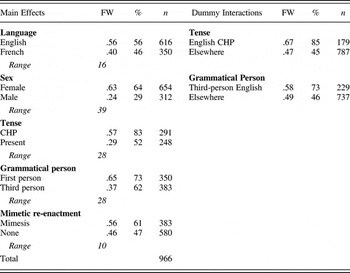
To examine whether underlying dissimilarities constitute significant differences between the two languages, we hone the comparative component of the investigation by combining the French and English data into a dummy-interaction analysis and creating a factor group for each language (see Buchstaller & D'Arcy, Reference Buchstaller and D'Arcy2009; Paolillo, Reference Paolillo2002). Significant factor groups, or main effects, identified in the original multivariate analyses of the data (see Table 12) are also included in the dummy-interaction analysis. We omit content of the quote, as it is not significant in English, and exclude past (English) and imperfect (French) from the temporal reference factor group as these do not appear in this factor group for both languages. For each distinct combination of factors, a dummy-interaction factor group is created. Abstracting away from the technical details of this procedure (for which see Paolillo, Reference Paolillo2002:66–71), we can say that if a main effect for a constraint is selected as significant (e.g., grammatical person), as well as the dummy-interaction factor group for the constraint in question (e.g., for grammatical person, first or third person in English or French), then we may infer that there is a significant difference between English and French with respect to that particular constraint. This allows us to pinpoint significant contrasts between the two languages in the sociolinguistic conditioning of être comme and be like.
Table 13 presents the results of such an analysis and confirms that both languages share four significant constraints on être comme/be like. The fact that no significant interaction with English or French is shown for either speaker sex or mimesis indicates that these constraints operate similarly in both languages. In the dummy-interaction analysis, only tense and grammatical person significantly differentiate English from French. The correlation of be like with the conversational historical present and the third person is consonant with previous research that has interpreted these associations as diagnostic measures of advanced grammaticalization. Taken together, these findings converge in buttressing our earlier conclusion that the linguistic conditioning of be like is not replicated in toto by être comme.
Dummy-interaction analysis testing for significant interactions between language and constraint effect in the use of be like and être comme

Note: CHP = conversational historical present.
DISCUSSION
Drawing on the framework of variationist linguistics, we have tracked seemingly parallel changes (i.e., être comme/be like) in the quotative systems of Ottawa French and English, which originated during the latter half of the 20th century. Not only have these changes unfolded in a similar time frame, they have arisen in a sociolinguistic context characterized by high levels of bilingualism, making a contact-induced explanation a logical inference. Yet despite the fact that a number of circumstantial lines of evidence implicate contact as the source of être comme, we emphasized that this inference could only be substantiated by effecting a detailed comparative analysis of the variable grammars hosting these innovations. Inspection of the constraints governing the selection of être comme and be like revealed a number of subtle differences in their respective linguistic conditioning. Closer examination of the data via a dummy-interaction analysis confirmed that être comme could not be construed as a wholesale facsimile of its English counterpart.
It still remains to be determined whether these findings rule out the possibility that aspects of the linguistic conditioning of être comme could be motivated, at least in part, by contact. This is an important question given that many scholars believe that wholesale replication of a grammatical construction is an uncommon outcome of language contact. Johanson (Reference Johanson, Siemund and Kintana2008:63), for example, maintained, “identity between models and copies is in principle excluded, all similarities being partial.” Thomason and Kaufmann (Reference Thomason and Kaufman1988:62) similarly argued that the lack of point-by-point identity between a candidate feature for contact-induced change and its presumed source should not be interpreted as indicating the absence of an external motivation for an innovation. When grammatical features are copied, some degree of alteration may ensue, as the underlying constraints on their use may not be replicated in their entirety (see, e.g., Meyerhoff, Reference Meyerhoff2003:338–342, on “transformation under transfer”). This line of reasoning has led to claims that partial equivalences established on the basis of contact can lead to parallel developments in a contact variety (Matthews & Yip, Reference Matthews and Yip2009:373). If we return to the data in Table 13 in search of such partial equivalences, we find that speaker sex and mimesis are the only two factor groups that operate similarly in French and English. Yet neither militates unequivocally in favor of exogenous influence. Sex-differentiation is an important concomitant of linguistic change irrespective of contact (Labov, Reference Labov1990), and the use of similative quotatives to encode mimetic re-enactment is amply documented cross-linguistically (Güldemann, Reference Güldemann2008), implicating the operation of universals.
Another possibility that we entertained at the outset of this study is that contact with English be like may have played a critical role in triggering the evolution of être comme in French (see Heine & Kuteva, Reference Heine and Kuteva2005). The problem here is that any hypothesis relating to the triggering effects of contact on linguistic change is notoriously difficult to test. This is because the key events that set a particular change in motion are generally not amenable to empirical verification: Such difficulties lie at the very heart of the actuation problem (Labov, Reference Labov and Labov1980). Furthermore, as proponents of contact-induced change have conceded, distinguishing contact-induced grammaticalization from internal grammaticalization is by no means a straightforward task (Heine & Kuteva, Reference Heine and Kuteva2003:540). Indeed, a certain skepticism has been expressed about the feasibility of reliably distinguishing internal and external causes of language change, not least because many changes purportedly have their roots in both (Thomason, Reference Thomason2001:62, 230; see also Otheguy, Reference Otheguy2012). Although it is easy to suspect that external factors conspire with internal ones in determining linguistic change, it is considerably more difficult to demonstrate that this is the case. Thomason (Reference Thomason2001:93) argued that a contact explanation for a particular change would only be convincing if it were supported by evidence of interference elsewhere in the grammar of a contact variety. In the case of Canadian French, recent attempts to ratify the existence of contact-induced change in a number of independent grammatical subsystems have so far turned up little evidence indicating that nonstandard features widely ascribed to contact with English (e.g., variable use of the subjunctive, preposition stranding, variable omission of relative markers) are in fact the product of convergence (Poplack, Reference Poplack, Guy, Baugh and Schiffrin1997; Poplack & Levey, Reference Poplack, Levey, Auer and Schmidt2010; Poplack et al., Reference Poplack, Zentz and Dion2012).
In the light of the aforementioned problems, we can now assess the efficacy of our own approach to establishing contact-induced change based on compliance with a number of rigorous criteria (Poplack et al., Reference Poplack, Zentz and Dion2012:204). By comparing synchronic datasets, each incorporating an apparent-time component, with a set of complementary real-time baselines, our analysis has enabled us to characterize the quotative systems of contemporary varieties of Ottawa French and English and to trace the longitudinal development of these systems over a substantial period. We have shown that être comme is an authentic change in progress that differs in nontrivial ways from its English counterpart. We also noted that similative quotative constructions have surfaced in numerous languages at various points in time, implicating the role of cross-linguistic tendencies in their evolution. The fact that two such constructions, style and genre, are attested in Metropolitan French (see Fleischman, Reference Fleischman1999), in addition to Canadian French, vitiates the role played by contact in their emergence in the latter variety. In sum, none of the criteria for contact-induced change that we invoked enables us to establish the primacy of external factors in the evolution of être comme.
CONCLUSIONS
In this study, we used the quantitative tools of variationist linguistics to investigate a potential case of contact-induced change. A key component of this investigation has been our commitment to effecting detailed comparisons of the underlying grammars of the putative source language and the host language accommodating the candidate feature for change. The value of this approach resides in its capacity to circumvent reliance on formal correspondences in determining whether a particular change is the product of contact. The results of our comparative analysis led us to attach an important premium to the role played by system-internal tendencies in the emergence of quotative être comme in Ottawa French. To be sure, our findings do not constitute sufficient cause for refuting the role of external causation in the evolution of être comme, but the weight of the available evidence we have reviewed indicates that external factors are not the only, or even the preferred, source of this innovation. A challenge for future research will be the elaboration and refinement of empirically accountable methodologies capable of elucidating the complex interplay of internal and external factors in shaping linguistic change in contact settings.