Introduction
Influenza is considered one of the most common respiratory diseases that causes the annual death of various people worldwide. In addition, it is categorized into 4 types, the most frequent of which are types A, B, and C. Type A influenza is the only influenza virus that is known to cause an influenza pandemic. Further, a pandemic can occur when a new and highly different influenza A virus emerges, which infects people and can efficiently spread between people. Reference Caini, Kusznierz and Garate1,2 Furthermore, type B influenza is the cause of epidemics and is regarded as an important cause of morbidity and mortality during interpandemic periods. Reference Caini, Kusznierz and Garate1 Additionally, its prevention represents an essential public health priority globally. Reference Caini, Kusznierz and Garate1 Finally, type C influenza infections generally lead to mild illness without any human influenza epidemics. 2
Nearly 10–20% of the world’s population is infected with influenza every year, and 6–8% of the infected die due to this disease. Reference Dikmen, Aksakal, Aycan and Aycan3–Reference Vasoo, Stevens and Singh6 In addition, influenza is mainly transmitted by droplets, and contact with influenza-contaminated humans, animals, and birds can infect human beings. Reference Christman, Kedwaii and Xu7,Reference Crawford, Dubovi and Castleman8 Some individuals, including children and adults, especially in mass gatherings (MGs), are more vulnerable to influenza due to the weakness of the immune system, infection with chronic respiratory, cardiovascular diseases, and non-immunity to influenza. Reference Ashshi, Azhar and Johargy9,Reference Haghshenas, Jafarian and Babamahmoodi10
MGs are defined as the concentration of people at a specific location for a particular reason over an intended time interval which can strain the planning and response resources of the country or community (ie, political, cultural, artistic, athletic, and religious). Reference Karampourian, Ghomian and Khorasani-Zavareh11,Reference Karampourian, Khorasani-Zavareh and Ghomian12 In addition, MGs are presented as one of the main contributing factors to transmitting influenza worldwide since individuals can spread the disease to their own country. Accordingly, other countries can spread it by participating in an MG. Reference Alzeer13 Approximately 2–3 million people from 180 countries are annually assembled for Hajj, which is considered the greatest global religious MG. Reference Al-Abdallat, Rha and Alqasrawi14–Reference Refaey, Amin and Roguski16 This gathering can lead to influenza transmission among the present population. Reference Al-Asmary, Al-Shehri and Abou-Zeid17–Reference Memish, Zumla and Alhakeem20 Further, there is a risk of rapid amplification and potential spread of flu by pilgrims traveling. Reference Forde21 In this regard, overcrowding, poor sanitation, and air pollution all contribute to the transmission of infections, the most important of which is an acute respiratory infection in Hajj. Reference Alqahtani, Wiley and Tashani15 Furthermore, overcrowding can cause prolonged unavoidable close contact and increase the risk of spreading respiratory pathogens among the pilgrims. Reference Hashem, Al-Subhi and Badroon22 Annually, more than one-third of Hajj pilgrims suffer from respiratory symptoms mostly due to respiratory viruses, especially the influenza virus. Reference Hashem, Al-Subhi and Badroon22
Various people receive vaccination against influenza before attending the Hajj ceremony, although they may be prone to this disease due to insufficient immunity. Reference Alqahtani, Rashid and Heywood23,Reference Ortiz, Perut and Dumolard24 Thus, some pilgrims are infected and can transmit the disease to others through close contact. Reference Al-Tawfiq, Zumla and Memish18,Reference Al-Tawfiq and Memish25–Reference Haworth, Barasheed and Memish27
Infection with influenza is associated with pain, suffering, disability, and the pilgrim’s death, which imposes great expenses on the health system of the nations. Reference Alzeer13 Numerous studies have focused on the prevalence of influenza among pilgrims and reported different statistics in this regard. Knowing about the prevalence of influenza among Hajj pilgrims is essential regarding planning for its controlling and making decisions about providing resources and required equipment and performing interventions in this respect. Therefore, the present systematic review and meta-analysis evaluated the prevalence of influenza among Hajj pilgrims in order to enable health authorities to adopt appropriate interventions in this regard.
Materials and Methods
Search Strategy
The current systematic review and meta-analysis investigated the incidence of influenza among pilgrims based on related preferred reporting items for systematic review and meta-analysis (PRISMA) guidelines. Reference Moher, Shamseer and Clarke28 All research steps, including search, study selection, article qualification, and data extraction, were conducted by 2 researchers (HS and AS) who were educated in the research method field, and decisions were made by a third researcher (MSK) in case of disagreement.
In the primary search, all English articles published by the end of 2019 were extracted by searching through several databases such as Web of Science, PubMed, Scopus, Cochrane Library, Science Direct, and Google Scholar. Additionally, all articles with medical subject headings and key terms were searched separately or in combination with other words using “AND” and “OR” operators. The topic search terms were as follows:
(1) “hadj” OR “hajj” OR “pilgrimage”
(2) “influenza” OR “human influenza” OR “respiratory tract infection” OR “acute respiratory infection” OR “pneumonia viral”
(3) “prevalence” OR “prevalence rate”
(4) #1 AND #2 AND #3
Eligibility Criteria and Study Selection
The inclusion criterion included all English studies reporting the prevalence of influenza, whereas the exclusion criteria were those studies evaluating other infectious respiratory diseases with no report on the prevalence of influenza and non-English and non-original studies including review articles and research letters. Based on the inclusion and exclusion criteria, the titles and abstracts of all studies were screened by 2 researchers (HS and AS), followed by their independent evaluation of the full texts of possible related studies and extraction of final studies for quality assessment. It should be noted that the third researcher (MSK) resolved disagreements between the 2 abovementioned researchers in all steps.
Quality Assessment and Data Extraction
The two researchers independently used the checklist of Strengthening the Reporting of Observational Studies in Epidemiology for the quality assessment of the studies. Reference Von Elm, Altman and Egger29 This checklist contained 22 different parts, scoring was based on the importance of each part, and the lowest score for study qualification was 15 out of 33. Reference Daliri, Safarpour and Bazyar30,Reference Bazyar, Pourvakhshoori and Safarpour31 In the present study, a score of 20 and above was acceptable. Reference Bazyar, Pourvakhshoori and Safarpour31 In addition, the data were extracted using a pre-prepared checklist, including the name of the author, the place and time of the study, sample size, along the type and prevalence of influenza. As previously mentioned, disagreements between the researchers were resolved by the researcher MSK.
Statistical Analysis
Random- and fixed-effect (in meta-analysis) models were applied to combine the results in heterogeneous and homogeneous studies, respectively. Further, I2 Reference Crippa, Khudyakov and Wang32 and Cochran Q tests Reference Crippa, Khudyakov and Wang32 were used to evaluate data heterogeneity, followed by using the degree of heterogeneity to assess the I2 index. Furthermore, low, moderate, and high degrees of heterogeneity were represented as 25, 50, and 75%, respectively. It is noteworthy that fixed and random effect models were used if I2 ≤ 50% and > 50%, respectively. Reference Lin33,Reference Huedo-Medina, Sánchez-Meca, Marín-Martínez and Botella34 Then, meta-regression was applied to evaluate the source of heterogeneity, and P < 0.05 was considered statistically significant. It should be noted that the publication bias was controlled by funnel plots and Begg’s tests, and the trim-and-fill method was employed to provide adjusted estimates for the publication bias, if any. Reference Egger, Smith, Schneider and Minder35 Additionally, a sensitivity analysis Reference Copas and Shi36 was performed to investigate the influence of each individual study or a group of studies on the overall prevalence estimate at a time. For instance, studies with small sample size or a low-quality score were deleted from the analysis. Eventually, data were analyzed using STATA software, version 14.0 (StataCorp, College Station, TX).
Results
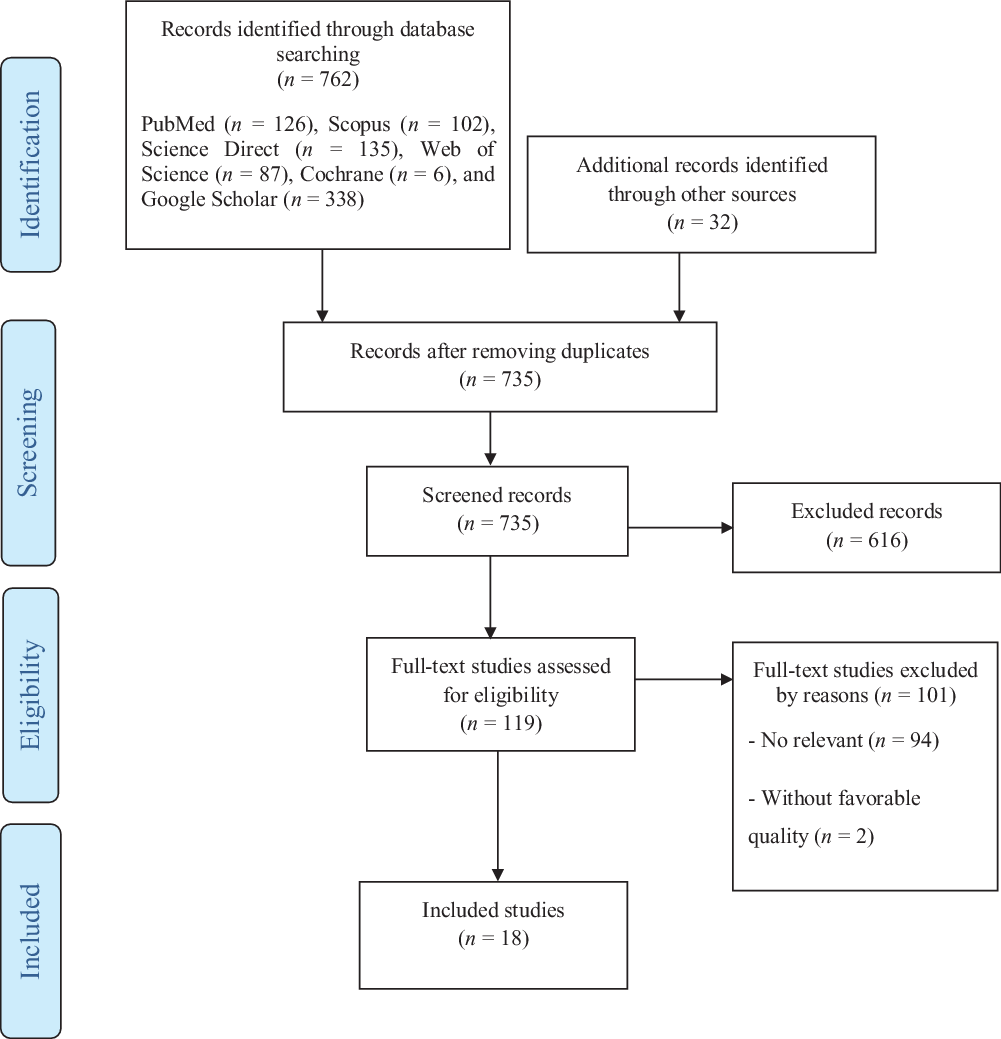
The present systematic review and meta-analysis included 794 studies after primary examinations. Following removing duplications, 735 studies were evaluated, and, finally, 18 cases with desirable quality on the prevalence of influenza among pilgrims were entered into the meta-analysis process (Figure 1). In addition, 62 431 samples from among the MGs of Hajj pilgrims were examined in this study.
The review process based on the PRISMA flow diagram.

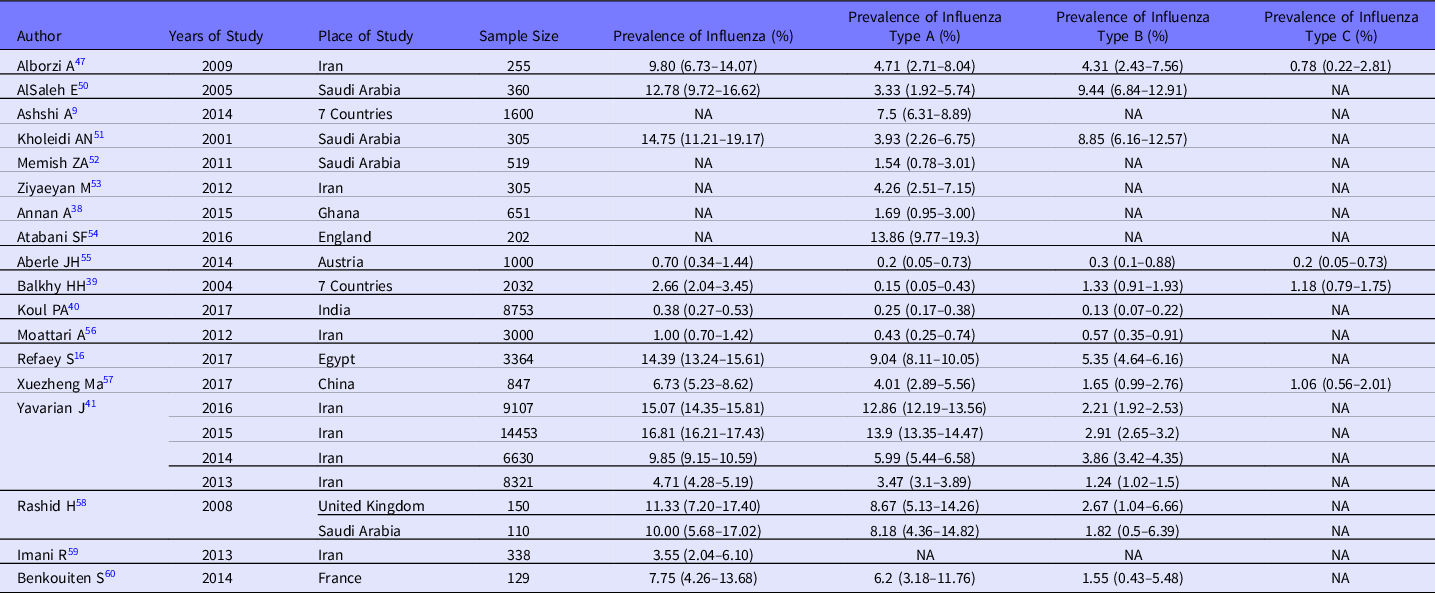
The evaluation of studies indicated that the highest prevalence rate of influenza was found among Iranian (16.8%) and Saudi Arabian (14.8%) pilgrims, whereas the lowest rate was related to Indian (0.4%) and Australian (0.7%) pilgrims. Further, the prevalence rate of types A and B influenza was reported as 0.14–13.9 and 0.3–9.4% (see Table 1).
General characteristics of eligible influenza studies for systematic review

Note: Seven countries included China, India, Brazil, Mexico, Russia, Indonesia, and Turkey.
NA = not available.
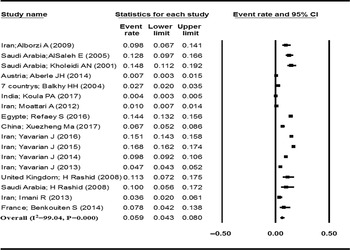
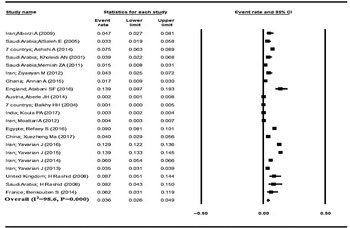
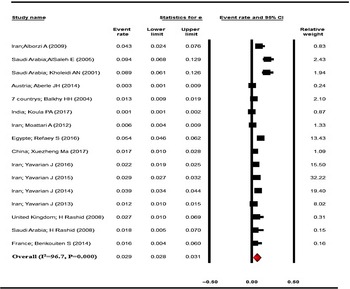
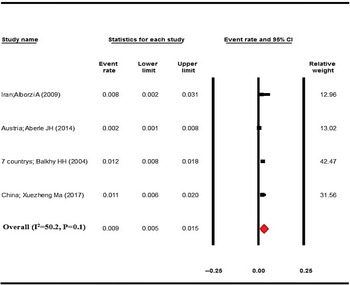
Based on the findings of this meta-analysis, the overall prevalence rate of viral influenza among pilgrims and the prevalence of types A, B, and C influenza were estimated at 5.9 (95% CI: 4.3-8.0), 3.6 (95% CI: 2.6-4.9), 2.9 (95% CI: 2.8-3.1), and 0.9% (95% CI: 0.5-1.5), respectively (Figures 2-5).
Pooled prevalence of influenza (%) based on the random-effects model.
Note: The midpoint of each line segment and the length of the line segment indicate the prevalence estimate and a 95% confidence interval in each study, respectively, and the diamond mark illustrates the pooled prevalence of influenza.

Pooled prevalence of influenza subtype A (%) based on the random-effects model.
Note: The midpoint of each line segment and the length of the line segment represent the prevalence estimate and a 95% confidence interval in each study, respectively, and the diamond mark displays the pooled prevalence of influenza subtype A.

Pooled prevalence of influenza subtype B (%) based on the random-effects model.
Note: The midpoint of each line segment denotes the prevalence estimate, and the length of the line segment indicates a 95% confidence interval in each study. In addition, the diamond mark demonstrates the pooled prevalence of influenza subtype B.

Pooled prevalence of influenza subtype C (%) based on the fixed-effects model.
Note: The midpoint of each line segment and the length of the line segment indicate the prevalence estimate and a 95% confidence interval in each study, respectively. Further, the diamond mark represents the pooled prevalence of influenza subtype C.

Considering heterogeneity between the studies conducted on the total prevalence of influenza (I2: 99%), subtypes A (I2: 98.6%) and B (I2: 96.7%) were analyzed by the random effect model, whereas the fixed effect model was performed in subtype C due to the homogeneity of the studies (I2: 50.2%).
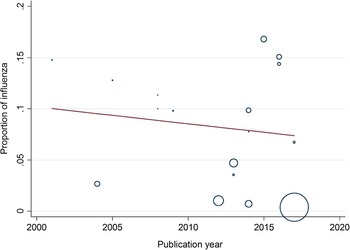
Furthermore, meta-regression was used to examine the relationship between the year of the study and the prevalence of influenza. Based on the results (Figure 6), the prevalence of influenza decreased by an increase in the year of the study, although the relationship was not significant (P = 0.6). Additionally, evaluating the studies by the Begg’s test revealed no publication bias (P = 0.21).
Meta-regression chart of the prevalence of influenza and publication year of the study.

Discussion
Based on the analysis, the overall prevalence rate of all types of influenza among pilgrims was estimated at 5.9%, and the prevalence rates of types A, B, and C influenza were 3.6, 2.9, and 0.9%, respectively. In Hajj, various pilgrims from different age groups, health status, and infection potentialities get in close contact with each other and create a great challenge to public health by spreading respiratory diseases every year. Reference Al-Tawfiq, Gautret, Benkouiten and Memish37 Several studies Reference Al-Abdallat, Rha and Alqasrawi14,Reference Refaey, Amin and Roguski16,Reference Annan, Owusu and Marfo38–Reference Yavarian, Jandaghi and Naseri41 reported a higher prevalence of influenza (1.3–20.7%) compared with other viruses among pilgrims from different countries, including Saudi Arabia, Iran, China, India, Egypt, Jordan, Ghana, France, and the UK. In another study, type A influenza was more common (0.6–13.9%) than type B influenza (0.8–6.8%). Reference Gautret, Benkouiten, Al-Tawfiq and Memish26 In a review study by Gautret et al., the prevalence rate of influenza among Hajj pilgrims was reported as 4.5–13.9%, and those of types A and B influenza were 0.6–15.8 and 0–11.5%., Reference Gautret, Benkouiten, Al-Tawfiq and Memish26 respectively, representing the highest prevalence rate for type A influenza. In addition, Al-Tawfiq et al. reported a 1.6–1.8% prevalence rate for type A subtype H1N1 influenza. Reference Al-Tawfiq, Benkouiten and Memish42 In their review study on Iranian pilgrims, Razavi et al. demonstrated the total prevalence of influenza and the incidence of types A and B as 10.68, 1.5, and 20%, respectively. Reference Razavi, Torabi and Salamati43 Based on the finding of a study evaluating the prevalence of all types of influenza in 2014 Hajj, type A influenza was the most predominant virus among the pilgrims (27.8%). Reference Gautret, Benkouiten, Al-Tawfiq and Memish26 In the current meta-analysis, the prevalence of influenza was extracted and statistically analyzed in 18 studies, and the results indicated that this disease was prevalent among the pilgrims. Millions of people from different countries travel to Saudi Arabia every year, imposing high costs on the health care systems of countries and thus leading to suffering, disability, and, in some cases, death. In general, various factors can increase the prevalence of influenza among pilgrims, including the lack of observing hygiene while having contact with other people (eg, shaking hands), using a mask, receiving vaccines, and separating patients infected with influenza from others. Reference Karampourian, Khorasani-Zavareh and Ghomian12,Reference Aledort, Lurie, Wasserman and Bozzette44,Reference Oshitani45 Although vaccination is one of the common approaches to prevent influenza infections and most countries suggest it to pilgrims, the average immunity due to the vaccine is reported as 59–63%. Reference Osterholm, Kelley, Sommer and Belongia46 Further, flu virus detection among vaccinated persons during Hajj is not uncommon due to a possible mismatch between the vaccine and circulating strains. Reference Hashem, Al-Subhi and Badroon22,Reference Gautret, Benkouiten, Al-Tawfiq and Memish26,Reference Annan, Owusu and Marfo38,Reference Alborzi, Aelami and Ziyaeyan47 Therefore, new guidelines and protocols are recommended for immunizing influenza in the Hajj in order to increase vaccine coverage and adequate protection against this disease. Reference Gautret, Benkouiten, Al-Tawfiq and Memish26
It is noteworthy that controlling influenza among pilgrims requires adopting managerial and educational principles in terms of the comprehensive observance of hygiene to prevent influenza infections and reduce the prevalence of this disease among pilgrims. Furthermore, using syndromic surveillance as a primary warning system during Hajj is necessary for controlling infectious diseases. More precisely, the international use of syndromic surveillance can have an impressive effect on reducing the release and transmission of such diseases. Eventually, it could prevent the influenza pandemic, which can play an important role in global health security. Reference Alotaibi, Yezli and Bin Saeed48,Reference Benkouiten, Al-Tawfiq and Memish49
Limitations
The present study had some limitations. The prevalence of influenza and its subtypes were not reported in some studies, and the study population was not specified in some studies.
Conclusion
Based on the findings, influenza remains prevalent, despite vaccinating pilgrims and following health protocols. Regarding the massive population of pilgrims, different individuals get infected with this disease due to religious gatherings every year, and the infection rate among pilgrims intensifies by the occurrence of influenza epidemics. In general, adopting managerial and educational approaches toward the comprehensive observance of sanitation among pilgrims is suggested for reducing the prevalence rate of influenza and its undesirable consequences among these people. Ultimately, syndromic surveillance is required in this regard, since it is effective in preventing, controlling, and effectively responding to contagious diseases such as influenza.
Acknowledgments
We would like to thank Dr Sanaz Sohrabizadeh for her technical support of this research.
Conflict(s) of Interest
The authors declare no potential conflicts of interest with respect to the research, authorship, and/or publication of this paper.